

What if your £1,630 investment in a British future was rejected because of a single weekend trip you forgot to log three years ago? For many EU residents, the path to british citizenship for european nationals feels less like a logical progression and more like a high-stakes gamble with their life savings. You’ve worked hard to secure your Settled Status, yet the transition to naturalisation introduces a maze of physical presence rules and complex dual nationality laws that can feel overwhelming. It’s perfectly natural to worry about the financial risk and the potential for a refusal letter that impacts your long-term security.
We understand that you’re looking for more than just a checklist; you’re seeking the absolute certainty that your application is flawless. This guide offers a comprehensive roadmap to help you manage the 2026 requirements with professional precision. We’ll break down the specific residency calculations, address concerns regarding your home country’s stance on dual citizenship, and outline the exact process to ensure you finally hold a British passport and the permanent peace of mind you deserve.
Key Takeaways
- Understand the mandatory 12-month waiting period following Settled Status and how to correctly calculate your continuous residence to meet Home Office requirements.
- Master the essential eligibility criteria, including English language proficiencies and the “Day One” physical presence rule, to secure british citizenship for european nationals.
- Learn to navigate the subjective “Good Character” requirement and the potential traps that often lead to application refusals for EU citizens.
- Gain a step-by-step overview of the online Form AN and the specific criteria for selecting qualified referees to validate your application.
- Discover the strategic value of professional OISC-registered audits in identifying errors before submission, protecting your investment and future in the UK.
The Transition from Settled Status to British Citizenship
Moving from the EU Settlement Scheme (EUSS) to naturalisation represents a definitive legal shift. While Settled Status provides a permanent right to reside under the Withdrawal Agreement, it remains an immigration status subject to Home Office oversight. Obtaining british citizenship for european nationals involves a formal application under the British Nationality Act 1981. This process transforms a resident into a citizen with full constitutional rights, moving beyond the limitations of treaty-based residency.
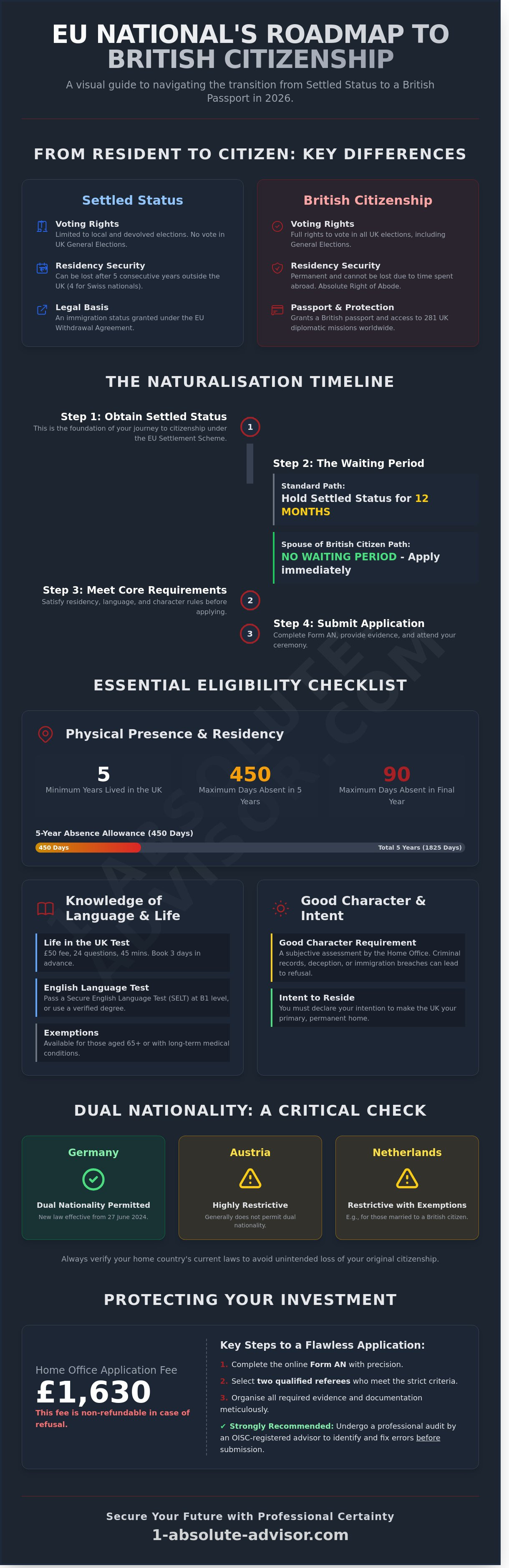
For most applicants, the “12-month rule” is the primary hurdle. You must have held Settled Status for at least 12 months before submitting your naturalisation form. This ensures you’ve been free from immigration time restrictions for a full year. However, if you’re married to or in a civil partnership with a British citizen, this waiting period doesn’t apply. You can submit your application the day your Settled Status is granted, provided you meet the three-year residency requirement.
It’s vital to distinguish between the Right of Abode and full citizenship. Right of Abode confirms your right to live and work in the UK without any immigration restrictions. While all British citizens automatically possess the Right of Abode, some Commonwealth citizens hold this right without being British. Only full citizenship grants the absolute right to a British passport and unconditional consular protection while travelling abroad.
Settled Status vs. British Citizenship: Key Differences
The most tangible shift occurs at the ballot box. European nationals with Settled Status can vote in local and devolved elections, but only British citizens can vote in UK General Elections. Residency security also improves significantly. Settled Status can be revoked if you stay outside the UK for more than five consecutive years, or four years for Swiss citizens. British citizenship is permanent. It provides a British passport, ensuring access to consular assistance from 281 UK diplomatic missions worldwide.
Dual Nationality Nuances for Europeans
Before applying, verify your home country’s stance on multiple passports. Germany modernised its nationality laws on 27 June 2024, now fully permitting dual nationality for its citizens. Conversely, Austrian and Dutch laws remain restrictive. Dutch nationals generally lose their original citizenship upon naturalising elsewhere unless specific exemptions apply, such as being married to a British citizen. Always confirm current bilateral agreements to avoid the unintended loss of your EU passport during the british citizenship for european transition.
Essential Eligibility Criteria for European Nationals
Securing british citizenship for european applicants in 2026 requires a meticulous approach to documentation and timing. The Home Office evaluates your history through a rigid lens of statutory requirements. You must hold Settled Status or Indefinite Leave to Remain for at least 12 months before submitting your naturalisation form. This 12-month waiting period doesn’t apply if you’re married to a British citizen; in that case, you can apply as soon as your status is granted. Every day of your qualifying period counts toward your final success.
Proving Your Knowledge of Language and Life
Demonstrating integration is a two-part process. First, you must pass a Secure English Language Test (SELT) at B1 level or higher. Approved providers include Trinity College London and Pearson. If you have a degree taught in English, you can often use your certificate instead, provided it’s verified by Ecctis. Second, the Life in the UK Test remains a mandatory hurdle. It’s a 45-minute computer-based exam consisting of 24 questions. As of 2026, the fee is £50. You should book your slot at least 3 days in advance at one of the 30 official test centres. Those aged 65 or over, or individuals with long-term physical or mental conditions, can claim an exemption. If you’re unsure about your eligibility for a waiver, consulting a compliance expert can prevent costly application rejections.
The Residency Requirement Breakdown
Meeting the residency requirements for british citizenship for european nationals is often the most complex part of the process. The Home Office tracks your physical presence with precision. To qualify, you must have lived in the UK for a minimum of 5 years. During this period, your total absences shouldn’t exceed 450 days. The final 12 months are the most restrictive; you’re only allowed 90 days outside the country. If you’ve exceeded these limits due to unavoidable circumstances like a 2025 family emergency or mandatory work assignments, the Home Office may exercise discretion. However, this is never guaranteed. You’ll also need to declare your ‘intent to reside’, which means you plan to make the UK your primary home. This isn’t just a tick-box exercise. Officials look for ties like UK-based employment, property ownership, or family units to confirm your commitment.
Navigating the ‘Good Character’ and Physical Presence Traps
The Home Office applies a subjective “Good Character” test to every adult applying for british citizenship for european nationals. Unlike the residency requirement, which is largely mathematical, good character relies on the discretion of a caseworker. They examine your conduct over the previous 10 years. Minor infractions, such as a £100 Fixed Penalty Notice for a traffic violation or a minor civil penalty, won’t automatically trigger a refusal. However, a pattern of such incidents suggests a persistent disregard for UK law. Total transparency is your only safeguard. If you fail to disclose a spent conviction or a civil penalty, the Home Office often views this as “deception,” leading to a mandatory refusal and a potential 10-year ban on future applications.
Financial Integrity and Tax Compliance
Your relationship with HMRC is a primary indicator of character. Caseworkers regularly cross-reference applications with tax records to ensure compliance. For self-employed Europeans, missing the 31 January Self Assessment deadline or having outstanding Class 2 National Insurance contributions can jeopardise the process. The Home Office expects applicants to have resolved all tax debts or have a formal “Time to Pay” agreement in place before submitting Form AN. Financial soundness isn’t just about wealth; it’s about demonstrating you’ve met all fiscal obligations to the state since your arrival.
The ‘Physical Presence’ Start Date Rule
The most common technical rejection involves the “Day One” rule. To meet the legal requirement, you must have been physically present in the UK exactly five years prior to the date the Home Office receives your application. If you apply on 12 November 2026, you must prove you were on British soil on 12 November 2021. This is a strict statutory requirement that catches out many frequent travellers.
- Verify your records: Check your passport stamps and digital flight receipts to confirm your location on that specific date five years ago.
- Avoid travel on application day: Don’t submit your application while you’re currently abroad on a business trip or holiday.
- Account for transit: If you were in international airspace or at sea on that start date, the requirement isn’t met.
Precision in these dates is non-negotiable for british citizenship for european applicants. While the Home Office can sometimes overlook minor absences over the limit, they rarely exercise discretion for the “Day One” presence rule. Ensuring your 5-year window starts on a day you were definitely in the UK is the simplest way to avoid an expensive and unnecessary rejection.
Organising Your Evidence: The Application Process
Securing british citizenship for european nationals involves a structured, digital-first approach. The primary vehicle for this transition is Form AN, an online application that requires meticulous attention to detail. In 2026, the Home Office application fee stands at £1,630. Accuracy is paramount. A single oversight in your five-year residency history can result in a refusal without a refund of these fees. This makes the preparation phase the most critical part of your journey.
Your application requires two referees to validate your character. One must be a professional person of any nationality, such as a chartered accountant, solicitor, or teacher. The second must be a British citizen aged 25 or over who isn’t related to you. Both must have known you for at least three years. After submission, you’ll book a biometrics appointment through UKVCAS. These centres are located across the UK. Appointment costs range from £0 to £210 depending on the urgency and location chosen.
The Document Checklist for EU Citizens
Successful applicants provide a robust paper trail. You must present your EU Settlement Scheme (EUSS) share code or Indefinite Leave to Remain (ILR) documentation. Residency proof is essential. We recommend using P60 documents from the last five years or council tax bills to demonstrate physical presence. If you’re married to a British citizen, the residency requirement shortens to three years. You’ll also need your Life in the UK test pass notification and a valid B1 English language certificate, unless you hold a degree taught in English.
The Citizenship Ceremony: The Final Step
Once your application is approved, usually within 12 to 24 weeks, you’ll receive an invitation to a citizenship ceremony. You must attend this event within 90 days. During the ceremony, you’ll swear an oath of allegiance or make an affirmation to the Monarch. You’ll then receive your Certificate of Naturalisation. This certificate is the legal proof of your status. You can then apply for your first British passport, which costs £88.50 for a standard 34-page document. Our team provides strategic naturalisation support to ensure your documentation meets these rigorous standards.
Securing Your Future with Professional Legal Support
Applying for british citizenship for european nationals isn’t just a paperwork exercise; it’s a significant financial and emotional investment. A single administrative oversight can lead to a refusal, resulting in the loss of the £1,630 Home Office application fee. DIY applications often fail because applicants misunderstand the nuance of “continuous residence” or fail to provide sufficient evidence for the years prior to receiving Settled Status. Errors in declaring minor traffic offences or historical gaps in Comprehensive Sickness Insurance (CSI) for students can trigger mandatory refusals under good character requirements.
An OISC-registered advisor acts as a critical safeguard for your future. We perform a comprehensive audit of your five-year residency history, identifying gaps in National Insurance records or P60s before the Home Office sees them. If you’ve exceeded the 450-day absence limit or have missing records from 2018 or 2019, we don’t just hope for the best. We build a robust legal argument based on Home Office discretion guidelines to protect your application. This proactive strategy transforms a high-risk submission into a predictable success.
Our Fixed-Fee Citizenship Management Service
Our approach eliminates the uncertainty of hourly billing. We begin with a detailed eligibility assessment to catch hurdles like the “Future Intentions” requirement or obscure character triggers. Our team manages the entire Home Office portal, including the precise uploading and indexing of documents to ensure clarity for the caseworker. We also draft professional legal cover letters that map your evidence directly to the British Nationality Act 1981, ensuring no room for misinterpretation.
Why Choose 1 Absolute Advisor?
We specialise in the specific hurdles European nationals face in the post-Brexit landscape. Our team maintains a high success rate by treating every british citizenship for european application as a strategic project rather than a standard form. We provide the stability and professional integrity you need to secure your family’s permanent place in the UK. Contact us today to start your journey to British citizenship and ensure your application is handled with absolute precision and care.
Take the Final Step Toward Your British Passport
Transitioning from Settled Status to full naturalisation in 2026 requires strict adherence to the 12-month waiting period and the 450-day total absence limit. Home Office caseworkers scrutinise every detail of the ‘Good Character’ requirement; even minor historical oversights can jeopardise your future. Securing british citizenship for european nationals is a multi-layered process where fragmented evidence from the EU Settlement Scheme years must be unified into a bulletproof portfolio. Our OISC-registered immigration consultants specialise in resolving complex eligibility gaps through strategic, fixed-fee application management. We act as your professional partner, providing the absolute certainty required to navigate the UK’s evolving immigration framework. It’s time to finalise your status and enjoy the lifelong benefits of a British passport. Secure your British citizenship with our expert legal support and move forward with total confidence.
Frequently Asked Questions
Can I apply for British citizenship if I only have pre-settled status?
You cannot apply for British citizenship with pre-settled status alone. You must first obtain settled status under the EU Settlement Scheme or hold Indefinite Leave to Remain. Once you’ve held this permanent status for at least 12 months, you’re eligible to begin the process of british citizenship for european nationals. This 12-month waiting period is mandatory unless you’re married to a British citizen.
How much does the British citizenship application cost in 2026?
The Home Office fee for a naturalisation application in 2026 is £1,630, plus a £19.20 charge for biometric enrolment. You’ll also need to budget £50 for the Life in the UK test. These costs are non-refundable, so it’s vital to ensure your application is error-free before submission. Many applicants also incur costs for English language tests, which typically range between £150 and £200 depending on the provider.
Will I lose my original EU passport if I become a British citizen?
The UK government allows dual nationality, so you won’t lose your British status by holding another passport. However, whether you keep your original EU passport depends entirely on your home country’s laws. Nations like Germany, France, and Italy permit dual citizenship, but others like Austria or Lithuania have much stricter regulations. You should consult your national consulate to confirm their specific rules regarding the acquisition of a second nationality.
What happens if my application for naturalisation is refused?
If the Home Office refuses your application, you’ll receive a letter detailing the specific reasons for the decision. There’s no statutory right of appeal for citizenship cases, but you can apply for a formal reconsideration using form NR81. This review costs £450. If the refusal is based on the ‘Good Character’ requirement, you might be barred from reapplying for a period of 10 years, depending on the nature of the issue.
How long do I need to have lived in the UK before I can apply?
You must have been physically resident in the UK for a minimum of five years before starting your application for british citizenship for european residents. During this five-year period, you shouldn’t have spent more than 450 days outside the country. In the final 12 months before applying, your absences must not exceed 90 days. These strict residency requirements ensure that applicants have established a clear and permanent link to the UK.
Do I need to pass the Life in the UK test if I have a university degree?
You must still pass the Life in the UK test regardless of your educational background or university degrees. While a degree taught in English satisfies the language proficiency requirement, it doesn’t exempt you from the civic knowledge exam. The test consists of 24 questions about British history and culture, and you need a score of 75% to pass. Only those over the age of 65 or with specific permanent disabilities are exempt.
Can my children apply for citizenship at the same time as me?
Your children can apply for citizenship alongside you if they’re under 18 years old at the time of the application. This is technically a registration process using Form MN1 rather than naturalisation. The fee for registering a child is £1,214. If your child was born in the UK after you were granted settled status, they’re often automatically British citizens and don’t need a separate application to obtain a passport.
What is the ‘Good Character’ requirement for UK citizenship?
The ‘Good Character’ requirement is an assessment of your conduct and integrity over the last 10 years. The Home Office checks criminal records, tax compliance with HMRC, and your immigration history to ensure you’ve followed all UK laws. Even non-custodial sentences or persistent late tax filings can lead to a refusal. It’s a holistic review that aims to ensure new citizens are responsible members of society who respect the rule of law.