

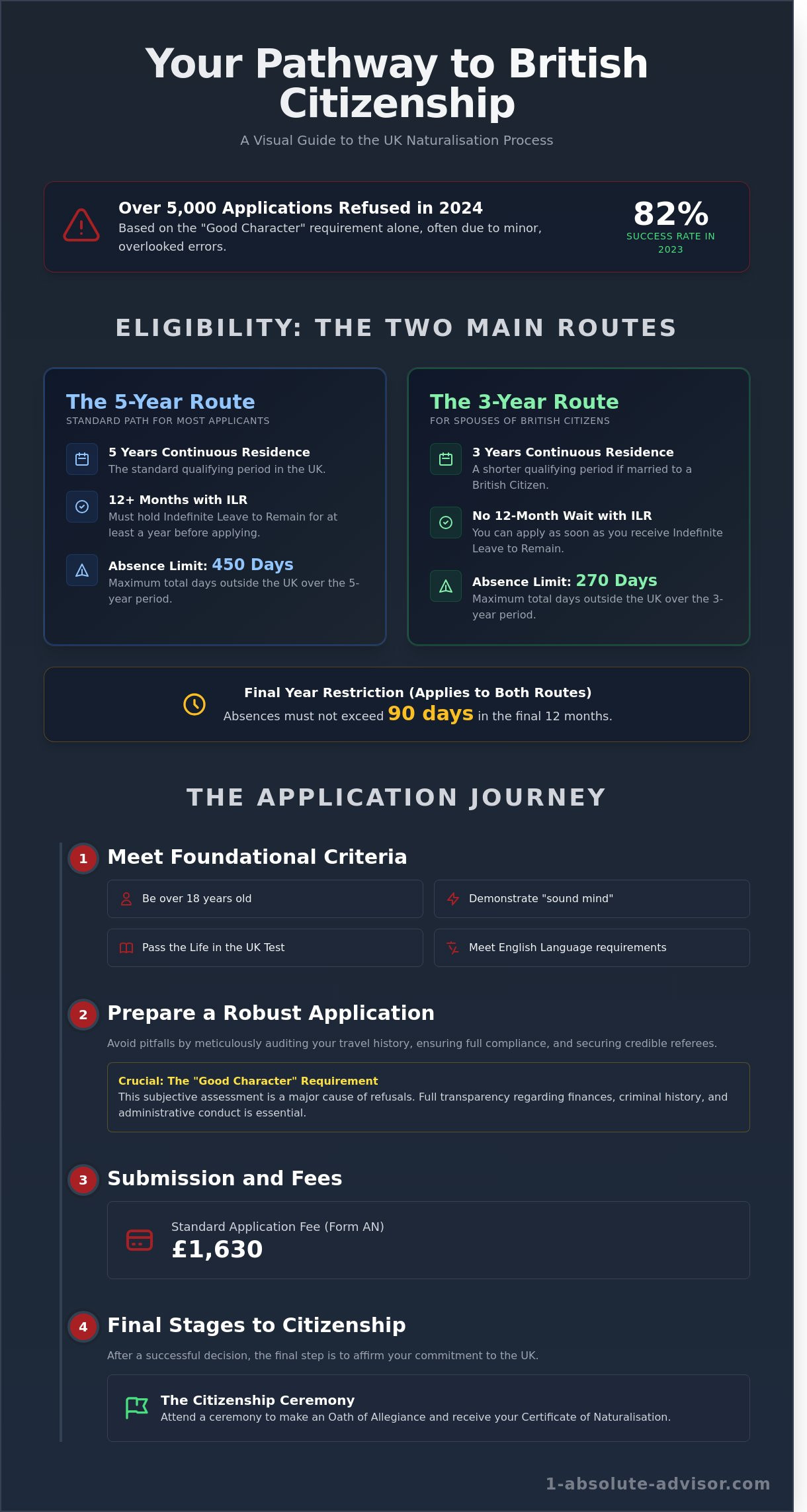
In 2024, the Home Office refused over 5,000 naturalisation applications based on the “good character” requirement alone, often due to minor, overlooked financial or administrative errors. It’s a sobering reminder that the path to british citizenship requires more than just time; it demands absolute precision. You’ve likely spent years building your career and home here, yet the final transition to permanent security often feels like walking through a legal minefield where a single miscalculated “absence” could derail your progress. We understand the stress that the Life in the UK test and complex residency rules can cause during this high-stakes process.
This guide provides the professional clarity you need to secure your future, offering a comprehensive roadmap through eligibility criteria and the nuances of the naturalisation process. We’ll break down the 2026 requirements into a logical, step by step strategy that replaces uncertainty with the confidence of holding a British passport. From auditing your travel history to ensuring full compliance with the latest Home Office guidance, we’ll help you move toward a successful outcome with strategic certainty and total peace of mind.
Key Takeaways
- Master the legal nuances of naturalisation to distinguish your rights and responsibilities under the United Kingdom’s highest legal status.
- Evaluate your eligibility by understanding the strict residency and mental capacity standards required for a successful submission.
- Navigate the complexities of the “good character” requirement to avoid the subjective pitfalls that often lead to british citizenship application refusals.
- Streamline your journey by identifying the exact documentation and professional referees needed to build a robust evidence portfolio.
- Prepare for the final transition by learning what to expect during the decision-waiting period and the concluding citizenship ceremony.
Understanding British Citizenship: Rights, Benefits, and Responsibilities
British citizenship represents the most secure legal standing an individual can hold within the United Kingdom. It grants an absolute right of abode, meaning you’re no longer subject to any form of immigration control. Understanding the history of British nationality law helps clarify why this status is fundamentally different from Indefinite Leave to Remain (ILR). While citizenship by birth typically applies to those born in the UK to at least one parent who is a citizen or settled, british citizenship through naturalisation is the specific legal process for adults to acquire this status after a period of residency.
The core benefits of becoming a citizen extend beyond simple residency. A British passport is a primary advantage, providing visa-free or visa-on-arrival access to 191 destinations as of 2024 data. You also gain the right to vote in all local and general elections, allowing for full participation in the UK’s democratic processes. These rights come with clear responsibilities. The Home Office requires all new citizens to swear an oath of allegiance, promising to respect the UK’s democratic values and obey its laws. This commitment ensures the social and legal integrity of the nation remains intact.
Why Naturalise? The Security of British Status
Securing british citizenship offers a level of permanence that residency permits cannot match. If you hold ILR, staying outside the UK for more than 730 consecutive days usually results in the automatic loss of your status. Citizens face no such restriction. This transition protects you from future legislative shifts, such as the 2022 Nationality and Borders Act changes. It ensures your right to return is irrevocable, regardless of how many years you spend working or living abroad. You also gain access to full British consular protection when travelling in any of the 193 UN-recognised states.
Naturalisation vs. Registration: Which Route is Yours?
Naturalisation is the standard path for adults who have lived in the UK for 5 years, or 3 years if married to a British citizen. Registration is a distinct process. It’s primarily designed for children born in the UK to non-settled parents or specific groups like British Nationals (Overseas). While naturalisation requires passing the Life in the UK test and an English language exam, registration often focuses on birth certificates and residency evidence. Most adults will use Form AN, while Form MN1 is the standard for registering minors. Each route requires specific evidence to prove eligibility under the British Nationality Act 1981.
Eligibility Criteria for Naturalisation: Are You Ready to Apply?
To secure british citizenship, you must meet precise statutory requirements established by the Home Office. Every applicant must be at least 18 years old and demonstrate “sound mind,” which ensures you understand the legal significance of the naturalisation process. While the requirements are rigorous, 82% of naturalisation applications were successful in 2023, proving that meticulous attention to detail leads to positive outcomes. You must also hold Indefinite Leave to Remain (ILR) or Settled Status under the EU Settlement Scheme before moving forward.
The 5-Year and 3-Year Residency Routes
Most applicants follow the standard 5-year route. This requires five years of continuous residence and holding ILR for at least 12 months before the application date. If you’re married to or in a civil partnership with a British citizen, the qualifying period is reduced to three years. In this case, you don’t need to wait the additional 12 months after receiving ILR. Calculating your qualifying period is a critical first step. It begins exactly three or five years before the date the Home Office receives your application. Applying even one day too early often leads to a refusal, resulting in the loss of the £1,630 application fee.
Managing Absences: The 450 and 90-Day Rules
The Home Office tracks your physical presence in the UK with high precision. For the 5-year route, you must not have spent more than 450 days outside the country. For the 3-year route, the limit is 270 days. The final 12 months are the most restrictive, allowing only 90 days of absence. If your travel exceeded these limits due to unavoidable work commitments or compassionate reasons, the Home Office might exercise discretion. This Citizens Advice guide to applying provides a useful breakdown of how these residency rules impact your “good character” assessment.
Proving Your Language and Integration
Integration is measured through two specific milestones. First, you must prove English proficiency at B1 level or higher on the Common European Framework of Reference for Languages (CEFR). This is usually verified through a Secure English Language Test (SELT) or a UK-recognised degree. Second, you must pass the Life in the UK test, which is a 45-minute exam covering British history, landmarks, and values. Exemptions are available for those over 65 or those with specific long-term health conditions. Ensuring your documentation aligns with these standards is essential for a successful path to british citizenship. For a holistic review of your eligibility, seeking an absolute advisor can provide the strategic clarity needed for complex cases.
Navigating the Good Character Requirement and Common Pitfalls
The Home Office defines “Good Character” as a clear demonstration of respect for the laws, values, and customs of the United Kingdom. Unlike the residency or English language requirements, this remains the most subjective element of any british citizenship application. Decision-makers at the Home Office possess broad discretion to refuse an application if they believe a person’s conduct, even if not strictly criminal, suggests they aren’t of good character. This assessment covers your entire history, not just your time spent within the UK.
Full disclosure is non-negotiable. Attempting to conceal a minor incident often leads to a mandatory 10-year refusal for deception. OISC-registered advisors typically perform a comprehensive risk audit before submission to ensure every detail aligns with the UK government’s guide to British citizenship and the latest caseworker guidance. They look for patterns of behavior that might trigger a refusal under the updated rules implemented on July 31, 2023, which tightened the criteria for criminality and non-compliance.
Criminality and Fixed Penalty Notices
Criminal convictions present significant hurdles, but they aren’t always a total bar. Since the rule changes in mid-2023, the Home Office has shifted away from fixed “rehabilitation periods” for many applicants; this means even older offenses can now impact your british citizenship eligibility. Minor issues like Fixed Penalty Notices (FPNs) for speeding or littering usually won’t cause a refusal unless you’ve accumulated numerous notices. A pattern of FPNs indicates a persistent disregard for the law. Failing to pay an FPN is particularly damaging, as it suggests a lack of financial and legal responsibility.
Financial Integrity and Immigration Breaches
Your financial history serves as a proxy for your character. An undischarged bankruptcy or deliberate tax evasion, including unpaid National Insurance contributions, will likely lead to a refusal. Caseworkers frequently check HMRC records to ensure compliance with the 1981 British Nationality Act. Regarding immigration history, the “10-year rule” is a critical benchmark. If you’ve overstayed a visa or worked without permission within the last decade, the Home Office will likely conclude you lack the requisite character. These breaches are viewed as a fundamental failure to respect UK immigration control.
The Application Journey: From Preparation to Submission
The transition to british citizenship requires meticulous coordination of historical data and legal identity. You’ll start by completing Form AN on the UK Government website. This digital portal demands a chronological account of your travel history and residence for the past 5 years. Accuracy is non-negotiable; even a minor discrepancy in your departure dates can trigger a request for additional clarification from the Home Office. It’s vital to cross-reference your passport stamps with flight confirmation emails to ensure every trip is accounted for.
The Role of Referees in Your Application
Two individuals must vouch for your character to validate your standing in the community. The first referee must be a professional of any nationality, such as a solicitor, teacher, or chartered accountant. The second referee must be a British citizen who is over 25 years old and not related to you by blood or marriage. Both individuals must have known you personally for at least 3 years. They’ll need to provide their passport details and contact information, as the Home Office frequently verifies these declarations during the 6-month processing window.
Document Checklist and Evidence of Residency
Proving your physical presence in the UK is the most document-intensive phase of the journey. While the Home Office can check tax records, providing your own evidence creates a stronger, “absolute” case for approval. You should prepare the following items:
- Passports and BRPs: All current and expired travel documents covering the qualifying period.
- Employment Evidence: P60s from the last 5 years or formal letters from employers confirming your start and end dates.
- EU Settlement Scheme: If you’re an EU citizen, you must provide your digital status share code to prove you’ve held Settled Status for at least 12 months.
- Professional Translations: Any document not written in English or Welsh requires a certified translation from a recognized agency.
Once your online form is submitted and the fee is paid, you’ll book a biometric appointment at a UKVCAS center. At this stage, you’ll provide your fingerprints and a digital photograph. You can choose to upload your scanned evidence through the Sopra Steria portal yourself or pay for a scanning service at the center. Most applicants find that self-uploading provides better control over the quality and organization of the submission. If you need expert help organizing your portfolio, you can consult our strategic advisors for a document audit.
Precision at this stage prevents the 8-week delays often caused by requests for further information. You don’t want to risk a rejection based on a missing utility bill or an unqualified referee. Every piece of evidence should serve as a brick in the foundation of your future status. After your biometrics are registered, the Home Office will begin its final assessment of your british citizenship eligibility.
Completing the Process: The Citizenship Ceremony and Beyond
The period following your application submission is often the most taxing part of the journey. While the Home Office typically aims to process british citizenship applications within six months, complex cases involving historical residency gaps or “good character” queries can extend this timeline. Once approved, you’ll receive an invitation letter via email or post. This document is your official clearance to proceed to the final stage. You must book your ceremony with the local authority within 90 days of receiving this notice to avoid your approval being cancelled.
What Happens at a British Citizenship Ceremony?
Ceremonies are usually group events organized by your local council, though private sessions can be arranged for an additional fee, often ranging between £100 and £150. The structure is formal and includes speeches by local dignitaries, the national anthem, and the presentation of your certificate. You’ll choose between an Oath of Allegiance, which is religious, or a non-religious Affirmation. Both carry the same legal weight. This moment marks your official transition from a resident to a citizen with full voting rights and the protection of the Crown.
Your First Steps as a New British Citizen
Your legal status changes the moment the ceremony concludes. You’re now required to return your Biometric Residence Permit (BRP) to the Home Office within five working days. If you miss this deadline, you could face a fine of up to £1,000. Most new citizens apply for their first British passport immediately after. In 2026, standard digital applications take approximately three to six weeks to process. It’s also vital to update your records with your employer, bank, and HMRC to ensure your tax and National Insurance profiles reflect your updated status.
How Professional Advice Secures Your Future
The financial stakes of a naturalisation application are significant. With government fees currently exceeding £1,630, a single oversight can lead to a costly rejection without a refund. OISC-registered experts provide the strategic oversight needed to navigate these complexities. A professional document check identifies potential “good character” red flags or residency miscalculations before you pay the fee. This proactive approach ensures your path to british citizenship remains secure and predictable. Speak to our expert advisors about your British citizenship application today.
Finalize Your Path to Permanent Belonging
Achieving british citizenship represents the culmination of a strategic journey toward absolute stability. By 2026, the Home Office requirements for naturalisation demand precise documentation and a clear history of residency. Success depends on navigating the 5-year residency rules with total accuracy regarding your time spent outside the UK. You’ve learned that even minor oversights in the Good Character assessment can lead to a refusal, so detailed preparation is non-negotiable.
Our OISC-registered advisors specialize in managing these complex nationality cases. We provide expert guidance on residency absence issues and character assessments to ensure your file is robust. We offer fixed-fee application management to provide total peace of mind and financial predictability. Our high success rate in complex cases reflects our commitment to professional integrity. Don’t leave your future to chance when expert oversight is available.
Book a Consultation for Your British Citizenship Application to secure your status. You’ve built a life here; it’s time to make it official.
Frequently Asked Questions
How long does it take to get British citizenship after applying?
Most applicants receive a decision within 6 months of submitting their biometric information at a UKVCAS center. While the Home Office aims to process 95% of standard cases in this timeframe, complex applications involving residency gaps may take 8 to 10 months. You’ll typically receive an invitation to your citizenship ceremony within 90 days of receiving your approval letter.
Can I apply for British citizenship if I have a criminal record?
You can apply, but any custodial sentence of 12 months or more will usually result in a mandatory refusal under current Home Office suitability criteria. For shorter sentences or non-custodial convictions, you must wait until the specific rehabilitation period defined in the 2023 updated guidance has expired. It’s vital to disclose even minor fixed penalty notices to maintain the integrity of your application.
What happens if my British citizenship application is refused?
If the Home Office refuses your request for british citizenship, you’ll receive a formal decision letter detailing the specific statutory grounds for the rejection. There’s no legal right of appeal; however, you can submit Form NR to request an administrative reconsideration if you believe a factual error occurred. This process costs £450 as of January 2026 and requires a clear demonstration that the caseworker misapplied the law.
Do I have to give up my original nationality to become a British citizen?
The United Kingdom permits dual nationality, so you don’t need to renounce your original passport to satisfy British law. However, you must verify the regulations of your home country; nations like China, India, and Japan don’t recognize dual status and may revoke your original citizenship automatically. We recommend a holistic review of your global tax and legal standing before you finalize your naturalisation plans.
How much does the British citizenship application cost in 2026?
The standard fee for a naturalisation application in 2026 is £1,630 per adult applicant. This total includes the £1,550 processing fee and the mandatory £80 contribution for the citizenship ceremony. You should also budget approximately £19.20 for biometric enrollment and £50 for the Life in the UK test. These fees are non-refundable, making it essential to ensure your application is 100% compliant before submission.
Can I travel outside the UK while my citizenship application is pending?
You’re permitted to travel internationally while your application is processing, provided you maintain your valid Indefinite Leave to Remain (ILR) or settled status. Since the Home Office uses a digital application process, they won’t retain your physical passport. You just need to ensure you’re present in the UK to attend your biometric appointment and your eventual citizenship ceremony within the required 90-day window.
What is the “Good Character” requirement for UK citizenship?
The Good Character requirement is a mandatory assessment of your conduct, including your criminal record, financial soundness, and honesty throughout your time in the UK. Caseworkers scrutinize the last 10 years of your history for issues like tax evasion, bankruptcy, or NHS debts exceeding £500. Demonstrating british citizenship readiness requires absolute transparency regarding any past civil penalties or motoring offenses to avoid a refusal based on deception.
Do I need a solicitor or advisor to apply for British citizenship?
There’s no legal requirement to use a solicitor, but approximately 40% of applicants choose professional representation to mitigate the risk of refusal. A qualified OISC advisor provides a strategic oversight that ensures your documentation meets the strict evidentiary standards of the Home Office. This professional audit is particularly valuable if you have complex absences or historical immigration issues that could jeopardize your £1,630 application fee.