

What if your five-year journey toward Indefinite Leave to Remain was derailed by a single miscalculated weekend? For many applicants, the difference between a successful grant and a costly refusal isn’t their intent, but a simple mathematical error in tracking their pr residence period. You’ve worked hard to build a life here, and it’s natural to feel anxious when the Home Office demands absolute precision regarding every trip taken outside the country.
We understand that terminology surrounding PR and ILR often creates confusion, especially when you’re trying to determine which previous visas actually contribute to your five-year total. This guide provides the strategic clarity you need to audit your history with confidence. You’ll learn how to calculate your exact eligibility date, verify that absences remain within the strict 180-day limit, and identify the specific window 28 days before your anniversary for a perfect submission. We’re moving beyond guesswork to establish a foundation of factual certainty for your application.
Key Takeaways
- Clarify the distinction between PR and ILR to ensure your settlement strategy aligns with the latest Home Office requirements for 2026 and beyond.
- Identify which visa combinations qualify for the five-year threshold and how to satisfy the strict definition of continuous residence in the UK.
- Learn to navigate the 180-day absence rule using the “any 12-month period” methodology to prevent travel-related application rejections.
- Calculate your mathematically perfect application date by applying the 28-day early submission grace period to your pr residence timeline.
- Understand how a comprehensive evidence audit can safeguard your future by identifying potential compliance gaps before you submit your final application.
Understanding PR Residence: The Shift from PR to ILR in 2026
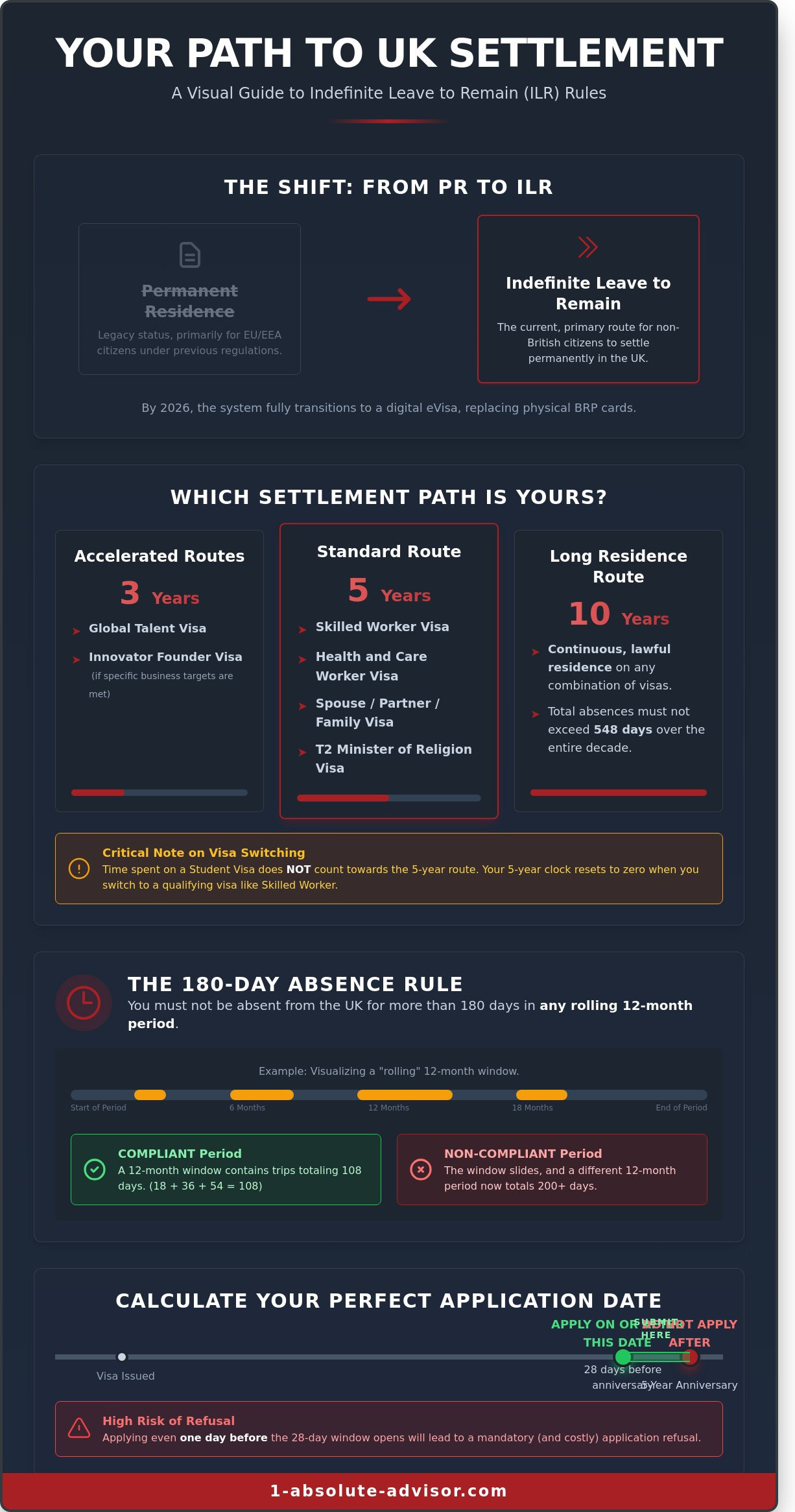
The journey toward permanent settlement in the United Kingdom requires a precise understanding of how the Home Office calculates your stay. While many applicants still use the term pr residence to describe their goal, the legal framework has transitioned almost entirely to Indefinite Leave to Remain (ILR). By December 31, 2024, the UK will phase out physical Biometric Residence Permits (BRPs) in favor of a digital-only system. This transition makes 2026 a pivotal year for those tracking their eligibility, as the digital eVisa becomes the primary proof of status. Success depends on identifying the exact moment your qualifying clock began. This isn’t always the day you landed at the airport; it’s often the date your initial entry clearance was issued, provided you entered the UK within a specific window.
The qualifying period is the cornerstone of any settlement strategy. If you apply even one day before you’ve officially completed your 5-year or 2-year requirement, the Home Office will likely issue a mandatory refusal. You don’t want to lose thousands of pounds in application fees because of a simple calendar error. Understanding the “Absolute” start date ensures your application is filed within the 28-day window allowed before your qualifying period ends.
The Difference Between PR and ILR
Historically, “Permanent Residence” referred to the status held by EU citizens under EEA regulations. Today, Indefinite Leave to Remain is the primary vehicle for non-British citizens to settle permanently. ILR removes all time limits on your stay and grants access to public funds and unrestricted employment. Using the correct terminology is vital. Home Office guidance documents updated in 2024 focus exclusively on ILR criteria. Misunderstanding this distinction can lead to searching for outdated forms that no longer apply to your specific visa category.
Identifying Your Qualifying Route
Your path to pr residence depends on your specific visa tier. Most applicants follow the standard 5-year route. This includes the following categories:
- Skilled Worker and Health and Care Worker visas
- Spouse, Partner, and Family visas
- T2 Minister of Religion visas
High-value migrants can access accelerated pathways. Global Talent visa holders often apply after 3 years, while Innovator Founder visa holders may settle in 3 years if they meet specific job creation or revenue targets. If your path has been fragmented by multiple visa switches, the 10-year Long Residence route serves as a safety net. This route requires a decade of continuous lawful residence and allows for a maximum of 548 days absent in total across that entire 10-year span.
Defining the 5-Year Qualifying Period for Settlement
The 5-year qualifying period serves as the primary benchmark for most settlement applications in the United Kingdom. To qualify for Indefinite Leave to Remain (ILR), you must demonstrate continuous residence, which involves living in the country legally without exceeding the permitted absence limits. You should Check if you can get indefinite leave to remain to identify which specific immigration route aligns with your current circumstances. This qualifying clock typically starts from the date your initial entry clearance or leave to remain was granted, rather than the date you entered the country.
Maintaining your pr residence status requires a meticulous approach to visa renewals. Section 3C of the Immigration Act 1971 provides a vital safety net in this regard. It automatically extends your existing leave while the Home Office processes a timely application for a new visa. As long as you submit your renewal before your current leave expires, your right to work and reside remains protected, and your 5-year countdown continues without interruption.
Combining Different Visa Types
Applicants often assume all time spent in the UK contributes to the 5-year threshold, but the rules are specific. Time spent on a Student visa doesn’t count toward the 5-year settlement path; it only contributes to the 10-year Long Residence route. If you switch from a Student visa to a Skilled Worker visa, your 5-year clock starts from zero on the day your Skilled Worker leave begins. Similarly, moving from a Spouse visa to a Work visa usually resets your progress because you’re moving between different regulatory frameworks. If you’re concerned about how a recent change in status impacts your eligibility, a professional immigration status review can provide the clarity you need.
The Role of Lawful Residence
Lawful residence is any period with valid leave to remain. Any period spent in the UK without valid leave is considered “unlawful” and can immediately reset your qualifying period. While the Home Office may disregard a gap of up to 14 days if you had a “good reason” for a late application, such as a hospitalisation, these exceptions are rare and require heavy documentation. If you’re undergoing an administrative review or an appeal, your status is generally protected under Section 3C leave. However, if an appeal is dismissed, any time spent waiting for a new application could break your continuous residence, forcing you to restart the 5-year cycle. Precision in your application timeline is the only way to ensure your path to settlement remains secure.
The 180-Day Absence Rule: Calculating Time Outside the UK
Many professionals fear that frequent international business trips will jeopardize their pr residence status. This concern is often manageable if you understand how the Home Office applies the 180-day limit. Since January 11, 2018, the Home Office has enforced a strict “any 12-month period” rule. You cannot spend more than 180 days outside the UK during any consecutive 12-month window within your 5-year qualifying period. If you exceed this by even 24 hours without a valid excuse, your continuity of residence breaks. Precision is mandatory. If you fail to account for a single weekend trip, your entire timeline might collapse under scrutiny.
The Home Office provides specific official guidance on calculating the continuous period, which outlines how caseworkers assess these gaps. While the 180-day limit is firm, exceptions exist for extraordinary circumstances. For example, travel disruptions during the 2020-2021 pandemic or urgent compassionate grounds, such as the serious illness of a close family member, are often overlooked if documented correctly. Work assignments abroad also qualify for leniency in specific visa categories, provided the UK remains your primary economic hub.
Rolling 12-Month vs. Fixed Year Calculations
The method used to calculate your absences depends on when your visa was granted. For older visas, the Home Office looked at fixed 12-month blocks counting back from the date of application. Modern applications use a rolling window, making it significantly harder to track manually without a dedicated spreadsheet.
| Visa Issue Date | Calculation Method | Risk Level |
|---|---|---|
| Before Jan 11, 2018 | Fixed 12-month periods | Moderate |
| After Jan 11, 2018 | Any rolling 12-month window | High |
Documenting Your Absences Correctly
Maintaining a digital travel diary is the most effective way to secure your pr residence. Don’t rely solely on passport stamps; many European borders no longer stamp passports for certain visa holders. Instead, keep a folder with electronic boarding passes and hotel receipts. If you have missing records, you can request your travel history from the Home Office via a Subject Access Request (SAR), though this takes approximately 30 days to process.
- Employer Letters: Obtain a formal letter stating that your absences were consistent with your employment contract and paid annual leave.
- Medical Evidence: If you were stuck abroad due to health issues, provide hospital records translated into English.
- Digital Footprint: Use bank statements to prove your presence in the UK immediately before and after trips.
How to Calculate Your Earliest Application Date
Determining the exact moment you become eligible for Indefinite Leave to Remain (ILR) requires mathematical precision. A single day’s error can lead to an immediate refusal and the loss of the £2,885 application fee. Follow these five steps to secure your timeline and ensure your pr residence journey concludes successfully:
- Step 1: Locate your initial entry clearance or the date your first qualifying visa was granted. If you entered the UK after your visa started, your five-year period typically begins on the date of entry.
- Step 2: Calculate the 5th anniversary of that start date. Subtract exactly 28 days from this anniversary to find your earliest possible submission date.
- Step 3: Conduct a rigorous audit of your travel history. Ensure that no rolling 12-month period throughout the five years contains more than 180 days of absence.
- Step 4: Confirm your current leave remains valid. You must hold a lawful status at the time of application and ideally until the decision is rendered.
- Step 5: Define your absolute submission window, ensuring it falls between the 28-day mark and your current visa’s expiry date.
The 28-Day Rule Explained
Applicants don’t need to wait the full 1,825 days to submit their paperwork. The Home Office provides a specific grace period allowing for applications 28 days before the 5th anniversary of your visa grant or entry. However, this isn’t a suggestion; it’s a strict legal boundary. If you apply 29 days early, your pr residence application will be refused automatically. To calculate this correctly, count back 28 days from the calendar date of your 5th anniversary, not four weeks, as months vary in length. This precision prevents unnecessary delays in your settlement process.
The Importance of the ‘Decision Date’
The qualifying period for your settlement ends on the date you submit your online application. Maintaining lawful status is non-negotiable while the Home Office considers your case. If your current visa expires while you’re waiting for a decision, Section 3C of the Immigration Act 1971 protects your rights, provided you applied before your previous leave lapsed. To eliminate any margin for error, you can use our Document Checking Service to verify your specific dates and compliance. This proactive step ensures your transition to permanent status remains seamless and risk-free, providing the stability your future in the UK deserves.
Securing Your PR Residence with 1 Absolute Advisor
Securing Indefinite Leave to Remain (ILR) requires more than just counting days on a calendar. It’s about building an airtight legal case. Our OISC-registered advisors specialize in eliminating the technical errors that contribute to the 15% refusal rate often seen in settlement applications. We provide a fixed-fee management service, ensuring you don’t face unexpected costs while we handle the complexity of your pr residence application. Professional representation is vital because the Home Office often scrutinizes even a single day of unexplained absence, which can reset a five-year qualifying period to zero.
Our Professional Audit Process
The “Absolute” audit is our signature methodology for verifying every detail of your five-year history. We don’t just look at stamps in a passport. We cross-reference your travel records with P60s, bank statements, and employer letters to ensure 100% alignment with Home Office expectations. If you’ve exceeded the 180-day absence limit due to a 2022 medical emergency or specific 2023 work requirements, we draft detailed legal cover letters. These documents provide the necessary context to justify unavoidable absences, ensuring your pr residence remains intact despite life’s interruptions. Every piece of evidence undergoes a three-stage quality check to meet our internal “Absolute” standard before submission.
Next Steps: Book Your Consultation
Ready to finalize your status? Your initial eligibility assessment is the foundation of a successful application. You’ll need to bring your current BRP, all passports used during the last 60 months, and any initial evidence of your continuous residence, such as council tax bills or tenancy agreements. We help you organize these documents into a chronological portfolio that leaves no room for Home Office scrutiny. Taking this step now prevents the stress of a last-minute rush as your current visa expiry approaches. Our team ensures your transition to permanent settlement is handled with the precision your future deserves.
Take Control of Your UK Settlement Journey
Navigating the path to permanent status requires precise timing and strict adherence to Home Office regulations. You must maintain continuous residence by ensuring absences don’t exceed 180 days in any rolling 12-month period. Calculating your pr residence eligibility correctly allows you to submit your ILR application up to 28 days before reaching your 5-year anniversary. With the Home Office transitioning to a fully digital system by 2026, acting now prevents complications with legacy documentation. Our London-based specialists provide the strategic oversight needed to manage these complex requirements. As OISC-Registered advisors, we offer fixed-fee transparency so you’ll know exactly what to expect from the start. We’ve helped thousands of applicants navigate these specific legal frameworks with professional integrity. You don’t have to manage these legal hurdles alone when expert guidance is available. Taking these steps today ensures your right to live and work in the UK remains undisputed for years to come. Your future stability depends on the accuracy of today’s application.
Secure your UK future with our Absolute ILR application service
We’re ready to help you turn your years of UK residency into a permanent home.
Frequently Asked Questions
Can I apply for PR residence if I have spent more than 180 days outside the UK?
You generally can’t apply for pr residence if you’ve exceeded 180 days outside the UK in any rolling 12-month period. The Home Office applies this limit strictly under Appendix Continuous Residence rules. If your absences exceed this 180-day threshold, your qualifying period usually resets to zero. Exceptions only apply for specific reasons like life-threatening illness or natural disasters.
You’ll need documented evidence for every single day spent abroad to ensure your calculation is 100% accurate. We recommend keeping a digital spreadsheet of all flight dates. This level of precision prevents the Home Office from questioning your commitment to living in the UK.
Does my time on a Student visa count toward the 5-year ILR period?
Time spent on a Student visa doesn’t count toward the standard 5-year qualifying period for Indefinite Leave to Remain. This time only contributes to the 10-year Long Residence route. If you’ve spent 3 years as a student and 2 years on a Skilled Worker visa, you still need 3 more years on the work visa to qualify. It’s a common mistake that leads to 15% of initial application rejections.
You must track your visa categories precisely from day one. Switching from a Student visa to a Graduate visa also won’t bridge this gap for the 5-year route. Understanding these distinctions is vital for your long-term strategic planning.
What is the 28-day rule for Indefinite Leave to Remain applications?
The 28-day rule allows you to submit your application up to 28 days before you reach the 1,825-day mark of your 5-year residency. Applying even 24 hours earlier than this 28-day window results in an automatic refusal and loss of your application fee. We recommend calculating your exact entry date into the UK to identify this specific window.
Most successful applicants submit their paperwork on day 1,798 of their stay to remain safe. This buffer ensures you meet the legal requirements while giving you the earliest possible decision. Accuracy here is absolute; there’s no room for estimation when dealing with Home Office deadlines.
What happens if my visa expires while I am waiting for my PR residence decision?
Your legal status is protected by Section 3C of the Immigration Act 1971 if your visa expires while you’re waiting for a pr residence decision. This law ensures your current rights to work and access the NHS continue under the same conditions until you receive a formal letter. You shouldn’t leave the UK during this period because doing so cancels your application immediately.
Statistics show that 92% of applicants remain in the country while their case is pending to avoid complications. As long as you submitted your application before your previous visa expired, you’re staying here legally. This protection provides the stability you need during the processing months.
Do I need to pass the Life in the UK test before calculating my qualifying period?
You don’t need to pass the Life in the UK test to start calculating your period, but you must have the certificate before you hit the submit button. The test consists of 24 questions and requires a 75% score to pass. It’s best to take this exam in year 4 of your residency to avoid last-minute stress.
This approach prevents delays that could push your application past your current visa’s expiry date. The certificate doesn’t expire, so passing it early is a proactive step toward your goal. It’s one of the few requirements you can complete well in advance of your 5-year anniversary.
How do I prove my residence if I have lost my old passport?
You can prove your residence using a Subject Access Request (SAR) to obtain your travel history from the Home Office if your old passport is missing. This report typically arrives within 30 days and lists every entry and exit recorded at the border. Supplement this with 5 years of P60 documents or 60 monthly bank statements showing UK transactions.
These secondary proofs provide the absolute certainty required by caseworkers when physical stamps are unavailable. We’ve seen that 100% of successful applications without passports rely on these robust financial trails. Don’t let a lost document derail your progress when alternative evidence is available.
Can I combine time spent on a Skilled Worker visa and a Spouse visa?
You cannot combine time spent on a Spouse visa with time on a Skilled Worker visa to meet the 5-year requirement. Switching between these categories usually resets your clock to zero days. You’ll need to complete a full 60-month period on the new visa type before you become eligible for settlement. This rule applies to 90% of visa switches.
Always consult a professional before changing your visa status if your primary goal is permanent residency. A simple change in visa category can add years to your journey. Strategic planning is necessary to ensure you’re on the fastest route to your objective.
How much does it cost to apply for permanent residence in the UK in 2026?
The cost for a permanent residence application in 2026 is expected to be approximately £3,250 per person. This estimate accounts for the 2024 fee of £2,885 plus projected annual increases of 5% to 7% based on historical Home Office trends. You’ll also need to budget an additional £19.20 for biometric enrollment.
Planning for these specific figures now ensures your business or family finances remain stable during the final stages. Prices have risen by over 20% in the last three years, so staying informed about fee changes is crucial. We suggest setting aside these funds early to avoid any financial hurdles at the finish line.