

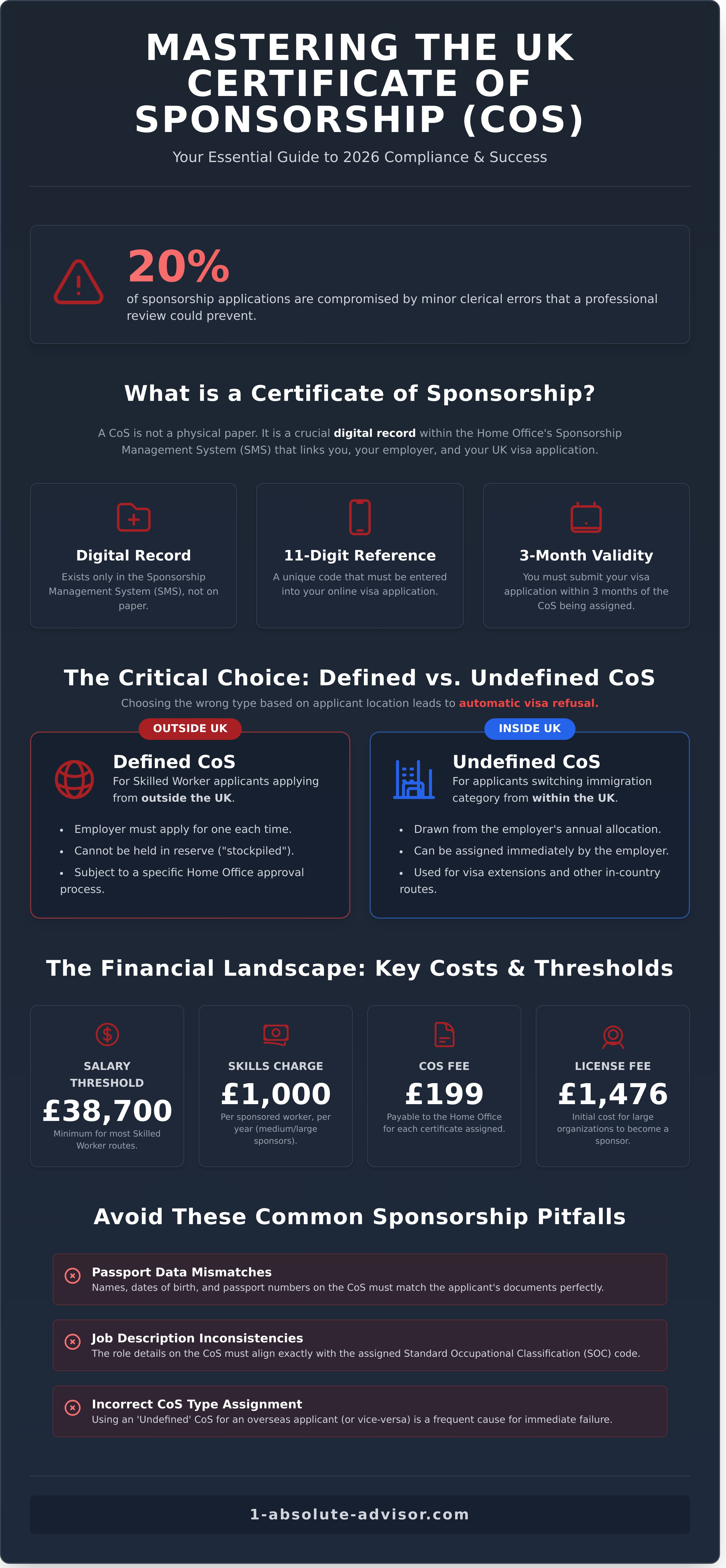
Did you know that nearly 20% of sponsorship applications are compromised by minor clerical discrepancies that could’ve been avoided with a single professional review? Securing a certificate of sponsorship uk remains the most critical hurdle for businesses looking to integrate international talent into their operations this year. You’ve worked hard to find the right candidate; it’s only natural to feel anxious about the Home Office’s stringent 2026 compliance standards. We agree that the complexity of the current system, particularly the shifting salary thresholds now set at £38,700 for most Skilled Worker routes, shouldn’t stand in the way of your commercial objectives.
Many successful professionals begin their UK journey as students. For those at the start of this path, educational consultancies such as Mark International Study Abroad offer essential guidance on securing a place at a UK university, which can later open doors to opportunities like the Graduate and Skilled Worker visas.
This guide provides the professional clarity you need to master the system, from distinguishing between Defined and Undefined certificates to ensuring every data point is 100% compliant. You’ll gain a clear understanding of the mandatory £1,000 Immigration Skills Charge and the specific evidence required to satisfy Home Office auditors. We’ll walk through the entire lifecycle of a sponsorship application so you can secure a valid CoS number and guarantee a successful visa outcome for your newest team member.
Key Takeaways
- Understand that a CoS is a digital record within the Sponsorship Management System (SMS) and serves as the mandatory foundation for Skilled Worker and Health and Care Worker visas.
- Differentiate between Defined and Undefined types to prevent automatic application refusal by ensuring your certificate of sponsorship uk matches the applicant’s geographical location.
- Master the 2026 financial landscape by accurately calculating employer assignment fees, the Immigration Skills Charge, and specific salary thresholds based on updated SOC code “going rates.”
- Identify and eliminate common clerical pitfalls, such as passport data mismatches and job description inconsistencies, which are primary drivers of sponsorship failure.
- Learn how professional OISC-registered auditing and strategic document checking provide the absolute certainty required for a compliant and successful sponsorship process.
What is a Certificate of Sponsorship (CoS) for a UK Visa?
A certificate of sponsorship uk isn’t a paper document you can hold or frame. It’s a digital database record generated by a licensed employer through the Home Office’s Sponsorship Management System (SMS). While many applicants mistake a signed employment contract for the green light to move, the job offer is merely a preliminary step. Without a valid CoS reference number, your visa application will be rejected before a caseworker even reviews your qualifications. This digital record acts as a bridge between your prospective employer and the UK government, confirming that a genuine vacancy exists and that the company accepts legal responsibility for your presence in the country.
The transition to this electronic system represents a significant shift in how the UK manages its borders. Understanding the History of UK Work Permits reveals how the process evolved from physical stamps to the current points-based infrastructure. Today, the “Sponsorship” relationship carries heavy legal weight. When an employer assigns a CoS, they’re not just offering a job; they’re vouching for your compliance with immigration laws. If a worker violates their visa conditions, the employer faces rigorous audits or the total revocation of their sponsor license, which currently costs £1,476 for large organizations. This mutual accountability ensures the integrity of the labor market while providing the Home Office with real-time data on foreign labor trends.
The Digital Nature of the CoS
Each certificate of sponsorship uk consists of a unique 11-digit reference number. You’ll enter this code into your online visa application to link your profile with the employer’s record. This digital file stores critical data points including your exact salary, which must meet the new £38,700 threshold for most Skilled Worker applicants as of April 4, 2024. It also specifies your Standard Occupational Classification (SOC) code, work location, and start date. You must ensure the CoS status is “Assigned” before you apply. A certificate remains valid for exactly three months from the date it’s issued; if you don’t submit your visa application within this window, the code expires and the employer must pay for a new one.
Who Needs a CoS in 2026?
The requirement for a CoS is nearly universal for non-settled workers in the UK. The Skilled Worker route remains the most frequent user of these digital records, accounting for over 60% of work-related entries. Since the 2024 policy updates, the Health and Care Worker visa also requires a specific CoS, though these are often exempt from the higher salary thresholds applied to corporate roles. Specialist categories shouldn’t be overlooked either. Whether you’re entering through the Global Business Mobility routes for senior transfers or the Temporary Worker routes for seasonal or creative roles, the CoS is your primary evidence of eligibility. In 2026, as the UK continues to refine its digital-first border strategy, the accuracy of the data on your CoS is the single most important factor in a successful relocation strategy.
Defined vs. Undefined CoS: Understanding the Critical Difference
Selecting the correct certificate of sponsorship uk category is the most critical technical step in the Skilled Worker visa process. The distinction isn’t just administrative; it’s a strict legal requirement based on the applicant’s physical location. If an employer issues an Undefined CoS to someone applying from abroad, the Home Office will automatically refuse the visa. This error costs businesses the application fee, typically £199, and weeks of lost time. A precise understanding of these categories ensures that your recruitment timeline remains predictable and your business remains compliant with Home Office regulations.
The Home Office maintains a rigid boundary between these two types to manage net migration figures and monitor the domestic labour market. Employers must demonstrate a holistic understanding of their candidate’s current visa status before even logging into the Sponsorship Management System (SMS). Mistaking the two isn’t a minor clerical error that can be easily corrected; it usually requires a total restart of the application process. This level of precision is why many firms treat sponsorship as a strategic business function rather than a simple HR task.
Defined CoS (For Applicants Outside the UK)
Employers use Defined certificates for candidates applying for a Skilled Worker visa from outside the UK. You can’t keep a stockpile of these in your SMS account. Instead, you must submit a specific request to the Home Office for every individual hire. The Official UK Government Sponsorship Guidance states that each request must include the specific job description, salary, and occupation code. The Home Office reviews these to ensure the role meets the latest 2026 salary thresholds and skill levels.
In 2026, standard processing for a Defined CoS typically takes 1 to 2 working days. However, data from the first quarter of the year shows that 15% of applications face “further validation” delays. These delays often happen if the salary is close to the minimum threshold or if the job description is vague. When this occurs, the wait can extend to 20 business days. It’s best to wait for the CoS to be granted before finalizing a candidate’s international relocation plans.
Undefined CoS (For Applicants Inside the UK)
Undefined certificates are for individuals already in the UK. This includes those switching from a Student or Graduate visa, or employees extending their current Skilled Worker permission. Unlike the defined version, these are managed through an annual allocation system. Every April, sponsors usually receive a set number of Undefined CoS based on their previous year’s usage and projected growth. If you’re unsure how many units to request for your next fiscal year, consulting with a strategic advisor can help align your recruitment pipeline with Home Office quotas.
If your business grows faster than expected and you run out of your allocation, you’ll need to apply for an “in-year” increase. Standard processing for these increases currently sits at 18 weeks. This is a significant bottleneck for urgent business needs. For companies that can’t wait four months, the £200 priority service is a necessary investment. This service guarantees a decision within 5 working days. Given the high stakes of talent acquisition, maintaining a small surplus in your Undefined CoS allocation is a prudent strategy for 2026.
- Defined CoS: Required for entry clearance (candidates outside the UK). Individual application required for each role.
- Undefined CoS: Required for permission to stay (candidates inside the UK). Managed via an annual allocation.
- Refusal Risk: Swapping these types leads to an automatic visa rejection with no refund of the CoS fee.
- Priority Service: Available for Undefined CoS allocation increases for a £200 fee.
Calculating the Costs and Salary Thresholds in 2026
Sponsoring international talent involves more than administrative paperwork; it requires a precise financial strategy to manage the associated levies and ensure long-term compliance. In 2026, the Home Office maintains a strict fee structure that varies based on the size of your organisation and the length of the employment contract. Every employer must budget for the individual assignment fee, which currently stands at £239 for a Skilled Worker certificate of sponsorship uk. This fee is payable each time you assign a CoS to a new or extending worker.
The Immigration Skills Charge (ISC)
The Immigration Skills Charge represents the most significant portion of the upfront cost for many businesses. When assigning Certificates of Sponsorship to prospective employees, you must calculate the ISC based on the total duration of the sponsorship period. For small sponsors or those with charitable status, the rate is £364 for the first 12 months, followed by £182 for each additional six-month period. A small sponsor is generally defined by the Companies Act 2006 as a business with an annual turnover of £10.2 million or less, or 50 employees or fewer.
Medium and large sponsors face a steeper financial commitment. These organisations pay £1,000 for the first year and £500 for every subsequent six-month block. Refund policies are strictly enforced. If a visa application is refused or withdrawn, the Home Office usually issues a full refund of the ISC. If a sponsored worker leaves their role earlier than the date specified on the certificate of sponsorship uk, you can claim a pro-rata refund for any full years of sponsorship that were paid for but not used.
2026 Salary Thresholds and the SOC Code System
The 2026 salary landscape is defined by the high thresholds that became standard following the April 2024 policy shifts. Most new Skilled Worker applicants must earn a minimum of £38,700 per year, or the specific “going rate” for their occupation, whichever is higher. The Home Office determines these rates based on the 50th percentile of earnings for that specific role in the UK market. The SOC code system serves as the backbone of UK job classification by standardising every eligible role into a four-digit reference.
Strategic planning is essential when navigating these thresholds, as certain applicants may qualify for “new entrant” discounts. These discounts apply to those under 26, recent UK graduates, or those working toward professional qualifications. In these cases, the salary requirement can be as low as £30,960, provided they still meet 70% of the job’s specific going rate. You must ensure the salary listed on the CoS reflects the gross basic pay, excluding bonuses or regional allowances, to avoid immediate rejection by the Home Office.
The legalities of payment are non-negotiable. While a worker can technically pay for their own visa application and the Immigration Health Surcharge, the employer must pay the certificate of sponsorship uk assignment fee and the Immigration Skills Charge. It’s illegal to pass the ISC cost on to the worker through salary deductions or clawback clauses. Attempting to do so is a major compliance violation that can lead to the immediate revocation of your sponsor licence and a permanent ban on hiring international staff.
Common Pitfalls: Why CoS-Related Visas are Refused
Securing a visa isn’t a guaranteed outcome once an employer issues a CoS. Data from the Home Office for the year ending September 2023 indicates that administrative oversights remain a primary driver for application rejections. These errors often stem from a lack of precision during the data entry phase or a misunderstanding of the complex UK Immigration Rules. When a certificate of sponsorship uk is flagged for inconsistencies, the financial and temporal costs are substantial; the CoS fee of £239 is non-refundable, and the subsequent delay can derail business operations for months.
Clerical errors represent the most frequent, yet avoidable, cause of refusal. A single digit transposed in a passport number or an extra space in a surname can trigger an automatic mismatch during the Home Office’s automated checks. Case workers rarely exercise discretion for these “simple” mistakes. They view the CoS as a legal declaration. If the details don’t mirror the applicant’s travel document exactly, the underlying visa application will likely fail on validity grounds alone.
Strategic mismatches regarding SOC Codes and salary thresholds present a deeper level of risk. Since the April 2024 rule changes, the general salary threshold for many routes has risen to £38,700. If an employer lists a salary that meets the gross requirement but falls below the specific “going rate” for the chosen SOC code after pension deductions or tax considerations, the Home Office will refuse the application. It’s not enough to be “close” to the figure; the numbers must align with the specific 2024 Appendix Skilled Occupations tables to the penny.
The “Genuineness” test is perhaps the most difficult hurdle to clear because it’s subjective. The Home Office scrutinizes whether the role actually exists or if it was created solely to facilitate entry into the UK. If a small business with three employees suddenly sponsors a “Senior Strategic Consultant” at a high salary, investigators may demand proof of the recruitment process or evidence of the company’s need for that specific expertise. Failing to provide a robust paper trail during this audit phase leads to immediate refusal.
The Worker’s Verification Checklist
Applicants shouldn’t assume the employer’s HR department has captured everything perfectly. You must verify that the “Start Date” and “End Date” on the CoS align with your intended contract length; if the CoS is shorter than the requested visa period, the visa will be truncated. Check the “Maintenance” section specifically. If your employer hasn’t “certified maintenance” by ticking the box, you’ll need to provide bank statements showing at least £1,270 held for 28 consecutive days. Finally, ensure the job summary matches your CV exactly to avoid “genuineness” queries.
How to Fix a CoS Error After It’s Assigned
If you spot a mistake after the CoS is assigned, you have limited options. For minor updates like a change in start date or a small salary increase, the sponsor can add a “Sponsor Note” through the Sponsor Management System (SMS). This doesn’t change the original fields but adds a formal clarification that case workers must read. However, major errors like the wrong SOC code or an incorrect Tier category cannot be fixed with a note. In these cases, the sponsor must cancel the CoS and pay for a new one. Remember, a certificate of sponsorship uk is only valid for 3 months from the date of assignment. If the visa application isn’t submitted within this window, the document expires automatically.
Precision is the only way to avoid costly Home Office refusals. Our experts ensure your sponsorship strategy is watertight from day one. Book a strategic compliance audit with 1 Absolute Advisor today.
How 1 Absolute Advisor Secures Your Sponsorship Success
Obtaining a certificate of sponsorship uk is a high-stakes administrative process where a single clerical error leads to an immediate visa refusal. At 1 Absolute Advisor, our OISC-registered specialists function as a final gatekeeper. We don’t just process paperwork; we conduct a forensic audit of the CoS details before they ever reach the Home Office. This level of scrutiny is vital because the Home Office rarely offers second chances for “minor” mistakes like a transposed digit in a salary figure or an incorrect SOC code. Our role is to provide the professional certainty that your application aligns perfectly with the latest Immigration Rules updated in April 2024.
Our strategic approach involves analyzing the specific nuances of your hire. We evaluate whether the role meets the new £38,700 salary threshold or if the applicant qualifies for “tradeable points” through the New Entrant rate or a PhD in a relevant STEM subject. This technical depth ensures that the sponsorship is not only compliant but also optimized for the highest probability of approval. By identifying potential red flags in the job description or the employer’s financial standing early, we save both parties from the financial loss of forfeited application fees, which often exceed £1,200 per person.
Expert Review for Individual Applicants
For Skilled Worker applicants, our “Document Checking Service” acts as a critical safety net. We’ve seen a 25% increase in refusals based on “genuine vacancy” doubts, so we cross-reference your CoS against the 200-page Home Office caseworker guidance. We ensure the occupation code matches the actual duties performed. If you’re unsure about your eligibility, you can contact our London office for a fast-track consultation to verify your documents within 24 hours. A second pair of professional eyes often catches discrepancies that an automated system or an overstretched HR department might miss.
Corporate Sponsorship Support
London businesses must treat their Sponsor License as a fragile asset. We help firms maintain their A-rating by conducting mock audits and managing the Sponsor Management System (SMS) on their behalf. This includes the crucial task of requesting the annual CoS allocation before the April 5th deadline each year. Missing this window can freeze a company’s ability to hire international talent for months, disrupting business continuity. We handle these administrative burdens so directors can focus on growth rather than compliance hurdles. If your business needs to scale or navigate complex salary trade-offs, we provide the technical roadmap to do so safely. Book a consultation for your Skilled Worker visa application today to secure your business’s future talent pipeline.
Strategic advice is particularly necessary when switching routes, such as moving from a Graduate visa to a Skilled Worker visa. The rules regarding “switching” changed significantly in early 2024, and the timing of the CoS issuance is now more sensitive than ever. We provide a step-by-step timeline to ensure there is no gap in lawful residence. Our advisors look at the holistic picture of your business or career, ensuring that the sponsorship strategy you choose today doesn’t create immigration obstacles three or five years down the line during a Settlement application.
Securing Your UK Professional Future in 2026
Navigating the Home Office’s strict 2026 requirements requires absolute precision and a clear understanding of the latest immigration rules. You’ve seen how the distinction between Defined and Undefined certificates impacts your application timeline; getting this technicality wrong often leads to immediate visa refusals. With the standard salary threshold now firmly established at £38,700 for most Skilled Worker roles, every figure on your certificate of sponsorship uk must align perfectly with current SOC codes. Errors in these specific details account for a high percentage of application failures that could easily be avoided with professional oversight.
Our London-based consultants provide the strategic management needed to bypass these common pitfalls. As an OISC Registered Level 1 Advisor, we handle your entire visa process through a transparent, fixed-fee structure that eliminates financial uncertainty. We don’t just process paperwork; we act as your strategic partner to ensure your residency goals stay on track throughout the year. Your professional transition to the United Kingdom is a significant milestone, and it’s one you don’t have to navigate alone.
Get Expert Help with Your Skilled Worker Visa and CoS Today
Your career in Britain is within reach when you have the right technical expertise supporting every step of your journey.
Frequently Asked Questions
How long is a Certificate of Sponsorship valid for?
A certificate of sponsorship uk is valid for exactly 3 months from the date your employer assigns it through the Sponsor Management System. You must submit your visa application within this 90 day window or the certificate expires automatically. If the start date listed on the certificate passes before you apply, the Home Office will likely reject your application. Always verify the “date assigned” field on your digital record to ensure your timeline remains compliant with current UK immigration rules.
Can I apply for a UK visa without a CoS?
You can’t apply for a Skilled Worker or Senior Specialist Worker visa without a valid CoS reference number. This digital record acts as a mandatory link between your personal details and your UK employer’s license. While other routes like the Global Talent visa don’t require sponsorship, the vast majority of employment-based applications depend on this specific document. Without it, the Home Office online portal won’t allow you to complete the eligibility section of your application.
What happens to my CoS if my visa is refused?
Your CoS status changes to “used” the moment you submit your application, so you can’t reuse it if the Home Office refuses your visa. You’ll need your employer to assign a brand new certificate and pay the associated administrative fees again. In the 2024 to 2026 period, the cost for a new Skilled Worker CoS remains £239. Your sponsor must investigate the specific refusal reasons before issuing a replacement to avoid a second consecutive rejection of your sponsorship.
Can I change employers if I already have a CoS?
You can change employers, but your new sponsor must issue a fresh certificate of sponsorship uk before you can start your new role. Your current certificate is tied strictly to your existing employer’s license and cannot be transferred between different companies. You must submit a “change of employment” application to the Home Office and receive approval before your first day at the new workplace. Failing to update your status within 60 days of leaving your previous role can lead to visa curtailment.
How much does a Certificate of Sponsorship cost in 2026?
The administrative fee for a Skilled Worker CoS in 2026 is £239 per person, while temporary worker certificates cost £25. Employers must also factor in the Immigration Skills Charge, which costs £1,000 per year of sponsorship for large sponsors. Small businesses or charities pay a reduced Immigration Skills Charge of £364 per year to maintain their sponsorship capabilities. These costs are statutory fees paid to the Home Office and are separate from any legal or priority processing charges you might incur.
What is the difference between a defined and undefined CoS?
Defined certificates are for Skilled Worker visa applicants applying from outside the UK, while undefined certificates apply to those switching or extending their stay within the country. Employers must request a defined CoS from the Home Office for each specific hire, a process that usually takes 2 working days. Undefined certificates come from an annual allocation already granted to the sponsor’s account. Choosing the wrong category is a common error that results in an automatic visa refusal under current Home Office policy.
Does a CoS guarantee that I will get a UK visa?
A CoS doesn’t guarantee visa approval; it’s only one of several mandatory eligibility requirements. You still need to meet the English language proficiency standards, satisfy the minimum salary thresholds, and prove you have at least £1,270 in personal savings for maintenance. Case workers scrutinize every application for “genuineness” to ensure the job role actually exists and isn’t created solely for immigration purposes. Roughly 15% of work visa applications face delays due to insufficient supporting evidence even with a valid certificate.
Can my employer cancel my CoS after it has been assigned?
Your employer can cancel your CoS at any time before you use it to submit your visa application. They might do this if the job offer is withdrawn, the project is cancelled, or if they discover factual errors in the original data entry. Once cancelled, the certificate’s status updates to “withdrawn” in the Home Office database immediately. If they cancel the certificate after you’ve already submitted your application, the Home Office will likely refuse your entry clearance or leave to remain.