
Navigating the complexities of UK immigration in 2026 requires a level of precision that goes beyond simple form-filling. For many couples, the journey toward a life together is shadowed by the daunting prospect of a refusal, the high cost of non-refundable application fees-often exceeding £1,800-and the persistent anxiety of being separated by bureaucratic hurdles. In an environment where online forums offer a sea of conflicting and often outdated advice, it is easy to succumb to the common mistakes on spouse visa application processes that lead to avoidable Home Office rejections.
This guide provides a comprehensive breakdown of the 2026 regulatory landscape, offering the professional validation and strategic clarity necessary to navigate the updated financial thresholds and stringent relationship requirements. By adopting a holistic approach to your submission, we aim to replace uncertainty with a ‘refusal-proof’ application strategy. Our objective is to ensure your transition to life in the UK is defined by stability and compliance rather than the stress of technical pitfalls, providing you with the absolute peace of mind that your family’s future is built on a foundation of expert integrity and methodical preparation.
Key Takeaways
- Navigate the updated 2026 Minimum Income Requirement (MIR) thresholds to ensure your financial evidence meets the Home Office’s stricter verification standards.
- Identify the most common mistakes on spouse visa application forms, from ‘Specified Document’ rule breaches to English language qualification errors.
- Master the ‘Genuine and Subsisting’ relationship test by focusing on strategic, high-impact evidence rather than overwhelming the caseworker with excessive chat logs.
- Learn how to avoid the devastating financial loss and emotional toll of re-entry bans caused by technical pitfalls in the submission process.
- Discover how a forensic audit by OISC-registered consultants can identify hidden refusal triggers before your application reaches the Home Office.
Understanding the High Stakes of UK Spouse Visa Refusals in 2026
Entering 2026, the UK immigration landscape has shifted toward an uncompromising, data-driven verification model. For couples seeking to build a life together in Britain, the margin for error has effectively vanished. The Home Office now employs sophisticated cross-referencing tools to validate financial records and employment history, making common mistakes on spouse visa application forms more visible-and more fatal-than ever before.
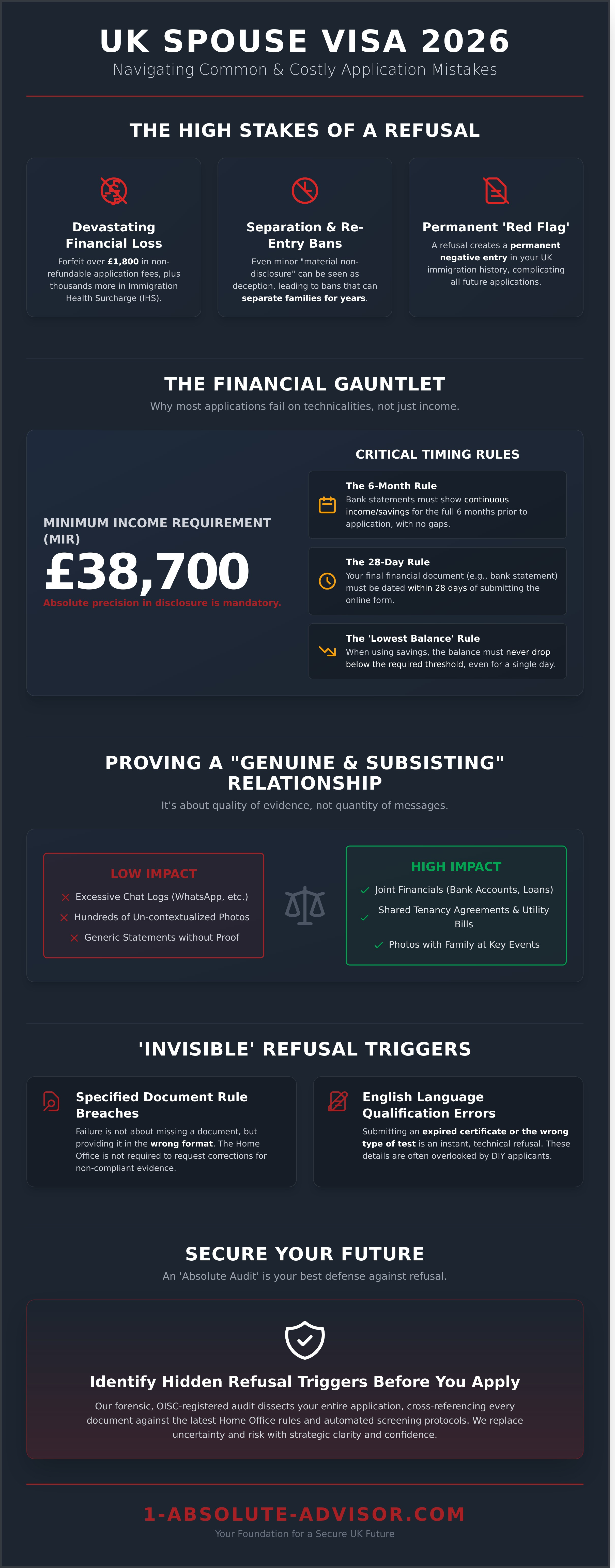
The cost of a refusal is not merely administrative; it is a significant financial and emotional blow. With application fees exceeding £1,800 and the Immigration Health Surcharge (IHS) adding thousands more to the total, a single mistake can result in the forfeiture of these funds. Beyond the capital loss, a refusal can trigger “re-entry” bans if the Home Office perceives any “material non-disclosure” as a deliberate attempt to deceive, potentially separating families for years.
It is critical to distinguish between a rejection and a refusal. A rejection typically occurs when an application is deemed “invalid” due to technicalities, such as incorrect fees. A refusal, however, is a formal finding that you have failed to meet the substantive requirements. In 2026, proving a “genuine and subsisting” relationship is no longer enough; technical compliance with every evidentiary sub-clause is the only path to approval.
The Reality of Home Office Decision Making
In the current climate, your case is handled by UK Visas and Immigration (UKVI), where Entry Clearance Officers (ECOs) review a digital dossier of your life. In 2026, automated systems pre-screen applications to flag inconsistencies in bank statements or tax filings against HMRC records. The burden of proof rests entirely on you; the ECO is not required to request missing information if your initial submission is incomplete or contradictory. Precision is the absolute prerequisite for success.
The Impact of a Refusal on Future UK Applications
A refusal is not a “clean slate” situation. It creates a permanent entry in your UK immigration history, acting as a red flag for every subsequent application, whether for a visitor visa or a future settlement attempt. Overturning a decision via Administrative Review has become increasingly difficult as the Home Office tightens its internal policy guidance. Appendix FM serves as the primary legal framework governing family-based immigration and spouse visa requirements in 2026. Avoiding common mistakes on spouse visa application submissions is therefore not just about the present, but about protecting your long-term right to remain in the United Kingdom.
The Financial Requirement: Why Most Applications Fail on Technicalities
The financial requirement is arguably the most rigid aspect of the UK immigration system. With the Minimum Income Requirement (MIR) set to reach £38,700 by 2026, applicants must demonstrate absolute precision in their financial disclosures. One of the most common mistakes on spouse visa application submissions is the assumption that simply meeting the income threshold is sufficient; in reality, the Home Office prioritizes the format and source of the evidence over the final figure.
To ensure compliance with Appendix FM-SE, you must observe the ‘6-Month Rule.’ This requires bank statements to be continuous, showing every transaction without gaps, and the final statement must be dated within 28 days of the online application. Even a 48-hour discrepancy in statement dates can lead to an immediate refusal. Furthermore, when combining income sources-such as mixing salaried employment with cash savings-the calculations become exponentially more complex, leaving no room for error.
Common Pitfalls in Salary and Employment Evidence
Discrepancies between employer letters and financial documents are a leading cause of failure. For a successful application, the gross salary stated in the employer letter must align perfectly with the payslips and the corresponding deposits shown in bank statements. We frequently observe refusals due to:
- The ‘Lowest Balance’ Rule: For applications relying on savings, the balance must never drop below the required threshold at any point during the 6-month period.
- Undocumented Income: ‘Cash-in-hand’ payments or discretionary bonuses that are not reflected on payslips or subject to PAYE tax are generally discounted by Caseworkers.
- Incomplete Documentation: Failing to cross-reference your evidence against the official spouse visa eligibility rules regarding specified evidence formats.
Self-Employed and Director Pitfalls
Applications under Category F (last full financial year) or Category G (average of the last two financial years) carry the highest refusal rates due to their evidentiary burden. Directors of specified limited companies must provide a CT600 (Company Tax Return), a Statement of Account, and evidence of dividend payments. Another of the common mistakes on spouse visa application forms for business owners is failing to prove the ‘full financial year’-the evidence must align with the relevant Company Tax Return period, not the calendar year or the personal tax year, unless they coincide.
Proving a Genuine Relationship: Beyond Wedding Photos and WhatsApp
The Home Office evaluates every application against the ‘Genuine and Subsisting’ test. This assessment determines whether a relationship is authentic, ongoing, and intended to continue in the UK. One of the most common mistakes on spouse visa application submissions is the assumption that a high volume of evidence equates to a successful outcome. Submitting 500 pages of WhatsApp logs or exhaustive call histories can be counterproductive; it often obscures the core narrative and suggests a lack of discernment in your presentation.
Instead, Caseworkers look for ‘Intervening Devotion’-clear, chronological evidence of how a couple maintains their bond during periods of separation. This includes travel bookings for visits, evidence of shared financial support, and a consistent pattern of communication. Furthermore, applicants must be mindful of cultural nuances. If your relationship follows specific traditional or religious customs that may not align with Western dating norms, it is vital to provide a clear, written explanation to ensure these are not misinterpreted by immigration officers as a lack of genuine intent.
The Hierarchy of Relationship Evidence
In the eyes of the Home Office, not all evidence is created equal. A strategic application prioritises primary evidence over social proofs. While meeting The Financial Requirement is a standalone necessity, demonstrating financial co-dependence-such as joint bank accounts, shared tenancies, or being named on each other’s insurance policies-acts as the strongest proof of a subsisting relationship.
- Statements of Support: Letters from family and friends should be detailed and specific to your circumstances, rather than using generic templates that lack personal insight.
- Cohabitation Evidence: For those applying as unmarried partners, the 2-year cohabitation rule remains a critical threshold. By 2026, the standard for documenting a shared life at the same address has become increasingly rigorous, requiring official correspondence from multiple sources (e.g., GP, HMRC, or utility providers).
Social Media and Digital Footprint Mistakes
Inconsistencies between your formal application and your digital footprint can lead to immediate suspicion. Immigration officers may review public social media profiles; if your relationship status or public posts contradict the timeline provided in your application, it creates a significant credibility gap. Another pitfall is the use of ‘staged’ evidence-overly curated or professional photo shoots that lack the organic feel of a long-term partnership. Ultimately, the quality of evidence always outweighs the quantity in relationship proofs. Focus on providing a concise, logical, and verifiable history of your life together to avoid the common mistakes on spouse visa application forms that lead to unnecessary refusals.
Procedural and Documentation Errors: The ‘Invisible’ Reasons for Refusal
While many applicants focus exclusively on proving the “genuine and subsisting” nature of their relationship, technical failures remain among the most common mistakes on spouse visa application submissions. These procedural errors often trigger automatic refusals because they violate the Home Office’s strict “Specified Document” rules, which leave little to no room for caseworker discretion.
Translation and Certification Standards
In 2026, the requirements for non-English documentation are more stringent than ever. Every document not issued in English or Welsh must be accompanied by a full translation that can be independently verified by the Home Office. An unofficial or “friend-assisted” translation is a guaranteed path to refusal. To meet the absolute standard of compliance, a certified translation must include:
- Confirmation from the translator that it is an accurate translation of the original document;
- The date of the translation;
- The translator’s full name, signature, and contact details;
- The translator’s professional credentials or seal.
Furthermore, when uploading to the Sopra Steria portal, digital documents must maintain original metadata integrity. Low-quality scans or photographs that obscure margins or security features are frequently rejected as “unreliable.”
The English Language Pitfall
Failure to meet the English language requirement is a frequent, yet avoidable, hurdle. Applicants must either hold a degree taught in English (verified by Ecctis) or pass a Secure English Language Test (SELT) from an approved provider. A common mistakes on spouse visa application is using a test provider that is not on the Home Office’s current approved list, or failing to meet the specific CEFR level: A1 for initial entry and A2 for the 30-month extension.
Strategic Note: Always verify the 2026 list of exempt countries, as the Home Office periodically updates which nationalities are deemed “majority English-speaking.”
Health Requirements and Surcharges
Beyond language and translations, two specific procedural areas often cause delays or denials:
- Tuberculosis (TB) Testing: If you are applying from a country on the mandatory screening list, your certificate must be from a Home Office-approved clinic. Certificates from unapproved private doctors or those that have exceeded their six-month validity period are not accepted.
- Immigration Health Surcharge (IHS): Errors in calculating the IHS-often due to incorrect entry of stay dates-can lead to an invalid application. Ensure the payment of the surcharge (currently calculated per year of the visa) is completed and the reference number is correctly integrated into your digital form.
At 1 Absolute Advisor, we believe that strategic preparation is the only way to mitigate these administrative risks. Ensuring every document meets the “Specified Document” rule is not just a formality; it is the foundation of a successful relocation strategy.
Securing Your Future: Why an Absolute Audit is Your Best Defense
The path to a successful UK visa is rarely paved with simple forms; it is built on a foundation of meticulous evidence. At Absolute Advisor, we employ a forensic “Absolute Audit” approach to every file. Rather than a cursory glance, our OISC-registered consultants perform a deep-dive analysis to identify “refusal triggers” before your application ever reaches a Home Office caseworker. By anticipating common mistakes on spouse visa application submissions-such as misaligned bank statement dates or insufficient proof of cohabitation-we transform a high-stakes gamble into a calculated success.
A critical component of our strategy is the professional Cover Letter. For applicants with complex financial histories, such as those relying on Category F self-employment income or intricate dividend structures, a standard checklist is insufficient. We narrate your financial history with precision, ensuring the caseworker understands exactly how you meet the £29,000 (or higher, depending on transitional arrangements) threshold. This transition from anxiety to certainty is underpinned by our fixed-fee model, providing you with absolute peace of mind without the fear of escalating legal costs.
The Document Checking Service vs. Full Management
Choosing the right level of support depends entirely on your case’s complexity. For those confident in their preparation but seeking a final “safety net,” Our Document Checking Service: Avoid Common Visa Errors provides a rigorous professional audit. This service often catches administrative oversights that even generalist solicitors might overlook. However, for cases involving previous refusals or non-standard income, our Full Management service offers a comprehensive strategic partnership from inception to approval.
Success as the Logical Conclusion of Preparation
Success in immigration is not a matter of luck; it is the logical result of exhaustive preparation. We recently assisted a couple who faced a refusal due to common mistakes on spouse visa application forms regarding the “adequate maintenance” requirement. By restructuring their evidence and providing a clear legal roadmap, we secured their approval through 2026.
A clean immigration record is an investment in your future, simplifying eventual applications for Indefinite Leave to Remain (ILR) and British Citizenship. Do not leave your family’s stability to chance. Book your Absolute Consultation today for a refusal-proof application and ensure your first application is your only application.
Securing Your Future: A Strategic Approach to UK Immigration
Navigating the complexities of the UK Home Office requirements in 2026 demands absolute precision and a proactive mindset. As we have explored, the most common mistakes on spouse visa application submissions often stem from technical oversights in financial documentation or a failure to present a holistic narrative of a genuine relationship. In a regulatory environment where the stakes involve your family’s unity, relying on guesswork is a risk few can afford. Success requires a commitment to compliance and a meticulous verification of every evidentiary detail before submission.
At Absolute Advisor, we act as your strategic partner, offering the stability and professional integrity necessary to navigate these high-stakes decisions. Our OISC Level 1 Registered Consultants provide a specialized focus on UK Immigration law, ensuring your application meets the most rigorous standards. With our fixed-fee pricing and no hidden costs, you gain the clarity and predictability essential for sound financial planning. Do not leave your future to chance; ensure your application is beyond reproach.
Secure your UK Spouse Visa with an Absolute Expert Audit and take the first definitive step toward your new life in the United Kingdom with confidence.
Frequently Asked Questions
Can I apply for a UK Spouse Visa if I don’t meet the financial requirement?
Generally, meeting the minimum income threshold of £29,000 is mandatory for a successful application. However, you may be exempt if your UK sponsor receives specific disability-related benefits, such as Personal Independence Payment (PIP) or Attendance Allowance, in which case you must satisfy the “adequate maintenance” test instead. Failing to correctly calculate these figures is one of the most common mistakes on spouse visa application, often requiring professional strategic planning to navigate.
How many photos do I need to provide for a Spouse Visa application in 2026?
There is no statutory number, but providing 10 to 15 high-quality photographs is considered the professional standard. These images should demonstrate the progression of your relationship over a significant period and across various settings. Focus on photos that include both partners alongside family and friends, as this provides evidence of social recognition. Quality and relevance are far more critical than volume; an excessive number of repetitive images can complicate the review process.
Will my Spouse Visa be refused if we had a small wedding?
The Home Office does not judge applications based on the size or cost of a wedding ceremony. Their primary concern is whether the marriage is legally recognized in the country where it took place and whether the relationship is genuine and subsisting. While a small ceremony is perfectly acceptable, you must ensure your supporting evidence-such as joint financial commitments and proof of cohabitation-is robust enough to demonstrate a legitimate and lasting union.
Can I use my partner’s income to meet the financial requirement?
This depends entirely on the applicant’s current location and legal status. If you are applying from outside the United Kingdom, only the UK-based sponsor’s income can be used to meet the £29,000 threshold. However, if the applicant is already in the UK on a valid visa that permits employment, such as a Graduate or Skilled Worker visa, their earnings can be combined with the sponsor’s income to satisfy the financial criteria.
What happens if my Spouse Visa is refused?
Upon refusal, you will receive a formal decision letter detailing the specific grounds for the rejection. You typically have the right to lodge an appeal with the First-tier Tribunal on human rights grounds or request an Administrative Review if an error was made by the caseworker. In cases where the refusal was due to a simple documentation error, it is often more efficient to submit a fresh application that addresses the previous deficiencies comprehensively.
Is a lawyer necessary for a UK Spouse Visa application?
While not legally mandatory, engaging a specialist advisor is a strategic step to mitigate risk. The complexity of UK immigration law and the strict evidential requirements make it easy to commit common mistakes on spouse visa application that lead to costly delays. Professional guidance ensures your submission is “absolute” in its accuracy, providing the stability and predictability needed when navigating life-changing legal processes.
How long must bank statements be valid for at the time of application?
Under the “28-day rule,” your most recent bank statement must be dated no more than 28 days before the date you submit your online application. This is a critical technical requirement that many applicants overlook. Furthermore, your bank statements must align perfectly with your payslips and employer’s letter. Any discrepancy in dates or amounts can lead to a refusal, as the Home Office requires precise financial transparency.
Does the Home Office check my social media during a Spouse Visa review?
While the Home Office does not routinely monitor every applicant’s social media, they reserve the right to investigate public profiles if they suspect a “marriage of convenience.” Discrepancies between your application details and your public digital presence can trigger additional scrutiny or an interview. It is prudent to ensure your public information is consistent with your application, although your primary focus should remain on providing high-quality documentary evidence.