

Navigating the complexities of the UK immigration system is a significant undertaking, where the emotional stakes of being separated from your partner are compounded by the substantial financial commitment of application fees, often reaching thousands of pounds. As we look toward 2026, the Home Office has implemented increasingly rigorous standards, making it essential to understand precisely how to avoid spouse visa refusal through meticulous preparation and strategic compliance. For many applicants, the confusion surrounding shifting financial thresholds and evidentiary mandates represents a significant barrier to the long-term stability they seek.
In this comprehensive guide, we move beyond basic documentation to provide a holistic framework for a “refusal-proof” application. You will gain absolute clarity on the 2026 financial requirements and the specific, high-level evidence necessary to satisfy Home Office caseworkers on your first attempt. Our objective is to replace the anxiety of the unknown with the peace of mind that stems from professional validation and strategic foresight. By adopting these expert legal strategies, you can ensure your path to a life together in the United Kingdom is built on a foundation of precision, predictability, and regulatory integrity.
Key Takeaways
- Navigate the complex 2026 financial landscape by mastering the specific income thresholds and the £62,500+ cash savings alternative to ensure absolute compliance.
- Understand why a marriage certificate is merely an “entry ticket” and how to document “Intervening Devotion” to satisfy the Home Office’s relationship standards.
- Discover expert legal frameworks on how to avoid spouse visa refusal by proactively managing the burden of proof with a meticulously structured evidence portfolio.
- Identify and bypass critical procedural traps, including strict “switching” prohibitions and the specific validity requirements for Approved English Language Tests (SELT).
- Leverage the 1 Absolute Advisor strategy of OISC-registered evidence audits and professional Legal Cover Letters to frame your case for a successful first-time approval.
Table of Contents
- Common Grounds for Spouse Visa Refusal in 2026
- Mastering the 2026 Financial Requirements
- Proving a "Genuine and Subsisting" Relationship
- Procedural Traps: Location, English, and Health
- The 1 Absolute Advisor Strategy for Guaranteed Compliance
Common Grounds for Spouse Visa Refusal in 2026
Navigating the UK immigration landscape requires more than just a valid marriage certificate; it demands a meticulous alignment with the Home Office’s evolving evidentiary standards. In 2026, the “burden of proof” remains entirely on the applicant. This means the Home Office is under no obligation to request missing information; instead, the onus is on you to present a comprehensive, “decision-ready” file. Understanding how to avoid spouse visa refusal begins with recognizing that caseworkers operate within a framework of strict compliance, where the absence of a single mandatory document can lead to an immediate rejection.
The introduction of AI-assisted document screening has further tightened the margin for error. These automated systems are programmed to cross-reference financial data and identify chronological gaps in cohabitation evidence with mathematical precision. This has created a significant “paperwork gap,” where genuine couples are refused not because their relationship is fraudulent, but because their documentary trail fails to meet the digital criteria. For those seeking a broader context on international standards, a family visa overview provides a useful baseline for how the UK’s stringent requirements compare to other jurisdictions.
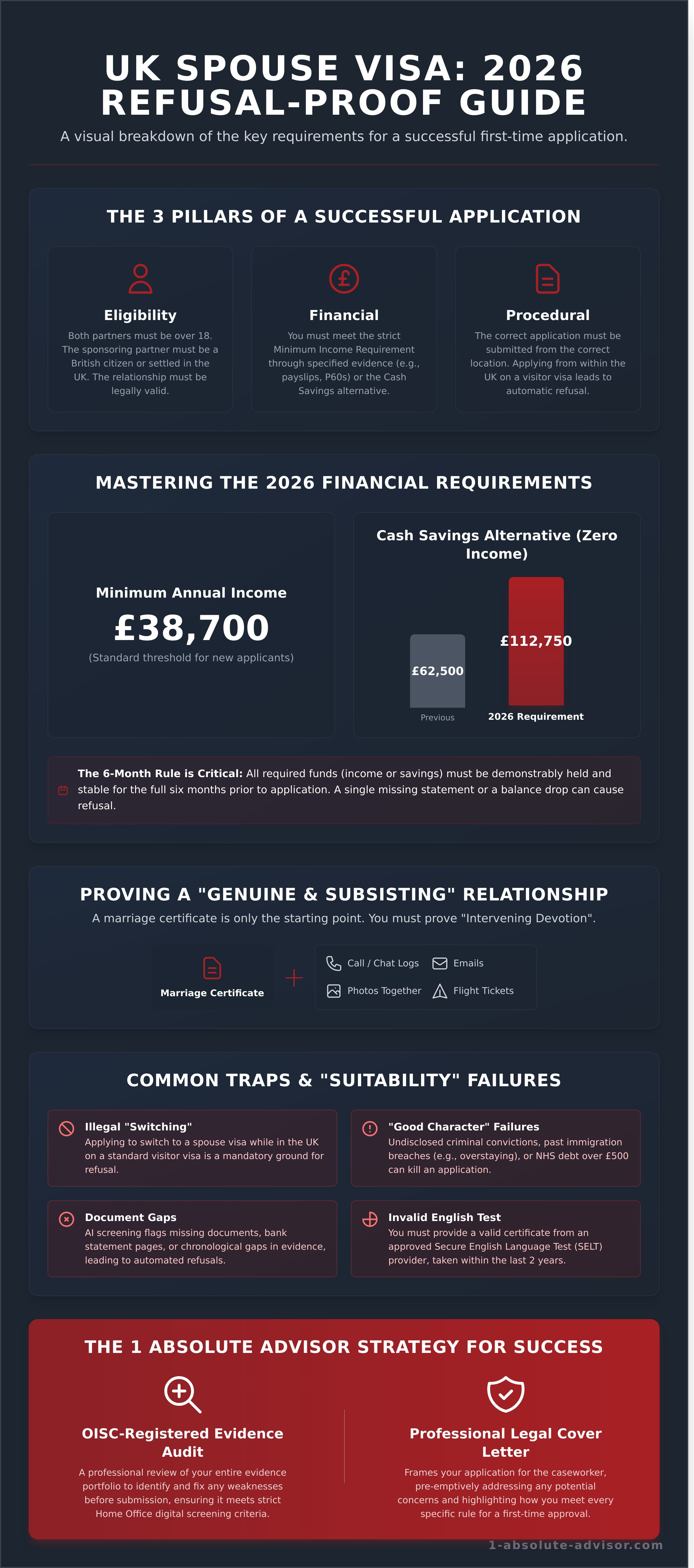
The Three Pillars of Application Success
To ensure a holistic and secure application, candidates must address three core areas of compliance:
- Eligibility: Demonstrating that both parties are over 18 and that the relationship is legally valid and “subsisting.”
- Financial: Providing absolute proof of meeting the minimum income threshold (currently £29,000 for most new applicants) through specified evidence like P60s, payslips, and corresponding bank statements.
- Procedural: Ensuring the correct forms are submitted from the appropriate legal jurisdiction, as applying from within the UK on a visitor visa, for instance, is a common ground for refusal.
Suitability and the “Good Character” Requirement
Suitability is often the “silent killer” of otherwise strong applications. The Home Office conducts rigorous background checks into an applicant’s history. Past immigration breaches, such as overstaying or working illegally, can trigger a mandatory refusal. Furthermore, undisclosed criminal convictions or outstanding debt to the NHS (typically exceeding £500) are viewed as “suitability” failures. In 2026, absolute transparency is the only viable strategy; any perceived attempt to deceive the Home Office will not only lead to a refusal but may result in a ten-year ban. Mastering how to avoid spouse visa refusal requires a proactive audit of your personal history to ensure every “Good Character” requirement is met with total integrity.
Mastering the 2026 Financial Requirements
The financial requirement remains the most common stumbling block for applicants. To understand how to avoid spouse visa refusal, one must first recognize that the Home Office has significantly increased the minimum income thresholds. As of 2026, the standard gross annual income requirement has risen to £38,700 (unless you are covered by transitional arrangements from a previous application). Precision is not merely encouraged; it is a mandatory prerequisite for success.
For those relying on “Cash Savings” to meet the requirement, the calculation is no longer the historical £62,500. Under the current formula-(Income Gap x 2.5) + £16,000-an applicant with zero eligible income would require £112,750 in accessible savings held for at least six months. According to the official UK spouse visa guidance, these funds must be held in a regulated financial institution and be immediately withdrawable.
- The 6-Month Rule: Bank statements must show the required balance or income consistency for a full six-month period. A single day where the balance drops below the threshold, or a missing statement page, will result in an immediate rejection.
- Combining Sources: While you can often combine salaried income with non-employment income (like rental dividends), you generally cannot combine self-employment income with cash savings to meet the threshold.
Proving Income: Employment vs. Self-Employment
For Category A employees (6+ months with the same employer), the Home Office demands a perfect correlation between documentation. Your payslips must match your bank statements to the exact penny. Any discrepancy, however minor, suggests financial inconsistency to a caseworker. For directors of limited companies or the self-employed, the evidentiary burden is higher, requiring CT600 forms, audited accounts, and proof of ongoing trade. This complexity is why meticulous strategic planning is essential to understand how to avoid spouse visa refusal due to technical accounting errors.
Common Financial Evidence Mistakes
Many applicants fail by submitting evidence from non-permitted sources. Funds held in cryptocurrency, certain illiquid ISAs, or stocks not liquidated prior to the application are frequently discounted. Furthermore, the “28-day rule” is absolute: your most recent financial document (bank statement or payslip) must be dated no earlier than 28 days before the date of your online application. Finally, ensure your employer’s letter is on official letterhead and explicitly confirms your salary, position, and contract type; a generic reference is rarely sufficient for compliance.
Proving a “Genuine and Subsisting” Relationship
In the eyes of the Home Office, a marriage certificate is merely an “entry ticket” to the application process; it is not definitive proof of a valid claim. To understand how to avoid spouse visa refusal, applicants must satisfy the “Intervening Devotion” standard. This requires demonstrating that the relationship is not only legally recognized but is active, emotional, and intended to be permanent. Caseworkers look for a consistent narrative of shared lives rather than a collection of isolated documents.
A strategic approach involves building a chronological evidence timeline. This narrative should span from the initial meeting through the development of the relationship to your current circumstances. If there are “weak ties”-for instance, if the applicant has never visited the UK or the sponsor has limited knowledge of the applicant’s home culture-it is vital to provide a holistic explanation of how the couple maintains their bond and plans their future together within the UK’s regulatory framework.
The Hierarchy of Relationship Evidence
The Home Office categorizes evidence based on its reliability. According to the Official UK Spouse Visa Requirements, objective financial and residential records carry the most weight. A well-structured application should prioritize the following:
- Primary Evidence: Joint bank accounts, shared mortgages, tenancy agreements, or utility bills in both names.
- Secondary Evidence: Travel logs, boarding passes from visits, and a curated selection of photos spanning the duration of the relationship.
- Supporting Evidence: Brief witness statements from friends or family and logs of digital communication (e.g., WhatsApp or video call history).
Addressing Red Flags in Your Relationship History
Proactive transparency is the most effective way to mitigate potential concerns. If your relationship involves “red flags” such as a significant age gap or the lack of a shared primary language, you must provide a logical explanation. For example, if communication occurs via translation software, documenting this shows honesty and compliance.
For long-distance couples, documenting the frequency of physical reunions and consistent financial support is essential. Demonstrating a clear, shared plan for your life in the UK is a fundamental step in how to avoid spouse visa refusal, as it proves the “subsisting” nature of the union despite geographical challenges.
Procedural Traps: Location, English, and Health
Even when financial and relationship requirements are met, procedural oversights remain a leading cause of application failure. Understanding how to avoid spouse visa refusal requires absolute precision regarding where you apply from and the specific health and language benchmarks set by the Home Office. At Absolute Advisor, we view these procedural elements not as mere administrative hurdles, but as the foundational pillars of a successful strategic application.
One of the most frequent “traps” involves the prohibition on switching. You cannot apply for a Spouse Visa from within the UK if you are currently on a Marriage Visitor Visa or a standard Visitor Visa. Attempting to do so is a fundamental breach of eligibility that leads to an immediate refusal. Furthermore, the Immigration Health Surcharge (IHS)-currently £1,035 per year for most applicants-must be paid in full during the application process. A common error is failing to provide the correct IHS reference number or underpaying due to incorrect duration calculations, which can jeopardise the entire submission.
Finally, applicants from specific countries listed by the Home Office must provide a valid Tuberculosis (TB) test certificate. Crucially, this test must be conducted at a Home Office-approved clinic; results from non-approved medical centres will not be accepted, regardless of the clinician’s qualifications.
Applying from the Correct Jurisdiction
Determining your application “route” is a critical first step. You are generally only eligible for an “In-Country” switch if you currently hold a visa valid for more than six months (such as a Skilled Worker or Student visa). If applying from abroad, you must use the “Entry Clearance” portal. Once approved, you are typically granted a 90-day window to enter the UK. Managing this timeline is essential, as missing this window requires a costly vignette transfer application to regain entry rights.
English Language and Digital Compliance
Compliance also extends to your linguistic and digital evidence. By 2026, the UK’s transition to a fully digital immigration system (eVisas) will be complete, making the accuracy of your digital footprint more vital than ever. To meet the English language requirement, you must use a provider on the Secure English Language Test (SELT) approved list, such as IELTS SELT Consortium or Pearson PTE Academic UKVI.
- Level: A minimum of A1 for the initial application (though B1 is recommended for future-proofing).
- Digital Scans: Ensure all documents are uploaded in high resolution, staying within the 6MB file size limit to avoid legibility issues.
For a comprehensive review of your procedural readiness, visit 1-absolute-advisor.com to ensure your application meets the highest standards of professional scrutiny.
The 1 Absolute Advisor Strategy for Guaranteed Compliance
Navigating the complexities of UK immigration requires more than just a checklist; it demands a strategic alignment of your personal history with the Home Office’s stringent internal benchmarks. At Absolute Advisor, our OISC-registered experts perform a forensic audit of your evidence, cross-referencing every document against the latest Home Office caseworker manuals. This meticulous approach is the definitive method for how to avoid spouse visa refusal in an increasingly automated system.
Our strategy centers on three core pillars of professional representation:
- The Legal Cover Letter: We don’t just submit documents; we frame your case. Our advisors draft a comprehensive legal submission that highlights how you meet every statutory requirement, effectively guiding the caseworker to a positive decision.
- 2026 Digital Portal Management: With the full implementation of the 2026 digital-first immigration system, technical errors can lead to instant rejections. We provide fixed-fee management to handle the entire upload process, ensuring data consistency.
- Document Check Service: For those who prefer a DIY approach, our “Final Review” serves as a critical safety net, identifying “hidden” grounds for refusal before you hit submit.
Why a London-Based Expert Makes the Difference
Operating from the heart of the UK’s legal hub, our advisors possess real-time insights into the policy shifts occurring in 2026. Whether you are dealing with complex financial structures-such as combined self-employment and dividend income-or a non-traditional relationship history, a London-based perspective ensures your application reflects current tribunal trends. We also specialize in fast-track assistance, prioritizing family reunification for those who cannot afford the standard 24-week waiting periods.
Take the Next Step Toward Your UK Future
Our professional audit provides the absolute peace of mind that your application is legally fortified against the scrutiny of Home Office caseworkers. When considering the path forward, evaluate the financial implications: a standard spouse visa application fee currently exceeds £1,800, and a refusal results in the total loss of this fee, alongside the potential costs of an expensive legal appeal. Investing in professional guidance is not merely a service; it is a safeguard for your family’s stability.
Don’t leave your future to chance. Book an Initial Consultation with a London Spouse Visa Expert today and ensure your journey to the UK is seamless and successful.
Conclusion: Strategic Precision for Your UK Spouse Visa Success
Navigating the complexities of UK immigration law in 2026 requires more than just completing forms; it demands a strategic, holistically planned approach. Understanding how to avoid spouse visa refusal hinges on two critical pillars: strictly adhering to the updated 2026 financial thresholds and providing undeniable, documented proof of a genuine and subsisting relationship. By proactively addressing potential procedural traps-from English language proficiency to specific health certifications-you move from uncertainty toward a predictable, successful outcome.
At Absolute Advisor, we act as your strategic partner, ensuring every aspect of your application meets the highest standards of compliance. As an OISC Level 1 Registered Firm, we are specialists in the complex 2026 financial requirements, offering fixed-fee pricing with no hidden costs to provide the stability and transparency your future deserves. Our methodical approach is designed to mitigate risks and protect your family’s long-term interests in the United Kingdom.
Take the first step toward a secure future with a team that prioritizes professional integrity and absolute quality. Secure your UK future with our expert Spouse Visa Application Service. With the right legal strategy and expert guidance, your path to a life together in the UK remains clear and achievable.
Frequently Asked Questions
What is the most common reason for a UK Spouse Visa refusal in 2026?
In 2026, the primary catalyst for refusal remains the failure to satisfy the updated financial requirement, which currently stands at £38,700 for most new applicants. Many couples fail to provide the specific, mandatory evidence required by Appendix FM, such as correctly formatted bank statements or specific employer letters. Understanding how to avoid spouse visa refusal starts with a meticulous audit of your financial documentation to ensure absolute compliance with the Home Office’s rigorous evidentiary standards.
Can I appeal a Spouse Visa refusal, or is it better to reapply?
The decision between appealing and reapplying depends on the specific grounds of the refusal. An appeal is generally appropriate if the Home Office made a legal error or overlooked submitted evidence, though the process is often protracted. Conversely, if the refusal was due to a simple administrative error or a missing document, reapplying is frequently the more efficient strategic path. A holistic assessment of your case is necessary to determine which route offers the highest probability of success.
How much cash savings do I need if my partner doesn’t meet the income threshold?
If your partner’s income does not meet the £38,700 threshold, you may utilize cash savings to bridge the deficit. To replace the income requirement entirely, an applicant generally needs £112,750 held in a regulated account for at least six months. This figure is derived by multiplying the threshold by 2.5 and adding the base amount of £16,000. Precise financial planning is essential, as the Home Office requires definitive proof regarding the source and accessibility of these funds.
Does the Home Office check my social media for relationship proof?
While the Home Office does not routinely monitor every applicant’s digital presence, they reserve the right to investigate public social media profiles if they suspect a relationship is not genuine or subsisting. Discrepancies between your application details and your public digital footprint can trigger further scrutiny and potential interviews. We advise ensuring that your public presence accurately reflects the reality of your relationship, providing an additional layer of consistency to your overall visa strategy.
What happens if I make a minor typo on my Spouse Visa application form?
A minor typographical error, such as a misspelled street name, rarely leads to an automatic refusal if the underlying intent is clear and the supporting evidence is accurate. However, errors in critical data-such as passport numbers or financial figures-can lead to a “minded to refuse” notification or an outright rejection based on false representations. Precision is the cornerstone of a successful application; every entry must be cross-referenced against primary documents to maintain absolute integrity.
How long does a Spouse Visa appeal take in 2026?
In 2026, a standard Spouse Visa appeal through the First-tier Tribunal typically spans between 6 to 12 months from lodgement to conclusion. This timeline accounts for the initial submission, the Home Office review period, and the eventual hearing date. Given this significant duration, it is often more strategically sound to submit a fresh, perfected application if the initial grounds for refusal can be easily rectified, thereby avoiding the lengthy uncertainty of the judicial system.
Can I stay in the UK while my Spouse Visa is being processed?
You may only remain in the UK during processing if you are applying for “leave to remain” as a switch from another valid visa category or an extension of an existing spouse visa. Under Section 3C of the Immigration Act 1971, your current leave and conditions are protected until a decision is reached. However, if you are applying for “entry clearance” from outside the UK, you must remain abroad until the visa is granted to ensure full legal compliance.
Is an OISC-registered advisor better than a standard solicitor for a spouse visa?
Both OISC-registered advisors and solicitors are legally qualified to assist, but their areas of expertise often differ. OISC advisors are specialist immigration practitioners whose entire professional focus is dedicated to Home Office regulations and tribunal procedures. Many applicants find that this specialized focus provides a more nuanced understanding of how to avoid spouse visa refusal compared to a general practice solicitor. Your choice should depend on the advisor’s specific track record in complex family migration cases.