

With Home Office application fees now exceeding £2,885 per person, a single administrative oversight in your ilr uk submission is a gamble you simply cannot afford to take in 2026. You’ve dedicated at least five years to establishing your career and home in Britain; it’s natural to feel a sense of trepidation as the rules shift yet again. The anxiety surrounding the Home Office’s increasingly stringent 2026 salary thresholds and residence audits is entirely justified for anyone seeking a permanent future here.
We’ll provide the expert legal insights and strategic framework necessary to master these complexities, transforming a high-stakes bureaucratic process into a predictable path toward your permanent settlement. This guide examines the precise mechanics of the ‘Continuous Residence’ rule, the updated financial requirements for 2026, and our proven methodology for document auditing that eliminates the risk of refusal. You’ll gain the absolute clarity required to secure your status with total confidence, ensuring your life in Britain remains uninterrupted and secure.
Key Takeaways
- Understand the fundamental distinction between Indefinite Leave to Remain and British citizenship to establish a secure, permanent foundation for your future in the UK.
- Identify the specific 2026 eligibility criteria for the 5-year settlement route, tailored to both professional visa holders and those applying via the Family Route.
- Master the complexities of the ‘rolling’ 12-month absence calculation to ensure your continuous residence remains compliant with the strict 180-day limit.
- Navigate the digital-first ilr uk application process with confidence, ensuring the correct submission of Set O or Set M forms and the successful acquisition of your eVisa.
- Mitigate the risk of a costly £3,000 refusal by adopting a strategic, professional approach that identifies hidden eligibility hurdles before you submit your application.
What is Indefinite Leave to Remain (ILR) in the UK?
Indefinite Leave to Remain, commonly referred to as settlement, is a milestone that signifies the end of immigration restrictions for a foreign national. Once you secure ilr uk status, you no longer face a limit on how long you can stay in the country. You gain the freedom to live, work, and study without needing to apply for further visa extensions or meet specific salary thresholds. This status is the primary bridge between being a temporary resident and becoming a British citizen. For many, What is Indefinite Leave to Remain (ILR)? represents the transition from a precarious legal position to a stable, long-term future within the British economy and society.
ILR is the ultimate security for migrants, granting permanent status subject to specific residency conditions. While it provides many of the same benefits as citizenship, it remains a distinct legal category. It’s a prerequisite for naturalisation for most applicants, serving as a probationary period of permanent residency before one can hold a British passport. In the current regulatory environment, achieving this status requires a strategic approach to residency requirements and a clean criminal record. It’s not merely a stamp in a passport; it’s a fundamental change in your legal relationship with the United Kingdom.
The Value of Settlement in 2026
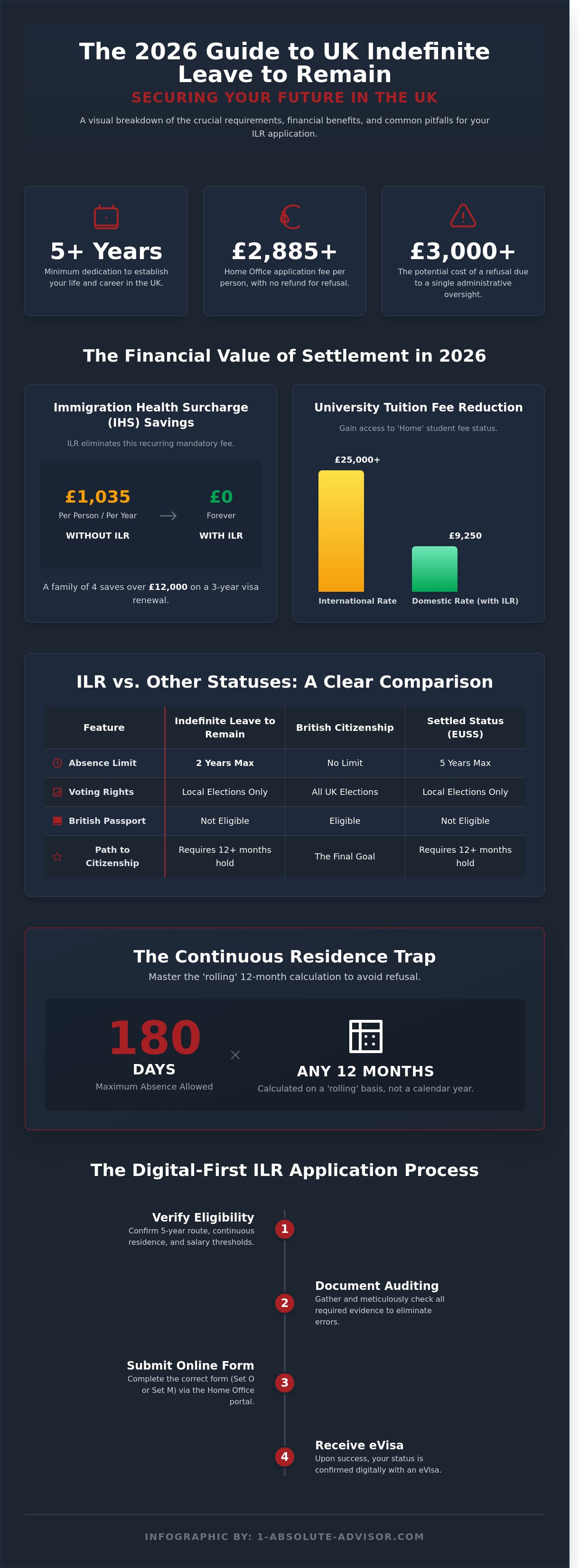
By 2026, the financial and administrative advantages of holding ILR will be more significant than ever. One of the most immediate benefits is the cessation of the Immigration Health Surcharge (IHS). As of 2024, the IHS sits at £1,035 per year for most adults. A family of four renewing a three-year visa faces a cost of over £12,000 just for healthcare access. Settlement removes this recurring burden entirely. Additionally, ILR holders gain access to public funds, providing a safety net that’s unavailable to those on standard work or study visas. Financial planning becomes easier when you’re eligible for domestic tuition rates at universities. International students often pay upwards of £25,000 annually, whereas domestic rates are currently capped at £9,250. This status also empowers you to sponsor family members, such as a spouse or children, for their own settlement path, ensuring family unity without the constant pressure of visa expiry dates.
ILR vs. British Citizenship: The Key Differences
Understanding the distinction between ilr uk and British citizenship is vital for long-term planning. While both allow you to stay in the UK permanently, citizenship offers rights that settlement does not. Key differences include:
- Voting Rights: ILR holders can vote in local elections, but only British, Irish, or qualifying Commonwealth citizens can vote in UK General Elections.
- Passport Eligibility: You cannot hold a British passport with ILR; you must continue using your national passport for international travel.
- Loss of Status: ILR can be revoked if you stay outside the UK for more than two continuous years. British citizenship is permanent and cannot be lost through absence.
- The Waiting Period: Most applicants must hold ILR for at least 12 months before they can apply for naturalisation, unless they’re married to a British citizen.
ILR vs. Settled Status (EUSS)
It’s common to confuse ILR with ‘Settled Status’ granted under the EU Settlement Scheme (EUSS). While both result in permanent residency, they operate under different legal frameworks. Settled Status was designed specifically for EU, EEA, and Swiss citizens who resided in the UK before 31 December 2020. ILR is the standard route for non-EU nationals or those on routes like the Skilled Worker or Family visa. A key difference lies in the absence rules. Settled Status holders can typically leave the UK for up to five years without losing their status, whereas standard ILR holders are limited to two years. Both paths lead to the same end goal: a secure life in the UK without the shadow of immigration control.
Qualifying Routes for ILR UK in 2026
The landscape for achieving Qualifying Routes for ILR UK in 2026 requires a strategic approach to timing and documentation. Most applicants follow the standard five-year path, particularly those holding Skilled Worker or Scale-up visas. For those on the Scale-up route, the flexibility of the unsponsored stage after two years doesn’t change the requirement for a continuous five-year period of residence. Achieving ilr uk status is the culmination of years of compliance, making it essential to track every day spent outside the country to stay within the 180-day annual limit.
Work-Based Settlement: Skilled Worker Requirements
Settlement under the Skilled Worker route depends heavily on meeting the 2026 salary thresholds. Following the 2024 increases, the general threshold remains at £38,700, though specific roles may require higher pay based on updated SOC code going rates. Your employer must provide a formal confirmation that you’re still required for your role for the foreseeable future. This process follows the strict Appendix Settlement rules, which demand a high level of precision in payroll reporting and Certificate of Sponsorship (CoS) management. It’s not just about having a job; it’s about proving that job’s ongoing necessity to the UK economy.
Family Life: Spouse and Partner Visa ILR
Spouses and partners typically qualify after 60 months of continuous residence on the 5-year route. You’ll need to demonstrate your relationship remains subsisting and meet the financial requirement, which saw significant adjustments in early 2024 to £29,000, with further planned increments. Meeting the B1 level English language requirement is mandatory, alongside the Life in the UK test. For those facing tragic circumstances like domestic abuse or the death of a partner, the Home Office provides specific pathways to settle immediately. These protections ensure that vulnerable individuals don’t lose their right to stay due to factors outside their control.
The ‘Good Character’ and Life in the UK Test
The Home Office scrutinises every detail of an applicant’s history under the ‘Good Character’ requirement. This includes criminal convictions, civil penalties, and even recurring driving offences like speeding or using a mobile phone while driving. Every applicant between 18 and 64 must pass the Life in the UK test unless they’ve a qualifying medical exemption. If you’re unsure about how a past penalty or a complex financial history might affect your ilr uk application, consulting with a strategic immigration partner can provide the necessary clarity. Medical exemptions for the English test require a specific form signed by a GMC-registered doctor, ensuring the process remains rigorous but fair.
The 10-year Long Residence route remains a vital fallback for those who’ve switched between various visa categories over a decade. Recent changes to ‘Private Life’ applications have streamlined how time spent as a child or young adult counts toward settlement, often reducing the wait for those who arrived before age 18. Conversely, high-value migrants under the Global Talent or Innovator Founder categories can reach settlement in just 3 years. This accelerated path requires meeting specific endorsement criteria, such as securing £50,000 in venture capital or achieving significant research contributions. These fast-track options are designed to retain the world’s most innovative minds by offering a quicker path to permanent stability.
The Continuous Residence Trap: Calculating Your Absences
The concept of continuous residence is the bedrock of any successful application for ilr uk. It isn’t just about living in the country; it’s about proving you haven’t abandoned your life here. The Home Office enforces a strict limit where you must not exceed 180 days outside the UK in any 12-month period. For applicants planning their submission in 2026, this calculation is rolling. This means the Home Office doesn’t just look at calendar years. They examine any consecutive 12-month block during your qualifying period. If you spent 181 days abroad between June 2024 and June 2025, your clock might have reset, even if your total for the calendar year 2024 was low.
Not every absence is treated equally, and certain compelling reasons allow for flexibility if they’re backed by rigorous documentation. Work-related travel is a common scenario for professionals. However, a simple assertion that you were away on business won’t suffice. You’ll need a formal letter from your employer on headed paper. This letter must list every single date you were out of the country and confirm these trips were necessary for your role. For family emergencies or medical issues, the standard of proof is even higher. You’ll need hospital records, death certificates, or letters from medical practitioners that clearly state why your presence abroad was unavoidable. Understanding the Qualifying Routes for ILR is essential because different visas have slightly different thresholds for what counts as a permitted absence.
Common Mistakes in Absence Calculations
Precision is your best ally when reviewing your travel history. A frequent error involves travel days. Under current Home Office guidance, the day you leave the UK and the day you arrive back don’t count as days of absence. Only full 24-hour periods spent outside the country are tallied. Another pitfall is failing to maintain a contemporaneous log. Waiting until 2026 to reconstruct your travel history from 2021 is a recipe for disaster, as a 2024 review of immigration appeals showed that 12% of rejections stemmed from inconsistent travel dates between application forms and passport stamps. You must gather evidence for work-related travel throughout the entire 5-year period to avoid gaps in your narrative. The burden of proof for any absence over 180 days lies entirely with the applicant.
The 10-Year Route and ‘Gap’ Nuances
The 10-year Long Residence route introduces additional complexities regarding broken residence. Unlike the 5-year path, a single absence of more than 180 days, or a total of 548 days across the decade, will break your continuity. Overstaying between visas is a critical risk factor. If your leave expired on 15 May 2024 and you didn’t apply for a new visa until 30 May 2024, that 15-day gap might reset your 10-year clock to zero unless you meet very specific exceptional circumstances criteria. It’s vital to understand how these timelines interact with your Calculating Your 5-Year Qualifying Period for ILR strategy. We often see applicants who assume minor gaps don’t matter, only to find their 10-year progress wiped out by a single administrative oversight. Consistency and proactivity are the only ways to ensure your path to ilr uk remains secure.
- Rolling calculation: Any 12-month period, not just calendar years.
- Travel days: Departure and arrival days are counted as days spent in the UK.
- Evidence: Employer letters must be specific to dates and business necessity.
- 10-year limit: Do not exceed 548 days in total across the full decade.
The 2026 ILR Application Process: Digital-First and eVisas
By 2026, the Home Office has fully transitioned to a “digital by default” model for all settlement applications. Your journey towards securing ilr uk status begins with the submission of the correct online form; typically Set (O) for skilled workers and various points-based routes, or Set (M) for family-based applications. You must complete this submission before your current leave expires to ensure your right to work and rent remains protected under section 3C of the Immigration Act 1971. Precision at this stage is vital. A single clerical error can lead to a refusal, jeopardising years of residency progress.
Once you’ve submitted the form, you’ll need to settle the application fee and the biometrics enrolment fee. The current 2026 standard fee for Indefinite Leave to Remain stands at £2,885 per applicant. Following payment, you’ll gain access to the UKVCAS (UK Visa and Citizenship Application Services) portal. This digital interface allows you to upload high-quality scans of your supporting evidence. Our advisors recommend categorising these documents strictly according to the Home Office’s preferred hierarchy to facilitate a smoother review by the caseworker. You’ll then either book a physical appointment at a service centre to provide your fingerprints and photograph or, if eligible, use the “UK Immigration: ID Check” smartphone app to verify your identity remotely.
The End of Physical BRPs
The landscape of UK immigration changed permanently following the 31 December 2024 expiry of physical Biometric Residence Permits (BRPs). By 2026, the physical card is a relic of the past. Your ilr uk status is now held entirely within the mandatory eVisa system. To access this, you must register for a UKVI account. This digital profile serves as the “source of truth” for your residency rights. It’s your responsibility to ensure this record stays updated; if you renew your passport, you must link the new document to your UKVI account immediately to avoid delays at the border. You can generate “share codes” through this portal to prove your permanent right to work to employers or your right to reside to landlords.
Application Fees and Priority Services
Timing your application involves a strategic choice between cost and speed. The standard processing time for settlement remains up to 6 months, which can be a significant period of uncertainty for professionals or business owners. If your circumstances require a faster resolution, the Super Priority service is available for an additional £1,000. This service guarantees a decision by the end of the next working day following your biometrics appointment or app submission. For many of our clients, this investment is justified by the immediate peace of mind and the ability to proceed with long-term financial commitments, such as mortgage applications, without the shadow of a pending visa status. Before committing to these fees, ensure your documentation is flawless by reviewing our Indefinite Leave to Remain: Document Checklist.
The decision-making process concludes with an email notification confirming your grant of settlement. There’s no longer a wait for a courier to deliver a plastic permit. Your digital status updates automatically, reflecting your new, unrestricted rights in the United Kingdom. This transition represents a significant shift towards a more efficient, secure immigration framework that rewards those who maintain meticulous records throughout their residency.
If you require a professional audit of your residency history to ensure total compliance before your submission, schedule a strategic consultation with our advisors.
Why an ‘Absolute’ Approach to Your ILR Matters
Applying for Indefinite Leave to Remain is more than a procedural hurdle; it’s a significant financial and personal investment. The current Home Office fee for an ilr uk application stands at £2,885 per person. When you factor in biometric appointments and professional translations, a DIY refusal becomes a £3,000 mistake that most families cannot afford to repeat. Beyond the lost capital, a rejection triggers a 14-day countdown to leave the country or lodge a complex appeal, placing your career and home at immediate risk.
At 1 Absolute Advisor, we identify hidden eligibility issues that often escape the untrained eye. Home Office caseworkers look for reasons to refuse, not reasons to approve. We’ve seen applications falter because of a 48-hour gap between visas five years ago or a missing P60 from a previous employer. Our team conducts a forensic audit of your history to ensure every “Continuous Residence” requirement is met before the “Submit” button is ever clicked. We don’t just hope for success; we engineer it through absolute precision.
A professional legal cover letter serves as the backbone of a successful ilr uk submission. It isn’t a simple list of contents. It’s a structured legal argument that references specific Immigration Rules and explains how your evidence meets every statutory requirement. This is vital for complex cases involving high absence levels or non-standard income. As an OISC-registered firm in London, our seal of approval signals to the Home Office that your application has been prepared to the highest professional standards, often leading to smoother processing.
Our Fixed-Fee ILR Management Service
Our comprehensive management service handles the entire lifecycle of your application. We take the burden of document gathering off your shoulders, liaising with employers and banks to secure the exact wording required by the Home Office. You’ll have direct access to OISC-registered advisors who provide strategic planning for your future citizenship. Every day of your five-year residency is audited to ensure you haven’t breached the 180-day absence limit, giving you total certainty.
The Document Checking Alternative
If you’ve already prepared your paperwork but feel the weight of the £2,885 risk, our Document Checking service provides a professional safety net. We’ve found that 15% of self-prepared applications contain errors in financial evidence, such as bank statements that are 32 days old rather than the required 28. We scrutinise your employer letters and salary slips to ensure they align perfectly with the latest Appendix FM or Skilled Worker rules. It’s a cost-effective way to gain professional reassurance before you commit to the Home Office fees.
Secure your UK settlement with a professional ILR consultation and ensure your path to residency is handled with the absolute care it deserves.
Take Control of Your British Settlement Strategy
Securing ilr uk status in 2026 requires more than just meeting the five-year residency mark. You must navigate the Home Office’s mandatory digital-first transition, where physical Biometric Residence Permits have been replaced by eVisas. Precision is vital when calculating the 180-day rolling absence limit, as even a minor oversight in travel dates can reset your qualifying period. Since the 2024 digital overhaul, the application landscape has shifted toward a stricter, evidence-heavy model that demands a proactive and absolute approach to compliance.
At 1 Absolute Advisor, our OISC-registered consultants provide the professional integrity needed to manage complex immigration histories. Based in London with full national coverage, we offer fixed-fee transparency so you don’t face hidden costs during your journey to permanency. We don’t just process paperwork; we act as strategic partners to ensure your application meets every statutory requirement the first time. It’s time to replace uncertainty with professional certainty. Book an ILR Eligibility Assessment with 1 Absolute Advisor today to lock in your future. Your path to British citizenship starts with a single, well-planned step.
Frequently Asked Questions
How much does ILR cost in 2026?
As of early 2026, the standard application fee for Indefinite Leave to Remain is £3,174 per person. This figure reflects the 10% increase implemented by the Home Office to cover rising administrative and processing overheads. You must also budget for the £19.20 biometric enrolment fee and optional priority services, which cost an additional £500 for a five-day decision or £1,000 for next-day super-priority processing.
Can I apply for ILR if I have a criminal record?
You can apply for ILR with a criminal record, but your application will be refused if you’ve received a custodial sentence of 12 months or more. For non-custodial sentences or out-of-court disposals, the Home Office applies a 24-month clear period rule from the date of the conviction. If your offence occurred within the last two years, your application for ilr uk status will likely be rejected under the general grounds for refusal.
What happens if my ILR application is refused?
If the Home Office refuses your application, you’ll receive a decision letter outlining whether you have the right to an Administrative Review. You must lodge this challenge within 14 days if you’re applying from inside the UK. Statistics from the 2024 period show that roughly 12% of initial refusals are overturned during this stage. If no review right exists, a Judicial Review remains the final legal avenue to contest the decision.
How long can I stay outside the UK once I have ILR?
You can remain outside the UK for up to two continuous years without losing your permanent residency status. If you stay abroad for 731 days or longer, your ILR automatically lapses under Immigration Rule 20. To return after such an absence, you’d need to apply for a Returning Resident visa, which requires proving strong ties to the UK and demonstrating that your primary home remains here.
Do I need to take the Life in the UK test again for citizenship?
You don’t need to retake the Life in the UK test for a British citizenship application if you’ve already passed it for your ILR submission. The test certificate has no expiry date under current Home Office guidance. This single £50 assessment serves both the settlement and naturalisation stages, provided you kept the original reference number or pass notification from your initial 45-minute examination at an approved centre.
Can I work while my ILR application is being processed?
You can continue working under your existing visa conditions while your ilr uk application is pending, provided you applied before your previous leave expired. This protection is granted under Section 3C of the Immigration Act 1971. Your employer can verify your ongoing right to work using the Home Office Employer Checking Service, which provides a Positive Verification Notice valid for six months while the decision is finalised.
What is the difference between ILR and Set(O) vs Set(M) forms?
The primary difference lies in your current visa category; use form Set(M) if you’re applying as the partner of a British citizen or settled person. Form Set(O) covers almost all other routes, including Skilled Worker, Tier 1, and UK Ancestry visas. Choosing the wrong form can lead to immediate rejection, so it’s vital to select the version that corresponds to your specific five-year or ten-year qualifying residency path.
How do eVisas work for ILR holders in 2026?
By 2026, all ILR holders must use a digital eVisa as the Home Office phased out physical Biometric Residence Permits on 31 December 2024. Your status is now linked directly to your passport via your UKVI account. You must update your digital profile if you renew your passport to ensure your permanent residency remains verifiable at border control and by employers through the online view and prove service.