

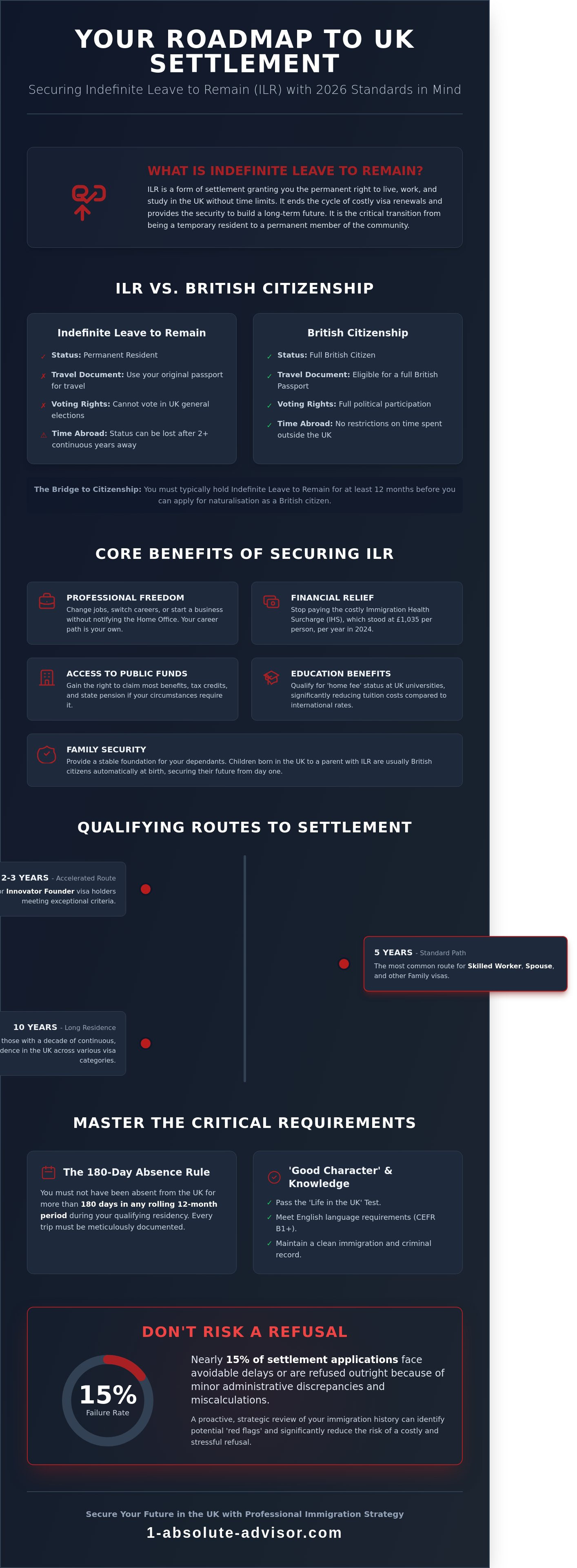
Nearly 15% of settlement applications face avoidable delays or refusals because of minor administrative discrepancies, even when the applicant meets the core criteria. You’ve likely spent years meticulously building your career and home in the UK, so it’s natural to feel anxious as your current visa expiry approaches. The complexity of the 180-day absence rule often creates unnecessary confusion for even the most diligent professionals who fear a single oversight might jeopardise their status.
This guide provides the exact requirements and strategic steps you need to secure indefinite leave to remain with absolute confidence. You’ll gain a clear roadmap that aligns with the 2026 standards, ensuring your evidence is beyond reproach and your application is robust. We’ll explore the various qualifying routes, clarify the precise calculation of residency periods, and outline the necessary steps to facilitate a successful transition to British Citizenship, giving you the long-term stability your future deserves. By following this structured approach, you can replace uncertainty with a professional strategy for permanent settlement.
Key Takeaways
- Understand the critical legal distinctions between settlement and citizenship to ensure your long-term status aligns with your personal and professional objectives.
- Identify whether you qualify for the standard five-year residency path or if your visa category allows for an accelerated two- or three-year route to settlement.
- Master the strict 180-day absence rule and ‘Good Character’ requirements to ensure your eligibility for indefinite leave to remain remains untarnished.
- Prepare for the 2026 application process by understanding the latest Home Office fee structures and the comprehensive documentation required for a successful submission.
- Discover how a proactive, strategic review of your immigration history can identify potential ‘red flags’ and significantly reduce the risk of a costly refusal.
What is Indefinite Leave to Remain (ILR) and Why Does it Matter?
Securing your future in the United Kingdom often culminates in a single, transformative status. Indefinite Leave to Remain (ILR) is a form of settlement that grants non-UK nationals the right to live, work, and study here without any time restrictions. It represents a shift from being a temporary resident to a permanent member of the community. For many, it’s the final hurdle before seeking full British nationality. The year 2026 stands out as a pivotal moment for thousands of applicants. This surge stems from the significant visa rule changes implemented in early 2021 following the UK’s departure from the European Union. Those who entered on five-year routes during that period will reach their eligibility threshold in 2026, making current preparation essential.
Settlement isn’t just a change in paperwork; it’s a strategic move that provides absolute security against future shifts in immigration policy. While a Skilled Worker visa or a Family visa requires periodic renewals and high fees, ILR offers a definitive end to the cycle of applications. It provides the peace of mind necessary for long-term financial planning, such as securing a mortgage or investing in a business. By obtaining ILR, you move from a position of “permitted stay” to “right of abode” in all but name, ensuring your place in the UK’s social and economic fabric is protected by law.
The Core Benefits of Settling in the UK
Indefinite Leave to Remain is the permanent removal of time limits on a person’s stay in the UK. Once you hold this status, you’re no longer tied to a specific employer or a restrictive sponsorship licence. This provides absolute professional mobility; you can switch careers or start a business without notifying the Home Office. Financial pressure also eases significantly. You’ll stop paying the Immigration Health Surcharge (IHS), which rose to £1,035 per year for most adults on 6 February 2024. Additionally, ILR provides a stable foundation for dependants. Children born in the UK to a parent with ILR usually acquire British citizenship automatically at birth under the British Nationality Act 1981. Other key benefits include:
- Access to Public Funds: You gain the right to claim most benefits and state pension credits if needed.
- Education: You may qualify for “home fee” status at universities, significantly reducing tuition costs compared to international rates.
- Healthcare: Full, free access to the NHS continues without the annual surcharge burden.
ILR vs. British Citizenship: Choosing Your Path
While ILR offers permanent residency, it’s distinct from British citizenship. It serves as the mandatory bridge for most people, as you typically need to hold ILR for 12 months before applying for naturalisation. However, some individuals choose to remain on ILR indefinitely to avoid losing their original nationality, especially if their home country doesn’t permit dual citizenship. You don’t get a British passport with ILR, and you can’t vote in UK general elections. Stability is also conditional. If you remain outside the UK for a continuous period of more than two years, your indefinite leave to remain will automatically lapse. Citizenship, by contrast, is much harder for the government to revoke and offers total protection against future changes in immigration policy. Choosing between the two depends on your long-term global mobility needs and your desire for full political participation in the UK.
Qualifying Routes: How Long Must You Live in the UK for ILR?
Securing indefinite leave to remain requires a meticulous understanding of the specific qualifying period attached to your current visa. It’s not merely about time spent in the country; it’s about the quality and continuity of that residence. Most professionals and family members will find themselves on a 5-year path. However, high-value migrants in the Global Talent or Innovator Founder categories can often reach settlement in 3 years if they meet specific economic or professional benchmarks. To ensure your timeline is accurate, you should check your eligibility for ILR via official channels before preparing your documents.
The 10-year Long Residence route remains a vital safety net for those who’ve held various leave types over a decade. Significant changes introduced in April 2024 now require that the 10-year period must be continuous and the most recent grant of leave must be on a route that leads to settlement. This prevents applicants from using a patchwork of temporary visas to jump straight into settlement without ever being on a long-term path. It’s also possible to combine time spent on different visas, such as moving from a Student visa to a Skilled Worker visa, provided there are no gaps in your lawful residence that exceed the Home Office limits of 180 days in any 12-month period.
The Skilled Worker and Tier 2 Settlement Path
For those on the Skilled Worker route, the landscape changed significantly in April 2024. By 2026, the standard salary threshold for settlement is expected to remain at the £38,700 level or the specific going rate for your occupation, whichever is higher. You’ll need a valid Certificate of Sponsorship (CoS) at the time of your application. Crucially, your employer must provide a formal letter confirming they still require you for the job for the foreseeable future and that your salary meets the 2026 requirements. For a tailored assessment of your timeline, our team can provide a comprehensive eligibility audit.
Family and Partner Routes to Settlement
The path for partners is split between the 5-year and 10-year routes. The 5-year route is reserved for those who meet all financial and English language requirements from the outset. As of 2026, the financial threshold for partners stands at £29,000, a figure that rose from £18,600 in early 2024. You must prove your relationship is ‘subsisting’ after half a decade together. This involves providing shared financial responsibilities, such as joint tenancies or utility bills, dated across the entire five-year period to demonstrate a genuine, ongoing life together in the UK.
Strategic planning is essential when calculating your qualifying period. If you’ve spent significant time outside the UK for work or personal reasons, you must document every absence. The Home Office defines continuous residence strictly; exceeding the 180-day limit in any rolling 12-month period can reset your clock to zero. Maintaining a precise log of travel dates and keeping old passports is not just helpful; it’s a requirement for a successful indefinite leave to remain application. Every day counts when you’re building a future in the United Kingdom.
The ‘Hidden’ Criteria: Absences, Good Character, and Life in the UK
Securing indefinite leave to remain requires more than just proving you’ve lived in Britain for five years. The Home Office conducts a qualitative assessment of your residency, focusing on your conduct and your integration into British society. While the Official government guidance on ILR outlines the basic pathway, the “hidden” criteria often cause the most significant delays or refusals for unprepared applicants.
The 180-day rule is the primary hurdle for frequent travellers. You can’t spend more than 180 days outside the UK in any rolling 12-month period during your qualifying years. This isn’t calculated by calendar year; it’s a moving window. If you’ve spent 181 days abroad between June 2024 and June 2025, your continuity is broken. You’ll need to reset your clock unless you qualify for specific exemptions like overseas work for a UK employer or serious family emergencies.
Calculating Continuous Residence and Absences
Documenting travel history is increasingly complex because of the prevalence of e-gates, which often leave passports without physical entry stamps. You must maintain a personal log of every departure and arrival date. If records are missing, cross-reference your history using flight confirmation emails, boarding passes, or bank statements that show your first UK transaction upon return. The 2026 digital application portal demands precise dates for every trip; even a 48-hour discrepancy can trigger a secondary audit of your file.
Exceptional circumstances do exist for those who exceed the 180-day limit. The Home Office may waive the restriction for reasons such as natural disasters, life-threatening illnesses, or professional requirements for certain Tier 1 or Global Talent visa holders. However, these claims require robust evidence, such as medical consultant letters or official employer certifications, to satisfy the caseworker’s discretion.
The Good Character Assessment: Beyond Criminality
The Good Character requirement is often misunderstood as a simple lack of a criminal record. In reality, it’s a deep dive into your financial and civil history. HMRC tax discrepancies are a leading cause of indefinite leave to remain refusals. If the income figures you reported to the Home Office for your previous visa extension don’t align with your Self Assessment filings from 2023 or 2024, caseworkers may accuse you of “litigation” or dishonesty under Paragraph 322(5) of the Immigration Rules.
Civil penalties and debts also carry significant weight. Unpaid NHS debts of £500 or more, outstanding County Court Judgments (CCJs), or a history of driving offences like speeding can suggest a disregard for UK law. Good Character involves an assessment of an applicant’s entire conduct, including financial integrity. Even a single civil penalty for employing an illegal worker in a small business can be grounds for a mandatory refusal, regardless of how long you’ve lived in the country.
Finally, you must demonstrate your integration through the Life in the UK Test and the English Language requirement. The 2026 curriculum for the Life in the UK Test places a heavier emphasis on modern British history and the digital economy. You must achieve a score of at least 75% across 24 questions. Simultaneously, you’ll need a Home Office-approved English qualification at Level B1 or higher. Ensure your test centre is on the Secure English Language Test (SELT) list, as certificates from non-approved providers are rejected instantly.
The ILR Application Process: Costs, Documents, and Timelines in 2026
Securing indefinite leave to remain in 2026 requires navigating an entirely digital ecosystem. The Home Office has fully transitioned to the eVisa system, meaning physical Biometric Residence Permits (BRPs) are now obsolete. Your status is linked directly to your passport via the UKVI portal. The application begins with an online form where you’ll provide a comprehensive history of your travel, employment, and addresses over the last five years. Precision is vital; even minor discrepancies between your application and your digital travel records can trigger lengthy enquiries.
With the entire process moving online, ensuring your personal technology is secure and reliable is more important than ever. For professionals and families navigating these digital requirements, having trusted IT support from a team like Digit-IT can provide essential peace of mind.
Financial planning is a prerequisite for a successful submission. As of January 2026, the standard application fee stands at £3,250 per person. This cost applies to both the main applicant and each dependant, meaning a family of four should budget at least £13,000 for the Home Office fees alone. These figures don’t include the cost of the Life in the UK test or English language certifications, which remain mandatory components of the process.
Standard vs. Super Priority Service
The choice between service tiers often dictates your strategic planning for the year. The Standard Service carries a processing window of up to six months, which can be restrictive if you have urgent international business travel or mortgage applications pending. In contrast, the Super Priority Service provides a decision within 24 hours of your biometric appointment for an additional fee of £1,000. In 2026, these slots remain highly competitive. We’ve observed that priority appointments often sell out within minutes of being released at midnight, so early booking is essential to avoid delays.
Essential Evidence and Documentation
The digital-first system demands high-quality scans of all supporting evidence. You must provide a continuous trail of residency covering your five-year qualifying period. Council tax bills and utility statements are the gold standard here, but employer letters confirming your absences from the UK are equally critical. If you’ve spent more than 180 days outside the UK in any 12-month period, you’ll need robust evidence of exceptional circumstances to avoid a mandatory refusal.
Financial evidence must be contemporary and flawless. You’ll typically need to provide:
- Six months of personal bank statements showing salary credits.
- Matching payslips that align perfectly with the net amounts shown in your statements.
- A formal P60 or an employer letter confirming your current salary and continued employment.
- Evidence of your English language proficiency at level B1 or higher.
The Home Office’s “Document Checking Service” is available at most biometric centres for an extra fee, but this only ensures your files are legible. It doesn’t verify if your evidence meets the strict legal requirements. For high-net-worth individuals or those with complex income structures, a professional audit is the only way to ensure 100% compliance before the “Submit” button is pressed. Small errors in 2026 are rarely met with requests for more information; they usually result in immediate rejection without a refund of the application fee.
Ensure your application is audit-ready by booking a comprehensive document review with our senior advisors today.
Your biometric appointment is the final physical step. While the eVisa is digital, you must still attend a UKVCAS centre to provide fingerprints and a facial scan. This data is synchronised with your digital profile, completing your transition to permanent residency. Once approved, you’ll receive a digital notification, and your status will be instantly verifiable by employers and landlords through the government’s online “view and prove” service.
Securing Your Future: Why Professional Immigration Advice Minimises Risk
An application for indefinite leave to remain represents the culmination of years of hard work, financial investment, and personal sacrifice. It’s the final bridge to permanent security in the United Kingdom. Treating this process as a mere administrative hurdle is a mistake that leads to costly consequences. The Home Office fee for a standard ILR application currently stands at £2,885 per person. A refusal doesn’t just result in the loss of this significant sum; it puts your right to work and your family’s stability at immediate risk. Professional advice ensures that your case is presented with the precision required to meet strict statutory requirements.
OISC-registered advisors act as a critical line of defence by identifying “red flags” before your file reaches a caseworker. These professionals understand the nuances of the Immigration Rules, which often change with little notice. They scrutinise your history for inconsistencies in tax filings, employment gaps, or previous visa breaches. By conducting a thorough audit of your documentation, they ensure your narrative aligns perfectly with the evidence provided. This proactive approach transforms a high-stakes gamble into a managed, predictable process.
Common Pitfalls That Lead to ILR Refusal
Many applicants fail because they provide standard documents that don’t meet specific Home Office formats. For instance, using simple internet bank statements instead of those that are officially stamped or accompanied by a letter can lead to an instant rejection. Another frequent error involves non-disclosure. You must declare all legal issues, including “spent” convictions or minor traffic offences. Failing to do so is often flagged as “deception,” which carries a mandatory 10-year ban on future applications. Finally, the 5-year qualifying period is calculated to the day. Miscalculating your entry date or the “continuous residence” requirement by even 24 hours results in a refusal without a refund.
How 1 Absolute Advisor Can Help
Our team provides a holistic, end-to-end management service designed to eliminate the stress of settlement. We operate on a fixed-fee basis, ensuring you have complete clarity on costs from the outset. We specialise in strategic solutions for complex cases, such as individuals with excessive absences exceeding the 180-day limit in any 12-month period. We don’t just compile papers; we build a robust legal argument to justify your absences based on professional or compassionate grounds. If you want to ensure your application is handled with absolute integrity, book a consultation for your ILR application with our London experts today.
Securing indefinite leave to remain is the definitive step toward your future as a British citizen. Once you’ve held ILR status for 12 months, you generally become eligible to apply for naturalisation. This transition allows you to hold a British passport and gain full voting rights. Our advisors stay with you through this entire journey, moving from the complexities of settlement to the finality of citizenship. We ensure your records are maintained perfectly, making the final application for a British passport a seamless conclusion to your immigration journey. Reliability and precision aren’t just goals; they’re the standards we apply to every client we represent.
Take the Final Step Toward Your Permanent UK Residency
Achieving indefinite leave to remain is the definitive milestone in your UK immigration journey, but the 2026 landscape demands absolute precision. Success rests on your ability to document continuous residence, usually over a five-year period, while strictly adhering to the 180-day absence limit. You’ve also got to navigate the Home Office’s rigorous good character assessments and the Life in the UK test requirements. With standard application fees currently set at £2,885, even a minor oversight in your evidence portfolio can lead to costly delays or a stressful refusal.
Our London-based consultancy specialises in managing complex settlement cases through a holistic and strategic lens. As OISC-registered advisors, we provide fixed-fee legal services that ensure your application meets every statutory requirement from the outset. We act as your professional mentor, identifying potential risks in your history and resolving them before they reach a caseworker’s desk. It’s about more than just a visa; it’s about securing your long-term stability with a partner who understands the gravity of your investment.
Secure your UK settlement with our expert ILR application service and move forward with the peace of mind that comes from expert representation. Your future in Britain is within reach.
Frequently Asked Questions
Can I apply for Indefinite Leave to Remain before my 5 years are up?
You can submit your application up to 28 days before you complete your 5-year qualifying residency period. It’s a critical error to apply earlier than this specific window, as the Home Office will likely refuse the application and retain your £2,885 processing fee. You’ve got to calculate your eligibility date precisely from the day your initial visa was granted or your date of entry into the UK.
What happens to my ILR if I stay outside the UK for too long?
Your settled status will automatically lapse if you remain outside the UK for more than two consecutive years. This “two-year rule” is strictly enforced, though individuals with status under the EU Settlement Scheme generally enjoy a longer five-year absence limit. If your status expires due to absence, you’ll need to apply for a Returning Resident visa, which requires proving strong, ongoing ties to the British Isles.
Do I need to take the Life in the UK test if I am over 65?
You’re exempt from both the Life in the UK test and the English language requirement if you’re aged 65 or over on the date of your application. This exemption also applies to children under 18 and individuals with long-term physical or mental health conditions. You’ll need to provide a valid passport or birth certificate to satisfy the caseworker of your age during the 2026 application cycle.
How much does the ILR application cost in 2026?
The standard fee for an indefinite leave to remain application currently stands at £2,885 per applicant. If you require a decision within 24 hours, the super priority service adds an extra £1,000 to your total costs. Don’t forget to budget for the £19.20 biometric enrolment fee and any professional fees for document translation or strategic legal advice to ensure your submission is flawless.
Can my dependants apply for ILR at the same time as me?
Your partner and children can apply for settlement alongside you, provided they’ve also completed their own 5-year residency requirement as dependants. If you’ve a child born in the UK, they might be eligible for immediate British citizenship once you’ve been granted your status. Each family member must submit an individual application form and pay the full £2,885 fee to be processed by the Home Office.
What is the 180-day rule for ILR, and how is it calculated?
You must not have spent more than 180 days outside the UK in any 12-month period during your qualifying residency. This calculation is performed on a rolling basis, so any 365-day block is subject to scrutiny. Accurate travel logs are essential for your indefinite leave to remain evidence pack, as missing even a single day of travel history can lead to a refusal based on excessive absences.
What happens if my ILR application is refused by the Home Office?
You’ll receive a formal decision letter that explains whether you’ve been granted the right to an administrative review or a full legal appeal. Recent 2024 data shows a refusal rate of roughly 4% for settlement applications, often due to missing documentation or simple procedural errors. If no appeal rights are provided, a judicial review might be your only remaining path to challenge the legality of the decision.
Will I get a physical BRP card when my ILR is granted in 2026?
You won’t receive a physical Biometric Residence Permit because the UK transitioned to a completely digital e-visa system on 1 January 2025. Your status is now linked to your UKVI account, which you’ll use to generate “share codes” for employers, landlords, or banks. This digital system is designed to reduce document fraud and ensures your right to remain is always accessible through the official government portal.