

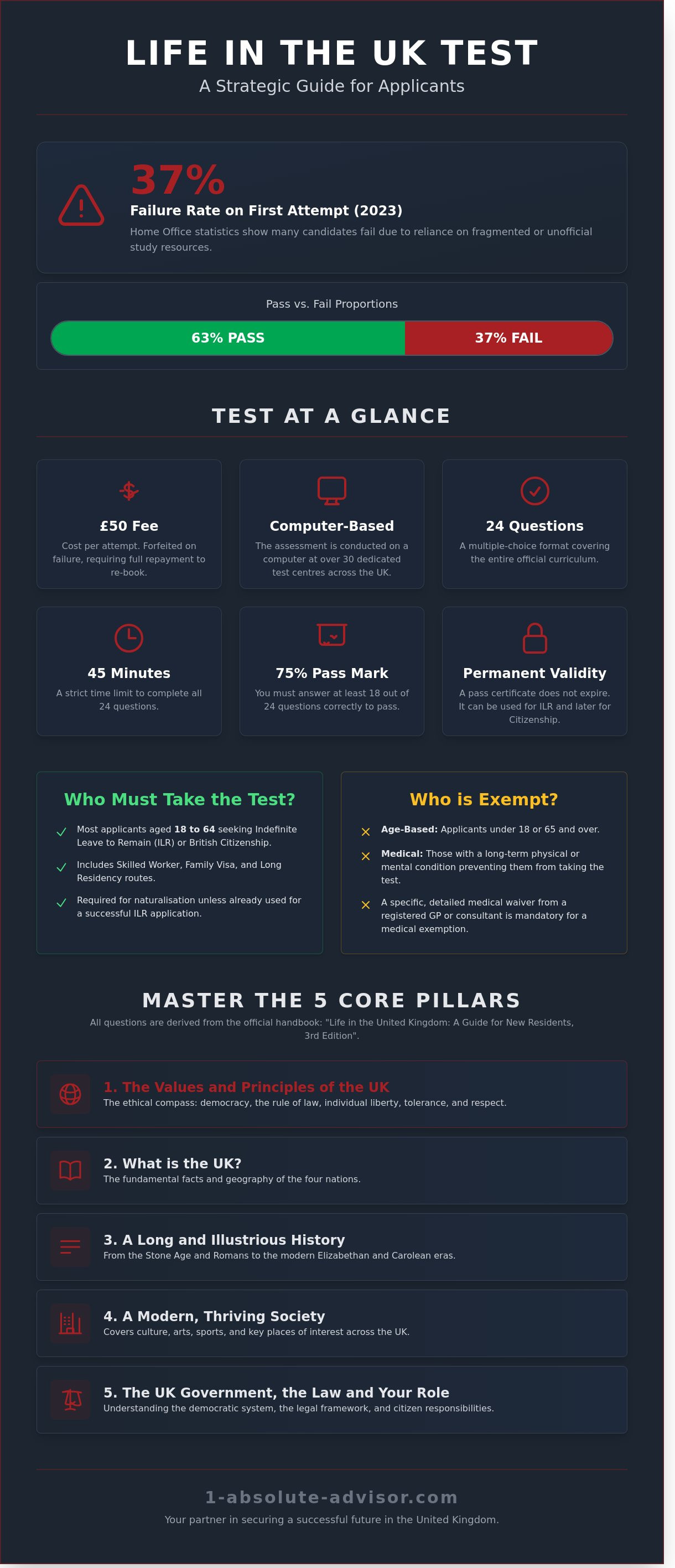
In 2023, official Home Office statistics indicated that approximately 37% of candidates failed their initial attempt at the life in the uk test, frequently because they relied on fragmented or unofficial study resources. It’s completely natural to feel intimidated by a curriculum covering 3,000 years of British history, especially when a single lapse in concentration means forfeiting your £50 exam fee and delaying your residency goals. You deserve a clear, professional strategy that removes the guesswork from this critical administrative hurdle.
This guide ensures you’ll master the 2026 curriculum and understand the precise booking requirements needed to avoid common pitfalls. We’ll show you how to effectively integrate your pass certificate into a successful Indefinite Leave to Remain (ILR) or British Citizenship application. Our holistic approach covers specific legal exemptions, provides a breakdown of reliable study materials, and outlines a step-by-step strategic plan to help you secure your future in the United Kingdom with absolute confidence.
Key Takeaways
- Gain a clear understanding of the life in the UK test structure, including the 75% pass threshold and the specific eligibility criteria for settlement and citizenship applications.
- Discover a strategic study programme based on the 3rd Edition of the Official Home Office Handbook, focusing on the five core syllabus areas to ensure comprehensive preparation.
- Navigate the practical logistics of the assessment, from booking through the official PSI Services portal for £50 to adhering to essential on-the-day examination rules.
- Learn how to integrate your pass certificate into a holistic ILR or British Citizenship application, ensuring all “Good Character” and legal requirements are met for a successful outcome.
- Access professional insights on the ethical foundations of the curriculum, specifically the “Values and Principles of the UK,” which form the cornerstone of the modern assessment.
Defining the Life in the UK Test: Purpose, Eligibility, and Exemptions
The Life in the United Kingdom test functions as a mandatory compliance benchmark for individuals seeking Indefinite Leave to Remain (ILR) or British citizenship. It’s a 45-minute computer-based assessment consisting of 24 multiple-choice questions. To secure a successful result, you must achieve a pass mark of 75%, which requires answering at least 18 questions correctly. This examination isn’t a mere formality; it’s designed to ensure that prospective citizens possess a sufficient understanding of British history, culture, and the democratic principles that underpin the nation’s legal system.
Home Office examiners derive all test content from the third edition of the official handbook, “Life in the United Kingdom: A Guide for New Residents”. Since the introduction of this requirement for naturalisation in November 2005, the curriculum has undergone several revisions to reflect modern British values. A critical advantage for applicants is the permanent validity of the pass certificate. Once you’ve successfully completed the life in the uk test, the result doesn’t expire. This means you won’t need to retake the exam when progressing from settlement to full British naturalisation, provided your personal details remain consistent across applications.
A strategic approach to this requirement involves booking the test well in advance of your planned application date. The current fee for the assessment is £50 per attempt. Tests are conducted at over 30 dedicated centres across the country, and you’ll need to present valid photographic identification upon arrival. Managing your preparation with the official materials is the only reliable way to ensure you meet the high accuracy threshold required by the Home Office.
Who is Required to Sit the Exam?
Most applicants aged between 18 and 65 must sit the exam as part of their settlement journey. This includes those applying for ILR under skilled worker routes, family visas, or long residency categories. If you’re applying for British Naturalisation, you must provide evidence of a pass unless you’ve already used a valid certificate for a previous successful settlement application. Strategic planning is essential here; always verify your specific visa route’s requirements at least six months before your eligibility date to avoid administrative delays.
Official Exemptions and Special Circumstances
Statutory exemptions apply to specific groups based on age or health status. You aren’t required to take the test if you’re under 18 years of age or if you’re 65 or older on the date your application is submitted. These age-based exemptions are applied automatically by the Home Office once your date of birth is verified through your passport or biometric residence permit. Residents in specific jurisdictions, such as the Isle of Man, follow localised testing protocols that align with their unique constitutional relationship with the United Kingdom.
Professional medical exemptions are available for applicants with long-term physical or mental health conditions that make sitting the exam impossible. This doesn’t simply cover a lack of English proficiency; it requires a specific medical waiver form signed by a registered GP or consultant. The clinician must provide detailed evidence of how the condition limits your ability to study for or attend the test centre. We’ve seen that the Home Office scrutinises these waivers closely, so ensuring your medical documentation is precise and current is vital for a successful exemption claim.
Mastering the 2026 Curriculum: What You Must Master
Success in the life in the uk test requires a methodical approach to five distinct pillars: Values and Principles, History, Government, Law, and Culture. You’ll find that the “Values and Principles of the UK” chapter acts as the ethical compass for the entire examination. It outlines fundamental expectations like democracy, the rule of law, individual liberty, and the support of others. Understanding these isn’t optional; they represent the shared agreement that holds the four nations together. Candidates must demonstrate they grasp these concepts before moving into the more granular historical or legal data.
The historical timeline you need to memorise is vast. It stretches from the Stone Age and the Roman occupation to the modern Elizabethan and Carolean eras. You’ll need to identify how Britain transitioned from a collection of tribes to a global power and then to a modern parliamentary democracy. The curriculum places significant weight on the 2022 transition of the monarchy, marking the end of the second Elizabethan age and the beginning of King Charles III’s reign. This continuity is a frequent theme in test questions.
The structure of the UK Government remains a high-weight topic. You need to distinguish between the roles of the Monarchy, Parliament, and the Judiciary. While the King is the Head of State, his role is constitutional and neutral. Power resides in Parliament, which consists of the House of Commons and the House of Lords. The Judiciary remains independent to ensure the law is applied fairly to everyone, including the government itself. If you’re ready to schedule your assessment, you should Book your Life in the UK Test through the official portal to ensure you have the most current slot and location information.
Key Historical Milestones and Figures
British history is a long arc of constitutional evolution. You’ll study the 1215 Magna Carta, which first limited the King’s power, and the 1689 Bill of Rights, which established parliamentary sovereignty. The 19th-century Reform Acts, specifically those in 1832 and 1867, are vital as they expanded the right to vote to wider sections of society. Knowledge of figures like William the Conqueror, who changed the English landscape in 1066, and Winston Churchill, who led the nation through the 1939 to 1945 conflict, is mandatory. You must also understand the significance of the 15th-century Wars of the Roses and the 17th-century Civil War in shaping the modern state.
Modern British Culture and Society
The 2026 curriculum emphasises the UK’s diverse identity across England, Scotland, Wales, and Northern Ireland. You’ll need to know public holidays like St George’s Day (23 April) or St Andrew’s Day (30 November). The Church of England’s role as the established church remains a key fact, though the UK protects all religious freedoms. Sporting history, from the 1966 World Cup win to the 2012 London Olympics, often appears in questions. Scientific contributions by figures like Isaac Newton or Stephen Hawking highlight the UK’s global intellectual impact. This cultural knowledge ensures you understand the daily life and traditions of the community you’re joining.
Preparing for these complexities often mirrors the precision needed in strategic business planning, where every detail impacts the final outcome. Approaching your life in the uk test with this level of rigour will ensure you aren’t just memorising facts, but understanding the logic of British society.
A Strategic Study Programme: How to Organise Your Preparation
Success on the life in the uk test isn’t a matter of luck. It’s the result of a disciplined, four week strategy designed to master a vast amount of historical and civic data. You’ll face 24 multiple choice questions in 45 minutes. To achieve the 75% pass mark, you must answer 18 questions correctly. This requires a methodical approach that prioritises long term retention over last minute cramming.
Your first step is to obtain the 3rd Edition of the Official Home Office Handbook. This is the only source material used for the exam questions. During the first three days, read the entire book cover to cover without taking notes. Treat it like a narrative. Understanding the flow of British history, from the Roman occupation to the Elizabethan era, provides the necessary context for the specific facts you’ll memorise later.
Once you’ve established this foundation, break the chapters into 30 minute study blocks. Research indicates that cognitive focus wanes after 40 minutes; short, intense sessions are more effective for absorbing complex legal and political structures. Spread these sessions over a 28 day period to ensure you’ve dedicated at least 14 hours of focused study before your test date. You can find the Official Life in the UK Test Information regarding the £50 booking fee and current identification requirements on the government’s portal.
During the final two weeks, transition to reputable practice tests. These aren’t just for checking your score. Use them to identify specific weak spots, such as the nuances of the UK’s 20th century history or the details of the UK constitution. Focus heavily on “firsts” and specific dates. For example, ensure you know that Sir Robert Walpole was the first Prime Minister, serving from 1721 to 1742, and that the Magna Carta was signed in 1215. These specific data points are frequently tested and easy to confuse under pressure.
Effective Memory Techniques for Dates and Names
Flashcards remain the most effective tool for memorising the hundreds of names and dates within the handbook. Create a physical or digital deck for the most frequently asked historical milestones, such as the 1928 act that gave women equal voting rights. Use mnemonics to remember sequences like the Royal Houses. A popular one is “Never Play Loud York Tunes Since Harry Won” to recall the order: Norman, Plantagenet, Lancaster, York, Tudor, Stuart, Hanover, and Windsor. Finally, employ the active recall method. Test yourself on a chapter before you feel fully prepared; this forces your brain to work harder to retrieve information, which strengthens memory pathways.
Common Pitfalls and Trick Questions
Many candidates struggle to distinguish between the powers of the House of Commons and the House of Lords. It’s vital to remember that the 650 MPs in the Commons are elected, while the Lords are appointed. Another common area of confusion is the difference between civil and criminal law. Civil law handles disputes between individuals or organisations, such as debt or personal injury; criminal law addresses offences that are prosecuted by the state. When sitting the exam, be wary of options containing “always” or “never”. The life in the uk test often uses these absolute qualifiers to create tempting but incorrect answers, as British law and history are frequently defined by exceptions and gradual shifts rather than rigid rules.
Practical Logistics: Booking Your Test, Costs, and On-the-Day Rules
Securing a slot for the life in the uk test requires a methodical approach to the official booking system. You must register through the PSI Services portal, which is the only authorised provider for these examinations. The Home Office mandates that you book your session at least 3 days in advance; however, popular centres in metropolitan areas often see their schedules fill up 14 to 21 days ahead. Spontaneous walk-ins don’t exist in this regulatory framework. As of January 2026, the test fee remains £50 per attempt. We’ve seen numerous third-party websites attempting to charge “administration fees” that inflate this cost to £80 or more. Avoid these scams by ensuring the URL ends in .gov.uk before entering your payment details.
Identification protocols are exceptionally rigid. You’ll need to present the original, physical version of the document you used during your online registration. This is usually a current passport, a Biometric Residence Permit (BRP), or a UK photocard driving licence. Beyond its use as official ID, learning to drive is a key step for many new residents, and services offering driving lessons Milton Keynes provide a structured path to getting on the road. If your ID has expired or if you bring a photocopy, the invigilators will deny you entry. There’s no refund for those who fail to meet ID requirements. If you’ve changed your name recently, perhaps through marriage or a deed poll, you must bring the original certificate to justify the discrepancy between your ID and the test booking.
The consequences of a failing grade involve both time and financial costs. If you don’t achieve the 75% pass mark, you must wait exactly 7 days before the system allows you to book a retake. This mandatory cooling-off period is designed to prevent candidates from simply guessing their way through multiple attempts. Each new attempt requires a fresh £50 payment, so professional preparation is the most cost-effective strategy.
Choosing the Right Test Centre
There are over 30 official PSI locations across the United Kingdom. While residents in London might gravitate toward the high-capacity centres in Croydon or Stratford, it’s often more efficient to check availability in smaller regional hubs like Reading or Watford if your local schedule is tight. For candidates with specific accessibility needs, the portal allows you to request “Special Arrangements.” You should submit these requests at least 4 weeks before your desired date to ensure the centre can provide screen readers, physical adjustments, or extra time for those with documented disabilities.
What to Expect at the Test Centre
Punctuality is a key component of the security process. You’re required to arrive at the centre 30 minutes before your scheduled start time. This window allows staff to perform identity verification and conduct a security briefing. The rules regarding personal items are absolute; you’ll be required to place your mobile phone, smartwatch, and even analogue timepieces in a secure locker. You can’t take anything into the testing room except your locker key and your ID. The life in the uk test interface itself consists of 24 multiple-choice questions. You’ll have 45 minutes to complete the digital exam, though most prepared candidates finish the task in approximately 15 to 20 minutes. It’s wise to use the remaining time to review your selections before clicking the final submission button.
Maintaining compliance throughout this process ensures your path to settlement remains unobstructed. Consult our specialists for comprehensive immigration strategy and compliance support to ensure your application meets every regulatory standard.
Beyond the Test: How 1 Absolute Advisor Secures Your Future
Successfully passing the life in the uk test in 2026 is a commendable milestone, but it’s vital to recognise that this result is merely one piece of a complex legal puzzle. A pass certificate doesn’t guarantee Indefinite Leave to Remain (ILR) or British Citizenship on its own. The Home Office evaluates your application through a holistic lens, where your test result must be supported by a flawless “Good Character” profile. This requirement scrutinises your conduct over the previous 10 years, including your financial history, tax compliance with HMRC, and any previous administrative breaches. Even a minor oversight in your history can lead to a refusal, regardless of how well you know British history or culture.
Our OISC-registered advisors provide the strategic oversight necessary to navigate these stringent requirements. In 2023, the Home Office reported that over 15,000 citizenship applications were refused, often due to “Good Character” issues or simple procedural errors that could’ve been avoided. We perform a rigorous audit of your entire immigration history and documentation. This proactive approach identifies potential risks before they reach a caseworker’s desk. Your 2026 pass certificate is a valuable asset; we ensure it’s protected by a robust, professionally prepared application that meets the highest standards of compliance.
Integrating Your Pass Certificate into Your Application
The Home Office has transitioned to a fully digital verification system, meaning you won’t receive a physical paper certificate after passing the life in the uk test. Instead, you’re issued a Unique Reference Number (URN). It’s critical that the personal details used to book your test, such as your middle names or the spelling of your surname, match your current passport and Biometric Residence Permit exactly. A single character mismatch can prevent the digital system from linking your result to your application, causing significant delays. Whether you’re applying for Settlement or moving directly toward Naturalisation, we verify that your digital records are synchronised to ensure a seamless verification process by Home Office officials.
Professional Legal Support for Complex Cases
Many applicants face challenges that go beyond the standard requirements, such as gaps in residency or previous visa refusals. For a successful Naturalisation application, you generally shouldn’t have spent more than 450 days outside the UK in the five years preceding your application, with no more than 90 days in the final 12 months. If your circumstances have forced you to exceed these limits, a standard application is likely to be rejected. We specialise in drafting comprehensive legal cover letters that cite specific statutory exceptions and Home Office guidance to justify these absences.
We also address complex histories involving historical immigration issues or litigation. Our role is to act as your strategic partner, ensuring that your path to permanent residency is not derailed by technicalities. We provide the stability and professional integrity required to handle sensitive legal matters with absolute precision. If you’re ready to move beyond the testing phase and secure your legal status in the United Kingdom, you can book a consultation for your ILR application to ensure your submission is handled with the expertise it deserves.
Secure Your Future as a British Resident
Mastering the 2026 curriculum requires a disciplined approach. You’ll need to navigate the essential chapters of the official handbook and commit to a structured study schedule to ensure you pass on your first attempt. Once you’ve paid the £50 booking fee and cleared the life in the uk test, you’ve removed the final academic barrier to your new life. However, passing the exam is only one part of a complex legal journey. The Home Office maintains strict evidentiary standards that require absolute precision to avoid costly delays or rejections.
1 Absolute Advisor acts as your strategic partner during this transition. As OISC-registered immigration consultants, we provide an expert document checking service that identifies potential issues before they impact your case. We operate on a fixed-fee basis, giving you total financial predictability while we manage your visa application from start to finish. Secure your UK residency with our expert ILR application service and benefit from a professional framework designed for your success. You’ve done the hard work of preparing for the test; now let us ensure your residency is protected by legal expertise.
Frequently Asked Questions
How much does the Life in the UK test cost in 2026?
The life in the uk test costs £50 per attempt in 2026. This fee is payable online via the official government booking portal using a valid debit or credit card. You won’t receive a refund if you cancel your appointment with less than 72 hours’ notice. This fixed cost remains the same regardless of which of the 30 plus authorised test centres you select for your examination.
Can I take the Life in the UK test online from home?
You can’t take the Life in the UK test online from home. Every candidate must attend one of the 36 official test centres in person to ensure strict identity verification and exam security. The Home Office requires a controlled environment to maintain the integrity of the settlement process. Attempting to sit the exam through any unofficial remote platform will result in an automatic rejection of your residency application.
What happens if I fail the Life in the UK test three times?
There’s no limit on the number of times you can sit the exam, so failing three times won’t prevent you from eventually obtaining settlement. You must wait at least 7 days before you’re eligible to book a new appointment. Each retake requires a fresh £50 payment. We advise candidates to review the official handbook material extensively after a third failure to identify specific knowledge gaps and avoid further financial loss.
Is the Life in the UK test required for a Spouse Visa extension?
The Life in the UK test isn’t required for a Spouse Visa extension. This specific requirement only applies when you reach the 5-year or 10-year mark and apply for Indefinite Leave to Remain or British Citizenship. For a standard 30-month extension, you’ll typically only need to prove your English language ability at A2 level. It’s often strategic to pass the test early to simplify your final settlement application.
How long is the Life in the UK pass certificate valid for?
Your Life in the UK pass certificate remains valid indefinitely. Once you’ve successfully met this requirement, the result doesn’t expire; you won’t need to retake the exam for subsequent applications. You’ll receive a unique Reference ID rather than a physical document. You must keep this number safe, as you’ll need to input it into your application for naturalisation or permanent residency to prove your compliance.
Do I need to take the test if I have a degree from a UK university?
You still need to take the test even if you hold a degree from a UK university. While your academic qualification satisfies the English language requirement, it doesn’t prove your knowledge of British customs and history. These are two separate legal criteria for settlement. Only individuals under 18, over 65, or those with a long-term physical or mental condition verified by a doctor’s letter are exempt from the exam.
What is the pass mark for the Life in the UK test?
The pass mark for the life in the uk test is 75 per cent. You’re required to answer at least 18 out of 24 multiple-choice questions correctly within the 45-minute time limit. The questions are generated from a database of over 1,000 facts covering British history, government, and law. We recommend a minimum of 20 hours of study to ensure you can meet this threshold consistently in practice exams.
Can I bring a translator to the Life in the UK test centre?
You aren’t allowed to bring a translator into the Life in the UK test centre. The examination is designed to be taken in English, Welsh, or Scottish Gaelic to demonstrate your integration into the community. If your language skills are below the B1 CEFR level, you should focus on language training before booking. Test centre staff are prohibited from helping you understand or interpret any of the 24 questions during the exam.