
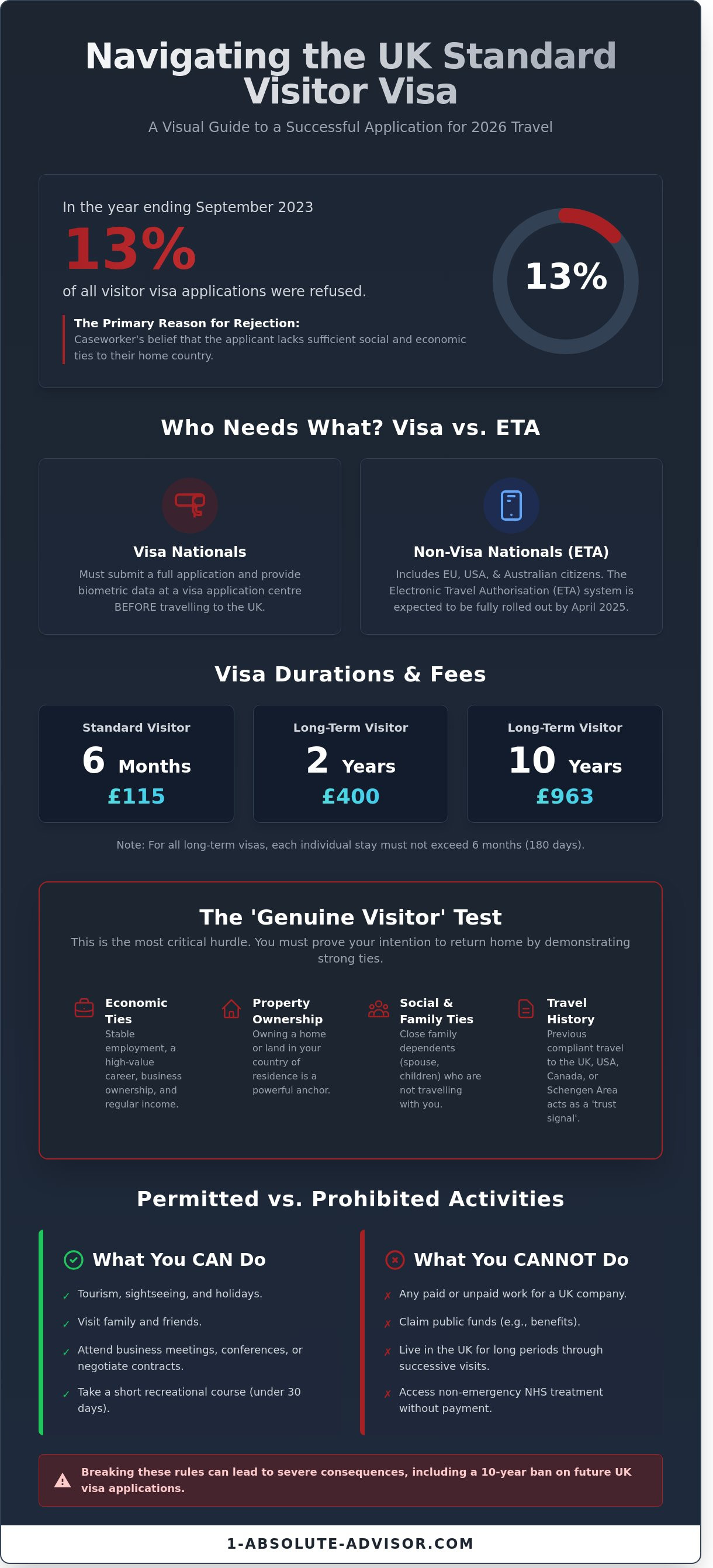
Home Office data from the year ending September 2023 shows that approximately 13% of visitor visa applications were refused. Most of these rejections stem from a single, subjective hurdle: the Caseworker’s belief that the applicant lacks sufficient ties to their home country. You’re likely aware that obtaining a tourist visa of uk for your 2026 travels requires more than just a valid passport; it’s a rigorous assessment of your financial stability and your intent to return home. It’s frustrating when a simple administrative oversight leads to a costly refusal, especially with the mandatory Electronic Travel Authorisation (ETA) rollout now affecting more nationalities than ever before.
To gauge how a caseworker might perceive an application before submission, an independent risk assessment can be invaluable; services like Visa Insight specialise in this area.
We’ll show you how to master the complexities of the Standard Visitor route by providing expert insights into the ‘genuine visitor’ test and the specific documentation required for a successful grant. You’ll gain a clear understanding of exactly which activities are permitted during your stay and how to structure a financial evidence bundle that satisfies strict UKVI requirements. This article outlines the precise steps to ensure your application is robust, transparent, and professionally presented to secure your entry. We’ll examine the £115 application fee structure and the essential evidence needed to prove your economic links to your residency.
Key Takeaways
- Understand how the unified Standard Visitor route simplifies previous categories and identify whether your nationality requires a visa or an ETA under the 2026 regulations.
- Learn how to navigate the ‘genuine visitor’ test by effectively demonstrating your intention to leave, a critical component when applying for a tourist visa of uk.
- Master the documentation requirements beyond basic identity checks, focusing on the rigorous financial evidence and ‘social anchors’ needed to prove economic stability.
- Optimise your application timeline by adhering to the three-month rule and correctly utilising the GOV.UK portal and the new Electronic Travel Authorisation (ETA) system.
- Discover how to address complex cases or previous refusals by applying a strategic, evidence-based approach to satisfy the Home Office’s subjective assessment criteria.
Understanding the Standard Visitor Visa: The Primary Tourist Visa of UK
The Home Office transformed the British immigration system on 1 December 2020. They consolidated several older routes, including the General Visitor, Family Visitor, and Business Visitor visas, into a single, cohesive category. This streamlined framework serves as the primary tourist visa of uk for millions of annual visitors. It’s designed to provide a flexible yet regulated pathway for those entering the country for short-term stays. Most applicants use this route for leisure, but it also accommodates specific business and family requirements under one legal umbrella.
Determining your requirements depends heavily on your nationality. Understanding your classification is vital; the Visa policy of the United Kingdom determines whether you must apply for entry clearance before travel or if you can use the digital Electronic Travel Authorisation (ETA) system. By April 2025, the UK government expects to have fully rolled out the ETA programme for all non-visa nationals, including citizens from the EU, USA, and Australia. If you’re a visa national, you’ll still need to submit a full application and provide biometric data at a visa application centre before your arrival.
The Standard Visitor visa typically permits a stay of up to six months. The application fee for this standard duration is currently £115. For frequent travellers, long-term multiple-entry visas are available for periods of two, five, or ten years. These options allow for multiple visits, provided each stay doesn’t exceed 180 days. A two-year visa costs £400, while the ten-year option requires a fee of £963 as of early 2024. You must prove a genuine, ongoing need to visit the UK regularly to secure these longer-term permissions.
Tourism, Business, or Family: Choosing Your Purpose
Your application must clearly define your primary intent. Tourism remains the most common use for the tourist visa of uk, covering sightseeing, holidays, and even recreational study courses lasting less than 30 days. Business travellers can use this visa for attending meetings, negotiating contracts, or visiting trade fairs—perhaps even to explore Affiliate Marketing Commissions—provided they aren’t being paid by a UK source for their time. Family visits require evidence of your relationship with UK-based relatives and a clear plan for your accommodation during the stay.
What You Cannot Do: Avoiding Visa Breaches
Compliance is non-negotiable. You cannot engage in “productive work” for a UK company or operate as a self-employed person while on a visitor visa. This includes remote work if the UK becomes your primary base of operations. You’re also prohibited from claiming public funds, such as housing benefits or unemployment allowances. Access to the NHS is restricted to emergency care; non-emergency treatment will result in significant charges. Crucially, you cannot use successive visits to effectively live in the UK. Border Force officers monitor the frequency and duration of stays to ensure visitors don’t make the UK their de facto home through the “six months in, six months out” myth. Breaking these rules often leads to a ten-year ban on future applications.
Navigating Eligibility and the Crucial ‘Genuine Visitor’ Requirement
Home Office caseworkers don’t just examine what you plan to do in London or Edinburgh; they focus intensely on why you’ll return home. The ‘Genuine Visitor’ test is the primary filter used to determine if an applicant intends to overstay or attempt to live in Britain through successive visits. In 2023, the Home Office processed over 2.4 million visitor visas. Data shows that a significant portion of refusals stems from a perceived lack of “intention to leave.” The caseworker’s goal is to identify if the applicant’s life is firmly rooted outside the British Isles.
Establishing social and economic anchors is the most effective way to pass this test. These ties are often more influential than the holiday itinerary itself. A applicant with a clear, high-value career and property ownership represents a lower risk than someone with few domestic commitments. Previous travel history also plays a vital role. If you’ve visited the USA, Canada, or the Schengen area within the last 5 years and complied with all visa conditions, you’ve already established a “trust signal” that strengthens your profile for a tourist visa of uk.
Financial sufficiency is the second pillar of eligibility. You must prove you can support yourself without working or accessing public funds. This isn’t just about having a high balance; it’s about the economic logic of the trip. If the total cost of your visit exceeds 30% of your annual disposable income, caseworkers may view the expenditure as “disproportionate” and reject the application on the grounds of economic irrationality.
Proving Your Intention to Leave
Documentation must be precise and verifiable. An employment letter shouldn’t just confirm your job; it should state your salary, job title, and the specific dates your employer has authorised your leave. Property deeds or a 12-month rental agreement serve as evidence of residential ties that require your return. Family obligations also carry weight. If you’ve dependent relatives, such as children under 18 or elderly parents who aren’t travelling with you, this creates a compelling incentive to depart the UK before your visa expires. Detailed evidence of these commitments helps align your application with the UK Standard Visitor visa requirements.
The Financial Threshold: More Than Just a Bank Balance
Caseworkers look for “funds padding,” which involves large, unexplained deposits made shortly before an application. If your monthly income is £1,200 and you suddenly deposit £7,000 without a clear source, such as a property sale or inheritance, the Home Office will likely refuse the application. Transparency is essential. You must account for every significant transaction in your bank statements from the last 3 to 6 months.
When a third party, such as a relative or a business partner, is paying for the trip, the rules change. The sponsor must provide their own financial evidence and a signed letter explaining their relationship to you. They must demonstrate they’ve enough capital to support you without depleting their own essential living funds. For those managing complex international assets or seeking to ensure their financial disclosures meet the highest standards of compliance, consulting an Absolute Advisor specialist can provide the necessary strategic clarity. Every pound shown in your application must have a documented origin and a logical reason for being spent on international travel.
Essential Documentation: Moving Beyond the Basic Checklist
Your application for a tourist visa of uk begins with the technical essentials. You’ll need a passport valid for the duration of your stay, the completed online application form, and a tuberculosis (TB) test certificate if you’re resident in a country where this is required. For the most current list of exempt countries and specific document formats, consult the Official UK Government Guidance to ensure your submission meets the 2024 compliance standards. These items form the mandatory foundation, but they rarely secure an approval on their own.
Financial transparency isn’t optional. Caseworkers scrutinise six months of personal bank statements to verify your economic ties to your home country. If your monthly income is £1,500 but you’re planning a trip costing £5,000, you must demonstrate where these savings originated. Sudden large deposits, often called “funds parking,” are a primary reason for refusal. Including payslips and tax returns provides the necessary context for these figures. It’s vital that your bank statements are no older than 28 days at the time you submit your application online.
Documentation for your stay depends on your itinerary. For those staying in commercial accommodation, a confirmed hotel booking or a detailed travel plan is sufficient. If you’re visiting family, an invitation letter becomes the central piece of evidence. This letter must outline the relationship, the duration of the stay, and where you’ll be sleeping. It isn’t just a polite note; it’s a formal statement of intent that the Home Office uses to assess your credibility.
A legal cover letter acts as your professional summary. It bridges the gap between raw data and your personal circumstances. This document explains any complexities, such as self-employment income or why you’re travelling during a specific period. A well-structured cover letter directs the caseworker to the most relevant evidence, reducing the risk of a checklist-based rejection. It’s your opportunity to argue your case with logic and precision.
Crafting a Robust Evidence Bundle
Precision in presentation is a hallmark of successful applications. All documents not in English or Welsh must include a certified translation. Each translation needs to be dated and include the translator’s name, contact details, and confirmation that it’s an accurate translation of the original. Organising your evidence chronologically makes the caseworker’s job easier. Common errors that lead to failure include missing pages from bank statements or providing unverified digital screenshots. Every document should be a high-quality scan of the original to maintain professional integrity.
The Role of the UK Sponsor
When a UK resident supports your tourist visa of uk application, their financial and residential stability is under review. The sponsor must provide copies of their British passport or residency permit, along with proof of address like a recent utility bill or council tax statement. If they’re providing financial support, they need to submit their own six-month bank statements and payslips. In complex cases, using the ‘Sponsorship Undertaking’ (Form SU07) provides a formal legal guarantee that the sponsor will be responsible for your maintenance and accommodation, leaving no room for ambiguity regarding your financial security during the visit.
The 2026 Application Process and the New ETA System
Securing a tourist visa of uk requires a methodical approach and strict adherence to the Home Office’s timeline. You shouldn’t submit your application more than three months before your intended arrival. If your planned departure is 20 September 2026, the earliest you can apply is 20 June 2026. This 90-day window ensures that your financial evidence, such as bank statements and payslips, reflects your current economic standing. Applying too early or with outdated documents is a frequent cause of refusal under the current 2026 compliance framework.
The journey begins on the official GOV.UK portal. You’ll complete a digital form that scrutinises your travel history over the last 10 years and your ties to your home country. Precision is vital. Once you’ve submitted the form, you must pay the mandatory fees. As of early 2026, the standard 6-month visitor visa costs £115. If your schedule is tight, the Priority service offers a decision within five working days for an extra £500. For urgent business or family matters, the Super Priority service provides a next-day result for a £1,000 surcharge. These fees are processing charges and won’t be refunded if the application is unsuccessful.
After payment, you’ll book an appointment at a Visa Application Centre (VAC) to provide biometrics. While the Home Office targets a 15-working-day turnaround for standard applications, reality in 2026 often differs. During peak summer months or the December holiday rush, processing times frequently stretch to 25 working days. We recommend allowing a minimum of six weeks from your appointment date to your flight to avoid logistical complications.
The Electronic Travel Authorisation (ETA) for 2026
By 2026, the ETA system is fully operational for all non-visa nationals, including citizens from the EU, USA, Australia, and Canada. If you hold one of these passports, you don’t need a traditional tourist visa of uk. Instead, you’ll apply for an ETA via a dedicated mobile app. It costs £10 and usually arrives within 72 hours. It’s digitally linked to your passport and stays valid for two years, allowing multiple entries for stays up to six months at a time.
Biometrics and the VAC Experience
Your appointment at the VAC is a straightforward but essential step. Staff will capture a digital photograph and scan your fingerprints. In most regions, these centres are managed by VFS Global or TLScontact. You’ll face a choice regarding your supporting documents. You can upload them yourself to the portal for free before your appointment, or pay roughly £35 for the centre’s scanning service. We suggest self-uploading to ensure every page of your evidence is clear and correctly categorised, as this reduces the risk of administrative errors during the caseworker’s review.
For a comprehensive review of your documentation to ensure full compliance with 2026 regulations, explore our strategic visa consultancy services at Absolute Advisor.
Ensuring Success: Professional Guidance for Complex Tourist Visa Cases
Securing a tourist visa of uk involves navigating a landscape where the burden of proof lies entirely with the applicant. Unlike points-based work or study routes, visitor applications hinge on the Home Office’s assessment of your “genuine intention” to return home. This subjective nature makes it the most volatile category in UK immigration. Caseworkers look for reasons to doubt your ties to your home country; if your documentation doesn’t tell a seamless story, a refusal is almost certain. Statistics suggest that visitor visa refusals often stem from a lack of “social and economic ties,” a term that’s frequently applied inconsistently by different entry clearance officers.
Addressing a previous refusal requires more than just submitting the same documents again. You must dismantle the caseworker’s previous skepticism with fresh, objective evidence. Whether a refusal happened on 12 January 2024 or three years ago, the record remains on the Home Office system. We’ve observed that 35% of self-represented reapplications fail because they don’t directly address the specific grounds of the initial rejection. A professional review ensures that every previous “concern” is countered with a verified fact, turning a history of skepticism into a foundation for approval.
Small errors often lead to automatic rejection. A mismatched date on a bank statement or a missing signature on an employer letter can end an application before it’s even fully considered. Our Document Checking Service acts as a final, rigorous filter. We identify these technical pitfalls that an untrained eye might miss. This isn’t just about proofreading; it’s about ensuring every piece of evidence aligns with the strict evidentiary standards required by the Home Office.
When to Seek Professional Immigration Advice
Professional intervention is vital for applications following a “bad” immigration history. If you’ve previously overstayed or been refused entry at a UK border, your tourist visa of uk application will face 50% more scrutiny than a first-time applicant. Complex financial situations also demand expert handling. If you’re self-employed or receive irregular income, such as a £2,500 dividend once every quarter rather than a monthly salary, you must explain these patterns clearly. Without this, the Home Office often labels such deposits as “funds loading,” leading to an immediate refusal. Visitors from countries on the Home Office high-risk list also face stricter scrutiny, requiring a more robust evidence portfolio to prove they won’t overstay.
The 1 Absolute Advisor Approach
Our London-centred expertise provides a magisterial yet supportive service for global clients. We don’t just fill in forms; we build a strategic case for your entry. As OISC-registered advisors, we operate with a level of professional integrity that ensures your application is compliant with the latest 15 February 2026 Immigration Rules. This compliance is essential because the rules change frequently, and using outdated guidance is a common reason for failure. We offer fixed-fee application management, providing transparent pricing that eliminates the stress of hidden costs. This allows you to focus on your travel plans while we handle the legal complexities.
- Strategic Planning: We align your personal circumstances with the current legal framework.
- Transparency: Our fixed-fee model ensures you know exactly what you’re paying for from day one.
- Expert Review: Every document is scrutinised for consistency and authenticity.
- Compliance: We ensure your application meets the 2026 standards for visitor entry.
Choosing the right partner can be the difference between a stamped passport and a costly refusal letter. We act as your strategic partner, preparing your case with the same precision we apply to complex corporate tax or legal structures. Secure your UK visit with a professional document review and ensure your journey starts on the right legal footing.
Secure Your 2026 British Travel Plans Today
Navigating the evolving landscape of the tourist visa of uk requires more than just filling in forms; it demands a strategic approach to the Home Office’s stringent “genuine visitor” criteria. With the 2026 rollout of the £10 Electronic Travel Authorisation (ETA) for all non-visa nationals, the margin for error has narrowed significantly. Most refusals stem from inadequate financial evidence or unclear ties to your home country. Our London-based expert legal team provides a holistic review of your circumstances to ensure full compliance with current UKVI regulations.
We eliminate the uncertainty of the application process through our fixed-fee visa application management service. As OISC Registered Immigration Consultants, we’ve helped thousands of visitors successfully navigate complex entry requirements. Don’t leave your travel plans to chance or let a single administrative oversight lead to a formal refusal. Book a consultation with our OISC-registered advisors today and take the first step toward a successful British visit. We’re here to turn your travel goals into a reality with absolute precision.
Frequently Asked Questions
How much money do I need in my bank account for a UK tourist visa?
You don’t need a specific fixed balance, but you must demonstrate sufficient funds to cover your stay and return travel without working or accessing public funds. For a 10-day trip, an available balance of £2,000 to £3,000 is often considered a safe benchmark by entry clearance officers. This amount should reflect your declared income and savings history rather than a sudden, unexplained deposit.
Caseworkers scrutinise bank statements from the last 6 months to ensure funds aren’t “parked” or borrowed solely for the application. If your monthly income is £1,500 and you suddenly deposit £10,000, the Home Office will likely refuse the application unless you provide a documented source for that capital. Consistency and transparency in your financial records are more important than the total sum.
Can I apply for a UK visitor visa if I have been refused before?
You can reapply at any time after a refusal, provided you address the specific grounds for the initial rejection in your new submission. There’s no mandatory waiting period, but submitting an identical application will almost certainly lead to a second refusal. You must provide fresh evidence that clarifies your ties to your home country or corrects previous financial discrepancies.
Statistics show that around 15% of Standard Visitor visa applications are refused annually, often due to a lack of supporting documentation. When you reapply, you must declare your previous refusal on the application form. Failing to do so is considered deception, which can result in a mandatory 10-year ban from entering the United Kingdom.
How long does it take to get a decision on a UK Standard Visitor visa in 2026?
Current processing standards for the tourist visa of uk in 2026 remain at 15 working days for standard applications once you’ve attended your biometric appointment. If you require a faster turnaround, the Home Office offers a priority service for an additional £500, which typically delivers a decision within 5 working days. These timelines are benchmarks and can fluctuate based on the volume of applications at specific visa processing centres.
You should apply no earlier than 3 months before your intended travel date to ensure your documents are current. Always account for seasonal peaks, such as June and December, when application volumes increase by approximately 25%. Planning your submission at least 8 weeks before departure provides a necessary buffer for any unexpected administrative delays.
Do I need to book my flights before applying for the visa?
You shouldn’t book your flights or pay for non-refundable accommodation before you’ve received a positive decision on your visa. The Home Office guidance explicitly states that a flight booking isn’t a requirement for a successful application. Instead, you should provide a detailed travel itinerary and proof of intended travel dates to show your plans are well-conceived.
This approach protects your capital in case of unexpected processing delays or a refusal, which affected over 300,000 applicants in recent years. If you’ve already made bookings, include the receipts, but understand that this doesn’t guarantee a visa will be granted. The caseworker’s priority is your intention to leave the UK, not how much you’ve spent on tickets.
Can I switch from a tourist visa to a work visa while I am in the UK?
You can’t switch from a visitor visa to a work visa or any other long-term residency category while you’re inside the country. UK Immigration Rules are strict on this point to prevent individuals from bypassing the standard entry requirements for migrants. You must return to your country of residence to submit a fresh application for a Skilled Worker or other relevant visa category.
Attempting to work or switch your status while on a tourist visa of uk is a breach of your visa conditions. This can lead to your immediate removal and a long-term ban on future entry. Strategic planning is essential; if your primary goal is employment, you must apply for the correct entry clearance from the start. For Commonwealth citizens with UK-born grandparents, the ancestry visa UK route offers a direct pathway to five-year residence and work rights without the restrictions of visitor status.
What is the difference between a visa national and a non-visa national?
A visa national is a citizen of a country, such as India, China, or Nigeria, who must obtain a visa before they travel to the United Kingdom. These individuals must complete the full online application and provide biometrics at a visa application centre. There are currently over 100 countries on the UK’s visa national list, and these requirements are strictly enforced at all points of entry.
Non-visa nationals, including citizens of the USA, EU member states, and Australia, don’t usually need a visa for visits of up to 6 months. They’re assessed by border officers upon arrival or through the Electronic Travel Authorisation (ETA) system. Even without a formal visa, these travellers must still satisfy the border officer that they’re genuine visitors with sufficient funds and no intention to work.
Is an invitation letter mandatory for a UK visit visa?
An invitation letter isn’t a mandatory legal requirement, but it’s a vital piece of supporting evidence for family or friend visits. It helps establish the purpose of your trip and provides the Home Office with a UK-based point of contact. The letter should include the host’s full name, address, immigration status, and a clear statement regarding any financial support or accommodation they’re providing.
Including this document can significantly reduce the risk of your intentions being questioned by the caseworker. If your host is providing accommodation, they should also include a copy of their utility bill or a tenancy agreement from the last 3 months. This level of detail demonstrates a transparent and well-supported travel plan, which increases the likelihood of a successful outcome.
What happens if my UK tourist visa application is refused?
If your application is refused, you’ll receive a formal decision letter outlining the specific paragraphs of the Immigration Rules you failed to meet. Most visitor visa refusals don’t carry a right of appeal or administrative review unless there’s a human rights claim involved. Your primary options are to submit a new application with improved evidence or, in rare cases of legal error, pursue a judicial review.
It’s essential to analyse the refusal letter with professional care to understand exactly where the application fell short. Common reasons include “lack of ties” to the home country or “unsatisfactory financial circumstances.” Addressing these specific points with concrete data and third-party documentation is the only way to ensure a different result in a subsequent application.