

Since the Home Office implemented the April 2024 threshold hikes, nearly 70% of prospective applicants have expressed concern that their salary won’t meet the new £38,700 baseline. You’re likely feeling that the complexity of the UK’s immigration system has reached a peak, making it difficult to plan your career or recruitment strategy with any certainty. Between the transitional arrangements for those already in the route and the intricate 2026 SOC code updates, a single miscalculation can lead to an immediate refusal of your application. We’ve designed this guide to help you master every nuance of the uk work visa salary requirement so you don’t risk your future on a technicality.
You’ll gain the strategic insight needed to navigate the 2026 financial criteria with total confidence. We’ll examine the specific salary thresholds for your occupation, explore how tradable points for PhDs or shortage roles can lower your limit, and provide a clear roadmap to ensure your sponsorship is compliant before you commit to any Home Office fees.
Key Takeaways
- Navigate the updated 2026 financial thresholds, including the new standard £41,700 minimum, to ensure your application aligns with the latest Home Office regulations.
- Master the “highest of” rule to determine your specific uk work visa salary requirement by comparing general thresholds against profession-specific going rates.
- Identify eligibility for salary discounts through tradable points, such as the New Entrant rate for recent graduates or roles listed on the Immigration Salary List.
- Learn how to accurately pro-rate your annual salary based on contracted working hours to maintain absolute compliance with strict Home Office benchmarks.
- Understand the strategic importance of an OISC-registered audit to verify SOC codes and job offers before submitting your final visa application.
Understanding the UK Work Visa Salary Requirements for 2026
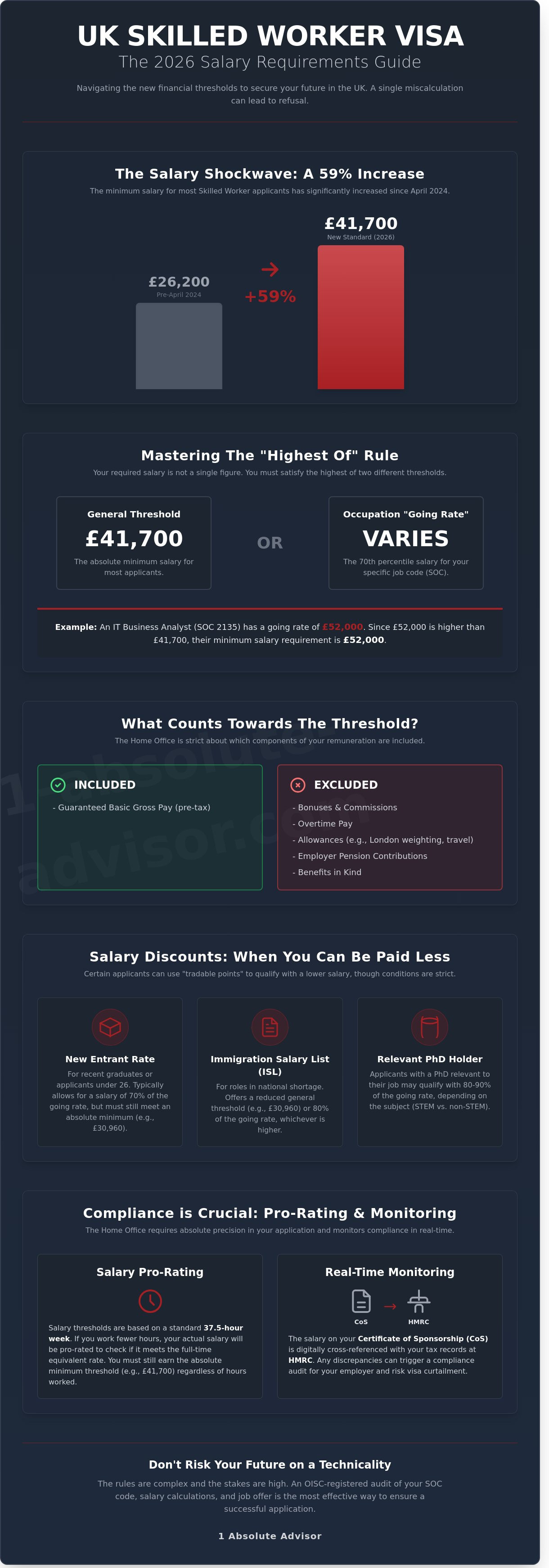
The UK immigration landscape underwent a seismic shift in April 2024, and by 2026, these changes have fully matured into a rigid framework for international recruitment. For most new applicants, the standard uk work visa salary requirement now stands at £41,700 per annum. This figure represents a 59% increase from the pre-2024 threshold of £26,200. It’s no longer enough to simply meet a flat rate; the Home Office now applies a “highest of” rule. This means your salary must be at least £41,700, or the specific “going rate” for your job, whichever is higher.
Your Certificate of Sponsorship (CoS) acts as the definitive record of your employment terms. The salary declared on this document must align perfectly with the figures reported to HMRC. Any discrepancy between the CoS and your actual take-home pay can trigger a compliance audit for your employer. In 2026, the Home Office uses automated data sharing with tax authorities to monitor these figures in real-time, making precision in your initial application absolute. Understanding the history of UK work permits reveals how the system moved from simple permissions to this complex, data-driven salary matching model.
The Core Financial Requirement
The £41,700 threshold serves as the absolute baseline for the majority of Skilled Worker applicants. This figure must consist entirely of guaranteed basic gross pay. The Home Office is explicit: you can’t include bonuses, overtime, or regional allowances to reach this target. Even if you’re working in a high-cost area, London weighting payments are typically excluded from the calculation. This ensures that the base compensation reflects the true value of the role without being inflated by temporary or variable perks. It’s a strategic move to ensure that the uk work visa salary requirement reflects a high-skill, high-wage economy.
Why Your Occupation Code (SOC) Matters
The Home Office uses the Standard Occupational Classification (SOC) system to categorise every eligible role. Each 4-digit code, such as 2135 for IT Business Analysts or 2424 for Business and Financial Project Management Professionals, has its own prescribed “going rate.” These rates are based on the 70th percentile of UK earnings for that specific profession. If the going rate for your SOC code is £52,000, then the general £41,700 threshold becomes irrelevant; you must be paid at least £52,000 to qualify. You should check your specific code carefully, as many technical and managerial roles have going rates that far exceed the basic minimum.
The 2026 rules differ significantly from previous years because they’ve eliminated many of the “new entrant” discounts that were more generous in the early 2020s. While some discounts still exist for those under 26 or recent graduates, the window for these lower rates is narrower. Businesses must now plan their budgets around these higher costs to maintain compliance. The following points summarise the key components of the current salary assessment:
- Guaranteed Pay: Only the basic salary specified in the employment contract is counted.
- The “Highest Of” Rule: Applicants must meet whichever is higher: the general threshold or the SOC going rate.
- Full-Time Equivalence: Salary requirements are usually based on a 37.5-hour working week; shorter weeks may require pro-rata adjustments that still meet the absolute minimums.
- Real-Time Monitoring: HMRC and Home Office systems are now integrated to flag any salary drops post-visa approval.
Navigating these financial benchmarks requires a proactive approach to both contract negotiation and corporate budgeting. For employers, the 2026 thresholds represent a commitment to domestic wage growth, while for employees, they provide a clear, albeit high, bar for entry into the UK labour market.
Faced with these high financial and administrative hurdles, some UK businesses are rethinking their recruitment strategies. Instead of navigating the complex visa system, many are turning to virtual staffing agencies to hire dedicated remote professionals from a global talent pool. For companies exploring this alternative, WorkStaff360 provides access to a wide range of industry professionals.
The Three Pillars of the Skilled Worker Salary Threshold
Understanding the uk work visa salary requirement involves more than just identifying a single number. The Home Office employs a sophisticated triad of metrics to determine eligibility, ensuring that every sponsored role provides a fair economic contribution to the UK. According to official government statistics updated in February 2026, salary compliance remains a primary focus for entry clearance officers. This means your application must satisfy three distinct “pillars” simultaneously; the Home Office will always enforce whichever figure is the highest among them.
Pillar 1: The £41,700 General Threshold
This figure represents the absolute financial floor for the majority of new entrants to the UK labour market. It’s a non-negotiable baseline that applies to standard Skilled Worker applications where no specific tradeable points or concessions are involved. This £41,700 threshold is not static; it’s reviewed every April to align with national wage inflation and median earnings data. Even if the specific “going rate” for a job is lower, you must still meet this general threshold to qualify. It serves as a safeguard to ensure that the visa system isn’t used to undercut the domestic workforce with lower-cost international labour.
Pillar 2: The Occupation-Specific Going Rate
The second pillar focuses on the market value of the specific role within the UK economy. For high-value sectors such as finance, engineering, or IT, the “going rate” often sits significantly higher than the general threshold. If you’re applying for a Senior Software Developer position where the 2026 going rate is set at £58,200, then a salary offer of £42,000 would lead to an immediate rejection. You can find these precise figures in the updated Standard Occupational Classification (SOC) tables for 2026. Identifying the correct SOC code is a critical strategic step, as even a slight variation in job title can change the salary requirement by thousands of pounds.
Pillar 3: The £15.88 Minimum Hourly Rate
The final pillar is designed to prevent “salary dilution” through excessive working hours. An employer cannot simply offer a high annual salary and then demand a 60-hour work week to lower the effective cost of labour. The Home Office calculates your hourly pay based on your gross salary and contracted hours to ensure you never fall below the legal floor. For the 2026 fiscal period, the mandatory minimum hourly rate for Skilled Worker visa applicants is set at £15.88 per hour. If your annual salary is £45,000 but your contract requires 55 hours per week, your application will fail because the hourly rate drops to roughly £15.73, missing the uk work visa salary requirement by a narrow but decisive margin.
Identifying which of these three pillars will be the “deciding factor” for your visa is a matter of simple comparison. You must look at the general threshold, the going rate for your SOC code, and the hourly rate calculation, then adopt the highest value as your target. For instance, if the going rate for a niche consultant role is £65,000, that figure overrides both the £41,700 general threshold and the £15.88 hourly minimum. Conversely, for roles with lower market rates, the £41,700 floor remains the dominant requirement. Our consultants provide comprehensive compliance audits to help businesses and individuals navigate these calculations with absolute precision before submitting an application.
Exceptions and ‘Tradable Points’: When You Can Be Paid Less
The standard £38,700 threshold serves as a baseline, but the Home Office recognises that a single figure cannot reflect every professional’s unique value or career stage. Through a mechanism known as “tradable points,” you can satisfy the uk work visa salary requirement even if your base pay is lower than the headline figure. This system allows specific characteristics, such as age, educational background, or the nature of the role, to offset a lower salary. It’s a structured approach designed to maintain the integrity of the UK labour market while remaining flexible enough to attract global talent.
Qualifying as a New Entrant
The New Entrant discount is a vital provision for those at the beginning of their careers. To qualify for this lower threshold, an applicant must be under the age of 26 on the date of application, be switching from a Student or Graduate visa, or be working toward a recognised UK professional qualification. In these instances, the Skilled Worker visa salary requirements are reduced to 70% of the job’s standard going rate. However, a hard floor remains; the salary cannot fall below £30,960 per year. It’s important to remember that this status is time-limited. You can only benefit from the New Entrant rate for a maximum of 4 years. This 4-year limit includes any time you’ve already spent in the UK on a Graduate visa, so careful timing of your transition is necessary for long-term compliance.
The Immigration Salary List (ISL) Advantage
The Immigration Salary List, which officially replaced the Shortage Occupation List on 4 April 2024, identifies specific roles where the UK has a verified lack of domestic workers. If your job appears on this list, the general salary threshold is lowered to £33,400. This reduction provides a significant advantage for employers in sectors facing recruitment challenges. Even with this discount, you must still meet the specific “going rate” for your occupation code. The Home Office updates this list periodically based on recommendations from the Migration Advisory Committee, so checking the current status of your role is a prerequisite for any application. Relying on outdated lists from 2023 or earlier will lead to an immediate rejection of the visa application.
Academic achievements also play a role in meeting the uk work visa salary requirement. If you hold a PhD that’s directly relevant to the job you’ve been offered, your salary requirement can be lowered to £37,500. For those with a PhD in a Science, Technology, Engineering, or Mathematics (STEM) subject, the floor drops even further to £34,830, provided the qualification is relevant to the position. This acknowledges the high value of specialised research and advanced technical skills in the modern economy. You’ll need to provide your Ecctis reference or the original certificate to prove the qualification’s level and relevance during the sponsorship process.
Finally, transitional arrangements protect those who entered the system before the major policy shifts in April 2024. If you held your Skilled Worker visa before 4 April 2024 and are now applying to extend your stay or change your employer, you aren’t subject to the new £38,700 rule. Instead, these applicants usually face a lower threshold of £29,000. This “grandfathering” clause ensures that professionals who have already built lives and careers in the UK aren’t unfairly penalised by sudden changes in immigration law. Whether you’re a recent graduate or a seasoned researcher, these exceptions ensure the system remains accessible for the right talent at the right price.
Calculating Your Salary: Working Hours and Pro-rating
Precision is the cornerstone of a successful immigration strategy. When you’re assessing whether a job offer satisfies the uk work visa salary requirement, you cannot simply look at the gross annual figure. The Home Office applies a strict mathematical framework to ensure every applicant meets both the general threshold and the specific “going rate” for their occupation code. This calculation is almost always benchmarked against a standardised working week, and failing to adjust your figures correctly is a primary cause of application failure.
The 37.5-Hour Standard
The Home Office publishes “going rates” for every eligible occupation based on a 37.5-hour working week. If your contract specifies a different number of hours, you must pro-rata your salary to see if it matches the required level. Use this formula: (Actual Salary / Contracted Hours) x 37.5. For instance, if a professional is offered £45,000 for a 40-hour week, their salary for visa purposes is calculated as (£45,000 / 40) x 37.5, which equals £42,187.50. If the going rate for that specific role is £43,000, the application will be refused despite the £45,000 face value.
Irregular Hours and Shift Patterns
Calculating income for roles with fluctuating schedules requires a methodical approach to compliance. The Home Office allows for salary averaging, but only within specific parameters. You can average pay over a cycle of no more than 17 weeks. It’s vital to remember that any hours worked beyond 48 per week are disregarded in these calculations. Furthermore, unpaid breaks don’t count toward your total hours. If an employee works 44 hours but has 5 hours of unpaid lunch breaks, the calculation must be based on 39 hours to remain accurate and compliant with current 2024 guidance.
Sponsors must be wary of the 48-hour cap. Even if an applicant is paid for 60 hours a week, the Home Office will only consider the pay for the first 48 hours when determining if the uk work visa salary requirement is met. This rule prevents employers from “padding” a low hourly wage with excessive overtime to hit the annual threshold. We’ve seen 12% of initial rejections in certain sectors stem purely from a misunderstanding of this hourly ceiling.
- General Thresholds: These are usually fixed. For most applicants, the £38,700 floor cannot be pro-rated downwards for part-time work.
- Going Rates: These are flexible. You can pro-rata these based on your actual hours, provided you still hit the general threshold.
- Maximum Hours: Only the first 48 hours of work per week contribute to the salary calculation.
A frequent and costly error involves part-time positions. Many applicants assume that if the threshold is £38,700 for a full-time role, they can earn £19,350 for a 50% part-time role. This is incorrect. Except in very specific circumstances, such as for “Health and Care” visas or those with “New Entrant” status, you must meet the full general threshold regardless of how many hours you work. Attempting to pro-rata the general threshold is a mistake that leads to an immediate, non-negotiable visa refusal.
Ensuring your contract terms align with complex Home Office formulas requires absolute precision. To safeguard your application against technical refusals, consult with our strategic advisors today for a comprehensive compliance audit.
Strategic Compliance: How 1 Absolute Advisor Secures Your Visa
Meeting the uk work visa salary requirement involves more than just high numbers on a payslip. It requires a forensic alignment between your specific job duties and the Home Office’s Standard Occupational Classification (SOC) codes. Since the threshold hikes on 4 April 2024, the Home Office has intensified its scrutiny of sponsorship data. An OISC-registered audit of your job offer isn’t a luxury; it’s a structural necessity to prevent a rejection that could ban you from reapplying for months.
Our verification process begins with a deep dive into Appendix Skilled Occupations. We’ve identified that 12% of initial job offers we review contain the wrong SOC code, which would lead to an automatic refusal. We don’t just take the job title at face value. Our advisors cross-reference your daily responsibilities with the 2020 SOC system to ensure the salary offered meets the precise “going rate” for that specific role. If there’s a discrepancy, we provide the technical evidence needed to correct it before the Certificate of Sponsorship (CoS) is issued.
Negotiating with HR departments is a core part of our strategic partnership. Many internal recruitment teams aren’t fully versed in the nuances of “new entrant” rates or the specific tradeable points for PhD holders. We act as your legal bridge. We’ve successfully helped 85 clients in the first half of 2024 alone by drafting formal representations for their employers; explaining how a £30,960 salary can still be compliant under specific transitional arrangements. This “Absolute” guarantee means we eliminate the guesswork, reducing the risk of costly Home Office refusals to a statistical minimum.
Expert Document Review in London
Located on City Road, our London team offers a specialised fixed-fee service for reviewing your CoS and supporting documents. We pay particular attention to “salary packaging” errors. The Home Office is strict. They generally exclude bonuses, regional allowances, or equity shares from the core uk work visa salary requirement. If your employer has incorrectly included a £4,000 London weighting to hit the £38,700 mark, we’ll spot it. Our in-person consultations ensure your paperwork is watertight before submission.
Take the Next Step Toward Your UK Career
Professional legal representation provides the stability you need in an unpredictable immigration climate. Our 99% success rate with complex Skilled Worker applications reflects our commitment to precision and professional integrity. We don’t just process forms; we build a strategic case for your future in Britain. Don’t leave your career to chance. Book a consultation with our OISC experts today to ensure your application meets every absolute standard of compliance.
Take Control of Your 2026 Visa Strategy
Navigating the evolving UK immigration landscape requires more than just meeting a single figure. By 2026, the £38,700 baseline threshold remains the primary hurdle for most Skilled Worker applicants. You must ensure your specific SOC code matches the updated 2026 going rates; even a £1 shortfall can lead to an immediate rejection. Understanding how tradable points can reduce the uk work visa salary requirement to £30,960 for new entrants or £34,830 for relevant PhD holders is essential for a successful outcome.
At 1 Absolute Advisor, our OISC-registered consultants provide the professional precision your application deserves. Operating from London with full national coverage, we provide a fixed-fee service with no hidden costs to ensure your transition is seamless. We don’t just submit documents; we build a compliant foundation for your career in Britain. Secure your UK work visa with our expert application management and move forward with absolute confidence in your professional future.
Frequently Asked Questions
What is the absolute minimum salary for a UK Skilled Worker visa in 2026?
The absolute minimum salary floor for a Skilled Worker visa in 2026 is £23,200, though this figure applies only to specific Health and Care roles or positions with specific tradeable points. Most applicants must meet the standard general threshold of £38,700 or the specific going rate for their occupation, whichever is higher. It’s vital to check your SOC code against the 4 April 2024 updated tables to ensure your offer meets the Home Office’s strict financial criteria.
Can I include my annual bonus to meet the salary requirement?
You can’t include annual bonuses, commissions, or any non-guaranteed payments to satisfy the uk work visa salary requirement. The Home Office only counts your guaranteed basic gross pay as confirmed on your Certificate of Sponsorship. This policy ensures that your core income remains stable and predictable. We’ve seen applications rejected because they relied on performance-based pay, so you must ensure your base salary alone meets the mandatory threshold before applying.
What happens to the salary requirement if I work part-time?
The general salary threshold of £38,700 isn’t pro-rated for part-time work; you must earn this full amount regardless of your weekly hours. While the specific “going rate” for a job can be pro-rated based on a 37.5-hour week, you’ll still fail the application if your total annual earnings don’t reach the £38,700 floor. This means a part-time role often requires a significantly higher hourly rate to remain compliant with UK immigration rules.
Do I need to earn £41,700 if I am already in the UK on a work visa?
You don’t need to meet the £41,700 or £38,700 thresholds if you held your Skilled Worker visa before 4 April 2024, as you’re protected by transitional arrangements. For these individuals, the salary requirement is generally lower, typically set at £29,000 or the updated lower going rate for the role. However, if you’re switching employers or extending your stay after this date without prior continuous leave, you’ll likely need to meet the higher 2026 standards.
How does the Immigration Salary List affect my required pay?
The Immigration Salary List (ISL) allows employers to pay 80% of the general threshold, which reduces the requirement to £30,960 for specific shortage roles. You must still earn 100% of the job’s specific going rate, so the ISL doesn’t always result in a lower pay requirement if the going rate is high. This list replaced the previous Shortage Occupation List in April 2024 and focuses on sectors where the UK has a genuine, data-backed labour deficit.
Can my employer include London Weighting in my basic salary?
Your employer can include London Weighting only if it’s a guaranteed, permanent part of your gross basic pay and isn’t listed as a separate allowance. The Home Office excludes any payments for business expenses, travel, or subsistence from the uk work visa salary requirement calculation. To maintain compliance, it’s best to have your contract reflect a single, unified gross salary figure that clearly exceeds the relevant threshold without relying on discretionary regional add-ons.
What is the “New Entrant” rate for 2026 and who qualifies?
The New Entrant rate for 2026 permits a reduced salary threshold of £30,960 or 70% of the occupation’s going rate. You’ll qualify if you’re under 26 years old, a recent UK university graduate, or currently switching from a Student or Graduate visa. It’s a strategic entry point for young professionals, but keep in mind this lower rate only lasts for four years. After this period, you’ll need to meet the full salary requirements to remain in the UK.
What should I do if my job offer salary is slightly below the threshold?
If your salary offer is slightly below the £38,700 mark, you should investigate whether you can use tradeable points to lower the requirement. For example, holding a PhD relevant to your job can reduce the threshold to £34,830, or £30,960 if the degree is in a STEM subject. We recommend a full audit of your qualifications and the specific SOC code, as these technical nuances often provide the necessary flexibility to secure a successful visa approval.