

Receiving a UK visa refusal can be a disorienting and stressful experience, immediately raising concerns about wasted application fees, the daunting complexity of legal terminology, and the immense pressure of a strict 14 or 28-day deadline. It is a moment where clarity and expert guidance are paramount. However, a refusal is not always the final word, especially when you suspect a caseworking error is the cause. The primary mechanism for challenging such an outcome is the Administrative Review, a formal process overseen by what is effectively an internal administrative review board within the Home Office, designed specifically to correct demonstrable mistakes in the original decision.
This comprehensive 2026 guide has been created to demystify this critical procedure. We will provide a clear, strategic roadmap for the crucial next 28 days, helping you to accurately assess whether a correctable error has been made. By navigating this article, you will gain the expert insights needed to understand the process, challenge the decision with confidence, and ultimately work towards overturning the visa refusal and securing your future in the UK.
Key Takeaways
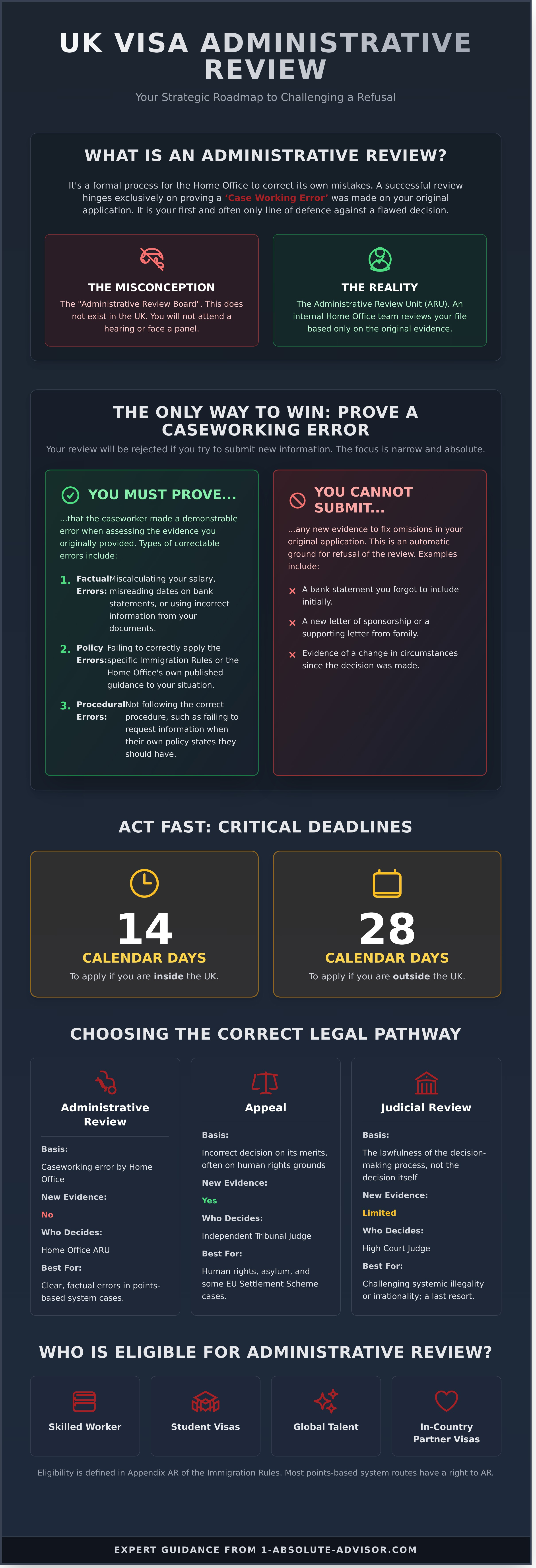
- Understand that a successful Administrative Review hinges exclusively on proving a ‘Case Working Error’; submitting new or missing evidence is not permitted.
- Learn the critical deadlines for challenging a decision (14 days in-country) and how to structure a persuasive legal argument to the Home Office.
- Distinguish between your right to a review, a formal appeal, and a Judicial Review to determine the correct legal pathway for your specific refusal.
- Clarify the role of the UK’s internal review mechanism, often mistakenly called the administrative review board, and how it actually functions to correct errors.
What is the Administrative Review Board in UK Immigration?
When a UK visa application is refused, the Administrative Review (AR) process serves as the primary mechanism for challenging the decision on the grounds of a “case-working error.” It is a formal request for the Home Office to re-examine your application, specifically to identify if the original decision-maker made a mistake in applying the Immigration Rules or their own policies. This internal procedure is designed to provide accountability and correct clear-cut errors without resorting to the more complex and costly process of a full Tribunal appeal.
Many applicants, particularly those familiar with US legal terminology, often search for the UK’s administrative review board. However, this term is a misnomer in the British context. The review is not conducted by a board or panel you appear before; instead, it is handled internally by a dedicated team within the Home Office known as the Administrative Review Unit (ARU).
The Difference Between a ‘Board’ and a ‘Review’
The UK’s Administrative Review Unit operates less like a judicial board and more like an internal auditor. A different caseworker, who was not involved in the original refusal, assesses the decision based on the exact same evidence and information you submitted with your initial application. This is a critical distinction: you cannot submit new evidence. The process is entirely paper-based, meaning you will not attend a hearing or be interviewed. It is a system of internal quality control, replacing the former right to a full, independent appeal for many visa categories.
Eligibility: Who Can Request a Review?
The right to request an Administrative Review is not automatic for every visa refusal. Eligibility is strictly defined under Appendix AR of the Immigration Rules, which lists the specific ‘eligible decisions’. The right to AR often depends on both the type of application and whether it was made from within the UK (in-country) or from overseas (out-of-country).
Generally, decisions eligible for Administrative Review include refusals for:
- Skilled Worker visas
- Student visas
- Global Talent visas
- Most other points-based system applications
- In-country applications for Spouse and Partner visas (where refusals from overseas often carry a full right of appeal instead)
Understanding this pathway is crucial, as it is a self-contained remedy. It stands apart from the broader legal principles that govern challenges against state bodies, such as those detailed in the framework of Judicial Review in English Law, which represents a more profound legal challenge in the High Court.
Identifying ‘Case Working Errors’: The Only Way to Win
An Administrative Review (AR) is not an opportunity to appeal a decision you disagree with or to submit missing documents. Its scope is exceptionally narrow: to correct a ‘Case Working Error’. In essence, a ‘Case Working Error’ is a failure by the Home Office caseworker to correctly apply their own published policy or the relevant Immigration Rules to the evidence you provided with your original application. Success hinges entirely on your ability to prove that such an error occurred, leading to an incorrect outcome.
The fundamental principle of this process is the prohibition on new evidence. The review is conducted based solely on the information and documents that were before the original decision-maker. If you forgot to include a crucial bank statement or a supporting letter, you cannot simply forward it now and expect the decision to be overturned. This strict focus on existing evidence is a core principle of the process, as outlined in the Official government guidance on Administrative Review, and it underscores why a meticulously prepared initial application is paramount.
To identify a potential error, you must methodically cross-reference the reasons for refusal outlined in your decision letter with the specific paragraphs of the Immigration Rules cited by the caseworker. This forensic analysis is where most successful challenges begin. You are looking for a clear disconnect between the rule itself and how the caseworker interpreted your evidence against it.
Types of Errors the AR Unit Will Correct
The internal review team, sometimes referred to as the administrative review board, is empowered to rectify specific, demonstrable mistakes. These typically fall into three categories:
- Factual errors: Misinterpreting key data from your documents, such as miscalculating a salary to wrongly conclude you do not meet the financial threshold, or using incorrect dates from bank statements.
- Procedural errors: A failure to follow correct procedure, such as not applying the ‘evidential flexibility’ policy where a simple document omission could have been requested and rectified.
- Calculation mistakes: Incorrectly counting the number of days spent outside the UK for an Indefinite Leave to Remain (ILR) application, leading to a wrongful refusal based on the continuous qualifying period.
Real-World Examples of Winning AR Grounds
In 2026, we continue to see specific patterns in caseworker mistakes that form strong grounds for an AR. For example, a recent successful challenge involved a Skilled Worker visa applicant whose caseworker completely overlooked a valid English language test certificate that was correctly uploaded to the application portal. In another case, an applicant for citizenship was refused on ‘Good Character’ grounds due to a historic driving offence that, according to the Home Office’s own guidance, should have been disregarded. These cases were won not by introducing new facts, but by proving the original decision was inconsistent with the evidence and the rules.
The prevalence of such human-centric errors highlights a common challenge found in many complex, rule-based systems. While immigration law remains a distinctly human field, it’s interesting to note the parallels in the corporate world, where firms like IntellifyAi now use intelligent automation to error-proof and streamline similarly intricate enterprise processes.
Administrative Review vs. Appeals and Judicial Review
Receiving a UK visa refusal can be a significant setback, but it is crucial to understand that this is not necessarily the final word. The strategic path you choose to challenge the decision is paramount to a successful outcome. The UK’s immigration system provides distinct mechanisms for challenging a negative decision: Administrative Review (AR), a full Appeal, and Judicial Review (JR). The appropriate route is determined not by choice, but by the nature of your application and the grounds of the refusal.
For most points-based system applications, such as Skilled Worker or Student visas, the sole right of challenge is an Administrative Review. A full right of appeal to the First-tier Tribunal is now largely restricted to cases with a human rights or international protection element. Understanding this distinction is the foundational step in formulating an effective response.
The Strategic Hierarchy of Challenges
A methodical approach is essential when considering a challenge. Each level represents a significant escalation in complexity, cost, and legal scope. We advise clients to view the options as a clear hierarchy:
- Level 1: Administrative Review. This is the first port of call for correcting clear, objective caseworker errors. If the decision-maker miscalculated points, overlooked a document submitted with the original application, or applied the rules incorrectly, an AR is the designated process.
- Level 2: Full Appeal. Reserved for specific case types, an appeal allows for a full reconsideration of your case before an independent Immigration Judge. Unlike an AR, you may be permitted to introduce new evidence and make comprehensive legal arguments.
- Level 3: Judicial Review (JR). This is the ‘nuclear option’ and a last resort. JR does not re-examine the merits of your application but challenges the lawfulness of the decision-making process itself. It is used when a decision is deemed irrational, procedurally improper, or beyond the Home Office’s legal powers.
Cost-Benefit and Timeline Analysis
The financial and time commitments for each route differ substantially. An Administrative Review has a fixed fee of £80 and is designed to be a swift, internal process. However, it is critical to note that by 2026, processing times have extended significantly, often taking several months, which can disrupt personal and professional plans. The entire process, as detailed in reports like the one from the Law Commission on Administrative Review, is intended as an internal quality check, but these delays must be factored into your strategy. In contrast, an appeal involves higher court fees (around £140) and substantially greater legal representation costs. Judicial Review is the most expensive route, with costs frequently running into thousands of pounds.
When to Abandon AR and Re-apply
In certain scenarios, the most pragmatic and time-efficient strategy is not to challenge, but to submit a fresh application. This is particularly true for ‘unfixable’ refusals where the applicant was genuinely at fault-for instance, by failing to provide a mandatory document or not meeting the financial requirements at the time of application. The purpose of the administrative review board is to correct official errors, not to provide an opportunity for applicants to rectify their own omissions. A carefully prepared new application can often be decided faster than a lengthy AR. However, it is vital to consider the impact on your immigration status. An in-time AR application typically extends your leave under Section 3C of the Immigration Act 1971, whereas a fresh application submitted after your previous leave has expired does not offer the same protection.
How to Apply for Administrative Review: Step-by-Step
Successfully challenging a visa refusal through Administrative Review (AR) requires a meticulous and timely approach. The process is not a re-evaluation of your original application but a formal request for a senior caseworker to check for a specific ‘case-working error’. Adhering to the strict procedural requirements is paramount to ensuring your case is even considered.
The first critical step is to calculate your deadline. This is non-negotiable:
- If you are in the UK: You have 14 calendar days from the date you receive your refusal decision.
- If you are outside the UK: You have 28 calendar days from the date you receive your refusal decision.
The application itself is submitted online via the official government portal. As of 2026, the fee is a standard £80, which is refunded if your original decision is overturned. While your AR is pending, if you applied from within the UK before your previous leave expired, your immigration status is typically protected by ‘Section 3C leave’, allowing you to remain legally in the UK under the same conditions as your previous visa.
Drafting the ‘Grounds for Review’
This is the most crucial element of your application. Your argument must be a compelling, fact-based legal submission, not an emotional appeal. The reviewing officer at the administrative review board is looking for clear evidence that the original decision-maker made an error. Structure your grounds logically: identify the error, explain why it’s an error by referencing the Immigration Rules, and state the desired outcome. For instance, instead of saying, “I need this visa for my family,” state, “The decision-maker incorrectly calculated my continuous residence period under Appendix Long Residence, paragraph LR 11.1, failing to account for the period between 10 January 2016 and 15 March 2016.”
The Waiting Game: 2026 Processing Times
Patience is essential. While the Home Office service standard for a decision is typically a few months, significant backlogs mean it is not uncommon to wait six months or longer in 2026. Unfortunately, there is no formal process to expedite a review. It is critical to understand that submitting a new, separate visa application while your AR is pending will be treated as an automatic withdrawal of your review request. Therefore, strategic patience is often the best course of action. If you believe your case requires a more complex legal strategy, seeking professional guidance is advisable to navigate the complexities of the system.
How 1 Absolute Advisor Secures Positive AR Outcomes
Navigating a visa refusal requires more than just filling out a form; it demands a forensic understanding of UK Immigration Rules and Home Office procedure. An untrained eye may miss a subtle caseworker error or a misapplication of policy, but these are precisely the details upon which a successful Administrative Review hinges. As OISC-registered professionals, our advisors are trained to identify these critical, often hidden, errors that can transform a refusal into an approval.
Our strategic advantage lies in our proactive ‘Document Audit’ approach. We believe the best way to handle a refusal is to prevent it from ever happening. By meticulously reviewing application bundles before submission, we identify potential weaknesses and ensure every piece of evidence aligns perfectly with the stringent requirements. This diligence minimises the risk of caseworker error and significantly strengthens your case from day one.
This methodical process has yielded a strong track record of success. We have consistently overturned initial refusals for clients across London and the UK, particularly in high-stakes categories like Skilled Worker and Spouse Visas. These aren’t just case numbers; they represent careers saved, families reunited, and futures secured. Our expertise in drafting compelling grounds for the administrative review board ensures your case is presented with the utmost clarity and legal precision.
Of course, for any advisory firm to achieve such results, a predictable pipeline of clients is essential. For legal practices looking to build similar systems for client acquisition, you can visit Retainer Engine for a blueprint on the topic.
Our Fixed-Fee Administrative Review Service
We provide a comprehensive, fixed-fee service that removes uncertainty during a stressful time. This includes a full analysis of your refusal letter and original application, the expert drafting of legal grounds for review, and the complete management of the submission process. This approach provides the peace of mind that comes from knowing your case is in the hands of seasoned professionals, with no hidden costs. Get your refusal letter reviewed by our experts to understand your options.
Beyond the Review: Long-term Immigration Strategy
A successful review is a critical victory, but it is only one part of your UK journey. We focus on the bigger picture, ensuring your next application is ‘refusal-proof’ and strategically aligned with your long-term goals, whether that is Indefinite Leave to Remain (ILR) or full British Citizenship. At its core, 1 Absolute Advisor focuses on ‘absolute’ compliance to avoid the need for reviews entirely.
Your Path Forward: Turning a Visa Refusal into a Success Story
Navigating the complexities of a UK visa refusal requires a precise and strategic approach. The essential takeaway is that an Administrative Review is not a second chance to submit new evidence, but a formal process to correct specific ‘case working errors’ made by the Home Office. Success hinges on meticulously identifying these errors and presenting a legally sound argument to the decision-maker. This is a nuanced challenge where professional expertise can make the decisive difference between a sustained refusal and an overturned decision.
As OISC-registered immigration consultants, the team at 1 Absolute Advisor possesses the specialist knowledge required to build a robust case. Our London-based experts, with a proven track record in complex Spouse and Skilled Worker visa cases, will forensically examine your refusal and construct a compelling application. Do not let a procedural error derail your future. Secure the expert guidance you need to challenge the decision effectively. Book an Administrative Review Consultation with 1 Absolute Advisor to have our specialists assess your case.
A visa refusal is not the end of your journey; it is a challenge that can be overcome with the right strategy and support.
Frequently Asked Questions About Administrative Reviews
Is the Administrative Review Board an independent court?
No, the Administrative Review is not conducted by an independent court. It is an internal process managed entirely by the UK Home Office. Although sometimes referred to as an administrative review board, the review is simply carried out by a different caseworker who was not involved in the original decision. Their sole function is to identify if a ‘case working error’ occurred based on the original application, which is a fundamentally different process from a judicial appeal in a court.
Can I submit new documents as part of my Administrative Review?
As a general rule, you cannot submit new documents or evidence during an Administrative Review. The process is designed exclusively to assess whether the original decision-maker made an error based on the information they had at the time of the decision. Submitting new evidence is typically grounds for the review to be dismissed, as it falls outside the strict scope of identifying a case working error. The focus remains squarely on the correctness of the initial assessment.
What is the success rate for UK Visa Administrative Reviews?
The success rate for Administrative Reviews varies and is contingent on proving a clear error was made. While official statistics fluctuate, it is a remedy with a narrow scope, meaning only a minority of applications typically result in the original decision being overturned. Success depends entirely on demonstrating a specific mistake, such as a calculation error or overlooked evidence, rather than on the general merits of your case. A meticulously prepared challenge is therefore essential.
Will I be deported if I apply for an Administrative Review while in the UK?
If you submit a valid, in-time Administrative Review application from within the UK, your existing leave to remain is automatically extended under Section 3C of the Immigration Act 1971. This legal protection, known as ‘3C leave’, remains in effect until your review is concluded. Therefore, you will not be considered an overstayer or be subject to removal or deportation while your application is being lawfully processed, provided it was submitted correctly and on time.
How much does it cost to challenge a visa refusal in 2026?
While specific Home Office fees for 2026 have not yet been announced, the current cost for an Administrative Review application is £80. Government fees are subject to periodic review and are likely to change by 2026, so it is crucial to verify the exact amount on the official UK government website when you apply. It is important to note that this fee is fully refunded if your review is successful and the original refusal decision is overturned.
What happens if my Administrative Review is unsuccessful?
If your Administrative Review is unsuccessful, the original visa refusal is upheld. At this stage, you will be expected to leave the UK if you do not have another form of leave to remain. Your next potential legal recourse may be to consider a Judicial Review, which is a more complex and costly court process that challenges the lawfulness of the decision-making procedure itself. Seeking expert legal advice is strongly recommended to assess the viability of this option.
Can I work in the UK while waiting for an Administrative Review decision?
Your right to work while awaiting an Administrative Review decision is dictated by the conditions of the visa you held when you applied. If your previous leave to remain permitted work, these conditions are typically extended under your ‘3C leave’. However, if your previous visa did not permit work, or if it had already expired before you submitted the application that was refused, you will not be permitted to work. You must adhere strictly to your previous visa’s conditions.
How do I know if my refusal was a ‘case working error’?
A ‘case working error’ is a specific mistake made by the Home Office decision-maker when assessing your application. Common examples include overlooking a key document you submitted, miscalculating your financial evidence, applying the wrong immigration rule, or failing to consider a relevant policy. To identify such an error, you must meticulously compare the reasons for refusal stated in your decision letter against the evidence you provided in your original application and the relevant regulations.