UK Spouse Visa Requirements 2026: The Definitive Expert Guide
Posted on
For many families, the dream of building a shared future in Britain is often overshadowed by the daunting complexity of Home Office regulations. Navigating the uk spouse visa requirements 2026 demands more than just a basic understanding of application forms; it requires a precise, strategic approach to meet increasingly stringent criteria and shifting administrative mandates. At 1 Absolute Advisor, we recognize that the fear of visa refusal and the resulting threat of family separation is a heavy burden. This guide is designed to replace that uncertainty with professional clarity, providing a methodical breakdown of the latest rules and the specific evidence required to ensure your application is successful the first time.
Within this definitive expert guide, you will master the nuances of the 2026 financial thresholds, ensuring your income and savings evidence-strictly documented in GBP (£)-aligns perfectly with current compliance standards. We move beyond bureaucratic jargon to offer a holistic, jargon-free roadmap to approval, focusing on the most efficient route to living together in the United Kingdom. By following this strategic framework, you will gain the absolute certainty needed to compile a robust evidence portfolio, minimizing risks and securing your family’s future in an ever-evolving regulatory landscape.
Key Takeaways
Navigate the complex 2026 legal landscape of Appendix FM with a strategic understanding of the latest Home Office policy shifts and eligibility criteria.
Identify the specific evidentiary standards required to prove a “genuine and subsisting” relationship to the satisfaction of rigorous caseworker scrutiny.
Master the updated uk spouse visa requirements 2026 by calculating whether your employment income or cash savings meet the new increased financial thresholds.
Ensure full compliance with mandatory English language proficiency and tuberculosis testing through approved Secure English Language Test (SELT) providers.
Execute a precise application roadmap, from strategic document indexing to the final Biometric Residence Permit (BRP) acquisition, to ensure a successful first-time result.
Understanding the UK Spouse Visa Landscape in 2026
The UK Spouse Visa, technically categorized as a Family Visa under Appendix FM of the Immigration Rules, serves as the primary gateway for non-UK residents to build a life with their partners in Britain. As we navigate the landscape of 2026, the route has reached a state of relative stability following the significant transitional shifts and financial threshold increases of 2024 and 2025. This regulatory framework is deeply intertwined with the complexities of British nationality law, ensuring that while family life is protected, the integration of new residents remains economically sustainable.
To qualify in 2026, applicants must be in a relationship with a British citizen, a person with settled status, or someone with qualifying limited leave (such as those on a Skilled Worker or Graduate visa in specific contexts). The route is open to:
Married Partners: Those in a legally recognized marriage.
Civil Partners: Those in a registered civil partnership.
Unmarried Partners: Those who have been living together in a relationship akin to marriage for at least two years.
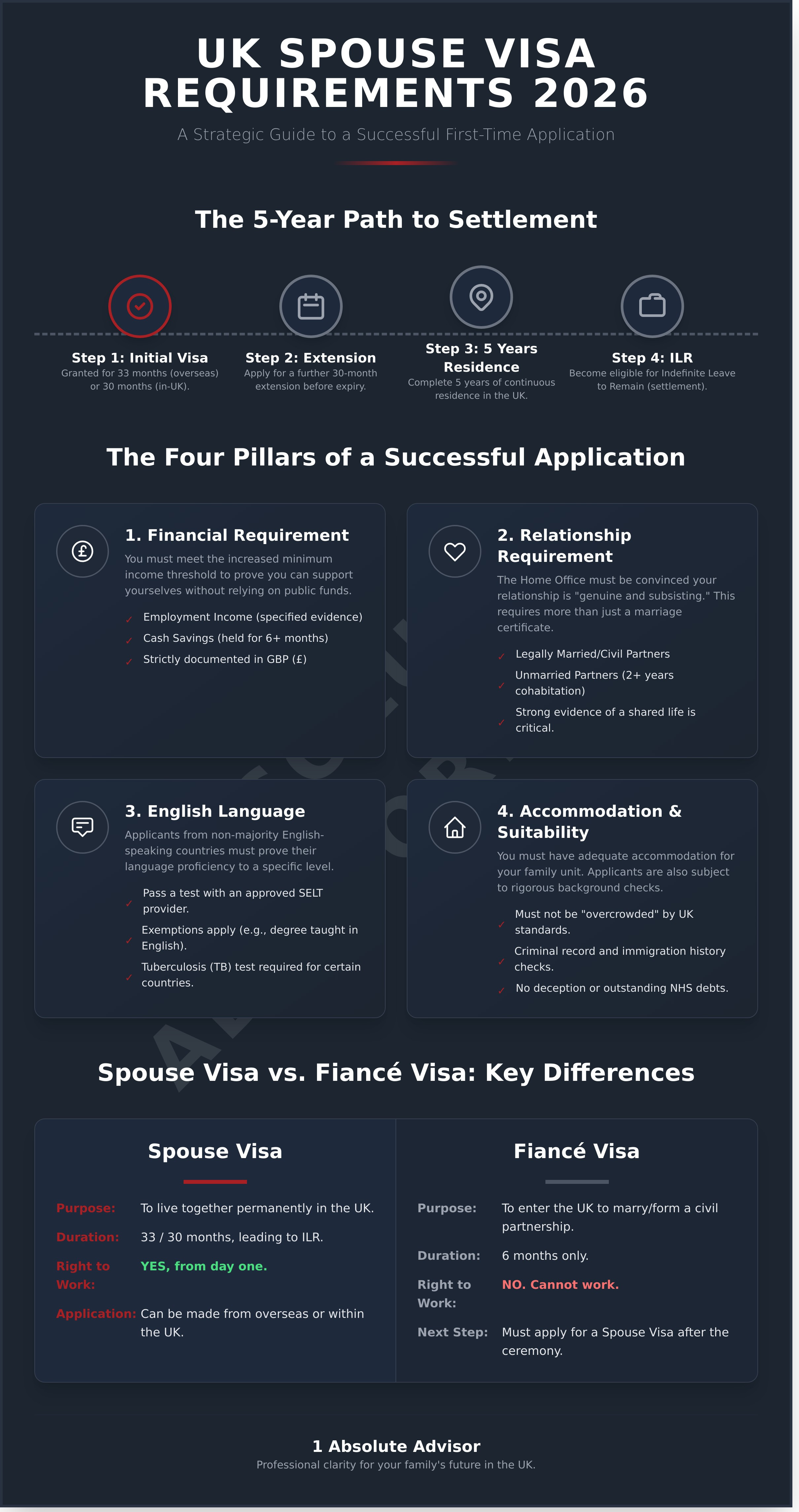
The journey is structured as a “probationary period.” Most successful applicants are granted an initial stay of 33 months (if applying from overseas) or 30 months (if applying from within the UK). After a further 30-month extension, and upon completing five years of continuous residence, the applicant may become eligible for Indefinite Leave to Remain (ILR), provided they continue to meet the uk spouse visa requirements 2026.
The Core Purpose of the Spouse Visa Route
The primary objective of this route is to facilitate genuine family life while ensuring that the incoming partner does not rely on public funds. Unlike the Fiancé Visa, which is a short-term entry clearance (6 months) intended for those planning to marry in the UK without the right to work, the Spouse Visa grants full rights to work and study from day one. This immediate access to the labor market is a critical component of the UK’s strategy to ensure that migrant families contribute actively to the national economy.
Eligibility Overview: The Four Pillars of Success
Achieving a successful outcome requires a holistic alignment with the four fundamental pillars of the application: Financial, Relationship, English Language, and Accommodation. The Home Office maintains a strict policy of compliance; failing to provide specified evidence for even one minor requirement leads to a mandatory refusal. Given the high-stakes nature of these applications and the substantial Home Office fees involved, seeking OISC-registered guidance is no longer a luxury but a strategic necessity to mitigate risk and ensure a seamless transition into UK society.
The Relationship and Suitability Requirements
To successfully navigate the uk spouse visa requirements 2026, applicants must first establish that their relationship is legally recognized and fundamentally “genuine and subsisting.” A marriage or civil partnership must be valid in the country where it took place and must not fall within prohibited degrees of relationship under UK law. Beyond the legal certificate, the Home Office subjects every application to a “suitability” assessment. This involves a rigorous review of the applicant’s background, including criminal convictions, previous immigration breaches, and outstanding NHS debts. Any evidence of deception in current or prior applications will lead to a mandatory refusal under the suitability criteria.
For those applying as unmarried partners in 2026, the standard remains proving a “relationship akin to marriage.” While the historical requirement for two years of cohabitation has seen more flexible interpretation for those with valid reasons for living apart, the burden of proof for a durable, committed bond is higher than ever. Following the official UK government guidance is essential to ensure your evidence meets the current threshold for durability.
Evidencing a Genuine and Subsisting Relationship
Caseworkers look for a narrative of a shared life rather than a collection of disparate documents. A well-structured relationship timeline should include:
Intermittent Evidence: Financial co-mingling, such as joint bank statements or shared utility bills.
Social Evidence: Photos spanning the duration of the relationship and logs of consistent communication (e.g., WhatsApp or call histories).
Travel History: Flight itineraries and passport stamps proving physical meetings, especially for long-distance couples.
For couples formalizing their union, high-quality visual records from specialists like Boutique Weddings can serve as compelling evidence that powerfully substantiates the relationship’s authenticity for the Home Office.
A common pitfall is providing “stale” evidence; the Home Office requires proof that the relationship is active and ongoing at the time of the decision.
The Accommodation Requirement
The sponsor must demonstrate that the couple will have “adequate” housing in the UK without recourse to additional public funds. The property must comply with the “no overcrowding” rule defined by the Housing Act 1985, which calculates a room-to-occupant ratio. To satisfy the uk spouse visa requirements 2026, you should provide:
A formal tenancy agreement or a Land Registry title deed.
A letter from the landlord or mortgage provider confirming no objection to the applicant’s residency.
A Property Inspection Report if the accommodation is shared with individuals other than the sponsor’s immediate family.
The 2026 Financial Requirement: Salary vs. Savings
The financial pillar remains the most scrutinized aspect of the uk spouse visa requirements 2026. Following the phased increases mandated by the Home Office, the minimum gross annual income threshold has stabilized at £38,700 for most new applicants. This benchmark reflects a strategic shift toward ensuring that sponsoring families possess the economic resilience to thrive in the UK without relying on public funds. Achieving compliance requires a meticulous approach to documenting income streams, which are strictly categorized by the authorities.
Most applicants rely on Category A or B (Employment), while business owners and directors must navigate the more complex Category F or G (Self-employment). For those receiving specific disability-related benefits, such as Personal Independence Payment (PIP) or Attendance Allowance, the “Adequate Maintenance” exception remains in place. This alternative focuses on the couple’s net income after housing costs, rather than the flat gross threshold. Understanding the nuances of these 2026 spouse visa financial requirements is essential for a successful, “absolute” submission that avoids the pitfalls of administrative refusal.
Employment Income Strategies
For salaried employees, the Home Office typically applies the “lowest payslip” rule under Category A. This means your annual income is calculated based on the lowest monthly salary received in the six months prior to application. Consistency is vital; even a minor, temporary reduction in hours can lead to a rejection if it pulls the calculated annual total below the £38,700 mark. While initial entry visas usually rely solely on the sponsor’s income, renewals and “switch” applications within the UK allow for the combined income of both partners to be utilized, providing greater flexibility for established households.
The Cash Savings Alternative
Cash savings (Category D) offer a robust alternative or supplement for those whose salaries fall short of the uk spouse visa requirements 2026. The formula for total savings required is currently (Threshold × 2.5) + £16,000. At the £38,700 threshold, an applicant would need £112,750 in accessible funds to meet the requirement through savings alone. Key compliance factors include:
The 6-Month Rule: Funds must have been held in a regulated financial institution for at least 182 days prior to application.
Source of Funds: You must provide a clear, documented trail of how the money was acquired (e.g., inheritance, property sale, or long-term savings).
Bridging the Gap: Savings above £16,000 can be used to “top up” a salary deficit, provided the math aligns precisely with Home Office calculations.
English Language and Tuberculosis Requirements
Beyond the financial criteria, achieving absolute compliance with the uk spouse visa requirements 2026 necessitates meeting specific personal benchmarks. These non-financial requirements-English language proficiency and medical clearance-are foundational to a successful application. Failure to provide the correct documentation from an approved provider can lead to immediate refusal, regardless of the strength of your financial evidence.
The SELT Pathway and Academic Qualifications
For an initial spouse visa application, the Home Office requires applicants to demonstrate English language proficiency at a minimum of CEFR Level A1 in speaking and listening. This must be achieved through a Secure English Language Test (SELT) provided by an approved body, such as IELTS SELT Consortium, Pearson, or LanguageCert.
Academic Alternative: If you hold a degree taught in English, you may bypass the SELT. However, degrees obtained outside the UK must be verified by Ecctis (formerly UK NARIC) to confirm they meet the UK standard and were indeed taught in English.
Validity and Strategy: While a Level A1 certificate is sufficient for the first entry, strategic planning suggests considering a higher level (A2 or B1) if your proficiency allows, as this may simplify future extension or Indefinite Leave to Remain (ILR) applications.
Exemptions: Applicants are exempt if they are aged 65 or over, have a long-term physical or mental disability that prevents them from meeting the requirement, or are nationals of a majority English-speaking country.
Tuberculosis (TB) Screening Protocol
The Home Office maintains a strict medical surveillance protocol for applicants from specific countries where tuberculosis is prevalent. If you have been resident in any of the listed countries for six months or more, a TB clearance certificate is a mandatory component of the uk spouse visa requirements 2026.
It is vital to note that you cannot obtain this certificate from a standard local GP. The screening must be conducted at a Home Office-approved clinic. The certificate is typically valid for six months from the date of the x-ray; therefore, timing your appointment is essential to ensure the clearance remains valid at the moment your application is submitted.
Ensuring every detail of your application is handled with professional precision is the key to a seamless transition. For a comprehensive review of your eligibility and strategic guidance, visit 1-absolute-advisor.com.
The Application Roadmap: From Document Checklist to BRP
Navigating the uk spouse visa requirements 2026 requires more than just collecting papers; it demands a methodical execution of the Home Office’s procedural roadmap. To ensure a seamless transition for your family, the application process should be viewed as a strategic operation, moving through five distinct phases.
Step 1: Strategic Document Gathering: Begin by creating a digital index of your evidence. Every bank statement, marriage certificate, and utility bill must be organized chronologically to demonstrate a clear narrative of your relationship and financial stability.
Step 2: Form Completion: You must complete the online VAF4A form if applying from outside the UK, or the FLR(M) form if you are already in the country and switching or extending your stay. Precision in these forms is non-negotiable.
Step 3: Financial Obligations: Payment of the Home Office application fee and the Immigration Health Surcharge (IHS) is required at the point of submission. Ensure your accounts are liquid and ready for these significant GBP (£) transactions.
Step 4: Biometrics and Uploading: Attend your appointment at a UKVCAS or VFS Global center to provide fingerprints and photographs. Concurrently, your digitally indexed documents must be uploaded to the official portal in high resolution.
Step 5: Decision and BRP: Following the decision period, successful applicants will receive their Biometric Residence Permit (BRP) or digital status, confirming their right to live and work in the UK.
Common Mistakes That Lead to Refusals
Even a minor oversight can jeopardize your future. The “28-day rule” is a frequent pitfall; your financial evidence and employer letters must be dated within 28 days of the online application submission. Furthermore, low-quality digital uploads can lead to delays or “missing evidence” notifications. Most critically, failure to disclose previous visa refusals or minor legal infractions-even those considered spent-can result in a refusal on “suitability” grounds, often carrying a long-term ban on future applications.
Why a London Advisor is Your Best Defense
In a landscape of shifting regulations, Absolute Advisor provides the “Absolute” advantage through a professional OISC-registered audit of your evidence. We don’t just check boxes; we draft a comprehensive Legal Cover Letter that serves as a roadmap for the Home Office caseworker, explicitly detailing how you satisfy every nuance of the uk spouse visa requirements 2026. By identifying potential weaknesses before submission, we transform a stressful administrative burden into a predictable, successful outcome.
Conclusion: Achieving Certainty in Your UK Spouse Visa Application
Navigating the evolving landscape of British immigration law requires more than just completing forms; it demands a strategic understanding of the uk spouse visa requirements 2026. From meeting the rigorous financial thresholds-whether through employment income or substantial savings-to providing indisputable evidence of a subsisting relationship, every detail must be precisely aligned with Home Office expectations. Meticulous preparation regarding English language proficiency and health clearances remains the cornerstone of a successful outcome in an increasingly complex regulatory environment.
At Absolute Advisor, our OISC Level 1 Registered Consultants provide the professional integrity and holistic oversight necessary to manage even the most intricate financial and relationship cases. We operate with absolute transparency, offering fixed-fee services with no hidden costs to ensure your peace of mind throughout the process. As your strategic partners, we ensure that your application is not only compliant but positioned for success. Do not leave your family’s future to chance; our specialists are here to provide the stability and expertise your case deserves.
Building a secure life also involves protecting your property. Once you are settled, especially if you plan to own a vehicle for commuting or family travel, it’s prudent to understand the best ways to keep it safe. To learn about advanced vehicle security options available in the UK, you can find out more.
Frequently Asked Questions
How much is the UK Spouse Visa fee in 2026?
As of 2026, the standard application fee for a UK Spouse Visa depends on the point of application. For individuals applying from outside the United Kingdom, the fee is £1,846. Conversely, those applying to switch or extend their stay from within the UK will encounter a fee of £1,048. It is essential to view these figures as the baseline cost, as they do not include the mandatory healthcare surcharge or potential priority processing fees required for an absolute guarantee of timely service.
Can I apply for a UK Spouse Visa from inside the UK?
Yes, you may apply from within the country provided you currently hold a valid visa that permits switching. Most long-term visa holders, such as those on Skilled Worker or Graduate visas, are eligible. However, you cannot switch to a spouse visa if you are in the UK on a visitor visa or have been granted leave for less than six months. Ensuring your current status aligns with the uk spouse visa requirements 2026 is a critical first step in your strategic residency planning.
How long does the UK Spouse Visa processing take in 2026?
Standard processing times for 2026 remain bifurcated based on the application location. Overseas applications typically receive a decision within 24 weeks (approximately 6 months), while internal applications are generally processed within 8 weeks. These timelines are contingent upon the submission of a complete and professionally structured evidence file. Any ambiguity in the documentation can lead to significant delays, making meticulous preparation a prerequisite for a predictable and successful outcome.
What happens if my UK Spouse Visa is refused?
In the event of a refusal, the Home Office will provide a formal decision letter detailing the specific grounds for the rejection. Most applicants are granted a right of appeal under Article 8 of the Human Rights Act. Navigating this process requires a sophisticated legal assessment to determine whether to pursue a lengthy appeal or to submit a fresh application that proactively addresses the initial deficiencies. Professional intervention at this stage is vital to mitigate further risk to your immigration history.
Do I need a lawyer for a UK Spouse Visa application?
While there is no statutory mandate to engage legal counsel, the complexity of the uk spouse visa requirements 2026 often warrants professional oversight. A specialist advisor acts as a strategic partner, ensuring that financial evidence, accommodation standards, and relationship proof meet the exacting “balance of probabilities” required by Home Office caseworkers. For many, this professional rigour provides the necessary security and peace of mind when navigating such a high-stakes financial and personal investment.
Can I combine my part-time job income with my savings?
Yes, the regulations allow for the combination of salaried income and cash savings to meet the minimum financial threshold. However, strict evidentiary rules apply; only savings held above the £16,000 baseline can be utilized to offset a shortfall in annual earnings. The calculation involves a precise formula where the income deficit is bridged by a specific ratio of savings. This holistic approach to meeting financial requirements demands careful accounting to ensure all figures are compliant with current immigration law.
What is the “Immigration Health Surcharge” (IHS) and how much is it?
The Immigration Health Surcharge (IHS) is a mandatory financial contribution that grants visa holders access to the National Health Service (NHS). For 2026, the surcharge is set at £1,035 per year for adults. Given that an initial Spouse Visa is typically granted for a period of 30 months, applicants must settle a total IHS payment of £2,587.50 at the time of application. This payment is a non-negotiable requirement for the visa to be processed and issued.
Is there a fast-track (Priority) service for Spouse Visas in 2026?
The Home Office continues to offer expedited processing through Priority and Super Priority services for applicants requiring a swift resolution. For an additional fee of £500, the Priority service aims to provide a decision within 30 working days for overseas applicants. Those applying within the UK may opt for the Super Priority service at a cost of £1,000, which typically secures a decision by the end of the next working day. These services offer a strategic advantage for those with urgent relocation requirements.