

Could a minor calculation error in your monthly payroll be the single factor that triggers a Home Office visa refusal in 2026? You likely understand that securing a talent pipeline is vital for your business growth, yet the shifting regulatory environment makes compliance feel like a moving target. Staying ahead of the uk skilled worker visa salary threshold 2026 requires more than just meeting a flat figure; it demands a strategic alignment with the latest Home Office directives. We recognize the pressure of ensuring every “going rate” calculation is flawless to avoid the costly disruption of a rejected application.
This guide will help you master these complex financial requirements, from the £41,700 baseline to the intricate new pay-period compliance rules, ensuring your visa applications remain beyond reproach. You’ll gain the confidence that your payroll structure meets every Home Office standard for 2026. We’ll examine the specific salary benchmarks for various SOC codes, clarify the impact of part-time work on eligibility, and outline the exact steps to secure a successful path to Indefinite Leave to Remain.
Key Takeaways
- Understand the new financial landscape for 2026, including the £41,700 baseline and the critical “whichever is higher” rule for occupation-specific rates.
- Learn how to accurately calculate your eligible pay according to the uk skilled worker visa salary threshold 2026, aligning your SOC code and contracted hours with Home Office requirements.
- Identify opportunities for lower entry points by utilizing salary discounts for New Entrants, PhD holders, or roles on the Immigration Salary List (ISL).
- Move beyond annual figures to master the strict new pay-period compliance standards mandated by the Statement of Changes HC 1691.
- Discover how a professional OISC-registered audit and legal cover letter can provide the absolute precision required to secure your visa approval.
Understanding the 2026 Skilled Worker Visa Salary Thresholds
The UK immigration framework has undergone substantial revisions to align with national economic objectives, placing a heavier emphasis on high-value skills and financial self-sufficiency. For sponsors and applicants alike, the uk skilled worker visa salary threshold 2026 serves as the primary benchmark for eligibility. This financial requirement ensures that international talent contributes effectively to the UK economy while maintaining a standard of living consistent with domestic professional roles.
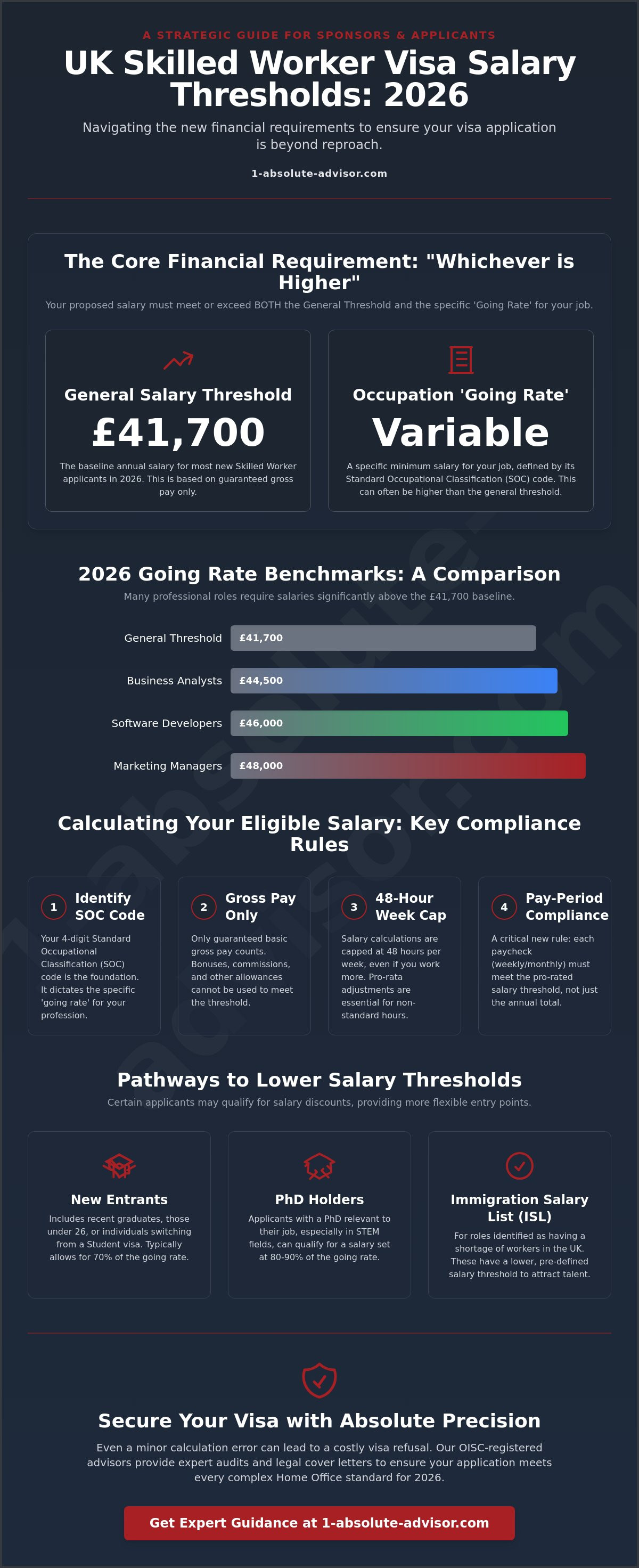
To understand the current requirements, it’s helpful to look at the history of the Skilled Worker visa and its predecessors. The system has evolved from a relatively flexible work permit regime into a rigorous, points-based structure where salary is a non-negotiable pillar. The 2026 rules mandate a “whichever is higher” approach. This means an applicant’s salary must meet or exceed both the general threshold and the specific “going rate” for their particular job role. Precision in these calculations is mandatory to avoid visa refusals or compliance issues for the sponsoring employer.
The General Salary Threshold for 2026
The baseline salary requirement for most new Skilled Worker applicants has risen to £41,700 per annum in 2026. This figure marks a calculated increase from the £38,700 threshold established in April 2024, reflecting inflationary pressures and the government’s commitment to a high-wage economy. This £41,700 figure applies to most “standard” applications where no specific salary discounts, such as those for New Entrants or Health and Care workers, are applicable.
It’s vital to recognize that this threshold only accounts for “guaranteed” basic gross pay. Employers cannot include bonuses, commission, or regional allowances to bridge a gap in the base salary. From a strategic planning perspective, businesses must ensure that the employment contract explicitly states a gross annual salary that meets this uk skilled worker visa salary threshold 2026 without relying on variable performance-related pay.
The “Going Rate” for Your Occupation
Meeting the general £41,700 threshold is only the first step in the financial assessment. The Home Office utilizes the SOC 2020 (Standard Occupational Classification) codes to determine the specific “going rate” for every eligible profession. If the going rate for a code is higher than the general threshold, the higher amount becomes the mandatory minimum.
For 2026, many professional roles require salaries significantly above the baseline:
- Software Developers: The going rate has climbed to approximately £46,000, reflecting the high demand for technical expertise.
- Marketing Managers: These roles often demand a minimum of £48,000 to satisfy the 50th percentile earnings requirement.
- Business Analysts: Requirements typically hover around £44,500 depending on the specific seniority level defined in the SOC code.
How to Calculate Your Eligible Salary for 2026
Determining your eligibility under the 2026 immigration rules requires a methodical approach to financial data. The Home Office utilizes a dual-check system where your earnings must satisfy both a general threshold and a job-specific going rate. To begin, you must identify your four-digit Standard Occupational Classification (SOC) code. This code is the foundation of your application, as it dictates the specific 2026 going rate for your profession. Once identified, you should cross-reference this against the official salary requirements to find the exact figure assigned to your role.
The next step involves calculating your gross annual salary based on your contracted hours. It’s vital to remember that the Home Office applies a strict 48-hour cap on salary calculations. If your contract specifies 50 hours per week, the income generated by those final two hours isn’t counted toward the threshold. Most calculations use a standard 37.5-hour week as a baseline. If your hours differ, you’ll need to apply pro-rata adjustments to ensure your figures align with the uk skilled worker visa salary threshold 2026, which is set at £41,700 for most applicants.
Compliance isn’t merely an annual concern; it’s a per-pay-period requirement. You must ensure that every paycheck, whether issued weekly or monthly, meets the pro-rated equivalent of the 2026 framework. Fluctuations in pay can lead to compliance issues during future audits or extension applications.
Pro-Rata Calculations for Part-Time Workers
Confusion often arises regarding how part-time work affects eligibility. The general threshold of £41,700 is an absolute floor; it’s not pro-rated downwards for part-time employees. However, the job-specific going rate is pro-rated. For instance, if a role has a going rate of £50,000 based on a 37.5-hour week, but you work 30 hours, your pro-rated going rate becomes £40,000. Even though you meet the pro-rated going rate, you’d still fail the application because your total earnings don’t reach the £41,700 absolute minimum. You must always satisfy the higher of the two figures regardless of your working hours.
Guaranteed Allowances vs. Excluded Benefits
The Home Office is specific about what constitutes “salary.” Your calculation can include basic gross pay and guaranteed, non-discretionary allowances that are paid in money. If an allowance is contingent on performance or is at the employer’s discretion, it’s excluded from the uk skilled worker visa salary threshold 2026 calculation.
Several common compensation elements are strictly disregarded, including:
- Overtime payments and commission.
- Performance-related bonuses or incentive pay.
- Regional weighting, such as London Allowance.
- Benefits in kind, including health insurance or gym memberships.
Complex shift patterns can further complicate these calculations for 2026. If your pay varies due to night shifts or weekend premiums, only the guaranteed base portion is typically reliable for visa purposes. For businesses managing diverse payroll structures, partnering with a specialist like Absolute Advisor ensures that your salary offers remain compliant with evolving immigration law.
Lower Salary Thresholds: ISL, New Entrants, and PhDs
The standard uk skilled worker visa salary threshold 2026 of £38,700 isn’t a universal requirement across all sectors. The Home Office recognizes that specific industries and career stages require more flexibility to maintain the UK’s global competitiveness. By utilizing salary discounts, employers can sponsor workers at lower rates, provided the role meets specific criteria. These reductions apply to either the “going rate” for the occupation code or the general threshold, depending on which figure remains higher after the discount is applied.
Qualifying as a New Entrant in 2026
The New Entrant category remains a vital pathway for recruiting junior talent and fresh perspectives. To qualify, an applicant must usually be under the age of 26, a recent graduate switching from a Student or Graduate visa, or working toward a recognized professional qualification. This status grants a 30% discount on the occupation’s going rate. However, there’s a strict 4-year limit on how long a worker can remain in this category; this includes any time already spent on a Graduate visa. For 2026, the absolute minimum salary floor for new entrants is set at £33,400. It’s a strategic entry point for firms looking to build long-term internal expertise without the immediate burden of the highest salary brackets.
The Immigration Salary List (ISL) Benefits
The Immigration Salary List replaced the old Shortage Occupation List to focus on roles where government intervention is sensible and sustainable. Roles on this list, such as specific civil engineering, laboratory technician, or niche creative positions, benefit from a 20% discount on the standard salary threshold. In 2026, this reduces the annual salary floor to £33,400. Beyond the lower pay requirements, being on the ISL is financially advantageous because it significantly reduces the visa application fees for both the sponsor and the applicant. This dual benefit makes ISL roles highly sought after for budget-conscious recruitment strategies in specialized fields.
PhD holders also access reduced thresholds to encourage high-level research and innovation within the UK. If a candidate holds a PhD relevant to their specific job role, they receive a 10% discount on the salary requirement. This discount increases to 20% if the qualification is in a STEM subject (Science, Technology, Engineering, or Mathematics). For those in the medical and social care fields, the rules are even more distinct. Eligible health and care workers often follow a specific £29,000 threshold, which is explained in detail within the latest NHS Skilled Worker visa guidance. These varied thresholds ensure that the UK’s financial requirements don’t block essential talent in research, healthcare, and public service. Understanding these nuances is critical for any business planning its 2026 recruitment budget, as it allows for significant cost optimization while remaining fully compliant with Home Office regulations.
The 2026 Pay-Period Framework: A New Compliance Standard
The introduction of the Statement of Changes HC 1691 has fundamentally shifted the landscape of UK immigration enforcement. It’s no longer sufficient for a business to simply promise a compliant annual salary in an employment contract. The Home Office now demands proof of compliance at every single touchpoint of the payroll cycle. This transition moves the focus from a theoretical yearly total to the actual, liquid earnings reported to HMRC through the Real Time Information (RTI) system. Under this framework, the uk skilled worker visa salary threshold 2026 is treated as a rigid, recurring obligation rather than a flexible annual target.
The Home Office uses sophisticated data-sharing protocols to audit salary compliance in real-time. By cross-referencing the figures on a worker’s Certificate of Sponsorship (CoS) with the data submitted by your payroll department to HMRC, they can identify “underpayment” the moment it happens. This automated oversight means that discrepancies which might have gone unnoticed in previous years are now flagged instantly, often triggering a compliance visit or a formal request for information without prior warning.
Complying with Pay-Period Requirements
The Home Office evaluates compliance based on the specific pay frequency defined in the employment agreement, whether that’s weekly, fortnightly, or monthly. Pay-period compliance requires every individual payslip to reflect the pro-rata minimum threshold. If an employee takes a few days of unpaid leave or reduces their hours during a specific month, their earnings might fall below the required pro-rata level. Even if their total annual pay eventually exceeds the £38,700 or £29,000 threshold, a single “underpaid” period creates a breach. Variable hours represent the highest risk for employers, as any fluctuation that brings the period total below the uk skilled worker visa salary threshold 2026 mandate results in immediate instability for the worker’s visa status.
Sponsor Licence Risks and Audits
Failing a pay-period check carries severe consequences for the employer’s Sponsor Licence. The link between payroll records and CoS validity is now absolute. If an audit reveals that a worker was paid less than the required pro-rata amount, the Home Office can suspend or even revoke the sponsor licence. This doesn’t just impact the individual worker; it puts the entire sponsored workforce at risk of having their visas shortened to 60 days. To avoid this, HR departments should implement “pre-payroll” audits. These checks ensure that no payslip is finalized if the gross pay doesn’t meet the pro-rata threshold for that specific period. Strategic management of unpaid absences and overtime is essential to maintain a clean compliance record.
Maintaining a perfect compliance record requires a proactive approach to payroll management and strategic foresight. To protect your business from the risks of licence revocation, you can consult with our strategic compliance team to audit your current systems and ensure you meet every requirement.
Securing Your Skilled Worker Visa with 1 Absolute Advisor
Success in a UK immigration application isn’t found in guesswork. It’s built on precision. Our OISC-registered advisors don’t just check boxes; they audit your entire salary structure to ensure compliance with the uk skilled worker visa salary threshold 2026. We scrutinize your gross annual pay, hourly rates, and specific SOC codes to prevent the common errors that lead to immediate rejection. This audit includes a deep dive into your contract to ensure that only eligible allowances are counted toward the threshold, protecting you from the risk of a refused Certificate of Sponsorship.
Complex pay structures often confuse Home Office caseworkers. We resolve this by providing a professionally drafted legal cover letter with every application. This document explains exactly how your salary meets the requirements, especially if you’re utilizing tradeable points for a PhD or a role on the Immigration Salary List. Our “Absolute” guarantee means your eligibility assessment is handled with the same rigor we apply to corporate tax compliance. We don’t just submit forms; we build a legal defense for your right to work in the UK.
From Work Visa to Permanent Residency
Securing your initial visa is just the first step in a longer journey. Maintaining the uk skilled worker visa salary threshold 2026 is vital for your future ILR UK application. We help you plan for settlement from day one. This strategic approach ensures your career progression and salary increases keep pace with the higher settlement thresholds required after five years. You can find more details on long-term planning in our Skilled Worker Visa UK 2026 guide. We ensure that every pay rise or job change is recorded correctly to avoid issues during your permanent residency application in 2031.
Our Fixed-Fee Application Management
Our fixed-fee management service provides a comprehensive solution for both employers and employees. We manage the entire lifecycle of the application, from the initial document check to the final submission. Our service includes:
- A full audit of your employment contract and salary breakdown.
- Calculation of pro-rata salaries for part-time workers to ensure they hit the £15.88 hourly minimum.
- Identification of potential hurdles, such as how maternity leave or unpaid absences might affect your threshold compliance.
- Direct communication with the Home Office on your behalf.
We identify salary hurdles before they lead to a refusal, saving you thousands in lost application fees. Book a consultation with our expert advisors today to secure your professional future in the UK with absolute certainty.
Mastering Your 2026 UK Immigration Strategy
Securing your professional future requires a precise alignment with the evolving uk skilled worker visa salary threshold 2026. Success depends on more than just meeting a base figure; it involves navigating the complex interplay between the Immigration Salary List (ISL), new entrant discounts, and the specific requirements for PhD-level roles. The 2026 pay-period framework introduces a strict compliance standard that demands absolute accuracy in how your earnings are structured and reported to the Home Office. Failing to account for these nuances can lead to avoidable delays or rejections.
You don’t have to manage these regulatory shifts alone. Our team of OISC Level 1 Registered Immigration Consultants maintains deep expertise in the HC 1691 and 2026 Statement of Changes, ensuring every detail of your application stands up to scrutiny. We provide a transparent, fixed-fee service with no hidden costs, allowing you to plan your move with total financial certainty. Secure your UK Skilled Worker Visa with 1 Absolute Advisor to transform these complex requirements into a clear path forward. Your career in the United Kingdom is a significant investment, and we’re here to ensure it’s built on a foundation of total compliance and professional integrity. Take the next step with confidence.
Frequently Asked Questions
What is the minimum salary for a UK Skilled Worker visa in 2026?
The standard minimum salary for most applicants in 2026 is £38,700, though this figure can vary based on your specific occupation’s going rate. Meeting the uk skilled worker visa salary threshold 2026 is a non-negotiable requirement for maintaining your sponsorship status. You must earn the higher of this baseline or the specific going rate for your SOC code to ensure your application’s success and long-term compliance.
Can I be paid less than £41,700 if I am switching from a Graduate visa?
Yes, you can be paid less than the standard threshold if you qualify as a “New Entrant” when switching from a Graduate visa. New Entrants typically receive a 30% discount on the standard salary requirement, which brings the minimum down to approximately £30,960 or 70% of the job’s going rate. This lower threshold only applies for a maximum of four years, including any time you’ve already spent on your Graduate visa.
How does the Home Office calculate salary for part-time workers in 2026?
The Home Office calculates part-time salaries by pro-rating the annual threshold based on a standard 37.5-hour working week. Even if your total annual earnings exceed the minimum, you’ve still got to meet the specific hourly rate requirement, which is currently £15.88 for most standard roles. If you work 20 hours per week, your salary is assessed against the hourly equivalent rather than just the gross annual figure to ensure fair pay.
What happens if my salary falls below the threshold during my visa period?
If your salary falls below the required uk skilled worker visa salary threshold 2026, your employer must notify the Home Office through the Sponsor Management System within 10 working days. This situation often leads to visa cancellation unless the reduction is due to specific permitted reasons like maternity or sick leave. We recommend a proactive compliance audit if you anticipate any structural changes to your compensation packages to avoid losing your right to work.
Are bonuses and overtime included in the Skilled Worker salary calculation?
Bonuses, overtime payments, and regional allowances aren’t included in the core salary calculation for your visa application. The Home Office only considers your guaranteed basic gross pay as stated on your Certificate of Sponsorship. If your base salary is £35,000 but you earn £10,000 in performance bonuses, you won’t meet a £38,700 threshold. It’s vital to ensure your contract specifies a high enough base rate to maintain your legal status.
Do I need to meet the same salary threshold to extend my visa in 2026?
You’ll need to meet the updated 2026 salary thresholds when extending your visa, unless you qualify under specific transitional arrangements for workers sponsored before April 4, 2024. Those under transitional rules usually face a lower threshold based on the 25th percentile rather than the 50th. However, most applicants in 2026 will need to align with the higher £38,700 or £41,700 benchmarks to secure their extension and continue their professional journey.
What is the “going rate” and where can I find it for my SOC code?
The “going rate” is the minimum salary the government sets for specific job roles, found in the SOC code tables of the UK Immigration Rules. You can locate your specific code in Appendix Skilled Occupations on the official GOV.UK website. Each code identifies the market rate for that profession. In 2026, you’re required to pay whichever is higher: the general threshold or the specific going rate for that individual SOC code.
Can I include my housing allowance in the £41,700 requirement?
You can’t include housing allowances or other benefits in kind to meet the £41,700 salary requirement. The Home Office strictly requires the uk skilled worker visa salary threshold 2026 to be met through gross basic pay alone. Any additional perks like relocation packages, health insurance, or accommodation subsidies are treated as separate from your qualifying income. Relying on these extras to reach the financial limit’ll result in a visa refusal or compliance issues.