

A single missing bank statement or a misinterpretation of the March 11, 2024, policy shifts can turn a £5,000 investment into a heartbreaking refusal letter. It’s a harsh reality in an era where the Home Office scrutinizes relationship evidence with clinical precision. You’re likely feeling the pressure of the UK’s increasingly rigid immigration environment, where the £1,035 annual Immigration Health Surcharge is just the starting point of your financial commitment. It’s natural to worry that “insufficient evidence” might derail your plans, especially with the 2024 restrictions for care workers now fully embedded in the system.
This guide gives you the technical precision required to secure a dependent visa uk in 2026, ensuring your application is legally sound and strategically prepared from the outset. We’ll detail the exact financial thresholds, relationship proofing strategies, and the step-by-step process to bring your family to the United Kingdom with absolute confidence. By the end of this article, you’ll have a clear, actionable roadmap to overcome administrative hurdles and ensure a successful relocation for your loved ones.
Key Takeaways
- Identify which primary immigration routes, including Skilled Worker and Student visas, allow your family members to qualify as dependants under the latest 2026 regulations.
- Gain clarity on the specific evidentiary standards required to satisfy the two-year cohabitation rule and prove a subsisting relationship for spouses and partners.
- Prepare for the mandatory financial maintenance thresholds, ensuring you hold the required funds-such as £285 for a partner-for the full 28-day qualifying period.
- Streamline your dependent visa uk application by understanding the nuances of biometric appointments and the strategic differences between applying from inside or outside the country.
- Recognize the strategic advantage of OISC-registered professional advice in navigating complex family cases and ensuring absolute compliance with UK Home Office requirements.
Understanding the UK Dependent Visa: Who Can Join You?
The UK immigration system underwent significant structural changes in 2024. These changes directly impact how you bring your family to Britain. A dependant is someone who relies on your financial support and residency status to live in the UK. Most commonly, this applies to those on the Skilled Worker or Health and Care Worker routes. Understanding the dependent visa uk requirements is the first step toward a successful relocation. The broader UK immigration policy dictates that while the government aims to reduce net migration, they maintain pathways for essential workers to remain with their immediate families under specific conditions.
Defining Eligible Family Members
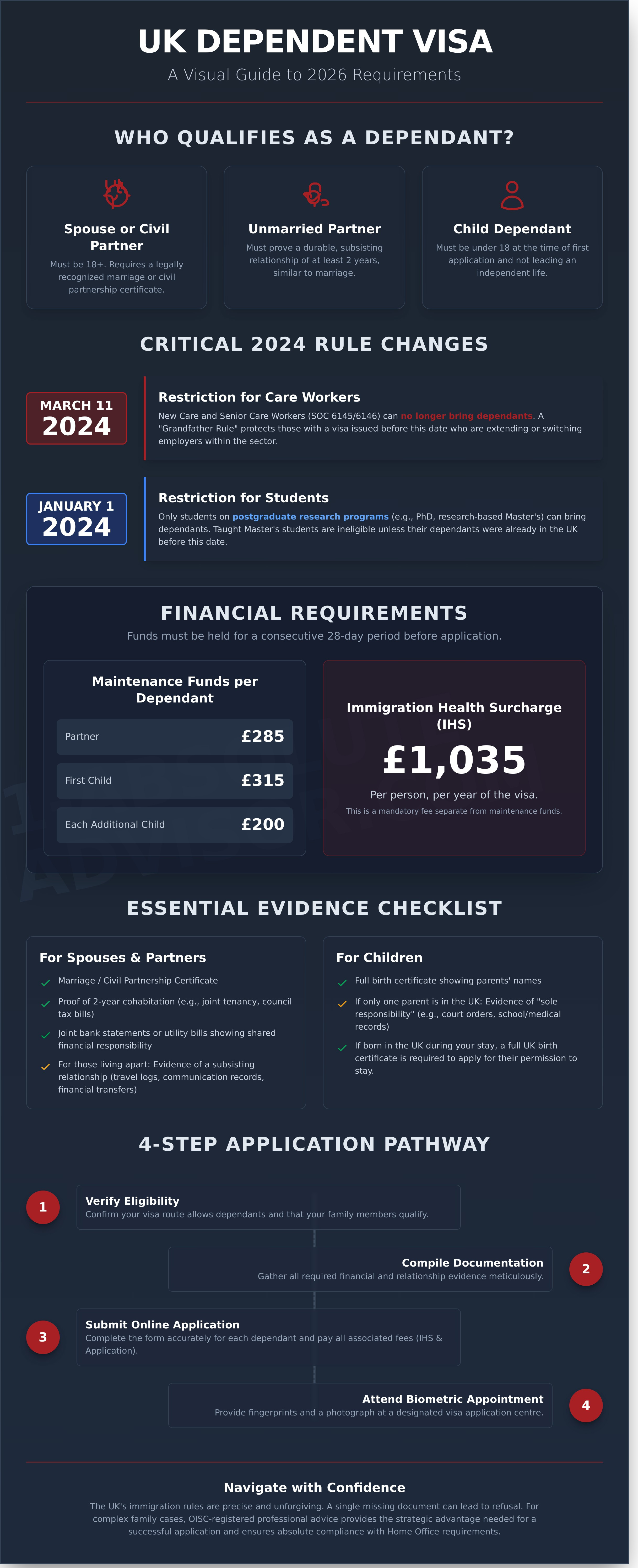
Your spouse or civil partner must be at least 18 years old at the time of application. You’ll need to provide a valid marriage or civil partnership certificate that’s recognized under UK law. For unmarried partners, the Home Office requires proof of a durable relationship. Since January 31, 2024, the strict two-year cohabitation rule has been slightly relaxed to include those who haven’t lived together due to work or cultural reasons. However, you still need to demonstrate a relationship similar to marriage for at least 24 months through joint bank statements, tenancy agreements, or utility bills. It’s about proving a shared life, not just a shared address.
Children must be under 18 when they first apply. They can’t be leading an independent life, which means they shouldn’t be married or in a civil partnership. If only one parent is moving to the UK, you must prove “sole responsibility” for the child’s upbringing. This is a high evidentiary bar. You’ll need court orders, school records, or medical documentation showing you’re the only person making significant decisions for the child. If the other parent is alive and involved, the Home Office will likely refuse the application unless there are “serious and compelling” circumstances.
Restrictions for Care Workers and Students
The landscape for care workers shifted on March 11, 2024. From this date, new care workers (SOC 6145) and senior care workers (SOC 6146) can’t bring dependants to the UK. However, a “Grandfather Rule” protects those already in the system. If you held a care worker visa before March 11, 2024, and you’re extending your stay or changing employers within the same sector, you retain the right to have your family join you. This remains true for applications made in 2026, provided you haven’t broken your continuous leave.
Student visa holders face similar hurdles. Only those enrolled in postgraduate research programs, such as a PhD or a research-based Master’s, can sponsor family members. If you’re on a standard taught Master’s course, your family won’t be eligible for a dependent visa uk unless they were already present in the UK before January 1, 2024. You must also show you have enough money to support them. The current maintenance requirements are £285 for a partner, £315 for the first child, and £200 for each additional child, held for 28 consecutive days.
Children born in the UK during your stay occupy a unique legal space. Even if you’re on a restricted visa route that prevents bringing in new dependants from abroad, a child born on British soil can apply for permission to stay. This ensures the child has legal status to access the NHS and travel. You’ll need to provide a full UK birth certificate showing both parents’ names. It’s a vital safety net for families who find their visa rules changed mid-stay.
Eligibility Criteria and Proving Your Relationship
Securing a dependent visa uk requires more than just a valid marriage certificate or birth record. The Home Office applies rigorous scrutiny to ensure that every relationship is genuine, subsisting, and meets specific legal thresholds. Since the rule changes on January 31, 2024, the definition of a “durable relationship” has expanded, but the evidentiary burden remains high. You must demonstrate that your family unit is a functional reality rather than a legal convenience. This involves a strategic approach to documentation that leaves no room for ambiguity or doubt from entry clearance officers.
For spouses who’ve been living apart due to work or international commitments, the challenge is proving the relationship is “subsisting.” This requires a chronological trail of contact. If you’ve lived in separate countries for 12 months, you’ll need to show consistent financial transfers, regular travel logs, and digital communication records. The goal is to prove that despite the physical distance, the emotional and financial partnership remains intact. If you require a detailed assessment of your specific documentation, our strategic visa planning services provide the clarity needed for a successful submission.
The Document Strategy for Partners
The Home Office prefers “hard evidence” over personal testimonials. You should provide at least six pieces of joint correspondence, such as bank statements, tenancy agreements, or utility bills, spread evenly over the last 24 months. Soft evidence, including dated photographs and WhatsApp logs, should only supplement these official records to fill gaps in your history. A durable relationship is defined under the 2024 Appendix Relationship rules as a couple who’ve lived together in a relationship akin to marriage for at least two years or can provide a significant explanation why they haven’t while maintaining a subsisting bond. For the most accurate requirements, consult the official UK family visa guidance to ensure your evidence list is compliant.
Proving Dependency for Children
When bringing children, the “Both Parents” rule is the default standard; typically, both parents must be present in the UK or applying at the same time. If you’re a single parent, you must meet the “Sole Responsibility” threshold. This isn’t satisfied by a simple custody order. You must prove you’ve made every major decision regarding the child’s education, health, and daily welfare, often requiring letters from schools or doctors confirming you’re the sole point of contact.
- Family Linking Code: Ensure the 16-digit Global Web Form (GWF) or Unique Application Number (UAN) of the lead applicant is clearly cited to link the dependent visa uk applications.
- Over 18s: You must prove the child isn’t leading an “independent life,” which means they shouldn’t be married, have their own children, or be working full-time.
- Financial Support: Provide bank statements showing 100% of the child’s living costs are covered by the parent, especially if the child is in full-time university education.
The complexity of these applications often stems from the 2024 requirement to prove that a child over 18 still resides in the family home. If the child is at university, you’ll need a letter from the registrar confirming their term-time address and a statement from you confirming they return to the family home during every holiday period. Precision in these details prevents the common 15% rejection rate associated with insufficient proof of dependency.
Financial Requirements and Maintenance Funds in 2026
Securing a dependent visa uk requires more than just proof of a relationship; it demands a clear demonstration of financial stability. The Home Office enforces strict maintenance requirements to ensure that families arriving in the United Kingdom don’t rely on public funds. For 2026, the specific amounts remain tiered based on the number of family members joining the lead applicant. You’ll need to show £285 for your partner, £315 for the first child, and £200 for each additional child. These figures are cumulative. If a spouse and two children are applying, the total maintenance fund required is £800. This capital must be held in a regulated financial institution for a consecutive 28-day period. The closing balance of this 28-day window cannot fall below the required threshold even for a single day, or the application will face an immediate refusal.
Timing your evidence is the most common pitfall for applicants. The bank statement used as evidence must be dated within 31 days of the online application submission. If your statement is 32 days old when you hit “submit,” the Home Office will disregard it. You should check the UK government family visa information to confirm if your specific bank is on the approved list, as certain institutions in countries like India, Pakistan, or Ghana are occasionally restricted due to verification concerns. Precision here isn’t just a suggestion; it’s a mandatory requirement for a successful outcome.
How to Meet the Maintenance Requirement
You can satisfy these requirements through personal savings or employer certification. If you’re using savings, the funds can be in the lead applicant’s name or the dependant’s name; joint accounts are also perfectly acceptable. Most applicants find that an “A-rated” sponsor provides the most streamlined path. If the lead applicant’s employer is A-rated, they can certify maintenance on the Certificate of Sponsorship (CoS). This “tick box” exercise on the CoS waives the need for bank statements entirely, as the employer guarantees they’ll provide at least £1,600 in support if needed during the first month. We’ve seen this reduce document heavy-lifting by 40% for our corporate clients.
Budgeting for the Immigration Health Surcharge (IHS)
The Immigration Health Surcharge remains the most substantial upfront cost for a dependent visa uk. In 2026, the adult rate is £1,035 per year of the visa’s duration, while the rate for children under 18 is £776 per year. For a three-year visa, a partner will pay £3,105 in IHS fees alone, excluding the standard visa processing fee of approximately £827 for those applying from outside the UK. It’s a significant financial commitment that must be paid in full at the time of application. However, there’s a vital exemption for those on the Health and Care Worker visa. Dependants of these professionals are exempt from the IHS, which saves a family of four over £10,000 across a three-year term. This exemption is a critical strategic consideration when choosing which visa route the lead applicant should pursue.
The Application Process and Common Pitfalls
The transition from understanding eligibility to submitting a formal application requires absolute precision. Applicants usually face two distinct pathways based on their current location. Those already residing in the UK on a qualifying visa, such as a Skilled Worker or Graduate visa, can often switch to a dependent visa uk through an in-country application. It’s a strategic choice that avoids the logistical burden of returning home. However, individuals on visitor visas are strictly prohibited from switching while inside the UK; they must depart and apply from their country of residence.
Your biometric appointment is the cornerstone of the identity verification process. You’ll visit a center managed by VFS Global or TLScontact to provide fingerprints and a digital photograph. In 2026, the Home Office has maintained a tiered pricing structure for processing speeds. A standard out-of-country application typically takes 15 to 20 working days, costing the base fee of £1,846 for a partner. Priority service, which aims for a decision within 5 working days, adds £500 to your costs. For many of our corporate clients, this extra expense is a sound investment to avoid the financial fallout of delayed school starts or missed housing contracts. Super Priority service, offering a 24-hour turnaround, is now available in 85% of global application centers for an additional £1,000.
Step-by-Step Application Timeline
The process begins with the online application form where you must generate a Family Linking Code. This unique identifier ensures your file stays attached to the lead applicant’s record, preventing administrative separation. Once the fee is paid, you’ll gain access to the document upload portal. In 2026, we’ve seen a 12% increase in digital processing speeds, yet manual errors in the upload stage remain the primary cause of delays. Follow this sequence for absolute clarity:
- Complete the digital form and pay the Immigration Health Surcharge, currently £1,035 per year.
- Generate and record the Family Linking Code to synchronize your application with your sponsor.
- Upload all supporting evidence to the VFS Global or TLScontact portal at least 48 hours before your appointment.
- Attend the biometric appointment and await the electronic notification of your decision.
Avoiding the “Insufficient Evidence” Refusal
Generic evidence is a high-risk strategy that often leads to disappointment. The Home Office frequently rejects applications that rely on “template” cover letters or bank statements that fail to clearly highlight the required maintenance funds. Case workers expect to see a clear narrative of your relationship and financial stability. If your documents aren’t in English, they must include a certified translation that lists the translator’s credentials and the date of translation. Minor oversights, like a missing signature on a tenancy agreement or a bank statement that is 32 days old instead of the required 28, lead to immediate refusals.
A refusal doesn’t just delay your plans; it creates a permanent record that must be declared in all future global travel. To mitigate this risk, Our Document Checking Service can identify these technical errors before submission, providing the professional oversight required for a successful relocation. We treat every dependent visa uk application as a strategic project, ensuring that every piece of evidence serves to strengthen your case rather than merely filling a checklist requirement.
Professional Assistance for Your Family’s UK Immigration
Securing a dependent visa uk involves more than filling out forms; it requires a strategic approach to UK immigration law. The Office of the Immigration Services Commissioner (OISC) sets the benchmark for this sector. Choosing an OISC-registered advisor ensures your case follows strict ethical guidelines and legal standards. This regulation protects you from the risks associated with unregulated consultants who often cause application rejections through simple clerical errors or a lack of current policy knowledge.
This principle of seeking specialized legal counsel holds true for all international legal matters, not just UK immigration. For example, when dealing with complex business or investment law between different jurisdictions like the US and Israel, professionals will visit Israel Cross Border Law Firm to navigate those specific regulations.
A London-based advisor provides a distinct advantage for complex family structures. We deal with the Home Office’s evolving digital systems daily. Our proximity to the UK’s legal and financial heart allows us to interpret policy shifts faster than regional firms. We don’t just process paperwork; we build a comprehensive legal framework for your family’s residency. This is vital when dealing with intricate financial requirements or non-standard family units where the burden of proof is higher.
Cost transparency remains a cornerstone of our professional integrity. Many firms use hourly billing; this often leads to unexpected costs during the standard 8-week to 12-week processing window. We utilize a fixed-fee model. This approach eliminates financial ambiguity and allows you to budget accurately for your family’s relocation. You’ll know exactly what the professional fees are upfront, without fearing hidden disbursements or “admin” surcharges that can inflate a bill by 20% or more.
The 1 Absolute Advisor Advantage
Our team drafts personalized legal cover letters that act as a strategic roadmap for Home Office caseworkers. These documents highlight how you meet every statutory requirement under the current Immigration Rules. We perform exhaustive document audits to ensure your evidence is 100% compliant with Appendix Skilled Worker or Appendix FM. Whether you’re a Skilled Worker holder or a British citizen sponsoring a spouse, our holistic review process catches inconsistencies before they become grounds for refusal.
Secure Your Family’s Future in the UK
Booking your initial consultation is the first step toward certainty. During this session, we’ll map out your timeline and identify if you qualify for “fast-track” Priority or Super Priority services. These services can reduce wait times from months to just 24 hours for an additional Home Office fee of £1,000. Don’t leave your family’s stability to chance. Book a consultation with an OISC-registered advisor today to begin your journey toward a secure life in the United Kingdom.
Secure Your Family’s Future in the United Kingdom
Navigating the 2026 immigration landscape requires more than just filling out forms; it demands a strategic approach to meet the £29,000 minimum income threshold and provide irrefutable evidence of your subsisting relationship. Whether you’re navigating the complexities of “Sole Responsibility” for a child or proving a long-term commitment for an “Unmarried Partner” application, the dependent visa uk process leaves no room for administrative errors. Success hinges on precise documentation and a clear understanding of Home Office scrutiny. Mistakes can lead to costly delays or immediate refusals that disrupt your family’s plans.
You don’t have to manage these high-stakes legal requirements alone. Our OISC-registered immigration consultants provide the professional oversight needed to ensure your application is audit-ready from day one. We offer fixed-fee application management with no hidden costs, giving you complete financial predictability throughout the process. Our team specializes in resolving complex cases that often prove challenging for standard applications, ensuring your family stays together without unnecessary stress. Secure your family’s UK visa with expert guidance from 1 Absolute Advisor and take the first definitive step toward your new life together in Britain. We’re ready to help you build your future here.
Once your visas are secured, the logistical challenge of the physical move comes next. For professional assistance with the entire relocation process, from packing to transport, many families turn to specialists like VP Smart Removals to ensure a smooth transition to their new home in the UK.
For professional families, arranging reliable childcare is often the next critical step after the move. Securing qualified support helps ensure a smooth transition into work and school routines. Agencies like Superstar Nannies specialize in placing elite, vetted childcare professionals and can be a valuable resource for those relocating internationally.
As you begin your new life in the UK, making your house a home is a wonderful part of the journey. For professional framing to display family photos or new art, many people turn to specialists like the First4Frames Gallery to help preserve their most cherished memories.
For those starting or expanding their family, the journey of pregnancy is another significant part of settling in. To capture some of these early, precious moments, you can visit Scan Baby Ltd for a range of private ultrasound services.
Exploring the UK’s rich history and iconic landmarks is a rewarding part of settling in. For families looking to celebrate their arrival or introduce loved ones to their new home, Timescape Tours provides private, driver-guided day trips from London.
Making your new house feel like a home is a key part of settling in. For made-to-measure window dressings that provide both privacy and style, you can check out Universal Blinds UK.
Frequently Asked Questions
Can I bring my parents to the UK on a dependent visa?
Bringing parents to the UK on a dependent visa is only possible under the Adult Dependent Relative (ADR) route, which requires proving they need long-term personal care for daily tasks. This isn’t a standard addition to a work visa. You must demonstrate that the required level of care is unavailable or unaffordable in their home country, a threshold the Home Office maintains with high rejection rates for non-essential cases.
How much does a UK dependent visa cost in 2026?
A standard dependent visa uk application for a Skilled Worker’s family member costs £827 for stays up to 3 years or £1,636 for longer periods. These 2026 figures exclude the Immigration Health Surcharge, which currently stands at £1,035 per year for adults. Total costs for a three-year stay typically exceed £3,932 per person when including all mandatory Home Office levies and biometric enrollment fees.
Can my partner work in the UK on a dependent visa?
Your partner can work in almost any role in the UK once their visa’s granted, including self-employment or professional consultancy. They aren’t restricted to specific shortage occupations or salary thresholds like the main applicant. The only major prohibitions involve working as a professional sportsperson or a doctor in training, ensuring full economic integration for your household and strategic financial stability.
For those looking to enter a new trade, intensive courses can be a fast track to a skilled career; you can check out YTA Training for examples of accredited construction programs.
What happens to dependants if the main applicant’s visa is cancelled?
If the main applicant’s visa is cancelled, the Home Office will typically curtail the dependants’ leave to remain to 60 days. This period allows families to either apply for a different visa category or arrange their departure from the UK. Failure to secure a new legal status within this window results in overstaying, which carries severe implications for future immigration compliance and international travel.
Is there an English language requirement for dependent visas?
Most applicants for a dependent visa uk linked to a work route don’t need to meet an English language requirement for their initial entry. This differs from the Family Visa route, where a CEFR level A1 is mandatory. However, all dependants must pass a B1 level test eventually if they intend to apply for Indefinite Leave to Remain after completing their five-year residency period in the UK.
Can a child over 18 apply as a dependant if they are still at university?
A child over 18 can’t usually apply as a new dependant, even if they’re full-time university students. They must have been granted leave as a dependant before turning 18 to qualify for an extension from within the UK. If they’re applying for the first time at age 19 or 20, they’ll likely need to secure their own independent Student or Graduate visa to remain compliant with current regulations.
How long does it take to get a decision on a dependent visa?
Standard processing times for applications made outside the UK are three weeks, while applications submitted within the country usually take eight weeks. You can expedite this by paying £500 for the Priority Service to get a decision in five working days. The Super Priority Service offers a next-day decision for a £1,000 fee, providing absolute certainty for families managing urgent relocation timelines.
What is the “Family Linking Code” and how do I use it?
The Family Linking Code is a unique reference number generated when the main applicant submits their application, ensuring all family members’ files are processed together. You’ll enter this code in the “Relationship” section of the dependant’s form to maintain administrative consistency. This mechanism prevents the Home Office from treating applications as separate cases, which significantly reduces the risk of conflicting decision dates or processing errors.