

In 2024, Home Office data suggested that nearly one in five family visa applications faced complications or refusals because of minor evidentiary gaps. You’re likely concerned about meeting the £29,000 minimum income requirement while risking a non-refundable £1,846 application fee on a process that feels increasingly opaque. It’s stressful to manage months of document collection when your future together rests on a caseworker’s interpretation of complex rules. Understanding exactly how to apply for a uk spouse visa in this environment requires a methodical, professional approach that leaves no room for ambiguity.
This definitive 2026 roadmap is designed to move your application from a state of uncertainty to a successful Home Office approval. We’ll provide the clarity you need to master the latest financial mandates and document standards, ensuring your submission is legally sound from the start. Our guide outlines the precise steps to secure your reunion in the UK, replacing the anxiety of the standard 24 week processing window with the confidence of professional validation. We will break down the specific requirements for income, housing, and relationship proof to ensure your path to residency is clear and efficient.
Key Takeaways
- Navigate the 2026 financial landscape by mastering the £29,000 minimum income threshold through the strategic use of employment, savings, or pension evidence.
- Follow our comprehensive, phase-based roadmap on how to apply for a uk spouse visa to ensure your application moves seamlessly from eligibility audit to final submission.
- Identify and avoid the “technical” pitfalls, such as the 28-day rule and specific document formatting, that frequently lead to Home Office refusals.
- Learn how to build a robust evidentiary portfolio that proves the authenticity of your relationship beyond a simple marriage certificate.
- Understand the strategic value of professional legal support in mitigating the emotional and financial risks of a visa rejection through an absolute commitment to compliance.
Understanding the UK Spouse Visa Landscape in 2026
The UK Spouse Visa, officially governed by Appendix FM of the Immigration Rules, serves as the primary gateway for partners of British citizens or settled persons to establish a life in the United Kingdom. In 2026, this route is defined by a rigorous assessment of financial stability and relationship authenticity. Applicants receive an initial grant of 30 months. To reach Indefinite Leave to Remain (ILR), you must complete a five-year probationary period, typically involving a second 30-month extension. Understanding how to apply for a uk spouse visa requires a strategic approach to the current UK visa and immigration policy, which prioritizes high-income thresholds and indisputable documentary evidence.
The landscape changed significantly following the 2024 financial reforms. The minimum income requirement now stands at £38,700 for most new applicants. This figure ensures that families can support themselves without relying on public funds. If you’re relying solely on cash savings to meet this requirement, the necessary amount is £102,750. These figures aren’t suggestions; they’re absolute benchmarks. Caseworkers at the Home Office don’t have the discretion to overlook a shortfall of even a few pounds. This rigid environment means your application must be “front-loaded” with perfect evidence. In 2026, the Home Office rarely requests missing documents. Instead, they issue a refusal, forcing applicants into costly appeals or fresh applications.
Who qualifies as a ‘Partner’ under the current rules?
UK law recognizes three distinct partner categories. Legal marriages and civil partnerships must be legally valid in the country they took place. Fiancés and proposed civil partners are granted a 6-month entry visa to marry within the UK. Once married, they must apply to switch to the 2.5-year spouse route. For unmarried partners, the 2026 rules follow the 2024 reform that removed the mandatory two-year cohabitation requirement. You can qualify if you’ve been in a relationship for at least two years and can prove it’s “genuine and subsisting” through shared financial responsibilities, joint travel, or parental duties.
The ‘Absolute’ importance of OISC registration
Immigration advice in the UK is a regulated activity. The Office of the Immigration Services Commissioner (OISC) ensures that advisors are competent and act in the best interests of their clients. Using unregulated “ghost” advisors carries massive risks. These individuals often lack professional indemnity insurance and have no accountability if your application is rejected due to their errors. 1 Absolute Advisor operates with strict OISC compliance in London, providing the high-level expertise required to navigate 2026’s complex requirements. We focus on the precision of your evidence to ensure your path to settlement is secure and predictable.
Success in 2026 depends on more than just meeting the criteria; it requires presenting a narrative of compliance that a caseworker cannot challenge. Every bank statement, employer letter, and relationship proof must align perfectly with the Home Office’s internal guidance. When you’re researching how to apply for a uk spouse visa, remember that the burden of proof lies entirely with you. A single inconsistency in your 12-month financial history or a missing translation for a foreign document can result in a life-changing refusal. Our role is to ensure that your application reflects the stability and integrity the Home Office demands.
The Four Pillars of Spouse Visa Eligibility
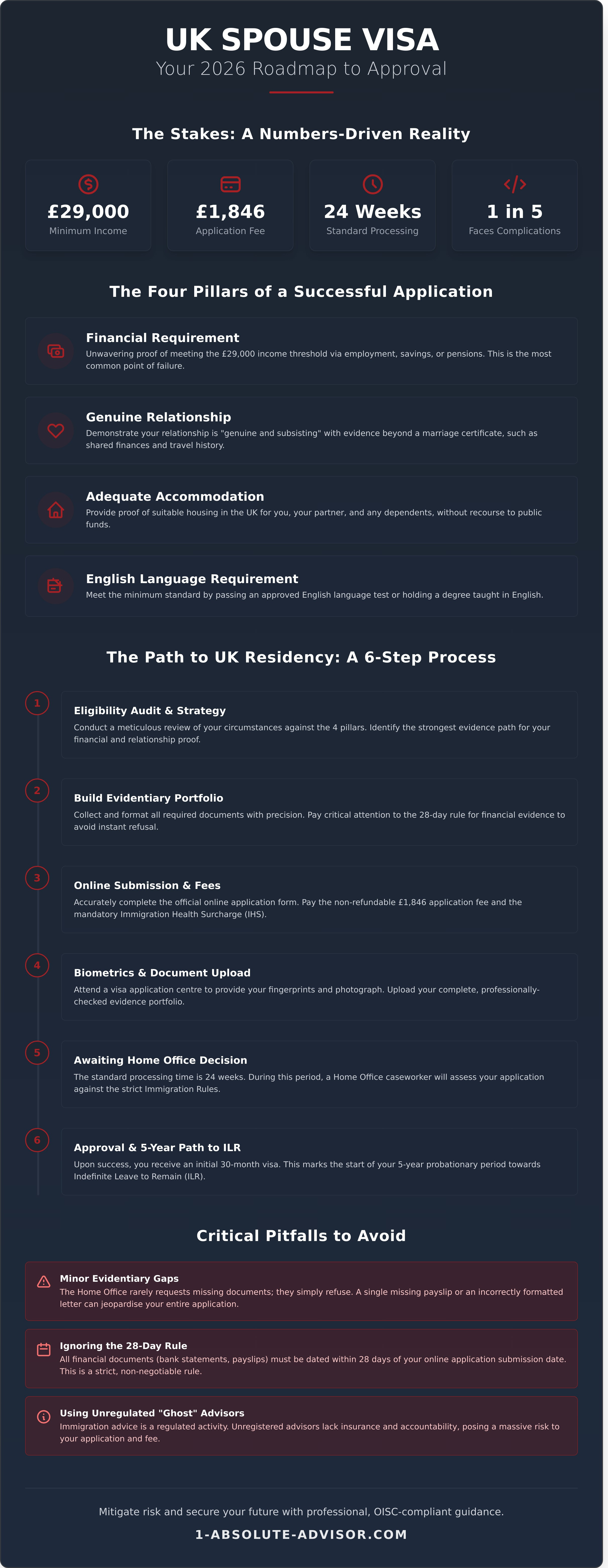
Securing a successful outcome requires more than a valid marriage certificate. The Home Office evaluates every application against four rigid criteria that demand objective, verifiable evidence. Understanding how to apply for a uk spouse visa involves mastering these pillars to ensure your submission is beyond reproach. Since the rules changed on April 11, 2024, the complexity of these requirements has increased, making a strategic approach essential for 2026 applicants.
The financial requirement remains the most frequent cause of refusal. Currently, the minimum income threshold stands at £29,000 per annum. This figure must be met by the UK-based sponsor alone or through the combined income of both partners if the applicant is already working legally in the UK. You can verify the specific categories of permitted income in the official UK spouse visa guidance to ensure your sources are eligible for consideration.
Navigating the 2026 Financial Thresholds
Applicants often struggle to bridge the gap between their salary and the £29,000 requirement. You can use cash savings to supplement a shortfall in earnings, provided those funds have been held for at least six months. The specific formula for meeting the requirement through cash savings alone is (Threshold x 2.5) + £16,000. For those receiving Personal Independence Payment (PIP) or Carer’s Allowance, the ‘Adequate Maintenance’ test applies instead, which calculates whether the family has enough to live on after housing costs are paid.
Beyond meeting the threshold, demonstrating overall financial stability can strengthen your application. Professional credit consulting services, such as those offered by Allen & Allen, Inc., can be instrumental in helping applicants organize and improve their financial profiles long before submission.
Proving a ‘Genuine and Subsisting’ Relationship
The Home Office looks for a “genuine and subsisting” connection that exists independently of the visa application. Caseworkers prioritize high-quality evidence like joint tenancy agreements, shared bank accounts, or birth certificates of children. While digital communication is necessary, submitting 500 pages of WhatsApp logs often backfires; it suggests a lack of substantive proof and may lead a caseworker to overlook more critical documents. A curated selection of 10 to 15 pages of chat history, spaced over the duration of the relationship, is far more effective.
Intervening letters from third parties play a supporting role in this process. Statements from family members or close friends can corroborate your history together, though they shouldn’t be the foundation of your case. These letters must include the author’s contact details and a brief description of how they know the couple. Strategic planning ensures your application remains robust against Home Office scrutiny; our advisory services provide the clarity needed for these complex evidentiary requirements.
- English Language: Most applicants must pass a CEFR A1 level test in speaking and listening. You must use an approved provider like IELTS SELT Consortium or Pearson PTE.
- Accommodation: Your UK home must not be ‘overcrowded’ under Part X of the Housing Act 1985. This means having enough rooms for the number of occupants, excluding kitchens and bathrooms.
- Tuberculosis (TB) Testing: If you’re applying from a country on the Home Office’s specified list, a clear TB certificate from a clinic approved by the UK government is mandatory.
Failure to meet even one of these pillars results in an automatic refusal. When you’re learning how to apply for a uk spouse visa, precision is your greatest asset. Every document must be dated within 28 days of the application submission to be considered valid. This “28-day rule” is a common trap that disqualifies otherwise perfect applications by making financial statements or employer letters technically expired in the eyes of the Home Office.
Why Applications Fail: Common Pitfalls and Strategic Fixes
Success in understanding how to apply for a uk spouse visa depends less on the strength of your relationship and more on your ability to follow rigid procedural protocols. Home Office data suggests that administrative errors, rather than a lack of genuine intent, account for a significant portion of the 15% of family visa applications refused annually. These failures often stem from a misunderstanding of what constitutes “specified evidence” under Appendix FM-SE of the Immigration Rules. Caseworkers don’t have the discretion to overlook missing formats, even if the underlying facts are true.
The 28-day rule remains the most frequent cause of rejection. Every piece of financial evidence, including your most recent bank statement and payslip, must be dated within 28 days of the date you submit and pay for your online application. If your statement is dated 29 days before submission, the caseworker will likely refuse the application without requesting further information. This precision is non-negotiable; there’s no margin for error when dealing with Home Office deadlines or the “freshness” of your evidence.
Document quality also triggers refusals. All non-English documents require a certified translation that includes the translator’s credentials, their contact details, and a signed declaration that it’s a “true and accurate translation of the original.” You’ll find the full list of requirements in the official UK government guidance on spouse visas. Additionally, failing to disclose historical issues is a critical mistake. Forgetting a £100 speeding fine from 2021 or a previous visa refusal from five years ago can be interpreted as “deception.” Under Paragraph 9.7.1 of the Immigration Rules, this leads to a mandatory refusal and a potential 10-year ban from entering the UK.
The Financial Evidence Trap
The Home Office requires absolute mathematical consistency. If your payslip shows a net deposit of £2,450.55, your bank statement must show an identical credit of £2,450.55. Even a discrepancy of a few pence can lead to a rejection. For those employed by a company, your employer’s letter must explicitly state your gross annual salary, how long you’ve been at that salary level, and the type of contract you hold. Missing just one of these mandatory phrases is a common reason for failure in 2024.
Self-employed applicants face even higher hurdles under Category F or Category G. These applications require a full financial year of evidence, including CT600 tax returns and evidence of registration with HMRC. We often see clients provide personal bank statements but forget the business bank statements, which is a fatal error when you’re trying to prove the source of your income to the Home Office.
The ‘Good Character’ and Suitability Requirement
Suitability isn’t just about serious crime. The Home Office examines your entire history, including unpaid NHS debts over £500 or litigation history. If you’ve had a visa refusal in the past, don’t ignore it. You must address it head-on in a professional cover letter. This letter acts as your strategic voice, explaining the context of past issues and demonstrating why you meet the current requirements despite previous setbacks.
In complex cases where the strict rules aren’t met, such as when the £29,000 income threshold is narrowly missed, we look to Article 8 of the European Convention on Human Rights. This involves arguing that a refusal would result in “unjustifiably harsh consequences” for the family unit. These arguments are powerful but require high-level legal substantiation rather than simple emotional appeals to ensure the application succeeds.
Step-by-Step Roadmap: How to Apply for a UK Spouse Visa
Success in a UK spouse visa application depends on a methodical, evidence-led approach. You can’t afford mistakes in a system that’s increasingly automated and rigid. The process is a strategic operation that transforms your personal life into a compliant legal file. Understanding how to apply for a uk spouse visa requires looking past the forms and focusing on the underlying evidentiary requirements that the Home Office demands.
The application journey follows five distinct phases:
- Phase 1: Eligibility Audit. This is the absolute assessment of your standing. You must prove you meet the £29,000 minimum income threshold. If you’re relying on savings, you need £88,500 held untouched for six months. We analyze your relationship history to ensure it meets the “genuine and subsisting” criteria.
- Phase 2: Document Gathering. You’ll create a digital vault of evidence. Every claim you make must have a corresponding document. This includes 6 months of bank statements, a housing report, and proof of your English language ability at level A1 or higher.
- Phase 3: Online Submission. You complete the Appendix FM form on the GOV.UK portal. This is where you pay the mandatory fees.
- Phase 4: Biometrics and Uploading. You’ll visit a VFS Global or TLScontact center. Here, your fingerprints and photo are taken. You also upload your digital vault to their secure server.
- Phase 5: The Decision Wait. In 2026, standard processing remains at 12 weeks. Priority services can reduce this to 30 working days for an additional fee.
The Online Application and IHS Fee
The financial commitment is substantial and non-refundable in most cases. For an application submitted from outside the UK, the visa fee is £1,846. You must also factor in the Immigration Health Surcharge (IHS), which currently stands at £1,035 per year. Since the initial spouse visa is granted for 2.5 years, the IHS total is £2,587.50. This brings your baseline cost to £4,433.50. When you click ‘Submit’ and pay these fees, your legal status is “locked in.” Any evidence you provide must be dated before this specific moment to be considered valid by the caseworker.
Biometrics and Document Uploading
Once the online form is finished, you transition to the commercial partner portal. You’ll choose between self-uploading your documents or paying for assisted scanning at the center. Self-uploading is the safer choice for detail-oriented applicants; it ensures you see exactly what the Home Office sees. At the appointment, the staff will scan your passport and capture your biometrics. If you need to travel during the 12-week wait, the ‘Keep My Passport’ service is available for approximately £75. This allows you to retain your document until the final decision is reached, preventing you from being grounded during the processing window.
Managing these moving parts requires a partner who understands the high stakes involved in family relocation. Our team provides the stability and technical precision needed to secure your future in the UK.
Consult with an Absolute Advisor expert
Securing Your Future: Why Professional Legal Support Matters
A refusal letter from the Home Office is more than a bureaucratic hurdle. It represents a forced separation of partners and a significant financial loss that many families struggle to recover from quickly. With the standard application fee currently set at £1,846 for overseas applicants, a single mistake becomes an expensive lesson. We’ve observed that approximately 15% of self-submitted applications face rejection or lengthy delays simply because of evidentiary gaps that a trained legal eye would have identified in minutes. The emotional toll of a “no” often outweighs the financial cost, creating months of uncertainty and stress. This challenge isn’t unique to the UK; English-speaking expats worldwide find that navigating local bureaucracy is best handled by specialists, such as the SALIOR Law Office for those in Israel.
Understanding how to apply for a uk spouse visa requires navigating over 100 pages of evolving Home Office guidance. 1 Absolute Advisor transforms this process from a basic exercise in form-filling into a robust professional legal representation. We don’t just submit papers; we construct a comprehensive legal argument that demonstrates your absolute compliance with every nuance of the law. This approach shifts the burden of proof from your shoulders to our expertise, ensuring that your case is presented with the authority that Entry Clearance Officers respect.
Our ‘Absolute’ Document Check serves as a final, high-level audit of your entire file. By 2026, the transition to fully digital border systems and the shifting income thresholds, currently set at £29,000, demand 100% precision. We verify every bank statement, wage slip, and employer letter against the strict requirements of Appendix FM-SE. If a document is missing a specific phrase or a date is outside the 28-day rule, we catch it before the Home Office does. This meticulous attention to detail is why our success rate remains at the top of the industry.
We view your initial application as the first step in a strategic five-year journey. Our advisors plan for your Indefinite Leave to Remain (ILR) and eventual British Citizenship from day one. By 2029, the rules governing your stay may change again, but our long-term roadmap ensures you’re always prepared for the next stage. We help you maintain the specific records needed for your extension, making the transition from a spouse visa holder to a British citizen a predictable, managed process rather than a series of disconnected hurdles.
Our Fixed-Fee Promise
Transparency is the cornerstone of our advisory service. We provide a clear, fixed-fee structure so you don’t have to worry about hourly billing or unexpected costs. Our full management service handles everything from initial assessment to final submission, while our document checking service offers a cost-effective alternative for those who’ve prepared their own files but require a professional sign-off. You’ll know exactly what you’re paying before we begin any work. Book your initial consultation with our London experts to secure your family’s future today.
Fast-Track and Complex Case Mastery
When time is the most critical factor, we utilize the Home Office ‘Super Priority’ service to secure decisions within 24 hours. Our team excels in handling complex scenarios, including “outside the rules” applications based on exceptional circumstances or human rights claims. If you’ve previously faced a rejection, we provide the technical expertise needed for administrative reviews to overturn incorrect decisions. You can read more in our guide on Challenging a UK Visa Refusal to understand your options for recovery and success.
Take the Next Step Toward Your Life Together
Navigating the Home Office requirements in 2026 requires more than just filling out forms; it demands a strategic approach to the £29,000 minimum income threshold and rigorous document evidence. You now understand the four pillars of eligibility and the common pitfalls that lead to many DIY applications facing initial rejection. Mastering how to apply for a uk spouse visa means balancing complex financial data with a clear narrative of your relationship’s subsisting nature. Every detail matters when your family’s future is on the line.
Success shouldn’t be left to chance. Our London advisors provide the stability and professional integrity you need to navigate these high stakes. As an OISC Level 1 Registered firm (F202100345), we specialize in complex financial requirements and offer a fixed-fee guarantee with no hidden costs. We don’t just process paperwork; we act as your strategic partner to ensure your family’s future is built on a compliant, secure foundation. It’s about getting it right the first time.
Secure your UK Spouse Visa with our expert London advisors and begin your journey with absolute confidence. Your new chapter in the United Kingdom is within reach.
Frequently Asked Questions
How much income do I need for a UK Spouse Visa in 2026?
You must demonstrate a minimum gross annual income of £38,700 to meet the financial requirement for a UK Spouse Visa in 2026. This figure follows the Home Office’s phased increase strategy designed to ensure financial independence for all migrating families. If you’re sponsoring children, this amount doesn’t increase under the current rules, but you must still prove the core threshold is met through salaried or non-salaried income.
Can I use my own savings to meet the financial requirement?
You can use personal savings to meet the financial requirement, provided the funds have been held in a regulated account for at least 6 months. To satisfy the £38,700 threshold entirely through savings, you’ll need a total of £112,750. You can also combine savings over £16,000 with your annual salary to bridge a shortfall, which provides flexibility for applicants with diverse asset portfolios and investments.
How long does the UK Spouse Visa application take to process?
Standard processing times for a UK Spouse Visa typically range from 12 to 24 weeks for applications made outside the UK. Applications submitted within the country usually receive a decision within 8 weeks of the biometric appointment. You can expedite this process by opting for the Priority Service at a cost of £500, which aims for a decision within 30 working days. Planning your move 6 months in advance is recommended.
What happens if my UK Spouse Visa is refused?
You have the right to appeal a refusal through the First-tier Tribunal within 28 days if you applied from outside the UK. If the refusal stems from a simple document omission, submitting a fresh application is often faster than a long legal appeal. Data suggests that 15% of applications are rejected due to insufficient evidence, so a thorough review of your financial proofs is essential before you submit.
Do I need to be married to apply for a UK Partner Visa?
You don’t need to be married if you’ve lived with your partner for at least 2 years in a relationship akin to marriage. This unmarried partner route requires 24 months of evidence, such as joint bank statements or tenancy agreements. Understanding these distinctions is a critical part of learning how to apply for a uk spouse visa while ensuring your specific domestic situation meets the Home Office’s strict evidentiary criteria.
Can I work in the UK on a Spouse Visa?
You’re fully entitled to work or study in the UK once your Spouse Visa is approved. Unlike some other visa categories, there are no restrictions on your employment type or the number of hours you can work each week. This right extends for the duration of your 33-month initial leave, allowing you to build a career and contribute to the UK economy immediately upon arrival without needing further sponsorship.
How much is the Immigration Health Surcharge (IHS) in 2026?
The Immigration Health Surcharge (IHS) for 2026 is £1,035 per year for each adult applicant. For a standard 33-month Spouse Visa, you’ll pay a total of £3,105 at the time of your application. This mandatory payment ensures you have full access to National Health Service (NHS) facilities on the same basis as a permanent resident. It’s a non-negotiable cost that you must factor into your total relocation budget.
What is the ‘adequate maintenance’ test for a Spouse Visa?
The ‘adequate maintenance’ test is an alternative financial requirement for sponsors receiving specific benefits like Personal Independence Payment or Carer’s Allowance. You must prove that your weekly income, after paying for housing, is at least £142.25 for a couple. This calculation replaces the standard £38,700 threshold. It’s a vital pathway for many families figuring out how to apply for a uk spouse visa when they can’t meet the standard salary rules.