

Imagine receiving an email on a Tuesday morning informing you that your employer has entered insolvency, and your first thought isn’t about your redundancy pay, but your legal right to remain in the country. It’s a moment of profound uncertainty that thousands of skilled workers face annually. You’re likely asking, “what happens to my visa if my sponsor goes into administration” and feeling the pressure of an invisible clock ticking. We understand that your career and residency are at stake, and the fear of immediate deportation can be overwhelming when you’ve built a life in the UK.
You aren’t alone in this concern, as many professionals wrongly assume their leave to remain expires the moment a company collapses. This guide provides the absolute clarity you need to manage this transition with confidence. We’ll explain the 60-day curtailment period, the specific steps to secure a new Certificate of Sponsorship, and how to assess alternative visa routes before your current status expires. By following this 2026 roadmap and using resources like SafeKeep to organise your vital documents and life admin, you can transform a corporate crisis into a manageable professional transition while maintaining your legal standing and peace of mind.
Key Takeaways
- Understand the critical 60-day curtailment period and why your timeline for action only begins once you receive an official notification letter from the Home Office.
- Learn to distinguish between company administration and liquidation to determine the immediate risk level to your sponsorship and your future residency in the UK.
- Discover exactly what happens to my visa if my sponsor goes into administration and how to navigate this transition while maintaining full legal compliance.
- Identify the strategic steps for securing a new “Visa-Ready” employer and obtaining a fresh Certificate of Sponsorship (CoS) to protect your professional status.
- Recognise why professional legal support is essential for managing Home Office communications and avoiding the procedural errors that often lead to visa refusals.
Understanding Sponsor Administration and Your Visa Status
When a UK company enters the legal process of administration, it means the business has become insolvent and is now placed under the control of a licensed insolvency practitioner. For a sponsored worker, this creates immediate professional and personal uncertainty. You’re likely asking: what happens to my visa if my sponsor goes into administration? While the situation is serious, it doesn’t mean your right to remain in the UK vanishes instantly. Administration is designed to rescue the company as a going concern or achieve a better result for creditors than liquidation, meaning there’s often a window where the business continues to operate.
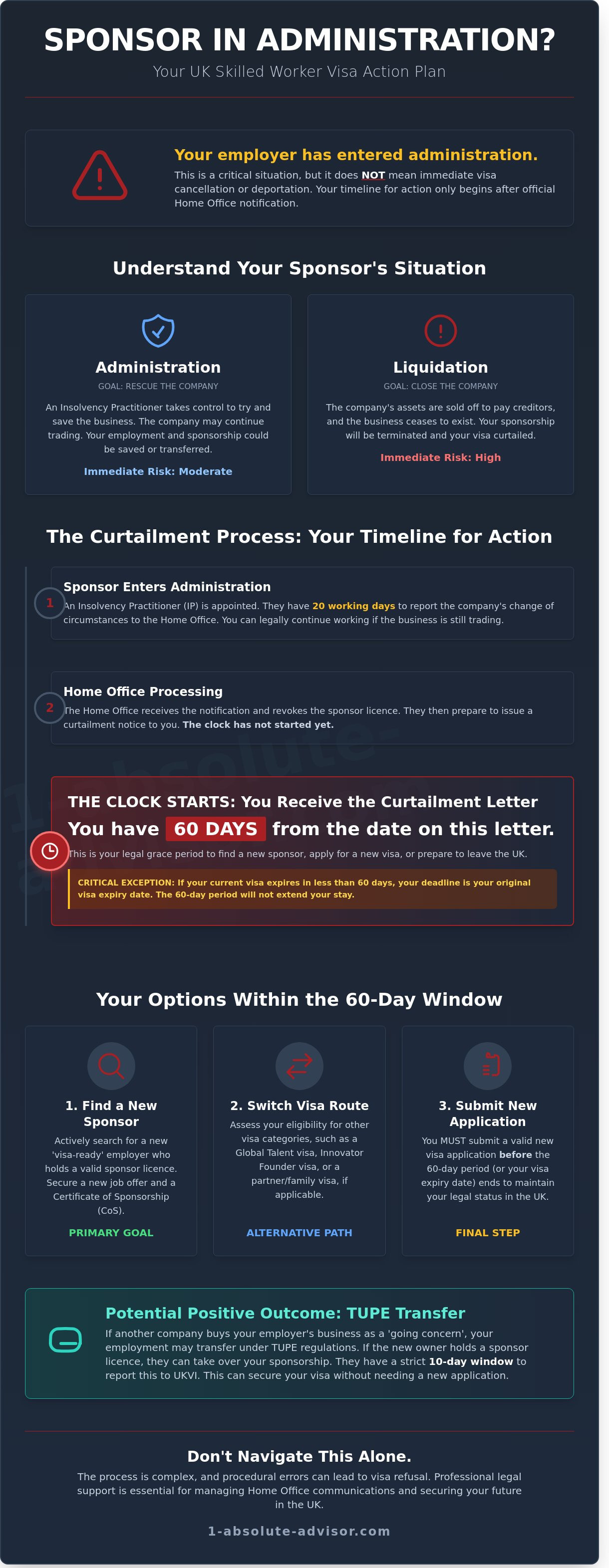
The Home Office requires all Skilled Worker sponsors to maintain specific financial and ethical standards. When a firm enters administration, its ability to honour its sponsorship duties is scrutinised. If the company eventually stops trading or loses its licence, your Certificate of Sponsorship (CoS) becomes invalid. However, you shouldn’t panic. The UKVI curtailment process isn’t instantaneous. You’ll typically receive a formal letter giving you 60 days to find a new sponsor or depart the UK, but this only happens after the Home Office is officially notified and processes the change. You won’t be deported the same day the administrators walk through the door.
The Role of the Insolvency Practitioner
Once appointed, the insolvency practitioner (IP) replaces the company’s directors in making all key decisions. They’re now responsible for your employment status and the company’s compliance duties. Under UKVI rules, the IP has a duty to report the change in the company’s circumstances to the Home Office within 20 working days. You should maintain regular contact with your HR department or the IP’s team during this transition. They’re legally bound to inform you if your role is being made redundant or if the sponsorship licence is being surrendered, which directly affects what happens to my visa if my sponsor goes into administration.
Your Right to Work During Early-Stage Administration
You can usually continue working while the company is “in the red,” provided the business is still trading and the administrators haven’t terminated your contract. If a new buyer acquires the company, your employment may transfer under the Transfer of Undertakings (Protection of Employment) Regulations, commonly known as TUPE. In these instances, the new owner has a strict 10-day window to report the business sale to UKVI. If they hold a valid sponsor licence, they can often take over your sponsorship, ensuring your visa remains secure without you needing to file a fresh application from outside the country.
The 60-Day Curtailment Rule: Your Timeline for Action
When a UK company enters insolvency or administration, its ability to sponsor migrant workers effectively ceases. According to the official Home Office guidance, the Home Office will usually revoke the sponsor licence once the organisation stops trading or undergoes a significant change in ownership that doesn’t involve a TUPE transfer. This triggers a process known as curtailment, which shortens your leave to remain. Understanding what happens to my visa if my sponsor goes into administration is vital for maintaining your lawful status.
The standard procedure provides you with a 60-day window to either find a new sponsor and submit a fresh visa application or leave the UK. It’s a common misconception that this countdown begins the moment the company enters administration. In reality, the 60-day period only starts from the date printed on the official curtailment notice sent to you by the Home Office. During this legal grace period, you’re permitted to remain in the country and search for new employment, though you cannot start working for a new employer until your new visa application is granted.
There’s a critical exception to the 60-day rule. If your current visa was already set to expire in less than 60 days, the Home Office won’t extend your stay. Your deadline remains your original visa expiry date. Acting quickly is essential, as the administrative process for issuing these notices can be unpredictable. If you’re concerned about your specific timeline, seeking professional immigration advice can help clarify your options before the notice arrives.
Receiving the Curtailment Letter
The Home Office typically sends curtailment notices via email or post. Delays are frequent; it can take several weeks or even months for the Home Office to process the sponsor’s insolvency report and issue your letter. You must ensure your contact details are up to date on the UKVI system. If you’ve moved house or changed your email address without notifying them, you might miss the notice, leading to an accidental overstay. If you know your employer has closed but haven’t received a letter, don’t assume your visa is safe. The 60-day limit is a hard deadline once issued, and “I didn’t receive the letter” is rarely accepted as a valid legal defence for overstaying.
Travel Restrictions During Curtailment
Leaving the UK during the curtailment period is exceptionally risky. While your visa remains technically valid for those 60 days, it’s “curtailed,” meaning it’s no longer backed by an active sponsor. If you exit the Common Travel Area, you’ll likely be refused re-entry at the border. Border Force officers can see the status of your sponsor licence in their system. If the licence is revoked, your right to enter the UK on that specific visa effectively ends the moment you clear passport control outbound. For urgent family matters abroad, you should consult a legal expert to explore if a Change of Conditions or a priority visa application is a safer route than attempting to travel on a compromised visa.
How Different Types of Insolvency Affect Your Sponsorship
The legal framework governing insolvency determines the timeline and security of your visa status. While administration aims to rescue a business as a going concern, liquidation focuses on winding up operations and distributing assets to creditors. Understanding these distinctions is vital for assessing what happens to my visa if my sponsor goes into administration. Administration often provides a temporary breathing space where the company continues to trade, whereas liquidation is far more urgent and usually signals the immediate end of your sponsorship.
A Company Voluntary Arrangement (CVA) represents the most hopeful path for a sponsored worker. This is a formal agreement with creditors that allows a company to pay its debts over a fixed period. Because the business continues to exist as the same legal entity, the sponsor licence often remains intact. However, the Home Office must be notified of the CVA. They’ll assess if the company can still meet its sponsorship obligations. According to the official Home Office guidance on sponsor insolvency, a sponsor must report these changes within 20 working days via the Sponsor Management System (SMS).
In cases of compulsory or voluntary liquidation, the business ceases to trade, which makes licence revocation almost inevitable. If the Home Office chooses to suspend a licence instead of revoking it immediately, it’s usually to allow for an investigation. During a suspension, you can generally continue working, but the employer cannot issue any new Certificates of Sponsorship (CoS) or recruit new migrant workers.
When the Sponsor Licence is Revoked
TUPE Transfers and New Sponsors
If another company buys your employer out of administration, the Transfer of Undertakings (Protection of Employment) regulations, or TUPE, may protect your job. While your contract moves to the new owner, your visa sponsorship doesn’t transfer automatically. In the global business landscape, professional brokerage firms like Bravo Kilo Advisors help manage the complexities of M&A and company sales. The new employer has a strict 28-day window to apply for a sponsor licence if they don’t already hold one. If the new owner refuses to take on your sponsorship or fails to meet the Home Office requirements, your role will no longer be visa-compliant. In this situation, you’ll need to secure a new sponsor or change your visa category to remain in the UK legally.
Navigating Your Options: Finding a New Sponsor or Switching Routes
Understanding what happens to my visa if my sponsor goes into administration is the first step toward securing your future in the UK. Once the Home Office identifies that your employer is no longer trading, they’ll typically issue a curtailment letter. This notice usually shortens your remaining leave to 60 days. This window is your primary opportunity to either secure a new sponsor or transition to a different immigration category. You shouldn’t wait for the letter to arrive; proactivity is your most significant asset in this scenario.
The Search for a New Sponsor
Finding a “Visa-Ready” employer requires a targeted approach. You should immediately consult the Home Office Register of Licensed Sponsors, which currently lists over 100,000 organisations authorised to employ foreign workers. When you approach these companies, it’s vital to frame your situation transparently. Explain that your current sponsor has entered administration, a business event entirely outside your control. This positioning ensures you don’t appear as a “high-risk” candidate, but rather as a proven professional who’s available due to corporate restructuring. To further strengthen your profile during this critical period, you can explore Reputation Intelligence to ensure your digital presence accurately reflects your professional value.
The logistics of moving to a new employer involve obtaining a fresh Certificate of Sponsorship (CoS). Your new employer must assign this to you before you can submit a “Change of Employment” application. Speed is essential because you must complete this process before your 60-day curtailment period ends. The standard Home Office fee for a Skilled Worker visa (up to three years) is currently £827, and you’ll also need to account for the Immigration Health Surcharge, which stands at £1,035 per year.
Switching to Family or Residency Routes
If you’re hesitant to rely on another corporate sponsor, alternative routes might provide more stability. For those with a British or settled partner, switching to a UK Spouse Visa is often a logical move. This path grants you the right to work for any employer without needing individual sponsorship, effectively “future-proofing” your residency against corporate insolvency.
- Indefinite Leave to Remain (ILR): If you’re nearing the five-year mark on your current route, you should verify your eligibility for Indefinite Leave to Remain (ILR). The Home Office generally doesn’t penalise applicants for brief gaps in employment caused by a sponsor’s administration, provided a new application is lodged promptly.
- Global Talent Visa: This is an excellent option for leaders or potential leaders in fields like tech, science, or the arts, as it requires no specific employer sponsorship.
- Graduate Visa: If you recently completed a degree in the UK, you might be eligible for a two-year unsponsored stay.
The Home Office views your status during the administration process through the lens of continuous lawful residence. As long as you submit a valid application for a new visa before your current leave expires, your right to remain in the UK is protected under Section 3C of the Immigration Act 1971. This legal safeguard ensures you aren’t considered an overstayer while your new application is being processed.
Consult with our absolute experts today to determine which visa route offers the most secure path for your specific professional circumstances.
Securing Your Future in the UK with Professional Legal Support
When a company enters insolvency, the Home Office typically grants a 60-day grace period for visa holders to secure new employment or switch categories. Attempting a DIY visa switch during this high-pressure window often results in refusal. Errors in documentation or failing to account for the specific nuances of the sponsor’s insolvency can lead to a permanent mark on your record. 1 Absolute Advisor manages every aspect of communication with the Home Office to ensure your status remains protected while you focus on your next career move.
Understanding what happens to my visa if my sponsor goes into administration requires a strategic look at the 60-day deadline. We conduct a rigorous audit of your documents well before this limit expires. Our team identifies potential pitfalls in your application that could lead to administrative silence or immediate curtailment. We offer fast-track services for those who need to secure a new Certificate of Sponsorship (CoS) urgently, often within a matter of days.
Expert Guidance for Complex Transitions
Our consultants analyse your eligibility across multiple UK immigration routes to find the safest path forward. We don’t just fill out forms; we draft detailed legal cover letters that explain the technicalities of the sponsor’s administration to Home Office caseworkers. This level of detail is essential to maintain a clean immigration history. It ensures that your journey towards Indefinite Leave to Remain (ILR) or British citizenship isn’t derailed by circumstances outside your control.
Take Control of Your Immigration Status
Working with an OISC-registered consultant provides the professional integrity needed during a corporate crisis. Company collapses are chaotic, but your legal strategy shouldn’t be. We reduce the personal stress of redundancy by providing a clear, step-by-step roadmap for your transition. Our approach focuses on long-term stability and compliance rather than short-term fixes.
- Immediate Eligibility Assessment: We review your qualifications for Skilled Worker, Global Talent, or High Potential Individual routes.
- Direct Home Office Liaison: We act as your formal representative, handling all enquiries and notifications regarding your sponsor’s status.
- Fast-Track Processing: For urgent cases, we prioritise your application to meet strict employment start dates.
Don’t leave your right to stay in the country to chance. Contact 1 Absolute Advisor for a priority consultation to discuss what happens to my visa if my sponsor goes into administration and secure your professional future in the UK.
Securing Your Right to Remain in the UK
Navigating the uncertainty of corporate insolvency requires immediate attention to Home Office timelines. The 60-day curtailment rule remains a rigid boundary for Skilled Worker visa holders, meaning you must secure a new sponsor or switch routes before this window closes. Understanding what happens to my visa if my sponsor goes into administration is the first step toward stability, but execution is what preserves your future. Whether your employer faces administration or full liquidation, the Home Office typically updates the register of licensed sponsors within days of the formal insolvency filing.
Success in these complex Skilled Worker transitions depends on precision and speed. At 1 Absolute Advisor, our OISC Registered Immigration Consultants provide fixed-fee visa management services to ensure your application meets every regulatory requirement without hidden costs. We act as your strategic partner, identifying alternative pathways and managing the transition to a new employer before your current leave expires. Don’t leave your status to chance when professional intervention can secure your position in the UK.
Book an Urgent Consultation to Protect Your UK Visa Status
Frequently Asked Questions
How long can I stay in the UK if my sponsor goes into administration?
You’ll typically have 60 days to find a new sponsor or leave the UK once the Home Office issues a formal curtailment notice. This period starts from the date on the letter, not the date the company enters administration. If your current visa expires in less than 60 days, the original expiry date remains your final deadline. Understanding what happens to my visa if my sponsor goes into administration is vital for planning your next strategic move.
Can I start working for a new employer immediately if my current sponsor fails?
You can’t start working for a new employer until you’ve secured a new Certificate of Sponsorship and submitted a valid visa application. Under current Home Office regulations, you must wait for your new leave to remain to be granted or for specific “start work” conditions to be met. Moving to a new role without this formal approval constitutes illegal working, which jeopardises your future eligibility for Indefinite Leave to Remain.
Do I need to tell the Home Office if my company is in administration?
You aren’t personally required to notify the Home Office of the administration, as this responsibility lies with the court-appointed insolvency practitioner. They’re legally mandated to report the change in circumstances within 10 working days via the Sponsor Management System. However, you should proactively monitor your correspondence. Once the Home Office processes the report, they’ll send a formal notice detailing what happens to my visa if my sponsor goes into administration.
What happens to my dependents if my visa is curtailed?
Your dependents’ immigration status is directly linked to your own, so their leave will be curtailed in line with yours. If your visa is reduced to 60 days, your partner and children will receive similar notices and must act within the same timeframe. They’ll need to be included in any new application you make for a different visa route, such as a new Skilled Worker visa, to remain in the UK legally.
Can I switch to a Spouse Visa if my Skilled Worker sponsor goes bust?
You can switch to a Spouse Visa from within the UK if your partner is a British citizen or has settled status. You must meet the financial requirement, which rose to £29,000 on 11 April 2024, and provide evidence of a genuine relationship. This route offers more long-term security than the Skilled Worker path. It removes the dependency on a specific corporate sponsor for your residency rights and provides a stable foundation for your future.
Will I be banned from the UK if I stay past the 60-day curtailment period?
Overstaying your 60-day curtailment period by more than 30 days usually results in a mandatory re-entry ban of at least one year. Under the Immigration Act 1971, staying in the UK without valid leave is a criminal offence. Such a breach will also likely lead to the refusal of any future UK visa applications. The Home Office takes compliance with stay limits very seriously, so it’s essential to act before your leave expires.
Is it possible to extend the 60-day period if I haven’t found a job?
The Home Office rarely extends the 60-day curtailment period for individuals who haven’t found a new job. Extensions are only considered in exceptional cases, such as a documented medical emergency that prevents travel, supported by evidence from a consultant. Lack of employment opportunities isn’t considered a valid reason for an extension. You should focus on switching to an alternative visa category or securing a new sponsor before the 60 days conclude.
What if I am on maternity leave when my sponsor goes into administration?
You still face the standard 60-day curtailment rule even if you’re on maternity leave when the sponsor’s licence is revoked. While you might still be entitled to receive Statutory Maternity Pay from the government if the company can’t pay, your right to reside in the UK remains tied to your sponsorship. You’ll still face the 60-day limit to find a new sponsor or switch to a different visa category to maintain your legal status.