

A single day’s absence beyond the permitted limit can dismantle five years of meticulous residency planning. You’ve likely spent years building a professional life in the UK, yet the prospect of the final application feels more like a high-stakes gamble than a legal formality. It’s natural to feel overwhelmed by the rising Home Office fees and the rigid interpretation of the continuous residence requirement. When you prepare to apply for indefinite visa status, the margin for error effectively disappears under the 2026 immigration framework. Even a minor oversight in your 180-day absence log can lead to a refusal that jeopardizes your future.
We’ve designed this guide to transform that uncertainty into a strategic roadmap, ensuring your documentation meets the rigorous standards required for a successful submission. You’ll gain the clarity needed to present a case that satisfies every Home Office caseworker’s checklist without the need for repetitive inquiries. We’ll examine the specific evidence required for various routes, the updated calculation methods for the 180-day rule, and the precise steps to transition from permanent residency to British citizenship later.
Key Takeaways
- Understand the fundamental eligibility criteria and the five-year residency requirement necessary to transition to permanent settlement in the UK.
- Identify the correct digital application portal to apply for indefinite visa status, ensuring you avoid the significant financial and administrative risks of using the wrong form.
- Master the technicalities of the “Continuous Residence” requirement and the 180-day rule to ensure your time spent outside the UK does not disqualify your submission.
- Follow a structured, step-by-step roadmap for gathering essential evidence, including language proficiency and Life in the UK test certifications.
- Discover how professional strategic oversight can mitigate risks for complex cases, providing a secure and predictable path toward your long-term future.
Understanding Eligibility: Who Can Apply for an Indefinite Visa?
Indefinite Leave to Remain (ILR) represents the final milestone in the UK immigration journey, providing a secure foundation for permanent settlement. It effectively removes time limits on your stay and grants you the freedom to work or study without sponsorship. For most professionals and families, the primary goal is to apply for indefinite visa status after completing a set period of lawful residence. This process requires a strategic approach to ensure every day of your stay aligns with Home Office mandates.
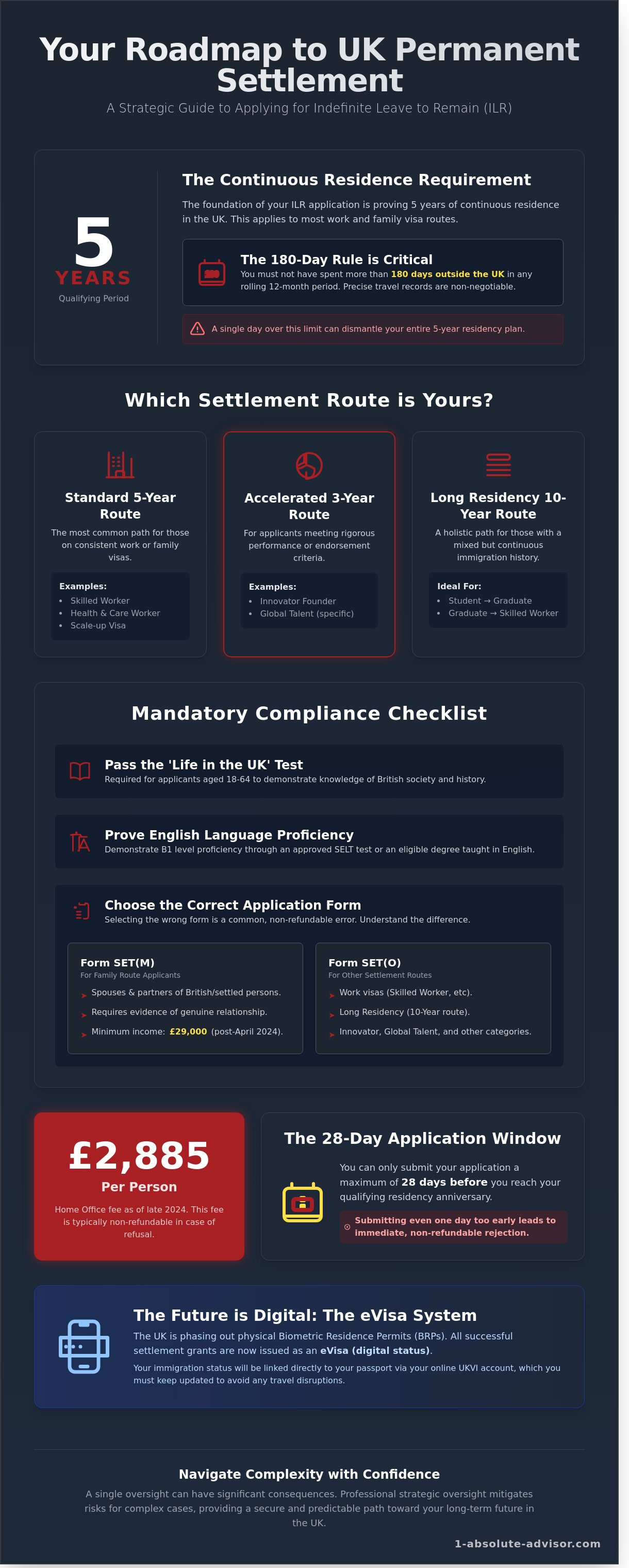
The core eligibility criteria typically center on a five-year continuous residence period. This applies to those on Skilled Worker, Health and Care Worker, or Scale-up visas. You must demonstrate that the UK has been your primary home. Under current 2024 guidelines, “continuous residence” means you’ve not spent more than 180 days outside the UK in any rolling 12-month period. Maintaining precise records of travel is essential for a successful submission, as even minor discrepancies can lead to delays.
Some applicants qualify for accelerated settlement. The Innovator Founder and specific Global Talent routes allow for ILR after only three years, provided you meet rigorous performance benchmarks or endorsement criteria. Regardless of the route, timing is your most significant risk factor. The Home Office allows you to submit your application no more than 28 days before you hit your five-year anniversary. Submitting even 24 hours too early leads to an immediate, non-refundable rejection. This 28-day rule is a common trap that requires careful calendar management.
The 5-Year vs. 10-Year Routes to Settlement
The standard 5-year path is the most direct route for those on consistent work or family-based visas. However, if your immigration history involves switching between various categories, such as moving from a Student visa to a Graduate visa and then to a Skilled Worker visa, the 10-year Long Residency rule may be more appropriate. While the 5-year route is faster, the 10-year path offers a holistic way to count all legal time spent in the country toward your settlement goal, provided there were no gaps in your leave.
Statutory Requirements: Life in the UK and English Language
Compliance involves more than just time spent in the country. Applicants between 18 and 64 must pass the Life in the UK test, which evaluates knowledge of British society and history. You must also prove English language proficiency at level B1 or higher on the CEFR scale. This is usually achieved through an approved Secure English Language Test (SELT) or by holding a degree taught in English. Certain exemptions exist for those with specific medical conditions or those from majority English-speaking nations like Canada or Australia.
Choosing the Correct Form: SET(M) vs. SET(O)
Selecting the wrong digital portal when you apply for indefinite visa is a common but expensive error. The Home Office treats SET(M) and SET(O) as distinct legal pathways with no overlap. Using the wrong form typically leads to an immediate rejection rather than a request for clarification. Since application fees reached £2,885 per person in late 2024, a clerical mistake results in significant financial loss. The Home Office rarely issues refunds for applications processed under the incorrect category.
You can include a partner and dependent children on a single application if they’re applying at the same time as you. This streamlines the process, though each person must still meet their specific eligibility criteria. By 2026, the UK will have fully transitioned to a digital immigration system. All successful settlement grants are now issued as an eVisa. You’ll no longer receive a physical Biometric Residence Permit (BRP). Instead, your status is linked to your passport through a UKVI account, which you must keep updated to avoid travel disruptions.
When to Use Form SET(M)
Form SET(M) is designed specifically for the family route. It’s the correct choice for spouses, civil partners, or unmarried partners of British citizens or persons with settled status. If you’re on the 5-year family path, you must provide robust evidence that your relationship is genuine and subsisting. This involves submitting at least six items of correspondence addressed to both of you at the same address, spread evenly over the last two years. Following the policy shifts in April 2024, most applicants must meet a minimum income threshold of £29,000. Failure to provide specific bank statements and wage slips that match this exact figure will lead to a refusal.
When to Use Form SET(O)
SET(O) serves as the “Other” category, covering the majority of work-based routes. This includes Skilled Workers, T2 Ministers of Religion, and those applying via UK Ancestry. For Skilled Workers, the requirements are particularly rigid. You must submit a formal letter from your employer, dated within 31 days of your application, confirming you’re still required for your role. This letter must also certify that your salary meets the 2026 thresholds. For many, this threshold is £38,700, though specific “going rates” for your occupation code may be higher. Precision in these documents is vital for a successful outcome. Our consultants can perform a comprehensive compliance review to ensure your salary and sponsorship details align with current Home Office benchmarks.
- SET(M): Used for family-based settlement (spouses and partners).
- SET(O): Used for work-based settlement (Skilled Workers, Ancestry, etc.).
- Digital Requirement: All 2026 grants are issued as eVisas.
- Financial Risk: Incorrect form usage results in a lost £2,885 fee.
Evidence and the Continuous Residence Requirement
Meeting the requirements to apply for indefinite visa status hinges on your ability to prove a stable, uninterrupted presence in the UK. The Home Office defines “Continuous Residence” as the period where an applicant has lived in the country without excessive absences. This remains the most scrutinized part of the process because the level of detail required for travel records is absolute. You must demonstrate that your life, finances, and professional future are firmly rooted in the British Isles.
The 180-day rule is the primary metric used for this assessment. You cannot spend more than 180 days outside the UK in any rolling 12-month period during your qualifying five years. It’s a common mistake to calculate this by calendar year; however, the Home Office looks at any consecutive 12-month block. If you exceed this limit, your continuity is broken, which effectively resets your five-year clock to zero. Consistency in your residency is as much about your physical presence as it is about your financial footprint.
The “Good Character” requirement is equally vital. This goes beyond major criminal records. You must disclose every interaction with the law, including fixed penalty notices for driving or minor tax discrepancies with HMRC. Concealing these facts is often viewed as deception. In the eyes of a caseworker, a failure to disclose a minor offence is a greater risk than the offence itself, often leading to a mandatory refusal and a potential ten-year ban on future applications.
Calculating Your Absences Accurately
Precision is mandatory when you apply for indefinite visa status. You should maintain a spreadsheet tracking every flight, ferry, or train journey out of the UK over the last 60 months. The Home Office counts only full days spent outside the country, meaning the day you leave and the day you return don’t count toward the 180-day limit. If you exceeded the limit due to compassionate grounds, such as a serious illness, you’ll need certified medical records to justify the exception. You must also provide evidence, such as utility bills or mortgage statements, to prove your UK home remained your primary residence during those absences.
The Document Checklist for 2026
By 2026, the UKVCAS system has fully digitized the evidence submission process. You’ll need to provide 60 months of bank statements, P60 documents, and employer letters that specifically confirm your ongoing role and salary. A professional cover letter is an absolute necessity to bridge any gaps in your history. It provides the narrative context that raw data cannot. Common errors that trigger a “Request for Information” include submitting scanned documents where the edges are cut off or providing bank statements that aren’t in a sequential, monthly order. These small administrative oversights can delay a decision by 8 to 12 weeks.
The Step-by-Step Process to Apply for Indefinite Leave to Remain
Securing permanent residency requires a methodical approach where timing and documentation must align perfectly. Before you begin the digital paperwork, you’ll need to finalize your preliminary qualifications. This includes passing the Life in the UK test and obtaining a CEFR B1 level English language certificate, unless you’re exempt due to age or a recognized degree taught in English. These credentials must be valid at the moment you hit submit; a common mistake is letting a language certificate expire just before the five-year qualifying period ends.
The process demands absolute attention to detail. In 2026, the Home Office continues to prioritize digital-first interactions, meaning your ability to apply for indefinite visa status depends on a clean, verifiable electronic trail. You’ll need to account for every absence from the UK over the last 60 months, ensuring you haven’t exceeded the 180-day limit in any consecutive 12-month period. This level of precision is what separates successful applications from those that face unnecessary delays or rejections.
Submitting Your Application Online
Your journey starts on the official GOV.UK website where you’ll create a UKVI account. It’s vital to select the specific settlement form relevant to your current visa route, such as Set(O) for skilled workers or Set(M) for family members. Once you’ve filled in your personal history, you’ll be prompted to pay the application fee. As of early 2026, these fees remain a significant investment, often exceeding £2,800 per person. While the Immigration Health Surcharge is generally not required for ILR applicants, you should verify this based on your specific visa category. After payment, you’ll gain access to the Sopra Steria (UKVCAS) portal. This is where you’ll upload high-quality scans of your passport, employer letters, and financial statements. Ensuring these files are legible and correctly categorized is a critical step in the strategy.
Attending the Biometric Appointment
The final physical hurdle is the biometric appointment. You’ll choose between free core centres or premium service points, which often offer evening or weekend slots for an additional fee. During this 15-minute session, a staff member will scan your fingerprints, take a digital photograph, and verify your original passport. It’s not an interview, but it’s a mandatory security check. You must bring your appointment confirmation and your current passport to avoid being turned away. If you’ve opted for the document scanning service, you’ll also bring your physical evidence here, though most applicants now prefer the control of the 100% digital upload route.
Once biometrics are submitted, the waiting game begins. In 2026, standard processing times typically hover around 180 days. If your professional or personal life requires a faster resolution, the Priority Service offers a decision within 5 working days, while Super Priority can deliver a result by the end of the next working day. Choosing the right service level is a tactical decision based on your upcoming travel needs and career moves. For those seeking a seamless transition to permanent residency, our bespoke immigration strategy services provide the clarity needed to navigate these complex timelines with confidence.
Securing Your Future: Professional Guidance and Next Steps
Completing the journey to permanent residency is a milestone that requires absolute precision. While the digital application process appears straightforward, the Home Office continues to exercise rigorous scrutiny. Data from 2024 shows that approximately 12% of settlement applications faced delays or refusals due to avoidable administrative errors or insufficient evidence. When you apply for indefinite visa status, you aren’t just submitting a form; you’re presenting a multi-year narrative of your life and compliance in the UK.
1 Absolute Advisor acts as your strategic partner throughout this transition. We manage the entire settlement journey by identifying potential red flags in your employment history or residency gaps before they reach a caseworker’s desk. For high-salary professionals and complex cases, our holistic approach ensures that every financial statement and employer letter aligns perfectly with current Appendix Settlement rules.
Why Use an OISC-Registered Consultant?
The UK’s immigration system is governed by strict statutory requirements. Engaging an OISC-registered consultant provides a layer of security that self-submission cannot match. We perform a comprehensive document audit to catch discrepancies in salary thresholds or tax records that often trigger mandatory refusals. Our team drafts detailed legal representations that pre-emptively address Home Office concerns, effectively “speaking the language” of the caseworker.
For those with urgent travel needs or professional commitments, we facilitate access to priority and super-priority services. These tracks can reduce the waiting time from six months to just 24 hours. Having a professional representative ensures your application is technically perfect, which is essential when utilizing these expedited, high-cost services.
From ILR to British Citizenship
Receiving your Indefinite Leave to Remain (ILR) is the penultimate step. Most residents must wait a full 12 months after obtaining their indefinite visa before they become eligible for naturalisation. However, if you’re married to a British citizen, this waiting period may not apply. It’s vital to maintain your status during this time; being absent from the UK for more than two years can result in the automatic loss of your ILR. To plan your final step toward a UK passport, consult our British Citizenship: The Complete Guide to Naturalisation in 2026.
- Residency Audit: Have you confirmed you haven’t spent more than 180 days outside the UK in any 12-month period?
- Financial Evidence: Do your payslips match your bank statements to the exact penny for the last 3-6 months?
- Life in the UK: Is your test pass certificate valid and linked correctly to your digital profile?
- Employer Support: Does your current sponsor confirm they still require you for the foreseeable future?
Don’t leave your future to chance. A single oversight can lead to a refusal that stays on your record permanently. By ensuring 100% accuracy before hitting “Submit,” you protect your investment and your life in the United Kingdom.
Securing Your Permanent Future in the United Kingdom
Achieving permanent residency requires more than just completing the 5-year qualifying period. You must accurately identify whether your specific circumstances demand a SET(M) or SET(O) form. Errors in calculating the 180-day absence limit often lead to avoidable refusals under current Home Office guidelines. Since the 2026 procedural updates, the evidentiary requirements for continuous residence have become significantly more detailed. It’s vital to verify every document against statutory requirements before you commit to the submission process.
When you’re ready to apply for indefinite visa status, small discrepancies in your residency history can jeopardize years of effort. 1 Absolute Advisor’s OISC-Registered Immigration Consultants provide fixed-fee application management to ensure your submission is legally sound. We specialize in complex residency calculations that address specific gaps or overlaps in your immigration history. This strategic approach transforms a stressful administrative burden into a structured path toward your long-term goals.
Book a Professional ILR Consultation with 1 Absolute Advisor to secure your status with confidence. Your permanent future in the UK depends on a precise, professionally managed application.
Frequently Asked Questions
How long does it take to get a decision after I apply for an indefinite visa?
Standard processing for settlement applications takes up to 6 months, though priority services offer decisions within 5 working days or 24 hours. Home Office data shows that 98% of straightforward applications meet these specific service standards. You should plan your professional and personal commitments around these windows to ensure your transition to permanent residency doesn’t disrupt your business or travel plans.
Can I leave the UK while my ILR application is being processed?
You can’t leave the Common Travel Area while your application is pending without automatically withdrawing your submission. Under Section 3C of the Immigration Act 1971, your current leave remains valid during the processing period to protect your legal status. If you depart the UK before receiving a formal decision, the Home Office treats your application as abandoned immediately, which necessitates a costly and time-consuming restart.
What happens if my application for indefinite leave to remain is refused?
If your application is refused, you’ll receive a decision letter outlining whether you have the right to an Administrative Review or a Judicial Review within 14 days. Government statistics indicate that many refusals stem from missing documentation or incorrect financial evidence. We recommend a strategic audit of your submission to identify the specific legal grounds for a challenge and to determine if a fresh application is a more viable path.
How much does it cost to apply for an indefinite visa in 2026?
The current fee to apply for indefinite visa status is £2,885 per applicant, though the Home Office traditionally reviews and adjusts these figures every April. You must also account for the £19.20 biometric enrollment fee and potential priority service costs ranging from £500 to £1,000. These costs are non-refundable, so ensuring your documentation is perfect the first time is a critical financial strategy for your household budget.
Do I need to retake the English test if I already did it for my initial visa?
You don’t need to retake the English test if your previous qualification is at CEFR level B1 or higher and is still on the Home Office approved list. If your initial visa only required an A1 or A2 level for entry, you’ll need to pass a new B1 test at an authorized provider. Accuracy here prevents the delays caused by insufficient language evidence, which affects roughly 10% of settlement applicants.
What is the “Life in the UK” test and how do I book it?
The Life in the UK test is a 45 minute exam covering British customs and history that requires a 75% score to pass. You must book it through the official government portal at least 3 days in advance for a fixed fee of £50. This certificate doesn’t expire, so passing it early is a proactive step that ensures your settlement strategy remains on schedule regardless of future policy changes.
Can I include my children in my indefinite visa application?
You can include your children under the age of 18 as dependents when you apply for indefinite visa status. Children born in the UK may have different paths to citizenship, but those born abroad must be included in your settlement application to maintain their legal residency. This holistic approach ensures your entire family’s security is handled in one synchronized process, reducing the risk of fragmented legal statuses.
What happens to my BRP after I am granted an eVisa for settlement?
Your physical Biometric Residence Permit becomes obsolete as the UK transitions to a fully digital eVisa system by the end of 2024. You’ll manage your settlement status through a UKVI account, which provides a share code for employers, banks, or landlords. This shift enhances security and ensures your right to work and reside in the UK is verifiable 24/7 without the need for physical documents.