

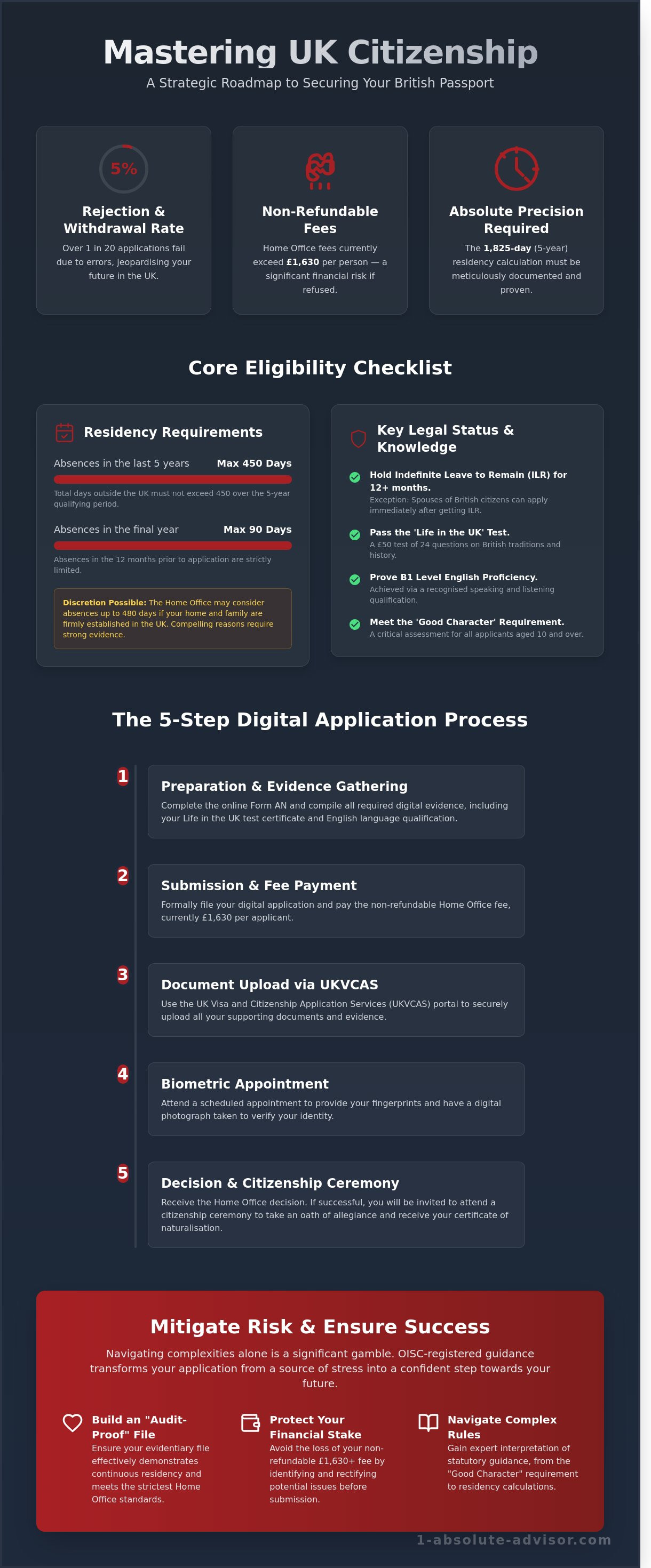
Did you know that according to 2024 Home Office transparency data, over 5% of naturalisation applications are rejected or withdrawn, often resulting in the loss of non-refundable fees that currently exceed £1,600 per person? When you decide to apply for citizenship uk, the margin for error is effectively zero. You’ve likely spent years meticulously tracking your absences and building a life here, so the thought of a single clerical mistake or a misunderstanding of the “good character” requirement jeopardising your future is a significant source of stress. We recognize that the 1,825-day residency calculation requires absolute precision to satisfy Home Office caseworkers.
This guide serves as your strategic partner to master these complexities and secure your British passport with total confidence. Our expert-led roadmap ensures your application is audit-proof by addressing the specific hurdles of the 2026 naturalisation process. We’ll walk you through documenting your residency history, interpreting the latest statutory guidance, and finalizing every detail to ensure your certificate is within reach.
Key Takeaways
- Understand the mandatory “12-month rule” following the grant of Indefinite Leave to Remain to ensure you meet all legal eligibility criteria before starting your journey.
- Learn how to accurately complete the online Form AN and prepare the specific digital evidence required to apply for citizenship uk without administrative delays.
- Discover how to build an “audit-proof” evidentiary file that effectively demonstrates your continuous residency, even when standard passport scans fall short.
- Navigate the complexities of the “Good Character” requirement to avoid common refusal traps that impact all applicants from age ten and above.
- Mitigate the significant financial risk of non-refundable Home Office fees by identifying the strategic benefits of professional document checking and OISC-registered guidance.
Understanding British Naturalisation: Are You Eligible to Apply?
British naturalisation is the formal legal process that allows a non-British adult to acquire the same rights and status as those born in the United Kingdom. It represents the final stage of a multi-year immigration journey. Achieving this status requires strict adherence to statutory requirements and a clear understanding of the Home Office’s regulatory framework. To apply for citizenship uk, you must first demonstrate a commitment to living in the country permanently while meeting specific character and residency criteria.
The standard path requires applicants to hold Indefinite Leave to Remain (ILR) or “settled status” for at least 12 months before submitting their documentation. This “12-month rule” ensures that the applicant has maintained a stable presence in the UK beyond the initial grant of permanent residency. However, different rules apply if you’re married to or in a civil partnership with a British citizen. In these cases, the 12-month waiting period is waived, allowing you to submit your application immediately after receiving ILR status. All applicants must be at least 18 years old and possess the “sound mind” necessary to understand the legal implications of the oath of allegiance.
The Residency Requirement and the 90-Day Rule
The Home Office applies a precise look-back period when you apply for citizenship uk. Officials check your physical presence exactly five years before the date your application is received. If you were not physically in the UK on that specific calendar day five years ago, your application will likely be refused. Beyond this specific date, you must not have spent more than 450 days outside the UK during the five-year period. The final year is even more restrictive; you’re limited to just 90 days of absence in the 12 months leading up to your application.
Applicants who have exceeded these limits shouldn’t lose hope immediately. The Home Office may exercise discretion if your absences total between 450 and 480 days, provided you’ve established your main home, family, and estate in the UK. If you’ve surpassed the limits due to “compelling reasons” like a medical emergency or unavoidable work commitments for a UK-based employer, you must provide specific evidence, such as hospital records or certified letters from your company’s director, to justify the breach.
Knowledge of Language and Life in the UK
Demonstrating an integration into British society is a core requirement of the naturalisation process. Most applicants must pass the Life in the UK test, a 45-minute exam consisting of 24 questions about British traditions and history. You can book this test at one of the 30 plus official centres across the country for a fee of £50. You’ll also need to prove your English language proficiency at a B1 CEFR level or higher. This is typically achieved through a recognized qualification in speaking and listening from an approved provider.
Exemptions to these testing requirements are strictly defined. If you’re 65 or older, you aren’t required to take the Life in the UK test or prove your language level. Similarly, individuals with long-term physical or mental conditions that make passing the test impossible can seek a waiver. These claims require a specific medical waiver form completed by a registered UK doctor to ensure compliance with Home Office standards.
The 5-Step Process to Apply for Citizenship in the UK
Securing British nationality is a multi-stage legal procedure that demands absolute precision. When you apply for citizenship uk, the Home Office expects a seamless digital trail of your residency and character history. The process follows a methodical sequence designed to verify your eligibility through five distinct phases. Most applicants find that strategic planning during the initial stages prevents costly delays or rejections later in the cycle.
- Step 1: Preparation. You must complete the online Form AN and compile digital evidence, including your Life in the UK test pass certificate and English language qualifications.
- Step 2: Submission. This involves the formal filing of your digital application and the payment of the current Home Office fee, which stands at £1,630 as of late 2024.
- Step 3: Document Upload. After payment, you’ll use the UKVCAS (UK Visa and Citizenship Application Services) portal to upload your supporting evidence or book a professional scanning service.
- Step 4: Biometrics. You’re required to attend a physical appointment to provide your fingerprints and a digital facial photograph.
- Step 5: Decision and Ceremony. Once approved, you’ll receive an invitation to attend a mandatory citizenship ceremony to take your oath and receive your naturalisation certificate.
Navigating the Online Form AN
The government’s digital portal allows you to register and save your progress, which is vital for managing the extensive data required. You must document every trip outside the country with total accuracy. Discrepancies between your travel logs and Home Office records can lead to refusal based on the “good character” requirement. You’ll also need to nominate two referees. One must be a professional of any nationality, such as a teacher or accountant, while the second must be a British citizen over the age of 25 who isn’t related to you. Choosing these individuals carefully ensures your apply for citizenship uk journey remains compliant with strict 2026 standards.
The UKVCAS Biometric Appointment Experience
The biometric stage is the final physical hurdle in the application. You’ll visit a service centre where staff capture your digital identity markers. It’s essential to bring your original passport and the appointment confirmation email. You can choose between “Standard” service points, which are often located in local libraries, or “Premium” VIP lounges in major cities like London or Manchester. The VIP options provide document checking and faster processing in a more comfortable environment. Unlike older systems, the UKVCAS process doesn’t require the Home Office to keep your physical passport. It’s scanned and returned to you immediately. A strategic partner can help you review your digital file before this final submission to ensure every document meets the required evidentiary threshold.
Building Your Audit-Proof Evidentiary File
The Home Office operates on a strict principle: the burden of proof rests entirely on your shoulders. When you prepare to apply for citizenship uk, you aren’t just filling out a form; you’re building a legal case for your right to remain permanently as a British national. Caseworkers don’t fill in the blanks or assume your presence in the country. If a gap exists in your timeline, they’ll likely flag the application for further scrutiny or rejection. This is why a simple passport scan often fails to meet the standard. While a passport shows your identity, it doesn’t provide a granular view of your daily residency, especially if you’ve used e-gates that don’t leave physical stamps.
You should view your evidence through a clear hierarchy of reliability. At the top sit official government and financial records. P60 documents from the last five years are the gold standard because they link your residency to HMRC tax contributions. Employer letters on headed paper, confirming specific dates of employment and any periods of leave, offer similar weight. Utility bills and council tax statements are useful but carry less authority. They prove a connection to an address, not necessarily your physical presence. Use a detailed cover letter to tie these threads together. This letter acts as your executive summary, explaining any complexities like name changes or brief periods of unemployment, ensuring the caseworker follows your logic from the first page.
Mandatory Documents for Every Applicant
Every successful application starts with a bedrock of three core components. First, you must provide your current passport and every previous passport held during your three or five-year qualifying period. If a passport was lost, a police report or official correspondence from your embassy is vital. Second, you need definitive proof of your status. This means your physical Biometric Residence Permit (BRP) or a digital status share code if you hold settled status. Finally, include your original Life in the UK test pass notification and your English language certificates at level B1 or higher. These are non-negotiable; missing even one will trigger an immediate stall in the process.
Supplementary Evidence for Complex Cases
If your situation isn’t a standard 9-to-5 employment history, you must provide additional layers of verification. Self-employed applicants should include their Annual Tax Calculations (SA302) and evidence of business activity, such as invoices or business bank statements. If you’ve exceeded the 450-day absence limit due to “compelling reasons,” you must document these events with precision. Medical emergencies require hospital letters; work-related travel needs a letter from your employer confirming the necessity of the trips. Before submitting, it’s wise to consult our ILR UK guide to ensure your underlying status is perfectly aligned with the requirements to apply for citizenship uk, as any flaws in your prior residency can haunt your naturalisation bid.
The “Good Character” Requirement: Avoiding Common Refusals
The “Good Character” requirement represents the most subjective phase when you apply for citizenship uk. Home Office caseworkers don’t simply look for a lack of a criminal record; they perform a discretionary, holistic assessment of your entire history. This rule is mandatory for every applicant aged 10 or older at the time of submission. While the British Nationality Act 1981 doesn’t provide a rigid definition of “good character,” the Home Office Nationality Policy Guidance, last updated in December 2023, identifies specific triggers that lead to refusal. These include criminal convictions, financial impropriety, and historical immigration breaches.
You must practice absolute transparency during this process. You’re required to disclose every incident, regardless of how much time has passed. This includes spent convictions under the Rehabilitation of Offenders Act 1974 and minor traffic offences like speeding tickets or fixed penalty notices. It’s a common mistake to assume minor issues don’t matter. In reality, the Home Office often views non-disclosure as an intentional attempt to deceive, which is a ground for refusal in itself. It’s the concealment, rather than the original minor offence, that often compromises an application.
Financial Integrity and HMRC Compliance
Your financial conduct serves as a key indicator of your reliability. Caseworkers scrutinize your records for unpaid taxes or unresolved disputes with HMRC. If you have a history of bankruptcy or high levels of debt, the Home Office evaluates whether you’ve acted dishonestly or recklessly. While a standard bankruptcy doesn’t cause an automatic refusal, any evidence of “debtor’s misconduct” or fraud will. We advise checking your tax compliance and credit standing before you pay the non-refundable fee. A single unresolved tax discrepancy from 2022 can jeopardize a 2026 application.
Previous Immigration Breaches and Deception
Past errors in your immigration journey can resurface during the naturalisation stage. If you’ve previously overstayed a visa by more than 28 days or worked in breach of your visa conditions, these factors weigh heavily against your character. The Home Office typically examines the last 10 years of your residency. If they determine you used “deception” in any prior application, they’ll likely refuse your request. For a detailed breakdown of how these factors influence your eligibility, read our British Citizenship guide.
Ensuring your background meets these high standards requires a strategic review of your personal and financial history. If you’re concerned about how past events might impact your ability to apply for citizenship uk, securing professional advice is the most effective way to mitigate risks before submission.
Professional Management: Why Use an OISC Registered Advisor?
Deciding to apply for citizenship uk is a significant financial and emotional commitment. As of late 2024, the Home Office application fee for naturalisation stands at £1,630. It’s vital to understand that these fees are generally non-refundable. If your application is refused due to a technical error, a missing document, or a misunderstood residency requirement, you lose that capital entirely. Professional management mitigates this risk by ensuring your file is compliant with the latest Home Office internal guidance before it reaches a caseworker’s desk.
Mistakes are expensive. A professional Document Checking Service provides a rigorous audit of your evidence. Advisors look for gaps in your five-year or three-year residency history that might trigger a rejection. Beyond simple checklists, experts draft detailed legal cover letters. These documents are essential if you need to explain complex issues, such as exceeding the permitted 450 days of absence or addressing “Good Character” concerns related to historical tax errors or civil penalties. We provide the peace of mind that comes with end-to-end management, allowing you to focus on your future while we handle the bureaucratic complexity.
Personalised Legal Support for Your Journey
Caseworkers appreciate clarity. We organise your evidence into a structured, indexed format that follows the logic of the British Nationality Act 1981. This professional presentation often facilitates a faster decision because the caseworker doesn’t have to hunt for facts. If the Home Office issues a request for further information (RFI), we manage all communication directly, ensuring that responses are timely and legally sound. OISC registration serves as a mandatory seal of quality, ensuring that your advisor is regulated, insured, and held to the highest professional standards in UK immigration law.
Next Steps: Securing Your Future in the UK
Approval is the beginning of a new chapter. Once you receive your invitation, you’ll attend a citizenship ceremony to take the oath of allegiance and receive your naturalisation certificate. This document is the key to your first British passport application. Transitioning from a migrant mindset to that of a citizen means gaining full voting rights and the permanent security of tenure in the UK. You no longer need to worry about visa expiries or changing immigration rules. It’s a definitive step toward absolute stability.
Ready to finalise your path to British nationality? Book a consultation with our citizenship experts today to ensure your application for citizenship uk is handled with professional precision.
Securing Your British Future Through Strategic Naturalisation
Navigating the path to British naturalisation requires more than just filling out forms; it demands a strategic alignment with current Home Office regulations. By 2026, the complexity of building an audit-proof evidentiary file and satisfying the stringent “Good Character” requirement has made precision a necessity rather than an option. You’ve now seen how the five-step process functions and why professional OISC-registered oversight is vital to mitigate the risk of a costly refusal. Every piece of evidence must be meticulously vetted to ensure it meets the rigorous standards set by UK Visas and Immigration.
The decision to apply for citizenship uk represents a significant milestone in your professional and personal life. Our team provides the stability and predictable outcomes you need through fixed-fee application management and expert legal cover letter drafting. We don’t just process paperwork; we act as your strategic partner to ensure every detail meets the highest standards of compliance and integrity. Our OISC-registered advisors bring the same level of professional rigor to your immigration status that you’d expect from a top-tier business consultancy.
Secure your British future with our expert citizenship application service and take the final step toward your new life with absolute confidence. Your journey toward British residency is a long-term investment that deserves the highest level of professional protection.
Frequently Asked Questions
How much does it cost to apply for British citizenship in 2026?
The standard fee for a British citizenship application currently stands at £1,630, following the fee structure established by the Home Office. You’ll also need to budget £19.20 for biometric enrollment and £50 for the Life in the UK test if applicable. These costs don’t include professional legal fees or the cost of English language certifications. The government typically reviews these figures every April, so checking the latest 2026 updates before submitting is essential for financial planning.
Can I apply for citizenship if I have been out of the UK for more than 90 days in the last year?
You can still apply, but you’ll need to provide a detailed explanation for the Home Office to exercise its discretion. The statutory limit is 90 days of absence in the 12 months preceding your application date. If your absences total between 100 and 179 days, caseworkers often overlook the excess if you’ve established your home, family, and estate in the UK. For absences exceeding 180 days, approval becomes significantly harder unless you’re working abroad for a UK based company.
How long does the Home Office take to process a citizenship application?
The Home Office aims to process 95% of citizenship applications within six months of the biometric appointment date. Some applicants receive their approval letter within 8 to 12 weeks, but this isn’t guaranteed for every case. If your application is complex or requires additional background checks, the timeline can extend beyond 180 days. You’ll receive a notification via email once the decision is made, and you’ll then have 90 days to book your citizenship ceremony.
What happens if my British citizenship application is refused?
If your application is refused, you’ll receive a letter explaining the specific grounds for the decision. You can request a formal reconsideration by submitting Form NR and paying a £450 fee. There’s no standard right of appeal for nationality cases, so this administrative review is your only path to challenge the Home Office. Statistics show that 10% of applications are refused due to failure to meet the good character requirement or incorrect documentation of residency dates.
Do I need to give up my original nationality to become a British citizen?
You don’t need to renounce your current nationality to apply for citizenship uk because the United Kingdom permits dual citizenship. However, you must verify the laws of your home country before proceeding. Nations like India, China, and Japan don’t recognize dual nationality and will automatically revoke your original citizenship the moment you naturalise as a British citizen. We recommend consulting a specialist to understand how a second passport impacts your tax status and property rights abroad.
Can I travel abroad while my citizenship application is being processed?
You’re allowed to travel outside the UK while your application is pending because the Home Office doesn’t retain your physical passport. After your biometric appointment at a UKVCAS center, you’ll keep all your original identity documents. It’s vital that you remain a UK resident during this period and don’t move your primary home to another country. You must also ensure you’re in the country to attend your citizenship ceremony within three months of receiving your approval.
Who can act as a referee for my UK citizenship application?
You must provide two referees who have known you personally for at least three years. One referee must be a professional person of any nationality, such as a teacher, accountant, or solicitor. The second referee must be a British citizen who is at least 25 years old and not related to you by birth or marriage. Both individuals must be in good standing and cannot be your legal representative or an employee of the Home Office or the UK Border Force.
Is the Life in the UK test required if I am over 65?
The Life in the UK test isn’t required for any applicant who is 65 years of age or older at the time they apply for citizenship uk. You’re also exempt from the B1 English language requirement once you reach this age threshold. If you’re under 65 but have a long term physical or mental condition, you may apply for an exemption by providing a specific medical waiver form signed by a registered doctor. For everyone else, the test remains a mandatory part of the process.