

On January 15, 2026, a Family Visa holder discovered that the end of their three-year relationship had instantly triggered a mandatory reporting requirement to the Home Office. It’s a situation where personal grief meets cold, administrative reality, often leaving individuals feeling vulnerable to immediate deportation. Learning how to cope with visa-related separation requires balancing your emotional recovery with a rigorous adherence to UK immigration compliance. You aren’t alone in feeling that the legal system complicates an already painful life transition, but your residential security doesn’t have to be the casualty of a breakup.
This comprehensive guide provides the strategic clarity you need to protect your right to remain in the UK under the 2026 immigration rules. You’ll gain a precise understanding of your reporting duties and a clear roadmap for switching to alternative routes like the Skilled Worker or 10-year long residency streams. We’ll examine the specific procedural steps necessary to transform this period of legal uncertainty into a stable, independent future, ensuring you maintain absolute control over your status.
Key Takeaways
- Understand your mandatory legal obligations to the Home Office and how the cessation of a ‘subsisting relationship’ fundamentally alters your right to remain.
- Learn how to cope with visa-related separation by effectively utilizing the 60-day curtailment period as a strategic window to transition to an alternative visa route.
- Identify independent pathways to residency, such as the Parent Route, to maintain your life and family ties in the UK without relying on a partner’s sponsorship.
- Master the practical steps of a visa transition, including leave audits and the collection of critical evidence, to build a resilient and compliant application.
- Discover why professional OISC-registered guidance is vital for navigating the complex legal and emotional landscape of a relationship breakdown while securing your future.
Understanding Your Legal Obligations After a Relationship Breakdown
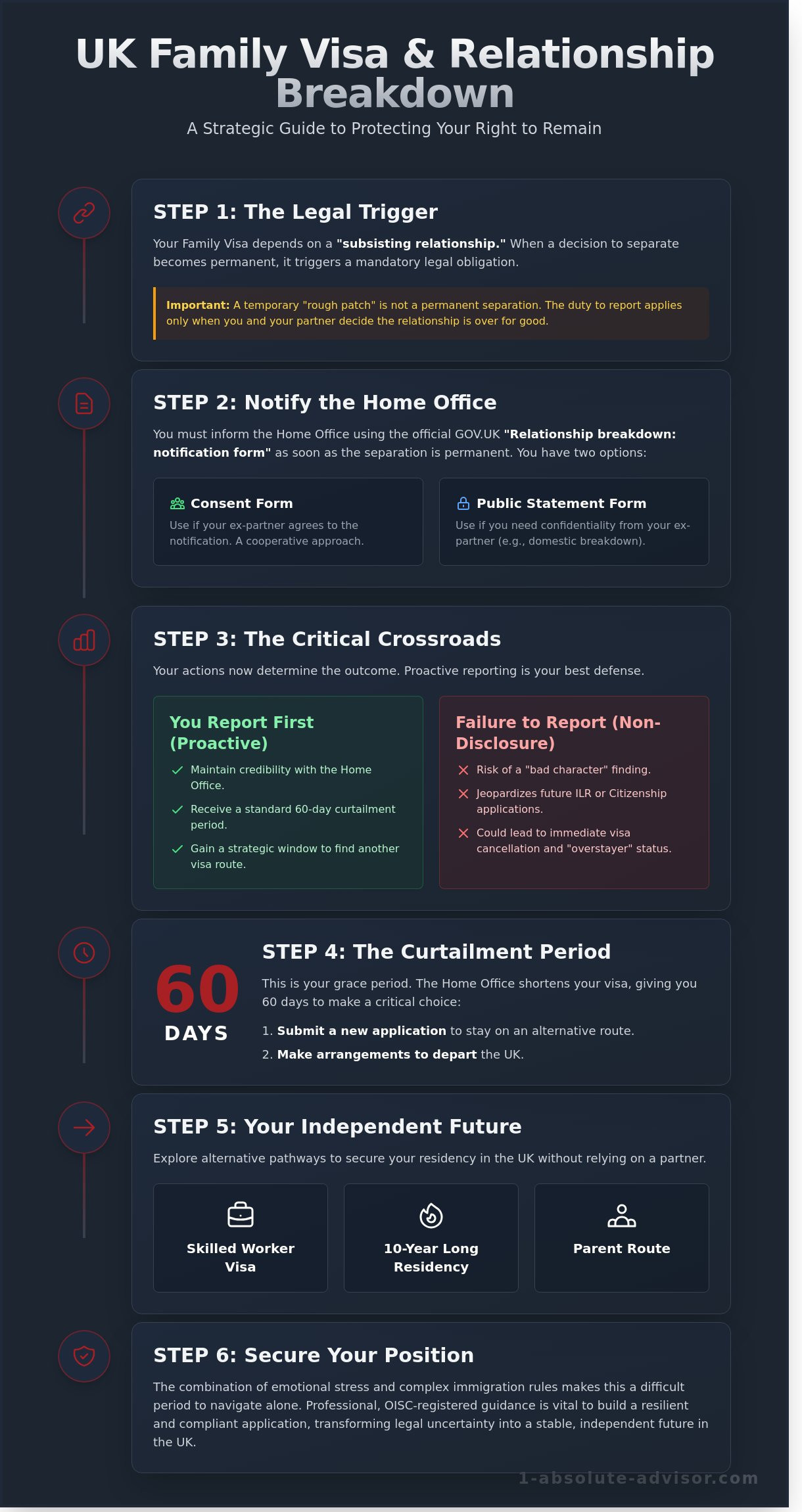
Immigration status under a Family Visa depends entirely on the existence of a “subsisting relationship.” This term is not merely a romantic sentiment; it is a strict legal requirement defined under Appendix Relationship with Partner of the UK Immigration Rules. A subsisting relationship requires that the couple is in a genuine partnership and intends to live together permanently in the UK. While a temporary “rough patch” or a brief period of marital friction does not legally terminate your status, a formal decision to separate permanently does. Understanding how to cope with visa-related separation requires a clear-headed approach to these legal definitions from the outset.
Transparency acts as your primary defense against future allegations of visa fraud. The Home Office views the failure to report a change in circumstances as a “material non-disclosure.” If you continue to live in the UK on a spouse or partner visa after the relationship has ended without informing the authorities, you risk a “bad character” finding. This designation can permanently jeopardize future applications for Indefinite Leave to Remain (ILR) or British Citizenship. Taking proactive steps ensures you remain compliant with the law even during personal turmoil.
How and When to Notify the Home Office
The duty to inform the Home Office is mandatory and should be completed as soon as the separation is considered permanent. You must use the official “Relationship breakdown: notification form” available on the GOV.UK website. The process requires specific data points, including your Home Office reference number, case ID, and your partner’s full details. If children are involved, you must provide their names and dates of birth to ensure their welfare is considered in any subsequent visa decisions.
Privacy is a significant concern during this process. The Home Office provides two distinct paths: the “Consent” form and the “Public Statement” form. If your ex-partner agrees to the notification, the Consent form is used. However, if you do not want your ex-partner to see the information you provide, or if the relationship ended due to domestic breakdown, the Public Statement form allows you to report the change while requesting that your new address and specific details remain confidential from your former partner.
The Consequences of Non-Disclosure
Failing to report a separation is a strategic error that often leads to the “curtailment” of your visa under less favorable terms. If your ex-partner reports the separation first, the Home Office may move to cancel your visa immediately. When you report the change yourself, you maintain a level of credibility that is essential for switching to a different visa category, such as a Work Visa or a Parent Visa. Usually, the Home Office will issue a letter giving you 60 days to either depart the UK or submit a new application to stay.
Ensuring your address is updated is a critical component of how to cope with visa-related separation effectively. All formal correspondence regarding your “curtailment” or “leave to remain” will be sent to the last address the Home Office has on file. If you have moved out and fail to update your details via the online “Update your UK Visas and Immigration account” service, you may miss the 60-day deadline to respond. Missing this window leads to an “overstayer” status, which carries severe legal penalties and complicates any future legal presence in the UK.
Navigating the 60-Day Curtailment Period
Curtailment is the formal process where the Home Office shortens your existing leave to remain. This usually occurs when the basis of your stay, such as a sponsorship or a marriage, ceases to exist. Under Immigration Rules Part 9, the Secretary of State has the power to reduce your remaining time to a standard 60-day window. Understanding this timeline is essential for anyone figuring out how to cope with visa-related separation, as it provides a finite period to assess future legal options before your status expires.
The 60-day rule acts as a transitional grace period. It’s a policy application designed to give individuals time to either depart the UK or find an alternative legal route. If your visa had more than 60 days left, it gets cut down; if it had less, the original expiry date usually stands. There are rare instances where the Home Office cancels permission with immediate effect, particularly in cases involving deception or serious criminal conduct. You must monitor your registered email and physical post daily. If a Notice of Curtailment is served to your last known address or “to file” because you’re unreachable, the 60-day countdown begins regardless of whether you’ve read the letter.
Your Rights and Restrictions During Curtailment
During these 60 days, your existing conditions generally remain in place. You can typically continue working or studying under the same terms as your original visa. Access to the NHS continues as you’ve already paid the Immigration Health Surcharge. However, you must not travel outside the Common Travel Area. Leaving the UK during a curtailment period effectively ends your leave immediately; you’ll likely be refused re-entry at the border because your permission to stay has been revoked.
Managing the Emotional and Practical Stress
The pressure of a ticking clock can be overwhelming. Use this time to organize your personal affairs, such as ending a tenancy or managing local assets, while you explore new pathways. Seeking assistance from migrant welfare organizations can provide emotional stability during this transition. Most importantly, securing a professional UK immigration assessment should be your priority. A strategic review of your situation helps identify if you qualify for a different visa category, such as a Skilled Worker or a private life route. Taking this step early transforms a crisis into a manageable transition. For those needing a clear roadmap, an Absolute Advisor consultation can provide the professional integrity required to navigate these complex legal waters and help you understand how to cope with visa-related separation through proactive planning.
Evaluating Your Options to Stay in the UK Independently
Separation doesn’t always necessitate a departure from the UK. Understanding how to cope with visa-related separation involves a clinical assessment of your individual eligibility for non-partner routes. By April 2026, the Home Office has solidified several pathways that allow individuals to transition from a dependent status to an independent one. Analyzing the 10-year long residence rule is a logical first step. If you’ve lived in the UK legally for a continuous decade, you might qualify for Indefinite Leave to Remain (ILR) regardless of your relationship status. This path requires a clean criminal record and no absences exceeding 180 days in any 12-month period, providing a permanent solution for those who have built a life here over the last ten years.
Staying as a Parent: The Article 8 Route
Securing your status as a parent provides a vital safety net under Article 8 of the European Convention on Human Rights. This route is applicable if you have a British or settled child under 18 years of age. You’ll need to demonstrate an active role in the child’s upbringing through school reports, medical records, or financial support evidence. While the ‘sole responsibility’ test remains a high bar for single parents, shared parental access is often sufficient if you can prove the child’s best interests require your presence. Courts prioritize child welfare under Section 55 of the Borders, Citizenship and Immigration Act 2009, making this a robust option for those wondering how to cope with visa-related separation while maintaining essential family bonds.
Work and Study: Switching Categories
Switching into a skilled worker visa uk offers a path based on professional merit rather than domestic ties. As of early 2026, the general salary threshold remains at £38,700 for most applicants, though certain healthcare or education roles may qualify for lower requirements. If you’re a recent graduate from a UK institution, the Graduate visa serves as a 2-year bridge to gain work experience without the immediate need for an employer’s sponsorship. For entrepreneurs with scalable business ideas, the Innovator Founder route is a viable alternative, provided an endorsing body approves your plan. Reviewing a broader UK work visa strategy ensures your residency remains secure and entirely independent of your former partner’s sponsorship.
Practical Steps for a Successful Visa Transition
Understanding how to cope with visa-related separation requires a methodical approach to your immigration status. You must move from emotional reaction to strategic action. The UK immigration system operates on strict timelines; missing a single deadline can jeopardize your right to stay. Following a structured transition plan ensures you remain compliant while exploring new routes to residency.
Step 1: Audit your current leave. Check your eVisa or BRP to identify your exact expiry date. Since the UK transitioned to fully digital records in January 2025, you should verify your status through the official “view and prove” service to ensure no discrepancies exist in the Home Office database.
Step 2: Collect evidence of your life in the UK. Gather documents that prove your employment history, housing stability, and family ties. This data forms the foundational evidence for any subsequent application you might pursue.
Step 3: Formalise your separation with the Home Office. You’re legally required to notify them when a qualifying relationship ends. While this triggers the curtailment process, it stops the clock on your current status as a dependent and allows you to move toward an independent immigration category.
Step 4: Secure professional legal advice. A specialist can map out your new application, whether it’s a Skilled Worker visa, a family visa based on your children, or a human rights claim. Mapping these options early prevents rushed, high-stakes decisions.
Step 5: Submit your new application before the 60-day curtailment period ends. This 60-day window is non-negotiable. Submitting a valid application within this timeframe maintains your right to work and access services under Section 3C leave while the Home Office processes your request.
Evidence Gathering Checklist
A successful transition depends on the quality of your documentation. You’ll need to demonstrate your integration and self-sufficiency through a clear paper trail:
- Proof of cohabitation: Bank statements, council tax bills, or utility invoices from the period your relationship was valid to prove the partnership was genuine.
- Financial records: Six months of payslips or personal bank statements demonstrating you meet the financial requirements without relying on public funds.
- Child-related documentation: Letters from schools, GPs, or social services if you have children in the UK, as their “best interests” are a primary consideration in many visa routes.
Applying for ILR Early
If your relationship ended because of domestic abuse, you don’t have to wait for the usual five-year period to settle. You can apply for ilr uk through the Domestic Violence Indefinite Leave to Remain (DV-ILR) route. This provision protects vulnerable individuals, allowing them to secure their status independently of their former partner. Securing your future involves learning how to cope with visa-related separation while simultaneously managing these complex legal requirements.
To succeed in a DV-ILR claim, you’ll need to provide evidence of the abuse, which can include police reports, medical records, or letters from support organisations. Even during this period of personal upheaval, you’ll still need to pass the Life in the UK test unless you’re exempt due to a specific physical or mental condition. Preparing for this test early can reduce overall stress during the final application stages.
How Professional Guidance Secures Your Future
Attempting a DIY visa application during a relationship breakdown often leads to critical errors. Emotional stress clouds judgment, causing applicants to miss deadlines or overlook mandatory evidence. In 2024, Home Office data indicated that a significant portion of family visa refusals stemmed from insufficient proof of relationship subsistence or financial requirements. When you are learning how to cope with visa-related separation, the technical burden of UK immigration law shouldn’t rest on your shoulders alone.
An OISC-registered advisor acts as your strategic partner. We don’t just fill out forms; we draft a comprehensive legal cover letter that contextualizes your situation for the caseworker. This document bridges the gap between raw evidence and the specific requirements of the Immigration Rules. Our team ensures that your current crisis doesn’t compromise your eligibility for british citizenship in the future. We meticulously review your history to satisfy “Good Character” requirements, which are essential for naturalisation in 2026. Managing these complexities through a fixed-fee service provides financial predictability when your personal life feels most unstable.
Avoiding Common Pitfalls
Ignoring a Home Office letter is a common mistake that leads to disastrous results. If you receive a notification regarding your leave to remain, you must act within the specified timeframe, usually 14 to 28 days. Failing to respond can lead to the curtailment of your visa. Overstaying even by a single day can trigger a re-entry ban and ruin your prospects for any future UK visa. Professional document checking identifies inconsistencies in bank statements or housing evidence before they reach the Home Office, significantly reducing the risk of a refusal based on technicalities.
Taking the Next Step
Every family situation is unique, and generic advice cannot replace a tailored strategy. Understanding how to cope with visa-related separation requires a clear roadmap for your legal status. Booking a consultation allows us to assess your specific circumstances, including any children involved or human rights claims. Before your first meeting, please gather your current passport, your BRP, any correspondence from the Home Office, and proof of your current living arrangements. Having these documents ready allows us to provide immediate, actionable advice during our initial session.
Don’t leave your residency status to chance during this difficult transition. Contact 1 Absolute Advisor for expert assistance with your visa transition and secure your long-term future in the UK with professional support.
Taking Control of Your UK Residency Path
Navigating a relationship breakdown while on a family visa requires a swift, strategic response to meet Home Office requirements. You must report changes to the authorities immediately to manage the 60-day curtailment period effectively. Understanding how to cope with visa-related separation involves evaluating your eligibility for independent routes, such as the Skilled Worker visa or the 10-year long residency path. These transitions are complex, but they provide a clear framework for remaining in the UK legally through 2026 and beyond. Our OISC-registered experts specialize in complex family visa transitions, ensuring every application aligns with current UKVI standards. We provide fixed-fee application management to remove financial uncertainty during this critical time. You don’t have to face the legal system alone when your future is at stake. By taking proactive steps today, you can transform a period of instability into a foundation for long-term security. Secure your future in the UK with a professional visa assessment and gain the clarity you need to move forward with confidence.
Frequently Asked Questions
Do I have to leave the UK immediately after my divorce is finalised?
You don’t have to leave the UK the moment your divorce is finalised. The Home Office typically issues a curtailment notice that grants you 60 days to either apply for a different visa or make arrangements to leave. This 60-day period begins from the date you receive the official letter, giving you a vital window to restructure your legal status.
Can I switch from a spouse visa to a work visa without leaving the country?
You can switch to a Skilled Worker visa from within the UK if you secure a job offer from a licensed sponsor. You’ll need to meet the specific salary and English language requirements defined in the 2024 Immigration Rules. This transition allows you to maintain continuous residency without the expense and disruption of returning to your home country for a new application.
What happens to my children’s visas if my partner and I separate?
Your children’s status usually depends on their length of residency and your new visa category. If a child has lived in the UK for 7 continuous years, they may qualify for leave to remain independently under private life rules. The Home Office must also consider the child’s best interests as mandated by Section 55 of the Borders, Citizenship and Immigration Act 2009.
Will the Home Office tell my ex-partner that I have applied for a new visa?
The Home Office won’t disclose your new application details or your current address to your ex-partner. Your privacy is strictly protected under the Data Protection Act 2018 and standard GDPR protocols. While the Home Office notifies the sponsor that the relationship has ended, they don’t share any information regarding your subsequent immigration steps or personal location.
How much does it cost to switch to a different visa category in 2026?
Switching to a Skilled Worker visa for up to 3 years costs £827 according to the fee structures established in 2024. You must also budget for the Immigration Health Surcharge, which currently stands at £1,035 per year of the visa’s duration. These figures represent the baseline government fees and don’t include potential costs for priority processing or professional legal representation.
What if I can’t find a job that meets the salary threshold for a work visa?
You might still qualify for a visa if your occupation is listed on the Immigration Salary List or if you’re under 26 years old. While the standard salary threshold rose to £38,700 in April 2024, “new entrants” and health sector workers often benefit from significantly lower requirements. Understanding how to cope with visa-related separation involves identifying these specific professional exemptions to secure your future.
Can I still apply for British Citizenship if my relationship ended before I got ILR?
You can’t apply for citizenship until you’ve held Indefinite Leave to Remain (ILR) for at least 12 months. If your relationship ends before you reach the ILR milestone, you must first switch to another visa, such as a work or ancestry visa, to complete the 5-year residency requirement. Learning how to cope with visa-related separation requires a strategic approach to bridge this gap in your settlement timeline.
What should I do if my ex-partner is threatening to ‘cancel’ my visa?
Your ex-partner doesn’t have the legal power to cancel your visa; only the Home Office holds that authority. If your partner uses your immigration status to threaten or control you, this is legally recognized as domestic abuse. You may be eligible for immediate settlement under the Appendix Victim of Domestic Abuse rules, which provide a path to permanent residency regardless of your partner’s wishes.