

A single administrative oversight during a corporate merger can trigger a Home Office audit within 28 days, potentially jeopardising every sponsored role in your business. You likely understand that corporate restructuring is a vital catalyst for growth, yet the technical burden of immigration compliance often feels like an after-thought during high-stakes negotiations. The impact of sponsor company acquisition on skilled worker visa status is a critical risk factor that requires precise, proactive management to prevent the automatic revocation of your key staff’s leave to remain.
We’ll show you how to protect your international workforce by aligning Transfer of Undertakings (Protection of Employment) regulations with strict Home Office reporting requirements. You’ll learn the exact steps to manage the 20-working-day reporting window and ensure a seamless sponsor licence transfer under your new corporate structure. This 2026 compliance guide provides a methodical roadmap to maintain continuous visa validity for all employees. By following this framework, you’ll avoid the £20,000 civil penalties per worker associated with compliance failures and secure an absolute level of stability for your strategic operations in the UK market.
Key Takeaways
- Understand why UK sponsor licences are non-transferable and how a change in legal ownership necessitates a fresh application for the acquiring entity.
- Learn how the distinction between a share sale and an asset sale dictates your reporting obligations and the overall impact of sponsor company acquisition on skilled worker visa compliance.
- Identify the critical 28-day reporting window and the specific SMS actions required by both parties to maintain strict Home Office regulatory standing.
- Clarify the specific conditions under which sponsored employees can remain in their roles without the immediate need to apply for a new visa during a corporate restructure.
- Discover how pre-acquisition immigration due diligence can safeguard your business from penalties and ensure a seamless transition for your international workforce.
Understanding the Non-Transferable Nature of UK Sponsor Licences
A UK sponsor licence isn’t a tangible asset that a company can buy, sell, or trade during a corporate merger. It’s a specific regulatory permission granted to a unique legal entity based on the ownership structure presented at the time of the initial application. When a business changes hands, the Home Office views the new entity as a different legal person, even if the trading name remains identical. This distinction is vital because the Home Office doesn’t allow the transfer of a licence between different organisations under any circumstances.
Any significant change in controlling interest, such as a share sale exceeding 50% or a direct asset transfer, renders the existing licence potentially invalid. If the impact of sponsor company acquisition on skilled worker visa holders isn’t managed through the correct legal channels, the consequences are swift. A failure to notify the Home Office of these structural shifts is a fundamental breach of sponsor duties. In the eyes of the authorities, an unreported change in ownership suggests a loss of transparency. This usually results in the immediate revocation of the licence and the subsequent curtailment of all sponsored staff visas, leaving employees with just 60 days to find a new sponsor or leave the country.
Why the Home Office Tracks Ownership Changes
The entire UK sponsorship system is built on a foundation of trust between the government and the employer. The Home Office delegates the responsibility of border control to businesses, expecting them to act as gatekeepers. When ownership changes, the government must verify that the new directors and Authorising Officers are fit and proper to uphold these duties. This vetting prevents the emergence of a shell company trade, where sponsorship permissions are sold to the highest bidder without regard for immigration integrity. Ensuring that the new owners meet the same stringent standards as the original applicants is a non-negotiable requirement for maintaining national security.
The 20-Day Compliance Window
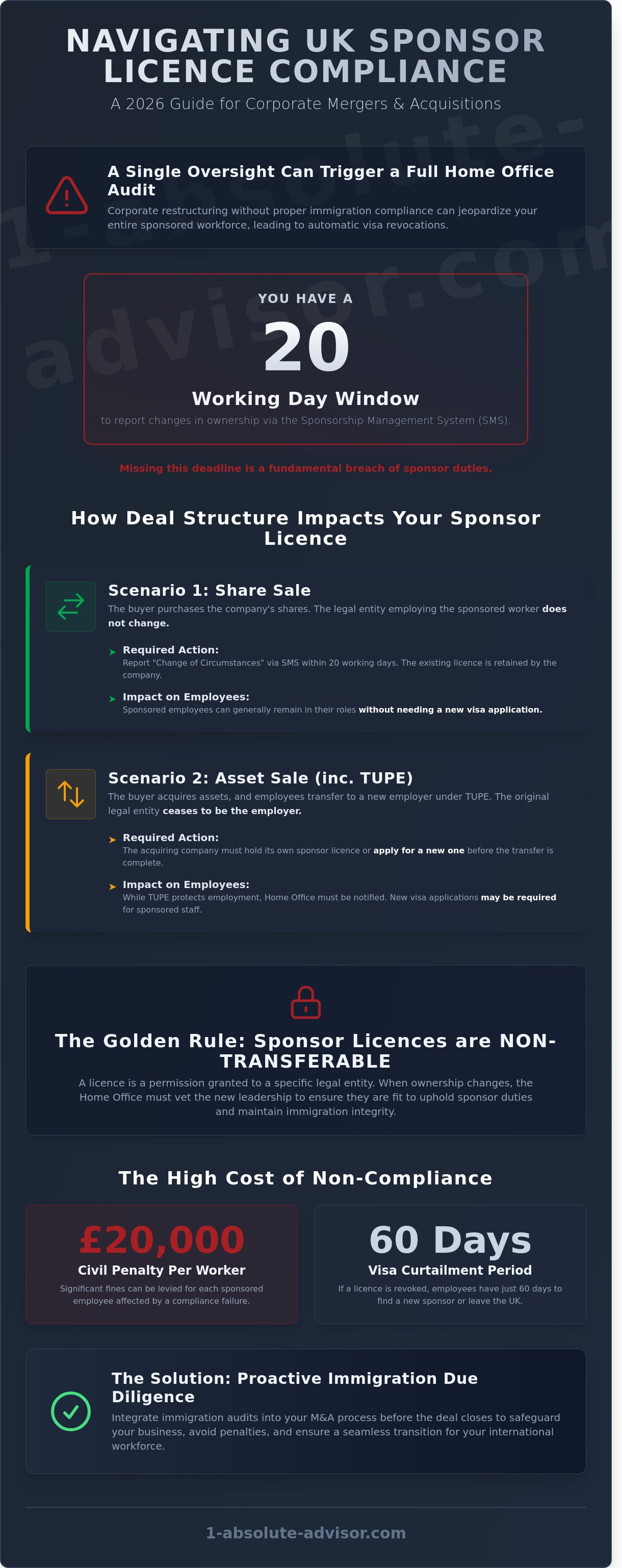
Speed is the most critical factor in maintaining compliance during a corporate transaction. The Home Office requires all sponsors to report changes in ownership or controlling interest via the Sponsorship Management System (SMS) within 20 working days. This isn’t a suggestion; it’s a hard deadline that leaves no room for administrative delay. The 20-day rule is the most critical timeline in UK business immigration. Missing this window can lead to severe operational risks, including:
- Immediate suspension or revocation of the sponsor licence.
- Civil penalties and fines for the business entity.
- The cancellation of active Skilled Worker visas for your entire international workforce.
- A cooling-off period before the company can apply for a new licence.
Strategic planning must account for the impact of sponsor company acquisition on skilled worker visa stability well before the deal closes. Proactive reporting ensures that the transition doesn’t disrupt your workforce or trigger unwanted Home Office scrutiny. Our experience shows that businesses that integrate immigration audits into their due diligence process avoid the most common pitfalls of post-acquisition compliance.
Share Sale vs. Asset Sale: How Deal Structure Affects Your Visa
The legal architecture of a corporate acquisition dictates the specific immigration workflow required to maintain compliance. While a deal might seem like a singular event to a boardroom, the Home Office views share sales and asset transfers through entirely different regulatory lenses. The impact of sponsor company acquisition on skilled worker visa holders depends on whether the legal entity employing them remains the same or changes entirely.
The Share Sale Scenario
In a share sale, the buyer purchases the shares of the target company. The legal entity employing the worker doesn’t change; the Company Registration Number and the existing employer-employee contracts remain intact. Only the “controlling interest” or the ultimate parent ownership shifts. This scenario generally involves fewer immediate hurdles for the visa holder, but it’s far from an administrative-free zone.
The sponsor must submit a “Change of Circumstances” report via the Sponsorship Management System (SMS) within 20 working days of the deal’s completion. Even though the licence remains valid, the Home Office requires full transparency regarding the new ownership structure. Existing Certificates of Sponsorship (CoS) stay in force, yet the new management must audit salary thresholds against 2026 standards. If the acquisition leads to a restructuring of pay scales, the organisation must ensure the worker still meets the minimum salary requirements for their specific SOC code. Failure to report these shifts accurately within the 20-day window can lead to a “B-rating” or total licence revocation.
The Asset Sale and TUPE Transfers
Asset sales are more complex because the employees move from Company A to Company B. This transition is typically governed by the Transfer of Undertakings (Protection of Employment) Regulations 2006, or TUPE. Under TUPE, the new employer inherits the rights, powers, duties, and liabilities of the previous employment contracts. From an immigration perspective, this constitutes a change of employer, which triggers a rigorous 20-day compliance countdown.
Company B must either already hold a valid sponsor licence or apply for one within 20 working days of the transfer. The new sponsor must explicitly report that they’re accepting “full responsibility” for the transferred staff. This process is strictly regulated by the UK Sponsor Duties and Compliance Guide, which outlines how the new owner assumes the legacy reporting history of the workers. If the new owner doesn’t secure a licence or fails to report the TUPE transfer correctly, the Home Office may curtail the workers’ visas to just 60 days, forcing them to find a new sponsor or leave the UK. Identifying these risks early in the due diligence phase is vital. If you’re managing a transition of this scale, seeking a strategic compliance audit can prevent costly disruptions to your workforce.
Navigating the SMS and Reporting Requirements Post-Acquisition
The Home Office mandates a strict 20-working-day window to report a corporate restructure. Missing this deadline can lead to the immediate downgrading or revocation of your sponsor licence. The impact of sponsor company acquisition on skilled worker visa holders is most acute during this administrative phase, as any lapse in reporting threatens the legality of their stay in the UK. Responsibility for reporting doesn’t fall on a single party; both the predecessor and the successor organisations must take action. The seller must report the cessation of trade or change in control, while the buyer must report the acquisition through their own Sponsorship Management System (SMS) portal.
The Home Office requires specific documentary evidence to validate the transition. You’ll need to upload the Sale and Purchase Agreement (SPA), relevant Companies House filings showing the new Persons of Significant Control (PSC), and a comprehensive list of all employees transferring under the Transfer of Undertakings (Protection of Employment) regulations, commonly known as TUPE. Managing the acquired company’s licence is equally critical. It typically becomes “dormant” for a period, allowing the new owner to move sponsored workers to their own licence before the old one is surrendered or expires.
Updating the SMS Profile
Distinguishing between a “Change of Ownership” and a “Merger” within the SMS is a common stumbling block. A merger usually involves two entities becoming a single new legal entity, while a change of ownership often involves the purchase of shares or assets. You must appoint a new Authorising Officer (AO) immediately if the previous one departs during the restructure. It’s also vital to add new Level 1 users from the acquiring company. This ensures that the system remains accessible and that the “dormant” licence doesn’t become an administrative dead end, preventing you from assigning new Certificates of Sponsorship (CoS) when needed.
Post-Acquisition Right to Work Audits
Acquiring a company doesn’t mean you inherit their statutory excuse against civil penalties. The new employer must re-verify the right to work for every transferred staff member to remain compliant with Home Office standards. Under TUPE, there’s a 60-day grace period from the date of transfer to complete these checks. Given that fines for illegal working rose significantly in 2024, reaching up to £60,000 per worker for repeat offenders, this audit is a non-negotiable priority. For a deeper understanding of standard compliance rules, refer to this guide on the Skilled Worker Visa UK 2026. The impact of sponsor company acquisition on skilled worker visa stability depends entirely on how meticulously these audits are performed within that initial two-month window.
The Impact on Sponsored Employees: Do You Need a New Visa?
The immediate reaction to a corporate takeover is often one of high anxiety. For workers on a Skilled Worker visa, the question “Will I be deported if my company is bought?” usually tops the list. You can rest assured that a change in ownership doesn’t trigger an automatic exit from the UK. Under the Transfer of Undertakings (Protection of Employment) Regulations 2006 (TUPE), your existing employment rights are protected. If the new entity takes over the sponsorship responsibility and your job role remains identical, you won’t need to apply for a new visa immediately. Your current leave remains valid until its original expiry date.
The impact of sponsor company acquisition on skilled worker visa holders depends heavily on the continuity of the role. You don’t need a new visa if your core duties, SOC code, and salary remain consistent with your original Certificate of Sponsorship (CoS). The Home Office views this as a seamless transfer of responsibility. While there’s no “cooling-off” period that requires you to stop working or leave the country, the new employer must report the change via the Sponsor Management System (SMS) within 28 days of the transfer. Failure to meet this administrative deadline is the employer’s risk, not yours, provided the job remains the same.
When a New Visa Application IS Required
There are specific triggers that mandate a fresh “Change of Employment” application. If the acquisition leads to a promotion or restructure that changes your core duties enough to move you into a different SOC code, you must apply for a new visa before starting that new role. Similarly, if your salary is adjusted downwards and falls below the 2026 thresholds, which currently sit at a baseline of £38,700 for most roles, your sponsorship might be at risk. Finally, if the acquiring company refuses to take over sponsorship or fails to obtain a license within the required 28-day window, your leave may be curtailed to 60 days.
Protecting the ILR Qualifying Period
Maintaining the “continuous residence” requirement is vital for those planning to stay in Britain long-term. Any “gap” in sponsorship during an acquisition can be catastrophic for your timeline. To avoid resetting the 5-year clock, ensure the new sponsor accepts full liability for your employment from day one of the transfer. This prevents a break in your lawful residence. You can learn more about how these periods are calculated in our ILR UK Guide, which explains the 5-year qualifying period in detail. Professional oversight ensures that the impact of sponsor company acquisition on skilled worker visa status doesn’t jeopardise your future settlement goals.
Ensuring Compliance During Restructuring with Professional Support
Corporate restructures carry inherent risks that extend far beyond the balance sheet. At 1 Absolute Advisor, we bridge the gap between corporate law and immigration compliance, ensuring that the impact of sponsor company acquisition on skilled worker visa holders doesn’t lead to operational disruption. We manage the transition for both buyers and sellers by aligning HR systems with Home Office requirements before the deal concludes. This proactive stance prevents the automatic revocation of licences that often occurs when the strict 20-working-day reporting window is missed.
Our approach is rooted in risk mitigation. We act as a strategic partner, preparing the necessary evidence for TUPE transfers and ensuring that the new entity’s hierarchy is ready to take on sponsorship duties. By handling the administrative burden of the Sponsorship Management System (SMS), we allow leadership teams to focus on the commercial integration of the two businesses.
Immigration Due Diligence for Acquisitions
A successful acquisition requires a granular look at the target company’s immigration health. We identify hidden liabilities, such as historic reporting failures or incorrect salary rates, which could trigger a Home Office audit post-completion. Our expert review includes:
- Licence Health Checks: Verifying if the target company has complied with Appendix Sponsor: Duties and Compliance to avoid inheriting “B-rated” or suspended licences.
- CoS Verification: A rigorous audit of current Certificates of Sponsorship to ensure job descriptions and SOC codes align with 2024 and 2026 salary thresholds.
- Right-to-Work Audits: Since civil penalties for illegal working increased to £60,000 per worker in February 2024, we verify the target’s historic compliance to protect the buyer from massive financial exposure.
Our Fixed-Fee Application Service
Managing the SMS during a merger is a technical burden that most internal HR teams aren’t equipped to handle alone. We provide fixed-fee management for the entire restructure process, offering a predictable cost structure that eliminates financial ambiguity. Our advisors provide dedicated support for Authorising Officers and Level 1 users, guiding them through the complexities of reporting “Changes of Circumstances” and new licence applications.
If a buyer isn’t already a sponsor, we facilitate fast-track licence applications to ensure they’re “sponsorship-ready” by the completion date. This ensures the impact of sponsor company acquisition on skilled worker visa status is managed with absolute precision, protecting your international talent from losing their right to remain in the UK.
Contact our OISC-registered advisors for a consultation to secure your workforce during your next corporate transition.
Securing Your Workforce During Corporate Transitions
Corporate restructures represent significant regulatory milestones rather than simple financial shifts. Whether your deal involves a share sale or an asset transfer, the impact of sponsor company acquisition on skilled worker visa holders requires immediate attention within the 20-working-day reporting window mandated by Home Office guidelines. Misidentifying a TUPE transfer or failing to update the Sponsorship Management System (SMS) can lead to the revocation of your licence and the curtailment of staff leave. It’s vital to remember that sponsor licences aren’t transferable; new entities often need to submit fresh applications within the 28-day grace period following a change of control.
Our team provides the absolute precision required to navigate these complex legal frameworks. As OISC-registered immigration consultants, we offer specialist expertise in corporate restructures and TUPE transfers to ensure your business remains compliant. We provide fixed-fee application management with no hidden costs, allowing you to plan your budget with total certainty. Secure your business and staff today with our professional Skilled Worker visa services. By addressing these compliance requirements proactively, you’ll protect your international talent and ensure your company’s long-term stability in the UK market.
Frequently Asked Questions
Does a company acquisition automatically cancel my Skilled Worker visa?
No, an acquisition doesn’t automatically cancel your visa. Under the Transfer of Undertakings (Protection of Employment) Regulations 2006, your employment contract and sponsorship usually transfer to the new entity. You’ll remain legally employed as long as the acquiring company follows the mandatory Home Office reporting procedures within the 20-working-day deadline.
How long do we have to notify the Home Office after a business merger?
The acquiring company must report the merger through the Sponsor Management System within 20 working days of the transaction’s legal completion. This timeframe is non-negotiable. Failure to meet this deadline can lead to the Home Office reducing your visa duration to 60 days, effectively forcing you to leave the UK or find a new sponsor.
What happens if the acquiring company does not have a sponsor licence?
If the new owner doesn’t hold a valid licence, they must apply for one within 20 working days of the acquisition date. This is a critical factor when assessing the impact of sponsor company acquisition on skilled worker visa holders. If the application is rejected, the company can’t legally sponsor you, and your leave to remain will likely be curtailed.
Can a sponsored worker change roles during a company restructure?
You can’t move into a role with a different SOC code without submitting a fresh “change of employment” application to the Home Office. If the restructure only changes your job title but your core duties and SOC code remain identical, the sponsor simply needs to update the SMS. Significant changes to salary or location also require formal reporting to maintain compliance.
Do I need to pay the Immigration Skills Charge again after an acquisition?
You don’t usually need to pay the Immigration Skills Charge again if your employment transfers under TUPE rules. The Home Office treats the initial payment as valid for the remainder of your current visa period. However, if the acquisition forces you to apply for a new visa because your job role has changed, the employer must pay the £1,000 annual fee again.
What is the risk of a sponsor licence being revoked during a share sale?
The risk of revocation increases if the new management fails the Home Office “fit and proper” person test during the mandatory 20-day reporting window. If the Home Office uncovers previous compliance gaps or determines the new owners are unsuitable, they’ll revoke the licence. This results in all sponsored staff receiving a 60-day notice to find alternative employment.
How does TUPE affect my right to work in the UK?
TUPE protects your continuous service record, which is vital for your future settlement prospects. The new employer must carry out a fresh right-to-work check within 60 days of the transfer to comply with the Immigration, Asylum and Nationality Act 2006. As long as the transfer is documented correctly, your right to work remains continuous throughout the transition period.
Can I apply for Indefinite Leave to Remain if my employer was acquired?
Yes, you can apply for ILR once you complete the 5-year residency period. The impact of sponsor company acquisition on skilled worker visa status won’t reset your qualifying period if the transfer followed TUPE regulations. You’ll need to provide a sponsor letter from the new entity confirming your continued employment and that you’re still required for your specific role.