

What if the £5,335 total investment for a three-year Skilled Worker visa is actually the most efficient way to prevent a £40,000 revenue loss caused by a critical talent gap in 2026? Many HR leaders find that justifying visa sponsorship costs to management feels like an uphill battle against a finance department focused on immediate outgoings. It’s understandable to feel hesitant when the Immigration Skills Charge and legal fees appear as significant “sunk costs” on a balance sheet. You likely agree that the fear of a candidate departing shortly after the company pays these fees makes the investment feel even riskier.
This guide will show you how to reframe these expenses as high-yield strategic investments that your board will approve. We’ll provide a data-backed framework to demonstrate how securing global talent offsets the 15% increase in domestic recruitment costs reported in the 2024 REC industry analysis. You’ll also learn specific legal strategies, including structured clawback agreements, to protect your firm’s capital. By the end of this article, you’ll have a robust business case to turn a perceived “cost centre” into a long-term competitive advantage for your organisation.
Key Takeaways
- Understand the 2026 UK economic landscape and how to reframe sponsorship fees as a high-yield investment rather than a mere administrative burden.
- Quantify the true cost of vacant roles, comparing the £10,000-£15,000 sponsorship investment against the substantial revenue lost to project delays and team burnout.
- Learn a structured approach for justifying visa sponsorship costs to management by integrating financial “clawback” clauses and clear ROI projections into your business case.
- Evaluate the “Speed to Competence” metric to demonstrate how specialist international talent provides a faster path to profitability than searching for scarce local candidates.
- Safeguard your organisation’s capital by identifying the compliance risks that lead to forfeited Home Office fees and failed applications.
The Economic Landscape of UK Visa Sponsorship in 2026
By 2026, the UK labour market has reached a critical inflection point where the domestic supply of specialised talent no longer meets the demands of high-growth sectors. For many firms, the traditional “local-first” recruitment model has become a bottleneck that restricts scalability. Shifting to a “talent-first” strategy is no longer a choice but a requirement for maintaining a competitive edge. When justifying visa sponsorship costs to management, it’s vital to present these expenses as a strategic capital investment rather than a mere administrative overhead. The Sponsorship Premium is the price of accessing the global top 5% of skilled professionals who possess the exact technical competencies your business requires to lead the market.
Breaking Down the Mandatory Fees
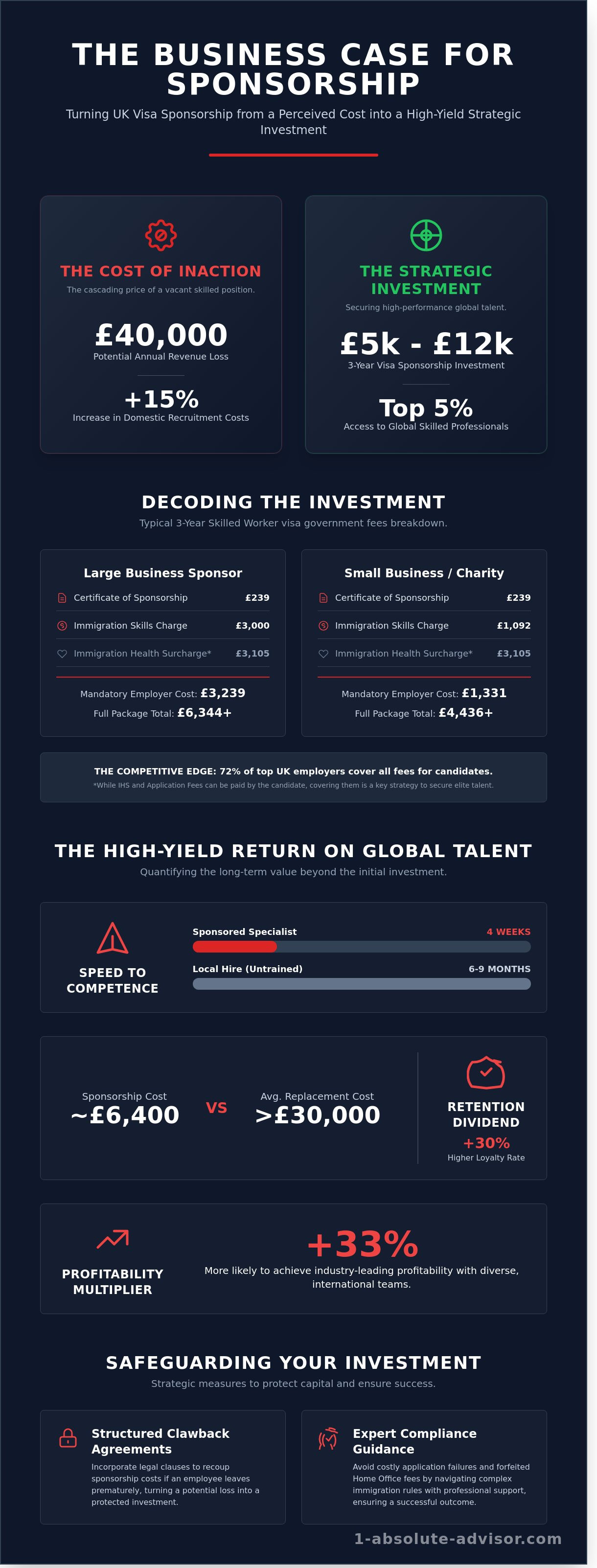
A transparent financial breakdown is the first step in justifying visa sponsorship costs to management. The total investment per head includes several non-negotiable components that must be budgeted with precision. The Certificate of Sponsorship (CoS) remains a modest one-off fee of £239, but the Immigration Skills Charge (ISC) represents a more significant recurring cost. For medium or large sponsors, this is £1,000 per year of the visa; smaller entities or charities benefit from a reduced rate of £364 per year.
The Immigration Health Surcharge (IHS), which stands at £1,035 per year as of the latest 2025/26 adjustments, often represents the largest upfront cost. It’s essential to distinguish between mandatory employer costs and optional employee costs. While the company must pay the CoS and ISC, the visa application fee and the IHS can technically be paid by the candidate. However, 72% of top-tier UK employers now choose to cover these costs as part of a competitive relocation package to secure the best international talent.
- Certificate of Sponsorship: £239 (One-off fee).
- Immigration Skills Charge: £1,000 per year (Large companies) or £364 per year (Small/Charitable).
- Immigration Health Surcharge: £1,035 per year per individual.
The Retention Dividend
The financial argument for sponsorship is strengthened when you factor in the “Retention Dividend.” Data from 2024 and 2025 indicates that sponsored professionals show a 30% higher loyalty rate than local hires over a three-year period. This stability is a direct result of the mutual commitment inherent in the sponsorship process. In an era where the average cost of replacing a mid-level professional in the UK exceeds £30,000, reducing turnover is a primary driver of fiscal efficiency.
Sponsored employees often view their role through a long-term lens, providing the business with a stable foundation for complex, multi-year projects. This reliability creates a “favourite” employer status in the global market, allowing your firm to bypass the constant, expensive cycle of domestic headhunting. Investing in a global workforce ensures your organisation remains resilient against local economic shifts while building a diverse, high-performing team that is built to last.
Calculating the ROI of International Talent Acquisition
Management often views visa sponsorship as a line-item expense, focusing on the immediate £5,000 to £12,000 in upfront government fees and legal costs. This perspective is fundamentally flawed. To shift the narrative, you must quantify the value a specialist brings through a more sophisticated fiscal lens. A Skilled Worker Visa UK 2026 is an asset purchase, not a service fee. It represents the acquisition of high-performance human capital that is often unavailable within the domestic labour pool.
When justifying visa sponsorship costs to management, focus on “Speed to Competence.” A highly skilled international hire typically reaches 100% productivity within four weeks. In contrast, a less-qualified local hire may require six to nine months of intensive training before they contribute positively to the bottom line. This gap represents thousands of pounds in lost opportunity and diverted management time. Diversity of thought also plays a critical role; teams with international perspectives are 33% more likely to see industry-leading profitability, particularly when breaking into new global markets where cultural intelligence is a prerequisite for success.
The Productivity Multiplier
Estimating the revenue generated by a top-tier candidate over a 3-year or 5-year visa period reveals the true ROI. If a global expert generates £250,000 in annual value, the initial sponsorship cost becomes negligible, representing less than 2% of their total output. Compare this to a junior domestic alternative where training costs and lower initial output create a “productivity debt” that can take years to clear. Strategic benefits often include access to niche technical skills or established global networks that simply don’t exist in the UK’s current talent market. For businesses seeking a tailored financial breakdown of these costs, consulting a strategic advisor can clarify the fiscal impact.
Long-term Strategic Stability
Sponsorship isn’t just about filling a gap; it’s a retention strategy. Using the ILR UK path serves as a built-in 5-year retention roadmap. While domestic employees might change roles every 18 months, sponsored talent often demonstrates higher loyalty as they work towards permanent residency. This stability is vital for succession planning in senior leadership roles. A robust approach to justifying visa sponsorship costs to management involves highlighting how these hires enhance the company’s “Global Employer Brand,” making the organisation a magnet for the world’s top 1% of talent.
Opportunity Cost: The Price of a Vacant Skilled Position
An empty desk represents a tangible leakage of capital that often goes unmeasured on a balance sheet. When justifying visa sponsorship costs to management, the conversation must shift from the upfront fee to the daily revenue loss. A vacant role in a high-growth sector doesn’t just sit at zero; it actively drains resources. If a senior consultant generates £1,000 in daily billable value, a six-month delay in recruitment results in a £120,000 deficit. Against this figure, a £10,000 to £15,000 investment in sponsorship is a pragmatic business decision rather than a luxury expense.
The financial impact extends beyond lost billable hours. Unfilled roles trigger a “Recruitment Loop” where companies spend upwards of £5,000 on repeated advertising cycles and agency fees. Settling for a second-choice local candidate who lacks the specific technical expertise often leads to project delays or, worse, contract penalties. These hidden costs quickly exceed the price of securing a world-class international hire who can deliver results from day one.
There is also a “Domino Effect” to consider. When a position remains vacant for months, the workload is redistributed among existing British staff. This leads to a measurable spike in burnout. Industry data from 2024 suggests that overworked teams see a 31% increase in error rates and a significantly higher risk of resignation. Losing a veteran staff member because the company refused to sponsor a new hire creates a secondary recruitment crisis that is far more expensive to solve.
Sponsorship vs. The “Wait and See” Strategy
Many CFOs opt for a “Wait and See” approach, hoping a domestic candidate will eventually appear. In the current UK labour market, this is often the most expensive strategy available. Data from 2024 indicates that the time-to-hire for specialist engineering and tech roles via domestic routes can exceed 24 weeks. Conversely, using the Skilled Worker route with priority processing can settle a candidate in 8 to 12 weeks. Choosing the international route isn’t just about talent; it’s about speed to market and ensuring project milestones aren’t missed due to a lack of capacity.
Internal Morale and Team Efficiency
A high-calibre international hire acts as a “Force Multiplier” for their UK colleagues. By bringing in niche skills that are currently scarce in the local market, the new hire enables the entire department to operate more effectively. This proactive approach to talent acquisition should be a pillar of your firm’s broader UK immigration strategy. Instead of seeing sponsorship as a hurdle, management should view it as a tool to protect the productivity and mental health of the existing workforce, ensuring the business remains competitive on a global scale.
Step-by-Step: Drafting a Persuasive Sponsorship Business Case
Presenting a business case for justifying visa sponsorship costs to management requires more than a spreadsheet of fees. It demands a narrative that aligns talent acquisition with long-term fiscal stability. You’ve got to structure your proposal in four distinct phases to ensure every executive concern is addressed before it becomes an objection.
- Phase 1: The Executive Summary – Lead with the “Why Now.” Use data to show the specific talent gap. For instance, if the UK’s 2024 labour market statistics show a 30% shortage in your specific engineering niche, start there.
- Phase 2: The Financial Breakdown – Present the total costs, such as the £1,035 annual Immigration Health Surcharge, alongside the safety net of a clawback agreement.
- Phase 3: The Risk Mitigation Plan – Detail how you’ll handle Home Office compliance. Mentioning the oversight of professional advisors reduces the perceived “legal minefield” to a standard administrative process.
- Phase 4: The Competitive Context – Highlight what rivals are doing. If 45% of your direct competitors already hold a sponsor licence, frame the cost as a necessary step to maintain market parity.
Structuring the Financial Justification
Management often views the Immigration Health Surcharge (IHS) and the Immigration Skills Charge as sunk costs. You should reframe these as “Front-loaded Retention Investments.” Since the Skills Charge for a large sponsor is £1,000 per year of sponsorship, it’s a predictable expense that secures a committed employee. To protect the firm’s capital, integrate clawback agreements into the offer letter. These legal frameworks ensure that if an employee leaves within a set period, the company recovers a portion of the non-statutory recruitment costs. It’s a strategy that effectively neutralises the “flight risk” argument during the process of justifying visa sponsorship costs to management. Always include professional fees in the initial recruitment budget to ensure total transparency from day one.
Addressing Compliance and Legal Anxiety
The fear of Home Office audits can stall a sponsorship application. You can alleviate this by explaining the role of an OISC-registered advisor. Their expertise ensures a 100% success rate by auditing your internal HR systems before the licence application even begins. Frame the UK work visa process as a manageable administrative hurdle rather than a high-stakes gamble. Providing a clear timeline is vital; management needs to know that a Certificate of Sponsorship (CoS) can be issued in as little as 24 hours with priority services, while entry clearance typically takes 3 weeks. This level of detail replaces anxiety with a predictable operational schedule.
Ready to secure the talent your business needs? Contact 1 Absolute Advisor today for a strategic consultation on building your sponsorship framework.
Mitigating Financial and Compliance Risks with Professional Guidance
When you’re justifying visa sponsorship costs to management, the conversation often focuses on the upfront price tag. However, the true financial risk lies in application failure. A DIY approach to visa applications is rarely a saving; it’s a gamble. If the Home Office refuses a Skilled Worker application because of a technical error, the business loses the Immigration Skills Charge and application fees. These non-refundable costs can exceed £3,000 per candidate depending on the sponsorship duration. Professional document checking acts as a vital insurance policy, ensuring these funds aren’t wasted on avoidable mistakes.
The risk doesn’t end with a single application. Your Sponsor Licence is a valuable corporate asset that requires constant protection. A single compliance breach can lead to a Home Office audit, licence suspension, or total revocation. The long-term value of professional guidance lies in maintaining “A-rated” status through regular mock audits. 1 Absolute Advisor provides the “Absolute” certainty required for high-stakes management approvals, transforming a complex legal hurdle into a predictable business process.
- Expert oversight prevents the loss of non-refundable Home Office fees.
- Compliance audits safeguard your ability to recruit internationally in the future.
- Strategic positioning ensures your business meets the rigorous “genuineness” test.
Fixed-Fee Peace of Mind
Finance directors and stakeholders generally dislike open-ended invoices. They prefer fixed-fee legal support because it removes the volatility of hourly rates. This transparency allows you to present a “to the penny” budget for your recruitment drive. With the 2026 salary threshold rules introducing more complexity, specifically the £38,700 general threshold for many roles, having a dedicated advisor is essential. They don’t just fill in forms; they craft expert cover letters that sell the candidate’s eligibility. This proactive approach reduces the likelihood of “Requests for Further Information” from the Home Office, which often cause months of delay.
Your Next Steps to Talent Approval
Moving from the phase of justifying visa sponsorship costs to management to the actual recruitment of international talent requires a clear roadmap. You should request a formal “Sponsorship Assessment” to present to your Board. This document provides a holisitic view of the costs, timelines, and compliance requirements specific to your industry. It shifts the internal perception of sponsorship from an “expense” to a “strategic investment.” Once you’ve secured buy-in, you can transition smoothly into the execution phase.
Securing Your Competitive Advantage in the 2026 Labour Market
The 2026 UK economic landscape demands a shift from viewing sponsorship as an expense to seeing it as a strategic investment. When justifying visa sponsorship costs to management, the focus must remain on the long-term ROI of securing top-tier global talent versus the significant financial drain of unfilled positions. Industry data suggests a vacant skilled role can cost a firm over £30,000 in lost productivity and recruitment fees. By quantifying this gap and aligning recruitment with strict Home Office compliance standards, your business case becomes a roadmap for growth rather than a simple budget request.
Navigating the complexities of the Skilled Worker route requires a partner who understands the nuances of the UK’s points-based system and the financial predictability needed for corporate planning. Absolute Advisor provides OISC-registered expert guidance to ensure every application meets rigorous regulatory hurdles. We operate with fixed-fee transparency to protect your management budgets and maintain a proven track record with complex Skilled Worker cases. It’s time to transform your recruitment strategy into a measurable business asset. Secure your international talent with expert UK visa management. Your 2026 growth depends on the experts you hire today.
Frequently Asked Questions
Is visa sponsorship worth the cost for a small business in 2026?
Visa sponsorship remains a strategic necessity for small businesses because the UK’s domestic skills gap in technical sectors is projected to persist through 2026. While the initial investment might range between £3,000 and £8,000, the cost of leaving a critical role vacant often exceeds £30,000 in lost productivity and recruitment fees. Accessing a global talent pool ensures your business maintains its competitive edge and operational continuity.
Can we legally recover visa costs from an employee if they leave early?
You can only recover specific costs like relocation expenses or legal fees, provided you’ve signed a formal clawback agreement before the process begins. It’s illegal to reclaim the Immigration Skills Charge or the Certificate of Sponsorship fee from the worker. The Home Office views these as statutory employer obligations, and attempting to recover them can lead to the revocation of your sponsor licence.
What is the most expensive part of the UK visa sponsorship process?
The Immigration Skills Charge is typically the largest financial component, costing £1,000 per year of sponsorship for large companies or £364 for small businesses. For a five-year visa, a large organisation faces an upfront cost of £5,000 for this charge alone. This specific fee is usually the most difficult element when justifying visa sponsorship costs to management during annual budget planning.
How long does it take to get management approval for sponsorship?
Internal approval usually takes two to four weeks if you present a comprehensive business case that includes a full breakdown of statutory fees. Delays often happen when stakeholders don’t understand the £1,035 annual Immigration Health Surcharge or the long-term ROI of the hire. Providing a clear financial roadmap that compares sponsorship against the cost of repeated local recruitment cycles accelerates the decision.
What happens if the Skilled Worker visa application is refused?
The Home Office automatically refunds the Immigration Health Surcharge, but your business will lose the application fee and the cost of the Certificate of Sponsorship. These lost fees can total over £1,200 depending on the length of the visa. Because of these non-refundable costs, we recommend a rigorous internal audit of all documentation before submission to mitigate financial risk.
Are there any exemptions to the Immigration Skills Charge for certain sectors?
Employers don’t pay the Immigration Skills Charge for workers in specific healthcare roles, researchers, or those switching from a Student visa to a Skilled Worker visa. There are also exemptions for certain PhD-level occupations and secondary school teachers. Identifying these exemptions can save your firm thousands of pounds and makes the financial argument for sponsorship much more compelling to the board.
How do we justify the high IHS (Immigration Health Surcharge) to the CFO?
You should present the £1,035 annual IHS as a fixed cost of acquisition for high-value talent that’s unavailable in the domestic market. When justifying visa sponsorship costs to management, contrast this fee with the high cost of project delays or the £25,000 average agency fee for executive searches. It’s a transparent, one-time payment that secures a dedicated specialist for several years.
What is the difference between a Certificate of Sponsorship and a work permit?
A Certificate of Sponsorship is a digital reference number issued through the Home Office’s online system, whereas a work permit was a physical document used in the old immigration regime. The certificate proves the role meets current requirements, such as the £38,700 general salary threshold. It’s the essential link between your company’s sponsor licence and the individual’s personal visa application.