
British Citizenship for European Nationals: The 2026 Guide to Naturalisation

What if your £1,630 investment in a British future was rejected because of a single weekend trip you forgot to log three years ago? For many EU residents, the path to british citizenship for european nationals feels less like a logical progression and more like a high-stakes gamble with their life savings. You’ve worked hard to secure your Settled Status, yet the transition to naturalisation introduces a maze of physical presence rules and complex dual nationality laws that can feel overwhelming. It’s perfectly natural to worry about the financial risk and the potential for a refusal letter that impacts your long-term security.

We understand that you’re looking for more than just a checklist; you’re seeking the absolute certainty that your application is flawless. This guide offers a comprehensive roadmap to help you manage the 2026 requirements with professional precision. We’ll break down the specific residency calculations, address concerns regarding your home country’s stance on dual citizenship, and outline the exact process to ensure you finally hold a British passport and the permanent peace of mind you deserve.

Key Takeaways

  • Understand the mandatory 12-month waiting period following Settled Status and how to correctly calculate your continuous residence to meet Home Office requirements.
  • Master the essential eligibility criteria, including English language proficiencies and the “Day One” physical presence rule, to secure british citizenship for european nationals.
  • Learn to navigate the subjective “Good Character” requirement and the potential traps that often lead to application refusals for EU citizens.
  • Gain a step-by-step overview of the online Form AN and the specific criteria for selecting qualified referees to validate your application.
  • Discover the strategic value of professional OISC-registered audits in identifying errors before submission, protecting your investment and future in the UK.

The Transition from Settled Status to British Citizenship

Moving from the EU Settlement Scheme (EUSS) to naturalisation represents a definitive legal shift. While Settled Status provides a permanent right to reside under the Withdrawal Agreement, it remains an immigration status subject to Home Office oversight. Obtaining british citizenship for european nationals involves a formal application under the British Nationality Act 1981. This process transforms a resident into a citizen with full constitutional rights, moving beyond the limitations of treaty-based residency.

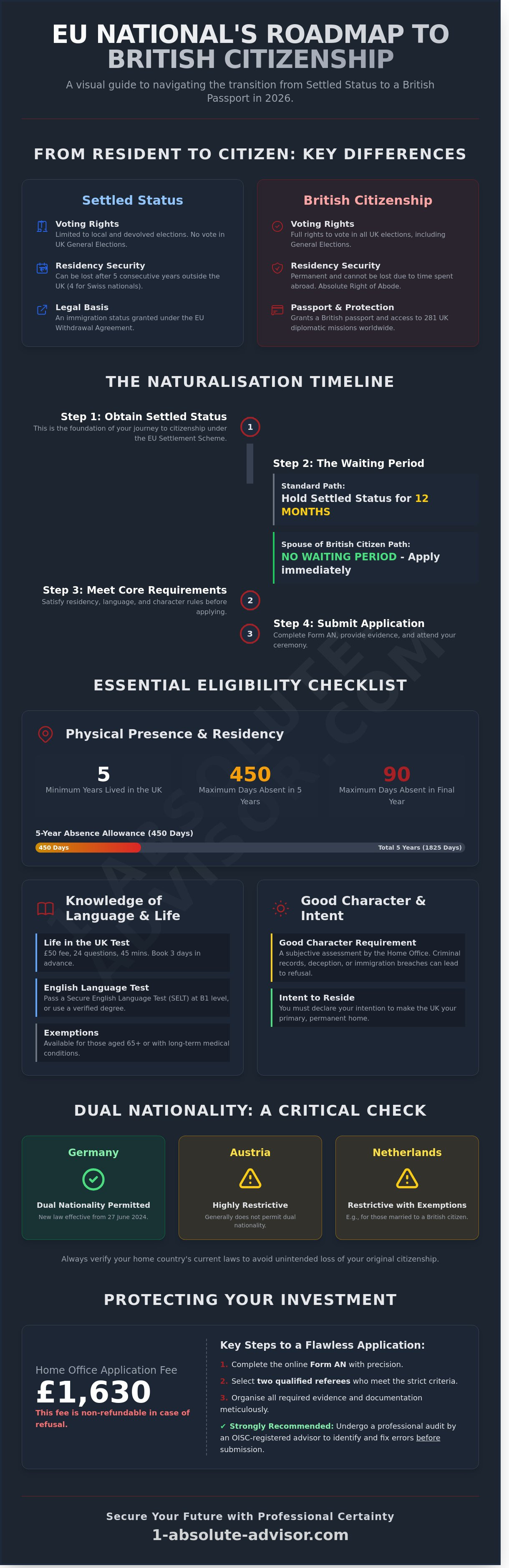
For most applicants, the “12-month rule” is the primary hurdle. You must have held Settled Status for at least 12 months before submitting your naturalisation form. This ensures you’ve been free from immigration time restrictions for a full year. However, if you’re married to or in a civil partnership with a British citizen, this waiting period doesn’t apply. You can submit your application the day your Settled Status is granted, provided you meet the three-year residency requirement.

It’s vital to distinguish between the Right of Abode and full citizenship. Right of Abode confirms your right to live and work in the UK without any immigration restrictions. While all British citizens automatically possess the Right of Abode, some Commonwealth citizens hold this right without being British. Only full citizenship grants the absolute right to a British passport and unconditional consular protection while travelling abroad.

Settled Status vs. British Citizenship: Key Differences

The most tangible shift occurs at the ballot box. European nationals with Settled Status can vote in local and devolved elections, but only British citizens can vote in UK General Elections. Residency security also improves significantly. Settled Status can be revoked if you stay outside the UK for more than five consecutive years, or four years for Swiss citizens. British citizenship is permanent. It provides a British passport, ensuring access to consular assistance from 281 UK diplomatic missions worldwide.

Dual Nationality Nuances for Europeans

Before applying, verify your home country’s stance on multiple passports. Germany modernised its nationality laws on 27 June 2024, now fully permitting dual nationality for its citizens. Conversely, Austrian and Dutch laws remain restrictive, and Polish nationals often require specialised legal advice from a firm like Kancelaria Radcy Prawnego Monika Trych to understand the nuances. Always confirm current bilateral agreements to avoid the unintended loss of your EU passport during the british citizenship for european transition.

Essential Eligibility Criteria for European Nationals

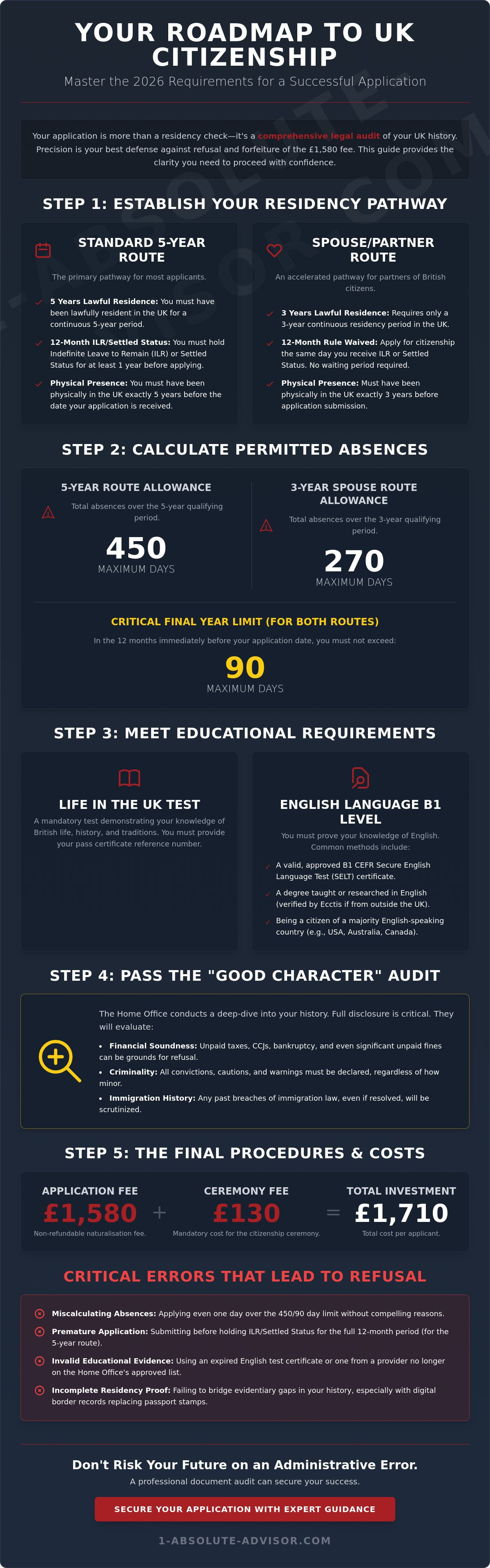
Securing british citizenship for european applicants in 2026 requires a meticulous approach to documentation and timing. The Home Office evaluates your history through a rigid lens of statutory requirements. You must hold Settled Status or Indefinite Leave to Remain for at least 12 months before submitting your naturalisation form. This 12-month waiting period doesn’t apply if you’re married to a British citizen; in that case, you can apply as soon as your status is granted. Every day of your qualifying period counts toward your final success.

Proving Your Knowledge of Language and Life

Demonstrating integration is a two-part process. First, you must pass a Secure English Language Test (SELT) at B1 level or higher. Approved providers include Trinity College London and Pearson. If you have a degree taught in English, you can often use your certificate instead, provided it’s verified by Ecctis. Second, the Life in the UK Test remains a mandatory hurdle. It’s a 45-minute computer-based exam consisting of 24 questions. As of 2026, the fee is £50. You should book your slot at least 3 days in advance at one of the 30 official test centres. Those aged 65 or over, or individuals with long-term physical or mental conditions, can claim an exemption. If you’re unsure about your eligibility for a waiver, consulting a compliance expert can prevent costly application rejections.

The Residency Requirement Breakdown

Meeting the residency requirements for british citizenship for european nationals is often the most complex part of the process. The Home Office tracks your physical presence with precision. To qualify, you must have lived in the UK for a minimum of 5 years. During this period, your total absences shouldn’t exceed 450 days. The final 12 months are the most restrictive; you’re only allowed 90 days outside the country. If you’ve exceeded these limits due to unavoidable circumstances like a 2025 family emergency or mandatory work assignments, the Home Office may exercise discretion. However, this is never guaranteed. You’ll also need to declare your ‘intent to reside’, which means you plan to make the UK your primary home. This isn’t just a tick-box exercise. Officials look for ties like UK-based employment, property ownership, or family units to confirm your commitment.

British Citizenship for European Nationals: The 2026 Guide to Naturalisation

The Home Office applies a subjective “Good Character” test to every adult applying for british citizenship for european nationals. Unlike the residency requirement, which is largely mathematical, good character relies on the discretion of a caseworker. They examine your conduct over the previous 10 years. Minor infractions, such as a £100 Fixed Penalty Notice for a traffic violation or a minor civil penalty, won’t automatically trigger a refusal. However, a pattern of such incidents suggests a persistent disregard for UK law. Total transparency is your only safeguard. If you fail to disclose a spent conviction or a civil penalty, the Home Office often views this as “deception,” leading to a mandatory refusal and a potential 10-year ban on future applications.

Financial Integrity and Tax Compliance

Your relationship with HMRC is a primary indicator of character. Caseworkers regularly cross-reference applications with tax records to ensure compliance. For self-employed Europeans, missing the 31 January Self Assessment deadline or having outstanding Class 2 National Insurance contributions can jeopardise the process. The Home Office expects applicants to have resolved all tax debts or have a formal “Time to Pay” agreement in place before submitting Form AN. Financial soundness isn’t just about wealth; it’s about demonstrating you’ve met all fiscal obligations to the state since your arrival.

The ‘Physical Presence’ Start Date Rule

The most common technical rejection involves the “Day One” rule. To meet the legal requirement, you must have been physically present in the UK exactly five years prior to the date the Home Office receives your application. If you apply on 12 November 2026, you must prove you were on British soil on 12 November 2021. This is a strict statutory requirement that catches out many frequent travellers.

  • Verify your records: Check your passport stamps and digital flight receipts to confirm your location on that specific date five years ago.
  • Avoid travel on application day: Don’t submit your application while you’re currently abroad on a business trip or holiday.
  • Account for transit: If you were in international airspace or at sea on that start date, the requirement isn’t met.

Precision in these dates is non-negotiable for british citizenship for european applicants. While the Home Office can sometimes overlook minor absences over the limit, they rarely exercise discretion for the “Day One” presence rule. Ensuring your 5-year window starts on a day you were definitely in the UK is the simplest way to avoid an expensive and unnecessary rejection.

Organising Your Evidence: The Application Process

Securing british citizenship for european nationals involves a structured, digital-first approach. The primary vehicle for this transition is Form AN, an online application that requires meticulous attention to detail. In 2026, the Home Office application fee stands at £1,630. Accuracy is paramount. A single oversight in your five-year residency history can result in a refusal without a refund of these fees. This makes the preparation phase the most critical part of your journey.

Your application requires two referees to validate your character. One must be a professional person of any nationality, such as a chartered accountant, solicitor, or teacher. The second must be a British citizen aged 25 or over who isn’t related to you. Both must have known you for at least three years. After submission, you’ll book a biometrics appointment through UKVCAS. These centres are located across the UK. Appointment costs range from £0 to £210 depending on the urgency and location chosen.

The Document Checklist for EU Citizens

Successful applicants provide a robust paper trail. You must present your EU Settlement Scheme (EUSS) share code or Indefinite Leave to Remain (ILR) documentation. Residency proof is essential. We recommend using P60 documents from the last five years or council tax bills to demonstrate physical presence. If you’re married to a British citizen, the residency requirement shortens to three years. You’ll also need your Life in the UK test pass notification and a valid B1 English language certificate, unless you hold a degree taught in English.

The Citizenship Ceremony: The Final Step

Once your application is approved, usually within 12 to 24 weeks, you’ll receive an invitation to a citizenship ceremony. You must attend this event within 90 days. During the ceremony, you’ll swear an oath of allegiance or make an affirmation to the Monarch. You’ll then receive your Certificate of Naturalisation. This certificate is the legal proof of your status. You can then apply for your first British passport, which costs £88.50 for a standard 34-page document. Our team provides strategic naturalisation support to ensure your documentation meets these rigorous standards.

Applying for british citizenship for european nationals isn’t just a paperwork exercise; it’s a significant financial and emotional investment. A single administrative oversight can lead to a refusal, resulting in the loss of the £1,630 Home Office application fee. DIY applications often fail because applicants misunderstand the nuance of “continuous residence” or fail to provide sufficient evidence for the years prior to receiving Settled Status. Errors in declaring minor traffic offences or historical gaps in Comprehensive Sickness Insurance (CSI) for students can trigger mandatory refusals under good character requirements.

An OISC-registered advisor acts as a critical safeguard for your future. We perform a comprehensive audit of your five-year residency history, identifying gaps in National Insurance records or P60s before the Home Office sees them. If you’ve exceeded the 450-day absence limit or have missing records from 2018 or 2019, we don’t just hope for the best. We build a robust legal argument based on Home Office discretion guidelines to protect your application. This proactive strategy transforms a high-risk submission into a predictable success.

Our Fixed-Fee Citizenship Management Service

Our approach eliminates the uncertainty of hourly billing. We begin with a detailed eligibility assessment to catch hurdles like the “Future Intentions” requirement or obscure character triggers. Our team manages the entire Home Office portal, including the precise uploading and indexing of documents to ensure clarity for the caseworker. We also draft professional legal cover letters that map your evidence directly to the British Nationality Act 1981, ensuring no room for misinterpretation.

Why Choose 1 Absolute Advisor?

We specialise in the specific hurdles European nationals face in the post-Brexit landscape. Our team maintains a high success rate by treating every british citizenship for european application as a strategic project rather than a standard form. We provide the stability and professional integrity you need to secure your family’s permanent place in the UK. Contact us today to start your journey to British citizenship and ensure your application is handled with absolute precision and care.

Once your citizenship is secured, the journey of building your life and career in the UK truly begins. For many, this includes establishing or growing a business. If you’re an entrepreneur looking to make your mark, developing a strong brand is a crucial next step. For an example of how a creative consultancy can shape a powerful business identity, you can click here.

Take the Final Step Toward Your British Passport

Transitioning from Settled Status to full naturalisation in 2026 requires strict adherence to the 12-month waiting period and the 450-day total absence limit. Home Office caseworkers scrutinise every detail of the ‘Good Character’ requirement; even minor historical oversights can jeopardise your future. Securing british citizenship for european nationals is a multi-layered process where fragmented evidence from the EU Settlement Scheme years must be unified into a bulletproof portfolio. Our OISC-registered immigration consultants specialise in resolving complex eligibility gaps through strategic, fixed-fee application management. We act as your professional partner, providing the absolute certainty required to navigate the UK’s evolving immigration framework. It’s time to finalise your status and enjoy the lifelong benefits of a British passport. Secure your British citizenship with our expert legal support and move forward with total confidence.

Frequently Asked Questions

Can I apply for British citizenship if I only have pre-settled status?

You cannot apply for British citizenship with pre-settled status alone. You must first obtain settled status under the EU Settlement Scheme or hold Indefinite Leave to Remain. Once you’ve held this permanent status for at least 12 months, you’re eligible to begin the process of british citizenship for european nationals. This 12-month waiting period is mandatory unless you’re married to a British citizen.

How much does the British citizenship application cost in 2026?

The Home Office fee for a naturalisation application in 2026 is £1,630, plus a £19.20 charge for biometric enrolment. You’ll also need to budget £50 for the Life in the UK test. These costs are non-refundable, so it’s vital to ensure your application is error-free before submission. Many applicants also incur costs for English language tests, which typically range between £150 and £200 depending on the provider.

Will I lose my original EU passport if I become a British citizen?

The UK government allows dual nationality, so you won’t lose your British status by holding another passport. However, whether you keep your original EU passport depends entirely on your home country’s laws. Nations like Germany, France, and Italy permit dual citizenship, but others like Austria or Lithuania have much stricter regulations. You should consult your national consulate to confirm their specific rules regarding the acquisition of a second nationality.

What happens if my application for naturalisation is refused?

If the Home Office refuses your application, you’ll receive a letter detailing the specific reasons for the decision. There’s no statutory right of appeal for citizenship cases, but you can apply for a formal reconsideration using form NR81. This review costs £450. If the refusal is based on the ‘Good Character’ requirement, you might be barred from reapplying for a period of 10 years, depending on the nature of the issue.

How long do I need to have lived in the UK before I can apply?

You must have been physically resident in the UK for a minimum of five years before starting your application for british citizenship for european residents. During this five-year period, you shouldn’t have spent more than 450 days outside the country. In the final 12 months before applying, your absences must not exceed 90 days. These strict residency requirements ensure that applicants have established a clear and permanent link to the UK.

Do I need to pass the Life in the UK test if I have a university degree?

You must still pass the Life in the UK test regardless of your educational background or university degrees. While a degree taught in English satisfies the language proficiency requirement, it doesn’t exempt you from the civic knowledge exam. The test consists of 24 questions about British history and culture, and you need a score of 75% to pass. Only those over the age of 65 or with specific permanent disabilities are exempt.

Can my children apply for citizenship at the same time as me?

Your children can apply for citizenship alongside you if they’re under 18 years old at the time of the application. This is technically a registration process using Form MN1 rather than naturalisation. The fee for registering a child is £1,214. If your child was born in the UK after you were granted settled status, they’re often automatically British citizens and don’t need a separate application to obtain a passport.

What is the ‘Good Character’ requirement for UK citizenship?

The ‘Good Character’ requirement is an assessment of your conduct and integrity over the last 10 years. The Home Office checks criminal records, tax compliance with HMRC, and your immigration history to ensure you’ve followed all UK laws. Even non-custodial sentences or persistent late tax filings can lead to a refusal. It’s a holistic review that aims to ensure new citizens are responsible members of society who respect the rule of law.

British Citizenship: The Complete Guide to Naturalisation in 2026

In 2024, the Home Office refused over 5,000 naturalisation applications based on the “good character” requirement alone, often due to minor, overlooked financial or administrative errors. It’s a sobering reminder that the path to british citizenship requires more than just time; it demands absolute precision. You’ve likely spent years building your career and home here, yet the final transition to permanent security often feels like walking through a legal minefield where a single miscalculated “absence” could derail your progress. We understand the stress that the Life in the UK test and complex residency rules can cause during this high-stakes process.

This guide provides the professional clarity you need to secure your future, offering a comprehensive roadmap through eligibility criteria and the nuances of the naturalisation process. We’ll break down the 2026 requirements into a logical, step by step strategy that replaces uncertainty with the confidence of holding a British passport. From auditing your travel history to ensuring full compliance with the latest Home Office guidance, we’ll help you move toward a successful outcome with strategic certainty and total peace of mind.

Key Takeaways

  • Master the legal nuances of naturalisation to distinguish your rights and responsibilities under the United Kingdom’s highest legal status.
  • Evaluate your eligibility by understanding the strict residency and mental capacity standards required for a successful submission.
  • Navigate the complexities of the “good character” requirement to avoid the subjective pitfalls that often lead to british citizenship application refusals.
  • Streamline your journey by identifying the exact documentation and professional referees needed to build a robust evidence portfolio.
  • Prepare for the final transition by learning what to expect during the decision-waiting period and the concluding citizenship ceremony.

Understanding British Citizenship: Rights, Benefits, and Responsibilities

British citizenship represents the most secure legal standing an individual can hold within the United Kingdom. It grants an absolute right of abode, meaning you’re no longer subject to any form of immigration control. Understanding the history of British nationality law helps clarify why this status is fundamentally different from Indefinite Leave to Remain (ILR). While citizenship by birth typically applies to those born in the UK to at least one parent who is a citizen or settled, british citizenship through naturalisation is the specific legal process for adults to acquire this status after a period of residency.

The core benefits of becoming a citizen extend beyond simple residency. A British passport is a primary advantage, providing visa-free or visa-on-arrival access to 191 destinations as of 2024 data. You also gain the right to vote in all local and general elections, allowing for full participation in the UK’s democratic processes. These rights come with clear responsibilities. The Home Office requires all new citizens to swear an oath of allegiance, promising to respect the UK’s democratic values and obey its laws. This commitment ensures the social and legal integrity of the nation remains intact.

Why Naturalise? The Security of British Status

Securing british citizenship offers a level of permanence that residency permits cannot match. If you hold ILR, staying outside the UK for more than 730 consecutive days usually results in the automatic loss of your status. Citizens face no such restriction. This transition protects you from future legislative shifts, such as the 2022 Nationality and Borders Act changes. It ensures your right to return is irrevocable, regardless of how many years you spend working or living abroad. You also gain access to full British consular protection when travelling in any of the 193 UN-recognised states.

Naturalisation vs. Registration: Which Route is Yours?

Naturalisation is the standard path for adults who have lived in the UK for 5 years, or 3 years if married to a British citizen. Registration is a distinct process. It’s primarily designed for children born in the UK to non-settled parents or specific groups like British Nationals (Overseas). While naturalisation requires passing the Life in the UK test and an English language exam, registration often focuses on birth certificates and residency evidence. Most adults will use Form AN, while Form MN1 is the standard for registering minors. Each route requires specific evidence to prove eligibility under the British Nationality Act 1981.

Eligibility Criteria for Naturalisation: Are You Ready to Apply?

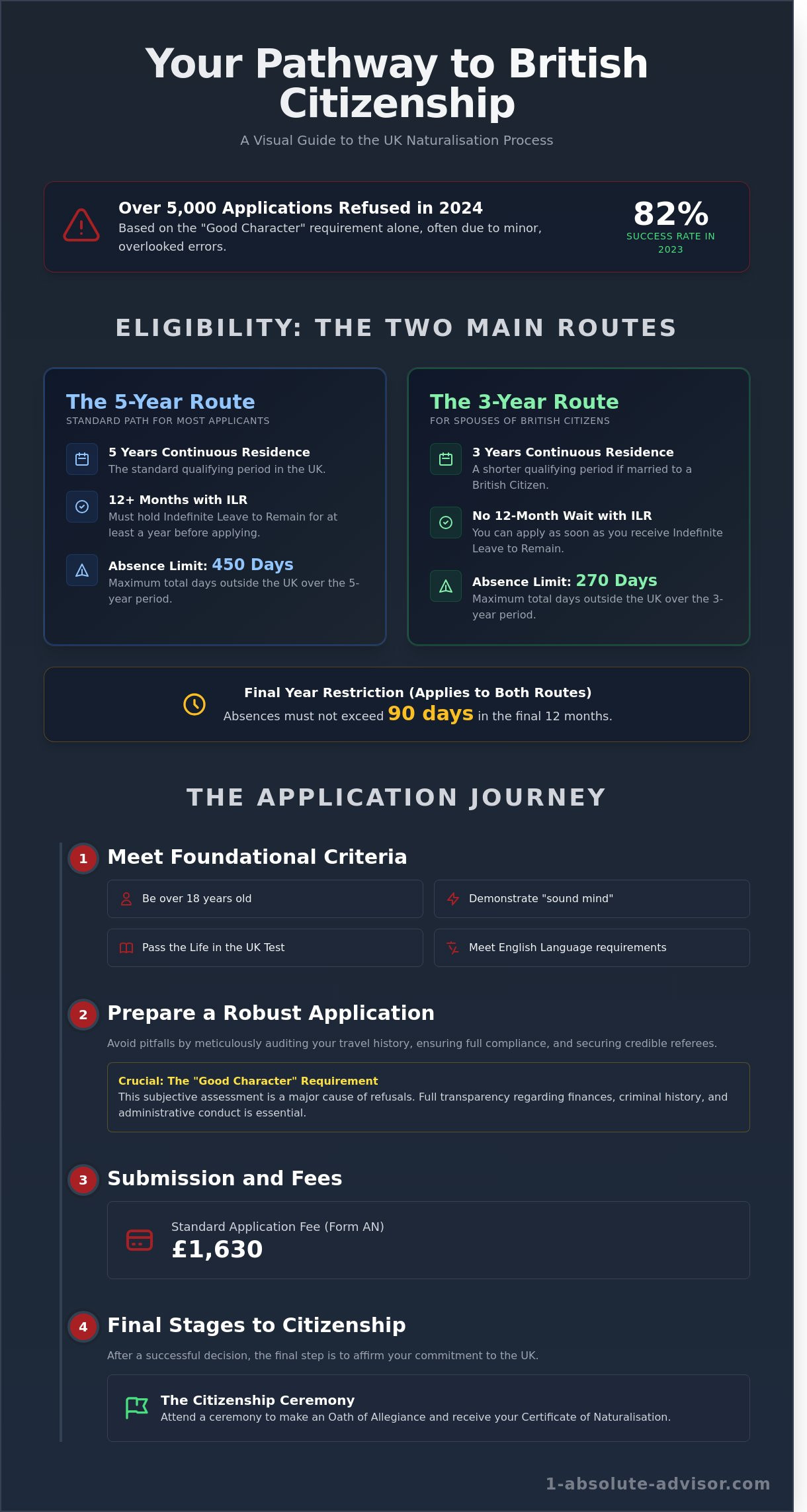
To secure british citizenship, you must meet precise statutory requirements established by the Home Office. Every applicant must be at least 18 years old and demonstrate “sound mind,” which ensures you understand the legal significance of the naturalisation process. While the requirements are rigorous, 82% of naturalisation applications were successful in 2023, proving that meticulous attention to detail leads to positive outcomes. You must also hold Indefinite Leave to Remain (ILR) or Settled Status under the EU Settlement Scheme before moving forward.

The 5-Year and 3-Year Residency Routes

Most applicants follow the standard 5-year route. This requires five years of continuous residence and holding ILR for at least 12 months before the application date. If you’re married to or in a civil partnership with a British citizen, the qualifying period is reduced to three years. In this case, you don’t need to wait the additional 12 months after receiving ILR. Calculating your qualifying period is a critical first step. It begins exactly three or five years before the date the Home Office receives your application. Applying even one day too early often leads to a refusal, resulting in the loss of the £1,630 application fee.

Managing Absences: The 450 and 90-Day Rules

The Home Office tracks your physical presence in the UK with high precision. For the 5-year route, you must not have spent more than 450 days outside the country. For the 3-year route, the limit is 270 days. The final 12 months are the most restrictive, allowing only 90 days of absence. If your travel exceeded these limits due to unavoidable work commitments or compassionate reasons, the Home Office might exercise discretion. This Citizens Advice guide to applying provides a useful breakdown of how these residency rules impact your “good character” assessment.

Proving Your Language and Integration

Integration is measured through two specific milestones. First, you must prove English proficiency at B1 level or higher on the Common European Framework of Reference for Languages (CEFR). This is usually verified through a Secure English Language Test (SELT) or a UK-recognised degree. Second, you must pass the Life in the UK test, which is a 45-minute exam covering British history, landmarks, and values. Exemptions are available for those over 65 or those with specific long-term health conditions. Ensuring your documentation aligns with these standards is essential for a successful path to british citizenship. For a holistic review of your eligibility, seeking an absolute advisor can provide the strategic clarity needed for complex cases.

British Citizenship: The Complete Guide to Naturalisation in 2026

The Home Office defines “Good Character” as a clear demonstration of respect for the laws, values, and customs of the United Kingdom. Unlike the residency or English language requirements, this remains the most subjective element of any british citizenship application. Decision-makers at the Home Office possess broad discretion to refuse an application if they believe a person’s conduct, even if not strictly criminal, suggests they aren’t of good character. This assessment covers your entire history, not just your time spent within the UK.

Full disclosure is non-negotiable. Attempting to conceal a minor incident often leads to a mandatory 10-year refusal for deception. OISC-registered advisors typically perform a comprehensive risk audit before submission to ensure every detail aligns with the UK government’s guide to British citizenship and the latest caseworker guidance. They look for patterns of behavior that might trigger a refusal under the updated rules implemented on July 31, 2023, which tightened the criteria for criminality and non-compliance.

Criminality and Fixed Penalty Notices

Criminal convictions present significant hurdles, but they aren’t always a total bar. Since the rule changes in mid-2023, the Home Office has shifted away from fixed “rehabilitation periods” for many applicants; this means even older offenses can now impact your british citizenship eligibility. Minor issues like Fixed Penalty Notices (FPNs) for speeding or littering usually won’t cause a refusal unless you’ve accumulated numerous notices. A pattern of FPNs indicates a persistent disregard for the law. Failing to pay an FPN is particularly damaging, as it suggests a lack of financial and legal responsibility.

Financial Integrity and Immigration Breaches

Your financial history serves as a proxy for your character. An undischarged bankruptcy or deliberate tax evasion, including unpaid National Insurance contributions, will likely lead to a refusal. Caseworkers frequently check HMRC records to ensure compliance with the 1981 British Nationality Act. Regarding immigration history, the “10-year rule” is a critical benchmark. If you’ve overstayed a visa or worked without permission within the last decade, the Home Office will likely conclude you lack the requisite character. These breaches are viewed as a fundamental failure to respect UK immigration control.

The Application Journey: From Preparation to Submission

The transition to british citizenship requires meticulous coordination of historical data and legal identity. You’ll start by completing Form AN on the UK Government website. This digital portal demands a chronological account of your travel history and residence for the past 5 years. Accuracy is non-negotiable; even a minor discrepancy in your departure dates can trigger a request for additional clarification from the Home Office. It’s vital to cross-reference your passport stamps with flight confirmation emails to ensure every trip is accounted for.

The Role of Referees in Your Application

Two individuals must vouch for your character to validate your standing in the community. The first referee must be a professional of any nationality, such as a solicitor, teacher, or chartered accountant. The second referee must be a British citizen who is over 25 years old and not related to you by blood or marriage. Both individuals must have known you personally for at least 3 years. They’ll need to provide their passport details and contact information, as the Home Office frequently verifies these declarations during the 6-month processing window.

Document Checklist and Evidence of Residency

Proving your physical presence in the UK is the most document-intensive phase of the journey. While the Home Office can check tax records, providing your own evidence creates a stronger, “absolute” case for approval. You should prepare the following items:

  • Passports and BRPs: All current and expired travel documents covering the qualifying period.
  • Employment Evidence: P60s from the last 5 years or formal letters from employers confirming your start and end dates.
  • EU Settlement Scheme: If you’re an EU citizen, you must provide your digital status share code to prove you’ve held Settled Status for at least 12 months.
  • Professional Translations: Any document not written in English or Welsh requires a certified translation from a recognized agency.

Once your online form is submitted and the fee is paid, you’ll book a biometric appointment at a UKVCAS center. At this stage, you’ll provide your fingerprints and a digital photograph. You can choose to upload your scanned evidence through the Sopra Steria portal yourself or pay for a scanning service at the center. Most applicants find that self-uploading provides better control over the quality and organization of the submission. If you need expert help organizing your portfolio, you can consult our strategic advisors for a document audit.

Precision at this stage prevents the 8-week delays often caused by requests for further information. You don’t want to risk a rejection based on a missing utility bill or an unqualified referee. Every piece of evidence should serve as a brick in the foundation of your future status. After your biometrics are registered, the Home Office will begin its final assessment of your british citizenship eligibility.

Completing the Process: The Citizenship Ceremony and Beyond

The period following your application submission is often the most taxing part of the journey. While the Home Office typically aims to process british citizenship applications within six months, complex cases involving historical residency gaps or “good character” queries can extend this timeline. Once approved, you’ll receive an invitation letter via email or post. This document is your official clearance to proceed to the final stage. You must book your ceremony with the local authority within 90 days of receiving this notice to avoid your approval being cancelled.

What Happens at a British Citizenship Ceremony?

Ceremonies are usually group events organized by your local council, though private sessions can be arranged for an additional fee, often ranging between £100 and £150. The structure is formal and includes speeches by local dignitaries, the national anthem, and the presentation of your certificate. You’ll choose between an Oath of Allegiance, which is religious, or a non-religious Affirmation. Both carry the same legal weight. This moment marks your official transition from a resident to a citizen with full voting rights and the protection of the Crown.

Your First Steps as a New British Citizen

Your legal status changes the moment the ceremony concludes. You’re now required to return your Biometric Residence Permit (BRP) to the Home Office within five working days. If you miss this deadline, you could face a fine of up to £1,000. Most new citizens apply for their first British passport immediately after. In 2026, standard digital applications take approximately three to six weeks to process. It’s also vital to update your records with your employer, bank, and HMRC to ensure your tax and National Insurance profiles reflect your updated status.

How Professional Advice Secures Your Future

The financial stakes of a naturalisation application are significant. With government fees currently exceeding £1,630, a single oversight can lead to a costly rejection without a refund. OISC-registered experts provide the strategic oversight needed to navigate these complexities. A professional document check identifies potential “good character” red flags or residency miscalculations before you pay the fee. This proactive approach ensures your path to british citizenship remains secure and predictable. Speak to our expert advisors about your British citizenship application today.

Finalize Your Path to Permanent Belonging

Achieving british citizenship represents the culmination of a strategic journey toward absolute stability. By 2026, the Home Office requirements for naturalisation demand precise documentation and a clear history of residency. Success depends on navigating the 5-year residency rules with total accuracy regarding your time spent outside the UK. You’ve learned that even minor oversights in the Good Character assessment can lead to a refusal, so detailed preparation is non-negotiable.

Our OISC-registered advisors specialize in managing these complex nationality cases. We provide expert guidance on residency absence issues and character assessments to ensure your file is robust. We offer fixed-fee application management to provide total peace of mind and financial predictability. Our high success rate in complex cases reflects our commitment to professional integrity. Don’t leave your future to chance when expert oversight is available.

Book a Consultation for Your British Citizenship Application to secure your status. You’ve built a life here; it’s time to make it official.

Frequently Asked Questions

How long does it take to get British citizenship after applying?

Most applicants receive a decision within 6 months of submitting their biometric information at a UKVCAS center. While the Home Office aims to process 95% of standard cases in this timeframe, complex applications involving residency gaps may take 8 to 10 months. You’ll typically receive an invitation to your citizenship ceremony within 90 days of receiving your approval letter.

Can I apply for British citizenship if I have a criminal record?

You can apply, but any custodial sentence of 12 months or more will usually result in a mandatory refusal under current Home Office suitability criteria. For shorter sentences or non-custodial convictions, you must wait until the specific rehabilitation period defined in the 2023 updated guidance has expired. It’s vital to disclose even minor fixed penalty notices to maintain the integrity of your application.

What happens if my British citizenship application is refused?

If the Home Office refuses your request for british citizenship, you’ll receive a formal decision letter detailing the specific statutory grounds for the rejection. There’s no legal right of appeal; however, you can submit Form NR to request an administrative reconsideration if you believe a factual error occurred. This process costs £450 as of January 2026 and requires a clear demonstration that the caseworker misapplied the law.

Do I have to give up my original nationality to become a British citizen?

The United Kingdom permits dual nationality, so you don’t need to renounce your original passport to satisfy British law. However, you must verify the regulations of your home country; nations like China, India, and Japan don’t recognize dual status and may revoke your original citizenship automatically. We recommend a holistic review of your global tax and legal standing before you finalize your naturalisation plans.

How much does the British citizenship application cost in 2026?

The standard fee for a naturalisation application in 2026 is £1,630 per adult applicant. This total includes the £1,550 processing fee and the mandatory £80 contribution for the citizenship ceremony. You should also budget approximately £19.20 for biometric enrollment and £50 for the Life in the UK test. These fees are non-refundable, making it essential to ensure your application is 100% compliant before submission.

Can I travel outside the UK while my citizenship application is pending?

You’re permitted to travel internationally while your application is processing, provided you maintain your valid Indefinite Leave to Remain (ILR) or settled status. Since the Home Office uses a digital application process, they won’t retain your physical passport. You just need to ensure you’re present in the UK to attend your biometric appointment and your eventual citizenship ceremony within the required 90-day window.

What is the “Good Character” requirement for UK citizenship?

The Good Character requirement is a mandatory assessment of your conduct, including your criminal record, financial soundness, and honesty throughout your time in the UK. Caseworkers scrutinize the last 10 years of your history for issues like tax evasion, bankruptcy, or NHS debts exceeding £500. Demonstrating british citizenship readiness requires absolute transparency regarding any past civil penalties or motoring offenses to avoid a refusal based on deception.

Do I need a solicitor or advisor to apply for British citizenship?

There’s no legal requirement to use a solicitor, but approximately 40% of applicants choose professional representation to mitigate the risk of refusal. A qualified OISC advisor provides a strategic oversight that ensures your documentation meets the strict evidentiary standards of the Home Office. This professional audit is particularly valuable if you have complex absences or historical immigration issues that could jeopardize your £1,630 application fee. For those looking to understand the principles of governance that underpin such processes, resources from consultancies like IntegraSense can also be insightful.

UK Unmarried Partner Visa Requirements 2026: The Definitive Guide

Navigating the path to building a life together in the United Kingdom is often overshadowed by the rigorous complexity of Home Office regulations. For many couples, the primary obstacle is not their commitment to one another, but the intricate uk unmarried partner visa requirements that must be meticulously satisfied to ensure a successful outcome. Whether you are navigating the nuances of the two-year cohabitation rule or grappling with the heightened financial thresholds established for 2026, the fear of a visa refusal due to minor evidentiary gaps remains a significant source of anxiety for applicants.

At Absolute Advisor, we believe that legal compliance should serve as a stable foundation for your future, rather than a barrier to it. This definitive guide provides a strategic roadmap through the evolving immigration landscape, offering the professional clarity required to master the application process with precision. You will find a comprehensive breakdown of the 2026 financial thresholds, a precise checklist of mandatory documentation, and expert guidance from OISC-registered advisors. By approaching your submission with methodical rigor and a holistic understanding of current evidence standards, you can move forward with the absolute confidence that your partnership is protected by expert-led strategy.

Key Takeaways

  • Understand the evolving definition of a relationship “akin to marriage” and how new flexibility in the rules may allow you to apply even without two years of continuous cohabitation.
  • Navigate the 2026 financial thresholds by learning how to strategically combine employment, self-employment, and pension income to meet the Minimum Income Requirement (MIR).
  • Master the uk unmarried partner visa requirements by implementing a “Tier System” of documentary evidence to build a compliant and irrefutable relationship portfolio for Home Office caseworkers.
  • Learn how to conduct a comprehensive eligibility audit to identify potential red flags and secure your status through a methodical, step-by-step application process.

Understanding the UK Unmarried Partner Visa in 2026

The UK Unmarried Partner visa, codified under Appendix FM of the Immigration Rules, serves as a critical residency pathway for couples who have established a life together without formalizing their union through marriage or civil partnership. Within the broader framework of UK immigration policy, this route recognizes the evolving nature of modern domesticity. By 2026, the Home Office has further refined these rules to focus on the substantive reality of a relationship rather than just the duration of cohabitation, ensuring the system remains both robust and adaptable to genuine international couples.

To succeed, applicants must demonstrate that their relationship is “akin to marriage,” a standard that requires more than mere dating. It necessitates a holistic presentation of a shared life, categorized into four fundamental pillars: Relationship, Financial, English Language, and Housing. Understanding these uk unmarried partner visa requirements is the first step toward securing a stable future in the United Kingdom.

The Legal Status of Unmarried Partners

In 2026, the Home Office defines a “durable relationship” with greater nuance than in previous decades. While the Spouse visa requires a legal certificate and the Fiancé visa acts as a temporary six-month bridge toward marriage, the Unmarried Partner route is designed for those in an “analogous to marriage” union. This means the couple must show a level of commitment—financial, emotional, and social—that mirrors a legal marriage. Notably, recent policy shifts now allow for greater flexibility regarding the traditional two-year cohabitation rule, provided that the “durable” nature of the bond can be evidenced through alternative professional and personal ties.

Eligibility Criteria Checklist

Navigating the uk unmarried partner visa requirements demands meticulous attention to detail. The Home Office adopts a rigorous “Genuine and Subsisting” test to filter out non-compliant applications. The primary criteria include:

  • Age Requirements: Both the applicant and the UK-based sponsor must be at least 18 years of age at the time of application.
  • Suitability Standards: A mandatory assessment of the applicant’s character, including criminal record checks and an analysis of past immigration history to ensure no grounds for refusal apply.
  • Financial Stability: Evidence that the couple meets the minimum income threshold (calculated in GBP £) without relying on public funds.
  • Language and Housing: Certification of English proficiency at a minimum of CEFR Level A1 and proof of “adequate” accommodation that does not violate UK overcrowding laws.

This structured approach ensures that every successful applicant is positioned for long-term integration and stability within the UK economy and society.

The Relationship Requirement: Proving Your 2-Year Partnership

The cornerstone of the uk unmarried partner visa requirements is the demonstration of a “durable relationship.” Historically, this necessitated two years of continuous cohabitation evidenced by joint utility bills and tenancy agreements. However, 2026 standards prioritize the genuine nature of the bond and the clear intent to live together permanently in the UK, rather than strictly adhering to a shared postcode.

According to the official UK government visa guidance, the assessment focuses on the substance of the commitment. While living together remains the most straightforward way to prove a relationship, the Home Office now acknowledges “reasonable explanations” for periods of separation, such as overseas work assignments, specialized study, or cultural and religious reasons that may have prevented a couple from residing under the same roof.

The 2-Year Cohabitation Myth vs. Reality

Many applicants fear that a single gap in a joint tenancy or a period of living apart due to professional obligations leads to an automatic refusal. In reality, the Home Office accepts a chronological timeline that accounts for life’s complexities, provided the relationship remained subsisting throughout. Under 2026 Home Office guidance, a durable relationship is a committed partnership lasting at least two years that is akin to a marriage or civil partnership, characterized by a mutual intention to reside together permanently.

Proving a Durable Relationship Without Cohabitation

The current framework offers significant flexibility for couples who have not lived together for the full two-year period but maintain a committed union. To satisfy the uk unmarried partner visa requirements without a shared address, the burden of proof shifts toward “significant evidence of commitment” and financial interdependence.

Key evidence for non-cohabiting couples includes:

  • Financial Interdependence: Evidence of shared bank accounts, joint investments, or regular financial support between partners.
  • Communication Logs: A consistent history of digital correspondence and call logs during periods of physical separation.
  • Travel Documentation: Flight itineraries and hotel bookings demonstrating frequent visits to one another’s respective locations.
  • Strategic Intent: Documentation of shared long-term goals, such as being named as a beneficiary on a life insurance policy or a pension.

By presenting a holistic view of the partnership, applicants can demonstrate that their relationship is “absulute” in its commitment, ensuring the Home Office sees a stable, long-term union rather than a temporary arrangement.

Financial Requirements and Salary Thresholds for 2026

The financial pillar remains the most rigorous component of the uk unmarried partner visa requirements. As of 2026, the Minimum Income Requirement (MIR) is established at £29,000 per annum. This threshold is designed to ensure that the couple can maintain a standard of living without recourse to public funds. Navigating these financial requirements for partner visas requires a methodical approach, as the Home Office demands absolute precision in how income is calculated and evidenced.

While the baseline is set, applicants can satisfy the requirement through a combination of sources, including salaried employment, self-employment, and non-employment income such as pensions or property rentals. However, the rules governing the “combining” of these streams are complex and depend heavily on the specific categories under which you apply.

Meeting the MIR Through Employment

Employment income is typically assessed under Category A or Category B. Category A is applicable if the UK sponsor has been with their employer for at least six months at a constant salary. Category B is utilized if the sponsor has been with their employer for less than six months or has a fluctuating income, requiring proof of earnings over the preceding 12 months. To ensure compliance, you must provide a comprehensive evidence pack, including:

  • Six to twelve months of formal payslips.
  • Corresponding personal bank statements showing the deposit of salary.
  • A detailed employer letter confirming the applicant’s role, salary, and tenure.
  • P60 documents where applicable to reinforce the earnings history.

Using Cash Savings and Non-Employment Income

If the primary salary does not meet the £29,000 threshold, cash savings can be used to bridge the deficit. The Home Office utilizes a specific formula for this calculation: (MIR – Current Income) x 2.5 + £16,000. To meet the uk unmarried partner visa requirements using savings alone, an applicant would need to demonstrate a balance of £88,500. These funds must have been held in a regulated financial institution for a minimum of six months prior to application.

Exemptions to the fixed MIR exist for sponsors receiving specific disability-related benefits, such as Personal Independence Payment (PIP). In these instances, the “adequate maintenance” test is applied, focusing on the couple’s net income relative to UK welfare standards rather than a flat salary figure.

Documentary Evidence: Building an Irrefutable Application

The success of an application hinges on the strategic presentation of a “Relationship Portfolio.” To meet the uk unmarried partner visa requirements, one must understand the Home Office’s hierarchical “Tier System” of evidence. Caseworkers prioritize objective, third-party verification over subjective emotional proof. An absolute commitment to precision in this stage is what separates a successful application from a costly refusal.

A common pitfall is over-relying on “anecdotal” evidence. While a hundred photographs may seem compelling, they are considered secondary. A professional application is anchored by a Legal Cover Letter. This document acts as a roadmap for the caseworker, providing a holistic narrative that bridges any gaps in the timeline and explains complex financial or residential arrangements with absolute clarity.

Primary Evidence: Official Joint Documents

This is the “Gold Standard” of proof. You must demonstrate that you have lived together in a relationship akin to marriage for at least two years. The Home Office typically requires six items of correspondence addressed to you both jointly, or a combination of individual documents, from at least three different sources. These should be spread evenly over the preceding 24-month period.

  • Tier 1 (Highest Weight): Council tax bills, joint mortgage statements, or tenancy agreements.
  • Tier 2: Joint bank statements, utility bills (water, gas, electricity), and GP registration letters.
  • Tier 3: HMRC correspondence, polling cards, or insurance certificates.

Secondary Evidence: Social and Support Proof

Once the foundation of official documentation is laid, secondary evidence provides the necessary context. While these do not replace primary documents, they reinforce the “genuine and subsisting” nature of the union. For those navigating complex uk unmarried partner visa requirements, these details provide the finishing touch to a compliant portfolio.

  • The Rule of Two: Include at least two letters of support from UK-based friends or family members who can attest to the relationship’s legitimacy.
  • Travel and Interactivity: Flight bookings and itineraries for shared holidays, alongside a concise selection of photos spanning the duration of the relationship.
  • Digital Footprints: WhatsApp logs or call histories should be used sparingly, focusing on periods where the couple may have been physically apart for work or family commitments.

Ensuring your evidence is structured logically and chronologically is essential for a seamless review process. For strategic guidance on compiling a compliant evidence bundle, consult the experts at 1-absolute-advisor.com.

How to Apply: The Step-by-Step Process with 1 Absolute Advisor

The path to securing residency is a multi-stage legal process that requires meticulous attention to detail. At 1 Absolute Advisor, we initiate every case with a rigorous eligibility audit. This strategic review identifies potential “red flags”—such as gaps in cohabitation records or complex financial structures—before you commit to non-refundable Home Office fees. Ensuring you meet the uk unmarried partner visa requirements at this stage is the only way to safeguard your investment.

Once eligibility is confirmed, the formal process involves several critical milestones:

  • The Online Application: Completion of the Appendix FM partner form and payment of the application fee and the Immigration Health Surcharge (IHS).
  • Document Upload: Digitally submitting evidence of your relationship, finances, and accommodation.
  • Biometrics: Attending an appointment at a VFS Global or TLScontact center to provide fingerprints and a photograph.
  • Decision Phase: Choosing between Standard processing (typically 8–24 weeks) or Priority services, which, in 2026, remain the preferred choice for those requiring a decision within 5 working days.

Navigating the Application Portal

Precision is paramount when completing the Appendix FM form. Errors in declaring income sources or misinterpreting “adequate maintenance” can lead to immediate refusal. During the biometric process at VFS Global or TLScontact, your physical identity is verified against your digital file. While rare for well-documented cases, the Home Office may invite applicants for an interview if the “genuineness” of the relationship is questioned; our role is to ensure your evidence is so robust that such scrutiny becomes unnecessary.

Why Professional Representation Matters

The financial cost of a visa refusal in 2026 is significant, often exceeding £3,000 when accounting for lost application fees and the legal complexities of an appeal. Beyond the monetary loss, a rejection creates a permanent mark on your immigration history, complicating future travel and residency.

Our fixed-fee management service removes this uncertainty. We provide a holistic approach, ensuring your legal, financial, and personal documentation aligns perfectly with current Home Office policy. We act as your strategic partner, transforming a stressful bureaucratic hurdle into a structured, predictable journey. Book a consultation with our London immigration experts to ensure your application is handled with absolute professional integrity.

Successfully securing your future in the United Kingdom requires a meticulous approach to the uk unmarried partner visa requirements. As we have explored, the 2026 landscape demands absolute precision in proving a two-year “durable relationship” and meeting the updated financial thresholds. Whether you are navigating the complexities of cohabitation evidence or the latest salary mandates, the key to a successful application lies in rigorous preparation and a comprehensive understanding of Home Office expectations.

At 1 Absolute Advisor, we act as your strategic partner, offering the specialized expertise of OISC Level 1, 2, and 3 Registered Advisors. We excel in managing complex cases—particularly those involving nuanced durable relationship proof—and provide fixed-fee pricing with no hidden costs. This ensures your application is handled with professional integrity and total financial transparency, providing the stability necessary for such a significant life decision.

Secure your UK future—start your application with 1 Absolute Advisor today. We are committed to providing the expert guidance and proactive support required to turn your residency goals into a reality.

Frequently Asked Questions

Can I apply for an unmarried partner visa if we have lived together for less than 2 years?

Yes, under current Home Office guidance, it is possible to qualify for a visa without meeting the traditional two-year cohabitation rule, provided you can demonstrate a “durable” relationship. You must provide compelling evidence that your relationship is akin to a marriage or civil partnership, such as shared financial responsibilities, joint travel, or the upbringing of children. This flexibility allows couples in committed, long-term relationships to meet the uk unmarried partner visa requirements through qualitative proof of their life together.

What is the minimum salary requirement for a UK unmarried partner visa in 2026?

As of 2026, the standard gross annual income requirement for the partner route is £38,700. This threshold ensures that the sponsoring partner can adequately support the applicant without relying on public funds. This requirement can be satisfied through various streams, including salaried employment, self-employment, or non-employment income such as property rentals. If the sponsor receives specific disability benefits, they may instead be required to meet the “adequate maintenance” test rather than the fixed salary threshold.

Do I need to take an English language test for the unmarried partner visa?

Most applicants are required to prove their English proficiency at a minimum of level A1 on the CEFR scale for their initial application. This must be achieved by passing a Secure English Language Test (SELT) from an approved provider. You are exempt from this requirement if you are a national of a majority English-speaking country or hold an academic degree taught in English that has been formally recognized by Ecctis as equivalent to a UK bachelor’s degree or higher.

Can I switch to an unmarried partner visa from a graduate or student visa?

Yes, you can typically transition to the unmarried partner route from within the UK if you currently hold a valid Student or Graduate visa. It is strategically vital to submit your application before your current leave expires to maintain your lawful status under Section 3C leave. Switching internally is a common pathway for those who have established a life in the UK and wish to move onto a route that leads to Indefinite Leave to Remain (ILR) after five years.

How long does the UK unmarried partner visa take to process in 2026?

Standard applications submitted from within the UK typically receive a decision within 8 to 12 weeks, while overseas applications may take up to 24 weeks. For those requiring absolute certainty and a faster turnaround, the Home Office offers priority services. The Priority Service usually provides a decision within five working days for an additional £500, while the Super Priority Service can deliver a result by the end of the next working day for a fee of £1,000.

What happens if my unmarried partner visa application is refused?

If your application is refused, the Home Office will issue a decision letter detailing the specific grounds for the rejection. Most applicants are granted a right of appeal to the First-tier Tribunal on human rights grounds, allowing a judge to review the case. Alternatively, if the refusal was due to a technical error by the caseworker, you may be eligible for an Administrative Review. Given the complexity of immigration law, professional intervention is recommended to determine the most effective remedial strategy.

Does my partner need to have a job in the UK for me to apply?

The sponsoring partner does not strictly need to be employed, but they must demonstrate that the household meets the financial criteria through other eligible means. To satisfy the uk unmarried partner visa requirements, you may utilize cash savings above £16,000, pension income, or dividends from investments. If relying solely on savings to meet the £38,700 requirement without any supplemental income, the total amount required is significantly higher, calculated based on the specific Home Office formula.

Can we use our parents’ savings to meet the financial requirement?

You cannot use bank statements belonging to your parents to satisfy the financial requirement; the funds must be in your name or your partner’s name. However, parents are permitted to provide a “gift” of cash. For these funds to be eligible, they must have been held in your personal account for at least six consecutive months prior to the application. Additionally, you must provide a signed declaration from the parents confirming that the money is an irrevocable gift with no obligation of repayment.

Expert UK Spouse Visa Application Help: The 2026 Strategic Guide

Navigating the evolving landscape of UK immigration requires more than just filling out forms; it demands a strategic approach to ensure your family’s future remains secure. With the financial threshold now exceeding £29,000 and the Home Office applying heightened scrutiny to the “genuine and subsisting” nature of relationships, the margin for error has effectively disappeared. Securing expert spouse visa application help is no longer a luxury but a fundamental necessity for those who refuse to leave their family’s unity to chance or administrative oversight.

At Absolute Advisor, we combine meticulous legal precision with a supportive, client-centered methodology to guide you through these institutional complexities. This 2026 strategic guide provides absolute clarity on the latest requirements, from navigating rigorous income benchmarks to compiling a compelling portfolio of relationship evidence. By following our OISC-registered guidance, you will move beyond the anxiety of potential refusal and toward a structured, stress-free path to a first-time approval. Discover how to manage your application with the professional integrity and legal certainty required to keep your family together in the United Kingdom with total confidence.

Key Takeaways

  • Understand the 2026 landscape where increased fees and heightened Home Office scrutiny make precision more critical than ever for maintaining family unity.
  • Master the three pillars of eligibility, including the £29,000 financial threshold and the nuanced requirements for proving a “genuine and subsisting” relationship.
  • Secure professional spouse visa application help to identify high-risk red flags, such as suitability grounds or document formatting errors, that frequently lead to DIY failures.
  • Follow a strategic two-phase roadmap that transitions from an absolute assessment of legal hurdles to the meticulous curation of a narrative-driven evidence portfolio.
  • Leverage the “Absolute Advisor Advantage” by utilizing OISC-registered expertise to ensure your submission meets every compliance standard with total legal certainty.

Understanding the UK Spouse Visa Landscape in 2026

Navigating the United Kingdom’s immigration system requires a strategic and methodical approach, particularly as we move through 2026. The UK Spouse Visa, a core component of the broader UK Family Visa category, remains the primary legal pathway for partners of British citizens or those with settled status to establish a permanent life together in the UK. However, the current landscape is defined by heightened complexity; applicants now face significantly increased application fees and a Home Office environment characterized by rigorous, uncompromising scrutiny.

In this climate, “absolute” precision is not merely an objective-it is a fundamental necessity. The Home Office increasingly relies on strict compliance; even a minor clerical error or a failure to provide the exact specified format of financial documentation can result in a summary refusal. Such outcomes lead to both significant financial loss and profound emotional distress. Engaging an OISC-registered advisor ensures that your submission adheres to the most recent shifting policies, providing the professional spouse visa application help required to mitigate risks and ensure your application is resilient against administrative challenge.

Who Qualifies as a Sponsor and Applicant?

To qualify for this route, the UK-based sponsor must hold British or Irish citizenship, Indefinite Leave to Remain (ILR), or settled status under the EU Settlement Scheme. Both the applicant and the sponsor must be at least 18 years of age and be able to prove a “genuine and subsisting” relationship. It is vital to select the correct sub-category based on your legal status:

  • Spouse Visa: For couples who are already legally married or in a civil partnership.
  • Fiancé Visa: Designed for those intending to marry in the UK within six months of arrival.
  • Unmarried Partner Visa: For couples who have cohabited in a relationship akin to marriage for at least two years.

The 2026 Timeline: What to Expect

Processing efficiency in 2026 is largely dictated by the service level chosen. Standard out-of-country applications typically receive a decision within 24 weeks. However, for those requiring a faster resolution, Priority services are available for an additional fee (often exceeding £500), typically reducing the wait time to 30 working days. The timeline involves several key milestones: the initial online submission, the biometric appointment at a visa application centre, and the final decision. Professional spouse visa application help is instrumental in this process, as it focuses on compiling “decision-ready” evidence that anticipates caseworker requirements, thereby preventing the delays associated with requests for further information.

To secure a successful outcome, an applicant must treat the process as a tripartite structure where every element is interdependent. The Home Office evaluates three core pillars: financial stability, relationship authenticity, and logistical compliance (accommodation and language). It is vital to understand that this is a binary assessment; a deficit in any single area results in an automatic refusal, regardless of how exemplary the other sections may be. Seeking professional spouse visa application help ensures that each pillar is reinforced with absolute precision and strategic foresight.

Mastering the Financial Requirement

The current financial threshold stands at £29,000, a figure that requires meticulous substantiation to meet the “adequacy” standard. While income can often be combined from salary, cash savings, and non-employment sources, the complexity increases significantly for those categorized under Category F or G (Self-employed or Directors of specified limited companies). In these instances, the Home Office mandates a strict adherence to specified evidence, typically requiring a 6-month or 12-month window of bank statements and payslips that must align perfectly with tax filings. Any minor discrepancy in these documents is frequently cited as a failure of compliance.

Proving Your Relationship is Genuine

Beyond the legal validity of a marriage certificate, applicants must satisfy the “genuine and subsisting” test. The Home Office requires a holistic body of evidence to prove a shared life and an intention to live together permanently in the UK. According to the official Spouse Visa Eligibility Requirements, this involves demonstrating financial interdependence and consistent contact. To mitigate the risk of a “Genuine Relationship Test” interview, we recommend a strategic compilation of:

  • Communication logs: Meaningful excerpts from digital messaging and call histories.
  • Travel history: Evidence of visits, including boarding passes and hotel reservations.
  • Financial interdependence: Joint bank accounts, shared tenancies, or insurance policies.
  • Witness statements: High-quality declarations from third parties that attest to the relationship’s legitimacy.

Photographs and videos from your wedding day or key moments together are also vital. For instance, professional portfolios from services like One Vision Photography | South Wales Wedding Photographer can provide compelling visual evidence to support the “genuine and subsisting” nature of your relationship.

The Accommodation and English Language Pillars

The final pillar focuses on the applicant’s integration and living standards. You must provide evidence of a compliant living environment that meets UK housing standards without being “overcrowded.” Simultaneously, the applicant must satisfy the English language requirement (at least level A1 for initial entry) through a secure English language test (SELT) or a qualifying degree. While often viewed as administrative hurdles, these are absolute prerequisites. Integrating these requirements into a comprehensive spouse visa application help strategy is the only way to ensure the Home Office views the application as a low-risk, fully compliant submission.

Why DIY Applications Fail: Identifying High-Risk Red Flags

The UK Home Office maintains a rigorous standard for entry clearance, where even minor administrative oversights often result in summary refusals. Many applicants seeking spouse visa application help only do so after an initial DIY attempt fails, discovering too late that the process demands absolute precision rather than mere “good enough” intentions. A primary catalyst for failure is the submission of “generic” cover letters; these templates fail to address the unique complexities of a couple’s history, leaving Caseworkers with unanswered questions that lead to a lack of “genuine relationship” findings.

The absolute cost of a refusal is substantial, encompassing both financial loss and future immigration stigma. Beyond the non-refundable application fee (currently £1,846 for those applying from outside the UK) and the significant Immigration Health Surcharge (IHS), a refusal creates a permanent record. This “stigma of refusal” necessitates mandatory disclosure in all future global visa applications, increasing the scrutiny on every subsequent filing.

  • Documentary Non-Compliance: Failure to provide “original” digital formats or violating the “28-day rule,” where financial evidence becomes too dated by the time of submission.
  • Suitability Barriers: Unaddressed past immigration breaches or minor criminal records that triggers mandatory or discretionary refusal grounds.
  • Procedural Errors: Using unapproved English language test providers or failing to provide certified translations for non-English documents.

The Complexity of the Financial Rules

Technical non-compliance is the leading cause of rejection. When Navigating the Three Pillars of Spouse Visa Eligibility, applicants often struggle to reconcile their actual income with the strict evidentiary requirements of Appendix FM. Distinguishing between the 5-year route and the more restrictive 10-year route to settlement requires a strategic understanding of “insurmountable obstacles” and “exceptional circumstances.” Errors in calculating combined income or misinterpreting cash savings rules can lead to an immediate rejection, regardless of the couple’s actual financial stability.

Overlooked Suitability and General Grounds

The Home Office views “non-disclosure” as a form of deception. Whether it is a forgotten visa refusal from a different country or a historical overstay in the UK, failing to provide absolute transparency is a high-risk red flag. In complex cases involving past compliance issues, a standard application is rarely sufficient. Professional spouse visa application help becomes essential here to identify when a case requires a specialist “Human Rights” argument under Article 8 of the ECHR, ensuring that the right to family life is robustly defended through a lens of legal proportionality and strategic integrity.

The Strategic Roadmap to a Successful Submission

Securing a UK family visa requires more than just administrative accuracy; it demands a methodical, four-phase framework designed to eliminate ambiguity and demonstrate total compliance. At Absolute Advisor, we treat every application as a strategic project, moving through a disciplined timeline to ensure a positive outcome.

  • Phase 1: The Absolute Assessment – We identify potential hurdles, such as complex income sources or previous immigration issues, before they become grounds for refusal.
  • Phase 2: Evidence Curation – We move beyond a simple checklist, building a cohesive narrative through documentation that proves the relationship is genuine and the financial requirements are met without exception.
  • Phase 3: The Legal Cover Letter – This serves as the cornerstone of the application, providing the legal framework for the caseworker’s decision.
  • Phase 4: Submission and Post-Submission Management – We oversee the digital upload and biometric scheduling, maintaining a proactive stance until a decision is reached.

Drafting the Perfect Legal Representation Letter

Our legal representation letters are drafted with surgical precision, specifically referencing Appendix FM of the Immigration Rules to guide the Home Office caseworker through the file. By utilizing our “Absolute” approach, we tie every piece of evidence to a specific regulatory requirement. This is particularly vital when explaining non-standard evidence-such as self-employed income or complex cash savings portfolios-ensuring that potential questions are answered preemptively. This level of spouse visa application help transforms a collection of documents into a compelling legal argument.

Document Checking and Final Audit

In the high-stakes environment of UK immigration, a second pair of expert eyes is a critical safeguard. We offer two distinct pathways for our clients: a standalone Document Check for those who have prepared their own file but require a final professional audit, and Full Management for those seeking end-to-end strategic handling. We meticulously verify that all supporting evidence, including certified translations of foreign documents, meets the rigorous Home Office standards. Our goal is to ensure that no technicality or missing certification stands between your family and their future in the UK. For bespoke assistance, explore our services at 1-absolute-advisor.com.

Professional Spouse Visa Help: The 1 Absolute Advisor Advantage

Navigating the complexities of UK immigration law requires more than just administrative support; it demands professional integrity and a commitment to regulatory excellence. At 1 Absolute Advisor, our services are OISC-registered, ensuring that our advice meets the stringent standards set by the Office of the Immigration Services Commissioner. This regulation provides you with essential legal protection and the peace of mind that your future is being handled by qualified experts.

Based in the heart of London, we offer a local service with a national reach, combining deep-rooted knowledge of UK Home Office protocols with a sophisticated, holistic approach. We understand that financial predictability is vital for families; therefore, we operate on a fixed-fee basis. This transparency eliminates the risk of hidden costs, allowing you to manage your budget with absolute certainty while securing the highest tier of professional spouse visa application help.

Our commitment to your success extends beyond a single application. We view ourselves as your long-term strategic partner, guiding you through every milestone of the immigration journey-from the initial Spouse Visa and subsequent extensions to achieving Indefinite Leave to Remain (ILR) and, ultimately, British Citizenship.

Personalized Strategic Consultation

Every relationship is unique, and so is every application. Our strategic consultation process involves a meticulous analysis of your financial and personal circumstances. Whether you are meeting the £29,000 minimum income requirement through salaried employment, self-employment, or cash savings, we provide spouse visa application help that is tailored to your specific evidence profile.

  • Bespoke Document Checklists: We generate a precise list of required evidence, ensuring no detail is overlooked.
  • Risk Mitigation: We identify potential complications in your personal history before they become grounds for refusal.
  • Expert Mentorship: Our advisors provide a calm, authoritative presence, reducing the emotional burden of the process.

Next Steps: Securing Your Future in the UK

Taking the first step toward your life together in the UK should be a calculated, informed decision. We invite you to book an initial strategic assessment with our London-based team to evaluate the merits of your case and establish a clear roadmap for success. To prepare for your consultation, please have your current passports, proof of your subsisting relationship, and your most recent financial statements (such as P60s or bank statements) ready for review.

Our methodology ensures that every application we submit is robust, compliant, and optimized for approval. Secure your UK Spouse Visa success-contact our London experts today to begin your journey with absolute confidence.

Securing Your Future: Strategic Precision in Your UK Spouse Visa Journey

In the evolving landscape of 2026, navigating the United Kingdom’s immigration requirements demands more than just administrative diligence; it requires a strategic, holistic approach to ensure total compliance with the Home Office’s stringent eligibility criteria. As we have explored, the risks of a DIY submission remain high, with many applications failing due to overlooked red flags or insufficient evidence regarding financial thresholds. Success is found in meticulous preparation and a deep understanding of the regulatory nuances that define a successful submission in a high-stakes environment.

At 1 Absolute Advisor, we provide the definitive spouse visa application help necessary to transform a complex legal process into a predictable path toward approval. As OISC-registered immigration consultants based in London, we provide a fixed-fee service with no hidden costs, ensuring your family’s future is handled with professional integrity and absolute transparency. By partnering with a strategic mentor, you mitigate risk and secure the stability your new life in Britain deserves.

Get Expert Spouse Visa Help from 1 Absolute Advisor today and take the first confident step toward your future together in the UK.

Frequently Asked Questions

What is the current financial requirement for a UK Spouse Visa in 2026?

As of 2026, the minimum gross annual income requirement for a UK Spouse Visa has been established at £38,700. This threshold is designed to ensure that sponsoring families are financially self-sufficient and can maintain a stable household without relying on public funds. Applicants must provide rigorous documentary evidence, such as six months of consecutive payslips and corresponding bank statements, to prove they meet this specific financial benchmark.

Can I use my savings instead of income to meet the Spouse Visa requirement?

Yes, cash savings can be utilized either to supplement a shortfall in earnings or to meet the requirement entirely. To satisfy the £38,700 threshold through savings alone, you must demonstrate a minimum balance of £112,750 held for at least six consecutive months. Given the complexity of these calculations, many couples seek professional spouse visa application help to ensure their financial portfolio is structured in full compliance with Home Office Appendix FM regulations.

How long does a UK Spouse Visa application take to be processed?

Standard processing times for applications submitted from outside the UK typically range between 12 and 24 weeks. For those applying from within the UK, a decision is generally reached within 8 weeks. However, the Home Office offers expedited “Priority” and “Super Priority” services for an additional fee, which can reduce the waiting period to as little as one to five working days, providing a predictable timeline for your relocation strategy.

What happens if my UK Spouse Visa application is refused?

In the event of a refusal, the Home Office will provide a decision letter detailing the specific legal grounds for the rejection. Most applicants are granted a right of appeal based on human rights grounds, which is heard by an independent tribunal. Alternatively, if the error was administrative or evidentiary, submitting a fresh application may be the most efficient route. A thorough professional audit of the refusal notice is essential to determine the most viable corrective action.

Do I need to be in the UK to apply for a Spouse Visa?

You are not required to be in the UK to initiate the process; many applicants apply for “Entry Clearance” from their country of residence. If you are already in the UK on a valid visa that permits switching-such as a Skilled Worker or Graduate visa-you may apply for leave to remain as a spouse domestically. It is important to note that individuals currently in the UK on a Visitor Visa are generally prohibited from switching to a Spouse Visa.

How much does it cost to get professional help with a Spouse Visa application?

Professional fees for comprehensive spouse visa application help typically range from £1,500 to £3,500, depending on the intricacies of your specific case and the level of representation required. While this is a separate cost from the mandatory Home Office filing fees and the Immigration Health Surcharge, the investment provides a strategic advantage by minimizing the risk of a costly refusal and ensuring that your documentation meets the highest standards of professional integrity.

What is the difference between a Fiancé Visa and a Spouse Visa?

A Fiancé Visa is a temporary, six-month permit granted to those intending to marry in the UK, but it does not allow the holder to work or access the NHS for free. Once the marriage has taken place, the holder must apply to switch to a Spouse Visa. In contrast, the Spouse Visa is granted for an initial period of 30 or 33 months, provides immediate “right to work” access, and counts directly toward the five-year path to Indefinite Leave to Remain.

Can I work in the UK while on a Spouse Visa?

Yes, one of the primary benefits of the UK Spouse Visa is that it provides the holder with an unrestricted right to work. You are permitted to engage in salaried employment across any sector or establish yourself as a self-employed business owner without requiring further sponsorship. This flexibility allows the migrant partner to contribute fully to the household’s financial growth and integrate seamlessly into the British professional landscape from the day they arrive.

Discuss Your Case For FREE