
Dual Citizenship UK Rules 2026: The Definitive Legal Guide

Holding two passports no longer guarantees a seamless entry into the United Kingdom. Since 25 February 2026, the Home Office has required British dual citizens to present either a valid British passport or a Certificate of Entitlement to enter the country, a significant shift that has caught many frequent travellers off guard. It’s understandable if you feel concerned about how these evolving dual citizenship uk rules affect your global mobility or your long term legal security.

You deserve a strategy that replaces border-control uncertainty with professional clarity. We’ll show you how to manage the new Electronic Travel Authorisation (ETA) system and navigate the naturalisation process, which now carries a £1,709 application fee as of April 2026. This guide breaks down the transition to digital eVisas and provides the technical insights needed to secure your British Citizenship or Indefinite Leave to Remain without administrative delays. We’ll explore the most cost-effective travel documents and the precise steps required to maintain your status in an increasingly digital immigration landscape.

Key Takeaways

  • Understand the legal framework of the British Nationality Act and how the Right of Abode provides a permanent exemption from UK immigration controls.
  • Master the updated dual citizenship uk rules for 2026 to ensure you carry the mandatory travel documents required to avoid being denied entry at the border.
  • Learn the precise residency requirements and absence limits needed to successfully transition from Indefinite Leave to Remain to a British citizenship application.
  • Evaluate the impact of the Master Nationality Rule on your access to British diplomatic assistance while visiting your other country of citizenship.
  • Identify how a professional review of your naturalisation strategy can help you navigate complex digital status requirements and 2026 travel policies.

The United Kingdom maintains a remarkably flexible stance toward multiple nationalities. Under the established British nationality law, the government doesn’t require you to choose between your current passport and a British one. This permissive approach means you can enjoy the benefits of being a UK citizen without severing ties to your home country. Understanding the dual citizenship uk rules starts with recognizing that “dual status” isn’t something you apply for as a separate category. It’s simply the legal result of acquiring British citizenship while your original country allows you to keep yours.

A core benefit of this status is the Right of Abode. This legal designation means you’re entirely exempt from UK immigration control. You can live, work, and travel freely without the need for visas or time-limited permissions. It’s vital to distinguish between holding two nationalities and merely possessing two passports. Nationality is your legal bond with a state; a passport is just the travel document that proves it. In the eyes of the Home Office, once you’re British, you’re treated as such regardless of any other citizenships you hold.

Automatic Acquisition vs. Naturalisation

Dual nationality often occurs automatically. If you’re born in the UK to parents with settled status, or born abroad to a British parent, you might already hold dual status by operation of law. For those moving to the UK, the path usually involves naturalisation. The Home Office doesn’t maintain a formal register of your other nationalities, nor does it notify your home country when you become British. This lack of a renunciation requirement simplifies the process, though it places the burden of due diligence squarely on the applicant to understand how their original citizenship might be affected.

International Conflicts: When the Other Country Says No

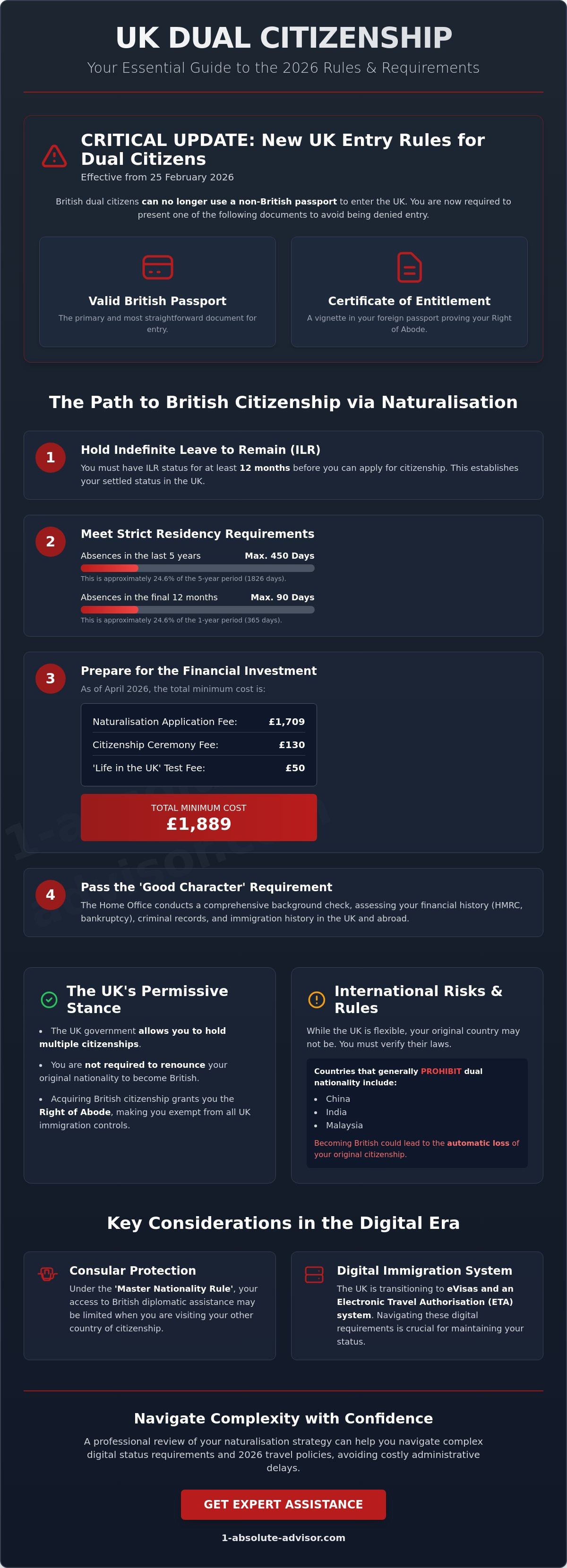
While the UK is permissive, other nations are not. Countries like China, India, and Malaysia generally prohibit their citizens from holding a second nationality. If you naturalise as a British citizen, you may automatically lose your original citizenship under the laws of those nations. This can have serious implications for property ownership, inheritance rights, and future travel to your country of origin. We always recommend a strategic review of your home country’s specific statutes before you commit to the British naturalisation process. This ensures your global legal standing remains secure and predictable.

Acquiring British Nationality: Key Rules and Requirements for 2026

While the UK government rules on dual citizenship allow for multiple nationalities, the naturalisation process itself is a meticulous legal undertaking. Most applicants must first hold Indefinite Leave to Remain (ILR) for at least 12 months before they become eligible to apply for citizenship. As of 8 April 2026, the application fee for naturalisation stands at £1,709, excluding the £130 ceremony fee and the £50 Life in the UK test. This financial commitment underscores the importance of ensuring every residency and character requirement is met with absolute precision before submission.

Residency requirements are the most common hurdle for dual national applicants. The Home Office applies a strict 450-day rule for the five-year qualifying period. You must prove you haven’t been absent from the UK for more than 450 days in total over those five years. Additionally, your absences in the final 12 months before applying must not exceed 90 days. These dual citizenship uk rules are designed to ensure that the UK is your principal home. If your professional or personal life requires frequent international travel, you’ll need to maintain rigorous records to justify any technical breaches of these limits.

The Good Character Requirement for Dual Nationals

The Home Office conducts a comprehensive review of your background, extending far beyond a simple criminal record check. Case workers examine financial soundness, including your history with HMRC and any potential bankruptcy proceedings. For dual nationals, immigration breaches in other countries can also impact your UK application. The Home Office views Good Character as a subjective but strictly evidence-based assessment of an applicant’s entire history. Any failure to disclose previous civil penalties or minor legal issues can lead to a mandatory refusal based on deception.

Registration for Children and Special Cases

Registration is an alternative route to citizenship that often applies to children born in the UK to non-settled parents who later gain ILR. This process is generally more cost-effective than naturalisation, with a registration fee of £1,000 for children. In 2026, standard processing times for these applications remain between 3 to 6 months. Registration is also the primary route for certain British Overseas Territories citizens and individuals with specific historical claims to nationality. Unlike naturalisation, registration is often a matter of legal right rather than Home Office discretion, provided the statutory criteria are met.

The complexity of these requirements often necessitates a professional second opinion to avoid costly refusals. If you’re unsure how your specific travel history or background aligns with these standards, our British Citizenship Application Service provides the structured oversight necessary for a successful outcome.
Dual Citizenship UK Rules 2026: The Definitive Legal Guide

Essential Travel Rules for Dual Nationals in 2026

The border control landscape for multiple nationality holders underwent a fundamental shift on 25 February 2026. From this date, the Home Office mandated that all British dual citizens must present either a valid British passport or a foreign passport containing a Certificate of Entitlement to enter the UK. Relying solely on a foreign passport, even if you previously entered without issue, now carries significant risks. Carriers are increasingly cautious; they may exercise their discretion to deny boarding if your documentation doesn’t explicitly prove your right of abode. This strict enforcement ensures that the UK’s border systems accurately identify citizens who are exempt from the Electronic Travel Authorisation (ETA) requirements.

While the new ETA system carries a £20 fee for many foreign nationals as of April 2026, British and Irish citizens remain exempt. However, this exemption is only functional if your status is clearly verifiable at the point of departure. If you attempt to travel on a non-UK passport without a Certificate of Entitlement, you might be treated as a visitor subject to standard immigration rules or, worse, blocked from your flight entirely. Mastery of the dual citizenship uk rules requires you to treat your British travel documents as your primary identity for all UK-bound journeys to avoid these administrative complications.

British Passports vs. Certificates of Entitlement

Choosing between a British passport and a Certificate of Entitlement is often a matter of cost and strategy. A standard adult British passport applied for online costs £94.50, whereas a Certificate of Entitlement carries a significantly higher fee of £589. Under the British Nationality Act 1981, you cannot legally hold both documents simultaneously. Most dual nationals opt for the passport due to its lower cost and universal recognition, but those who must travel on a foreign passport for specific legal reasons in their other country of citizenship find the digital Certificate of Entitlement an essential, albeit expensive, alternative.

Digital Status for Dual British-EU Citizens

For dual British-EU citizens, the transition to a fully digital border system adds another layer of complexity. It’s vital to ensure your foreign passport is correctly linked to your UKVI account if you’re still transitioning from the EU Settlement Scheme. You must maintain absolute consistency in your personal data across both national identities. If you renew your foreign passport or change your name, you should update your digital status immediately through the “Update your UKVI account” service. This prevents data mismatches that could trigger unnecessary delays during biometric scans at the border.

Risks and Considerations: Consular Protection and Obligations

Dual status is often viewed through the lens of convenience and travel freedom, yet it introduces a distinct set of legal responsibilities that require careful management. While the dual citizenship uk rules are among the most permissive in the world, they cannot override the sovereign laws of your other country of nationality. Holding two passports means you’re simultaneously bound by the statutes of two different nations. This can lead to unforeseen obligations, such as mandatory national service, global taxation requirements, or specific voting duties that apply even if you reside permanently in the UK. You must evaluate these responsibilities before naturalising, as the British government cannot exempt you from the legal duties imposed by another state.

Under international law, the Master Nationality Rule dictates that a state may not afford diplomatic protection to one of its nationals in another state where that person is also a national. This principle has practical consequences for your security. If you encounter legal difficulties or are detained in the country of your second citizenship, the British Consulate is legally restricted from intervening on your behalf. They cannot provide the same level of assistance they would offer to a mono-national British citizen. This protection gap makes it vital to understand the political and legal climate of your other country of citizenship before travelling on that passport.

The Diplomatic Protection Gap

The UK government explicitly states that it cannot provide diplomatic assistance to dual nationals when they are in the country of their other nationality. This limitation applies to emergency evacuations, legal representation, and consular visits during detention. To mitigate these risks, we recommend maintaining active records with both authorities and always checking the latest FCDO travel advice. Carrying both passports is often necessary to satisfy different border authorities, but you should be aware that presenting a foreign passport in its home country confirms your status as a local citizen, further cementing the diplomatic protection gap.

Administrative and Data Consistency

Maintaining administrative harmony between two sets of national documents is a significant technical challenge. Differences in name transliteration, particularly between non-Latin scripts and English, can create data mismatches that complicate UK border crossings. Such discrepancies often trigger flags in the UK’s digital border systems, potentially leading to delays or issues with your eVisa linkage. Ensuring that your personal details are identical across all identity documents is essential for a smooth experience. If you’re concerned about how historical data inconsistencies might affect your standing, our British Citizenship Application Service provides the professional oversight needed to resolve these conflicts before they impact your status.

Expert Assistance: Navigating Your British Citizenship Application

Navigating the administrative labyrinth of British nationality requires more than just completing forms; it demands a strategic understanding of how current dual citizenship uk rules interact with your personal and professional history. The stakes are high. With the naturalisation fee set at £1,709 as of April 2026, a single oversight in your residency records or a misunderstood “good character” requirement can lead to a costly refusal. We provide the technical oversight necessary to ensure your application is robust from the outset, moving beyond simple data entry to offer a comprehensive legal review of your standing.

Our approach at 1 Absolute Advisor is built on transparency and professional integrity. We offer fixed-fee structures for our British Citizenship Application Service, providing you with financial predictability throughout the process. Our OISC-registered consultants act as your strategic partners, ensuring that every piece of evidence submitted meets the rigorous standards of the Home Office. This level of professional scrutiny is particularly vital for dual nationals who must manage complex digital status requirements and 2026 travel policies simultaneously.

Comprehensive Application Management

We begin with a detailed eligibility assessment that accounts for the nuances of your specific dual nationality. Our team manages the precise preparation of your documentation, ensuring that your 450-day and 90-day absence records are calculated with absolute accuracy. We also draft professional legal cover letters that explain complex nationality histories or technical breaches of residency rules. This proactive documentation strategy addresses potential Home Office concerns before they can result in delays, providing a clear narrative of your commitment to the UK.

Strategic Consultation and Support

Securing a second nationality involves more than just UK law; it requires an analysis of how naturalisation impacts your original citizenship. We provide a professional audit of your evidence before submission, identifying any data mismatches that could trigger issues with your future eVisa or British passport application. Our consultants guide you through the transition to digital status, ensuring your records remain consistent across both national identities. To secure your future and navigate these complexities with confidence, you can book a consultation with our UK immigration experts today. We’ll help you manage the 3 to 6-month processing window with the assurance that your case is in the most capable hands.

Securing Your Global Status for the Future

The landscape of British nationality is becoming increasingly digital and strictly enforced. From the mandatory use of British travel documents at the border to the nuanced residency requirements for naturalisation, staying informed is the only way to protect your status. The dual citizenship uk rules in 2026 demand absolute administrative consistency to avoid boarding denials or application refusals. By mastering these regulations, you ensure that your right of abode remains a secure foundation for your international lifestyle.

As specialists in complex British nationality law, we provide the strategic foresight needed to navigate these changes without stress. Our OISC-registered immigration consultants offer fixed-fee application management, ensuring your path to citizenship is transparent and legally sound. Secure your British citizenship with expert guidance from 1 Absolute Advisor and move forward with the confidence that your legal affairs are in expert hands. Your dual-national future is a valuable asset; let’s ensure it’s protected with precision and professional integrity.

Frequently Asked Questions

Does the UK allow dual citizenship in 2026?

Yes, the United Kingdom continues to allow dual nationality under the British Nationality Act 1981. You don’t need to apply for dual status; it’s a legal standing you acquire by holding British citizenship alongside another nationality. The UK government doesn’t require you to renounce your original citizenship, though you should check if your home country has similar permissive laws.

Can I travel to the UK with my non-British passport if I am a dual citizen?

You can only enter the UK on a foreign passport if it contains a Certificate of Entitlement to the Right of Abode. Since 25 February 2026, the Home Office has strictly enforced rules requiring dual citizens to prove their right of abode at the point of boarding. Without a British passport or this specific certificate, you risk being denied entry by your travel carrier.

Do dual British citizens need an ETA to enter the UK?

No, British and Irish citizens are exempt from the Electronic Travel Authorisation (ETA) system and the associated £20 fee. However, this exemption only applies if you can prove your citizenship at the border. To benefit from these dual citizenship uk rules, you must present a valid British passport or a foreign passport with a Certificate of Entitlement to avoid being treated as a standard visitor.

Will I lose my original citizenship if I apply for British nationality?

The UK government won’t ask you to give up your original nationality, but your home country might have different regulations. Nations such as China, India, and Malaysia generally don’t permit dual citizenship and may revoke your original passport automatically upon UK naturalisation. It’s essential to verify your country of origin’s statutes before proceeding with a British citizenship application.

What is a Certificate of Entitlement and do I need one?

A Certificate of Entitlement is a vignette placed in a foreign passport that proves you have the Right of Abode in the UK. As of April 2026, this document costs £589. You only need one if you choose to travel to the UK on a non-British passport instead of using a standard British passport, which is the more cost-effective option at £94.50.

How much does it cost to apply for British citizenship in 2026?

The application fee for naturalisation as a British citizen is £1,709 as of 8 April 2026. Successful adult applicants must also pay a mandatory £130 fee for their citizenship ceremony. Additional costs include the £50 Life in the UK test and a potential £19.20 biometric enrolment fee, bringing the total standard investment to approximately £1,908 per adult.

Can my children hold dual UK citizenship?

Yes, children can hold multiple nationalities if they qualify for British citizenship by birth or descent. If a child isn’t automatically a citizen, you can apply to register them for a fee of £1,000. Like adults, children aren’t required by the UK to renounce other citizenships, allowing them to maintain global mobility from an early age.

What happens if I enter the UK on my foreign passport without proving British citizenship?

You may be treated as a foreign visitor, which subjects you to stay limits and prohibits you from accessing public funds. If your foreign nationality requires an ETA or visa, and you haven’t obtained one because you’re a citizen, you might be blocked from boarding your flight. Proving your status with the correct documents is vital to exercising your full rights as a dual national.

Applying for British Citizenship After ILR: The Complete 2026 Guide

Is your British passport application a simple administrative step, or a high-stakes legal audit that could be derailed by a single overlooked traffic offense? Many applicants feel a justified sense of relief after securing Indefinite Leave to Remain, yet the final transition to naturalisation introduces a new layer of complexity and scrutiny. With the Home Office fee for applying for british citizenship after ilr now standing at £1,709, plus a mandatory £130 ceremony fee, the financial and emotional stakes have never been higher. You might feel anxious about rumors of the residency period increasing to ten years, or perhaps you’re concerned about how the broad “Good Character” requirement interprets your financial history.

We recognize that this process is about more than just forms; it’s about ending all immigration restrictions and securing your future in the UK permanently. This guide provides an expert breakdown of the 2026 residency rules and application requirements to help you master this transition with confidence. We’ll examine the strict 90 day absence limits for your final 12 months, the comprehensive “Good Character” assessment, and the strategic audit of your residency history necessary for a successful naturalisation application.

Key Takeaways

  • Understand the critical legal distinctions between permanent residence and naturalisation within the evolving 2026 regulatory framework.
  • Learn how to navigate the mandatory “12-month rule” when applying for british citizenship after ilr, including the specific physical presence requirements.
  • Identify potential risks within the “Good Character” assessment, specifically how minor civil penalties or financial history can impact your eligibility.
  • Discover the strategic requirements for Form AN, including the selection of qualified referees and the preparation of a robust digital evidence trail.
  • Evaluate the financial implications of an application refusal and how a professional document audit serves as a vital safeguard for your investment.

From Permanent Residence to Naturalisation: Transitioning After ILR in 2026

Securing Indefinite Leave to Remain is a landmark achievement, but it remains a form of immigration status rather than a final destination. When you consider applying for british citizenship after ilr, you’re moving beyond “permission to stay” toward full participation in the British state. While ILR grants you the right to work and live without time limits, it’s still subject to the 1971 Immigration Act’s provisions. Citizenship, governed by the broader framework of British nationality law, provides a permanent legal bond that cannot be revoked as easily as a residency permit.

2026 has emerged as a pivotal year for applicants. Following the significant policy shifts in late 2025 and the subsequent fee increases on April 8, 2026, the Home Office has intensified its scrutiny of residency history and financial conduct. The current application fee of £1,709, combined with the £130 ceremony fee, represents a significant investment in your future. Understanding the distinction between naturalisation, which is the standard path for most adults, and registration, typically reserved for children or specific historic cases, is essential to ensure you don’t waste these non-refundable fees on the wrong legal pathway.

The benefits of making this final transition are substantial and go beyond simple paperwork. Becoming a citizen grants you:

  • The unrestricted right to live and work in the UK without any future Home Office oversight.
  • Eligibility for a British passport, facilitating easier international travel.
  • Full voting rights in local and general elections, allowing you to influence the laws that affect your life.
  • Robust protection from deportation, providing a level of security that residency alone cannot offer.

The Security of Citizenship vs. ILR

One of the most significant advantages of citizenship is the removal of the “two-year absence” rule. Those holding ILR can lose their status if they remain outside the UK for more than two consecutive years. Citizenship eliminates this risk entirely, allowing you to live abroad for extended periods without jeopardising your right to return. It provides a permanent anchor in an evolving geopolitical landscape. If you’re still navigating the preliminary steps of residency, our ILR UK guide offers a comprehensive look at the foundation needed before you transition to naturalisation.

Who Can Apply for Naturalisation?

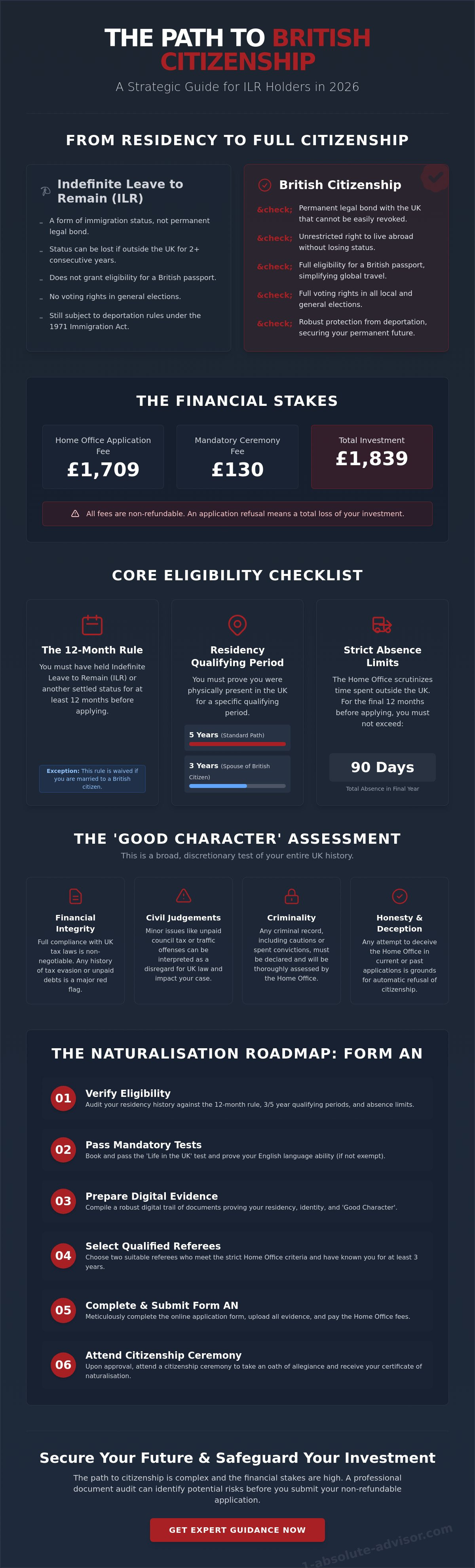
Eligibility for naturalisation generally requires you to be over 18 and to have held ILR for at least 12 months. However, if you’re married to a British citizen, this one-year waiting period is waived. This allows you to apply for citizenship immediately upon receiving your residency. You must also demonstrate that you’ve been physically present in the UK for the required qualifying period, usually five years, or three years for spouses. Beyond residency, the Home Office requires proof of your knowledge of life in the UK and a clean “Good Character” record. This assessment isn’t just about criminal records; it includes your financial integrity, such as tax compliance and even minor civil penalties.

Core Eligibility: The 12-Month Rule and Residency Requirements

The path to naturalisation requires meticulous attention to timing. When applying for british citizenship after ilr, the most common hurdle is the 12-month rule. This regulation mandates that you must’ve held settled status for at least one year before submitting your application. Despite rumors of a 10-year residency requirement following the 2025 policy debates, the standard qualifying period remains five years for most applicants in 2026. This period is reduced to three years for those married to British citizens, who also enjoy an exemption from the 12-month waiting period.

Understanding the Core Eligibility: The 12-Month Rule and Residency Requirements is vital for a successful outcome. You must prove you were physically present in the UK exactly five years (or three years if married to a citizen) before the date the Home Office receives your application. If you were on holiday or a business trip on that specific calendar day five years ago, your application may be refused. It’s a binary requirement that leaves little room for error.

Absence limits are equally rigid. You can’t have spent more than 450 days outside the UK during the five-year qualifying period. More critically, the final 12 months before your application are subject to a stricter 90-day limit. Exceeding these thresholds without documented exceptional circumstances often leads to a refusal. If your travel history is extensive, a professional document checking service provides the necessary audit to ensure your data is accurate before submission.

Calculating Your Qualifying Period Correctly

The Home Office uses a methodical “back-counting” method to verify your presence. The qualifying period is the continuous 5-year block immediately preceding the application date. When tallying absences, only full days spent outside the UK count. The days you depart and the days you arrive back in the country are treated as days of UK presence. Miscalculating these “partial days” is a frequent error that can lead to an incorrect total, potentially jeopardising your applying for british citizenship after ilr process.

Exemptions and Policy Nuances in 2026

While the 2025 White Paper sparked discussions about longer residency tracks, the 2026 rules maintain the established 5-year and 3-year frameworks. However, caseworkers now have clearer guidelines on discretionary powers for excess absences caused by unavoidable travel or work requirements. For those transitioning from a Skilled Worker Visa UK, ensuring your employment records align with your residency claims is paramount to proving continuous lawful presence.

Applying for British Citizenship After ILR: The Complete 2026 Guide

The “Good Character” assessment is perhaps the most subjective element of applying for british citizenship after ilr. While residency requirements rely on objective dates, this criterion gives Home Office caseworkers significant discretion to evaluate your overall conduct. The official UK government guidance provides a framework, but many applicants are surprised by what actually triggers a refusal. Criminality isn’t limited to custodial sentences; even persistent driving offences, speeding fines, or Fixed Penalty Notices (FPNs) can lead to a negative outcome if they suggest a disregard for the law. Civil penalties, such as County Court Judgments (CCJs) for unpaid debts, are also scrutinized. If you have a history of financial instability or litigation, it’s vital to address these points proactively in your application.

Financial integrity is a non-negotiable pillar of being a British citizen. Caseworkers expect you to be fully compliant with HMRC, ensuring all Income Tax and National Insurance contributions are settled. Similarly, arrears in Council Tax can be viewed as a failure to meet the requirements of good character. The Home Office isn’t just looking for a clean criminal record; they’re looking for a pattern of responsibility and a commitment to the UK’s social and financial systems. Being current with all public liabilities is essential before you hit the submit button.

The Impact of Immigration Breaches

Past immigration conduct is a major factor in the decision-making process. If you’ve overstayed a visa or worked without permission in the last 10 years, the Home Office will likely refuse your application under the “10-year rule.” Full disclosure is the only viable strategy. Any attempt to omit a past infraction is classified as “deception,” which carries much harsher consequences than the original breach itself. If your immigration history isn’t perfectly linear, you should seek a professional audit of your records to ensure your narrative is transparent and legally sound.

English Language and Life in the UK Requirements

Integration is measured through two primary hurdles: language proficiency and cultural knowledge. You must hold an English language qualification at B1 CEFR level or higher, unless you’re a national of a majority English-speaking country or have a degree taught in English. The Life in the UK test remains a mandatory requirement for applying for british citizenship after ilr in 2026. To pass on your first attempt, rely strictly on the official study materials. Exemptions are rare, generally reserved for those over the age of 65 or individuals with specific, documented medical conditions that make testing impossible.

The Naturalisation Roadmap: A Step-by-Step Guide to Form AN

The transition from resident to citizen is formalized through the submission of Form AN. When applying for british citizenship after ilr, your preparation must be surgical. You’ll need a comprehensive digital record of your residency, including every passport held during your qualifying period and definitive proof of your ILR status. In 2026, the application is primarily digital, requiring you to upload these documents to a secure portal after paying the £1,709 naturalisation fee and the £130 ceremony fee. This stage is where many administrative errors occur, often regarding the exact dates of entry and exit from the UK. Precision here is the difference between a successful grant and a costly refusal.

Once the fees are settled, you’ll book a biometric appointment at a UKVCAS service point. Here, your fingerprints and photograph are taken for a £19.20 fee. It’s a standard procedure, but it marks the beginning of the official waiting period. Unlike visa applications, there’s no priority or super-priority service for naturalisation. You should prepare for a processing window of three to six months. During this time, the Home Office conducts deep-background checks into your history and character.

Selecting Your Referees Strategically

Referees act as a bridge of trust between you and the Home Office. You must provide two: one “professional” referee and one “British citizen” referee. The professional referee can be of any nationality but must belong to an accepted profession, such as a teacher, accountant, or solicitor. The second must be a British citizen over the age of 25 who isn’t related to you. If the Home Office chooses to verify your application, they may contact these individuals to confirm your identity and character. Selecting people who are responsive and well-established is a vital tactical move.

Biometrics and the Waiting Game

Your appointment at the UKVCAS service point is the final physical step. While your application is pending, you’re generally permitted to travel outside the UK, provided you maintain your residency requirements and have a valid passport and BRP. However, it’s wise to remain in the country if your travel history is already near the absence limits discussed in previous sections. Tracking your application is done through the online portal, though updates are often infrequent until a decision is reached.

The final milestone is the Citizenship Ceremony. Once approved, you’ll receive an invitation to attend a local authority ceremony where you’ll take an oath of allegiance. This is the moment you receive your certificate of naturalisation, which you’ll then use to apply for your first British passport. If the administrative complexity of Form AN feels overwhelming, our British Citizenship Application Service provides a comprehensive audit to ensure your roadmap to citizenship is clear of obstacles.

Securing Your Future: Why Professional Guidance Matters for the Final Step

The decision to submit your final application is a significant financial and legal commitment. When you’re applying for british citizenship after ilr, you’re risking more than just time. The Home Office fees, which total £1,839 when including the mandatory ceremony, are non-refundable. If your application is refused due to a simple oversight or a misinterpretation of the “Good Character” guidance, that capital is effectively lost. This isn’t just a paperwork exercise; it’s a strategic legal transition that requires a high degree of precision to protect your investment and your future.

A professional document audit serves to catch “invisible” errors that often bypass the untrained eye. These can range from minor discrepancies in travel dates to the selection of a referee who doesn’t strictly meet the Home Office’s professional criteria. OISC-registered advisors bring a level of strategic oversight that ensures your narrative is consistent across all five years of residency. We handle complex issues, such as past immigration breaches or discretionary absence requests, by providing the legal framework necessary to support your case. Before you hit “submit” on Form AN, ensure you’ve completed this final checklist:

  • Verify your physical presence in the UK on the exact day five years prior to the application date.
  • Cross-reference every entry and exit stamp in your current and expired passports against your absence log.
  • Confirm both referees meet the age, nationality, and professional requirements.
  • Audit your financial history for any undisclosed CCJs, tax arrears, or persistent penalties.
  • Ensure your Life in the UK and English language test certificates are still valid and accepted.

Avoiding Common Refusal Pitfalls

Many applicants fall into traps that a professional audit would easily catch. These pitfalls often involve mismatched residency dates or failing to provide a detailed explanation for absences that exceed the standard limits. A well-crafted professional cover letter is essential if you’re asking a caseworker to exercise discretion. It allows you to present your residency history as a cohesive, compliant whole. For those seeking technical specifications on the naturalisation process, our British Citizenship pillar provides a deep dive into the underlying legal requirements and caseworker instructions.

The 1 Absolute Advisor Advantage

Our firm operates with a transparent fixed-fee approach to citizenship applications, ensuring you have complete cost predictability from the start. We leverage our OISC registration to provide the high-level strategic oversight required for applying for british citizenship after ilr in a high-scrutiny environment. We don’t just check boxes; we audit your entire UK history to eliminate risks before they reach a caseworker’s desk. Don’t leave your final step to chance. Speak with a citizenship expert today to audit your eligibility and secure your British passport with confidence.

Finalizing Your Path to British Nationality

Achieving naturalisation marks the definitive end of your immigration journey and the beginning of permanent security in the United Kingdom. As we’ve explored, the process of applying for british citizenship after ilr in 2026 requires more than just meeting residency dates. It demands a rigorous audit of your conduct, financial integrity, and physical presence to satisfy the Home Office’s strict criteria. With non-refundable application and ceremony fees now exceeding £1,800, there’s no room for administrative oversights or miscalculated absences.

Our OISC-registered immigration consultants specialize in managing these complexities with precision. We provide fixed-fee application management that covers everything from comprehensive document checking to strategic cover letters for complex residency or “Good Character” cases. By choosing professional oversight, you ensure your transition to citizenship is handled with the stability and integrity it deserves. Our goal is to provide the peace of mind that comes from knowing your case is in expert hands.

Secure your British Citizenship with our expert legal support and take the final step toward your UK passport with absolute confidence. Your future as a British citizen is within reach.

Frequently Asked Questions

Can I apply for British citizenship immediately after getting ILR if I am married to a British citizen?

Yes, you can apply for naturalisation immediately upon receiving your settled status if you are married to a British citizen. The standard 12-month waiting period that applies to other applicants is waived in these circumstances. However, you must still ensure you have been physically present in the UK for at least three years and meet all other residency and character requirements before submitting your application.

What happens if I have spent more than 450 days outside the UK in the last 5 years?

Exceeding the 450-day absence limit typically results in a refusal unless the Home Office chooses to exercise discretion. Caseworkers may overlook a slight excess if you can prove your home, family, and primary interests remained in the UK throughout the period. For more substantial absences, you’ll need to provide compelling evidence of exceptional circumstances, such as unavoidable travel for work or serious illness, to avoid a negative outcome.

Does a speeding ticket or minor driving offence count against the “Good Character” requirement?

A single speeding ticket or minor fixed penalty notice doesn’t usually lead to a refusal, but it must be disclosed. The Home Office looks for a pattern of behavior rather than isolated incidents. However, persistent offending or failing to pay fines can suggest a disregard for the law. Any attempt to conceal these offences is viewed as deception, which is a much more serious threat to your application’s success.

How much are the Home Office fees for British citizenship in 2026?

The total mandatory cost for an adult naturalisation application in 2026 is £1,839. This includes the £1,709 application fee and the compulsory £130 citizenship ceremony fee. Additionally, you must budget £19.20 for biometric enrolment. These costs increased on April 8, 2026, and are non-refundable, meaning a refusal results in a significant financial loss. It’s essential to ensure your eligibility is verified before making this payment.

Do I need to give up my current passport to become a British citizen?

The UK government permits dual nationality, so you aren’t required to renounce your original citizenship to become British. You can hold both passports simultaneously under UK law. However, you must check the regulations of your country of origin. Some nations don’t permit dual citizenship and may automatically revoke your original nationality once you naturalise in the UK. This is a critical legal consideration for your global mobility.

What is the “Life in the UK” test, and do I have to take it again if I took it for ILR?

The Life in the UK test is a mandatory assessment of your knowledge of British customs and history. You don’t need to retake the test if you’ve already passed it for your Indefinite Leave to Remain application. The pass certificate doesn’t expire and remains valid for applying for british citizenship after ilr. You simply need to provide your original test reference number as part of your digital evidence on Form AN.

Can my application be refused if I have outstanding debt or a low credit score?

A low credit score isn’t a ground for refusal, but outstanding public debt is a serious concern. The Home Office specifically audits your financial integrity, focusing on unpaid Council Tax, HMRC arrears, or unresolved County Court Judgments. If you’re in a debt management plan, you should provide evidence that you’re meeting your obligations. Failure to manage public liabilities is often interpreted as a failure of the good character requirement.

How long does the citizenship ceremony take, and is it mandatory?

The citizenship ceremony is a mandatory final step and typically lasts between 30 and 60 minutes. You must attend this ceremony within 90 days of receiving your approval letter to finalize your status as a British citizen. During the event, you’ll take an oath or affirmation of allegiance and receive your naturalisation certificate. This certificate is the legal document you’ll need to apply for your first British passport.

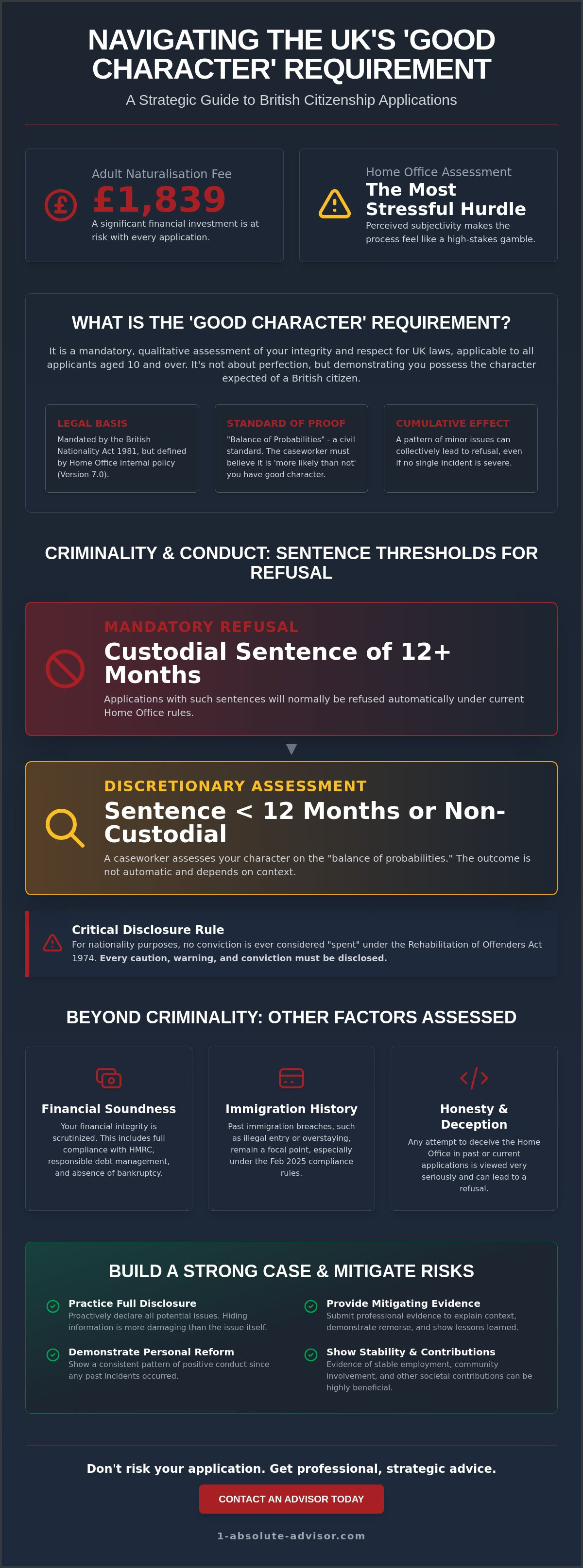
Good Character Requirement for British Citizenship: 2026 Guidance

Your path to naturalisation doesn’t demand a flawless life history, but it does require an uncompromising demonstration of your current integrity. With the adult naturalisation fee now reaching £1,839, the good character requirement british citizenship assessment is often the most stressful hurdle for applicants to clear. Many people fear that a minor financial oversight or a long-past legal issue will lead to an automatic refusal and the loss of their significant financial investment. This uncertainty has only intensified with the February 10, 2025, policy changes regarding illegal entry, which are currently awaiting a critical judicial review in June 2026.

We recognize that the perceived subjectivity of Home Office caseworkers can make the process feel like a gamble. This strategic guide is designed to replace that anxiety with a structured, professional approach to your application. You’ll gain a precise understanding of the Version 7.0 guidance thresholds, including how the Home Office weighs custodial sentences and financial soundness. By following this framework, you can accurately assess your own eligibility and take proactive, actionable steps to address and mitigate potential character concerns before you submit your documents.

Key Takeaways

  • Understand the statutory framework of the British Nationality Act 1981 to ensure your application aligns with the mandatory standards for all applicants aged 10 and over.
  • Identify the specific thresholds where custodial sentences trigger mandatory refusals versus when caseworkers maintain discretionary power under the latest 2026 guidance.
  • Recognize how financial integrity, including HMRC compliance and debt management, directly impacts the good character requirement british citizenship assessment.
  • Evaluate the implications of the February 2025 immigration compliance rules to understand why past entry breaches remain a focal point for Home Office scrutiny.
  • Develop a robust mitigation strategy using full disclosure and professional evidence to proactively address potential character concerns before submission.

Defining the Good Character Requirement for Naturalisation

The good character requirement british citizenship isn’t a simple box to tick; it’s a qualitative assessment of your integrity and respect for the laws of the United Kingdom. While the requirement is a mandatory component of British nationality law under the British Nationality Act 1981, the legislation itself doesn’t provide a strict definition of ‘good character.’ This leaves the Home Office to define the standard through its own internal policy guidance, currently updated as Version 7.0 on April 30, 2026. This assessment applies to every applicant aged 10 or over, meaning even young registrants must meet the threshold of being a law-abiding individual.

Caseworkers are tasked with looking beyond a clean criminal record. They evaluate whether you’ve shown honesty in your dealings with the government and whether your presence in the UK is conducive to the public good. Because the definition is policy-driven rather than strictly codified in law, it allows the Home Office to adapt its scrutiny as societal expectations and political priorities change. You aren’t just proving you haven’t broken the law; you’re demonstrating that you possess the level of integrity expected of a British citizen.

The Caseworker’s Perspective: The Balance of Probabilities

When a caseworker reviews your history, they don’t look for proof beyond a reasonable doubt as a criminal court would. Instead, they apply a civil standard of evidence. In the context of nationality law, the balance of probabilities means the caseworker must be satisfied that it is more likely than not that the applicant possesses good character based on the evidence provided. This means that a series of minor, unrelated issues, such as small financial penalties or historical immigration breaches, can have a cumulative effect. Even if no single incident justifies a refusal, a pattern of non-compliance might lead a caseworker to conclude that you don’t meet the necessary standard of integrity.

Why Perfection is Not Mandatory

It’s vital to understand that the Home Office distinguishes between genuine human error and a deliberate attempt to deceive or flout the law. A forgotten parking fine from eight years ago isn’t viewed with the same severity as a recent, undisclosed tax debt. The impact of any negative incident often diminishes as more time passes without further issues. Caseworkers are directed to consider the whole picture, including evidence of personal reform, stable employment, and community contributions. If you can show that a past mistake was an isolated event and that you’ve since lived as a responsible member of society, you can still successfully navigate the good character requirement british citizenship process. Success often depends on how you frame your history rather than the history itself.

Criminality and Conduct: Thresholds for Refusal in 2026

Criminality remains the most objective metric within the Home Office assessment framework, yet its application requires a nuanced understanding of current policy. Since the rule changes on July 31, 2023, the alignment with Part 9 of the Immigration Rules has become more rigid. For any application submitted in 2026, a custodial sentence of 12 months or more will normally result in a mandatory refusal of citizenship. This threshold represents a significant tightening of the rules compared to previous years, where longer sentences were often required to trigger such a definitive outcome. It’s a clear signal that the Home Office prioritizes a clean legal record for those seeking to naturalise.

When a sentence is less than 12 months, or if the applicant received a non-custodial sentence, the decision shifts from mandatory to discretionary. In these instances, the Official Home Office Guidance directs caseworkers to assess the applicant on the balance of probabilities. They look for evidence that the individual’s conduct, even without a lengthy prison stay, suggests a disregard for the law. It is vital to remember that for the good character requirement british citizenship, no conviction is ever considered “spent” under the Rehabilitation of Offenders Act 1974. Every caution, warning, and conviction must be disclosed, regardless of how much time has passed.

The “persistent offender” rule adds another layer of complexity. If an applicant has a long history of minor offences, such as low-level shoplifting or repeated public order incidents, the Home Office may refuse the application based on a pattern of behaviour. Even if no single offence meets the 12-month threshold, the cumulative effect demonstrates a lack of respect for UK society. If you’re concerned about how a past mistake might be interpreted, our British Citizenship Application Service can provide a professional review of your history to identify potential risks.

Driving Offences and Fixed Penalty Notices (FPNs)

A single speeding ticket or a one-off Fixed Penalty Notice for a minor traffic violation rarely leads to a refusal. However, these incidents still fall under the umbrella of the good character requirement british citizenship. A pattern of driving conduct, such as multiple FPNs within a short period or accruing enough penalty points to face a disqualification, indicates a habitual failure to comply with regulations. Transparency is your most effective tool here. Failing to disclose penalty points is often viewed more severely than the points themselves, as it suggests a deliberate attempt to deceive the caseworker.

Pending Charges and Ongoing Investigations

If you’re currently the subject of an active police investigation or have pending criminal charges, the Home Office will typically pause your application. They won’t make a final determination until the legal proceedings have concluded. This is to ensure the character assessment is based on the final outcome of the case. If a charge is eventually dropped or you’re acquitted, you must provide official documentation from the court or police to restart the processing of your naturalisation. Applicants in this situation should wait for a clear resolution before proceeding to avoid a premature decision based on incomplete information.

Good Character Requirement for British Citizenship: 2026 Guidance

Financial Soundness: Debts, Taxes, and Bankruptcy

Financial stability is often overlooked by applicants, but the Home Office views your fiscal conduct as a direct reflection of your integrity. Meeting the good character requirement british citizenship involves demonstrating that you’ve fulfilled your financial obligations to the United Kingdom. This doesn’t mean you must be debt-free to succeed. Instead, the focus is on whether you’ve managed your liabilities honestly and transparently. Caseworkers look for evidence that you respect the financial systems of the country you wish to join.

HMRC compliance is a pillar of this assessment. Caseworkers frequently cross-reference applications with tax records to ensure that you aren’t just living in the UK, but contributing according to the law. If you’ve habitually filed late tax returns or have outstanding tax liabilities without an agreed repayment plan, this can trigger a refusal. It suggests a failure to comply with the statutory obligations expected of a citizen. For those with complex tax histories, our British Citizenship Application Service can help ensure your documentation accurately reflects your compliance.

County Court Judgments (CCJs) and bankruptcy are also critical areas of scrutiny. While a single CCJ might not derail an application, a history of ignored judgments indicates a lack of responsibility. Bankruptcy and Individual Voluntary Arrangements (IVAs) must be disclosed in every case. Bankruptcy is particularly sensitive; if it resulted from reckless behavior or a deliberate attempt to avoid creditors, it’s likely to lead to a refusal. However, if it arose from genuine misfortune and you’ve been discharged, you may still meet the character standard.

NHS Debt and Public Funds

Unpaid NHS charges are a specific point of concern for the Home Office. Current guidance indicates that an outstanding NHS debt of £500 or more will normally lead to an application being refused. Beyond debt, caseworkers also examine whether you’ve accessed public funds you weren’t entitled to. While debt alone is not a bar to citizenship, dishonest debt management or failing to disclose financial liabilities is often fatal to an application.

Council Tax and Utility Arrears

Debts to local authorities, particularly council tax arrears, signal a lack of commitment to your local community. If you have outstanding arrears, it’s essential to have a formal repayment plan in place before you submit your application. You’ll need to provide evidence of this rectification, such as letters from the council or utility providers confirming the agreement and your consistent payment history. This proactive approach demonstrates that you’re taking steps to resolve your financial issues, which supports your claim of good character.

The 2025/2026 Immigration Compliance Rules

The good character requirement british citizenship assessment has undergone its most rigorous transformation since the Nationality and Borders Act. On February 10, 2025, the Home Office introduced a stringent policy stating that any applicant who entered the UK illegally will normally be refused citizenship. Unlike previous versions of the guidance, where a significant passage of time might have mitigated an entry breach, the current stance is largely indifferent to how many years have passed since the initial incident. This change has created significant hurdles for long-term residents who have otherwise lived exemplary lives but whose arrival in the UK was not through official channels.

Deception remains a primary ground for refusal. If you’ve previously provided false information in a visa application, you’re likely facing a 10-year period during which naturalisation is virtually impossible. In some cases, particularly where the deception was orchestrated or involved identity fraud, the bar can be permanent. Similarly, working in breach of your visa conditions, even for a short period, is viewed as a fundamental failure to respect the laws of the United Kingdom. It suggests that your commitment to compliance is conditional, which is a significant red flag for caseworkers.

If your history involves complex entry or compliance issues, our British Citizenship Application Service offers the strategic oversight needed to identify potential grounds for an ‘exceptional circumstances’ plea before you risk your application fee.

Illegal Entry and the ‘Normally Refuse’ Policy

In the current 2026 legal landscape, ‘illegal entry’ includes entering without leave, using clandestine means, or arriving via small boat crossings. The “normally refuse” policy is currently the standard for caseworkers, meaning they’ll reject applications regardless of whether the applicant has since obtained Indefinite Leave to Remain (ILR). While the Home Office acknowledges human rights and exceptional circumstances, these are rarely granted without overwhelming evidence of reform or unique hardship. It’s also vital to monitor the upcoming judicial review scheduled for June 9-11, 2026, as the court’s decision could force a significant softening of this policy for long-term residents.

Deception and Dishonesty

Failing to disclose a material fact is the leading cause of avoidable refusals. This includes not just criminal records, but also past visa refusals from other countries or minor civil penalties. The Home Office also maintains a zero-tolerance policy for dishonesty in Life in the UK or English language tests. If there’s any evidence that you used a ‘proxy’ or cheated during these assessments, it’s considered a fundamental breach of the good character requirement british citizenship. Such findings usually result in a 10-year ban on all future citizenship applications, as they demonstrate a lack of the basic integrity required for naturalisation.

Strategic Preparation: Mitigating Good Character Risks

Success in a naturalisation application often depends less on a perfect past and more on the quality of your current strategic preparation. The good character requirement british citizenship assessment is fundamentally a forward-looking test of integrity. This means that while past mistakes remain on your record, your proactive efforts to rectify them can significantly influence a caseworker’s decision. The cornerstone of any successful mitigation strategy is the ‘Full Disclosure’ approach. Attempting to conceal a historical caution or a financial judgment is almost always viewed as a fresh act of deception, which carries its own mandatory refusal period.

Gathering robust evidence of reform is your most powerful tool when addressing previous conduct issues. This involves more than just a lack of new offences. You should aim to provide professional references, evidence of consistent employment, and documentation of community involvement or voluntary work. These elements help build a narrative of a person who is a settled, contributing member of British society. If your history includes a non-custodial sentence or a period of financial instability, it’s often wise to delay your application. Waiting until you’re well outside the standard refusal windows mentioned in British Citizenship: The Complete Guide to Naturalisation in 2026 ensures your case is built on a foundation of long-term stability.

A compelling cover letter is the final piece of the strategic puzzle. It shouldn’t offer excuses. Instead, it should provide clear, factual context for any historical issues and detail the specific steps you’ve taken to ensure they aren’t repeated. This letter serves as your voice during the assessment, guiding the caseworker through your evidence and explaining why you meet the good character requirement british citizenship today.

The Role of Professional Legal Representation

Engaging an OISC-registered advisor provides an objective audit of your immigration and personal history. These professionals are trained to identify ‘hidden’ risks, such as forgotten historical breaches that might still appear on internal Home Office systems. By building a robust bundle of evidence that anticipates caseworker concerns, an advisor helps move your application from a position of vulnerability to one of professional strength. This level of oversight is particularly vital for those navigating the complexities of the 2025 illegal entry rules.

Checklist for a ‘Character-Ready’ Application

To ensure your submission is as strong as possible, follow this systematic preparation framework:

  • Step 1: Obtain a Subject Access Request (SAR) to see exactly what information the Home Office holds on your file.
  • Step 2: Audit your HMRC status and credit report to identify and resolve any outstanding financial ‘red flags’ before applying.
  • Step 3: Secure high-quality professional references from individuals who can vouch for your integrity and standing in the community.
  • Step 4: Utilize a document checking service to perform a final audit and confirm your evidence meets the 2026 guidance standards.

Securing Your Future as a British Citizen

Achieving naturalisation in 2026 requires more than a simple application; it demands a proactive demonstration of your integrity and respect for UK law. We’ve explored how the Home Office now scrutinizes financial soundness and immigration history with unprecedented depth. Success hinges on your ability to present a transparent, evidence-backed narrative that addresses the good character requirement british citizenship with precision. Whether you’re navigating the complexities of the 2025 illegal entry rules or managing historical financial issues, your approach must be both honest and strategic.

Our team provides the professional stability you need during this life-changing process. With OISC-registered expertise and a focus on fixed-fee application management, we specialize in complex naturalisation cases that require a nuanced touch. We don’t just process documents; we act as your strategic partner to safeguard your investment and your future in the UK. We’ll help you audit your history and build a robust case that stands up to caseworker scrutiny.

Book a Legal Consultation to Assess Your Good Character Eligibility

Taking the right steps today ensures that your path to citizenship remains clear and certain. You’ve worked hard to build your life here, and we’re here to help you finalize that journey with confidence.

Frequently Asked Questions

Does a speeding ticket affect my British citizenship application?

A single speeding ticket or Fixed Penalty Notice doesn’t typically lead to a refusal, provided you disclose it. However, accruing multiple fines or penalty points suggests a habitual disregard for the law. This pattern can negatively impact the good character requirement british citizenship assessment by demonstrating a lack of respect for UK regulations. Transparency is essential; caseworkers view non-disclosure as a more serious integrity issue than the minor traffic offence itself.

Can I apply for citizenship if I have a County Court Judgment (CCJ)?

Yes, you can apply, but you must disclose the CCJ and demonstrate that you’re managing the debt responsibly. A single judgment doesn’t result in an automatic refusal if you’ve entered into a formal repayment plan. Caseworkers are primarily concerned with whether you’ve ignored the court’s order. Providing evidence of consistent payments or showing that the debt has been satisfied helps prove your financial integrity and responsibility.

What happens if I forget to disclose a minor caution from 15 years ago?

Forgetting to disclose any legal incident, regardless of how minor or old it is, can lead to a refusal based on deception. In citizenship law, no caution or conviction is ever considered “spent” under the Rehabilitation of Offenders Act 1974. The Home Office views non-disclosure as a deliberate attempt to mislead the caseworker. It’s always safer to include the details and provide a brief explanation of the circumstances.

How does the Home Office check my financial history for the good character requirement?

The Home Office uses a cross-departmental approach, accessing records from HMRC, the Department for Work and Pensions (DWP), and the NHS. They verify your tax compliance, benefit claims, and any outstanding health service debts over £500. Caseworkers also have the authority to check credit reference agencies for public records like bankruptcies or County Court Judgments. This comprehensive review ensures all applicants meet the financial integrity standards expected of a British citizen.

Will my application be refused if I entered the UK illegally many years ago?

Under the February 10, 2025, policy update, illegal entry will normally lead to a refusal regardless of how much time has elapsed. This is a significant shift from previous guidance where long-term residency could mitigate past breaches. While there are narrow exceptions for human rights or truly exceptional circumstances, the default position is now a refusal. Applicants in this situation should monitor the judicial review scheduled for June 2026 for potential policy changes.

Can I still get citizenship if I have been bankrupt in the past?

You can still succeed if your bankruptcy has been discharged and wasn’t the result of reckless or dishonest behavior. The Home Office assesses the cause of the insolvency to determine if it reflects poorly on your character. If the bankruptcy was due to genuine misfortune, such as a business failure during an economic downturn, it’s less likely to trigger a refusal. You must provide the discharge certificate and a clear explanation of the events.

Does receiving benefits affect the good character requirement?

Lawfully receiving public funds or benefits doesn’t negatively impact your application. The good character requirement british citizenship only becomes an issue if there’s evidence of benefit fraud or a deliberate attempt to claim funds you weren’t entitled to. Caseworkers look for honesty in your dealings with the DWP. As long as your claims were accurate and you’ve complied with all reporting requirements, receiving financial support isn’t a barrier to naturalisation.

What counts as an ‘exceptional grant’ in a good character refusal case?

An ‘exceptional grant’ is a rare decision where a caseworker approves an application despite the applicant failing a specific character threshold. This usually requires overwhelming evidence of positive contribution to the UK or significant human rights considerations that outweigh the negative conduct. It isn’t a standard route and usually involves cases where a refusal would result in a disproportionate impact on the applicant’s life or where remarkable reform has been demonstrated.

British Citizenship Application Requirements UK: The 2026 Comprehensive Guide

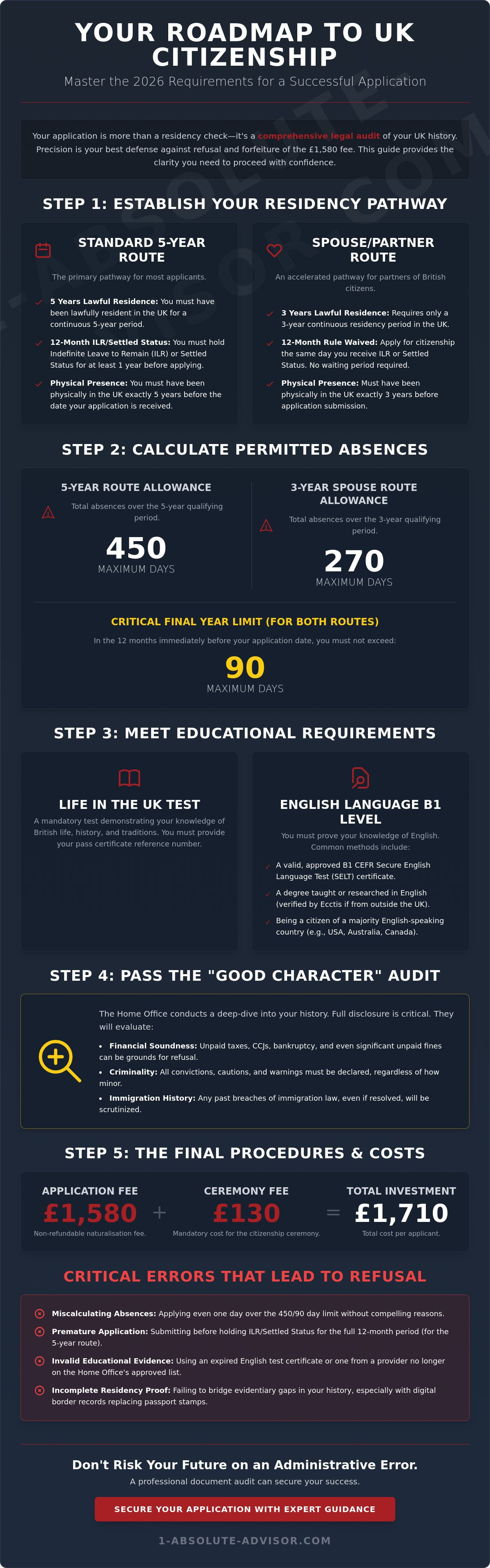
What if your British citizenship application is actually a comprehensive legal audit of your entire UK history rather than a simple residency check? It’s natural to feel a sense of dread when a single overlooked parking fine or a few extra days spent abroad could lead to a refusal and the forfeiture of your £1,580 application fee. You’ve worked hard to build a life here, and the thought of a minor administrative error jeopardizing your future is understandably stressful. Precision is your best defense against such risks.

By following this guide, you’ll master the intricate british citizenship application requirements uk and the heightened “good character” standards required to secure your passport in 2026. We’ve designed this resource to provide the professional clarity you need to move forward with absolute confidence. We’ll examine the 450-day absence limit, the potential shift to B2 English language proficiency, and the strategic steps necessary to ensure your history meets the Home Office’s strictest criteria. From the mandatory £130 ceremony fee to the nuances of the Life in the UK test, we’ll cover every detail to protect your investment and your legal status.

Key Takeaways

  • Distinguish between the three-year and five-year residency routes and understand why you must hold Indefinite Leave to Remain for a full year before applying.
  • Master the latest 2026 british citizenship application requirements uk regarding English language proficiency and the mandatory Life in the UK test to avoid costly delays.
  • Learn how the Home Office evaluates “Good Character” and how to proactively address past financial issues or minor legal infractions that could threaten your success.
  • Navigate the updated fee structure, including the £1,580 naturalisation fee and £130 ceremony cost, while following a clear step-by-step roadmap for biometric appointments.
  • Identify the common administrative errors that lead to immediate refusal and discover how a professional document audit can bridge evidentiary gaps in your residency history.

Core Eligibility: Indefinite Leave to Remain and Residency Rules

The foundation of any successful naturalisation claim rests on the “physical presence” requirement. You must have been physically present in the UK on the day exactly five years before your application reaches the Home Office. This is a non-negotiable legal standard within British nationality law. For most applicants, this five-year residency is paired with the “12-month rule,” which dictates that you must have held Indefinite Leave to Remain (ILR) for at least one full year before submitting your request. Precision is mandatory. A single day’s discrepancy in your timeline can result in an immediate refusal of your british citizenship application requirements uk.

In 2026, the integration of the EU Settlement Scheme (EUSS) is a critical component of the eligibility framework. If you hold “Settled Status,” the Home Office treats this as the functional equivalent of ILR. However, the 12-month waiting period still applies unless you’re married to a British national. We’ve seen many applicants miscalculate this transition, assuming that the grant of Settled Status immediately qualifies them for citizenship. It’s vital to verify the exact date your status was granted rather than the date you applied for it. This distinction ensures your application isn’t filed prematurely, protecting your fee and your record.

Calculating Permitted Absences and the 450-Day Rule

The Home Office allows for a maximum of 450 days outside the UK during your five-year qualifying period. Crucially, you can’t exceed 90 days of absence in the 12 months immediately preceding your application. If your travel exceeds these limits, the caseworker has the discretion to refuse the application unless you provide evidence of “compelling reasons.” These reasons might include crown service, significant health issues, or unavoidable travel restrictions. With the shift toward digital borders, proving your residency requires meticulous record-keeping. We recommend maintaining a comprehensive log of flight bookings and employer letters, especially where physical passport stamps are no longer issued.

Specific Rules for Spouses and Civil Partners

If you’re married to or in a civil partnership with a British citizen, the residency requirements are significantly more lenient. You only need to demonstrate three years of lawful residence, and the 12-month ILR waiting period is waived entirely. This means you can apply for citizenship the day you receive your ILR or Settled Status. The absence limit is also reduced to 270 days over the three-year period, with the standard 90-day limit in the final year still in effect. For those still in the earlier stages of this journey, our UK Spouse Visa Guide 2026 provides a strategic roadmap for maintaining eligibility for future naturalisation.

Educational Requirements: English Language and Life in the UK

Demonstrating your integration into British society is a dual-process requirement that extends beyond mere physical presence. To satisfy the british citizenship application requirements uk, you must provide verifiable proof of your English language proficiency and your knowledge of life in the United Kingdom. While many applicants rely on results from previous visa stages, using an expired certificate from a Skilled Worker or Spouse visa application can lead to an immediate refusal if that test is no longer on the Home Office’s approved list. We always recommend checking the current official government guidance to ensure your provider remains valid at the time of your 2026 submission. Precision saves time. The Home Office rarely offers second chances for administrative oversights regarding educational evidence.

Proving Your Knowledge of English

Applicants from majority English-speaking countries, including the USA, Australia, and Canada, are typically exempt from sitting a formal language test. If you aren’t from an exempt nation, a UK degree certificate or an international degree taught in English (verified by Ecctis) serves as a robust alternative to a formal exam. For everyone else, booking a B1 CEFR level test at a registered Secure English Language Test (SELT) centre is the only path forward. It’s a strict requirement; a certificate from a non-approved centre will result in a rejected application. If you’re unsure whether your specific degree or older test certificate meets the current standards, our British Citizenship Application Service can provide a definitive audit of your educational evidence before you pay the Home Office fees.

Mastering the Life in the UK Test

The Life in the UK test is a 45-minute examination based on the official handbook. It covers the history, traditions, and legal systems of the four nations. One common pitfall is a mismatch between the name on your booking and your official ID. If they don’t match exactly, the test centre will turn you away, and you’ll lose your booking fee. Success here is permanent. Once you pass, the certificate never expires, making it a foundational asset for your future. Understanding how these educational hurdles fit into the broader landscape is essential, as detailed in our analysis of Navigating UK Immigration in 2026.

Exemptions do exist for those who may find these requirements impossible to meet. If you’re aged 65 or over, you’re automatically exempt from both the language and the Life in the UK requirements. Similarly, applicants with long-term physical or mental conditions that prevent them from learning English or taking the test can apply for a waiver. This requires a specific medical waiver form completed by a UK-registered doctor. General claims of stress or difficulty learning a language won’t suffice; the evidence must be clinical and comprehensive.

British Citizenship Application Requirements UK: The 2026 Comprehensive Guide

The “Good Character” Requirement: A Strategic Deep-Dive

The “Good Character” assessment is the most subjective element of the british citizenship application requirements uk. Unlike the residency rules discussed earlier, which are largely mathematical, character is evaluated based on whether you are deemed worthy of the privilege of citizenship. The Home Office doesn’t just look at major crimes; they examine your entire financial and legal footprint in the UK. This includes a review of your tax compliance, any outstanding NHS debts exceeding £500, and even your history of company directorships. If you’ve been involved with a company that went into liquidation while owing significant debts, the caseworker may question your financial integrity. Precision in your disclosure is the only way to safeguard your application.

Criminality remains a primary focus, but a common misconception is that “spent” convictions don’t matter. For naturalisation, the Rehabilitation of Offenders Act 1974 doesn’t apply in the same way it does for employment. You must disclose every conviction, caution, and reprimand, regardless of how much time has passed. While a single minor offence from a decade ago might not lead to a refusal, failing to mention it certainly will. Caseworkers look for evidence that you’ve respected the laws and obligations of the UK throughout your stay, not just during the qualifying period.

Non-Criminal Breaches: Driving Offences and Civil Penalties

Minor legal issues often cause the most anxiety for applicants. Fixed Penalty Notices (FPNs), such as speeding tickets or parking fines, don’t usually lead to a refusal on their own. However, a “pattern of behaviour” is a significant risk factor. If you’ve accumulated multiple FPNs over a short period, the Home Office may view this as a persistent disregard for the law. As noted in the Citizens Advice guide, being proactive about these disclosures is essential. You should also disclose any ongoing civil litigation or County Court Judgments (CCJs), as these reflect on your financial soundness and overall character.

The Duty of Candour: Why Honesty is the Only Policy

The Home Office values transparency above all else. Any attempt to hide information is classified as “deception,” which carries a mandatory 10-year ban on future applications. This is why the duty of candour is so vital. If you have a complex history, it’s often necessary to draft a witness statement that provides context for past mistakes. This strategic approach is a core part of our British Citizenship: The Complete Guide to Naturalisation. Explaining that a debt was due to a specific hardship or that an immigration breach was unintentional can often mitigate the risk of refusal. Honesty isn’t just a moral choice; it’s a legal necessity for securing your British passport.

Application Costs, Procedures, and the Final Roadmap

The final phase of securing your status involves a structured sequence of administrative steps and significant financial commitments. Once you’ve confirmed you meet the british citizenship application requirements uk, the process moves from document gathering to formal submission. This begins with an online application followed by a mandatory UKVCAS appointment. At this appointment, your biometric information is captured and your original documents are digitally scanned for Home Office review. A standard decision typically arrives within six months, though complex cases involving “Good Character” issues or extensive absences may take longer.

One often overlooked aspect of the roadmap is the “Intention to Reside” requirement. Unlike Indefinite Leave to Remain, citizenship is granted with the expectation that the UK will be your primary home. If your records show you’ve already established a life elsewhere or plan to relocate immediately after naturalisation, the Home Office may question the sincerity of your application. Proving your intent involves demonstrating ongoing ties, such as employment, property ownership, or family roots within the country. This strategic focus ensures your application isn’t viewed as a mere “passport of convenience.”

Total Cost of Naturalisation in 2026

Understanding the full financial scope is essential for effective planning. The costs extend beyond the headline application fee, and since these fees are generally non-refundable, accuracy is paramount. If you’re still at the stage of securing permanent residency, our ILR UK: The Complete Guide provides the necessary groundwork for these final steps.

  • Naturalisation Application Fee: £1,580
  • Citizenship Ceremony Fee: £130
  • Life in the UK Test: £50
  • English Language Test (B1/B2): Approximately £150
  • Biometric Enrolment: Variable (standard and premium slots available)

The risk of refusal represents a total loss of these funds. If you’re concerned about the financial implications of a minor error, our British Citizenship Application Service provides a professional audit to ensure your investment is protected.

The Citizenship Ceremony and Beyond

The journey concludes with a mandatory citizenship ceremony, which must take place within 90 days of your approval. Here, you’ll take an oath or affirmation of allegiance to the Monarch and receive your certificate of naturalisation. This certificate is your most valuable legal document; you’ll need it to apply for your first British passport. A critical final step often missed is the return of your Biometric Residence Permit (BRP). Once you’ve attended your ceremony, you’re legally required to return your BRP to the Home Office for cancellation. Failing to do so can result in significant fines, even though you are now a British citizen.

Why Professional Representation is Vital for Success

The decision to apply for naturalisation is the culmination of years of planning and financial sacrifice. Attempting a “Do-It-Yourself” application involves navigating the high-stakes british citizenship application requirements uk without a safety net. Minor errors, such as miscalculating the 450-day absence limit or failing to disclose a historical Fixed Penalty Notice, don’t just lead to delays; they result in an immediate refusal. In such cases, the Home Office retains your entire £1,580 application fee. This forces you to restart the process and double your expenditure. Professional representation transforms this precarious journey into a controlled, strategic operation where every risk is identified and mitigated before submission.

A primary benefit of expert guidance is the inclusion of a comprehensive legal cover letter. This document isn’t a mere formality. It serves as a strategic brief that addresses potential “Good Character” concerns or complex residency gaps before a caseworker can flag them. By interpreting the law in your favour and providing context for past financial issues or minor legal infractions, we provide the Home Office with a clear rationale for approval. This proactive approach mitigates the subjective nature of the assessment process, ensuring your history is viewed through a lens of compliance and integrity. We ensure your investment is protected by a standard of professional integrity that matches the importance of your future status.

Strategic Evidence Gathering

Proving five years of continuous residence requires more than just a passport. For contractors, freelancers, or frequent business travellers, the evidentiary burden is significantly higher. We identify the most robust combination of P60s, employer letters, and utility records to eliminate any “gaps” in your timeline. Our professional document checking service acts as a final audit, ensuring every piece of evidence is verified and aligned with the 2026 standards. This level of detail is essential for those whose employment history doesn’t follow a standard 9-to-5 pattern, where digital records must be cross-referenced with physical presence data.

The 1 Absolute Advisor Advantage

Our OISC-registered expertise is built on a foundation of high-success naturalisation strategies. We don’t just fill out forms; we act as your strategic partner, navigating the nuances of the 2026 immigration rules with precision and authority. We offer fixed-fee peace of mind, ensuring that your total investment is protected by advisors who understand the gravity of your british citizenship application requirements uk. Our approach is holistic, treating your application as a vital business decision that requires absolute accuracy. Secure your future in the UK with our expert citizenship application service.

Securing Your Future with Strategic Precision

Navigating the british citizenship application requirements uk involves more than just counting days. It requires a meticulous audit of your entire legal and financial footprint. Success depends on your ability to prove both continuous residency and the subjective “good character” standard. Whether you’re managing the 450-day absence limit or addressing minor legal infractions, absolute accuracy is your only protection against the loss of your £1,580 application fee. We’ve seen how minor administrative errors can derail years of planning.

As OISC-registered immigration consultants, we specialize in complex cases and provide the fixed-fee transparency you need for peace of mind. Our role is to act as your strategic partner, ensuring every evidentiary gap is bridged before your submission reaches the Home Office. Book a consultation for your British Citizenship application today and take the final step toward your UK passport with confidence. Your journey to naturalisation is a major life milestone, and we’re dedicated to making it a successful one.

Frequently Asked Questions

How long does a British citizenship application take in 2026?

Standard processing time is approximately six months from the date of your biometric appointment. Some cases are resolved faster, while those requiring additional scrutiny regarding the british citizenship application requirements uk or “Good Character” may take longer. You’ll receive a notification via email or post once a decision has been reached.

Can I apply for British citizenship if I have a criminal record?

You can apply, but you must disclose all convictions, including those that are spent. The Home Office evaluates criminal records under the “Good Character” requirement. While serious or recent offences lead to refusal, minor or historical issues may be mitigated through a legal cover letter explaining the circumstances.

What happens if my British citizenship application is refused?

If your application is refused, the Home Office will send a letter explaining the reasons, but they won’t refund your £1,580 fee. You may have the option to request a formal reconsideration if you believe a mistake was made. In most cases, it’s more effective to address the specific grounds for refusal and submit a new, professionally audited application.

Do I need to pass the Life in the UK test if I am over 65?

No, applicants aged 65 or older are automatically exempt from the Life in the UK test and the English language requirement. You simply need to provide proof of your age, such as a valid passport or birth certificate, with your application. This exemption also applies to those with permanent physical or mental conditions that make taking the test impossible.

Can I travel outside the UK while my citizenship application is pending?

You can travel abroad while your application is being processed, provided you maintain your UK residence. It’s essential to be present in the UK for your biometric appointment and eventually your citizenship ceremony. You must also ensure that any travel doesn’t contradict your stated “intention to reside” in the United Kingdom as your primary home.

What are the current Home Office fees for British citizenship in 2026?

The standard fee for an adult naturalisation application in 2026 is £1,580, plus a mandatory £130 fee for the citizenship ceremony. If you are registering a child as a British citizen, the application fee is £1,214. These costs don’t include the fees for the Life in the UK test or the required English language examinations.

Is there a difference between naturalisation and registration?

Naturalisation is the legal process for adults to become citizens, whereas registration is the route typically used for children or individuals with specific historical claims. Both pathways require meeting specific british citizenship application requirements uk, but registration often has different residency and fee structures. Adults who aren’t already British must almost always use the naturalisation route.

How much time can I spend outside the UK after becoming a British citizen?

There are no statutory limits on how much time you can spend abroad once you’ve been granted British citizenship. Unlike Indefinite Leave to Remain, which can lapse after two years of absence, citizenship is permanent. However, you must demonstrate a genuine intention to make the UK your main home at the time you submit your initial application.

Discuss Your Case For FREE