
Switching from Fiancé to Spouse Visa UK: The 2026 Transition Guide

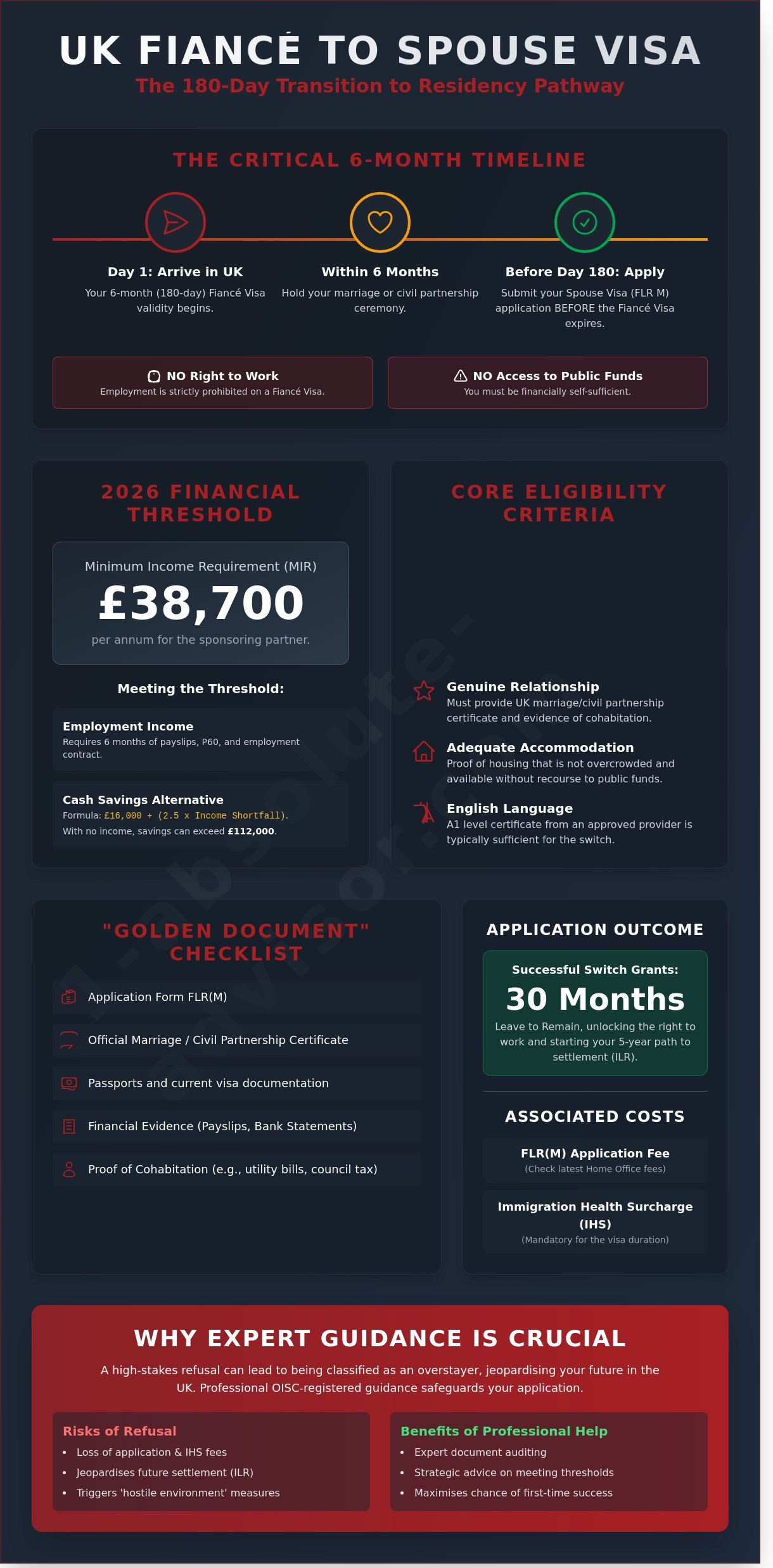
What if the true test of your relocation strategy isn’t the move itself, but the 180-day window following your arrival? For many couples, the strict six-month limit on a fiancé visa creates a high-stakes race against time, especially as you don’t yet have the legal right to work. We understand that managing this transition is a significant professional and personal undertaking, particularly with the 2026 financial threshold now established at £38,700 for most applicants.

Successfully switching from fiancé to spouse visa uk shouldn’t be a source of anxiety, but a structured step toward your long-term stability. This guide provides the professional clarity you need to master the application process, secure your 30-month residency, and finally unlock your career potential in the British labour market. We’ll examine the mandatory documentation, the critical timing of your submission, and the precise steps to avoid any costly gaps in your lawful residence.

Key Takeaways

  • Understand the strategic transition from a temporary six-month entry clearance to a formal “Leave to Remain” application following your UK wedding ceremony.
  • Master the 2026 financial eligibility criteria and relationship evidence necessary for switching from fiancé to spouse visa uk with absolute confidence.
  • Ensure your submission includes the “golden documents,” such as your marriage certificate and updated financial records, to meet the stringent Appendix FM standards.
  • Anticipate the full financial requirements of the transition, including the specific FLR(M) application fees and the mandatory Immigration Health Surcharge (IHS).
  • Discover how professional OISC-registered guidance and expert document audits can safeguard your application against the risk of a high-stakes refusal.

Understanding the Transition: From Fiancé to Spouse Visa

The fiancé visa serves as a specific, short-term entry clearance granted for exactly six months. Its sole legal purpose is to facilitate a marriage or civil partnership ceremony within the United Kingdom. Once the ceremony concludes, the holder doesn’t automatically gain residency. Instead, the process of switching from fiancé to spouse visa uk represents a formal application for “Leave to Remain” (FLR M). This transition is a fundamental legal shift. You move from a restrictive, visitor-like status to a formal resident status, which provides the foundation for your future in Britain.

Under the UK’s points-based immigration system, maintaining continuous lawful presence is a non-negotiable requirement. For 2026, Home Office enforcement remains stringent regarding expiry dates. If you don’t submit your spouse visa application before that 180-day window closes, you risk being classified as an overstayer. This status can jeopardise future settlement, lead to a loss of the right to rent, and trigger hostile environment measures. We advise clients to treat the six-month deadline as a hard limit rather than a target.

The “Right to Work” Milestone

A significant limitation of the fiancé visa is the total prohibition on employment. Holders cannot legally work, whether paid or unpaid, and they have no access to public funds. This often creates a period of financial dependency that can strain a household’s strategic planning. Transitioning to a spouse visa removes these barriers immediately upon approval. You gain unrestricted access to the UK labour market, allowing you to seek employment or establish a business. For professionals with pending job offers, submitting the application the moment the marriage certificate is issued is vital to minimise career gaps.

The 5-Year Path to Settlement (ILR)

Strategic planning is essential for long-term residency and eventual citizenship. Many applicants mistakenly believe their time spent in the UK on a fiancé visa contributes to the five-year residency requirement for Indefinite Leave to Remain (ILR). It does not. The “clock” for permanent settlement only starts on the day the spouse visa is officially granted. Delaying the process of switching from fiancé to spouse visa uk effectively pushes back your eventual eligibility for ILR. We recommend viewing the marriage certificate as a catalyst for your long-term immigration security, ensuring the application is lodged promptly to begin the residency count without unnecessary delay.

Eligibility and Financial Requirements in 2026

The process of switching from fiancé to spouse visa uk requires a precise transition from a visitor-like status to a resident partner. By 2026, the Home Office has intensified its focus on the “subsisting” nature of relationships. You must provide your legal UK marriage certificate to prove the ceremony occurred within the six-month fiancé entry period. Beyond the certificate, evidence such as joint utility bills, shared bank statements, or proof of cohabitation since the wedding is vital to demonstrate that the union is genuine and continuing.

Accommodation standards remain a pillar of the 2026 requirements. You’re required to prove that you and your spouse will live in “adequate” housing that isn’t overcrowded according to the Housing Act 1985. This must be achieved without recourse to public funds, ensuring the couple is self-sufficient. For the English language requirement, the A1 level certificate you obtained for your fiancé visa is typically valid for this initial switch, provided the test provider remains on the Home Office’s approved list and the certificate hasn’t expired.

Navigating the 2026 Financial Thresholds

By early 2026, the Minimum Income Requirement (MIR) under Appendix FM has fully aligned with the median salary for Skilled Workers, set at £38,700. This threshold applies to most sponsors, regardless of the number of children involved, following the 2024 policy shifts. Meeting this figure requires meticulous documentation of P60s, payslips, and employment contracts covering the last six months. This financial landscape often requires a deeper expert analysis of UK settlement rule changes to understand how these figures impact long-term residency goals.

If your combined salary doesn’t reach the £38,700 mark, you can utilise the Cash Savings Route. In 2026, the required savings amount is calculated as £16,000 plus 2.5 times the shortfall of the income. For those with no categorised income, this total can exceed £112,000. You’re allowed to combine employment income with dividends, rental income, or pension payments, but the Home Office won’t allow the combination of self-employment income with cash savings to meet the threshold.

The Suitability Criteria

Suitability is the Home Office’s assessment of an applicant’s personal history and conduct. This mandatory check looks beyond your financial status to ensure your presence in the UK is conducive to the public good. Officials scrutinise criminal records, previous immigration breaches, and any history of providing false information in prior applications. Even a single instance of overstaying or a minor non-custodial sentence can trigger a “Good Character” review. If you have concerns about your previous conduct, seeking a consultation with an absolute advisor ensures your application is prepared with the necessary legal nuance to mitigate potential refusals.
Switching from Fiancé to Spouse Visa UK: The 2026 Transition Guide

Essential Documentation for a Successful Switch

The transition from a fiancé visa to a spouse visa represents a shift from an intended union to a legally recognised partnership in the eyes of the Home Office. The marriage or civil partnership certificate is the absolute foundation of this application. It acts as the “golden document” that validates your change in status. Without a certified copy of this record, the application cannot proceed. Precision in your paperwork is the cornerstone of a successful outcome, as caseworkers in 2026 operate with heightened scrutiny regarding document authenticity.

Updated financial evidence is equally critical. You cannot simply point to the evidence submitted during your fiancé visa application. The Home Office requires a fresh snapshot of your sponsor’s financial health to ensure they still meet the minimum income threshold. This usually involves providing the most recent six months of payslips and corresponding bank statements. For a detailed breakdown of current eligibility and specific financial tiers, refer to the UK Government Guidance on Spouse Visas. Additionally, the sponsor’s letter of support should be updated to reflect your new marital status, confirming their ongoing commitment to provide for your housing and maintenance without recourse to public funds.

What Evidence Can You Reuse?

While much of the application requires fresh data, certain elements from your initial entry clearance remain valid. Your TB test results, if still within their six-month validity period at the time of the new submission, can often be reused. English language certificates at level A1 or higher also remain valid for switching from fiancé to spouse visa uk purposes. However, you must avoid the trap of using “old” financial data. The 2026 thresholds are strictly enforced; any bank statement older than 28 days at the time of application will likely result in a rejection. Organise your digital upload by category, ensuring the caseworker can clearly see the chronological progression from your arrival to your wedding day.

Proving a Genuine and Subsisting Relationship

A marriage certificate proves a legal event, but it doesn’t automatically prove a subsisting relationship. You must demonstrate a shared life through proof of cohabitation. This includes joint utility bills, council tax statements, or tenancy agreements that list both names at the same address. If you’ve only been married for a few weeks, provide letters from the GP or bank addressed to you both individually at the same residence.

Digital submissions in 2026 favour quality over quantity. Limit your photo evidence to 10 to 15 high-quality images that show the wedding ceremony and subsequent life together in the UK. Excessive communication logs are rarely necessary if you are living together. Instead, focus on documents that prove your intention to live together permanently, such as joint savings accounts or shared insurance policies. These documents provide the objective proof of a stable, long-term future that the Home Office demands.

The Application Process: Timing and Fees

The administrative transition from a fiancé visa to a spouse visa is a structured five-step sequence that demands absolute precision. Your priority is ensuring the Home Office receives your submission before your initial six-month entry clearance expires. The process for switching from fiancé to spouse visa uk follows a specific digital and physical workflow designed to verify your ongoing eligibility and the validity of your recent marriage.

  • Step 1: Complete the FLR(M) online application form with comprehensive details regarding your relationship and financial status.
  • Step 2: Pay the required visa application fee and the mandatory Immigration Health Surcharge (IHS) through the official portal.
  • Step 3: Book and attend a biometric appointment at a UKVCAS centre to provide your fingerprints and a digital photograph.
  • Step 4: Upload your digitised supporting evidence, including your marriage certificate and financial statements, via the official partner portal.
  • Step 5: Await the Home Office decision while your legal status is protected by statutory safeguards.

Managing Application Costs and the IHS

Budgetary planning for 2026 must account for two primary costs. The standard Home Office fee for an in-country switch currently stands at £1,048. Beyond this, you must pay the Immigration Health Surcharge. This levy is currently £1,035 per year of the visa, totalling £2,587.50 for the initial 30-month spouse grant. Paying the IHS is a non-negotiable prerequisite for accessing the National Health Service (NHS) without additional charges. If you require an expedited result, the Super Priority service offers a decision within 24 hours for an additional £1,000 fee. This is often a strategic choice for couples with upcoming professional commitments or travel requirements.

The Section 3C Leave Safety Net

Section 3C of the Immigration Act 1971 provides a vital legal bridge for applicants. It prevents you from becoming an overstayer if your fiancé visa expires while the Home Office processes your new application. Your existing rights and conditions remain active as long as the application was submitted in time. However, this protection is fragile. A common mistake is attempting to travel outside the Common Travel Area while the application is pending. Doing so automatically withdraws your application and terminates your 3C leave. You must remain within the UK until you receive your new Biometric Residence Permit or digital status confirmation.

Once your status is officially confirmed and travel restrictions are lifted, you can explore Chatham Island Adventures & Tours to celebrate your new life in the UK with a curated, small-group journey.

Maintaining compliance during this transition is essential for your long-term residency goals. If you need expert assistance to ensure your documentation meets every rigorous standard, you can consult our specialist immigration advisors for a comprehensive file review.

Expert Assistance: Why Professional Guidance Matters

The process of switching from fiancé to spouse visa uk carries a high burden of proof. Even a minor clerical error can lead to an immediate refusal, resulting in the loss of thousands of pounds in Home Office fees. OISC-registered advisors act as a critical safeguard against these risks. They ensure every piece of evidence meets the strict legal thresholds set by the Home Office. Professional guidance isn’t just about filling forms; it’s about strategic risk mitigation for your family’s future.

At 1 Absolute Advisor, we’ve seen how non-standard income, such as self-employment or director dividends, complicates applications. Our advisors conduct a comprehensive “Document Check” before final submission. This stage identifies gaps that an untrained eye would miss, such as missing pages from an annual tax return or incorrect bank statement periods. We streamline the transition to provide the peace of mind necessary during such a life-changing event. Our team handles the complexities of previous refusals by addressing the Home Office’s concerns head-on with detailed legal representations.

Avoiding Common Refusal Pitfalls

The Home Office often denies applications due to the “specified evidence” trap. This happens when applicants provide the right information but in the wrong format. For example, bank statements must show specific dates and meet Appendix FM-SE requirements exactly. If your financial evidence lacks a single mandatory detail, the caseworker has the power to refuse the application without asking for clarification. You can find a detailed breakdown of these requirements in our UK Spouse Visa Guide 2026.

  • Financial Evidence: We verify that payslips and bank statements align perfectly with the £29,000 minimum income threshold.
  • Accommodation Standards: We ensure your housing evidence meets the 1985 Housing Act requirements to prevent “overcrowding” refusals.
  • Relationship Proof: We help curate a timeline of your marriage that satisfies the “genuine and subsisting” criteria through robust evidence.

Our Fixed-Fee Application Management

Transparency is the cornerstone of our service. We offer a fixed-fee model so you won’t face unexpected legal costs or hidden charges. The “Absolute” approach manages the entire lifecycle of your application. We start with a deep-dive assessment and stay with you until your Biometric Residence Permit (BRP) arrives. This end-to-end management removes the stress of switching from fiancé to spouse visa uk. If you’re ready to secure your UK status with a team that treats your case as a priority, book a consultation with our expert team today.

Take the Final Step Toward Your UK Residency

Navigating the transition to a long-term life in Britain requires strict adherence to the Home Office’s evolving 2026 standards. You must ensure your application for switching from fiancé to spouse visa uk is submitted before your initial six-month leave expires. Success hinges on meeting the Appendix FM financial threshold, which currently stands at £29,000 per annum, and providing definitive proof of your legal marriage. Missing these deadlines or failing to provide the correct specified evidence often leads to costly delays or immediate refusals.

Our OISC-registered consultants specialise in the 2026 Appendix FM financial requirements, providing the strategic oversight needed to manage complex documentation. We offer a fixed-fee service with no hidden costs to ensure your path to residency remains predictable and transparent. Secure your right to live and work in the UK with our expert visa management and establish your permanent home with confidence. Your future in the UK is within reach when you’ve a professional partner handling every intricate detail of the process.

Frequently Asked Questions

Can I work while waiting for my fiancé to spouse visa switch?

You cannot work while your application for switching from fiancé to spouse visa uk is pending with the Home Office. Under Section 3C of the Immigration Act 1971, your existing visa conditions remain in force while you wait for a decision. Since the fiancé visa specifically prohibits any form of employment, you must wait until your spouse visa is officially granted and your new status is confirmed before starting a job or engaging in self-employment.

What happens if my fiancé visa expires before we get married?

If your fiancé visa expires before your wedding ceremony, you’ll lose your legal right to remain in the UK and become an overstayer. The Home Office requires you to marry within the six-month validity period of your initial entry clearance. If unforeseen circumstances like a medical emergency delay the ceremony, you must apply for an extension and provide documented evidence from a registrar or doctor to avoid being asked to leave the country.

Do I need to leave the UK to switch from a fiancé to a spouse visa?

You don’t need to leave the UK to transition to your new status as a spouse. The fiancé visa category is specifically designed to facilitate an in-country switch once the marriage or civil partnership is legally registered. You must submit your online application before your current six-month visa expires; this ensures you remain legally resident under the protection of Section 3C leave throughout the processing period.

How much does it cost to switch to a spouse visa in 2026?

The Home Office application fee for switching from fiancé to spouse visa uk is currently £1,048 for applications submitted within the country. You’re also required to pay the Immigration Health Surcharge, which is set at £1,035 per year for adults. Because the spouse visa is granted for a period of 30 months, the total surcharge payment at the point of application is £2,587.50, bringing the total mandatory government cost to £3,635.50.

How long does the spouse visa switch take to process?

Standard processing for an in-country spouse visa application usually takes 8 weeks from the date of your biometrics appointment. This timeline can fluctuate based on Home Office caseload volumes or the complexity of your financial documentation. If you need a faster decision to begin working or to travel abroad, you can pay for an expedited service to receive a result much sooner.

What is the minimum income requirement for a spouse visa in 2026?

The minimum income requirement for a spouse visa currently stands at £29,000 per year following the threshold increase implemented in April 2024. You can meet this financial requirement through the British sponsor’s salary, self-employment income, or combined cash savings. If you’re relying entirely on savings without any employment income, you’ll need to demonstrate a total of £88,500 held in a regulated financial institution for at least six months.

Can I use the Super Priority service for a spouse visa switch?

You can use the Super Priority service for an additional fee of £1,000 to receive a decision on your application by the end of the next working day. This service is a strategic choice for couples who need to formalise the applicant’s right to work immediately after the wedding. Once you attend your biometrics appointment at a UKVCAS centre, the Home Office processes the file as a priority and typically sends the outcome via email within 24 hours.

Is a new English language test required for the switch?

You don’t need to take a new English language test if your previous certificate from your fiancé visa application was at level A1 or higher and remains on the list of approved providers. The requirement for the first spouse visa is the same A1 CEFR level you met for your initial entry clearance. Many applicants choose to take the A2 or B1 test during this stage anyway; this proactive approach simplifies their future extension and Indefinite Leave to Remain applications later on.

Fiancé Visa UK Requirements 2026: The Definitive Guide to a Successful Application

What if the difference between starting your life together and a devastating visa refusal was a single bank statement dated just 48 hours too late? It’s understandable why the 2026 Home Office landscape feels more like a legal minefield than a path to marriage. You’ve likely spent hours worrying about shifting financial thresholds and the emotional strain of being apart while waiting for a decision. We recognise that the weight of these regulations feels overwhelming when your future is at stake.

For expats managing this process from abroad, such as in Thailand, the administrative burden can be twofold, often involving local legalities alongside UK immigration. For example, while preparing a visa application, one might also need to convert driving license pattaya to stay compliant with local regulations. This need for localized legal support is a common challenge for expats globally; for those navigating life in Israel, for example, you can visit Salior Ben Hamou Law Office for practical representation.

This guide provides a strategic breakdown of the fiancé visa uk requirements for 2026, ensuring your evidence meets the Absolute standard of quality. You’ll master the complexities of the £38,700 minimum income threshold and learn how to present a portfolio of evidence that leaves no room for Home Office doubt. We’ll examine the specific document timelines required for your six-month stay and the precise steps to transition into a Spouse Visa immediately after your wedding ceremony.

Key Takeaways

  • Understand the foundational eligibility criteria for the Family Visa, ensuring both partners meet the essential age and intention requirements for marriage within the initial six-month entry period.
  • Navigate the updated fiancé visa uk requirements for 2026, specifically regarding the £29,000 minimum income threshold and how to strategically leverage the ‘Savings Route’ to bridge financial gaps.
  • Learn how to successfully evidence the authenticity of your bond and provide the concrete proof of wedding arrangements required by the Home Office to satisfy the ‘genuine and subsisting’ test.
  • Master the mandatory document checklist, from English language proficiency to suitable accommodation standards, to ensure your submission is comprehensive and avoids common administrative pitfalls.
  • Develop a strategic timeline for transitioning from a fiancé visa to a spouse visa, ensuring you maintain your legal status through a seamless Leave to Remain application immediately after your ceremony.

Understanding the UK Fiancé Visa Requirements in 2026

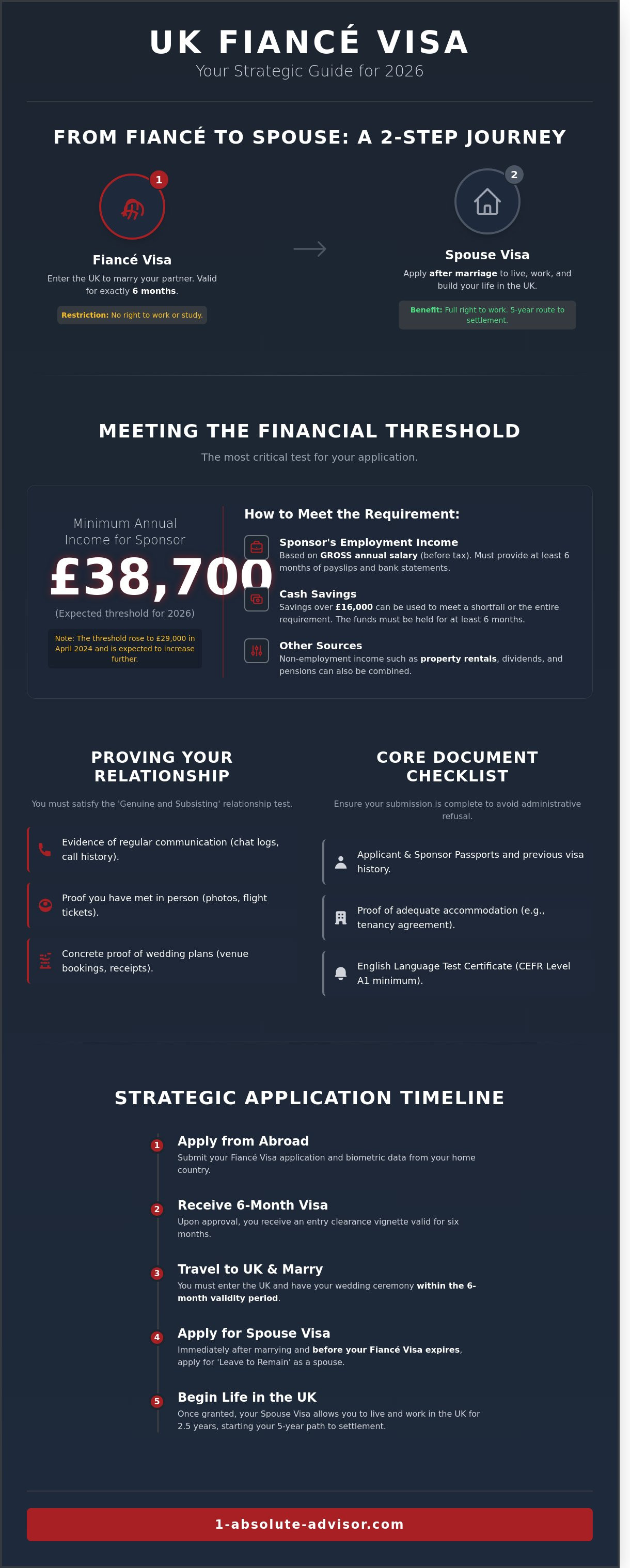
The UK fiancé visa, a specific category under the Family Visa route, serves as a short-term entry clearance for individuals intending to marry or enter a civil partnership with a British citizen or settled person. This visa remains valid for exactly six months. During this 180-day window, the couple must hold their ceremony and then apply for a transition to a Spouse Visa to remain in the country long-term. Meeting the fiancé visa uk requirements is a rigorous process that demands proof of a genuine relationship and the financial capacity to support the applicant without relying on public funds.

The 2026 regulatory environment continues to reflect the strict fiscal policies established in recent years. Understanding Modern UK Immigration History provides the necessary context for why the Home Office prioritises high income thresholds and robust evidence of cohabitation or intent. Unlike the Marriage Visitor Visa, which is strictly for those who intend to leave the UK after their wedding, the fiancé visa is a settlement route. It allows the holder to switch to a five-year path to Indefinite Leave to Remain (ILR) without departing the UK, provided they meet the eligibility criteria at each stage.

Fiancé Visa vs. Spouse Visa: Key Differences

A primary restriction of the fiancé visa is that it doesn’t grant the right to work or study in the UK. This creates a period of financial dependency on the sponsor until the marriage is registered and the Spouse Visa is granted. The six-month limit forces a strict timeline on wedding planning; any delay in the ceremony can jeopardise the applicant’s legal status. From a cost perspective, this is a two-step process. Couples must pay the initial entry clearance fee of £1,846 and then a further fee for the Leave to Remain application after the wedding. While more expensive than marrying abroad and applying for a Spouse Visa directly, it offers the significant benefit of allowing the couple to start their life together in the UK immediately.

Who can be your UK Sponsor?

The sponsor must hold a specific legal status to qualify, such as British or Irish citizenship, Indefinite Leave to Remain, or settled status under the EU Settlement Scheme. They’re required to prove they can provide adequate accommodation for the applicant that doesn’t violate UK overcrowding laws. The sponsor acts as the primary financial guarantor for the applicant’s entry and maintenance throughout their stay. To satisfy fiancé visa uk requirements in 2026, the sponsor must generally show an annual income of at least £38,700, although certain savings and pension combinations can be used to meet this threshold if the salary falls short.

Meeting the UK Fiancé Visa Financial Requirement

The financial criteria represent the most rigorous hurdle in the application process. Since 11 April 2024, the minimum income requirement for a fiancé visa rose to £29,000 per annum. This threshold is a significant increase from previous years and is expected to rise again in stages, potentially reaching £38,700 by early 2026. To succeed, you must demonstrate that you can support yourselves in the UK without relying on public funds. This involves meeting the Official Fiancé Visa Requirements through specific, evidenced income streams.

A frequent pitfall involves the distinction between gross and net income. The Home Office evaluates your gross annual salary, which is your pay before tax and National Insurance deductions. Applicants who mistakenly calculate their eligibility based on take-home pay often find they actually exceed the requirement, while those who ignore the strict definition of “permitted sources” face automatic refusal. If the UK sponsor receives specific disability-related benefits, such as Personal Independence Payment (PIP) or Attendance Allowance, they may be exempt from the £29,000 limit. In these cases, they must satisfy the ‘Adequate Maintenance’ test instead, proving they have enough remaining funds after housing costs to meet standard UK subsistence levels.

Combining Income Sources

Meeting the fiancé visa uk requirements often involves pooling different revenue streams. You can combine salaried employment with non-employment income, such as property rentals or stock dividends. However, strict rules apply. Under Category A, you must prove you’ve held your current job for at least 6 months while earning above the proportional threshold. If you rely on dividends, you’ll need the last full financial year’s tax return, company accounts, and dividend vouchers. Mixing self-employment with salaried work is possible, but it requires a full 12 months of evidence, making the application more complex to document.

The Cash Savings Formula

If your annual earnings don’t reach £29,000, you can use cash savings to bridge the gap. The Home Office uses a specific formula: (Threshold x 2.5) + 16,000. To meet the full requirement through savings alone, you must hold £88,500. This capital must have been in your bank account for a minimum of 182 consecutive days before the application date. If the money was a gift from a parent or relative, you must provide a signed ‘Declaration of Source of Funds’ to prove it’s not a temporary loan. Ensuring your financial evidence is meticulously organised is the best way to avoid a rejection based on technicalities.

Fiancé Visa UK Requirements 2026: The Definitive Guide to a Successful Application

Evidencing Your Intention to Marry and Relationship Subsistence

The Home Office applies a rigorous “genuine and subsisting” test to every application. This isn’t a mere formality. Case workers look for evidence that your relationship is authentic and likely to continue long after the visa is granted. They evaluate the history of your bond and the logical progression toward marriage. Understanding the UK Migration Statistics reveals that family-based migration remains a significant pathway, which has led to heightened scrutiny of fiancé visa uk requirements to prevent marriages of convenience.

One of the most common misconceptions is that a venue doesn’t need to be booked until the visa is approved. This is the primary reason for application refusal. The Home Office expects to see a concrete timeline. If you haven’t secured a provisional date with a registrar or a venue, your application lacks the necessary “intent to marry.” A simple statement of intent isn’t enough; you must demonstrate that you’ve taken active, financial steps toward a ceremony that will occur within the six-month visa window.

Communication logs are vital but must be handled with precision. Don’t submit hundreds of pages of private conversations. Instead, provide a representative sample, such as one or two pages of call logs or chat exports per month of your relationship. Focus on the frequency and consistency of contact. Case workers want to see that you speak regularly, not read your most intimate secrets.

The Wedding Evidence Tier System

We categorise evidence into three tiers to ensure a robust application. Tier 1 is essential and includes provisional bookings at a registry office or venue, along with email correspondence with the local superintendent registrar. Tier 2 adds weight through financial commitments, such as receipts for engagement rings, wedding attire, or printed invitations. Tier 3 covers the finer details, including bookings for photographers, florists, or catering menus. A successful application typically presents a combination of all three tiers to prove a committed timeline.

Proving You Have Met in Person

Online-only relationships don’t qualify for this visa. The “physical meeting” requirement is a mandatory threshold that cannot be bypassed. You must prove you’ve met in person at least once. We recommend providing a clear table of meetings, supported by passport stamps, flight boarding passes, and hotel invoices. Photos are useful but should show the couple in different locations and time periods to demonstrate a sustained history. For couples who’ve already had a religious ceremony that isn’t legally recognised in the UK, this documentation is excellent evidence of a subsisting relationship, provided the plan for a legal UK ceremony is also documented.

The Fiancé Visa Document Checklist and Application Timeline

Compiling a robust evidence portfolio is the most critical stage of the application process. Meeting the fiancé visa uk requirements involves more than just filling out forms; it requires providing objective proof that your relationship, financial status, and living arrangements meet strict Home Office standards. In 2026, the shift towards fully digital submissions means every document must be scanned and uploaded with high clarity to avoid delays or technical rejections.

English Language and Health Requirements

Applicants must demonstrate their ability to integrate into British society by passing an approved English language test. You need to achieve at least CEFR Level A1 in speaking and listening. It’s vital to use a provider on the Home Office ‘Secure English Language Test’ (SELT) list, such as IELTS SELT Consortium or Pearson. If you’re from a majority English-speaking country like Australia or Jamaica, you’re exempt from this testing. Test certificates are generally valid for two years, so ensure your results haven’t expired before you hit the submit button.

Health screenings are equally mandatory for applicants from specific countries. If you’ve been living in a country listed by the Home Office for six months or more, you must provide a valid Tuberculosis (TB) clearance certificate. This certificate must come from a clinic specifically approved by the Home Office; results from private GPs or unapproved hospitals won’t be accepted. Most TB certificates remain valid for six months from the date of the chest X-ray.

Accommodation and Suitability

You must prove you have ‘adequate accommodation’ available upon arrival. This means the property won’t be overcrowded under the Housing Act 1985 and won’t require additional recourse to public funds. To satisfy this, include your tenancy agreement or Land Registry title deed. If you’re staying with family, a ‘No Objection’ letter from the homeowner is required, alongside a property inspection report if the residence is shared with multiple adults.

The ‘Suitability’ criteria act as a final gatekeeper. You’re required to disclose all criminal convictions, even those considered ‘spent’ in other jurisdictions, and any previous immigration issues like overstaying or deportations. Failure to disclose these can lead to a refusal on ‘General Grounds’, which often carries a 10-year ban on future applications. Planning for your transition to a Spouse Visa early is essential; our UK Spouse Visa financial requirements 2025 guide provides the strategic framework for your next steps.

In 2026, standard processing times for out-of-country applications typically range up to 24 weeks. If you require a faster decision, the Priority Service aims to provide an outcome within 30 working days for an additional fee of £500. After submitting your digital application, you’ll attend a biometric appointment at a VFS Global or TLScontact centre to provide your fingerprints and photograph.

If you’re uncertain about your document readiness, contact 1 Absolute Advisor for a professional document audit to ensure your submission is flawless.

Transitioning from Fiancé to Spouse Visa: A Strategic Approach

Securing your initial entry is a significant milestone, but the process doesn’t end at the airport. Once you’ve successfully met the fiancé visa uk requirements and arrived in Britain, you have a 6-month window to marry and switch your status. This transition to Leave to Remain (LTR) as a spouse is the most critical phase of your immigration journey. It represents the official start of your residency clock. Time spent on a fiancé visa doesn’t count towards settlement, so applying for the Spouse Visa promptly is essential to begin your 5-year route to Indefinite Leave to Remain.

Post-Wedding Legal Steps

The moment your ceremony concludes, your focus must shift to administrative compliance. You’ll need the original Marriage Certificate issued by the General Register Office. This document is the primary evidence required to “switch” your status. You’re moving from proving an “intention to marry” to providing “proof of a legal union.”

Timing is everything in this process. You must submit your Spouse Visa application online before your 6-month fiancé visa expires. If you apply even one day late, you risk becoming an overstayer, which can lead to a 10-year ban on future applications. By submitting a valid application before the expiry date, your right to stay is protected under Section 3C of the Immigration Act 1971 while the Home Office processes your case.

The 1 Absolute Advisor Advantage

The transition from a fiancé to a spouse visa involves rigorous scrutiny of your financial stability and living arrangements. Our OISC-registered consultants provide the professional oversight needed to navigate these complexities. We identify hidden risks in your evidence, such as non-compliant bank statements or inadequate housing reports, before they lead to a refusal.

We operate with a “Fixed-Fee” promise. This means the price we quote is the price you pay, with no hidden charges for follow-up correspondence or document checking. This transparency allows you to plan your life in the UK without financial uncertainty. We act as your strategic partner, ensuring there’s no gap in your lawful residence.

Book a consultation with our expert immigration advisors today to ensure your transition is handled with absolute precision.

Securing Your Future Together in the UK

Successfully navigating the fiancé visa uk requirements in 2026 demands more than just a collection of documents; it requires a strategic approach to Home Office compliance. You’ve learned that meeting the £29,000 minimum income threshold and providing precise evidence of your intent to marry within 180 days are the pillars of a successful application. This initial six-month visa serves as the critical foundation for your eventual transition to a Spouse Visa and long-term residency. Every detail in your submission must align with current immigration rules to avoid costly delays or refusals.

As OISC-registered consultants, we specialise in managing complex family migration cases through a holistic, fixed-fee service that removes legal uncertainty. Our team provides the professional integrity and precision needed to handle rigorous financial audits and relationship subsistence checks. We’ll manage the intricate logistics of your application so you can focus on your upcoming wedding. Secure your UK Fiancé Visa with our expert legal support and take the first definitive step toward your new life together. Your journey to a settled life in Britain is within reach when backed by absolute professional expertise.

Frequently Asked Questions

Can I work in the UK while on a fiancé visa?

You aren’t permitted to engage in any form of employment, including self-employment or unpaid voluntary work, while residing in the UK on a fiancé visa. This visa serves as a 6-month entry clearance specifically for organising your wedding or civil partnership ceremony. You’ll only gain the legal right to work after you’ve married and successfully switched to a Spouse Visa from within the UK.

What happens if we don’t get married within the 6-month fiancé visa period?

You must apply for a 6-month extension or depart the UK if your wedding doesn’t take place before your visa expires. To secure an extension, you’ll need to provide objective evidence to the Home Office, such as a confirmed venue booking, proving that the ceremony is scheduled for the near future. Failing to marry or extend your stay results in a breach of immigration rules, which jeopardises future residency applications.

How much income do I need to sponsor my fiancé in 2026?

The sponsoring partner must demonstrate a minimum gross annual income of £38,700 to satisfy the fiancé visa uk requirements in 2026. This financial threshold was implemented in April 2024 to ensure couples can support themselves independently. You can meet this figure through various streams, including salaried income, dividends from a limited company, or specific pension payments, provided you provide 6 to 12 months of consecutive payslips.

Do I need to take an English language test for a fiancé visa?

You’re required to pass a Home Office approved English language test at CEFR Level A1 in speaking and listening. This test must be conducted by a Secure English Language Test (SELT) provider, such as IELTS SELT Consortium or Pearson. If you hold a degree taught in English that’s recognised by Ecctis as equivalent to a UK bachelor’s degree, you’re exempt from this specific testing requirement.

Can I switch from a visitor visa to a fiancé visa while inside the UK?

You cannot switch from a standard visitor visa to a fiancé visa while you’re physically present in the UK. Immigration rules mandate that you must return to your country of habitual residence to submit your application and attend a biometric appointment. The Home Office strictly enforces this policy to prevent individuals from bypassing the formal entry clearance process through temporary tourist routes.

What is the difference between a fiancé visa and a proposed civil partner visa?

The only distinction between these two routes is the legal nature of the union you intend to form. A fiancé visa is for those planning a marriage, while the proposed civil partner visa applies to couples entering a civil partnership under the Civil Partnership Act 2004. The fiancé visa uk requirements, application fees, and subsequent rights to remain in the country are identical for both categories.

How long does the UK fiancé visa take to process in 2026?

Standard processing times for fiancé visa applications generally take up to 24 weeks from the date you submit your biometrics. If you require a more rapid turnaround, the Home Office priority service is available for an additional £500, which typically delivers a decision within 30 working days. These durations can fluctuate based on the specific volume of applications handled by the regional processing hub at the time of your submission.

Can my fiancé use their overseas income to meet the financial requirement?

The applicant’s current overseas salary cannot be used to meet the fiancé visa uk requirements. Only the UK sponsor’s income is calculated for the £38,700 threshold unless the applicant is already working legally in the UK on a different visa. However, you can use joint cash savings over £16,000 to supplement a shortfall in the sponsor’s earnings, provided the funds have been under your control for at least 182 days.

Fiancé Visa United Kingdom: 2026 Comparison and Eligibility Guide

The most direct path to a life together in Britain is frequently the one that carries the highest risk of financial inefficiency and legal delay. It’s natural to feel apprehensive about the Home Office’s £29,000 minimum income requirement, particularly when a single administrative error can result in a flat refusal and months of painful separation. You deserve a strategy that prioritises both your emotional well-being and your long-term financial stability. This 2026 analysis ensures you approach the fiance visa united kingdom with absolute certainty, comparing it against alternative partner routes to find the most cost-effective and secure solution for your future.

We understand that navigating these regulations requires more than just filling out forms; it demands a holistic view of your transition to British life. We’ll examine the mandatory £1,846 application fee, the specific 184-day validity window, and the precise evidentiary requirements needed to satisfy the 2026 compliance standards. By the end of this guide, you’ll have a clear decision on which visa path aligns with your goals, ensuring you secure your right to live and work in the UK on your first attempt.

Key Takeaways

  • Evaluate the strategic advantages of the fiancé route versus the spouse visa to ensure your immigration path aligns with both your wedding plans and long-term residency goals.
  • Master the 2026 eligibility pillars, including the latest financial thresholds and the specific evidence required to satisfy the Home Office’s “genuine and subsisting” relationship test.
  • Calculate the full financial commitment by comparing application fees and understanding the unique Immigration Health Surcharge requirements for a fiance visa united kingdom.
  • Learn to identify and avoid common refusal triggers, such as the use of generic application templates that often lead to immediate Home Office scrutiny.
  • Understand how professional OISC-registered oversight can safeguard your future by navigating the complex nuances between published guidance and statutory immigration rules.

Choosing Your Path: The UK Fiancé Visa vs. Spouse Visa Dilemma

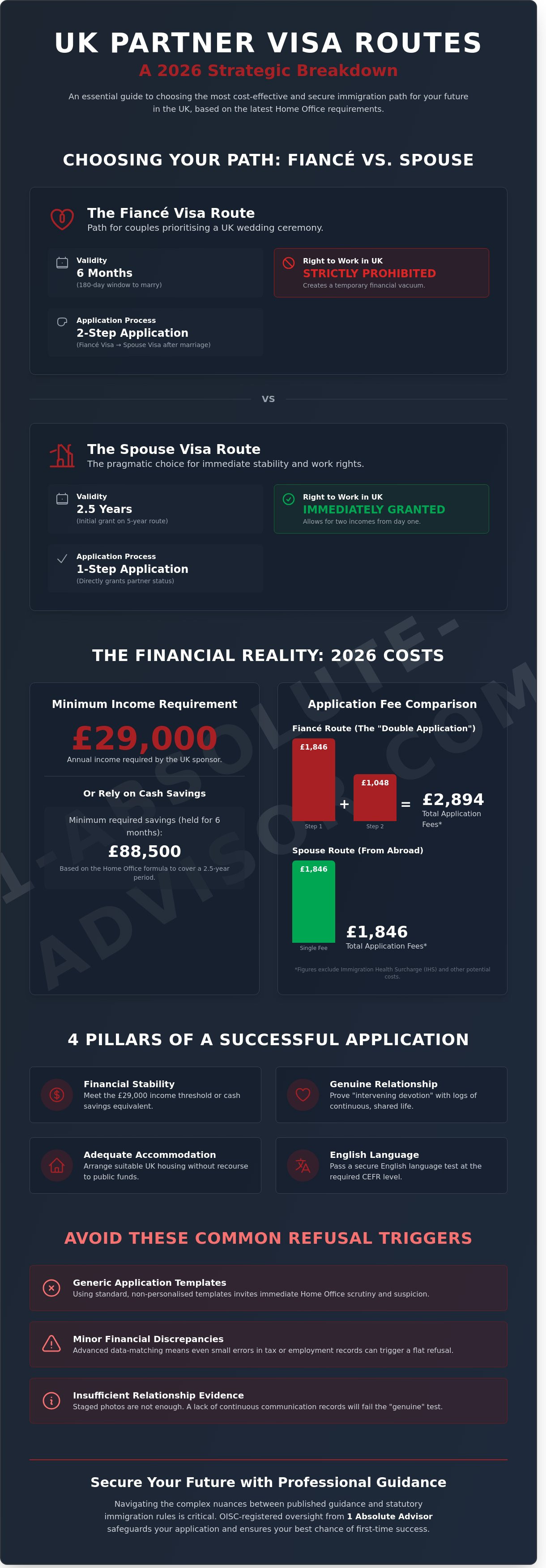
Choosing the right immigration route is a high-stakes strategic decision that shapes your first year in Britain. The fiance visa united kingdom provides a specific six-month entry clearance designed for couples who prioritise a British wedding ceremony above immediate employment. It’s a settlement route, meaning the Home Office recognises your intent to stay long-term, yet it carries a significant restriction: you cannot work. This creates a temporary financial vacuum. You’ll face the £1,846 initial application fee while being legally barred from earning a salary until you transition to a spouse visa after the wedding. We understand that relocating across borders while coordinating a wedding is an immense emotional undertaking; our goal is to ensure your path is logically sound and financially sustainable.

Understanding the Purpose of the Fiancé Visa

This visa is valid for exactly 180 days. You must marry or enter a civil partnership within this timeframe to qualify for a further stay. It’s the absolute choice for couples whose primary objective is a UK-based ceremony surrounded by local family and friends. While the initial duration is short, the Home Office treats this as a settlement application, requiring you to meet the same £29,000 financial threshold introduced in April 2024. It serves as a bridge, allowing you to settle your affairs and celebrate your union before committing to the full five-year partner route.

When to Consider the Spouse Visa Instead

If financial pragmatism is your priority, applying for a spouse visa from outside the UK after marrying abroad is often the superior strategy. This route grants the applicant the immediate right to work upon arrival, providing household stability from day one. You also avoid the “double application” trap. Choosing the fiance visa united kingdom requires paying for the initial entry and then a subsequent £1,048 fee to switch to spouse status once married. By marrying in a third country or the partner’s home nation, you bypass this second set of processing fees and administrative delays, streamlining your path to permanent residency.

For couples considering this route, marrying in nearby Ireland can be a beautiful and logistically simple alternative. To learn more about planning a ceremony there, you can visit Rev. Brenda O’Grady Wedding Solemniser & Family Celebrant for guidance on legal marriages.

Planning your future requires a holistic view of both your emotional needs and your balance sheet. Whether you choose the fiancé route for its ceremonial significance or the spouse visa for its economic advantages, precision in your initial application is vital to avoid costly rejections. Every pound and every day counts when building a life together in the UK.

Eligibility Criteria: Meeting Strict Home Office Requirements in 2026

Securing a fiance visa united kingdom in 2026 demands more than just a planned wedding date. The Home Office relies on Appendix FM, a rigid legal framework where the burden of proof rests entirely on the applicant. Success hinges on four non-negotiable pillars: financial stability, relationship authenticity, adequate accommodation, and English language proficiency. Case workers now utilise advanced data-matching tools to verify employment and tax records, meaning even a minor discrepancy in digital filings can trigger an immediate administrative refusal without a request for further information.

The Financial Requirement: Navigating the £29,000 Threshold

The minimum income requirement for a British sponsor stands at £29,000, following the policy shifts established in April 2024. You can meet this through salaried employment, self-employment, or non-employment income such as dividends and pensions. If your annual income falls short, cash savings can bridge the gap. The Home Office uses a specific “16,000 plus” formula: any amount over £16,000 is divided by 2.5 to offset the income deficit. For instance, to rely solely on savings for the initial 2.5-year period, you’d need £88,500 held in a regulated account for at least six months. Our specialists at Absolute Advisor provide detailed financial audits to ensure your portfolio meets these precise benchmarks before submission.

For applicants managing assets or income from the Gulf region, structuring this financial evidence to meet UK standards can be particularly complex. In these cases, guidance from a strategic advisory firm familiar with the GCC market, such as Grad-Ex Consultancy, can provide essential clarity.

Evidence of a Genuine and Subsisting Relationship

Proving your bond requires moving beyond staged photography. In 2026, the Home Office prioritises “intervening devotion” logs that demonstrate a continuous, shared life. This evidence must include:

  • Digital Communication: Exports of chat logs from platforms like WhatsApp or Signal, showing consistent contact over time.
  • Financial Links: Proof of money transfers or shared travel bookings that pre-date the application by at least 12 months.
  • The Letter of Intent: A formal statement detailing your clear plans to marry within six months, including registrar enquiries or venue deposits.

This letter isn’t a mere formality; it must provide a chronological narrative of the relationship. If you’ve lived apart, you must document every physical meeting with flight stubs and hotel receipts. Failure to provide a logical timeline of your commitment often leads to “lack of genuine intent” refusals, which are notoriously difficult to appeal.

Fiancé Visa United Kingdom: 2026 Comparison and Eligibility Guide

Direct Comparison: Costs, Timelines, and Long-term Residency

Choosing between these routes isn’t just a matter of preference; it’s a significant financial commitment that dictates your life for the next five years. While both paths lead to the same destination, the fiance visa united kingdom route involves a more complex, multi-stage payment structure. You’re essentially paying for the privilege of a UK-based wedding before your formal residency begins, which carries a distinct price tag in both time and money.

Financial Breakdown: Initial Fees vs. Extension Costs

The initial Home Office application fee for both a fiancé and a spouse visa from outside the UK stands at £1,846 as of early 2026. However, the fiancé route is considerably more expensive over time. Once married, a fiancé must apply to switch to a spouse visa within the UK, costing an additional £1,048. This double-handling of fees makes the spouse visa from abroad approximately £1,200 cheaper when you factor in the administrative costs and the avoidance of a second application so soon after arrival.

The Immigration Health Surcharge (IHS) creates the most significant “hidden” difference. Fiancé visa applicants don’t pay the IHS upfront because their six-month stay doesn’t grant full NHS access. They must pay the full £2,587.50 surcharge only when they transition to the spouse visa. In contrast, spouse visa applicants pay the IHS for the full 33-month duration at the start. Total costs over a five-year path to settlement often exceed £12,500 for fiancés, compared to roughly £11,300 for those entering directly as spouses. Getting the documentation right the first time is essential to avoid forfeiting these substantial fees.

Speed and Flexibility: Which Route is Faster?

Standard processing times in 2026 for out-of-country applications typically range from 12 to 24 weeks. If you’re facing a tight deadline for a booked wedding venue, the fiance visa united kingdom priority service is a vital tool. For an extra £500, the Home Office usually provides a decision within 30 working days, though these slots are often limited in high-demand periods.

The fiancé route offers unparalleled flexibility for couples who haven’t yet married but want to hold their ceremony on British soil. It’s the only option that allows you to enter the UK legally to marry without requiring you to leave the country immediately after the ceremony. You should note that the “clock” for Indefinite Leave to Remain (ILR) only starts once the spouse visa is granted. This means a fiancé route adds about six months to your total time spent reaching permanent residency compared to the spouse route.

  • Initial Fee: £1,846 for both routes.
  • Switching Fee: £1,048 (Fiancé only).
  • IHS Cost: £1,035 per year (not paid initially on fiancé route).
  • ILR Clock: Starts immediately on a spouse visa; delayed on a fiancé visa.

Recent Home Office data from early 2026 suggests that approximately 14% of entry clearance applications are refused due to preventable administrative errors. The most frequent trigger for a fiance visa united kingdom refusal involves the submission of generic, “template” relationship statements. Entry Clearing Officers (ECOs) utilise software to flag identical phrasing across different applications; if your “genuine and subsisting” evidence looks like a carbon copy of an online sample, it invites intense scrutiny. A refusal carries a heavy psychological burden, often separating couples for an additional 6 to 12 months while they navigate the limited scope of Administrative Review. Since this review process rarely allows for new evidence, your initial “bundle” must be absolute in its accuracy.

Document Preparation: The Importance of the ‘Bundle’

Success depends on how you structure your evidence. We recommend categorising your bundle into four distinct pillars: financial stability, proof of relationship, adequate accommodation, and English language proficiency. All documents not in English or Welsh must be accompanied by a full translation that includes the translator’s credentials and confirmation of its accuracy. To satisfy the Home Office, the ‘specified evidence’ rule for bank statements requires that they are original, dated within 28 days of the online application, and explicitly show the mandatory minimum income being deposited as per Appendix FM-SE requirements.

  • Financial: Six months of consecutive payslips and matching bank statements.
  • Relationship: A timeline of physical meetings, flight logs, and photographic evidence spanning the duration of the partnership.
  • Accommodation: A property inspection report or a formal letter from a landlord confirming no overcrowding will occur.

The Switching Process: From Fiancé to Spouse Visa

Once you marry in the UK, you must transition to a Spouse Visa before your initial 6-month leave expires. This process requires a fresh application to the Home Office, but it allows you to remain in the country while the decision is pending. For couples who value speed, the ‘Super Priority’ service is available for an additional fee of £1,000, typically delivering a decision within 24 hours of the biometric appointment. It’s vital to remember that the 5-year clock for Indefinite Leave to Remain (ILR) only begins once the Spouse Visa is granted; time spent on a fiance visa united kingdom does not count towards your permanent residency residency requirement.

Ensuring your documentation meets these rigorous standards is the only way to avoid costly delays. Consult with an Absolute Advisor expert to verify your document bundle before submission.

Secure Your Future: Professional Guidance for Your Fiancé Visa

Securing a fiance visa united kingdom is a process governed by Appendix FM of the Immigration Rules, a legal framework that now spans over 1,100 pages. Many couples mistakenly rely on the “Home Office Guidance” found on GOV.UK, yet this guidance is merely a simplified summary of the law. It doesn’t carry the same legal weight as the actual Immigration Rules. A single discrepancy in how you present your £29,000 minimum income evidence or a failure to meet the specific “genuine and subsisting” relationship criteria can lead to an immediate refusal. Our role is to bridge the gap between simple guidance and complex statutory requirements, ensuring your application is legally robust.

Why OISC-Registered Expertise Matters

The UK government strictly regulates immigration advice through the Office of the Immigration Services Commissioner (OISC). Using an unregulated “consultant” is risky; they lack the professional indemnity insurance and the rigorous oversight that OISC-registered advisors must maintain. At 1 Absolute Advisor, we operate under these strict standards of accountability. This expertise is vital when handling complex histories, such as previous visa refusals or intricate financial structures like self-employment or offshore dividends. Recent data suggests that roughly 15% of family-related visa applications are refused, often due to preventable administrative errors. We apply a methodical audit to every file to ensure you don’t become part of that statistic.

  • Regulatory Compliance: We adhere to the highest standards of professional integrity and legal accuracy.
  • Strategic Depth: We look beyond the forms to build a narrative that satisfies Home Office caseworkers.
  • Risk Mitigation: Our team identifies potential red flags in your relationship history before they reach the Home Office.

Our Fixed-Fee Application Management

Transparency is the cornerstone of our partnership. We provide a fixed-fee service that covers the entire lifecycle of your fiance visa united kingdom application. You won’t encounter hidden costs or unexpected hourly billings. This fee includes a comprehensive review of your documentation, ensuring that every bank statement, letter of support, and proof of accommodation meets the exact specifications required by the Home Office. We treat your application as a strategic investment in your family’s future, providing the stability you need during a period of significant life change. Our proactive approach means we prepare for future risks today, giving you the peace of mind that your case is in expert hands.

Don’t leave your future to chance. Book a consultation with our expert immigration advisors to begin your journey with absolute confidence.

Take the Next Step Toward Your Life in Britain

Navigating the Home Office’s 2026 requirements demands more than simple document collection. With application fees for partner routes now frequently exceeding £1,846, the financial and emotional stakes are significant. You’ve seen how the choice between a six-month entry and a direct spouse visa impacts your timeline and long-term residency path. Success in obtaining a fiance visa united kingdom depends on meticulous attention to detail to avoid the common refusal triggers that derail so many applications.

Our OISC-registered professional advisors provide the strategic precision necessary for complex partner cases. We operate on a fixed-fee service with no hidden costs, ensuring your transition is handled with the integrity and predictability your future deserves. It’s time to replace uncertainty with expert-led confidence. We’ve managed hundreds of successful outcomes by focusing on absolute compliance and proactive risk management.

Secure your UK fiancé visa with our OISC-registered experts

Your journey to building a permanent home in the UK is a major milestone, and we’re here to ensure your first steps are taken on solid ground.

Frequently Asked Questions

Can I work in the UK on a fiancé visa?

No, you don’t have the right to work or study in the UK while holding this specific visa. The Home Office grants this entry clearance solely for the purpose of marriage or civil partnership within a six-month window. You’ll gain full access to the UK labour market only after you’ve married and successfully switched to a spouse visa from within the country.

How much money do I need for a UK fiancé visa in 2026?

You must meet a minimum income requirement of £38,700 per year as of the regulations established on 11 April 2024. This figure applies to most 2026 applicants unless you’re exempt due to receiving specific disability benefits. If you’re relying entirely on cash savings to meet the threshold, you’ll need £102,400 held in a regulated financial institution for at least six months.

What happens if we don’t get married within the six months?

You’ll be expected to leave the UK before your visa expires to avoid violating Section 24 of the Immigration Act 1971. If there’s a legitimate, documented reason for the delay, such as a serious illness or a venue cancellation, you can apply for a six-month extension. Staying beyond the expiry date without an active application can lead to a 10-year re-entry ban.

Can I switch from a visitor visa to a fiancé visa while inside the UK?

No, you can’t switch from a visitor category to any family-based residency route while you’re physically in the country. Appendix V of the Immigration Rules is very strict about this requirement. You must return to your country of habitual residence to submit your application for a fiance visa united kingdom and wait for entry clearance before returning to get married.

Do I need a tuberculosis (TB) test for a UK fiancé visa?

Yes, you’ll need a TB certificate if you’ve been living in a country listed by the Home Office for six months or more. This includes over 100 nations such as India, Pakistan, and South Africa. You must obtain this certificate from a clinic specifically approved by the Home Office, as results from non-approved medical centres won’t be accepted during the fiance visa united kingdom process.

How long does it take to get a fiancé visa for the United Kingdom?

Standard processing times for family visas currently sit at 24 weeks, or roughly six months. If you need a faster decision, you can pay an additional £500 for the priority service to receive an answer within 30 working days. These timelines depend heavily on the complexity of your financial evidence and the current volume of applications at the relevant processing hub.

Can my fiancé bring their children on this visa route?

Yes, children under the age of 18 can be included as “dependants” on your application. You’ll need to demonstrate that the UK-based sponsor can provide adequate accommodation without relying on public funds. Under the rules implemented in April 2024, the financial threshold remains £38,700 regardless of the number of children, provided you aren’t under the old transitional arrangements.

Is the English language test mandatory for all fiancé visa applicants?

Yes, you must prove your English proficiency unless you’re a national of a majority English-speaking country like Canada or New Zealand. Most applicants need to pass a CEFR Level A1 test in speaking and listening from an approved provider like IELTS or Pearson. If you’ve earned a degree taught in English that’s recognised by Ecctis as equivalent to a UK bachelor’s degree, you’re exempt.

Discuss Your Case For FREE