

Applying for naturalisation isn’t just a bureaucratic hurdle; it’s a strategic narrative of your integration into the UK. With the standard application fee rising to £1,709 on April 8, 2026, the stakes for a first-time approval have never been higher. You’ve likely spent years building your life here, yet the fear of a rejection based on a missing bank statement or a misunderstood good character clause remains a heavy burden. Identifying the exact documents required for british citizenship application is the most critical step in protecting your investment and your future.
We understand that proving five years of continuous residence or documenting every absence can feel like an impossible forensic exercise. This definitive guide simplifies the complexity of the Home Office requirements into a manageable, professional checklist. We’ll examine the specific evidence needed to satisfy the 2026 regulations, from English language proficiency to the nuances of the new eVisa system. By the end of this article, you’ll have the clarity needed to submit a comprehensive evidence bundle that leaves no room for caseworker doubt.
Key Takeaways
- Identify the precise evidence needed to verify your current identity and settled status under the updated 2026 Home Office guidelines.
- Learn how to construct a robust evidence trail for the documents required for british citizenship application, ensuring your 5-year residency history is fully verifiable.
- Understand why the “Good Character” assessment now places significant emphasis on financial integrity and HMRC compliance alongside criminal record checks.
- Master the technical requirements of the UKVCAS digital portal to ensure your uploaded document bundle is logically structured for the caseworker.
- Discover how a professional Document Checking Service provides a final layer of security to protect your application fee from avoidable technical refusals.
The Core Identity and Status Documents for Naturalisation
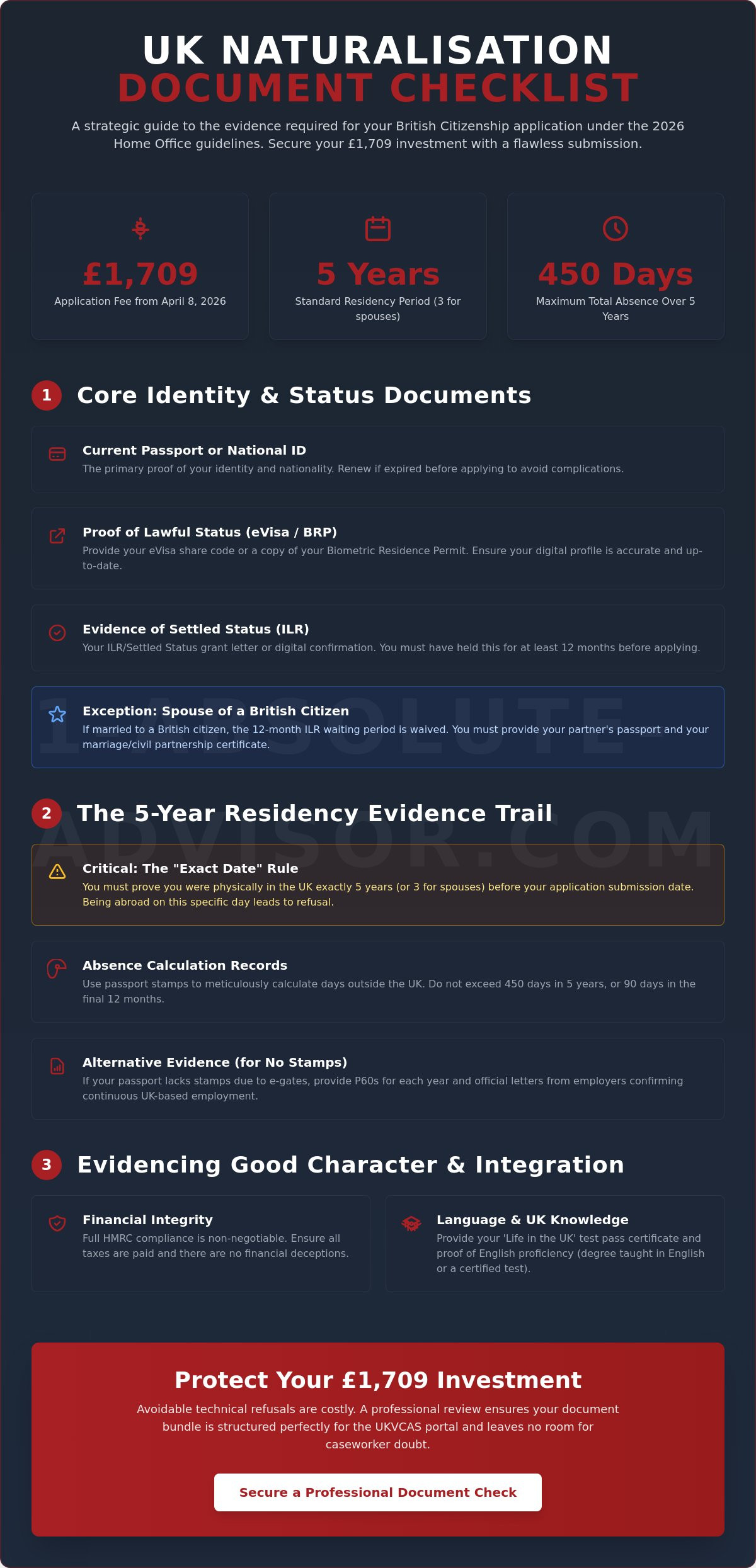
The foundation of every successful naturalisation claim rests on your ability to prove your identity beyond any reasonable doubt. The Home Office maintains a strict evidentiary standard, as these documents form the legal basis for your transition under British nationality law. Without a precise set of core documents, even the most integrated resident faces a swift rejection. You must view this stage as the bedrock of your application bundle.
Proving Your Identity and Nationality
Your current, valid passport is the primary evidence of your nationality and identity. It serves as a comprehensive record of your personal details and provides a baseline for your travel history. If your passport has expired, you should ideally renew it before applying. While the Home Office may accept an expired document solely for proving nationality in specific circumstances, it complicates the verification process.
As we move through 2026, the reliance on physical Biometric Residence Permits (BRPs) has diminished significantly. Most applicants now manage their status through the digital eVisa system. When compiling the documents required for british citizenship application, you must ensure your digital profile is accurate and up to date. For those under the EU Settlement Scheme, providing your share code or the digital confirmation of your settled status is mandatory. If you still possess a physical BRP, it remains a vital secondary piece of evidence until its formal replacement by the digital-only framework. Consistency across these digital and physical records is paramount to avoid delays.
Evidence of Settled Status (ILR)
Gaining British citizenship requires you to be free from immigration time restrictions. For most applicants, this means proving you’ve held Indefinite Leave to Remain (ILR) or Settled Status for at least 12 months before the date of your application. You’ll need to provide the original grant letter or the digital record that confirms the date your status was awarded. This 12-month rule is a frequent point of confusion that leads to premature applications.
There’s a significant exception to this waiting period. If you’re married to, or in a civil partnership with, a British citizen, you can apply for naturalisation the moment you receive your ILR. In these specific cases, your partner’s British passport and your marriage or civil partnership certificate become core documents required for british citizenship application. For EU citizens who transitioned from Permanent Residence to Settled Status, it’s vital to provide the document that proves when you first acquired the right of permanent residence. Accuracy regarding these dates prevents the costly mistake of applying too early and forfeiting your £1,709 application fee.
Proving the Residency Requirement: The 5-Year Evidence Trail
The residency requirement is often the most scrutinized portion of the naturalisation process. You must demonstrate that you’ve been physically present in the UK for the qualifying period, which is typically five years, or three years if you’re applying as the spouse of a British citizen. A critical nuance often overlooked is the “exact date” rule. This requires you to prove you were physically standing on UK soil precisely five years (or three) before the day the Home Office receives your application. If you were on holiday or a business trip on that specific date five years ago, your application could be refused, regardless of your overall integration. This rule is absolute, and failing to account for it can lead to a costly rejection of your £1,709 application fee.
Primary Residency Documents
Passports remain the primary documents required for british citizenship application to track your movements. Case workers examine entry and exit stamps to calculate your total absences, ensuring you haven’t exceeded the 450-day limit over five years or the 90-day limit in the final 12 months. However, the rise of digital borders and e-gates means many modern passports lack physical stamps. In these instances, you should rely on P60 certificates and formal employer letters that confirm your continuous physical presence through your tax and employment history. These official records provide a level of certainty that simple travel itineraries cannot match, especially when dealing with the Home Office’s increasingly digital-first verification systems.
Addressing Gaps in Your Residency History
Gaps in your history require a proactive approach to prevent caseworker skepticism. If you’ve had periods of unemployment or were not required to pay tax, supplementary evidence becomes essential. Utility bills, council tax statements, and bank statements showing regular UK-based transactions are effective tools for “bridging” these months. For those who weren’t working, such as stay-at-home parents or students, letters from a GP or school records can serve as authoritative proof of residence. If you’re unsure whether your evidence meets the Home Office’s strict threshold, our British Citizenship Application Service offers the professional oversight needed to ensure your residency narrative is airtight before submission.
If your absences exceed the standard limits due to compelling circumstances, such as illness or unavoidable travel restrictions, you’ll need to provide a concise, factual explanation supported by evidence. Precision here is vital. A messy or incomplete residency trail is the most common reason for delays in the typical 3 to 6-month processing window. Providing a clear, chronological document bundle demonstrates the stability and predictability that the Home Office expects from future citizens. Every piece of evidence should work together to form an undeniable record of your life in the United Kingdom.
Evidencing “Good Character” and Social Integration
The “good character” requirement is arguably the most subjective element of the naturalisation process. Unlike residency rules, which are based on quantifiable dates, character assessments allow caseworkers to exercise significant discretion. A clean criminal record is the baseline, but the Home Office examines your overall conduct, including your financial integrity and history of civil compliance. This means your documents required for british citizenship application must demonstrate that you’ve managed your fiscal responsibilities with precision. Evidence of HMRC compliance, such as P60s for employees or self-assessment tax returns for the self-employed, serves as vital proof that you’ve contributed appropriately to the UK’s social fabric. Unpaid debts, bankruptcy, or even a history of late tax payments can lead to a discretionary refusal that forfeits your £1,709 application fee.
Tests and Language Proficiency
Integrating into British society requires a demonstrated understanding of its history and language. The Life in the UK test is a mandatory milestone for most applicants. You won’t receive a physical certificate; instead, you must provide the unique Test ID number from your digital pass notification. Alongside this, you must evidence your English language proficiency at level B1 or higher. This involves providing a certificate from an approved Secure English Language Test (SELT) provider. If you’re 65 or older, or if you hold a degree-level qualification taught in English, you’re exempt from these tests. However, you must include your original degree certificate. If the degree was obtained outside the UK, you must also provide a formal statement of comparability to verify its status.
The Referee Declarations
Every application requires endorsements from two separate referees who’ve known you for at least three years. One referee must be a professional person of any nationality, such as a teacher, solicitor, or manager of a limited company. The second must be a British citizen who is either over 25 or a professional person themselves. These individuals must sign a specific referee declaration form, which you then scan and upload as part of your digital bundle.
Choosing the right people is vital. Referees can’t be related to you, your solicitor, or each other. The Home Office frequently rejects referees who don’t meet these specific criteria, which can stall your progress. Including these declarations correctly is a non-negotiable part of the documents required for british citizenship application evidence. It’s a layer of social verification that confirms your standing in the community. Caseworkers rely on these testimonials to build a complete picture of your life in the UK, making it essential to select individuals who can confidently verify your identity and character.
The Strategic Preparation: Scanning and Digital Uploads
The final phase of your naturalisation journey involves transitioning from a collection of physical evidence to a structured digital submission. The Home Office utilizes the UK Visa and Citizenship Application Services (UKVCAS) portal for this purpose. While you’ll attend a physical appointment to provide biometric information, your success depends heavily on the quality of the digital bundle you upload beforehand. A logical, well-indexed structure is vital. Caseworkers manage vast volumes of data; a disorganized upload increases the risk of oversight or misinterpretation. Using a professional legal cover letter to index your documents required for british citizenship application and explain complex residency gaps provides the narrative clarity that raw data lacks.
Digital Submission Standards
The UKVCAS portal has specific technical constraints that can disrupt your application if ignored. Files must typically be in PDF, JPG, or PNG format, with a standard size limit of 6MB per file. Clarity is non-negotiable. Blurry scans or cut-off margins are often treated as missing evidence, which can trigger a rejection and the loss of your £1,709 fee. You shouldn’t rely solely on the generic checklist generated by the online form. This list is a baseline, not a definitive guide, and it often fails to account for the specific supplementary evidence needed for complex residency or character histories. Our Document Checking Service provides a comprehensive audit of your digital bundle to ensure every scan meets these exacting technical requirements before you commit to the final submission.
Handling Missing Documentation
Missing records present a significant risk, but they don’t have to be fatal to your application if handled with transparency. If a previous passport was lost or stolen, you must provide the relevant police report or a lost property reference number. If you’ve lost track of your exact travel history over the last five years, you can obtain a Subject Access Request (SAR) from the Home Office to recover your immigration and border records. This ensures your declared absences match the government’s own data. In cases where a mandatory document is truly unobtainable, you must provide a formal affidavit or a statutory declaration to explain the absence and offer alternative proof. Proactively addressing these gaps with formal substitutes demonstrates the integrity and “good character” that caseworkers look for in a future British citizen.
Preparing for your biometric appointment is the final tactical step. You’ll need to bring your original passport and the appointment confirmation. While the staff at the UKVCAS centre may offer document scanning services, it’s far more secure to have your bundle uploaded and verified well in advance. This approach allows you to walk into your appointment with the confidence that your evidence is complete, clear, and logically presented. Precision at this stage reduces the likelihood of the Home Office requesting additional information, which is the primary cause of processing times extending beyond the typical six-month window.
Securing Your Future: How Professional Review Protects Your Investment
The financial commitment involved in a naturalisation application is substantial. As of April 8, 2026, the main application fee stands at £1,709, with an additional £130 required for the mandatory citizenship ceremony. Because the Home Office doesn’t refund these fees in the event of a refusal, a minor oversight in the documents required for british citizenship application becomes a very expensive mistake. Beyond the monetary loss, a rejection can impact your future immigration history and delay your integration by years. Professional oversight transforms the process from a stressful administrative task into a secure, strategic transition. It’s about more than just filling in forms; it’s about ensuring your evidence bundle is beyond reproach.
Why Use an OISC Registered Consultant?
Choosing an OISC registered consultant provides more than simple administrative assistance. It offers a comprehensive legal strategy. We look beyond the surface of your evidence to identify potential “Good Character” risks or residency gaps that a standard checklist might miss. For instance, a civil penalty or a forgotten tax issue can be fatal to an application if not addressed proactively with a supporting statement. Our Document Checking Service acts as a final audit, identifying technical errors in your scans or inconsistencies in your travel dates before the Home Office sees them. For a deeper understanding of the broader context, you can review our article on British Citizenship: The Complete Guide to Naturalisation in 2026. Our role is to act as a mentor, ensuring every piece of evidence in your bundle strengthens your case.
Taking the Next Step
Once your submission is complete and biometrics are enrolled, the typical processing window in 2026 spans three to six months. During this period, the Home Office conducts its final verifications. Upon approval, you’ll receive an invitation to your local citizenship ceremony, where you’ll swear an oath of allegiance and receive your certificate. This certificate is the final document needed to apply for your first British passport. To ensure your journey concludes successfully and your £1,709 investment is protected, you should Book a Document Checking Session today. A professional audit is the most effective way to eliminate doubt and secure your future as a British citizen with total confidence.
Finalizing Your Path to British Citizenship
Achieving naturalisation is a landmark achievement that requires meticulous attention to detail. Success depends on your ability to present a cohesive evidence bundle that bridges every residency gap and addresses every character requirement with total clarity. As explored in this guide, the technical accuracy of your digital uploads is just as critical as the legal validity of your passport. Navigating the specific documents required for british citizenship application remains a daunting task, especially when a single error risks the forfeiture of your £1,709 fee.
Our team of OISC Level 1 Registered Advisors specializes in managing complex naturalisation cases with fixed-fee transparency. We provide the strategic audit necessary to identify risks before they reach a Home Office caseworker, ensuring your narrative of integration is supported by undeniable evidence. To protect your investment and ensure a seamless transition, ensure your application is flawless with our professional Document Checking Service.
Your future in the United Kingdom is a project worth protecting. With the right preparation and professional oversight, you can approach your citizenship ceremony with the confidence that your status is secure. We look forward to helping you take this final step in your journey.
Frequently Asked Questions
Do I need to send my physical passport to the Home Office for citizenship?
You don’t need to surrender your physical passport to the Home Office. You’ll bring the document to your UKVCAS biometric appointment for scanning and verification; you’ll keep the passport thereafter. This digital-first approach ensures you maintain your ability to travel and your primary form of identification while your application is under consideration.
Can I apply for British citizenship if I have lost my old passports?
Yes, you can apply, but you must provide robust alternative evidence of your residency for the periods covered by the missing documents. You should include a police report or a lost property reference number. It’s also advisable to obtain a Subject Access Request (SAR) from the Home Office to confirm your travel records, ensuring the documents required for british citizenship application form a complete history of your presence in the UK.
What counts as “Good Character” for a British citizenship application?
Good character encompasses more than just a clean criminal record. It includes your financial integrity, such as consistent HMRC compliance and the management of any debts or bankruptcy. The Home Office also assesses your immigration history and any civil penalties. Any evidence of dishonesty or a failure to respect UK laws can lead to a discretionary refusal of your application.
How much does the British citizenship application cost in 2026?
The application fee for naturalisation rose to £1,709 per adult on April 8, 2026. You must also pay a £130 fee for the citizenship ceremony. Additional costs typically include the £50 Life in the UK test and the B1 English language test, which generally ranges between £150 and £200 depending on the provider and location.
Do I need a lawyer to check my documents before I apply?
While a lawyer isn’t legally required, professional oversight is a strategic way to protect your substantial application fee. Expert advisors identify subtle risks in your evidence bundle, such as residency gaps or character concerns, that might lead to a refusal. Utilizing a Document Checking Service provides a professional audit that ensures your submission is technically perfect before it reaches a caseworker.
What happens if my British citizenship application is refused due to missing documents?
If your application is refused, the Home Office doesn’t refund the £1,709 fee. You’ll receive a decision letter outlining the specific reasons for the refusal. While you may apply for an Administrative Review if you believe a caseworker made a factual error, missing evidence usually requires a completely new application and a second payment of the full fee.
How long does the Home Office take to process citizenship applications in 2026?
Most naturalisation applications are processed within 3 to 6 months from the date of your biometric appointment. Complex cases involving detailed character assessments or extensive travel histories can take longer. Ensuring the documents required for british citizenship application are logically organized and clearly scanned is the most effective way to avoid unnecessary delays during this period.
Can I travel outside the UK while my citizenship application is being processed?
You’re permitted to travel outside the UK while your application is pending. Your application won’t be withdrawn if you leave the country, provided you intend to make the UK your permanent home. You must ensure you possess a valid passport and proof of your Indefinite Leave to Remain or eVisa status to facilitate your re-entry into the UK.