

A single missing bank statement from a specific 28-day window can derail a four-year degree before it even begins. You’ve worked hard to earn your university placement, yet the student visa uk process remains a rigid barrier where a small administrative error often leads to an immediate refusal. It’s natural to feel anxious about the rising Immigration Health Surcharge, which currently sits at £776 per year for students, or the complex task of proving you hold exactly £12,006 in accessible funds for a nine-month course in London.
We agree that the Home Office’s shifting 2026 regulations shouldn’t stand between you and your professional goals. This guide promises to transform that complexity into a clear, tactical checklist to secure your CAS and navigate the financial evidence rules with absolute precision. You’ll find a complete breakdown of the 2026 application timeline, specific strategies to avoid common refusal triggers, and a clear explanation of your work rights to ensure your transition to the UK is seamless and stress-free.
Key Takeaways
- Understand the transition to the fully digital 2026 eVisa system and how to navigate the evolving UK immigration landscape with professional precision.
- Master the essential requirements for securing your Confirmation of Acceptance for Studies (CAS) from a licensed sponsor to form a solid application foundation.
- Learn how to avoid common “refusal zones” by strictly adhering to the 28-day financial evidence rule and calculating the exact funds required for your student visa uk.
- Follow a strategic application timeline that ensures the correct payment of the Immigration Health Surcharge (IHS) and prevents costly academic delays.
- Identify “hidden” refusal triggers through expert guidance to safeguard your financial investment and ensure your long-term educational goals in the United Kingdom.
What is the UK Student Visa? Navigating the 2026 Landscape
The student visa uk represents the mandatory legal authorization for international students aged 16 or older who wish to study in Britain. It functions as the successor to the Tier 4 (General) route, which was officially replaced on October 5, 2020. By January 2025, the UK government completed its transition to a digital-first immigration model. In 2026, physical documents like Biometric Residence Permits (BRPs) no longer exist. Instead, your immigration status is managed through an online eVisa system. This digital record links directly to your travel document, ensuring your right to study, work part-time, and access services is verifiable instantly by authorities via a UKVI account.
Choosing the Student Route is a strategic decision for your academic and professional future. It’s the primary path for degree-level studies at licensed sponsor institutions. Successfully holding this visa often acts as a prerequisite for the Graduate Route, which allows two years of post-study work. The UK Visa Policy Overview outlines how this fits into the wider points-based system. Precision in your initial application is vital to avoid delays that could jeopardize your university enrollment. Mistakes in documentation often lead to refusals, which can impact future travel to the UK and other Five Eyes nations. You must treat the application as a compliance exercise rather than a mere formality.
The 70-Point Requirement Breakdown
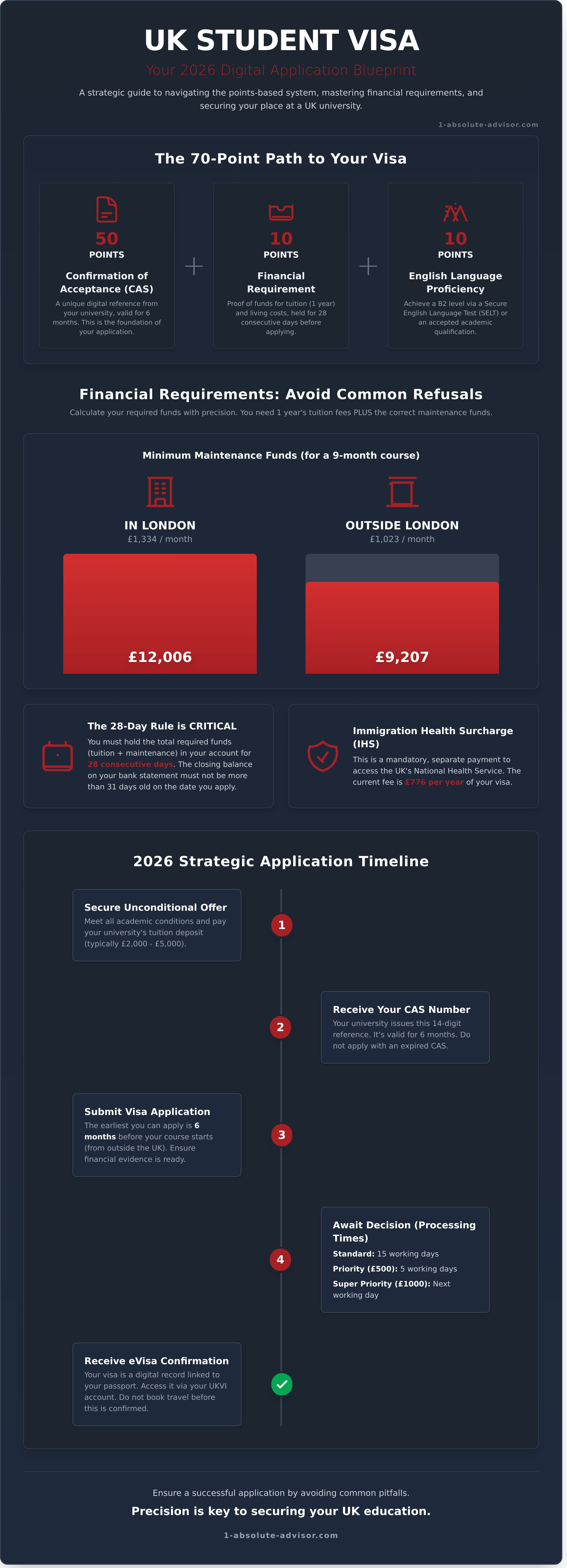
The points-based system ensures objective compliance. You must secure 70 points to qualify. This isn’t a discretionary decision by a caseworker; it’s a mathematical certainty if you provide the correct evidence. The breakdown for 2026 remains consistent with the established framework:
- 50 Points: Confirmation of Acceptance for Studies (CAS). Your university issues this digital reference after you meet all their academic and administrative conditions. It’s valid for a single application and expires after 6 months.
- 10 Points: Financial Requirement. You must demonstrate the ability to pay for one year of tuition and support yourself. In 2026, the monthly maintenance requirement for London is £1,334; outside London, it’s £1,023. You must hold these funds for 28 consecutive days before applying.
- 10 Points: English Language Proficiency. You’ll prove this through a Secure English Language Test (SELT) or by having a degree taught in English. Most degree-level courses require a B2 level on the CEFR scale.
When to Begin Your 2026 Application
Timing is a critical component of your strategic planning. If you’re applying from outside the UK, the earliest you can submit is 6 months before your course start date. Standard processing takes 15 working days. If you’re already in the UK on a different visa, you can apply to switch up to 3 months before your studies commence. Internal decisions usually take 8 weeks. For urgent cases, the Priority Service (£500) offers a 5-day turnaround, while the Super Priority Service (£1,000) provides a decision by the next working day. You shouldn’t book non-refundable travel until your eVisa is confirmed in your UKVI account. Missing these windows can result in a late enrollment, which universities are often legally required to report to the Home Office.
The CAS: Your Golden Ticket to Studying in the UK
The Confirmation of Acceptance for Studies (CAS) is the digital foundation of your student visa uk application. It isn’t a physical document but a unique 14-digit reference number generated by your Licensed Student Sponsor through the Home Office’s Sponsor Management System. This number links your personal details, course information, and financial evidence directly to the UK government’s database. While the CAS is an essential prerequisite, you shouldn’t mistake it for a guarantee of entry. The university confirms your academic suitability, but the Home Office retains the final authority to assess your financial credibility and genuine student intent. If the Home Office finds discrepancies between your CAS and your supporting evidence, they’ll reject the application regardless of your university’s support.
Obtaining Your CAS Number
You can’t receive a CAS until you’ve secured an unconditional offer. This means you’ve met all academic requirements and paid any required tuition deposits, often ranging from £2,000 to £5,000 depending on the institution. Once issued, a CAS is valid for exactly 6 months. Timing is critical; if you apply for your visa using a CAS that has expired by even one day, the system will automatically flag it as invalid. You’ll find detailed guidance on managing these timelines within the Official UK Student Visa Requirements. Always verify that the tuition fees paid and any scholarships awarded are accurately reflected on the CAS before you hit submit on your visa application. Discrepancies in these figures are a leading cause of administrative delays.
Accuracy is the primary defense against rejection. You must ensure your CAS details match your passport exactly. A missing middle name or a transposed digit in your passport number will result in an immediate refusal. In 2024, administrative errors accounted for nearly 12% of initial visa rejections. Don’t assume the university’s admissions team is infallible. Review every field in your CAS draft with the same scrutiny you’d apply to a legal contract. If you find an error, request a “CAS note” from your sponsor to correct the record before the Home Office processes your file.
Academic Progression Rules
If you’re already in the country and applying for a new student visa uk, you must satisfy the “Academic Progression” requirement. This rule ensures students aren’t simply using education as a means to extend their stay indefinitely. Generally, your new course must be at a higher Regulated Qualifications Framework (RQF) level than your previous one. Moving from an RQF Level 6 (Bachelor’s) to an RQF Level 7 (Master’s) is the standard path. If your new course is at the same level, your sponsor must provide a written justification explaining how the new program represents a deeper specialization or supports a specific career path. For the 2026 intake, exceptions to this rule are strictly limited to students completing integrated Master’s or PhD programs, or those who’ve had to resit exams due to documented extenuating circumstances.
Managing these complex requirements demands a strategic approach to your documentation. If you’re unsure how your specific academic history aligns with current Home Office policy, seeking a professional compliance review can prevent costly application failures. Common CAS errors that lead to immediate rejection include:
- Incorrect RQF level for the proposed course of study.
- Failure to include details of previous UK study in the “Evidence Used to Obtain Offer” section.
- Mismatched course start dates that don’t allow for the required 15-hour-per-week study minimum.
- Using a CAS that has already been used in a previous, unsuccessful application.
A CAS is a one-time-use code. If your visa is refused, you cannot simply reuse the same number for a fresh application. You’ll need to request a brand-new CAS from your university, which often involves a second round of internal credibility interviews. Treat your CAS as the high-value asset it is; it’s the bridge between your academic ambitions and legal residency in the UK.
The Refusal Zones: Financial and English Requirements
Financial stability and linguistic competence are the two pillars where most student visa uk applications fail. Precision is your only defense here. Caseworkers don’t look for intent; they look for mathematical and literal compliance with Appendix Finance. For 2026, you must demonstrate you hold tuition fees for the first year plus monthly living costs. In London, this is £1,334 per month for up to nine months, totaling £12,006. Outside London, the requirement is £1,023 per month, totaling £9,207. These figures are non-negotiable and must be liquid.
Applicants from “low-risk” nationalities often fall into a complacency trap. While you might not need to upload financial documents initially under the differentiation arrangement, you’re still legally required to have the funds. The Home Office conducts spot checks on approximately 12% of these applications. If you can’t produce the records within 7 to 10 days of a request, your application is rejected immediately. This is where University Visa Guidance becomes essential, as your Confirmation of Acceptance for Studies (CAS) will detail exactly how much you’ve already paid and what remains. Always ensure your CAS data matches your bank statements to the penny.
The 28-day rule remains the most common point of failure. To satisfy the 2026 financial mandate, you must maintain a minimum balance covering your unpaid tuition plus £12,006 for London or £9,207 for outside London for 28 consecutive days, with the final statement date falling within 31 days of your submission. If your balance drops by even £1 during that window, the clock resets. Caseworkers use a strict checklist that includes the bank’s name, account holder’s name, and a clear transaction history. They’ll verify the currency conversion using the OANDA rate from the exact date of your application.
Bulletproofing Your Bank Statements
The Home Office maintains a specific “excluded list” of financial institutions, particularly in countries like Pakistan, India, and Nigeria, where they don’t trust the verification systems. Ensure your funds are in a regulated bank that provides electronic or stamped paper statements. If you’re using parental funds, you must provide a birth certificate proving the relationship and a signed letter of consent. This letter must explicitly state that your parents allow you to use the funds for your student visa uk and stay in the country. General “support” letters without these specific phrases often lead to delays.
Proving Your English Proficiency
You’re exempt from English testing if you’re a national of a majority English-speaking country, such as Canada, Antigua and Barbuda, or Guyana. If you’re relying on a degree taught in English from a non-UK country, you must obtain an Ecctis (formerly UK NARIC) certificate to prove the level is equivalent to a UK bachelor’s degree. Don’t rely on old test results; Secure English Language Tests (SELT) like IELTS for UKVI or Pearson PTE Academic UKVI are only valid for two years. Using an unapproved provider or an expired certificate is a fast track to an administrative refusal, as the Home Office systems automatically flag invalid test reference numbers.
Step-by-Step: The 2026 Student Visa Application Timeline
Securing your student visa uk requires a disciplined approach to documentation and timing. The process begins exactly six months before your course start date if you’re applying from outside the United Kingdom. Your first milestone is obtaining the Confirmation of Acceptance for Studies (CAS) from your university. This 14-digit reference number is valid for a single use and expires if not used within six months of issuance. You shouldn’t submit your application until you’ve confirmed that every detail on the CAS, including your passport number and course fees paid, is 100% accurate.
Once you have your CAS, the sequence of events moves quickly. You’ll complete the online UKVI application, pay the associated fees, and book your identity verification. For 2026, the standard processing time remains 15 working days for international applications, though priority services can reduce this to five days for an additional £500 fee. The final stage involves receiving your decision letter and, crucially, ensuring your digital status is correctly linked to your passport through the UKVI account system.
The Immigration Health Surcharge (IHS)
The IHS is a mandatory payment that grants you access to the National Health Service (NHS) on the same basis as a UK resident. For 2026, the student rate is set at £776 per year. If your course includes a partial year of six months or less, you’ll pay £388 for that period. You must pay the total amount for the entire duration of your visa upfront. This allows you to visit GPs and hospitals without additional charges, though you’ll still pay for prescriptions, dental care, and eye tests. If your student visa uk application is refused, the Home Office automatically refunds the IHS payment to your original payment method, usually within six weeks of the refusal notice.
Biometrics and Identity Verification
The method you use to verify your identity depends on the type of passport you hold. Most EU, EEA, and Swiss citizens, along with some non-EU nationals with biometric passports, can use the “UK Immigration: ID Check” smartphone app. This eliminates the need to visit a physical center. If the app isn’t an option, you’ll book an appointment at a VFS Global or TLScontact center. You’ll need to provide your fingerprints and a digital photograph during this session. It’s vital to bring your valid passport and a printed copy of your appointment confirmation.
Digital document management is the most common area where applicants stumble. When uploading your evidence to the partner portal before your appointment, ensure all files are in PDF, JPG, or PNG format. Each file must be clear, legible, and under 6MB in size. If you’re using a physical center, don’t leave the upload until the last minute; most providers charge an additional “document scanning” fee if you haven’t uploaded them 24 hours before your slot. To ensure your financial and academic evidence meets these rigorous standards, consult our compliance specialists for a pre-submission audit.
By 2026, the UK will have fully transitioned to a digital-first immigration system. This means you won’t receive a physical Biometric Residence Permit (BRP) card. Instead, your status is hosted entirely online as an eVisa. You’ll use your UKVI account to share your status with landlords, employers, or banks via a “share code.” This system reduces the risk of lost documentation and streamlines the border crossing process, provided your passport details remain updated in the system at all times.
Maximizing Success: Why Professional Guidance Matters
Securing a student visa uk involves more than just filling out a form; it’s a high-stakes financial and academic investment that requires a strategic approach. A refusal carries a heavy price. You lose the £490 application fee and the Immigration Health Surcharge, which currently stands at £776 per year of study for 2026. Beyond the immediate financial loss, a refusal often forces you to defer your university place, delaying your career by an entire academic year. Home Office data shows that a significant percentage of rejections stem from administrative errors that are entirely preventable with professional oversight.
1 Absolute Advisor identifies “hidden” refusal triggers that often go unnoticed by applicants. These include subtle discrepancies in financial maintenance documents or bank statements that fail the strict 28-day rule. If your closing balance dips even £1 below the required threshold for a single day, your application will fail. Our OISC-registered London team acts as your professional bridge to the Home Office, ensuring every piece of evidence meets the exact evidentiary standards required for 2026. We don’t just process papers; we provide the stability and professional integrity needed to navigate the UK’s complex immigration landscape.
Planning your UK future starts long before you graduate. Transitioning to the Graduate Visa route requires a clean immigration history and a deep understanding of how your current student status impacts future eligibility. We treat your application as the first step in a long-term professional journey. By establishing a solid foundation now, you ensure that your path to post-study work remains open and uncomplicated.
Our Document Checking Service
We provide a rigorous audit of your Confirmation of Acceptance for Studies (CAS) and all supporting financial evidence. Even a minor typo in your CAS regarding your tuition fees paid can trigger a rejection. Our experts draft bespoke legal cover letters to explain complex scenarios, such as non-traditional funding sources or previous study gaps. This proactive approach eliminates ambiguity for the Home Office caseworker. Learn more about our Document Checking Service to ensure your application is absolute and error-free.
Beyond the Visa: Working and Living in the UK
Understanding the parameters of your stay is essential for maintaining your lawful status. Most students on a student visa uk are permitted to work 20 hours per week during term time, though certain courses limit this to 10 hours. Violating these conditions leads to immediate visa cancellation. Under the 2026 rules, only postgraduate researchers or students on specific government-sponsored programs can bring dependents to the UK. If you’re looking to build a life here after your studies, you should explore the Graduate Visa route, which offers a two-year window to work without the need for a corporate sponsor. For Commonwealth citizens with UK-born grandparents, the ancestry visa uk pathway provides an alternative five-year route to settlement that doesn’t require employer sponsorship or specific academic qualifications.
- Professional Audit: We verify that your bank statements show the required £1,334 per month (for London) or £1,023 (outside London) for the full 28-day period.
- Strategic Planning: We align your current application with the requirements for future Tier 2 or Graduate Visa transitions.
- OISC Accountability: As a regulated firm, we provide advice that is legally compliant and held to the highest professional standards.
Don’t leave your academic future to chance. The UK immigration system is precise, and the Home Office expects the same level of precision from you. Our team provides the megawatt clarity needed to turn a complex process into a successful outcome.
Navigate Your 2026 UK Academic Journey with Precision
Securing a student visa uk in 2026 demands a meticulous approach to compliance and timing. You must prioritize obtaining your CAS and demonstrating financial stability, which currently requires showing at least £1,334 per month for living costs if studying in London. Missing a single 28-day bank statement rule or failing to book your SELT English test 4 months in advance can jeopardize your entire enrollment. Success isn’t about luck; it’s about following a verified strategic roadmap that accounts for the latest Home Office policy shifts.
Our London-based team of OISC Registered Level 1 Advisors offers the professional integrity you need to navigate these complexities. We provide national coverage with a commitment to fixed-fee transparency, ensuring your transition to British higher education is predictable and secure. By treating your application as a strategic business project, we eliminate the risks of refusal and focus on absolute quality. Secure your UK education with our expert Student Visa service and take the first definitive step toward your future career with confidence.
Frequently Asked Questions
How much money do I need for a UK Student Visa in 2026?
You must demonstrate you have enough funds to cover your tuition fees for one academic year plus monthly living costs of £1,334 for London-based courses or £1,023 for locations elsewhere. For a standard nine month course, this equates to a maintenance requirement of £12,006 or £9,207 respectively. These funds must remain in your bank account for 28 consecutive days before you submit your application.
Can I work in the UK while on a Student Visa?
Most students on a student visa uk can work up to 20 hours per week during term time and full-time during official university holidays. You aren’t permitted to be self-employed, work as a professional sportsperson, or fill a full-time permanent vacancy. These conditions are strictly monitored; any breach can lead to the immediate cancellation of your leave and impact future immigration applications.
How long does it take to get a UK Student Visa decision?
A standard decision takes three weeks for applications made outside the UK and eight weeks for those submitted within the country. If you’re on a tight schedule, you can pay £500 for the priority service to get a result within five working days. The super priority service costs £1,000 and typically provides a final decision by the end of the next working day.
What happens if my UK Student Visa application is refused?
The Home Office will provide a refusal letter detailing the specific reasons for the rejection, such as insufficient financial evidence or missing documents. You generally have 14 days to request an administrative review if you believe the caseworker made a factual error. If the refusal is based on a genuine mistake you made, it’s often faster to submit a new application with corrected information.
Do I need a TB test for a UK Student Visa?
You’ll need a tuberculosis (TB) certificate if you’re a resident of a listed country and your course lasts longer than six months. The test must be conducted at a clinic specifically approved by the Home Office; results from non-approved centers won’t be accepted. Your certificate is valid for six months, so it must be current at the time you finalize your visa submission.
Can I switch from a Student Visa to a Skilled Worker Visa?
You can transition to a Skilled Worker visa once you’ve successfully completed your degree or after 24 months of study if you’re a PhD student. Your prospective employer must hold a valid sponsor license and offer a salary that meets the minimum threshold, which is currently £38,700 for most roles. This strategic move allows you to start your professional career in the UK immediately after your studies.
Is the UK Student Visa interview mandatory for everyone?
Interviews aren’t mandatory for every applicant, but the Home Office frequently conducts credibility interviews to ensure your intentions are genuine. These sessions last about 30 minutes and focus on your academic background, your reasons for choosing the UK, and your post-study plans. Preparing thoroughly for this stage is vital for a successful student visa uk outcome and demonstrates your commitment to your education.
How much is the IHS fee for students in 2026?
The Immigration Health Surcharge (IHS) for students is set at £776 for each 12 month period of stay granted. For a three year undergraduate program, the total cost is £2,328 plus the fee for the additional four months typically added to the end of the visa. You must pay the full amount upfront during the online application process to access the National Health Service.