

A single administrative oversight following your naturalisation can result in a £1,000 fine, potentially turning a hard-earned celebration into a costly legal headache. You’ve navigated years of rigorous requirements, and mastering the british citizenship ceremony process is the final safeguard for your new status. It’s natural to feel a sense of urgency or even slight apprehension regarding the strict timelines and formal protocols required by the Home Office in 2026. You’ve worked hard to reach this milestone, and ensuring a compliant transition is the only way to protect your long-term security.
This article provides the professional clarity you need to transition from a resident to a citizen with absolute confidence. You’ll gain a comprehensive roadmap covering everything from the three month booking deadline to the specific differences between the Oath and the Affirmation. We’ll also detail the mandatory steps for returning your Biometric Residence Permit within five working days and explain exactly how to manage your travel rights while you wait for your first British passport application to be processed.
Key Takeaways
- Understand the critical 90 day window to book your ceremony once the Home Office invitation arrives to avoid jeopardising your application status.
- Navigate the choices between standard group and private ceremonies, ensuring you have the correct documentation ready for your local council appointment.
- Prepare for the legal core of the british citizenship ceremony process by selecting the pledge version, either the Oath or Affirmation, that best reflects your personal values.
- Learn the mandatory administrative steps required immediately after the ceremony, including the strict five day deadline for returning your Biometric Residence Permit to avoid significant fines.
- Discover the essential role of your Certificate of British Citizenship in securing your first UK passport and establishing your permanent travel rights.
The Citizenship Ceremony Invitation: Your 90-Day Countdown
The british citizenship ceremony process serves as the definitive legal conclusion to your naturalisation journey. While many applicants view the approval email as the finish line, your legal status doesn’t actually change until you’ve stood before a registrar and made your formal pledge. Under the established framework of British nationality law, the ceremony is the mechanism that transforms a resident into a subject with full civic rights and responsibilities. Most adult applicants must participate in this tradition, though certain exceptions exist for those becoming British Overseas Territories citizens or those with specific physical or mental health exemptions.
Your invitation letter is essentially a “golden ticket” for the final stage of your application. It’s a mandatory document that you must present to the local authority on the day of your event. Without this specific correspondence, the registrar cannot legally administer the oath or issue your certificate. Treat this document with the same care you’d give a passport; it’s the only proof that your local council has the authority to grant your citizenship.
Receiving Your Home Office Notification
It’s vital to distinguish between the initial “successful application” notification and the formal ceremony invitation. You’ll often receive an email confirming your approval first, but this doesn’t always contain the booking instructions. The actual invitation follows shortly after, providing the specific details for your designated local council. If you haven’t received this second piece of correspondence within 12 weeks of your approval notice, you should proactively contact the Home Office Nationality Enquiries team. When it does arrive, verify every detail immediately. Ensure your name and date of birth match your identity documents exactly, as even a minor clerical error can cause significant friction during the british citizenship ceremony process.
The Consequences of Missing the Deadline
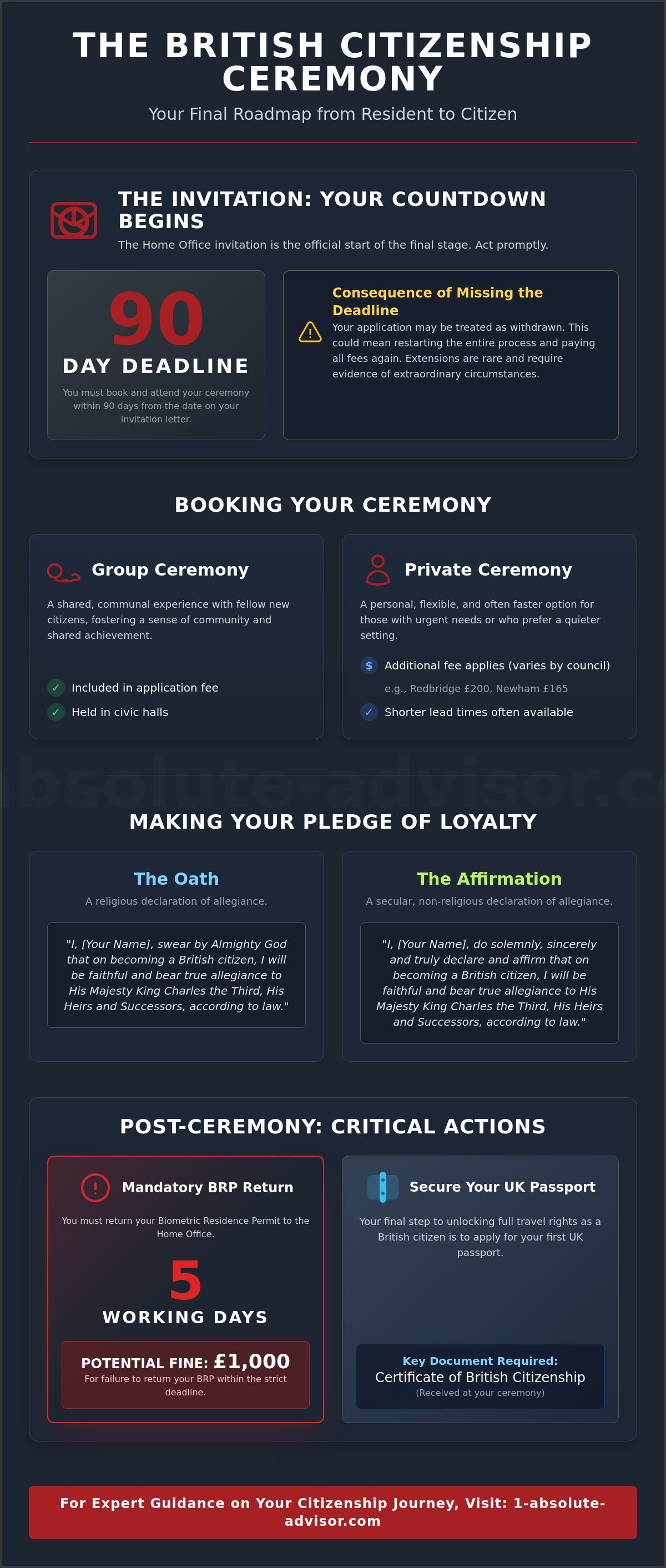
The Home Office imposes a strict 90 day window for you to book and attend your ceremony. This three month countdown begins from the date printed on your invitation letter, not the date you receive it. If you fail to schedule your appointment within this timeframe, your application may be treated as withdrawn. In such cases, you’d likely have to restart the entire British Citizenship Application Service process, including paying the application fees again.
If you’re facing extraordinary circumstances, such as a medical emergency or a family bereavement, you don’t have to face the risk of expiration alone. You can contact the Home Office to request an extension, provided you can supply documentary evidence of your situation. However, these extensions aren’t guaranteed. It’s always safer to book the earliest available slot to ensure you remain compliant with the 2026 regulations.
Booking and Preparing for Your British Citizenship Ceremony
Once you’ve received your invitation, the next phase of the british citizenship ceremony process involves coordinating with your local registrar’s office. This isn’t merely an administrative formality; it’s a choice between two distinct experiences. Most councils offer standard group ceremonies, which are included in the initial application fee, or private ceremonies for those seeking a more personal or expedited event. When booking your citizenship ceremony, you’ll need to confirm which format suits your schedule and personal preferences.
Group vs. Private Ceremonies
Group ceremonies foster a sense of shared achievement, often held in civic halls with multiple new citizens. They provide a community atmosphere that many find rewarding. However, if you require a more flexible schedule or a quieter environment, a private ceremony might be preferable. While the standard £130 fee covers group events, private options incur additional costs that vary by local authority. For example, Redbridge Council currently charges £200 for a private session, while Newham Council charges £165. These private appointments often provide shorter lead times, which can be critical if you need to secure your citizenship certificate quickly for urgent travel needs.
Administrative Checklist for the Day
Preparation is the key to a stress-free experience. You must bring your original Home Office invitation letter and a valid form of photographic identification. Acceptable ID includes your current passport, your Biometric Residence Permit (BRP), or a UK driving licence. Upon arrival, expect a check-in process where the registrar verifies your identity and confirms whether you’ve chosen the religious Oath or the secular Affirmation. This is also when you’ll finalise any guest arrangements. Most group ceremonies allow two guests per applicant, but space is often limited. Confirming guest numbers during the booking stage is essential to avoid disappointment on the day.
The ceremony is a formal legal occasion attended by local dignitaries, such as the Lord Lieutenant or the Mayor. While there’s no mandatory uniform, most applicants choose smart-casual attire or traditional national dress to reflect the dignity of the event. Aim to arrive 15 to 30 minutes before the scheduled start time. Registrars work to tight schedules. Late arrivals may be refused entry, which would require a complete rebooking of the appointment. Punctuality is vital throughout the british citizenship ceremony process to ensure your transition to citizenship remains on track. If you’re still in the earlier stages of your journey, using a professional British Citizenship Application Service can ensure your paperwork is flawless long before you reach the booking stage.
Oath vs. Affirmation: Making Your Pledge of Loyalty
Standing to recite your pledge is the precise legal point where your status changes from a resident to a citizen. While your application has been approved, the Official guidance on British citizenship ceremonies clarifies that this public declaration is the only venue where the transition becomes final. You aren’t just reciting a script. You’re entering a formal, lifelong agreement with the United Kingdom. The Superintendent Registrar or a presiding official will lead the group, ensuring the british citizenship ceremony process maintains the solemnity required for such a significant milestone.
The Oath of Allegiance
The Oath of Allegiance is tailored for applicants who wish to frame their commitment within a religious context. By swearing “by Almighty God,” you’re making a spiritual and legal promise of loyalty. The specific wording requires you to be faithful and bear true allegiance to His Majesty King Charles III, his heirs, and successors according to law. The Oath is a binding legal contract with the Crown. It signifies your acceptance of the UK’s democratic values and your willingness to uphold its laws.
The Affirmation of Allegiance
The Affirmation of Allegiance serves as a secular alternative for those who prefer a non-religious promise. It’s essential to understand that the Affirmation carries the exact same legal weight as the Oath. Choosing this version doesn’t change your status or your rights as a citizen. If your ceremony takes place in Wales, you can choose to make your pledge in either English or Welsh. This flexibility ensures that the british citizenship ceremony process remains inclusive and respectful of individual beliefs and cultural heritage.
After the pledges and the national anthem, the presiding official will present you with your Certificate of British Citizenship. This document is the definitive proof of your status. It’s far more vital than a birth certificate for a new citizen, as you’ll need it for every official interaction from this point forward. Most registrars suggest you verify the spelling of your name and your date of birth before leaving the hall. A small error caught now saves weeks of administrative delays during your first passport application. Your journey through the British Citizenship Application Service has led to this moment; treat this certificate as the foundation of your new life in the UK.
Post-Ceremony Obligations: BRP Return and Passport Applications
Completion of the british citizenship ceremony process marks a profound legal shift in your standing within the United Kingdom. You’re no longer a resident subject to immigration control; you’ve become a British citizen with all associated rights and duties. However, this new status brings immediate administrative obligations that carry heavy penalties if ignored. You must now manage the transition from your previous residency documents to your new identity as a citizen with precision and care.
The 5-Day BRP Return Rule
Your Biometric Residence Permit (BRP) becomes legally void the moment your ceremony concludes. Under 2026 Home Office regulations, you must return this permit within five working days of your ceremony. Failure to comply with this deadline can result in a fine of up to £1,000. To fulfil this requirement, you should cut the card into small pieces, ensuring you cut through the chip and the magnetic strip. Place these pieces in a plain, windowless envelope and post them to the address specified in your approval notification. This step is a critical final component of the british citizenship ceremony process and ensures your record remains compliant.
Applying for Your First British Passport
Your Certificate of British Citizenship is now your most vital legal document. It’s the primary evidence of your status, even more significant than a birth certificate for a naturalised citizen. You’ll need this original document to apply for your first UK passport. Before you begin the application, ensure you’ve reviewed the comprehensive requirements for British Citizenship to ensure all previous milestones were correctly recorded. Most applicants choose the online application route for efficiency, though paper forms remain available at designated Post Offices. Your certificate will be mailed back to you separately once your passport is issued.
Travel Restrictions During Transition
Many new citizens face a “travel gap” immediately following their ceremony. It’s unwise to book international travel until your British passport is physically in your possession. Since your BRP must be destroyed and your previous non-British passport no longer grants you entry as a UK resident, you risk being denied re-entry at the border. Current processing times for a first British passport typically range from 4 to 10 weeks. You should plan your international commitments strategically during this window to avoid being stranded abroad without a valid travel document that the UK border authorities will recognise.
If you’re concerned about the timing of your transition or need help managing your final documents, our British Citizenship Application Service provides the professional oversight needed to ensure your journey concludes without administrative errors.
Expert Guidance for Your British Citizenship Journey
Completing the british citizenship ceremony process is a monumental achievement, but the path to that final pledge is often paved with complex administrative hurdles. While the ceremony itself is a celebration, the legal work required to secure your invitation must be beyond reproach. A “first-time right” application isn’t just about filling out forms; it’s about presenting a comprehensive legal argument that satisfies every Home Office requirement. Engaging OISC-registered advisors ensures that your submission is reviewed with the same level of scrutiny it will face from immigration officials, effectively preventing the delays or refusals that can stall your progress for months.
Professional Oversight of Your Application
Our team focuses on the strategic elements of your case, particularly the “Good Character” requirements which are frequently the source of unexpected refusals. We examine your history with precision to ensure that when you submit your British Citizenship Application Service request, there are no hidden risks that could jeopardise your invitation. For those who are still building their residency foundation, we provide seamless support by managing ILR UK applications, ensuring that every stage of your journey is handled with professional integrity. Our fixed-fee approach to nationality services provides you with financial predictability, allowing you to focus on your future as a citizen without worrying about escalating legal costs.
Next Steps with 1 Absolute Advisor
Your relationship with the UK doesn’t end when the national anthem stops playing. Many new citizens face ongoing questions regarding complex nationality claims, particularly if they have ancestors with ties to former British territories. We also provide expert guidance on dual citizenship issues, helping you understand how your new British status interacts with the laws of your country of origin. Ensuring the security of your entire family is often the next priority. We specialise in supporting families through the registration of children as British citizens, ensuring that your loved ones share in the same permanent security you’ve worked so hard to achieve.
The british citizenship ceremony process is the gateway to a new life of opportunity and civic participation. By choosing a strategic immigration partner, you’re not just hiring a service; you’re securing a mentor who understands the nuances of the law and the importance of your success. If you’re ready to take the final step toward your UK passport with absolute confidence, book a consultation for your British Citizenship application today. We’ll ensure your transition is smooth, compliant, and professionally managed from start to finish.
Securing Your Future as a British Citizen
Navigating the british citizenship ceremony process is the final administrative hurdle before you can fully embrace the rights and responsibilities of UK nationality. By understanding the strict 90 day booking window and the mandatory five day deadline for returning your Biometric Residence Permit, you protect your status from unnecessary legal risks. This transition represents more than just a change in paperwork; it’s the culmination of years of dedication and adherence to the UK’s residency requirements. You’ve reached the threshold of a new life, and ensuring these final steps are compliant is vital for your long-term security.
If you’re beginning your application or facing a complex nationality claim, professional oversight is the most reliable way to ensure a successful outcome. Our OISC-registered immigration experts provide fixed-fee legal services tailored to your specific circumstances, ensuring your case is handled with the precision it deserves. Start your British Citizenship application with 1 Absolute Advisor to secure your future with confidence. Your journey to becoming a British citizen is a significant milestone, and we’re here to ensure every step is handled with the highest level of professional integrity and care.
Frequently Asked Questions
Do I need to attend a citizenship ceremony if I am under 18?
Attendance is not mandatory for applicants under the age of 18. Minors become British citizens the moment the Home Office approves their registration application. However, children who are turning 18 during the application process or those who wish to celebrate with their parents are welcome to attend. If a minor chooses to attend, they aren’t legally required to take the oath or affirmation, though they may participate in the celebratory aspects of the event.
Can I travel abroad after my citizenship ceremony but before I get my passport?
Traveling abroad during this window is highly discouraged due to significant re-entry risks. Once you complete the british citizenship ceremony process, your Biometric Residence Permit (BRP) is legally void and must be returned to the Home Office. You cannot use a void BRP or your citizenship certificate to pass through UK border control. You’ll generally need to wait for your first British passport to be issued, which currently takes between 4 and 10 weeks, to ensure a lawful return to the country.
What happens if I lose my British Citizenship Certificate?
If you lose your original certificate, you must apply to the Home Office for a formal replacement. This is a time consuming and costly process, as the certificate is the only legal proof of your naturalisation. Because you need this document for your first passport application and many other legal functions, it’s vital to store it in a secure location. If the certificate is lost or stolen, you should report it to the police and the Home Office Nationality Group immediately to begin the recovery process.
Can I have a private citizenship ceremony instead of a group one?
You can request a private ceremony through your local authority if you prefer a more personal setting or require a specific date. These appointments offer greater flexibility but require an additional fee beyond the standard application cost. For example, Redbridge Council currently charges £200 for a private session, while other regions like Leicestershire charge around £85. You should contact your designated council’s registrar as soon as you receive your invitation to discuss their specific availability and local pricing.
What is the difference between an Oath and an Affirmation?
The primary difference lies in the religious nature of the declaration. The Oath of Allegiance is a religious pledge where you swear by “Almighty God” to be faithful to the Crown. The Affirmation of Allegiance is a secular alternative that carries the exact same legal weight but involves a non-religious “solemn and sincere” promise. Both versions require you to pledge loyalty to His Majesty King Charles III and uphold the democratic values of the United Kingdom.
How much does the British citizenship ceremony cost in 2026?
The standard fee for a group citizenship ceremony is £130, which is included in the total naturalisation application cost of £1,839 as of the April 8, 2026 fee increase. This fee covers the administrative costs of the registrar and the production of your certificate. If you opt for a private ceremony, you’ll need to pay a separate surcharge directly to your local council. These private fees are not regulated nationally and vary significantly depending on your chosen location and the day of the week.
What documents must I bring to my citizenship ceremony?
You must present your original Home Office invitation letter and a valid form of photographic identification to the registrar. Acceptable ID includes your current passport, your UK driving licence, or your Biometric Residence Permit. This documentation is essential for the registrar to verify your identity before you participate in the british citizenship ceremony process. If you fail to bring these items, the official cannot legally allow you to take the pledge or issue your citizenship certificate on that day.
How long does the citizenship ceremony usually last?
A standard group ceremony typically lasts between 30 and 60 minutes. This timeframe includes the welcoming speeches from local dignitaries, the formal recitation of the pledges, and the presentation of the certificates. Private ceremonies are often shorter, usually concluding within 15 to 20 minutes, as they focus solely on the individual applicant. Regardless of the format, you should plan to arrive at least 15 minutes early to complete the mandatory identity checks and administrative registration before the event begins.