

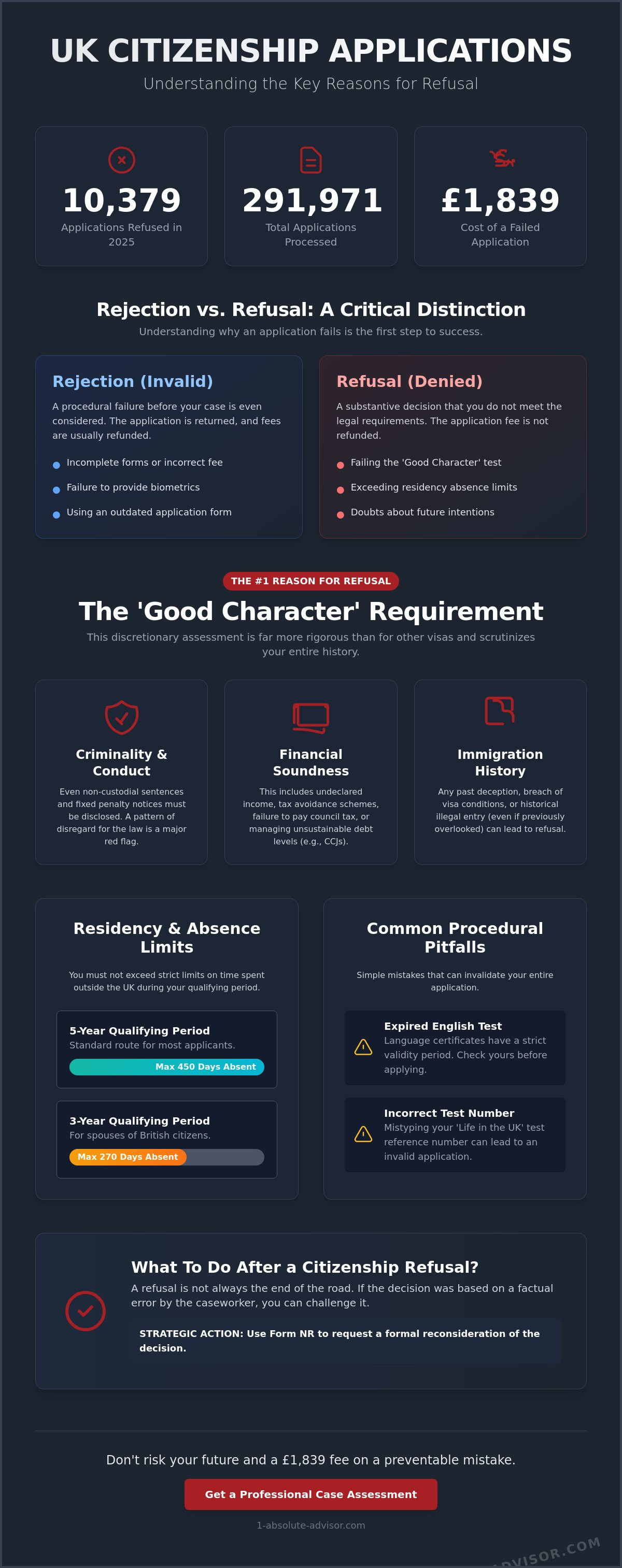
In 2025 alone, the Home Office refused 10,379 British citizenship applications, a stark reminder that naturalisation is a discretionary privilege rather than an automatic entitlement. Many applicants are surprised to find that holding Indefinite Leave to Remain does not guarantee a successful outcome, as the specific reasons for citizenship application refusal often involve “Good Character” assessments that are far more rigorous than those for permanent residency. With the adult application fee now standing at £1,839, the financial and emotional stakes of a rejection are higher than ever before.
It’s natural to feel concerned about how minor past oversights, such as tax errors or the stricter February 2025 policy on historical illegal entry, might impact your future in the UK. This article provides a professional analysis of current Home Office refusal criteria and explains how to proactively address potential risks in your profile. You’ll gain a clear understanding of how to protect your investment and the specific processes available, such as a formal reconsideration request, should you need to challenge a negative decision.
Key Takeaways
- Distinguish between administrative rejections for invalidity and substantive reasons for citizenship application refusal under the Home Office’s discretionary powers.
- Identify how the “Good Character” requirement extends beyond criminal records to include financial conduct and historical immigration compliance.
- Master the precise calculation of absence limits to ensure you don’t exceed the strict 450-day or 270-day thresholds for residency.
- Avoid common procedural errors related to expired English language certificates and incorrect Life in the UK test reference numbers.
- Learn the strategic process for using the NR Form to request a formal reconsideration if your application is denied due to a factual error.
The Landscape of British Citizenship Refusals in 2026
Obtaining British citizenship represents the final step in a long and often arduous journey, yet the path is increasingly fraught with complexity. In the year ending December 2025, the Home Office processed 291,971 applications, of which 10,379 resulted in a refusal. These figures highlight a critical reality: naturalisation isn’t a mere administrative formality. It’s a discretionary process governed by British nationality law, specifically the British Nationality Act 1981, which grants the Home Secretary broad powers to decide who is fit to join the national community.
The financial stakes are high. With the adult naturalisation fee now at £1,839, a failed attempt carries a heavy economic burden. Understanding the common reasons for citizenship application refusal is the first step toward mitigating these risks and ensuring your investment isn’t lost to a preventable error. Approaching this process requires the same level of strategic planning as a high-stakes business decision.
Rejection vs. Refusal: Understanding the Distinction
Applicants often use these terms interchangeably, but they carry vastly different legal consequences. A rejection occurs when an application is deemed “invalid” before a caseworker even considers its merits. This typically happens due to procedural errors:
- Failing to provide mandatory biometric data within the specified timeframe.
- Using an outdated version of the application form.
- Submitting the application without the correct fee payment.
A refusal, conversely, is a substantive denial. The caseworker has reviewed your history and concluded that you don’t meet the legal criteria. This is where professional scrutiny is most intense. Caseworkers exercise significant discretion, particularly when evaluating “Good Character” or residency patterns. Unlike a rejection, a refusal means the Home Office has actively decided you’re ineligible at this time, and you won’t receive a refund for the processing fee.
Why Naturalisation is Different from Other Visa Routes
Many assume that because they’ve successfully secured Indefinite Leave to Remain (ILR), citizenship is a guaranteed next step. This is a dangerous misconception. Visa routes are generally based on meeting rigid, statutory criteria. Naturalisation is different; it’s the grant of a privilege. The burden of proof rests entirely on you to demonstrate that you meet every facet of the requirements.
This shift in perspective is vital for navigating UK immigration in 2026. While ILR focuses on your right to stay, naturalisation focuses on your conduct and your future intentions. A single oversight in your past, even one that didn’t affect your ILR status, can become one of the primary reasons for citizenship application refusal. Approaching the process with a mentor-led mindset ensures these hidden hurdles are identified before they become permanent setbacks.
The ‘Good Character’ Requirement: The Most Common Refusal Reason
The “Good Character” requirement is perhaps the most misunderstood element of the naturalisation process. Unlike the residency criteria, which are largely based on quantifiable data, this assessment is inherently discretionary. The Home Office evaluates the conduct of every applicant over the age of 10 to determine if they are fit to be granted the privilege of citizenship. It’s not enough to simply lack a criminal record. One of the most frequent reasons for citizenship application refusal is a failure to demonstrate that you are a law-abiding and responsible member of society across all aspects of your life.
Caseworkers look for patterns of behaviour rather than isolated incidents. While a single minor mistake might not lead to an immediate denial, a history of non-compliance suggests a disregard for UK law. This assessment is far more rigorous than the checks performed for Indefinite Leave to Remain. If you’re concerned about how your history might be interpreted, our British Citizenship: The Complete Guide to Naturalisation in 2026 provides a deeper look into the standards expected by the Home Office.
Criminality and Conduct Beyond the Courtroom
Criminality is a primary focus, but the definition is broad. While custodial sentences often lead to mandatory refusal periods, non-custodial sentences and cautions are also significant. Even fixed penalty notices, such as those for driving offences or environmental littering, must be disclosed. A high volume of these “minor” infractions can indicate a lack of good character. As of February 10, 2025, the Home Office has also adopted a much stricter stance on historical illegal entry. Previously, a 10-year period of compliance might have mitigated an illegal entry; now, such an event can lead to a refusal regardless of how long ago it occurred.
The assessment also extends to your associations and public conduct. Involvement with extremist groups or having a reputation that brings your character into disrepute can trigger a refusal. Transparency is your best defence. Attempting to hide a past caution is often viewed as “deception,” which is itself a ground for a permanent bar on citizenship. You should consult Citizens Advice guidance for a baseline understanding of what constitutes a criminal record in a naturalisation context.
Financial Soundness and Debt Obligations
Your financial history is a direct reflection of your character in the eyes of the Home Office. Bankruptcy or being the director of a liquidated company doesn’t cause an automatic refusal, but the circumstances matter. If the bankruptcy was due to recklessness or a deliberate attempt to avoid creditors, it’s a major risk factor. Similarly, compliance with HMRC is non-negotiable. Unpaid taxes, late filings, or issues with self-assessment are common reasons for citizenship application refusal because they suggest a failure to contribute to the state as required.
Debt to the public purse is also scrutinised. Unpaid NHS debts of £500 or more are high-risk factors that often lead to denials. Before submitting your documents, it’s wise to ensure all council tax, taxes, and public debts are settled or managed through an agreed payment plan. If you’re unsure if your financial history meets the threshold, our British Citizenship Application Service can help you conduct a thorough pre-application audit to identify and mitigate these risks.
Residence Requirements and Excessive Absences
While “Good Character” assessments involve subjective judgement, residence requirements are strictly numerical. Yet, mathematical errors and poor record-keeping remain leading reasons for citizenship application refusal. The Home Office applies a binary logic to physical presence: you either stayed within the prescribed limits or you didn’t. For standard naturalisation, you shouldn’t have been absent for more than 450 days over the five-year qualifying period. If you’re applying as the spouse of a British citizen, this limit is significantly tighter, restricted to 270 days over a three-year period.
The final year of your residency is particularly sensitive. Regardless of your total five-year count, you must not have spent more than 90 days outside the UK in the 12 months immediately preceding your application. A common pitfall involves “partial days” of travel. The Home Office only counts full days of absence; the day you leave the UK and the day you return don’t count as absences. Miscalculating these even by 24 hours can trigger an automatic refusal of a £1,839 application.
The 5-Year and 3-Year Qualifying Periods
Precision is paramount when calculating your 5-year qualifying period for ILR and subsequent citizenship. You must have been physically present in the UK on the exact date five years (or three years for spouses) before the Home Office receives your application. If you were on a business trip or a weekend break on that specific calendar day years ago, your application will likely fail on a technicality.
Beyond physical presence, you must satisfy the “Future Intentions” requirement. This means proving the UK will be your principal home. If your records show frequent, long-term absences immediately after receiving Indefinite Leave to Remain, a caseworker might conclude you’re seeking a “passport of convenience.” This perceived lack of commitment is one of the more nuanced reasons for citizenship application refusal that catch high-travel professionals off guard.
Discretion for Excessive Absences
The Home Office has the power to exercise discretion if you’ve exceeded the limits, but it’s never guaranteed. You must provide compelling evidence for why your absences were unavoidable. Caseworkers generally only consider discretion for specific circumstances:
- Unforeseen global travel restrictions or mandatory quarantine.
- Serious, documented illness of the applicant or a close family member.
- Unavoidable business travel that is essential to a UK-based role.
The evidentiary burden is high. You can’t simply state there was a family crisis; you must provide medical records, employer letters, or official certificates. “I didn’t know the rules” is never an acceptable justification. If your absences are borderline, our Document Checking Service can help ensure your evidence is robust enough to trigger caseworker discretion rather than a flat refusal.
Procedural Pitfalls: English Language and Life in the UK
Procedural compliance is the mechanical foundation of any naturalisation case. While previous sections of this guide focused on conduct and residency, these administrative hurdles are equally decisive. Many applicants find that technical oversights, such as using an unrecognised test provider or failing to provide a valid reference number, become the primary reasons for citizenship application refusal. These errors are particularly frustrating because they are entirely preventable through meticulous preparation and document auditing.
The Home Office relies on automated systems to verify your credentials. If the data you provide doesn’t perfectly align with their internal databases, your application may be stalled or denied. Beyond the tests themselves, failing to respond to a Home Office Request for Further Information (RFI) within the standard 10-working-day window is a common cause of failure. Caseworkers won’t chase you indefinitely; a lack of response is usually interpreted as an inability to meet the requirements.
The English Language Requirement in 2026
To qualify for naturalisation, you must demonstrate a B1 level of English in speaking and listening. This must be achieved through a Secure English Language Test (SELT) from an approved provider, such as IELTS SELT Consortium, Pearson, or LanguageCert. It’s a common mistake to rely on a certificate from a provider that has lost its Home Office accreditation. Even if the test was valid for your ILR application years ago, you must ensure it remains on the current approved list for citizenship.
If you’re using a degree taught in English from a non-UK university, you cannot simply submit the diploma. You must obtain a formal statement of comparability from Ecctis to prove the degree meets the required standard. Only those over the age of 65 or those with documented, long-term physical or mental conditions are exempt from this requirement. Without the correct Ecctis verification or a valid SELT, the Home Office will likely refuse the application on the basis that the language criteria haven’t been met.
The “Life in the UK” Test Nuances
The “Life in the UK” test is a mandatory hurdle for most applicants. However, simply passing the exam isn’t enough; the administrative details must be flawless. A frequent reason for a mismatch in the Home Office portal is using a different form of identification at the test centre than the one used for the citizenship application. If the passport numbers don’t align, the system may fail to verify your result.
You must ensure the reference number provided in your application is the correct, current version from your pass notification. For a detailed breakdown of how to prepare for this assessment and avoid technical errors, see our guide on how to pass the Life in the UK test. If you’re concerned that your documents or test results might lead to a refusal, our British Citizenship Application Service provides a comprehensive review to ensure every procedural detail is compliant before you commit to the £1,839 fee.
What to Do After a Citizenship Refusal: Strategic Recovery
Receiving a refusal letter is a significant setback, but it shouldn’t be viewed as the definitive end of your British citizenship journey. The first priority is to conduct a dispassionate, forensic analysis of the Home Office’s reasoning. You must determine if the decision was based on a factual error, such as a caseworker miscalculating your absences, or a discretionary judgement regarding your “Good Character.” Because there is no statutory right of appeal for naturalisation decisions, your strategy must be precise and based on the specific reasons for citizenship application refusal outlined in your letter.
In many cases, a refusal is the result of a caseworker overlooking evidence that was already provided or misapplying the Home Office’s own internal guidance. If the error is procedural or factual, a formal request for reconsideration is often the most appropriate path. However, if the refusal stems from a substantive failure to meet the requirements, such as a recent criminal caution or excessive absences without compelling evidence, a fresh application at a later date may be more effective. Balancing the £1,839 cost of a new application against the likelihood of a successful challenge requires careful professional consideration.
The Reconsideration Process (Form NR)
The Form NR process is the primary mechanism for challenging a negative decision. This isn’t a full appeal; it’s a request for a senior caseworker to review the original decision to see if it was legally or procedurally sound. You must submit this request within the strict timelines mentioned in your refusal notice. Success in this area often depends on a robust legal cover letter that cites specific paragraphs of the British Nationality Act 1981 or the Home Office’s “Nationality Policy Guidance.” If your application was denied because a document was missing or the caseworker ignored a specific explanation, the NR process provides a vital opportunity to rectify the record without paying the full application fee again.
Planning a Successful Reapplication
If a reconsideration is unlikely to succeed, you must plan your reapplication with a focus on transparency. If the reasons for citizenship application refusal involved “Good Character” issues, you may need to wait for a specific period to pass. For example, some offences carry a 10-year bar on successful naturalisation. It’s critical that any new application acknowledges the previous refusal. Failing to disclose a prior denial is often interpreted as an attempt at deception, which can lead to a permanent bar on your future in the UK.
Before resubmitting, a professional document audit is essential to ensure that every historical error has been addressed. If you’ve faced a refusal and need to determine the most viable path forward, our Administrative Review Service or a targeted Document Checking Service can provide the strategic oversight needed to secure your future. In rare cases where a decision is demonstrably “unreasonable” or “unlawful” and all other avenues have failed, Judicial Review remains the final legal resort to challenge the Home Secretary’s discretion.
Protecting Your Investment in British Citizenship
The path to naturalisation is no longer a simple administrative box-ticking exercise. It requires a holistic review of your residency, financial conduct, and personal history to satisfy the Home Office’s high standards. Most reasons for citizenship application refusal stem from preventable oversights in absence calculations or a failure to address the rigorous “Good Character” requirements that go beyond standard visa checks. Approaching your application with professional precision is the only way to safeguard your £1,839 fee and your long-term security.
To navigate these complexities with confidence, it’s essential to have a strategic partner by your side. Our OISC-registered immigration consultants provide a comprehensive British Citizenship Application Service, featuring fixed-fee management and an expert document checking service to mitigate risks before submission. Secure your British Citizenship with our expert application management and ensure your journey is handled with professional integrity. Your future in the UK is a significant milestone; let’s ensure it’s built on a foundation of absolute compliance and peace of mind.
Frequently Asked Questions
Can I appeal a British citizenship refusal?
No, there’s no statutory right of appeal against the refusal of a British citizenship application. Because naturalisation is a discretionary grant rather than a legal entitlement, you can’t challenge the decision in an immigration tribunal. Your available options are to request a formal reconsideration via Form NR if you believe a factual or procedural error occurred, or to submit a fresh application once you’ve addressed the underlying issues.
How long do I have to wait to reapply for citizenship after a refusal?
The waiting period depends on the specific reasons for citizenship application refusal identified in your letter. If the denial was based on a “Good Character” issue, such as a criminal record, you may be barred for up to 10 years. However, if the refusal was due to a procedural oversight, such as a missing document or a minor residency gap, you can often reapply as soon as you meet the eligibility criteria and have the necessary evidence ready.
Will a citizenship refusal affect my current Indefinite Leave to Remain (ILR)?
Generally, a refusal doesn’t impact your Indefinite Leave to Remain status. Your right to reside and work in the UK remains intact as long as you continue to meet the requirements of your residency. The only exception is if the Home Office discovers that you used deception or fraud to obtain your ILR during their citizenship investigation, which could lead to the revocation of your settlement status.
What is the “Good Character” requirement for UK citizenship?
The “Good Character” requirement is an assessment of your conduct across your entire time in the UK, including criminality, financial soundness, and immigration compliance. Under the stricter policy effective from February 10, 2025, any history of illegal entry is now a primary ground for refusal. It also encompasses non-custodial sentences, unpaid NHS debts over £500, and any record of tax non-compliance with HMRC.
Can I get a refund for my citizenship application fee if it is refused?
No, the Home Office doesn’t refund the £1,839 adult naturalisation fee if your application is refused. This fee covers the administrative cost of processing and investigating your eligibility. You’ll only receive a refund for the £130 citizenship ceremony fee, as that part of the process will not be completed. This high financial risk is why many applicants choose a professional document checking service before submission.
What happens if I spent more than 450 days outside the UK?
Exceeding the 450-day absence limit in the five-year qualifying period usually results in a refusal. While caseworkers have limited discretion to overlook absences for compelling reasons like serious illness or essential business travel, they require exhaustive evidence to do so. If you cannot prove that your absences were unavoidable, you’ll likely need to wait until your rolling five-year total falls back within the permitted thresholds.
How much does it cost to request a reconsideration (Form NR)?
Requesting a reconsideration involves a specific administrative fee paid to the Home Office, which is significantly lower than the initial application cost. This process is intended for cases where you can demonstrate that the caseworker made a clear error or missed evidence that was already provided. It’s a vital tool for correcting factual mistakes without undergoing the full reapplication process and paying the standard fee again.
Do I need a lawyer for a British citizenship reapplication?
You aren’t legally required to use a representative, but professional assistance is highly recommended when dealing with complex reasons for citizenship application refusal. An OISC-registered consultant can help you interpret the refusal letter and build a stronger evidence base for your next attempt. Given the £1,839 cost of each application, ensuring your second submission is flawless is a prudent financial and strategic decision.