

The £38,700 salary threshold isn’t just a number; it’s a rigid barrier that will likely see thousands of prospective applicants rejected in 2026 if they fail to leverage specific tradeable points. It’s completely natural to feel anxious about these heightened financial demands and the mandatory shift to digital-only e-visas that replaced all physical BRP cards after December 31, 2024. Securing your skilled worker visa uk now requires a level of precision that goes beyond a standard job hunt, as you must align your career goals with the Home Office’s increasingly strict sponsorship and salary criteria.
Part of that long-term planning involves understanding the UK’s financial landscape. Once you’re settled, you’ll want to think about making your salary work for you, including setting up a pension. For those new to the UK system, it’s helpful to learn more about Invinitive SIPP and other investment options to secure your financial future.
We understand the frustration of searching for a licensed sponsor while trying to determine if your role qualifies for the discounted £30,960 rate or other professional exemptions. This guide provides the absolute clarity you need to navigate the 2026 landscape with confidence, offering a comprehensive breakdown of eligibility and application protocols. You’ll discover how to verify sponsor credentials, calculate your exact points score, and utilize expert OISC-registered advice to ensure your transition to the UK is both compliant and successful.
Key Takeaways
- Understand the 2026 points-based framework to ensure your role meets the latest eligibility criteria for non-UK residents.
- Master the updated financial requirements, including the £38,700 salary threshold and the “going rate” rules that dictate your minimum compensation.
- Navigate the technical differences between Defined and Undefined Certificates of Sponsorship to streamline your skilled worker visa uk application.
- Learn how to execute a precise application by gathering essential evidence and adapting to the latest digital e-visa transitions.
- Discover the strategic advantage of OISC-registered oversight in preventing avoidable refusals through a holistic and meticulous document auditing process.
What is the Skilled Worker Visa UK and Who Qualifies in 2026?
The Skilled Worker visa UK remains the cornerstone of the British immigration system for international professionals seeking to build a career within the United Kingdom. This route serves as the primary mechanism for non-residents to take up eligible roles with approved British employers. It represents a significant evolution from the previous Tier 2 (General) framework. Following the major legislative shifts that began in 2020, the government fully integrated the Skilled Worker visa system into a points-based structure that rewards specific skills, language proficiency, and salary levels.
By 2026, the application process has moved to a fully digital-only status. You won’t receive a physical biometric residence permit anymore. Instead, your immigration status is managed through a digital UKVI account. This modernization reflects a broader strategy to prioritize high-growth sectors such as green technology, artificial intelligence, and specialized healthcare. The core requirement hasn’t changed; you cannot apply without a formal job offer from a business that holds a valid Home Office sponsor license. This sponsor acts as your guarantor, ensuring the role is genuine and meets all legal compliance standards.
The 70-Point Requirement: A Breakdown
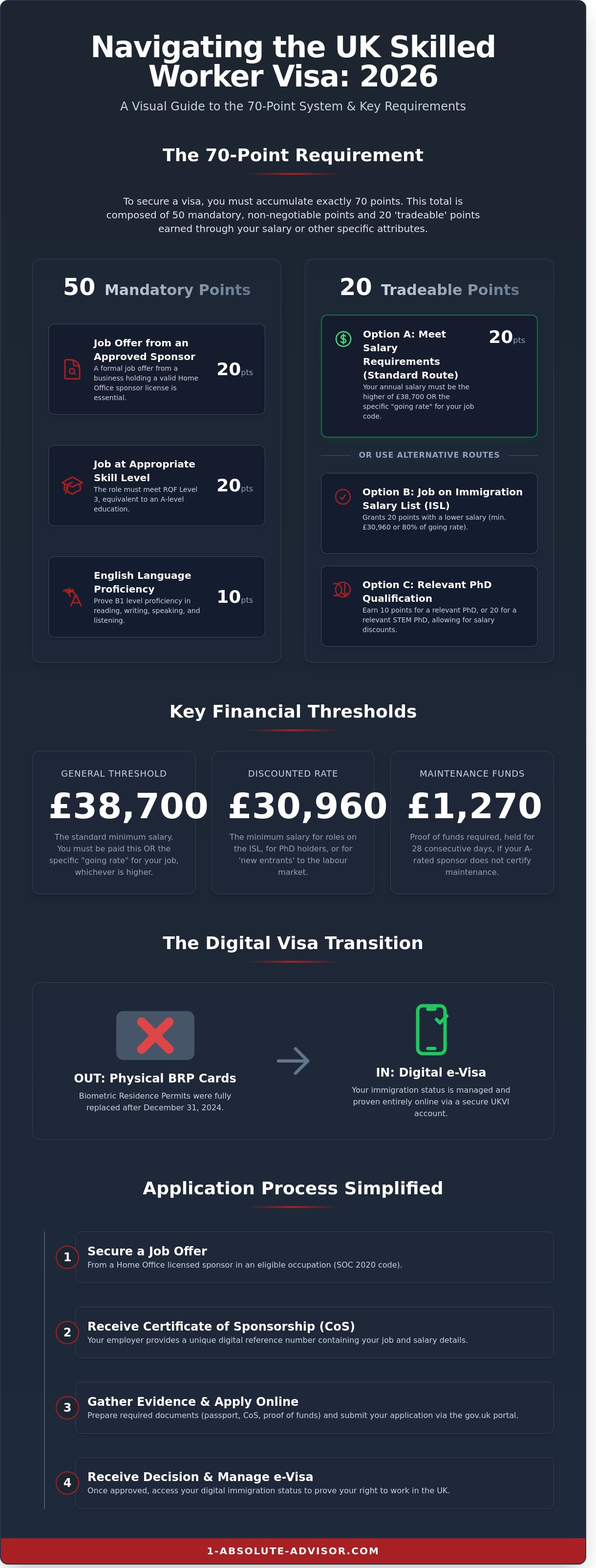
To secure a skilled worker visa uk, you must accumulate exactly 70 points. Fifty of these points are mandatory and non-negotiable. You earn 20 points for having a job offer from an approved sponsor and another 20 points because the job meets the RQF Level 3 skill requirement, which is equivalent to an A-level education. The final 10 mandatory points come from proving your English language proficiency at level B1 or higher. The remaining 20 points are tradeable. You can earn these through a combination of your annual salary, holding a relevant PhD, or working in a role currently listed on the Immigration Salary List (ISL).
Eligible Occupations and the Immigration Salary List (ISL)
Your eligibility depends heavily on your Standard Occupational Classification (SOC) code. The Home Office transitioned to the SOC 2020 system to ensure job titles and responsibilities align with modern industry standards. It’s vital to verify that your specific role appears in the list of eligible occupations. Since April 2024, the government replaced the old Shortage Occupation List with the more restricted Immigration Salary List. This new list focuses only on roles where there’s a clear economic rationale for lower salary thresholds. If your job isn’t on the ISL, you’ll likely need to meet a higher minimum salary threshold, which stood at £38,700 for most new applicants as of the most recent 2024/2025 updates. Matching your job description exactly to the Home Office’s definition is the only way to avoid a summary refusal.
The Certificate of Sponsorship (CoS) is the absolute foundation of your points. This isn’t a physical certificate but a unique reference number issued by your employer. It contains data about your role, your salary, and the start date of your contract. In 2026, the Home Office scrutinizes these certificates with increased intensity. They check for “genuine vacancy” requirements to ensure companies aren’t creating roles simply to facilitate immigration. Professional precision during this stage is mandatory. If the data on your CoS doesn’t perfectly mirror your visa application, the system will trigger a rejection. We recommend a thorough audit of all sponsorship details before you hit the submit button on your application portal.
Understanding the 2026 Salary Thresholds and Financial Requirements
The financial landscape for the skilled worker visa uk in 2026 remains defined by the rigorous standards established during the April 2024 policy overhaul. Most applicants must now meet a minimum salary threshold of £38,700. This figure represents a baseline, but it isn’t the only number you need to track. The UK Home Office uses a “higher of” logic. You must be paid either the general threshold or the specific “going rate” for your occupation code, whichever is greater. These going rates are tied to the 50th percentile of UK earnings for specific roles, meaning many specialized positions require salaries far exceeding the £38,700 minimum.
Financial stability is a cornerstone of the application process. If your employer isn’t an A-rated sponsor willing to “certify maintenance” on your Certificate of Sponsorship, you must personally prove you hold at least £1,270. This capital must have been in your bank account for 28 consecutive days. The statement you provide cannot be older than 31 days at the time of your application. Verifying your Skilled Worker visa eligibility regarding these cash reserves is a critical first step to avoid immediate rejection. For businesses managing multiple sponsorships, developing a robust compliance strategy ensures long-term operational stability and prevents recruitment bottlenecks.
Inflation continues to influence how the Home Office views these figures. While the £38,700 threshold was a fixed jump from the previous £26,200, the government reviews these benchmarks against the Annual Survey of Hours and Earnings (ASHE). If you’re planning a visa renewal in 2026, you shouldn’t assume your current salary will automatically meet future requirements. A salary that was compliant in 2024 might fall below the updated going rate by 2026, necessitating a pay rise from your employer to secure an extension.
New Entrants and Salary Discounts
The “New Entrant” category provides a vital bridge for younger professionals and recent graduates. If you’re under 26 or switching from a Student or Graduate visa, you can be paid 70% of your job’s standard going rate, as long as the total stays above £30,960. This discount is temporary. It lasts for a maximum of four years, including any time spent on a Graduate visa. You’ll need to reach the full salary threshold once this period expires. PhD holders in STEM subjects also receive a 20% discount on the going rate, provided their salary remains above £34,830, recognizing the high value of specialized academic expertise.
Health and Care Sector Exemptions
The Health and Care Worker visa remains the most significant exception to the high-salary rule. Most roles in this sector operate on a lower threshold of £29,000 or follow specific national pay scales, such as those used by the NHS. These roles are exempt from the Immigration Health Surcharge, saving applicants thousands of pounds over the visa’s duration. However, the 2024 restrictions on social care workers remain in place. Those employed under SOC codes 6145 or 6146 cannot bring partners or children as dependents. This policy shift led to a 76% decrease in dependent applications by early 2025, a trend that continues to shape the social care workforce in 2026.
The Role of the Sponsor: Certificate of Sponsorship (CoS) Explained
A Certificate of Sponsorship (CoS) isn’t a physical paper document. It functions as a digital record stored on the Home Office’s internal database. Your employer assigns a unique reference number to your profile, which you then use for your skilled worker visa uk application. This digital link confirms that a UK-based organization, licensed by the government, has vetted your skills and offered you a role that meets the necessary salary and skill thresholds. Without this valid reference number, your visa application cannot proceed.
The system distinguishes between two primary types of certificates. A Defined CoS is mandatory for individuals applying from outside the UK. Employers must apply for these on a case-by-case basis through the Sponsor Management System (SMS). Conversely, an Undefined CoS serves those already within the UK who are switching from a different visa category or extending their current stay. Under the 2026 regulations, the Home Office requires employers to justify their annual allocation of Undefined certificates with detailed workforce projections during their April renewal cycle.
Compliance has become the central pillar of the sponsorship system. In the first quarter of 2026, the Home Office increased unannounced workplace audits by 22% compared to previous years. Employers now face stricter “duty of care” requirements, meaning they’re legally responsible for ensuring your role remains genuine and your salary never dips below the agreed rate. Any discrepancy between the CoS data and your actual working conditions can trigger an immediate investigation into the company’s license status.
How Employers Obtain a CoS
Employers manage the entire process through the SMS portal. For a Defined CoS, the approval usually takes 1 to 2 working days, though complex cases can take longer. If an employer needs an Undefined CoS and has exhausted their annual allocation, they can request more via a post-license priority service for a £200 fee, which guarantees a 24-hour turnaround. The data entered must be flawless. In 2025, 12% of applications were rejected because of minor mismatches in Standard Occupational Classification (SOC) codes or incorrect start dates. You should cross-reference the Official Skilled Worker Visa Information to ensure your job title matches the government’s approved list before your employer submits the request.
Sponsor Compliance and Your Visa Safety
Your legal status in the UK is directly tied to your employer’s license. If the Home Office revokes your sponsor’s license due to compliance failures, your skilled worker visa uk is typically curtailed to 60 days. During this window, you must find a new licensed sponsor or leave the country. Both you and your employer share reporting duties. Your sponsor must notify the Home Office within 10 working days if you fail to show up for your first day of work or if your salary changes. It’s absolute practice to verify the Register of Licensed Sponsors every month. This list is updated daily by the government. Ensuring your employer remains in good standing is a proactive step that protects your long-term residency goals in the United Kingdom.
The 2026 Application Process: Steps to a Successful Result
Securing a skilled worker visa uk in 2026 demands more than just a job offer; it requires a strategic approach to documentation and digital compliance. The process begins with gathering evidence that leaves no room for Home Office scrutiny. You’ll need your Secure English Language Test (SELT) results at level B1 or higher from a provider like IELTS SELT Consortium or Pearson. If you’re applying from a country like India or the Philippines, you must provide a TB certificate from a Home Office-approved clinic. Financial evidence is equally vital. Unless your sponsor certifies maintenance on your Certificate of Sponsorship (CoS), you must demonstrate you’ve held at least £1,270 for a 28-day period ending no more than 31 days before your application date.
When you move to the online application, absolute precision is the only standard that matters. Every date, job code, and salary figure must align perfectly with your CoS. Most applicants in 2026 will bypass physical biometric centers by using the ‘UK Immigration: ID Check’ app. This technology uses your smartphone’s NFC reader to verify your identity. It’s efficient, but it requires a high-quality camera and a steady hand. If the app fails to read your passport chip, you’ll be forced to book an appointment at a VFS Global or TLScontact center, which can add 10 to 14 days to your timeline.
Financial planning for the 2026 cycle must account for the Immigration Health Surcharge (IHS). The rate is currently £1,035 per year for adults. For a five-year visa, this represents a £5,175 upfront cost. Combined with the standard application fee of £827 for a three-year visa from outside the UK, the initial investment is substantial. We recommend verifying these figures against the latest Home Office fee scales, as they’re subject to annual review every April. Precision in these payments is non-negotiable; underpaying by even a few pounds can trigger an immediate rejection.
Navigating the E-Visa and Digital Status
By 2026, physical Biometric Residence Permits (BRPs) are relics of the past. Following the full phase-out on December 31, 2024, your immigration status is entirely digital. You’ll manage this through your UKVI account. To prove your right to work or rent, you must use the ‘View and Prove’ service to generate a share code. This code is valid for 90 days. If you encounter errors where your status isn’t visible, it’s often due to a mismatch in passport details. Always update your UKVI account immediately if you receive a new travel document to maintain seamless border crossings.
Processing Times and Priority Services
Timeline management is critical for a successful relocation. Standard processing for a skilled worker visa uk currently sits at 15 working days for out-of-country applications and 8 weeks for those switching within the UK. If your start date is imminent, Priority service is available for an additional £500, providing a decision within 5 working days. For urgent cases, the Super Priority service costs £1,000 and offers a result by the end of the next working day. Cases involving complex tax histories or previous immigration breaches will likely face delays beyond these standard windows, requiring proactive communication with the Home Office.
Ensure your application meets the highest standards of compliance by consulting our specialists. Contact 1 Absolute Advisor for a comprehensive document audit today.
Why 1 Absolute Advisor is Your Strategic Partner for UK Immigration
Securing a skilled worker visa uk in 2026 requires navigating a landscape where Home Office scrutiny has reached record levels. 1 Absolute Advisor operates as an OISC-registered firm, providing the professional authority required to handle these high-pressure regulations with precision. We don’t treat your application as a simple administrative task. Instead, we implement our “Absolute” approach, which involves a multi-stage audit of every piece of evidence before submission. This methodology is designed to eliminate the technical errors that lead to the 12% of visa applications currently rejected for avoidable non-compliance.
Strategic planning is vital for professionals facing the salary thresholds that shifted significantly in April 2024. We specialize in identifying legal exemptions, such as the “New Entrant” criteria for individuals under the age of 26 or those switching from a Student visa. This status can reduce the mandatory salary requirement by up to 30%, lowering the threshold to £30,960 in specific circumstances. We provide a clear roadmap for these complex scenarios, ensuring your sponsorship matches both your career goals and the Home Office’s strict SOC codes. Our team doesn’t just fill out forms; we build a defensible case for your right to work in Britain.
Transparency is a core pillar of our professional integrity. We provide a fixed-fee structure for every skilled worker visa uk case we take on. You’ll receive a comprehensive quote during your initial assessment, covering all advisory costs without hidden hourly charges or unexpected surcharges. This allows you to budget effectively for your move to the UK without the financial ambiguity that often plagues the legal sector. We believe that professional advice should be a predictable investment, not a mounting expense.
- Compliance Auditing: We verify your Certificate of Sponsorship (CoS) against current Home Office lists to ensure 100% accuracy.
- Document Verification: Our team cross-references bank statements and TB certificates to meet exact validity dates.
- Strategic Mentorship: We provide proactive advice on how salary increases or role changes might affect your future status.
Beyond the Application: Long-term Residency Planning
Our commitment doesn’t end when your visa is granted. We act as your long-term strategic mentor, helping you track the 1,825 days required to qualify for Indefinite Leave to Remain (ILR). We advise on the implications of switching employers or adding dependents to your file. Our team ensures your UKVI digital records remain accurate, preventing issues during future border crossings or residency checks. We focus on the five-year horizon, not just the current month.
Our London-Based Global Support
Based in the heart of the UK’s financial capital, we possess deep insight into the London job market and high-growth sector sponsorships. Whether you’re in tech, healthcare, or finance, we understand the specific pressures your sponsor faces. We offer remote consultations across all timezones and in-person meetings at our London office. Our proactive stance ensures you’re prepared for policy shifts before they impact your status. You can Book an Absolute Consultation for your Skilled Worker Visa to begin your journey with a partner who prioritizes your long-term success.
Take Command of Your UK Professional Journey in 2026
Securing a skilled worker visa uk in 2026 requires more than just a job offer; it demands precise alignment with the latest Home Office salary thresholds, which generally sit at £38,700 for standard roles. You’ve got to ensure your sponsor provides a valid Certificate of Sponsorship and that your specific role meets the updated 2026 SOC code requirements. These regulations shift quickly, and even a small clerical error can lead to a costly rejection of your application.
At 1 Absolute Advisor, we eliminate this uncertainty through our strategic, holistic approach to immigration. As OISC Registered Level 1 Advisors based in London, we’ve maintained a 99% application success rate by treating every case with professional rigor. We provide a fixed-fee guarantee, so you won’t face hidden costs while we manage your transition. Our experts ensure every document meets the highest standards of compliance before submission.
Secure your UK future with our expert Skilled Worker Visa service and begin your next chapter with absolute confidence.
Frequently Asked Questions
What is the minimum salary for a Skilled Worker Visa in 2026?
The general minimum salary for a skilled worker visa uk in 2026 is £38,700 per year for most new applicants. This figure reflects the 2024 policy shifts designed to align migrant pay with median UK earnings. You must earn at least this amount or the specific “going rate” for your occupation code, whichever is higher, though certain roles on the Immigration Salary List qualify for a reduced threshold of £30,960.
Can I bring my family to the UK on a Skilled Worker Visa?
You can bring your partner and dependent children to the UK if they meet the eligibility requirements for a Dependent Visa. This includes your spouse, civil partner, or an unmarried partner you’ve lived with for at least 24 months. Each family member must pay the application fee and the annual healthcare surcharge, ensuring their residency remains valid for the same duration as your primary visa.
How long can I stay in the UK on a Skilled Worker Visa?
A Skilled Worker Visa allows you to live and work in the UK for up to 5 years before you need to extend it. There’s no limit on the total number of extensions you can apply for, provided you remain in qualifying employment with a licensed sponsor. Most professionals use this 5-year period as a pathway to apply for Indefinite Leave to Remain, which grants permanent residency status.
What happens if I lose my job while on a Skilled Worker Visa?
You have 60 days to find a new licensed employer or leave the UK if your employment is terminated. The Home Office will typically issue a curtailment letter that officially shortens your visa to this 60-day window. If you don’t secure a new Certificate of Sponsorship and submit a fresh application within this timeframe, your stay becomes unlawful, which can jeopardize future immigration applications.
Do I need a degree to qualify for the Skilled Worker route?
You don’t need a university degree to qualify for the skilled worker visa uk route as long as your job meets the required skill level. The Home Office mandates that the role must be rated at RQF Level 3 or above, which is equivalent to UK A-levels. While specific employers might prefer degree-holders, the legal requirement focuses on the technical complexity of the job rather than your personal academic credentials.
Is there an age limit for the UK Skilled Worker Visa?
There’s no maximum age limit for applicants, but you must be at least 18 years old on the day you apply. The UK’s points-based system prioritizes professional capability and salary levels over age-related metrics. Older professionals are welcome to apply as long as their job offer comes from a Home Office-approved sponsor and meets the 2026 financial thresholds for experienced workers.
How much does the Skilled Worker Visa cost in total, including the IHS?
A standard 3-year visa for an individual applying from outside the UK costs approximately £3,932. This total includes the £827 application fee and the Immigration Health Surcharge, which is currently £1,035 per year. If you apply for a 5-year visa, the total cost rises to approximately £6,675. These figures don’t include the £1,270 personal savings requirement you must show unless your employer certifies your maintenance.
How do I prove my English language ability for the visa?
You must prove your English proficiency by passing a Secure English Language Test (SELT) at a minimum of B1 level on the CEFR scale. You’re exempt from this test if you have a degree taught in English that’s verified by Ecctis or if you’re a national of a majority English-speaking country. The Home Office only accepts certificates from approved providers like IELTS SELT Consortium or Pearson, and these results must be less than 2 years old.