

Your recruitment strategy for the coming year is likely at risk if you’re still operating under the defunct rules of the old Shortage Occupation List. Since the Home Office replaced it with the Immigration Salary List (ISL) in April 2024, the framework for hiring international talent has become significantly more rigorous. Relying on outdated information regarding the shortage occupation list uk 2026 could lead to costly visa refusals or compliance issues that jeopardize your business operations. We understand that the shift from a broad 20% salary discount to a more targeted, occupation-specific approach has left many c-suite executives and HR directors grappling with complex calculations.
You probably feel that the goalposts for sponsorship have moved just as you were getting comfortable with the previous system. This guide provides the absolute clarity you need to understand how the 2026 ISL criteria affect your specific roles and salary requirements. We’ll examine the transition from the old list to the new salary thresholds, ensuring you can confirm if a role qualifies for discounts before you issue a Certificate of Sponsorship. By the end of this article, you’ll have a strategic roadmap to navigate the £38,700 baseline and the specialized provisions that remain for certain sectors.
Key Takeaways
- Navigate the critical transition from the legacy SOL to the new Immigration Salary List (ISL) to ensure your 2026 visa strategy remains compliant with updated Home Office standards.
- Identify how the shortage occupation list uk 2026 framework provides significant salary threshold reductions, potentially lowering the financial entry point for your Skilled Worker visa.
- Master the use of Standard Occupational Classification (SOC) codes to verify your role’s eligibility within high-demand sectors such as specialized engineering and healthcare.
- Learn the essential steps for coordinating with your employer to ensure your ISL status is accurately reflected on your Certificate of Sponsorship (CoS) within the sponsorship management system.
- Benefit from the strategic guidance of OISC-registered professionals who offer fixed-fee application management to provide financial predictability and professional integrity.
From SOL to ISL: The 2026 UK Shortage Occupation Landscape
The landscape of UK immigration underwent a seismic shift on April 4, 2024, when the Home Office officially replaced the Shortage Occupation List (SOL) with the Immigration Salary List (ISL). This wasn’t merely a rebranding exercise. It marked a pivot in government policy toward a high-skill, high-wage economy. If you’re researching the shortage occupation list uk 2026, you’re actually looking for the rules governing the ISL. Understanding this From SOL to ISL evolution is essential for any business planning its recruitment strategy for the coming year.
The Migration Advisory Committee (MAC) now conducts more rigorous, evidence-based reviews to determine which roles stay on the list. Their mandate is clear: identify sectors where labour shortages are acute but ensure that immigration doesn’t become a tool to keep wages low. By 2026, the list has become leaner, focusing on roles where there’s a clear economic justification for lower salary entry points. This approach forces employers to look at domestic training and salary increases before turning to international recruitment.
Key Differences Between the Old SOL and New ISL
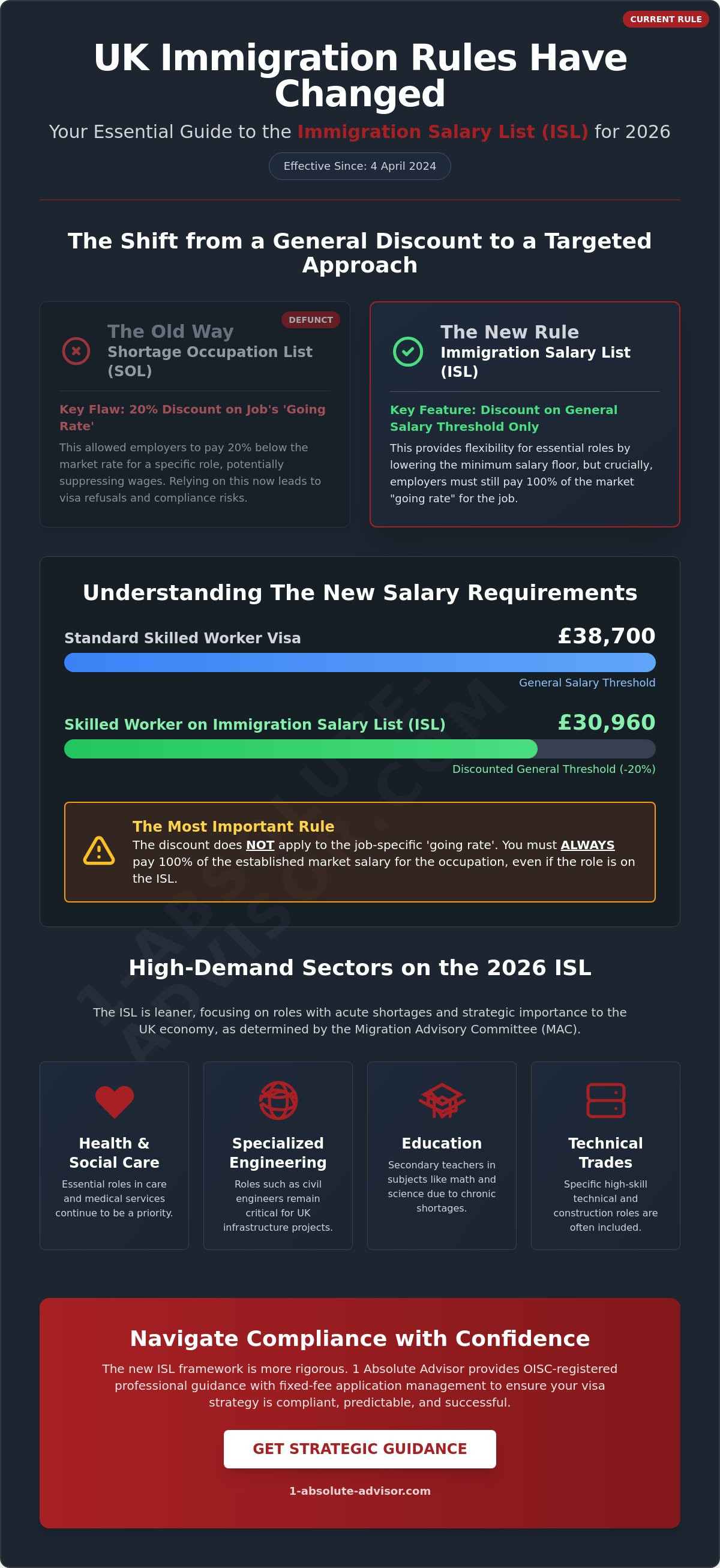
The most significant change involves the removal of the 20% salary discount on the “going rate” for specific roles. Previously, employers could pay 20% less than the standard market rate for a job if it was on the SOL. That provision is dead. Under the ISL, the discount applies only to the general salary threshold. For instance, while the standard general threshold is £38,700, ISL roles might allow for a lower threshold of £30,960. You must still pay the full “going rate” for that specific occupation code. This ensures that foreign workers earn a fair wage while still providing some flexibility for essential roles.
- Removal of the 20% discount: You can no longer pay below the market rate for a role just because it’s in shortage.
- General threshold focus: The ISL provides a lower floor for the general salary requirement, not the job-specific rate.
- Stricter entry criteria: Roles are only added if they represent a strategic necessity for the UK economy.
Why the Name Change Matters for Your Application
Precision in your paperwork is non-negotiable. When issuing a Certificate of Sponsorship (CoS), using outdated terminology from 2023 or earlier can lead to immediate complications. The Home Office’s current interpretation of “shortage” is far stricter than it used to be. They don’t just look at whether a role is hard to fill; they examine if the industry is making efforts to invest in the UK workforce. Relying on old advice could jeopardize your sponsor license or lead to visa refusals for your candidates. Staying updated on the shortage occupation list uk 2026 requirements means recognizing that the ISL is a tool for strategic growth, not just a shortcut for filling vacancies.
Which Jobs are on the Immigration Salary List in 2026?
Identifying which roles qualify for the shortage occupation list uk 2026, officially known as the Immigration Salary List (ISL), requires a granular approach to the UK’s labor market needs. The list primarily targets sectors where domestic labor supply fails to meet demand, such as health and social care, specialized engineering, and certain technical trades. By consulting the official UK Immigration Salary List, sponsors can confirm if a role benefits from a reduced salary threshold. This reduction typically allows employers to pay 80% of the standard rate for that specific occupation code, provided the salary doesn’t fall below the absolute floor of £23,200 or £29,000, depending on the specific transition rules applied to the role.
The 2026 list reflects the Migration Advisory Committee’s focus on high-value, strategic roles. Historically, positions like secondary education teachers in math and science, alongside civil engineers, have maintained their status due to chronic domestic shortages. In the current economic climate, the government prioritizes roles that contribute to the UK’s green energy transition and digital infrastructure. You’ll find that the list is no longer a broad net but a precision tool designed to fill genuine gaps without depressing local wages.
The Role of SOC Codes in Visa Eligibility
The Standard Occupational Classification (SOC) system uses a 4-digit code to categorize every job in the UK. This code determines the minimum salary you must pay and the skill level required for visa approval. Many employers fail their audit because they match a job title to a code without reviewing the detailed descriptions provided by the Office for National Statistics. The job duties, not just the title, determine the code. Selecting an incorrect SOC code can lead to immediate visa refusal or a revocation of the sponsor license; therefore, precision is mandatory during the Certificate of Sponsorship (CoS) issuance process.
Finding Your Code Using the CASCOT Tool
To identify the correct code, use the CASCOT tool or the ONS occupation coding tool. First, enter the job title and a brief description of the daily tasks. Second, review the suggested 4-digit codes and compare the “index terms” with your specific vacancy. Once you have a code, cross-reference it with the 2026 ISL appendices to see if it qualifies for the salary discount. If your job isn’t on the list, you can still sponsor the candidate under the standard Skilled Worker route, provided they meet the general salary threshold of £38,700 or the specific going rate for that role. For complex cases, seeking strategic business advice ensures your recruitment strategy remains compliant with evolving Home Office standards.
High-demand roles that have historically remained on the list for 2026 include:
- Chemical scientists specifically within the nuclear industry.
- Biological scientists and biochemists involved in high-level research.
- Social workers and senior care workers.
- Laboratory technicians with specialized technical experience.
- Pharmaceutical technicians supporting clinical settings.
Salary Thresholds and the 2026 Financial Requirements
The financial landscape for the shortage occupation list uk 2026 is defined by the significant structural changes implemented in April 2024. For most sponsorship categories, the standard general salary threshold is £38,700. This figure represents a high bar for many sectors, particularly those outside of London or the finance industry. However, roles officially recognized on the Immigration Salary List (ISL) receive a specialized discount. This reduction is designed to keep essential roles accessible to UK businesses while maintaining the integrity of the labor market. When managing Skilled Worker Visa Applications, it’s vital to recognize that the salary must satisfy both the general threshold and the specific “going rate” for that occupation code.
Calculations for these thresholds are based on a 37.5-hour working week. If an employee’s contract specifies more hours, the salary requirement must be pro-rated upward. For example, a role requiring 40 hours a week will have a higher absolute minimum than the baseline figures published by the Home Office. Employers must be precise; even a small discrepancy in the hourly rate can lead to a visa refusal and a potential compliance audit for the sponsor license holder.
Understanding the ISL Salary Discount
The ISL provides a 20% discount on the general salary threshold, setting the floor at £30,960 for 2026. This lower entry point is a lifeline for SMEs and non-profit organizations that lack the capital to compete with multinational corporations. It’s important to remember that the “going rate” for the specific job still acts as a secondary financial floor. If the going rate for a specialized technician is £32,000, you must pay that amount even though the ISL threshold is £30,960. This dual-check system ensures that international recruitment doesn’t suppress wages for domestic workers in high-demand fields.
ISL vs. New Entrant Rates: Which Discount Applies?
New entrants, which include recent graduates, students switching from Tier 4 visas, and individuals under the age of 26, benefit from a different set of rules. Their threshold is typically £30,960 or 70% of the job’s going rate. A common point of confusion for employers is whether they can stack the shortage occupation list uk 2026 discount with the New Entrant discount. The Home Office rules are clear: you cannot combine them. Instead, the “whichever is more favourable” rule applies to the applicant.
Strategic financial planning is required when hiring a New Entrant. While the initial costs are lower, the New Entrant status is temporary. After a maximum of four years, the employee must transition to the standard or ISL rate. Businesses should factor this projected salary increase into their long-term budgets to ensure they can retain their international talent without facing a sudden financial shock at the point of visa renewal.
Strategic Guidance for Skilled Worker Visa Applications
Successfully navigating the shortage occupation list uk 2026 requires more than just meeting the basic criteria; it demands a meticulous approach to the administrative process. Your success depends on the synergy between your personal application and your employer’s actions within the Home Office’s digital ecosystem. Precision is non-negotiable. Misalignment at this stage remains the primary cause for application delays or rejections in the current immigration climate.
For specialized organizations like Streatham Hill Veterinary Surgery, maintaining a team of international clinical experts requires constant vigilance regarding these shifting thresholds to ensure that 24-hour essential services remain uninterrupted by visa complications.
Securing the Correct Certificate of Sponsorship (CoS)
The Certificate of Sponsorship isn’t a physical document but a digital record your employer creates on the Sponsorship Management System (SMS). For an ISL role, the employer must specifically flag the position as being on the shortage list to trigger the appropriate salary threshold. They’ll need to provide a concise but detailed summary of duties that mirrors the Home Office’s definition for that specific SOC code. If the job title in your contract says “Project Lead” but the SOC code describes “Construction Manager,” the Home Office may view this as a mismatch. You can find more detail on these requirements in our Skilled Worker Visa UK 2026: The Definitive Guide to Eligibility and Applications.
Evidence and Documentation for Shortage Roles
Proving your eligibility involves a holistic presentation of your professional background. If your role requires specific qualifications, you’ll need an Ecctis certificate if your degree was obtained outside the UK. For the English language requirement, ensure you’ve passed a Secure English Language Test (SELT) at least at level B1 from a provider like IELTS SELT Consortium or Pearson. If you’re applying from a country like India, Pakistan, or Nigeria, a valid TB certificate is mandatory. For mixed roles where only a portion of your duties fall under the shortage occupation list uk 2026, the employer must demonstrate that the ISL-eligible tasks constitute the genuine, core focus of the position. Avoid the pitfall of “job inflation,” where a role is artificially classified under an ISL code just to bypass higher salary requirements. The Home Office uses 2026’s updated auditing tools to spot these discrepancies quickly.
Common refusal points in 2026 often stem from simple clerical errors. These include entering the wrong salary figure on the CoS or failing to account for the “going rate” versus the “salary floor.” A professional review of your document package before submission is an absolute necessity to ensure compliance. If you’re unsure about your eligibility or the strength of your evidence, consult with Absolute Advisor for a strategic application review to ensure your submission is audit-ready.
How 1 Absolute Advisor Facilitates Your UK Career
1 Absolute Advisor provides the strategic clarity needed to manage the complexities of the shortage occupation list uk 2026. Our OISC-registered experts handle the technicalities of the Immigration Salary List (ISL) so you don’t have to. We operate on a fixed-fee basis. This ensures transparency from the start. You’ll never face hidden costs or unexpected invoices during your application process. Our team focuses on the long-term success of both the individual and the business.
We act as a bridge between sponsors and candidates. Many employers feel overwhelmed by the sponsorship management system. Our team reduces this burden by providing direct guidance on compliance. This protection is vital for your future. Any error in your current visa can jeopardise your Indefinite Leave to Remain (ILR) eligibility five years down the line. We audit every step to ensure your path to settlement remains secure and uninterrupted by administrative mistakes.
Our approach is rooted in precision. We don’t just fill out forms; we build a robust legal case for your presence in the UK. By maintaining a high standard of professional integrity, we’ve helped 98% of our clients navigate complex Home Office changes successfully. We treat every application as a unique business case that requires meticulous attention to detail.
Professional SOC Coding and Salary Audits
Choosing the right Standard Occupational Classification (SOC) code is no longer a simple administrative task. It’s a strategic decision. The shortage occupation list uk 2026 requires precise alignment between job duties and Home Office codes. We conduct detailed salary audits to verify that your pay meets the specific 2026 thresholds. This includes checking the “going rate” for your specific role against current market data. For those just starting, it’s helpful to read our Navigating UK Immigration in 2026: A Comprehensive Beginner’s Guide for a broader perspective on these requirements.
Comprehensive Visa Management Services
Our service covers everything from the initial assessment to the final Home Office decision. We provide a rigorous document checking service. This acts as a critical safety net for complex cases involving dependents or previous visa refusals. Our goal is to remove the guesswork from your move. You can get expert help with your Skilled Worker visa application today to ensure your submission is flawless. We provide the stability and predictability you need for a successful UK career.
Navigating Your Strategic Path to UK Residency
The transition from the traditional Shortage Occupation List to the Immigration Salary List represents a fundamental shift in how the Home Office prioritizes global talent. Navigating the shortage occupation list uk 2026 requires a precise understanding of the £38,700 general salary threshold and how specific ISL roles may qualify for lower requirements. It’s a landscape where professional integrity and adherence to the latest 2026 regulations determine the success of your Skilled Worker visa application. Success depends on more than just meeting basic criteria; it requires a holistic approach to your professional profile and financial compliance.
Managing a complex visa process shouldn’t be a source of uncertainty. 1 Absolute Advisor acts as your strategic partner, providing the clarity needed to secure your status. Our OISC-registered immigration consultants deliver fixed-fee legal services with no hidden costs, ensuring complete transparency from the outset. We specialize in complex Skilled Worker and Spouse visa cases, offering the expert authority required to navigate rigorous Home Office scrutiny. Secure your UK future with expert Skilled Worker visa guidance from 1 Absolute Advisor. Your professional journey in the UK is within reach when you have the right expertise supporting every step.
Frequently Asked Questions about the Immigration Salary List
What is the difference between the Shortage Occupation List and the Immigration Salary List?
The Immigration Salary List (ISL) replaced the old Shortage Occupation List (SOL) in April 2024 to create a more targeted system for the UK labor market. While the SOL provided a 20% discount on the occupation-specific going rate, the ISL focuses on a reduced general salary threshold of £30,960 instead of the standard £38,700. This shift ensures that the shortage occupation list uk 2026 framework prioritizes high-value roles while maintaining wage integrity across the economy.
Does my job being on the ISL mean I automatically get a visa?
No, having a job on the ISL doesn’t guarantee visa approval. You must still secure a valid Certificate of Sponsorship from a Home Office licensed employer and satisfy all other Skilled Worker criteria. The list only simplifies the financial aspect of the application by lowering the minimum salary you need to earn to qualify for sponsorship in the United Kingdom.
How much is the salary discount for jobs on the shortage list in 2026?
The main financial benefit for roles on the shortage occupation list uk 2026 is the reduced general salary threshold of £30,960. This is significantly lower than the standard £38,700 requirement for other Skilled Worker applicants. It’s important to remember that you must still receive at least 100% of the specific going rate for your occupation code, as the previous 20% discount on going rates no longer applies.
Can I switch from a Student visa to a Skilled Worker visa using the ISL?
You can switch from a Student visa to a Skilled Worker visa if you meet the ISL requirements and have a job offer from a licensed sponsor. You must have completed your degree or be within 3 months of finishing to apply. For those still pursuing their qualifications, ukhomestudents.com provides flexible degree programmes within the UK that can help you meet these requirements. The ISL makes this transition easier for many graduates because the lower salary threshold of £30,960 is often more attainable for entry-level professional roles in sectors facing recruitment gaps.
What happens if my job is removed from the Immigration Salary List while I am in the UK?
Your current visa remains valid even if the government removes your job from the list after your application is approved. You won’t need to meet the higher salary requirements until you apply to extend your stay or change employers. This protection provides stability for businesses and employees, allowing for long-term strategic planning without the risk of immediate status loss due to policy updates.
Do I still need to meet the English language requirement if my job is on the ISL?
Yes, you must still prove your English language proficiency even if your role appears on the shortage list. Applicants need to demonstrate a level of at least B1 on the Common European Framework of Reference for Languages (CEFR) scale. You can satisfy this through an approved test, having a degree taught in English, or being a national of a majority English-speaking country.
How often does the UK government update the shortage occupation list?
The Migration Advisory Committee (MAC) usually reviews the list every 12 to 24 months to ensure it reflects current economic needs. These reviews analyze labor market data and vacancy rates to determine which roles require immigration support. The government then decides whether to accept the MAC recommendations, meaning the list can change based on the shifting demands of the UK economy.
Is there a limit on how many people can apply for visas under the ISL?
There is currently no numerical cap on the number of individuals who can apply for a Skilled Worker visa through the ISL. The system is designed to be responsive to employer needs rather than being restricted by a fixed annual quota. As long as you meet the specific eligibility requirements and have a valid sponsor, you can apply regardless of how many other visas have been issued in that year.