

Could a minor oversight in your financial history or a slight miscalculation of your travel dates jeopardize your entire future in the UK? As the Home Office adopts an increasingly compliance-driven approach, understanding the common reasons for ilr refusal is essential for anyone reaching the end of their qualifying period in 2026. With standard application fees now set at £3,226 per person, the financial and emotional stakes of a rejection have never been higher, making a proactive strategy more vital than ever.
It’s understandable to feel anxious when the path to settlement feels like a regulatory minefield, especially with the government’s shift toward an “earned settlement” model and heightened data sharing. This guide identifies the hidden pitfalls in the application process and provides the professional clarity you need to secure your permanent residency with confidence. We’ll examine the strict enforcement of the 180-day absence rule, explain how NHS debts or tax errors trigger mandatory refusals, and outline the precise steps required to rectify past application errors before they impact your future.
Key Takeaways
- Gain a strategic overview of the 2026 UKVI decision framework to identify and mitigate the common reasons for ilr refusal before submitting your application.
- Learn the precise methodology for calculating the 180-day rolling absence limit to protect your residency status from technical eligibility failures.
- Understand how to audit your financial records and Certificate of Sponsorship data to prevent refusals based on salary discrepancies or tax inconsistencies.
- Navigate the expanded ‘Good Character’ requirements, ensuring that minor legal matters like Fixed Penalty Notices are correctly disclosed to meet suitability standards.
- Establish a clear recovery plan for refused applications, focusing on the critical 14-day window for Administrative Reviews and the preservation of Section 3C leave.
Why ILR Applications Fail: Understanding the UKVI Decision Framework
An ILR refusal is a formal, written rejection of your settlement application under the UK Immigration Rules. It’s a definitive legal decision that carries immediate and severe consequences. For many applicants, a rejection doesn’t just mean a loss of the £3,226 application fee; it can lead to the curtailment of their current leave. This means that if your application is refused and your existing visa has expired, you may no longer have the legal right to work or remain in the country. Identifying the common reasons for ilr refusal is the first step in moving from a position of uncertainty to one of professional preparedness.
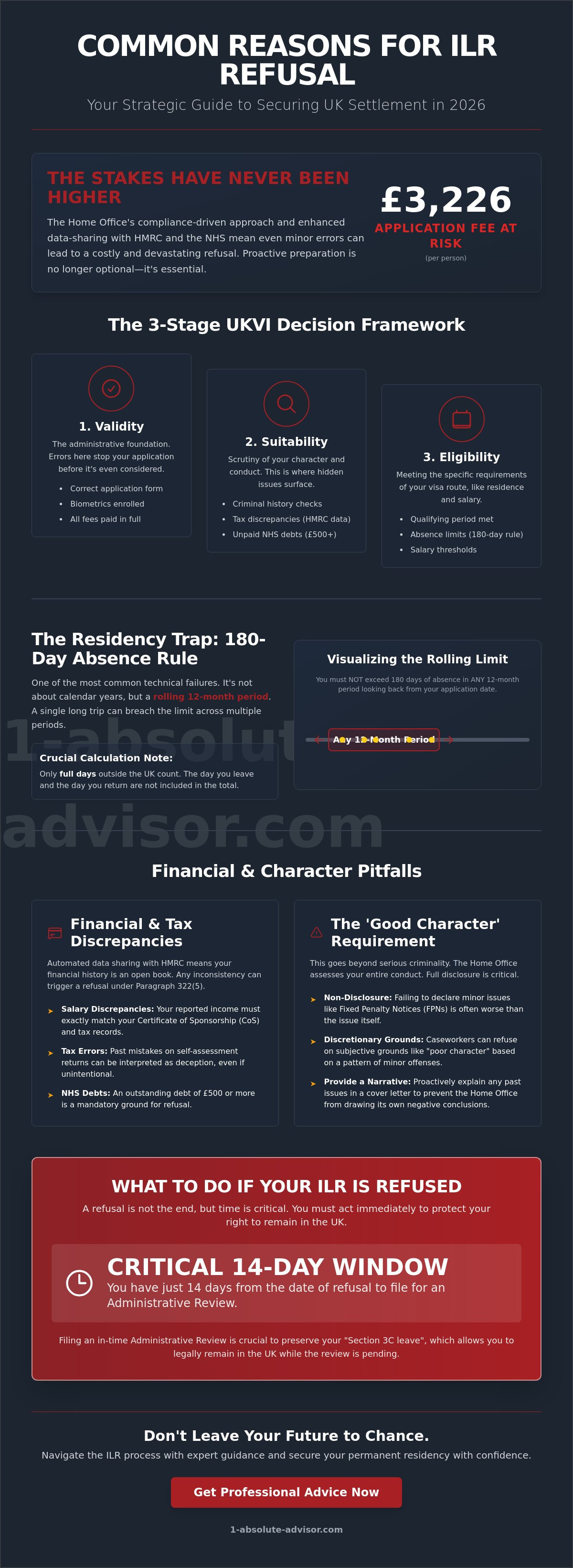
In 2026, the Home Office evaluates applications through a strict hierarchy of requirements. Modern caseworkers rely heavily on automated data-sharing systems that link the Home Office directly with HMRC, local councils, and the NHS. This integrated approach allows officials to verify your history instantly, making it impossible to hide past errors. The decision framework generally follows three stages:
- Validity: These are the administrative prerequisites, such as using the correct form, enrolling biometrics, and paying the required fees.
- Suitability: This stage scrutinizes your character and conduct, including any criminal history, tax discrepancies, or unpaid NHS debts of £500 or more.
- Eligibility: Here, the caseworker confirms you’ve met the specific rules of your visa route, such as the residency period and the 180-day absence limit.
Mandatory vs. Discretionary Refusal Grounds
The Immigration Rules divide refusal grounds into two distinct categories. Mandatory grounds leave the caseworker with no choice; if you have provided false representations or have a specific criminal record, the application must be refused. Discretionary grounds are more nuanced because the caseworker may refuse based on your history, such as persistent minor offenses or “poor character” indicators. Because discretionary decisions are often subjective, it’s vital to provide a proactive narrative that explains any past issues before the Home Office draws its own conclusions.
The Burden of Proof: Why the Applicant Must Prove Eligibility
Achieving Indefinite Leave to Remain requires you to meet the civil standard of proof, which is the “balance of probabilities.” You must prove it’s more likely than not that you meet every single requirement. It’s a common misconception that caseworkers have a duty to request missing information. In reality, the Home Office can refuse an application simply because the evidence provided was insufficient or not contemporaneous. You shouldn’t rely on assertions; every claim in your application must be supported by verifiable documentation, such as bank statements or official employer letters, to ensure a successful outcome.
The Residency Trap: Excessive Absences and the 180-Day Rule
Maintaining continuous residence is perhaps the most quantifiable yet frequently misunderstood aspect of the settlement process. One of the most common reasons for ilr refusal stems from applicants exceeding the 180-day limit within any rolling 12-month period during their qualifying years. Unlike older versions of the rules that looked at fixed annual blocks, the current framework requires you to ensure that at no point did your total absences exceed 180 days in any consecutive 12 months. This rolling calculation means that a single extended trip can potentially impact multiple 12-month windows, leading to an immediate rejection if your timeline isn’t managed with professional foresight.
Errors often occur when applicants rely on their own memory or flight bookings rather than official entry and exit records. The Home Office calculates these dates precisely; however, it’s a common relief to note that the day you depart the UK and the day you return don’t count as full days of absence. Only full days spent outside the country are tallied. If you’ve travelled frequently for work or personal reasons, a discrepancy of even 24 hours between your records and the Home Office’s digital data can trigger a refusal. Accuracy is not just a preference; it’s a mandatory requirement for a successful grant.
Exceptional Circumstances for Excessive Absences
If you have exceeded the 180-day limit, the caseworker has the discretion to overlook the breach if it was caused by “compelling or compassionate” reasons. This doesn’t include general work commitments or extended holidays. Instead, you must provide robust evidence of serious illness, natural disasters, or significant travel restrictions. When drafting a legal cover letter to explain these gaps, you should align your narrative with the good character requirement, ensuring total transparency about why you couldn’t return to the UK sooner. Assertions alone won’t suffice; you’ll need medical certificates or official government notices to support your claim.
Proving Continuous Residence Beyond Travel Dates
While passport stamps and digital records are primary, the Home Office often looks for secondary evidence to confirm you’ve truly maintained your life in the UK. This is particularly relevant for those using the 10-year route, where residency nuances are more complex. You should be prepared to provide council tax statements, utility bills, and employment records that cover the entire period. Ensuring these documents are organized chronologically can prevent a caseworker from doubting the continuity of your stay. If you’re unsure how your specific travel history fits into the rules, you might consider a professional Document Checking Service to verify your data. Correctly calculating your 5-year qualifying period is the foundation upon which your entire settlement future is built.
Financial and Tax Discrepancies: The Section 322(5) “Gotcha”
Financial scrutiny has become a cornerstone of the Home Office’s decision-making process in 2026. One of the most common reasons for ilr refusal involves discrepancies between the salary figures listed on a Certificate of Sponsorship (CoS) and the actual income received by the applicant. When your bank statements or HMRC records show a lower salary than what was promised to secure your visa, caseworkers often interpret this as a breach of your visa conditions. This isn’t merely an administrative error; it’s viewed as a failure to meet the core eligibility criteria for settlement.
The stakes are particularly high under Section 322(5) of the Immigration Rules. This provision allows the Home Office to refuse an application based on “bad character” or “dishonesty” if they find significant inconsistencies in your tax affairs. If you’ve declared one income to the Home Office for visa purposes and a different, lower income to HMRC to reduce your tax liability, the resulting refusal is often mandatory. Reconciling your HMRC self-assessment records with your ILR application before submission is a non-negotiable step for anyone with complex income streams.
HMRC Data Matching: The Home Office’s Digital Eyes
The integration of Real-time Information (RTI) sharing between HMRC and UKVI means that caseworkers no longer rely solely on the documents you provide. They can instantly verify your declared income against your tax contributions. If your bank statements show regular deposits that haven’t been declared to HMRC, or if your tax amendments were made only after you realized an ILR application was approaching, it triggers immediate suspicion. Addressing past tax errors requires a proactive approach; you must explain any amendments through professional representations to avoid a “bad character” finding that could bar you from future applications.
Inadequate Financial Evidence: Form vs. Substance
Even if you meet the financial thresholds, your application can fail due to the format of your evidence. The Home Office maintains strict rules on bank statement formats, frequently rejecting digital screenshots or uncertified copies that lack essential details like the bank’s logo or the applicant’s full name. For those on the 5-year route, you should consult the Skilled Worker Visa definitive guide to ensure your salary meets the specific 2026 thresholds. Self-employed applicants under Appendix FM face even higher evidentiary burdens, requiring precisely formatted profit and loss accounts and specific tax documents that prove the substance of their financial claims.
Suitability and the ‘Good Character’ Requirement: Beyond Criminality
The Home Office’s assessment of an applicant’s “suitability” has evolved into a broad and often discretionary examination of their entire life in the UK. While many individuals believe that only serious criminal convictions lead to a rejection, the reality in 2026 is far more complex. The “good character” requirement now grants caseworkers the power to refuse applications based on a wide range of non-criminal factors, including financial irresponsibility and past immigration breaches. Understanding these nuances is vital, as suitability issues have become one of the most common reasons for ilr refusal among otherwise eligible applicants.
Financial conduct is now under intense scrutiny due to enhanced data-sharing protocols between the Home Office, the NHS, and local authorities. As of 2026, any unpaid NHS debt of £500 or more is a standard ground for refusal. Similarly, persistent council tax arrears or litigation debts owed to the government can signal a failure to meet the suitability threshold. Even if you’ve lived in the UK for the required five or ten years, these financial “red flags” allow caseworkers to conclude that your presence is not conducive to the public good.
The Danger of Non-Disclosure and Deception
The most frequent trap for applicants is the failure to disclose minor legal encounters. You must declare all non-custodial sentences, cautions, and even Fixed Penalty Notices (FPNs) for driving offenses. Caseworkers rarely view an omission as a simple mistake; instead, they often categorize it as “dishonesty” or “deception.” Under the current rules, a finding of deception can trigger a mandatory 10-year ban on future applications. If you’re unsure about your recorded history, performing a “subject access request” (SAR) is a prudent step to see exactly what information the Home Office holds before you submit your form.
Public Interest and “Bad Character”
The Home Office also considers your broader conduct and associations. This includes any history of overstaying or working in breach of your visa conditions, even if those issues were resolved years ago. While minor breaches can sometimes be mitigated through professional legal representations, they must be addressed head-on rather than ignored. It’s helpful to review the British Citizenship good character guidance, as the standards applied during the naturalisation stage are often a precursor to the scrutiny you’ll face during your settlement application.
If you’re concerned that a past mistake or an outstanding debt might jeopardize your future, our Indefinite Leave to Remain (ILR) Application Service provides a comprehensive suitability audit to identify and resolve these risks before they reach a caseworker’s desk.
What to Do If Your ILR Is Refused: Appeals and Next Steps
Receiving a refusal letter is a distressing moment, but it’s not necessarily the end of your UK residency. The Home Office’s decision letter will specify the grounds for rejection, often citing the common reasons for ilr refusal we’ve discussed, such as absence miscalculations or suitability issues. Your immediate priority is to identify whether you’ve been granted a “right of appeal” or an “administrative review.” This distinction is critical because it dictates your legal strategy and determines how you can challenge the caseworker’s findings. Identifying the specific error in the decision is the first step toward a successful resolution.
You must act within 14 days of receiving the decision if you’re currently inside the UK. This window is vital for maintaining your Section 3C leave, which protects your right to work and stay in the country while your challenge is pending. If you miss this deadline, you risk becoming an overstayer, which complicates any future attempts at settlement and may trigger the “bad character” provisions in subsequent applications. Speed and precision are your most valuable assets during this period.
Administrative Review (AR) vs. Full Appeal
An Administrative Review (AR) is the appropriate route when the Home Office has made a “case-working error.” This might include miscalculating your 180-day rolling period or overlooking a document you already submitted. It’s generally a methodical process designed to correct simple mistakes. However, if your refusal involves human rights grounds, such as Article 8 (right to family life), you may have a right to a full appeal before an independent judge. While appeals offer a more comprehensive hearing where you can present oral evidence, they follow a much longer timeline than an AR.
In cases where the decision is “unreasonable” or “irrational” and no other appeal rights exist, a Judicial Review (JR) may be the last resort. Alternatively, if the refusal was based on missing evidence that you can now provide, submitting a “Fresh Application” is sometimes more efficient than entering a lengthy legal battle. Every case requires a unique assessment to determine which path offers the highest probability of success.
Mitigating the Damage: Professional Legal Intervention
A refusal doesn’t always require a fight; sometimes it requires a better explanation. A legal cover letter from an OISC-registered advisor can bridge the gap between your evidence and the caseworker’s understanding. This is especially true for discretionary refusals where the “balance of probabilities” wasn’t met. By gathering new, contemporaneous evidence or clarifying past tax amendments, you can often turn a rejection into a grant. To avoid these complications entirely, it’s highly recommended to contact 1 Absolute Advisor for a professional document check before you hit submit on your next application.
Securing Your Permanent Residency in 2026
The path to settlement is more than a five-year wait; it’s a rigorous compliance exercise that demands absolute precision. By understanding the common reasons for ilr refusal, from the intricacies of the rolling 180-day absence rule to the high stakes of HMRC data matching, you can move from a position of risk to one of strategic certainty. A successful grant depends on your ability to present contemporaneous evidence that leaves no room for caseworker discretion or suitability concerns.
While the regulatory environment is increasingly complex, you don’t have to navigate these requirements alone. At 1 Absolute Advisor, our OISC-registered immigration consultants specialize in fixed-fee application management and possess deep expertise in resolving complex ILR suitability cases. Whether you’re concerned about past tax amendments or residency gaps, we provide the professional oversight necessary to protect your life in the UK.
Secure your UK settlement with a professional ILR document review and take the final step toward your permanent residency with confidence. Your future in the UK is an investment worth protecting with the highest level of professional integrity.
Frequently Asked Questions
Can my ILR be refused for a speeding fine?
Yes, a speeding fine can lead to a refusal if you fail to disclose it on your application. While a single Fixed Penalty Notice (FPN) usually isn’t a mandatory ground for rejection, the Home Office views non-disclosure as “dishonesty” or “deception.” This remains one of the most avoidable yet common reasons for ilr refusal. You must declare every legal encounter, regardless of how minor it seems, to satisfy the suitability requirements.
What happens to my right to work if my ILR is refused?
Your right to work remains protected under Section 3C leave as long as you submit a challenge, such as an Administrative Review, within the 14-day deadline. If you fail to act within this window or your appeal rights are exhausted, your current leave ends immediately. At that point, you lose the legal right to work and may be required to leave the UK. Maintaining valid leave throughout the process is essential for your security.
How many days can I spend outside the UK for ILR in 2026?
You’re permitted to spend no more than 180 days outside the UK in any rolling 12-month period during your qualifying years. This rule is strictly enforced for all applications processed in 2026. The Home Office uses a rolling calculation, which means any consecutive 12-month window throughout your residency is scrutinized. Exceeding this limit without proving compelling or compassionate circumstances will lead to a refusal of your settlement.
Can I apply for ILR again if I have been refused once?
You can submit a fresh application if your previous ILR was refused, provided you still have valid leave or apply within the permitted grace period. However, if your refusal was based on a finding of deception or “bad character,” you may face a mandatory 10-year ban on future applications. It’s often more effective to rectify the original error through a new submission than to pursue a lengthy and uncertain appeal process.
Does a tax amendment with HMRC cause an ILR refusal?
A tax amendment can trigger a refusal if the Home Office suspects the change was made solely to meet visa requirements or to hide previous under-declarations. Real-time data sharing between HMRC and UKVI allows caseworkers to identify inconsistencies between your declared income and your tax contributions. If your financial affairs don’t match your immigration records, you risk a refusal under Section 322(5) for dishonesty.
What is the most common reason for ILR refusal for Skilled Workers?
Salary discrepancies between the Certificate of Sponsorship (CoS) and the actual pay received are the most frequent cause for refusal among Skilled Workers. In late 2025, over 3,100 employers lost their sponsor licences, which directly affected the settlement eligibility of their sponsored staff. If your salary falls below the 2026 thresholds or your employer’s compliance record is compromised, your application is at significant risk of rejection.
How long does an ILR appeal take in 2026?
The duration of an appeal depends on whether you’re pursuing an Administrative Review or a full Tribunal appeal. An Administrative Review typically takes between 28 days and three months, while a full appeal before the First-tier Tribunal can take 6 to 12 months. During this time, your Section 3C leave generally remains in place, which allows you to continue living and working in the UK legally while awaiting a decision.
Can I get a refund of my application fee if my ILR is refused?
No, the Home Office doesn’t refund the standard application fee of £3,226 if your ILR is refused. Fees are only refunded if an application is found to be “invalid” before the caseworker begins the assessment process. Once a formal decision has been issued, the payment is retained by the government regardless of the outcome, making it vital to ensure your application is correct the first time.