

Most applicants view Indefinite Leave to Remain as a simple final hurdle, but the Home Office treats it as a forensic audit of your entire five-year life in the United Kingdom. One minor oversight in your 28-day submission window or a single gap in your cohabitation evidence can lead to a refusal, risking the stability of the life you’ve built here. You’ve likely spent years worrying about the shifting £29,000 financial threshold or the stress of documenting every address change since you arrived. It’s natural to feel overwhelmed by the complexity of the current immigration landscape and the rising costs of settlement.
For many couples, proving a subsisting relationship involves documenting significant cultural milestones; those planning traditional celebrations can utilize Shaadi Prep to organize Asian weddings in the UK, ensuring these important life events are well-managed as they build their future together.
Our expert-led 2026 guide ensures you master the complexities of applying for ilr after spouse visa by providing a precise roadmap through the latest requirements. We’ll help you navigate the £3,226 application fee structure and the specific documentation needed to guarantee a successful outcome. By following this strategic approach, you’ll gain the permanent right to remain and a clear, predictable path toward British Citizenship. This article details the essential evidence, financial criteria, and timing strategies you need to secure your future without the fear of rejection.
Key Takeaways
- Learn how to calculate your eligibility date with precision to avoid a refusal, since even a one-day error in the 28-day window can lead to a rejected submission.
- Understand how the current £29,000 income threshold affects your case and whether you qualify for transitional arrangements based on your initial visa date.
- Master the specific evidence requirements for applying for ilr after spouse visa, including the “6-6-6” rule for documenting five years of continuous cohabitation.
- Identify the exact English language certifications and Life in the UK test standards you’ll need to satisfy the Home Office suitability criteria.
- Determine if the Super Priority service is the right strategic choice for your SET(M) application to accelerate your path to British Citizenship.
Understanding the 5-Year Route and the 28-Day Application Window
Securing Indefinite Leave to Remain (ILR) is the definitive milestone for any partner of a British citizen or settled person. This status, often referred to as settlement, grants you the right to live and work in the UK without time restrictions. It’s the essential bridge between temporary residence and British citizenship. However, the process of applying for ilr after spouse visa is governed by strict chronological requirements that leave no room for error. The Home Office views this application as a final verification of your five-year history in the country.
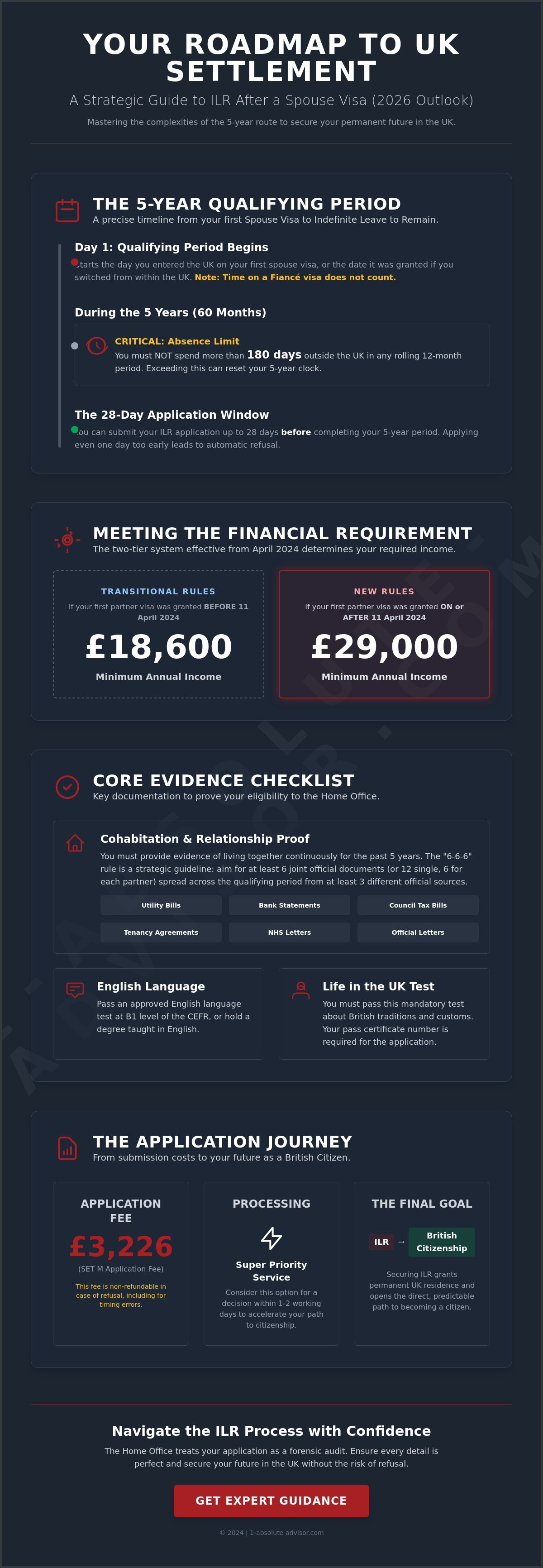
The standard qualifying period spans exactly five years, or 60 months, of continuous leave. During this time, you must maintain your primary residence in the UK. The Home Office enforces a strict absence limit: you cannot spend more than 180 days outside the country in any rolling 12-month period. Exceeding this limit can break your continuity of residence. This often resets your clock and forces you to seek further extensions instead of settlement. Accurate record-keeping of every trip abroad is vital for a successful submission.
Calculating Your Eligibility Date
Determining your precise application date is the first step in any successful strategy. For most, the five-year clock begins on the day you entered the UK with your initial spouse visa. If you switched to this route from within the UK, the start date is the day your first partner visa was granted. It’s vital to remember that time spent on a Fiancé visa is excluded from this calculation. This often causes confusion, as applicants assume their entire residency counts. In reality, the qualifying period only starts once you have transitioned to the spouse visa route. Meticulous planning when applying for ilr after spouse visa prevents costly timing mistakes.
The Risks of Early or Late Submission
The Home Office permits you to submit your application up to 28 days before you complete your five-year qualifying period. This window is a strict legal boundary. Applying even one day before this 28-day threshold results in an automatic refusal. Given the £3,226 application fee is non-refundable in these cases, timing is a high-stakes decision. If your current visa expires shortly before you hit the five-year mark, you must apply for an extension to remain legal. If you apply within the 28-day window or while your current visa is still valid, Section 3C leave protects your status. This legal mechanism ensures your rights to work and access the NHS continue while your settlement application is being processed.
Meeting the Financial Requirement: 2024 Rules and 2026 Realities
The financial landscape for settlement changed significantly in April 2024, creating a two-tier system for those reaching their five-year milestone. For those applying for ilr after spouse visa in 2026, understanding which threshold applies to your specific case is the difference between a grant and a refusal. The standard minimum income requirement now stands at £29,000 per year. This represents a substantial increase from the previous £18,600 limit. However, the Home Office has maintained transitional protections for families who entered the route under the older rules.
You can meet this requirement through a variety of sources, including gross salary, self-employment income, or director dividends. Cash savings remain a popular alternative or supplement, though the calculation requires careful attention to the 2026 multiplier rules. If you’re unsure how your diverse income streams combine to meet the Home Office’s strict criteria, our Indefinite Leave to Remain (ILR) Application Service provides a definitive assessment to ensure your figures are beyond reproach.
The Transitional Financial Requirement
The distinction between the £18,600 and £29,000 thresholds depends entirely on your initial entry date into the spouse route. If you successfully applied for your first partner visa before April 11, 2024, you’re eligible for the lower “old” rate of £18,600. Those who joined the route after this date must meet the higher £29,000 mark. Furthermore, applicants whose partners receive specific disability benefits may qualify for the “adequate maintenance” exemption, which replaces the fixed income threshold with a calculation based on net income after housing costs.
Evidencing Your Income: The 6-Month Rule
The Home Office categorizes income based on the duration and nature of your employment. Category A applies if you’ve been with the same employer for at least six months, while Category B is used for those with shorter tenures or variable income. You must provide a comprehensive audit trail that matches your reported earnings exactly. According to official UK government guidance, bank statements must be original or stamped by the bank and must correspond perfectly with your payslips.
A single discrepancy between your employer’s letter and your bank deposits is a leading cause of application failure. Your employer’s letter must explicitly state your gross salary, your length of employment, and the type of contract you hold. Even a missing signature or an undated letter can trigger a forensic rejection. Precision in this evidence phase is non-negotiable for anyone seeking permanent settlement in 2026. Every document must be scanned and uploaded in high quality to avoid delays during the digital review process.
Evidencing Your Life Together: The Cohabitation and Relationship Audit
Settlement is not merely a test of financial stability; it is a rigorous verification of the enduring nature of your partnership. When applying for ilr after spouse visa, you must demonstrate that your relationship has remained genuine and subsisting throughout your five-year stay. The Home Office focuses specifically on your cohabitation history since your last visa extension, requiring an unbroken paper trail that proves you and your partner share a home and life in the United Kingdom. This phase of the application is often the most labor-intensive, as it requires gathering documents from multiple sources to satisfy the strict “6-6-6” rule.
The Home Office categorizes evidence into tiers. The “Gold Standard” includes documents from government departments, local authorities, or utility providers. Think of council tax bills, HMRC correspondence, and water or energy statements. If you lack joint documents, you must provide twice as many individual documents addressed to the same residence. For couples who have faced periods of separation due to work or family emergencies, you must provide a detailed explanation. The Home Office only accepts “compelling” reasons for living apart, and even then, you must prove the relationship remained active through communication and financial support.
The 2-Year Cohabitation Document Checklist
You must provide at least six items of correspondence addressed to you and your partner jointly, or twelve items addressed to you individually at the same address. These documents must come from at least three different sources and be spread evenly across the last 24 to 30 months. If you find gaps in your utility or tax records, secondary evidence such as GP letters, polling cards, or bank statements can serve as effective fillers. Our Document Checking Service can help verify that your timeline is complete and your sources meet the necessary evidentiary weight.
Proving a “Subsisting” Relationship in 2026
While cohabitation documents are the primary focus, the “subsisting relationship” requirement remains a core pillar of the assessment. You’ll need to sign a formal declaration of your intention to live together permanently in the UK. In 2026, caseworkers rarely require photos or chat logs if your cohabitation evidence is robust. However, if you’ve recently moved house or have a non-traditional living arrangement, including a brief selection of photographs from the last two years can provide helpful context. If you moved recently, ensure your driving licenses and bank records were updated immediately, as mismatched addresses on key documents are a common red flag that triggers further scrutiny.
Knowledge of Language, Life in the UK, and the Suitability Test
While financial stability and cohabitation form the foundation of your case, the Home Office also requires proof of your successful integration into British society. This stage of applying for ilr after spouse visa focuses on your personal history and your ability to communicate effectively in English. These requirements aren’t just checkboxes; they’re statutory obligations that caseworkers examine with the same level of scrutiny as your bank statements. Failing to meet the language or suitability standards leads to immediate refusal, regardless of how long you’ve lived in the country. It’s the point where your personal conduct becomes as important as your marriage.
Language and Life in the UK Requirements
You must pass the Life in the UK test, which currently costs £50 per attempt. Once you achieve a passing score, the certificate has no expiry date, so you don’t need to retake it if you used it for a previous application. For the English language requirement, you need to reach CEFR Level B1 in speaking and listening. These tests must be taken with a provider approved by the Home Office, with fees typically ranging between £150 and £200. We’ve compiled a detailed resource on How to Pass the Life in the UK Test to help you prepare effectively. Certain applicants are exempt from these tests, specifically those aged 65 or over and individuals with long-term physical or mental conditions that make meeting the requirement impossible.
The Suitability Audit: Protecting Your Application
The suitability test is perhaps the most overlooked aspect of the settlement process. The Home Office conducts a comprehensive background check to ensure you meet the “good character” requirement. This audit goes beyond serious criminal convictions. Caseworkers look for patterns of behavior that suggest a disregard for the law, including County Court Judgments (CCJs), unpaid taxes, or persistent traffic offenses. If you have any concerns regarding your personal history or past legal issues, our Indefinite Leave to Remain (ILR) Application Service provides a professional assessment of your suitability before you submit your SET(M) form.
Honesty is the only viable strategy during this phase of applying for ilr after spouse visa. You must disclose all previous issues, including non-custodial sentences, cautions, or even minor fixed penalty notices. Attempting to hide a minor incident is often viewed as deception, which carries a mandatory refusal and can lead to a ten-year ban on future applications. Even if a conviction is considered “spent” under the Rehabilitation of Offenders Act, it must still be declared on your immigration application. This transparency is vital, as the suitability standards for settlement are the same ones used when you eventually apply for British citizenship. Even non-custodial sentences or police cautions must be disclosed to maintain the integrity of your application.
The Application Journey: From Submission to British Citizenship
The SET(M) online form represents the final administrative hurdle in your five-year residency. When applying for ilr after spouse visa, the transition from applicant to settled resident occurs the moment your biometric information is verified and your digital file is reviewed by a Home Office caseworker. This process is now entirely digital, allowing you to retain your physical passport while your application is pending. This is a significant procedural advantage, as it ensures you don’t lose your ability to travel or prove your identity during the standard processing window. However, you must remain in the UK, Ireland, or the Crown Dependencies until a decision is made to avoid your application being treated as withdrawn.
Choosing between service levels is a strategic decision that depends on your need for certainty. While the standard processing time can extend up to six months, the Super Priority service offers a decision by the end of the next working day for an additional £1,000 fee. In 2026, many families choose this route to eliminate the prolonged anxiety of a pending status and to finalize their settlement without delay. Once you’ve submitted the form and paid the £3,226 fee, you’ll book an appointment at a UKVCAS center to provide your fingerprints and a digital photograph.
Submission and Decision Timelines
The 24-hour decision window offered by the Super Priority service is a powerful tool for those who require immediate results. If the Home Office requires additional documentation or clarification, they’ll issue a Request for Further Information (RFI). Responding to an RFI with absolute precision is critical; any delay or insufficient response can pause your application and move it out of the priority queue. It’s essential to monitor your communication channels daily after submission, as the Home Office often provides short deadlines for these supplemental requests.
Why Professional Representation is Essential
The complexity of a five-year residency means that “hidden” risks, such as minor gaps in cohabitation or nuanced financial discrepancies, often go unnoticed by the untrained eye. Our team at 1 Absolute Advisor specializes in identifying these vulnerabilities before they reach a caseworker. We provide a comprehensive legal cover letter that frames your evidence within the context of current immigration law, ensuring that your narrative is clear and compelling. For a deeper understanding of the entire process, you should consult our ILR UK: The Complete Guide.
Once your ILR is granted, you achieve total freedom from immigration control. For those married to a British citizen, the path to naturalisation is significantly shorter than other routes. You don’t necessarily have to wait a full 12 months after receiving ILR to apply for British citizenship, provided you’ve lived in the UK for at least three years and meet the other residency requirements. This final step completes your journey from a temporary resident to a permanent member of British society. Secure your future in the UK with our expert ILR management service and ensure your transition to settlement is handled with the professional integrity it deserves.
Securing Your Permanent Future in the United Kingdom
Transitioning to Indefinite Leave to Remain is a transformative milestone that demands absolute precision in both timing and documentation. You’ve now seen how the 28-day application window, the tiered financial thresholds, and the forensic cohabitation audit form the backbone of a successful submission. Successfully applying for ilr after spouse visa represents more than just a legal status change; it’s the final hurdle before achieving total freedom from immigration control and a direct path to British citizenship. Precision is paramount.
Professional oversight is a strategic investment in your family’s stability, especially given the non-refundable £3,226 application fee. Our OISC-registered expert advisors specialize in fixed-fee application management, maintaining a high success rate even for complex settlement cases involving diverse income streams or evidence gaps. We provide the technical expertise needed to frame your history accurately for the Home Office. Book a consultation for your ILR application today to manage your transition with absolute confidence. Your permanent future in the UK is the priority, and we’re ready to help you secure it.
Frequently Asked Questions
Can I apply for ILR if my spouse visa has already expired?
You cannot submit a valid application for settlement if your current leave has already expired. Applying as an overstayer is extremely risky and typically leads to a refusal unless there are exceptional circumstances beyond your control. It’s essential to submit your SET(M) form within the 28-day window before your current visa expires. This ensures your legal status is maintained under Section 3C leave while the Home Office processes your case.
What happens to my ILR application if my relationship ends during the process?
If your relationship ends before a decision is made, you’re no longer eligible for settlement under the partner route. You have a legal obligation to inform the Home Office of this change in your circumstances immediately. Continuing with the application after a separation is considered deception. This carries severe consequences, including a potential ten-year ban on future UK visa applications and the loss of your right to remain in the country.
Navigating a separation while managing immigration requirements is complex. For those with international legal needs, such as English-speakers with ties to Israel, you can explore Divorce Proceedings Representation through the Salior Ben Hamou Law Office to ensure your interests are professionally managed.
How much does it cost to apply for ILR after a spouse visa in 2026?
The standard Home Office fee for applying for ilr after spouse visa in 2026 is £3,226 per applicant. You must also account for the £19.20 biometric enrolment fee and the £50 Life in the UK test cost. If you need to take a B1 English test, expect to pay between £150 and £200 depending on the provider. Fortunately, the Immigration Health Surcharge isn’t required for Indefinite Leave to Remain applications.
Can I include my children in my ILR application from a spouse visa?
You can include your children as dependents on your application provided they’re currently in the UK on a valid dependent visa. Each child must pay the full £3,226 application fee and provide their own biometric information. Children over the age of 18 must also meet the Knowledge of Language and Life in the UK requirements. It’s vital to ensure their residency history aligns with your own to avoid individual refusals within a family group.
Do I need to retake the English test if I passed it for my initial spouse visa?
You’ll likely need to take a new test because settlement requires a B1 level on the CEFR scale, which is higher than the A1 level usually required for initial entry. If you already passed a B1 level test for your most recent visa extension, you don’t need to retake it. Always verify that your previous test provider remains on the Home Office’s approved list for 2026. This prevents a refusal based on an invalid qualification.
How many days can I spend outside the UK before I am ineligible for ILR?
You must not spend more than 180 days outside the United Kingdom in any rolling 12-month period during your five-year qualifying stay. Exceeding this limit breaks the continuity of your residence and typically makes you ineligible for settlement. Caseworkers examine your travel history thoroughly when you’re applying for ilr after spouse visa. Keeping an accurate log of all departures and arrivals is a vital part of your preparation to ensure you meet this residency requirement.
What is the Super Priority service for ILR and how long does it take?
The Super Priority service is an optional expedited processing route that costs an additional £1,000. It aims to provide a decision by the end of the next working day after your biometric appointment. This service is a strategic choice for those who require immediate certainty or need to travel urgently. Given that the standard processing time can take up to six months, the Super Priority service offers significant peace of mind during a high-stakes transition.
Is there a minimum salary requirement for ILR after a spouse visa?
There is a mandatory financial threshold that most applicants must meet to qualify for settlement. For those who entered the spouse visa route after April 11, 2024, the minimum income requirement is £29,000 per year. If you were already on the partner route before that date, you’re protected by transitional arrangements and only need to meet the older £18,600 threshold. You must provide six months of evidence to prove this income is stable and ongoing.