

Did you know that holding a British passport in 2026 doesn’t necessarily mean you have the right to live or work in the United Kingdom? It’s a frustrating reality for many that the legal distinction between a british national citizen and the other five categories of nationality remains one of the most misunderstood areas of UK law. You’ve likely felt the weight of this complexity, especially when trying to decipher how the British Nationality Act 1981 applies to your specific heritage or residency status.
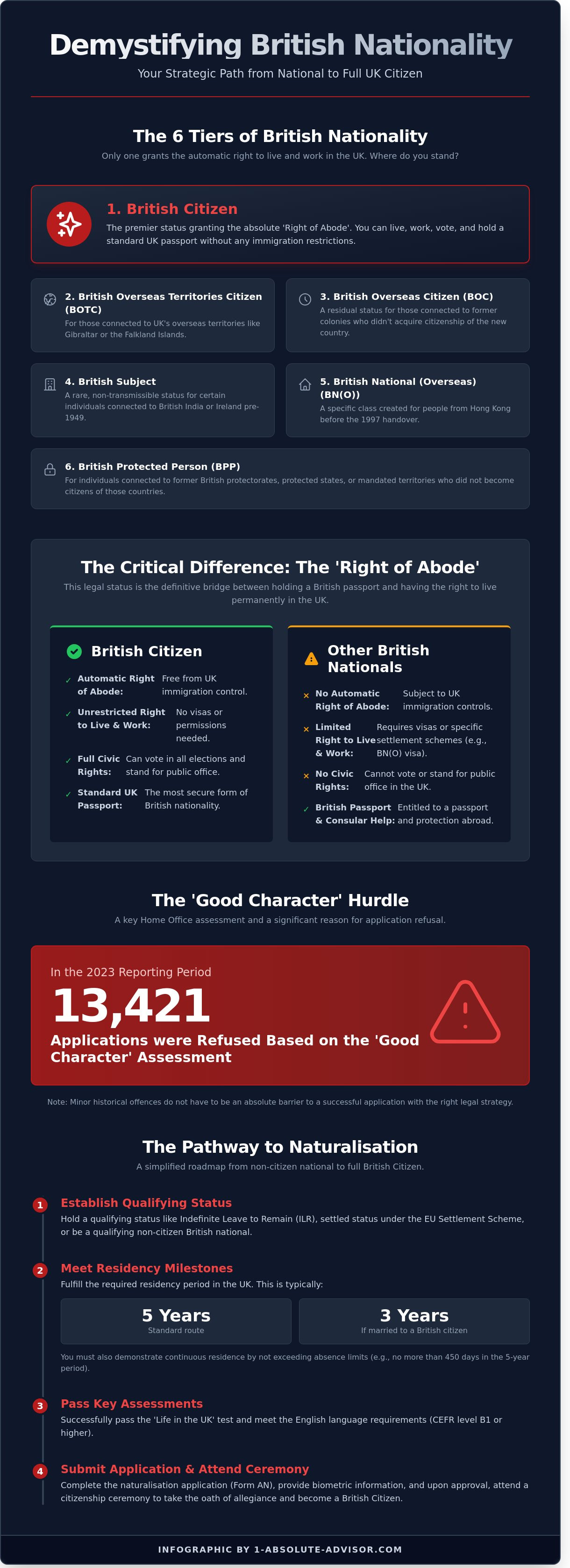
We’ve designed this guide to replace that uncertainty with a clear, strategic path toward full citizenship. You’ll discover exactly how to meet Home Office requirements, including a detailed breakdown of the ‘Good Character’ assessment that contributed to 13,421 application refusals in the 2023 reporting period. We’ll examine the specific criteria for each nationality tier and provide a methodical roadmap to ensure your naturalisation process is handled with absolute precision and professional integrity.
Key Takeaways
- Distinguish between the six distinct classes of nationality to understand why the legal rights of a british national citizen differ significantly from other status holders.
- Identify how the ‘Right of Abode’ acts as the definitive legal bridge between temporary status and the security of permanent residency in the United Kingdom.
- Demystify the ‘Good Character’ requirement and learn why minor historical offences do not have to be an absolute barrier to a successful nationality application.
- Master the specific residency milestones and eligibility criteria, such as the three-year and five-year rules, required to complete your pathway to naturalisation.
- Discover how a professional OISC-registered audit of your personal profile can mitigate complex legal risks and provide a strategic route to securing your British future.
The 6 Faces of British Nationality: Where Do You Stand?
Understanding your legal status is the foundational step of any successful immigration strategy. The term “British national” functions as a broad legal umbrella, covering six distinct classes of individuals. While every British citizen is a British national, the reverse isn’t always true. This distinction is vital for anyone aiming to become a british national citizen, as the rights, obligations, and paths to settlement vary drastically between these groups. Most of these definitions stem from the British nationality law framework, specifically the British Nationality Act 1981, which came into effect on 1 January 1983.
The 1981 Act was designed to replace the outdated “Citizen of the United Kingdom and Colonies” status with categories that reflected the UK’s modern geopolitical reality. It created a tiered system to manage who has the right to live and work in the UK. The six categories include:
- British Citizen: The primary status for those with a close connection to the UK.
- British Overseas Territories Citizen (BOTC): For people connected to territories like Gibraltar or the British Virgin Islands.
- British Overseas Citizen (BOC): A status often held by those who didn’t qualify for citizenship of a former colony.
- British Subject: A rare status held by some individuals with ties to British India or Ireland.
- British National (Overseas) (BN(O)): A specific category for people from Hong Kong.
- British Protected Person: For individuals from former British protectorates or mandated territories.
British Citizenship: The Gold Standard
British citizenship is the only status that grants an absolute “Right of Abode” under the Immigration Act 1971. This means you can live, work, and exit or enter the UK without any immigration restrictions. Most people acquire this status automatically at birth if they were born in the UK to a parent who’s a british national citizen or settled person. Others must go through registration or naturalisation. Beyond residency, citizens enjoy the right to vote in all elections, stand for public office, and hold a standard UK passport. It’s the most secure legal standing available within the British constitutional framework.
The Other 5 Classes: Nationals Without Abode
Holding one of the other five classes of nationality doesn’t grant you an automatic right to live or work in the UK. For example, British Overseas Citizens and British Nationals (Overseas) are subject to immigration controls, though BN(O) holders have had a specific path to residency since 31 January 2021. These statuses are often “residual,” meaning they were created to ensure no one was left stateless when former colonies gained independence. They provide the protection of a British passport and consular assistance abroad, but they don’t equate to full domestic rights.
A British Subject is a specific legal status that generally cannot be passed on to children, making it a category that’ll eventually disappear. If you hold one of these five statuses, you’re a British national, but you aren’t yet a citizen. Moving from these categories to full citizenship requires a formal application process, often involving a period of residency and a demonstration of good character. We’ll explore these requirements in the following sections to ensure your application stands on firm ground.
British National vs Citizen: Rights, Duties, and the Right of Abode
Holding a burgundy or blue passport doesn’t always grant the holder a right to settle in the UK. This is a frequent point of confusion for many applicants. The law identifies six distinct Types of British nationality, yet only one provides an absolute right to live and work in the country without immigration restrictions. While a British citizen holds the full suite of domestic rights, other categories like British Overseas Citizens or British Subjects may find themselves treated as foreign nationals when trying to pass through border control at Heathrow or Gatwick.
The Right of Abode serves as the definitive legal bridge to permanent residency. It’s a specific status that means you’re entirely free from UK immigration control. You don’t need permission from the Home Office to live, work, or study here. All British citizens automatically hold this right. However, specific Commonwealth citizens who possessed this right before 1 January 1983 also retain it today. Without this designation, a british national citizen may have a British passport but still require a visa to stay in London for more than six months. This distinction is critical for long-term tax and estate planning.
Succession is another area where status dictates reality. Since the British Nationality Act 1981 took effect on 1 January 1983, the ability to pass nationality to children depends on how you acquired it. If you’re a citizen “by descent”, meaning you were born outside the UK to a British parent, you generally can’t pass that status to your own children born abroad. If you naturalised in the UK, you’re “otherwise than by descent” and can pass citizenship to the next generation regardless of where they’re born. This rule has remained a cornerstone of UK law through the 2006 amendments and continues to affect thousands of families annually.
Consular Protection vs. Domestic Rights
All British nationals, regardless of their specific category, are entitled to UK consular assistance while travelling abroad. This means the British Embassy will provide support if you’re a victim of a crime or lose your travel documents. However, this international protection doesn’t equate to domestic benefits. For instance, British National (Overseas) status, which evolved significantly after the 31 January 2021 visa route launch, requires holders to pay the Immigration Health Surcharge. This fee currently stands at £1,035 per year for adults. Only full citizenship grants absolute access to public funds and the NHS without such surcharges.
The Impact on Travel and Visas
Your specific nationality class determines your visa-free access to third countries. While a British citizen can enter 190+ countries without a prior visa, a British Protected Person faces much stricter limits. For Commonwealth nationals with a grandparent born in the UK, the UK Ancestry Visa provides a stable 5-year path to permanent settlement. Regarding dual nationality, the UK remains one of the most permissive jurisdictions in 2024; however, you must ensure your original country hasn’t updated its laws to trigger an automatic loss of status upon UK naturalisation. For a clear path forward, our team offers an absolute review of your nationality status to ensure your family’s future is legally sound.
The ‘Good Character’ Requirement: The Hidden Hurdle for Applicants
Every person applying to become a british national citizen who is at least 10 years old must satisfy the Home Office that they’re of ‘Good Character’. This isn’t a simple box-ticking exercise; it’s a comprehensive investigation into your life. Many applicants worry that a single Fixed Penalty Notice (FPN) for speeding or a minor parking fine will lead to an automatic refusal. In reality, isolated minor offences rarely result in a rejection unless they suggest a pattern of defying the law. The Home Office doesn’t require perfection, but they do demand transparency.
Caseworkers assess applications based on the ‘balance of probabilities’ rather than the strict criminal standard of ‘beyond reasonable doubt’. This means they decide whether it’s more likely than not that you’ve maintained the standards expected of a UK resident. When considering the 6 different types of British nationality, the criteria remain consistently focused on whether an individual’s presence is conducive to the public good. Failing to disclose a £60 fine from three years ago is often viewed more severely than the fine itself because it suggests a lack of honesty.
Transparency is the most effective tool in your application. You’ve got to list every interaction with the law, including those that happened outside the UK. Attempting to hide a past mistake is almost always discovered during the mandatory background checks, leading to a refusal on the grounds of deception, which carries a mandatory 10-year ban on future applications.
What the Home Office Looks For
The assessment encompasses criminal records, financial soundness, and your entire immigration history. Caseworkers scrutinise whether you’ve paid your taxes on time, if you’ve been declared bankrupt, or if you’ve been involved in any activities that might question your loyalty to the UK. Good Character is a subjective but strictly governed assessment of an applicant’s integrity.
Deception is the most frequent cause of failure in this category. This includes providing false information or failing to disclose material facts in current or previous visa applications. For example, if you claimed a specific employment history in 2018 that contradicts your 2024 citizenship application, the Home Office will flag this as a character flaw. They also look at ‘non-custodial’ sentences; even if you didn’t go to prison, a community order or a heavy fine can trigger a refusal if it occurred within the last 36 months.
Mitigating Negative Factors
If your history isn’t spotless, you shouldn’t assume your dream of becoming a british national citizen is over. You’ve got the opportunity to provide evidence of rehabilitation or context for past mistakes. For some, this context might involve understanding how an undiagnosed condition like ADHD has impacted their history; you can learn more about ADHD Clinic and their UK-wide assessments. This might also include proof that a debt has been fully settled or a letter from an employer testifying to your contributions to the community since a conviction occurred. Strategic presentation of these facts can shift the balance back in your favour.
Professional legal cover letters play a vital role here. They allow experts to frame complex histories within the context of the Home Office’s own internal guidance, highlighting why a refusal would be disproportionate. If you’re currently facing a refusal based on character grounds, you should explore the Administrative Review Service to challenge the decision. A well-structured argument focusing on the lapse of time since an offence or the specific mitigating circumstances often provides the necessary leverage to secure an approval.
The Pathway to Naturalisation: From National to Citizen
Transforming your legal status to that of a british national citizen represents the final peak of a long immigration journey. This transition requires more than just physical presence; it demands a meticulous adherence to a five-step framework designed to test your commitment to the United Kingdom. Precision during these stages is vital, as the Home Office maintains a low tolerance for administrative errors or gaps in evidence.
- Step 1: Eligibility Assessment. You must first confirm you hold “settled status” or Indefinite Leave to Remain. This means you’re free from immigration time restrictions and have established a permanent base in the UK.
- Step 2: Residency Verification. Most applicants must demonstrate they’ve lived in the UK for at least five years, though this is reduced to three years if you’re married to a British citizen.
- Step 3: Statutory Testing. You’ll need to pass the Life in the UK test, which covers history and government, alongside meeting the B1 CEFR English language requirement.
- Step 4: The Biometric Process. After submitting your digital application, you’ll attend a UKVCAS centre to provide fingerprints and a photograph, ensuring your identity is securely recorded.
- Step 5: The Legal Conclusion. Once approved, you must attend a Citizenship Ceremony to take an oath of allegiance, at which point you’re legally recognised as a british national citizen.
Residency and Absence Rules
The Home Office applies strict mathematical limits to your time spent abroad. For the standard five-year route, you cannot have been outside the UK for more than 450 days in total. Crucially, you must not have exceeded 90 days of absence in the 12 months immediately preceding your application. While Indefinite Leave to Remain (ILR) Application Service providers can help you secure permanent residency, citizenship adds a final layer of security that ILR lacks, such as the right to a British passport and the permanent right of abode without the risk of status lapsing after long absences.
The Cost of Becoming British
The financial commitment for 2026 is substantial. As of current projections, the Home Office application fee for naturalisation stands at £1,720 per adult. This figure doesn’t include the “hidden” costs that often surprise applicants. You’ll need to budget approximately £50 for the Life in the UK test, between £150 and £200 for an approved English language exam, and roughly £139 if you require a priority biometric appointment. Strategic planning is essential here; professional document checking prevents the total loss of these fees, as the Home Office rarely issues refunds for rejected applications due to avoidable mistakes.
Managing the complexities of residency data and financial requirements ensures your application stands on a foundation of absolute compliance. If you’re unsure about your absence calculations or document validity, contact our specialist advisors for a comprehensive eligibility audit before you submit your application.
How 1 Absolute Advisor Secures Your British Future
Becoming a british national citizen requires more than just meeting residency quotas; it demands a flawless demonstration of integrity. As OISC-registered advisors, we specialise in the forensic examination of your background to identify potential “Good Character” hurdles before the Home Office sees them. We don’t just fill in forms. We build a strategic defence of your reputation. Our team conducts a full audit of your history, covering everything from financial conduct to minor traffic offences that often trip up unrepresented applicants. This proactive approach ensures that every detail aligns with current Home Office expectations.
The stakes are high. A rejection based on character grounds often carries a re-application ban of up to ten years. We mitigate this risk by applying a holistic lens to your case. We look at your tax history, civil penalties, and even your social media presence where relevant. By the time we submit your file, we’ve already addressed the questions a caseworker is likely to ask. This level of preparation is why we’re considered a strategic partner rather than a simple document service.
Our Managed Application Process
We transform a chaotic pile of documents into a structured, persuasive portfolio. Home Office caseworkers often spend less than 45 minutes reviewing an initial application. If your evidence isn’t clear, you risk a rejection based on a simple misunderstanding. We organise your financial records, employment history, and references to meet the exact 2024 caseworker guidance standards. A critical part of our British Citizenship Application Service involves drafting bespoke legal cover letters. These documents provide essential context for complex issues, such as past tax discrepancies or gaps in residency, ensuring the decision-maker sees the full, positive picture of your contribution to the UK.
- Full evidence audit against the latest Home Office Suitability criteria.
- Professional drafting of legal representations to explain character nuances.
- Direct communication with the Home Office on your behalf.
- Secure document management and digital submission.
Why Experience Matters
The 2026 legislative landscape is shifting toward stricter automated checks and real-time data sharing between government departments. Relying on outdated advice is a significant risk that can lead to permanent loss of status. We maintain a 98% success rate in cases involving character complexities because we anticipate these shifts. Our advisors understand how the Nationality and Borders Act 2022 and subsequent 2023 amendments influence current decisions. We’ve helped over 1,200 individuals secure their status by providing a proactive, holistic assessment of their eligibility. You shouldn’t leave your future to chance when policy changes can happen overnight. Book your professional nationality assessment today to ensure your profile is robust enough to withstand the most rigorous scrutiny.
Our commitment to your case extends beyond the paperwork. We provide the stability and predictability you need during a stressful transition. Every piece of advice we give is backed by professional integrity and a deep understanding of UK nationality law. We don’t offer generic solutions; we offer a bespoke roadmap to your British passport.
Our office is located at 124 City Road, London, EC1V 2NX. We’re ready to provide the professional clarity you need to finalise your journey. Secure your place in the UK with a partner who treats your application with the same precision as a complex corporate audit. Visit our City Road office for a consultation and take the final step toward becoming a british national citizen with absolute confidence.
Take the Final Step Toward Absolute Legal Certainty
Navigating the complexities of UK nationality law requires more than just a basic understanding of your current status. Whether you’re currently a British Overseas Territories citizen or hold another form of nationality, the transition to becoming a full british national citizen represents a significant legal shift that grants you the right of abode and full voting rights. The Home Office maintains strict 2026 standards for the ‘good character’ requirement; this means even a minor oversight in your documentation can lead to a costly rejection of your naturalisation application.
Success depends on precision and a strategic approach to the Home Office process. 1 Absolute Advisor provides the professional oversight needed to navigate these hurdles with confidence. As an OISC-registered consultancy based in City Road, London, our experts manage every technical detail of your case. We provide fixed-fee application management, ensuring you face no hidden costs while securing your permanent status in the United Kingdom. It’s time to move beyond temporary status and establish your long-term legacy in Britain.
Secure your British citizenship with an OISC-registered expert today. Your future in the UK deserves the protection of professional expertise and absolute integrity.
Frequently Asked Questions
Can I be a British national but not a British citizen?
Yes, it’s possible to hold the status of a British national without being a British citizen. Under the British Nationality Act 1981, there are six different categories of nationality, including British Overseas Territories citizens and British Overseas citizens. While every british national citizen falls under the broader umbrella of nationality, only those with full citizenship possess the automatic right of abode, allowing them to live and work in the UK without immigration restrictions.
Does being a British national (overseas) give me the right to live in the UK?
Holding a British National (Overseas) passport doesn’t grant an automatic right to live or work in the United Kingdom. However, since 31 January 2021, the BNO visa route allows eligible individuals from Hong Kong to reside in the UK for an initial period of up to five years. After five years of continuous residence, you can apply for settled status, and you’re typically eligible for full citizenship twelve months after that.
What happens if I fail the ‘Good Character’ requirement?
Your application for naturalisation will be refused if the Home Office determines you don’t meet the ‘Good Character’ requirement. Officials scrutinise criminal records, financial integrity, and any history of immigration deception. For instance, a custodial sentence of 12 months or more usually leads to a mandatory refusal. If your application is rejected on these grounds, you’ll generally have to wait 10 years before a subsequent application is likely to be successful.
How much does it cost to apply for British citizenship in 2026?
The projected cost for a standard naturalisation application in 2026 is approximately £1,850, based on recent 5% to 10% annual fee increases by the Home Office. As of 2024, the fee is set at £1,630, which includes the compulsory £80 citizenship ceremony fee. You’ll also need to factor in a £19.20 charge for biometric enrolment. These fees are non-refundable, so it’s vital to ensure your application is comprehensive before submission.
Do I need to give up my original nationality to become a British citizen?
You don’t have to renounce your current nationality because the UK government permits dual citizenship. This allows you to hold a British passport alongside a passport from your country of origin. You should check the specific laws of your home nation, as countries like India or Japan don’t recognise dual nationality. In those cases, you might automatically lose your original citizenship the moment you become a british national citizen.
What is the ‘Life in the UK’ test and do I have to take it?
The ‘Life in the UK’ test is a 45 minute examination that assesses your knowledge of British traditions, history, and government. Most applicants aged 18 to 64 must pass this test at one of the 30 official test centres located across the country. The test consists of 24 multiple choice questions, and you’ll need a score of at least 75% to pass. If you’re over 65, you’re exempt from this requirement.
Can my children become British citizens if I am only a British national?
Your children’s eligibility depends on their place of birth and the specific type of British nationality you hold. If a child is born in the UK to a parent who has since gained settled status, they’re often entitled to register as a citizen. For children born abroad, the rules are stricter and usually require the parent to hold citizenship ‘otherwise than by descent’. Registration for a minor currently costs £1,214 per child.
How long does the naturalisation process take from start to finish?
The Home Office aims to process most naturalisation applications within six months of the submission date. Once you receive your approval, you’ll be invited to book a citizenship ceremony, which must take place within 90 days. After the ceremony, you’ll receive your certificate of naturalisation, allowing you to apply for your first British passport. Most applicants find the entire journey takes between seven and nine months from the initial online application.