

In 2026, British citizenship is no longer just a residency milestone; it’s a rigorous test of long-term legal and financial compliance where a single oversight in your records can lead to an immediate refusal. You’ve likely spent years building your life and career in the UK, yet the complexity of the current requirements for uk citizenship 2026 can make the final step feel like the most precarious one. It’s natural to feel anxious about the strict 450-day absence limit or the subjective nature of the “Good Character” requirement, particularly when a failed application results in the loss of the £1,709 naturalisation fee updated in April 2026.
We understand that you’re seeking more than just a certificate; you’re looking for the permanent security that only a British passport provides against future immigration rule changes. This definitive guide offers a comprehensive breakdown of the latest eligibility criteria and residency rules to ensure your application is beyond reproach. We’ll examine the specific documentation needed for successful naturalisation, explain how to calculate your absences accurately, and prepare you for the upcoming shifts in integration and English language standards. This professional roadmap is designed to move you from uncertainty to a position of strategic confidence.
Key Takeaways
- Master the calculation of residency thresholds, specifically the 450-day absence limit, to prevent a refusal based on physical presence rules.
- Navigate the updated requirements for uk citizenship 2026, including the essential 12-month “settled” status period required for most naturalisation applicants.
- Examine the broader definition of “Good Character” to ensure your financial history and tax records align with Home Office expectations.
- Learn the strategic process for choosing qualified referees and completing Form AN to eliminate administrative errors that compromise high-stakes applications.
- Understand how a professional document audit can identify hidden risks in your profile, securing your long-term status and protecting your non-refundable fees.
Understanding the Core Requirements for UK Citizenship in 2026
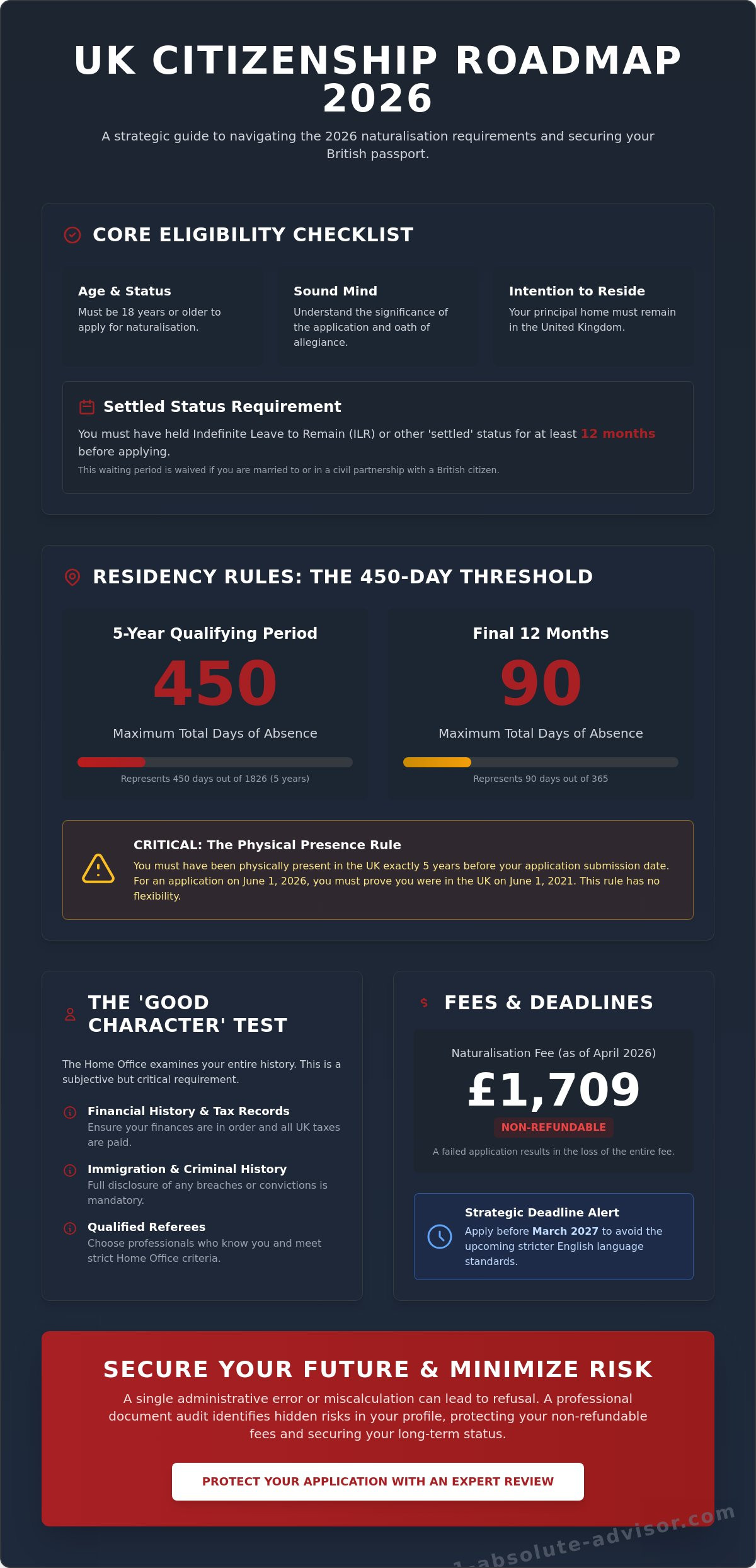
Naturalisation is the formal legal process for non-British adults to acquire full citizenship and the right to a British passport. This transition is governed by the British Nationality Act, which sets the framework for how individuals integrate into the UK’s civic structure. Understanding the requirements for uk citizenship 2026 is essential, as the Home Office has introduced more rigorous checks on residency and financial history. A core component of this is the 12-month settled rule. Unless you’re married to a British citizen, you must hold Indefinite Leave to Remain (ILR) for a full year before you’re eligible to apply. This period isn’t just a formality; it’s a test of your continued compliance with UK laws while no longer being subject to immigration control.
Exemptions exist for those in a legal marriage or civil partnership with a British national. If this applies to you, the 12-month waiting period is waived, allowing you to apply for naturalisation immediately after receiving ILR. Beyond residency, the Home Office also assesses whether an applicant is of sound mind. This requirement ensures that you have the mental capacity to understand the significance of the application and the oath of allegiance. While this is a standard legal threshold, waivers can be requested in specific circumstances where a medical professional can document why an individual may not meet the traditional definition of capacity.
Recent Legislative Changes and the 2026 Landscape
The Border Security, Asylum and Immigration Act 2025 has significantly altered the administrative backdrop of citizenship applications. While the qualifying period for most remains five years, the Act has intensified the scrutiny of your entire immigration history. Rumors regarding a mandatory 10-year residency for all cohorts have caused widespread anxiety in various forums. Currently, these rumors are unfounded for the majority of visa holders, but they highlight the volatile nature of immigration policy. Applying in 2026 is a strategic necessity to avoid the stricter English language standards arriving in March 2027. Securing your status now provides a buffer against future legislative shifts that could extend waiting periods or increase the complexity of the requirements for uk citizenship 2026.
Eligibility Checklist for Naturalisation
To begin your application, you must be 18 or older. If you’re seeking status for a child, the process is known as registration rather than naturalisation, which carries different legal standards and lower fees. A critical but often overlooked requirement is the “intention to live in the UK” clause. The Home Office expects your principal home to remain in Britain. This creates potential hurdles for digital nomads or professionals with frequent international assignments who cannot prove a clear center of life in the UK. For a deeper dive into long-term preparation and document gathering, our British Citizenship guide provides a comprehensive overview of the necessary milestones you must achieve before submitting Form AN.
Residency Rules and Absence Limits: The 450-Day Threshold
One of the most frequent causes for application refusal is a failure to meet the physical presence requirement on the exact date five years prior to the application. If you submit your form on June 1, 2026, you must prove you were physically standing on UK soil on June 1, 2021. This specific rule is a cornerstone of the requirements for uk citizenship 2026 and cannot be overlooked. Beyond this single day, the Home Office calculates your total time spent abroad. For the standard five-year route, your total absences must not exceed 450 days. This calculation is strictly enforced; even a slight miscount can result in a rejected application and the loss of your processing fees.
The final year of your residency carries even stricter weight. In the 12 months immediately preceding your application, you cannot be outside the UK for more than 90 days. While these numbers seem rigid, the Home Office does maintain discretionary powers to overlook excess absences in specific, well-documented cases. If you exceeded the limit due to unavoidable travel restrictions, serious illness, or mandatory overseas postings for a UK-based employer, you may still be successful. However, these exceptions require a high burden of proof and a clear explanation of why your “center of life” remained in Britain throughout the period.
The 3-Year Route for Spouses of British Citizens
If you’re married to or in a civil partnership with a British national, the path to naturalisation is significantly shorter. The residency requirement is reduced to just three years, with a total absence limit of 270 days. Additionally, the 90-day limit for the final 12 months still applies. Unlike other applicants, spouses don’t need to wait 12 months after receiving Indefinite Leave to Remain to apply. If you’re currently in the earlier stages of this journey, reviewing our UK Spouse Visa Guide 2026 will help you align your long-term residency strategy with these citizenship goals.
Proving Your Physical Presence
Compiling a precise travel log is a vital part of the process. The Home Office cross-references your claims with electronic border records, so accuracy is non-negotiable. You’ll need to provide your current and previous passports, but these aren’t always enough if stamps are missing or unclear. According to the Citizens Advice Guide to UK Citizenship, supplementary evidence like employer letters, P60s, or utility bills can bridge gaps in your record. A common pitfall is forgetting short weekend trips to Europe or the Channel Islands, which still count as absences. If you’ve lost old travel records, you can request a “Subject Access Request” from the Home Office to see what data they hold on your movements. To ensure your timeline is flawless before you pay the non-refundable fee, consider using a professional British Citizenship Application Service to audit your residency data.
The ‘Good Character’ Requirement and Knowledge of Life in the UK
The Home Office defines “Good Character” through a holistic lens that extends far beyond the absence of a criminal record. When assessing the requirements for uk citizenship 2026, case workers examine your entire history to determine if you’re a law-abiding and responsible member of society. Financial integrity is a major pillar of this assessment. If you have significant unpaid taxes, a history of bankruptcy, or have been involved in company liquidations under suspicious circumstances, your application faces a high risk of refusal. The Home Office maintains a direct link with HMRC to verify that your tax affairs are in order, as financial non-compliance is viewed as a failure to meet the civic obligations of a British citizen.
Your immigration history is equally critical. Past instances of overstaying, even if they were resolved through a subsequent visa grant, can still be used to question your character in the final naturalisation stage. Working in breach of your visa conditions or providing misleading information in previous applications are seen as fundamental red flags. Case workers look for a consistent pattern of behavior that demonstrates respect for the rule of law. Even if you’ve lived in the UK for many years, a single significant breach of immigration control can lead to a mandatory refusal period, often lasting ten years from the date of the incident.
Criminality and Civil Penalties
The Home Office applies specific thresholds for criminal convictions. Custodial sentences of four years or more result in an automatic and permanent refusal. For shorter sentences or non-custodial disposals like cautions, there are “rehabilitation periods” you must wait out before you’re eligible to apply. It’s a common misconception that minor traffic offenses are irrelevant. While a single speeding fine or Fixed Penalty Notice usually won’t trigger a refusal, a high volume of these penalties or a failure to pay them suggests a persistent disregard for the law, which can derail your case.
English Language and Life in the UK Test
Proving your integration into British society is a dual-track process. Most applicants must meet the B1 level of the Common European Framework of Reference for Languages (CEFR) in speaking and listening. It’s vital to act now, as the government has confirmed this requirement will rise to a B2 level in March 2027. You must also pass the £50 Life in the UK test, which evaluates your understanding of British history, values, and legal systems. Exemptions are strictly limited to those over the age of 65 or individuals with permanent medical conditions that prevent them from meeting these standards.
Navigating the Application Process: Documentation and Referees
Submitting your naturalisation application is a digital-first process centered around the online Form AN. While the interface appears straightforward, minor data entry errors regarding travel dates or previous addresses are frequent causes of administrative delay. Once you’ve paid the processing fee, you’ll be directed to the UKVCAS portal to book a biometric enrolment appointment. At this session, officials will capture your fingerprints and a digital photograph to verify your identity against Home Office records. Ensuring your digital uploads are clear and compliant is essential, as illegible scans or poorly cropped documents can lead to immediate requests for further information, extending the processing time well beyond the standard six-month window.
Meeting the technical requirements for uk citizenship 2026 involves more than just filling out boxes; it requires a meticulous audit of your supporting evidence. The Home Office expects a high standard of document organization. If you’re unsure whether your evidence meets these strict standards, our British Citizenship Application Service provides a professional review to ensure your submission is flawless before the Home Office begins its assessment.
Who Can Act as a Referee?
Your application must be supported by two individuals who can vouch for your identity and character. The first referee must be a person of any nationality who has “professional standing” from the Home Office’s approved list, which includes civil servants, solicitors, doctors, and accountants. The second referee must be a British passport holder who is either a professional or over the age of 25. Both individuals must have known you personally for at least three years. You cannot use family members, your own solicitor for this application, or Home Office employees as referees. Choosing individuals with stable professional backgrounds adds a layer of credibility to your file that case workers value.
Essential Document Checklist
The burden of proof lies entirely with you. You’ll need to provide a comprehensive record of your identity and residency, including:
- Current and expired passports covering the entire five-year or three-year qualifying period.
- Evidence of your Indefinite Leave to Remain (ILR) or settled status, typically provided via a BRP or a digital status share code.
- Tax records from HMRC, such as P60s or SA302 forms, which serve as dual-purpose evidence for both physical residency and financial integrity.
Missing a single travel stamp or failing to account for a brief period of unemployment can trigger a request for additional evidence. It’s better to provide a slightly over-documented case than one that leaves gaps in your five-year history.
Securing Your Future: How Professional Representation Minimizes Risk
The financial and emotional stakes of a naturalisation application are exceptionally high. With the Home Office fee set at £1,709 as of April 2026, a refusal is a costly setback, as only the £130 ceremony fee is refundable if the application fails. Most rejections don’t stem from a lack of eligibility, but from a failure to present evidence that satisfies the specific requirements for uk citizenship 2026. Professional representation serves as a final safeguard; it allows for an objective audit of your history to identify “red flags” before they reach a caseworker’s desk. OISC-registered advisors are trained to spot subtle inconsistencies in residency records or character disclosures that an applicant might overlook but the Home Office will certainly flag.
Complex cases involving historical overstaying, gaps in employment, or excess absences require more than just filling out a form. They require a strategic narrative. An advisor can draft a detailed cover letter that places these issues into a legal context, citing relevant Home Office guidance to argue why discretion should be exercised in your favor. This proactive approach transforms a standard submission into a robust legal case, significantly reducing the likelihood of a protracted administrative review or an outright refusal.
The Value of a Document Checking Service
For many, a full representation service isn’t necessary, but a professional document audit is indispensable. This service focuses on the technical precision of your evidence. It ensures that every month of your five-year residency is accounted for with high-quality scans of P60s, employer letters, or bank statements. Minor administrative oversights, such as a missing page from an old passport or a referee who doesn’t strictly meet the “professional standing” criteria, can lead to immediate rejection. A thorough check ensures your requirements for uk citizenship 2026 are met with robust, indisputable proof, providing the peace of mind that your investment is protected.
Beyond Citizenship: The British Passport
Once your application is approved, you’ll receive an invitation to a Citizenship Ceremony, where you’ll take an oath of allegiance to the Monarch. This ceremony is the final legal step in becoming a British citizen. Afterward, you’re eligible to apply for your first British passport. The timeline from the ceremony to receiving your passport typically spans four to six weeks. It’s also a critical time to consider dual citizenship rules; while the UK allows you to hold multiple nationalities, your country of origin may have different regulations. To ensure you’re fully prepared for this life-changing transition, contact 1 Absolute Advisor for a comprehensive eligibility assessment and strategic guidance on your path to a British passport.
Securing Your Future as a British Citizen
Achieving naturalisation is the final step in a long journey, requiring meticulous attention to the requirements for uk citizenship 2026. Success depends on your ability to prove continuous residency within the 450-day absence limit and demonstrate an unblemished “Good Character” record. As the Home Office increases its scrutiny of financial history and immigration compliance, the margin for error has never been smaller. Applying now is a strategic move to secure your status before stricter integration standards are introduced in early 2027.
You don’t have to manage this complex legal process alone. Our OISC-registered immigration consultants specialize in handling complex residency and character cases, ensuring every document meets the highest standards of evidence. We provide fixed-fee application management to give you total cost certainty while protecting your investment from the risk of refusal. Secure your British Citizenship with expert legal guidance today and take the final step toward the permanent security of a British passport. Your future in the UK is within reach; we’re here to ensure you cross the finish line with confidence.
Frequently Asked Questions
Can I apply for British citizenship immediately after getting ILR?
You can only apply immediately if you’re married to or in a civil partnership with a British citizen. For all other applicants, there’s a mandatory 12-month waiting period after receiving Indefinite Leave to Remain. This rule ensures you’ve demonstrated a commitment to living in the UK permanently before you transition to full citizenship status.
How much does British citizenship cost in 2026?
The application fee for naturalisation increased to £1,709 on April 8, 2026. This fee includes the £130 cost of the citizenship ceremony. Applicants should also account for the £50 Life in the UK test fee and approximately £150 for an English language test if they don’t already meet the exemption criteria.
What happens if I have spent more than 450 days outside the UK?
Exceeding the 450-day limit usually leads to a refusal unless the Home Office chooses to exercise discretionary power. You must provide robust evidence showing that your absences were due to unavoidable circumstances, such as serious illness, travel restrictions, or overseas postings for a UK-based employer. Explaining these requirements for uk citizenship 2026 clearly in a cover letter is essential for success.
Do I need to retake the Life in the UK test if I did it for ILR?
You don’t need to retake the test if you’ve already passed it for a previous settlement application. The pass certificate doesn’t expire and remains valid for your lifetime. You’ll simply need to provide your original test reference number when you complete your online Form AN for citizenship.
Who can be a referee for my UK citizenship application?
You must provide two referees who have known you personally for at least three years. One referee must be a person of any nationality who has professional standing, such as a solicitor, teacher, or accountant. The second referee must be a British passport holder who is either a professional or over the age of 25.
Will a speeding fine cause my citizenship application to be refused?
A single speeding fine or fixed penalty notice won’t typically result in a refusal if you disclose it and pay it promptly. However, a pattern of multiple offenses or any failure to pay fines can lead the Home Office to question your “Good Character.” Transparency is vital, as failing to disclose any penalty is viewed as deception.
How long does the Home Office take to process citizenship applications in 2026?
The standard processing time for naturalisation applications is six months. While some straightforward cases are decided sooner, applications involving complex residency issues or character concerns may take longer. Ensuring your submission perfectly aligns with the requirements for uk citizenship 2026 is the best way to avoid administrative delays.
Can EU citizens with Settled Status apply for British citizenship?
EU citizens with Settled Status are eligible to apply once they’ve held that status for 12 months. If you’re married to a British citizen, this 12-month waiting period is waived. You must still meet all other eligibility criteria, including the residency requirements and the Good Character assessment, just like any other non-British applicant.