

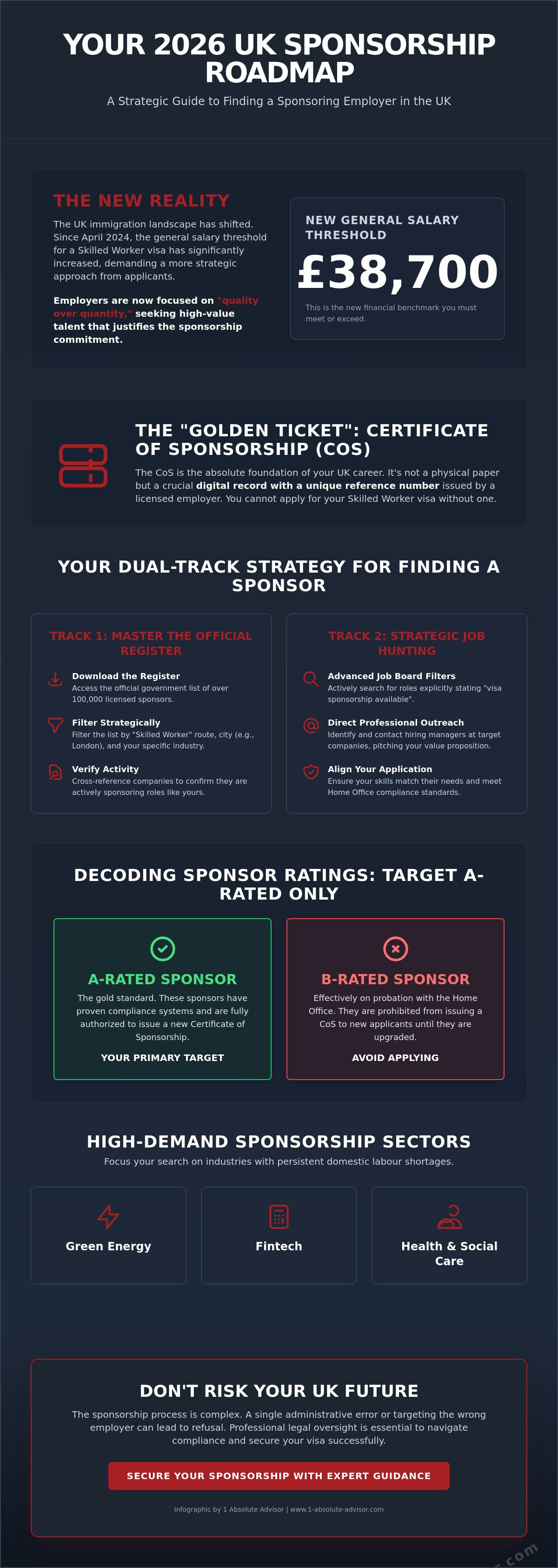
Since the general salary threshold for Skilled Worker visas jumped to £38,700 in April 2024, the barrier to entry for international talent has reached an unprecedented peak. By 2026, relying on volume based applications while finding a sponsoring employer in the uk is a strategy destined for failure. You’ve likely experienced the exhaustion of passing multiple interview rounds only to have the offer rescinded because the company’s license doesn’t cover your specific occupation code or salary requirements.
It’s understandable to feel overwhelmed by the complexity of the latest immigration rules and the sheer size of the Home Office register. We’ll provide you with a precise roadmap to identify active sponsors and master the art of the sponsorship pitch. This guide breaks down the 2026 financial criteria and offers a proven framework for building a shortlist of employers who possess the legal capacity and the commercial appetite to invest in your career. You’ll gain a clear understanding of how to verify a company’s sponsorship history and align your application with the most current Home Office compliance standards.
Key Takeaways
- Understand the critical role of the Certificate of Sponsorship (CoS) and why securing this “golden ticket” is the absolute foundation of your UK career strategy.
- Learn how to navigate and filter the official Register of Licensed Sponsors to efficiently identify high-potential employers in specific UK cities and sectors.
- Discover a proven dual-track strategy for finding a sponsoring employer in the uk by combining advanced job board filters with professional direct outreach.
- Master the 2026 salary threshold requirements and learn how to verify the “Going Rate” for your specific SOC code to ensure your application meets the latest financial benchmarks.
- Identify the common pitfalls in the sponsorship process and why professional legal oversight is essential to prevent administrative errors that could jeopardise your visa.
Understanding the UK Sponsorship Landscape in 2026
To succeed in finding a sponsoring employer in the uk by 2026, you must understand the regulatory architecture governing international recruitment. A licensed sponsor is a UK-based organization that the Home Office has vetted and authorized to hire non-settled workers. This authorization, known as a Sponsor Licence, isn’t a mere formality or a badge of honor. It’s a rigorous legal status that places significant compliance duties on the firm. When a company sponsors you, they’re effectively acting as a guarantor to the UK government, ensuring you meet the requirements of the UK’s points-based immigration system.
The central mechanism of this process is the Certificate of Sponsorship (CoS). It’s often called the “golden ticket” of UK immigration, but it’s actually a digital record, not a physical document. Each CoS has a unique reference number that you need for your visa application. By 2026, the appetite for sponsorship has shifted toward high-value roles. While the salary threshold increases introduced in April 2024 (raising the general minimum to £38,700 for many) created hurdles for entry-level positions, businesses in growth sectors continue to view sponsorship as a vital tool for securing global talent.
It’s crucial to recognize that sponsorship is a heavy legal commitment for the employer. They must track your attendance, report changes in your job description, and maintain detailed records for Home Office inspections. Because of these administrative and financial burdens, finding a sponsoring employer in the uk requires demonstrating that your skills offer a return on investment that justifies their compliance risk.
The Difference Between A-Rated and B-Rated Sponsors
The Home Office maintains a public register of licensed sponsors, assigning them ratings based on their ability to meet compliance duties. You should almost exclusively target A-rated sponsors. This rating indicates the company has proven systems for monitoring sponsored workers. If a company fails an audit, they’re downgraded to a B-rating. A B-rated sponsor is essentially on probation; they’re prohibited from issuing a CoS to new employees until they complete a government-mandated action plan. As a new applicant, a B-rated firm cannot help you.
To maintain these high standards of operational integrity, many organizations seek independent verification of their management systems. Partnering with a global certification and auditing body like International Associates Limited helps companies demonstrate their adherence to international benchmarks, providing further assurance of their commitment to regulatory compliance and quality.
The Role of the Skilled Worker Visa in 2026
The Skilled Worker route remains the primary pathway for sponsored employment. In 2026, the landscape is characterized by a “quality over quantity” approach from employers. Sectors such as Green Energy, Fintech, and Health and Social Care remain sponsorship-heavy due to persistent domestic labor shortages. For a comprehensive analysis of current salary benchmarks and specific occupation codes, refer to the Skilled Worker Visa UK 2026: The Definitive Guide. Understanding these technicalities ensures you don’t waste time targeting firms that cannot meet the updated financial requirements for your specific role.
How to Use the Official Register of Licensed Sponsors
The official Register of Licensed Sponsors is the most critical asset for anyone finding a sponsoring employer in the uk. As of early 2024, this database tracks over 100,000 organisations authorised to hire international talent. It’s a raw, high-volume dataset that requires a methodical approach to extract actionable leads. You won’t find job descriptions here; you’ll find the legal architecture that makes your employment possible.
To begin, download the “Worker and Temporary Worker” register in CSV format. This file often exceeds 11MB, so it’s best handled in Excel or Google Sheets rather than a standard text editor. Once opened, apply a filter to the header row. Your first move should be filtering the “Route” column for “Skilled Worker” or “Global Business Mobility,” depending on your specific visa path. Use the “Town/City” column to narrow your search to specific economic hubs like London, Manchester, or Birmingham if you have geographic constraints.
Distinguishing between active and legacy sponsors is vital for efficiency. A company might hold a license but hasn’t issued a Certificate of Sponsorship (CoS) in years. Check the “Rating” column; an “A (Premium)” or “A-rated” status is the standard. After identifying a potential lead, cross-reference the company name on LinkedIn. Search for the company name followed by “sponsorship” or “international recruitment” in the LinkedIn search bar. This reveals if they’re currently active in the talent market or merely maintaining a dormant license.
Filtering for Your Specific Industry
Precision is key when finding a sponsoring employer in the uk. Use Companies House to find the Standard Industrial Classification (SIC) codes for businesses in your field. By matching these codes to the names on the sponsor register, you can isolate firms that actually operate in your niche. While the “Big Four” professional services firms—Deloitte, PwC, EY, and KPMG—are perennial sponsors with thousands of licenses, don’t overlook boutique firms. In the last 12 months, hundreds of specialized tech and engineering startups have acquired licenses for the first time to fill specific skill gaps.
Tools to Simplify the Search
Several third-party platforms and browser extensions, such as UK Hired or Otta, attempt to scrape this data and overlay it onto job boards. These tools provide a smoother user experience and can save hours of manual cross-referencing. However, they occasionally suffer from sync delays. The Register of licensed sponsors: workers is the only 100% accurate source. Use third-party tools for discovery, but always verify the firm’s current status on the official GOV.UK list before applying. For professionals seeking a more tailored strategy for their UK transition, consulting an Absolute Advisor provides the regulatory clarity needed to move forward with absolute confidence.
Strategic Job Hunting: Where to Find Sponsoring Employers
Finding a sponsoring employer in the uk requires a transition from passive searching to a data-driven recruitment strategy. While the Home Office register of licensed sponsors lists over 100,000 organizations, it functions as a directory rather than a live job board. You must cross-reference this list with active vacancies to identify viable targets. Successful candidates often bypass generic applications by contacting HR departments at companies already on the register. This direct outreach demonstrates initiative and ensures your CV reaches someone who understands the administrative framework of the Skilled Worker route.
When you encounter the “Do you have the right to work in the UK?” question on application forms, clarity is essential. If you don’t currently hold a long term visa, answer “No” but immediately clarify your status in any available text box. State that you’re seeking a Skilled Worker visa and emphasize that the company’s status as a licensed sponsor makes the process straightforward. If you’re working with recruitment agencies, prioritize those specializing in international placements or high-demand sectors like engineering, tech, and healthcare; for instance, hospitality professionals should check out Operational Chef Consultant for specialized staffing support. These specialists often have pre-negotiated agreements with employers who’ve already budgeted for sponsorship costs.
Top Job Boards for Sponsored Roles
LinkedIn has refined its “Visa Sponsorship” keyword filter for 2026, making it a primary tool for international talent. However, many employers forget to tick this box. You should manually search for terms like “Certificate of Sponsorship” or “Tier 2” within job descriptions. On Indeed and Reed, look for “hidden” sponsorship offers by filtering for roles with salary levels that meet the current salary thresholds and eligibility requirements. For health and care professionals, the NHS Jobs portal is the most reliable source, as the majority of Trusts are established sponsors with dedicated international recruitment teams.
The Power of the Graduate Route Transition
Starting your UK career on a Graduate Visa UK is a highly effective “try before you buy” strategy for both you and your employer. This route allows you to work for two years without the company needing to sponsor you immediately. Use this time to become an indispensable asset. By the 18 month mark, you should initiate the conversation about “switching” to a Skilled Worker visa.
Timing your request is critical. Don’t wait until your visa is weeks from expiring. Instead, bring up sponsorship during an internal promotion cycle or a positive performance review. Presenting a clear plan that highlights your value and the company’s existing license status reduces the perceived risk for management. Businesses are 70% more likely to sponsor an existing high-performing employee than a new external hire because the cultural fit and technical competence are already proven.
Navigating Salary Thresholds and Eligibility in 2026
The 2026 financial landscape for international professionals is defined by the high salary floor established during the 2024 policy shifts. Most applicants now face a general threshold of £38,700. This figure represents a significant jump from previous years, making the process of finding a sponsoring employer in the UK a matter of financial alignment as much as professional merit. You must recognize that this £38,700 is merely a baseline; the Home Office requires you to be paid whichever is higher: the general threshold or the “going rate” for your specific Standard Occupational Classification (SOC) code.
Strategic flexibility exists for those classified as “New Entrants.” This group typically includes individuals under age 26, recent UK graduates, or those working toward professional qualifications. New entrants can often qualify with a salary of £30,960, provided the pay meets 70% of the job’s specific going rate. Additionally, tradeable points offer a mechanism to lower the threshold. A relevant PhD can reduce the salary requirement by 10%, while a PhD in a Science, Technology, Engineering, or Mathematics (STEM) subject can reduce it by 20%, provided the salary doesn’t drop below £30,960.
Standard vs. Lower Salary Rates
While the corporate world grapples with the £38,700 minimum, the Health and Care Visa route maintains a distinct structure. These roles generally follow national pay scales or a lower threshold of £29,000, ensuring the NHS remains accessible to international talent. In sectors like fintech or AI development, the “going rate” often sits well above £60,000, rendering the general threshold irrelevant. The “going rate” is specific to the job title, not just the visa category.
What if the Salary is Too Low?
If an offer falls short of the legal requirement, you must enter negotiations with precision. Focus on the gross basic salary; the Home Office does not count performance bonuses, regional allowances, or pension contributions toward the threshold. When finding a sponsoring employer in the UK, it’s vital to identify firms that understand these compliance nuances. If a potential sponsor cannot or will not meet the statutory minimum, you should walk away. Accepting a sub-threshold offer leads to an immediate visa refusal, which complicates all future immigration efforts.
Understanding these complex financial requirements is the first step toward a successful relocation. For a detailed assessment of your eligibility under current regulations, consult with our specialists at Absolute Advisor to secure your professional future.
How Professional Legal Guidance Secures Your Sponsorship
Securing a formal job offer is a significant milestone, but it represents only 50% of the journey toward working in Britain. The transition from candidate to visa holder involves a complex legal framework where even minor administrative oversights lead to immediate rejections. While finding a sponsoring employer in the uk is the necessary first step, the technical execution of the visa application determines your success. The Home Office’s scrutiny has intensified following the April 2024 threshold changes, making professional oversight a necessity rather than an optional luxury.
An incorrectly issued Certificate of Sponsorship (CoS) is a primary cause of application failure. If the assigned SOC code doesn’t perfectly align with your actual day-to-day duties, or if the salary falls even £1 below the updated £38,700 general threshold (or the specific going rate for your role), the visa will be refused. These errors are costly. You risk losing thousands of pounds in non-refundable fees, including the Immigration Health Surcharge, which currently stands at £1,035 per year for most adults. Expert guidance ensures these technical details are verified before any documents are submitted.
Vetting Your Future Sponsor
Not every company with a sponsor licence is a safe bet for your career. 1 Absolute Advisor performs deep-dive compliance checks on potential employers to identify red flags before you sign a contract. We examine the firm’s history with the Home Office to ensure they haven’t faced recent suspensions or civil penalties. Our advisors pay specific attention to “Genuine Vacancy” requirements. If the Home Office suspects a role was created solely to facilitate a visa rather than to meet a real business need, they’ll issue a refusal. We help you and your employer document the necessity of the role to prevent this outcome.
We also support candidates who find the perfect role at a company that doesn’t yet hold a licence. We can manage the sponsor licence application for the employer, turning a “no” into a “yes” by removing the administrative burden from their HR department. This proactive approach expands your options when finding a sponsoring employer in the uk beyond the existing list of registered sponsors.
Our Skilled Worker Visa Application Service
Our comprehensive management service takes the pressure off both the candidate and the employer. We handle the process from the moment the CoS is drafted until the final visa approval is granted. This includes a meticulous review of your English language evidence, financial requirements, and TB test results where applicable. We don’t believe in hidden costs; our fixed-fee transparency ensures you know exactly what your legal investment is from day one. You’ll work with a dedicated mentor who understands the nuances of the 2026 immigration landscape.
Don’t leave your UK career to chance. Ensure your application is resilient, compliant, and professionally managed from start to finish.
Navigating Your 2026 UK Career Strategy
Securing a role in the UK’s evolving job market requires more than a strong CV; it’s about a precise understanding of current Home Office regulations. By 2026, the baseline salary threshold for most Skilled Worker applicants remains a significant hurdle, often requiring a minimum of £38,700 unless specific tradeable points apply. Success depends on strategically identifying firms listed on the official Register of Licensed Sponsors and ensuring your role matches the specific SOC codes defined by the government. The process of finding a sponsoring employer in the uk is now a technical challenge where compliance is just as vital as your professional talent.
Absolute Advisor provides the stability and expertise needed to manage these complexities. As an OISC-registered immigration consultancy, we offer fixed-fee legal services that eliminate financial uncertainty. Our team specializes in the intricate 2026 salary threshold rules, ensuring your application meets every regulatory requirement from the start. Secure your UK future with expert Skilled Worker visa support. Your professional goals in the United Kingdom are within reach when backed by methodical planning and expert advocacy.
Frequently Asked Questions
How do I know if a UK company is licensed to sponsor?
You can verify a company’s status by checking the “Register of licensed sponsors: workers” published on the official UK government website. This public database is updated daily and lists every organization authorized to hire international talent. Finding a sponsoring employer in the uk starts with searching this list to ensure the firm holds a valid A-rated licence for the Skilled Worker route.
Can I apply for a job if the company is not on the sponsor list?
You’re free to apply, but the employer must obtain a sponsor licence before they can legally hire you. This application process typically takes 8 weeks, though companies can pay a £500 priority fee to receive a decision within 10 working days. Most successful candidates focus on firms already on the register to avoid the risk of a licence being denied.
What are the 2026 salary requirements for a Skilled Worker visa?
The general salary threshold for 2026 remains at £38,700 per year, or the specific “going rate” for your job code, whichever is higher. If you’re a “new entrant,” such as a graduate under age 26, you might qualify with a lower salary of £30,960. These figures are mandatory benchmarks that ensure your compensation aligns with current UK economic standards.
Do I need a job offer before I apply for a work visa?
You must have a formal job offer and a valid Certificate of Sponsorship (CoS) before you can submit a Skilled Worker visa application. The CoS isn’t a physical document but a unique digital reference number issued by your employer. It proves that a licensed organization has vetted your skills and committed to employing you under specific terms.
Can a small business sponsor my UK visa?
Small businesses can sponsor workers as long as they meet the Home Office’s eligibility criteria and pay the reduced fee of £536 for their licence. A company is classified as small if its annual turnover is £10.2 million or less and it has 50 or fewer employees. Many boutique firms in tech and creative industries use this route to secure specialized global expertise.
What happens if my sponsoring employer loses their licence?
If the Home Office revokes your employer’s licence, your visa will usually be shortened to 60 days. You’ll need to leave the UK or find a new position within this timeframe. Finding a sponsoring employer in the uk quickly during this period is vital to maintaining your residency and continuing your career path without interruption.
How much does it cost an employer to sponsor a worker in 2026?
Large organizations pay a £1,476 licence fee, while small sponsors pay £536. Beyond this, employers must pay the Immigration Skills Charge, which costs £1,000 per year of the visa for large firms and £364 for small ones. Every Certificate of Sponsorship issued also carries a flat fee of £239, making the total investment significant for any business.
Is it harder to find a sponsor after the 2024/2025 rule changes?
The 48% increase in the minimum salary threshold that took effect in April 2024 has made the market more competitive for entry-level roles. Employers are now more selective, focusing their sponsorship budgets on high-value positions that justify the higher salary requirements. While the total number of visas issued in the health sector fell by 81% in late 2024, engineering and IT sectors continue to show resilience.