

On April 4, 2024, the Home Office introduced sweeping changes to salary thresholds that fundamentally altered the framework for international professionals. If you’re approaching your renewal date, you probably feel that your right to work and your family’s stability shouldn’t be at the mercy of complex policy shifts. It’s a valid concern; a single administrative error or a misunderstanding of the 2026 salary requirements can lead to a refusal that puts your entire career at risk. This guide is designed to provide the absolute clarity required to manage your skilled worker visa extension with total confidence.
We’ll break down the complexities of the updated 2026 salary benchmarks and explain how to avoid the “no travel” rule traps that often cause significant stress. You’ll learn how to secure your continuous right to work while ensuring your dependants remain legally protected alongside you. This article provides a strategic roadmap to not only extend your stay but also to safeguard your multi-year progress toward Indefinite Leave to Remain (ILR).
Key Takeaways
- Identify the optimal submission window within the 60-day period before your current leave expires to maintain continuous lawful status in the UK.
- Master the updated 2026 salary thresholds and specific SOC code requirements essential for a compliant skilled worker visa extension application.
- Navigate the financial complexities of the renewal process, including precise calculations for the Immigration Health Surcharge and standard Home Office fees.
- Mitigate the risk of application cancellation by understanding the strict travel restrictions imposed while your extension remains under consideration.
- Determine whether you meet the five-year qualifying criteria for Indefinite Leave to Remain as a strategic alternative to a standard visa renewal.
When to Apply: Navigating the Skilled Worker Visa Extension Timeline
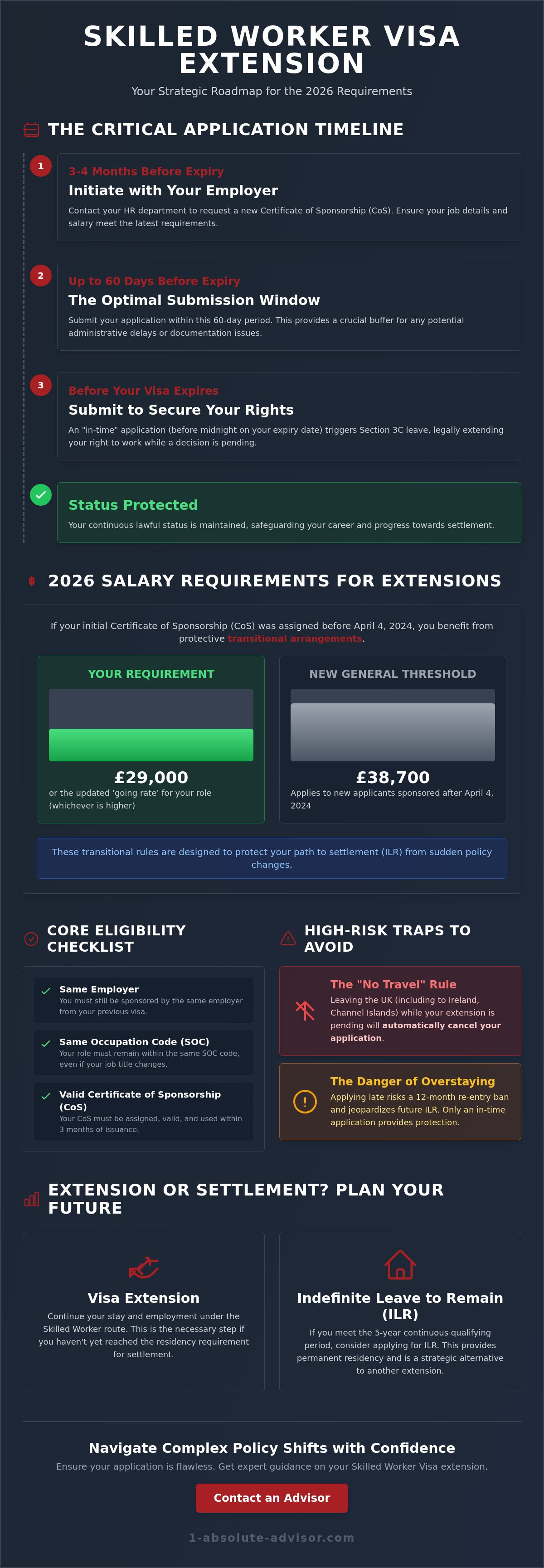
Precision is the hallmark of a successful skilled worker visa extension. While many applicants wait until the final weeks of their stay, the Home Office allows you to submit your application up to 60 days before your current leave expires. This window provides a necessary buffer for administrative delays. The current system evolved from the Skilled Worker visa predecessor, shifting toward a more digital, sponsor-led process that requires strict adherence to specific dates. Planning your submission around this 60-day mark ensures you have time to rectify any clerical errors in your documentation.
You must submit your online application before your current BRP or digital status expires. Doing so triggers Section 3C of the Immigration Act 1971. This legal provision automatically extends your existing leave and right to work while your application is being processed. If you miss this deadline by even a single day, you lose your right to work immediately and may face the consequences of the UK’s hostile environment policies. It’s a binary situation; you’re either legally protected or you’re an overstayer.
Your Certificate of Sponsorship (CoS) has its own lifespan. Once your employer assigns it, you have exactly three months to use it in a visa application. If you apply after this three-month period, the Home Office will reject your submission. Balancing this “3-month rule” with your 60-day application window requires strategic communication with your employer’s HR department to ensure the CoS is neither too old nor issued too late.
The 28-Day Rule and Overstaying Risks
Submitting an application late is a high-risk gamble. While the Home Office sometimes overlooks delays of up to 14 days if there’s a “good reason” beyond your control, this is never guaranteed. Overstaying can lead to a 12-month re-entry ban or jeopardize future Indefinite Leave to Remain (ILR) applications. Section 3C leave only applies if the application is “in-time,” meaning submitted before midnight on the expiry date. It’s the only absolute safeguard for your professional stability in the UK.
CoS Issuance: The First Step in Your Timeline
Your skilled worker visa extension depends entirely on a valid CoS. You should contact your HR department at least three to four months before your visa expires. Ensure the job code (SOC code) and salary levels meet the 2026 thresholds. If the CoS details don’t mirror your current role or the updated salary requirements, the application will fail. Verify the “valid until” date on the CoS document as soon as you receive it to ensure it aligns with your planned submission date.
Core Eligibility: Meeting the 2026 Salary and Skill Requirements
Securing a skilled worker visa extension in 2026 requires meticulous alignment with the Home Office’s updated salary scales and occupational classifications. The foundation of a successful renewal rests on your ability to prove that your role still meets the “going rate” for your specific Standard Occupational Classification (SOC) code. These rates are not static; they’re updated annually to reflect UK wage growth. You’ll need to verify your code against the 2026 salary tables to ensure your current pay hasn’t fallen below the new mandatory minimums.
The Home Office maintains strict continuity requirements for extensions. You must remain with the same employer who sponsored your current leave and continue working in the same occupation code. If your job title has changed but your core duties remain within the same SOC code, your eligibility remains intact. However, a promotion that moves you into a different SOC code is often treated as a change of employment, which necessitates a different application approach. Regarding English language proficiency, if you’ve already proved your level in a previous successful application, you don’t usually need to provide this evidence again for an extension.
Transitional Arrangements for Pre-April 2024 Applicants
Transitional arrangements are the protective rules for those sponsored before the April 2024 policy shift. If your initial Certificate of Sponsorship (CoS) was assigned before April 4, 2024, you aren’t subject to the higher £38,700 threshold. Instead, you’ll benefit from lower salary requirements, typically around £29,000 or the updated 2026 going rate based on the 25th percentile of earnings for your role. This protection is vital for those on the 5-year route to settlement, ensuring that sudden policy hikes don’t derail your path to permanent residency. You should consult a specialist in strategic immigration planning to confirm exactly which threshold applies to your specific grant date.
Standard 2026 Salary Thresholds
For applicants who entered the Skilled Worker route after April 4, 2024, the financial bar is significantly higher. The general salary threshold for a skilled worker visa extension is £38,700, though you must earn whichever is higher: the general threshold or the specific going rate for your SOC code. In 2026, these going rates are indexed to the 50th percentile of UK earnings for most professions. You can verify the most current figures through the official visa extension process portal.
Certain “tradeable points” can provide relief if your salary is below the standard threshold. These include:
- Relevant PhD: A 10% reduction to the salary requirement if the qualification is relevant to the job.
- STEM PhD: A 20% reduction if the PhD is in a science, technology, engineering, or mathematics subject.
- Health and Care Sector: Workers on the Health and Care Visa remain exempt from the £38,700 jump, typically following a lower threshold of £29,000 or their specific occupation’s scale.
Understanding these nuances is the difference between a seamless approval and a costly rejection. The Home Office’s 2026 guidance emphasizes that even a £1 deficit in the annual salary calculation will lead to an automatic refusal of the extension request.
For medical professionals working under these specific visa exemptions, planning for a future in the UK often involves more than just immigration paperwork. Expert services like Mortgages for Doctors can help healthcare workers navigate the complexities of securing a home loan while on a skilled worker or health and care visa.
The Application Journey: Step-by-Step Extension Process
The path to securing a skilled worker visa extension requires meticulous attention to detail and a proactive approach to compliance. You’ll start by completing the online application form, which demands precise historical data. This includes your travel history for the last 10 years and specific details of your current employment. Accuracy is paramount here; even minor discrepancies with your original visa application can trigger additional scrutiny from Home Office caseworkers.
Once you’ve submitted the form, you must pay the required fees immediately. These include the application fee, which varies based on the length of your stay, and the Immigration Health Surcharge (IHS). As of 2024, the IHS is £1,035 per year for most adults. Strategic planning is vital, as these costs represent a significant upfront investment in your professional future. Understanding long-term settlement trends helps you decide whether to extend for a shorter duration or the full five years required for Indefinite Leave to Remain (ILR).
Mandatory Documents for a Successful Extension
The Certificate of Sponsorship (CoS) reference number is the digital backbone of your skilled worker visa extension. Your employer must issue a new CoS that reflects your continued role or any updated salary figures that meet the 2026 thresholds. You don’t need to provide a physical copy, but the digital record must be active and assigned to you within the last three months.
Financial evidence remains a strict requirement. Unless your employer certifies maintenance on your CoS, you must provide bank statements showing at least £1,270 held for 28 consecutive days. These statements shouldn’t be older than 31 days at the time of application. Ensure your passport remains valid throughout the entire processing period to avoid administrative complications that could stall your right to work.
Identity Verification: App vs. Appointment
The Home Office has streamlined the identity process through the “UK Immigration: ID Check” smartphone app. If you’re a holder of a biometric passport from the EU, EEA, or several other eligible countries, you can bypass the physical biometric centre entirely. This digital route allows you to scan your documents and upload a selfie to verify your identity instantly from your home or office.
If the app doesn’t support your document type, you’ll need to attend a UKVCAS appointment. During this session, staff will capture your fingerprints and a digital photograph. It’s a standard procedure, but availability at free hubs can be limited, so it’s wise to book early. After your appointment or app submission, you’ll have a strict window, usually 10 working days, to upload any remaining supporting evidence to the UKVCAS portal. Missing this deadline can lead to an automatic refusal, so we recommend having all digital scans ready before you even hit the submit button.
Dependants and Travel: Managing Your Life During the Wait
Managing a skilled worker visa extension involves more than just securing your own professional standing. It requires a synchronized approach for the entire family unit. If your partner or children are currently in the UK as your dependants, their legal right to remain is inextricably linked to your status. You must ensure their applications are submitted before their current leave expires to avoid the risks associated with overstaying. While dependants can technically apply at a different time than the main applicant, doing so requires careful tracking of individual expiry dates and reference numbers.
Financial requirements for family members remain a critical checkpoint. If your family has lived in the UK for at least 12 months on a valid visa, they usually meet the financial requirement automatically. For those who haven’t reached this milestone, you must demonstrate specific savings: £285 for your partner, £315 for the first child, and £200 for each additional child. These funds must have been held in a regulated bank account for at least 28 consecutive days. Alternatively, your sponsor can “certify maintenance” on your new Certificate of Sponsorship (CoS), which removes the need for personal bank statements.
The Travel Trap: Section 34K Explained
The Home Office enforces a strict policy regarding international movement while an application is pending. Under Section 34K of the Immigration Rules, leaving the Common Travel Area (CTA) results in the immediate cancellation of your request. The CTA includes the UK, Ireland, the Isle of Man, and the Channel Islands. You can visit Dublin or Douglas without issue, but a flight to Paris or New York will end your application process. Leaving the UK before a decision is made automatically withdraws your extension application under Home Office rules. If an emergency requires you to travel, you’ll likely need to start the entire process again from outside the UK, which leads to redundant costs and significant delays.
Coordinating Dependant Extensions
Families often find it most efficient to submit all applications simultaneously. This ensures that the “family unit” receives decisions around the same time, providing peace of mind for school enrolments and travel planning. Each dependant requires a separate application form, but they must use the main applicant’s CoS reference number to link the files correctly. If your family circumstances have changed and a partner now qualifies for a route independent of your employment, you may find our guide on UK Spouse Visas helpful for evaluating a switch. Maintaining a clear timeline prevents any member of the household from losing their right to work or access the NHS during the transition period.
Strategic planning is the only way to mitigate the risks of a skilled worker visa extension for a large family. Consult with our advisors to secure your family’s future in the UK with absolute precision.
Extension or Settlement? Planning Your Future in the UK
Deciding between a skilled worker visa extension and applying for Indefinite Leave to Remain (ILR) is a pivotal strategic choice for your career. While an extension maintains your legal status under the sponsorship of an employer, ILR offers permanent residency. This status removes the necessity for a sponsor and ends the recurring burden of the Immigration Health Surcharge. Most applicants qualify for settlement after five years of continuous residence. We evaluate your specific immigration history to determine which path provides the highest level of security for your long-term goals.
The transition from a temporary visa to permanent residency requires meticulous planning. If you apply for a skilled worker visa extension when you were actually eligible for ILR, you may end up paying thousands of pounds in unnecessary fees. Conversely, applying for settlement without meeting the strict absence or salary thresholds can lead to a refusal that jeopardises your right to work. Our role is to provide the clarity needed to make the most cost-effective and legally sound decision.
The 5-Year Route to Indefinite Leave to Remain
The Home Office calculates your qualifying period based on continuous residence. You must not have spent more than 180 days outside the UK in any rolling 12-month period during those five years. If you’ve exceeded these limits, or if your current visa expires shortly before you hit the five-year milestone, a skilled worker visa extension acts as a vital bridge. This ensures you remain compliant while you wait to meet the settlement criteria. For a granular breakdown of these specific requirements, consult our comprehensive ILR UK guide.
- Freedom from Sponsorship: ILR holders can change jobs, start businesses, or take career breaks without notifying the Home Office.
- Long-term Savings: While the ILR application fee is a significant upfront cost, it eliminates future visa renewals and the annual IHS payments.
- Path to Citizenship: Settlement is the essential prerequisite for applying for British naturalisation, typically 12 months after ILR is granted.
Why Professional Advice is Critical for Extensions
Minor clerical errors or outdated salary data cause a significant percentage of visa refusals. These mistakes can reset your “continuous residence” clock to zero, delaying your settlement by years. Our OISC-registered advisors provide an absolute level of scrutiny, ensuring every document aligns with the latest 2026 regulations. We manage the entire process through transparent, fixed-fee structures, providing predictability in a volatile regulatory environment. This proactive management prevents the stress of Home Office interactions and secures your professional standing. To ensure your application is handled with precision, book a consultation for your Skilled Worker extension today. We don’t just process paperwork; we act as your strategic partner in securing your future in the UK.
Strategizing Your Long-Term Residency in the United Kingdom
Successfully navigating a skilled worker visa extension in 2026 demands precise alignment with the Home Office’s updated salary thresholds and specific occupation codes. It isn’t enough to simply submit a form. You must ensure your application is lodged before your current BRP expires to benefit from Section 3C leave, which legally preserves your right to work while your case is processed. This renewal phase often serves as the final bridge toward Indefinite Leave to Remain, making the accuracy of your submission a critical factor in your five-year settlement path.
Our team of OISC-registered immigration consultants specializes in complex work visa renewals. We offer fixed-fee application management that eliminates the uncertainty of shifting regulations and ensures your professional stability remains intact. By treating your extension as a strategic milestone rather than a bureaucratic hurdle, you protect both your career and your family’s future. Secure your UK future with our expert Skilled Worker extension service and let us handle the technical complexities of your renewal. You’ve built a life here; we’re here to help you keep it.
Frequently Asked Questions
How long does a Skilled Worker visa extension take to process in 2026?
Standard processing for a skilled worker visa extension typically takes 8 weeks when you apply from within the UK. You’re legally permitted to continue working under your current conditions while the Home Office reviews your case, provided your application was submitted before your previous leave expired. If your business requirements demand a faster turnaround, you can opt for expedited processing services for an additional fee.
Can I change my employer while my extension application is pending?
You shouldn’t start work for a new employer until the Home Office approves a specific change of employment application. While your extension is pending with your current sponsor, you’re legally tied to their employment terms and the specific Certificate of Sponsorship (CoS) linked to that application. Switching companies requires a brand new CoS and a successful application, as a standard extension only covers your existing role with your current sponsor.
What happens if my Skilled Worker visa extension is refused?
If the Home Office refuses your application, you’ll typically receive a notice detailing your right to an Administrative Review within 14 days. Your legal right to remain and work in the UK under Section 3C of the Immigration Act 1971 ends once the application is finally determined. It’s critical to seek professional advice immediately to assess if a fresh application or a legal challenge is the most viable strategic path for your situation.
Do I need to retake my English test for a visa extension?
You won’t need to retake an English language test if you’ve already proven your proficiency in a previous successful UK visa application. The Home Office accepts your prior results as long as they met the B1 level requirement on the Common European Framework of Reference for Languages (CEFR) at that time. This rule simplifies the skilled worker visa extension process for most professionals who are already integrated into the UK workforce.
How much is the Immigration Health Surcharge (IHS) for an extension in 2026?
The Immigration Health Surcharge for a skilled worker visa extension is currently £1,035 per year for each adult applicant. For a standard three year extension, you’ll need to pay £3,105 upfront as part of your online application process. These rates are set by the UK government and ensure your continued access to the National Health Service (NHS) throughout the duration of your stay.
Can I work for a different company while on a Skilled Worker extension?
You can take on supplementary employment for up to 20 hours per week, but strict conditions apply to this additional work. The second job must be in the same profession and at the same professional level as your primary sponsored role, or it must be a role on the Immigration Salary List. You must continue to fulfill the duties of the primary job for which your Certificate of Sponsorship was originally issued.
What is the maximum number of times I can extend my Skilled Worker visa?
There’s no maximum limit on how many times you can extend your Skilled Worker visa under current Home Office regulations. Many professionals choose to apply for Indefinite Leave to Remain (ILR) after completing five years of continuous residence in the UK. However, if you don’t meet the ILR criteria or prefer not to apply, you can continue extending your stay indefinitely as long as you have a valid sponsor and meet the salary thresholds.
Is there a priority service available for Skilled Worker extensions?
The Home Office provides two expedited options for those who need a faster decision on their skilled worker visa extension. The Priority Service costs £500 and delivers a result within five working days of your appointment or document upload. For urgent cases, the Super Priority Service costs £1,000 and provides a decision by the end of the next working day, ensuring minimal disruption to your professional life.