

Did you know that following the April 2024 policy overhaul, thousands of international professionals had to completely restructure their relocation plans to avoid permanent family separation? It’s a stressful reality for many, especially when you’re balancing a demanding career with the complex, ever-shifting requirements of the Home Office. You’re likely concerned about the rising costs of the £1,035 annual Immigration Health Surcharge or whether the restrictive care worker dependent rules will impact your specific household.
We understand that family stability is the foundation of your professional success in Britain. This guide ensures you master the skilled worker visa dependent visa uk application process under the 2026 regulations, providing the strategic clarity you need to keep your family together without the fear of refusal. We’ll examine the updated financial thresholds, the specific documentation required for a successful grant, and the precise five year path to Indefinite Leave to Remain (ILR) for your loved ones.
Key Takeaways
- Understand how the main applicant’s Certificate of Sponsorship (CoS) serves as the legal foundation for your family’s eligibility under the 2026 Home Office regulations.
- Master the specific evidentiary standards for “genuine and subsisting” relationships and maintenance funds required for a successful skilled worker visa dependent visa uk application.
- Learn the technical process of generating and utilizing the Family Linking Code to ensure all individual applications are processed as a synchronized family unit.
- Evaluate the professional flexibility granted to dependents, including unrestricted work rights and the strategic requirements for achieving Indefinite Leave to Remain (ILR).
- Identify proactive strategies to mitigate the risk of visa refusals by correctly addressing complex documentation issues such as financial errors and “sole responsibility” claims.
What is a Skilled Worker Dependent Visa? Eligibility in 2026
The Skilled Worker Dependent Visa serves as a secondary immigration permission, intrinsically linked to a lead migrant’s sponsorship under the UK’s points-based system. To secure this status, the applicant must demonstrate a qualifying relationship with a main Skilled Worker whose Certificate of Sponsorship (CoS) acts as the foundation for the entire family’s stay. Understanding the UK visa policy overview is essential for applicants to grasp how these individual permissions aggregate into a collective family relocation strategy. Under the 2026 Immigration Rules, a dependent is defined as a family member whose right to remain in the United Kingdom is strictly derivative of and conditional upon the valid leave of the primary visa holder.
Securing a skilled worker visa dependent visa uk requires a high level of documentary precision to satisfy the Home Office’s strict relationship requirements. The application process is rarely a mere formality; it demands a strategic alignment of the main applicant’s employment terms with the family’s long-term residency goals. If the main sponsor’s visa is curtailed or expires, the dependents’ visas typically follow the same fate, highlighting the precarious nature of this derivative status.
The 2024 Care Worker Ban: Who Can Bring Family in 2026?
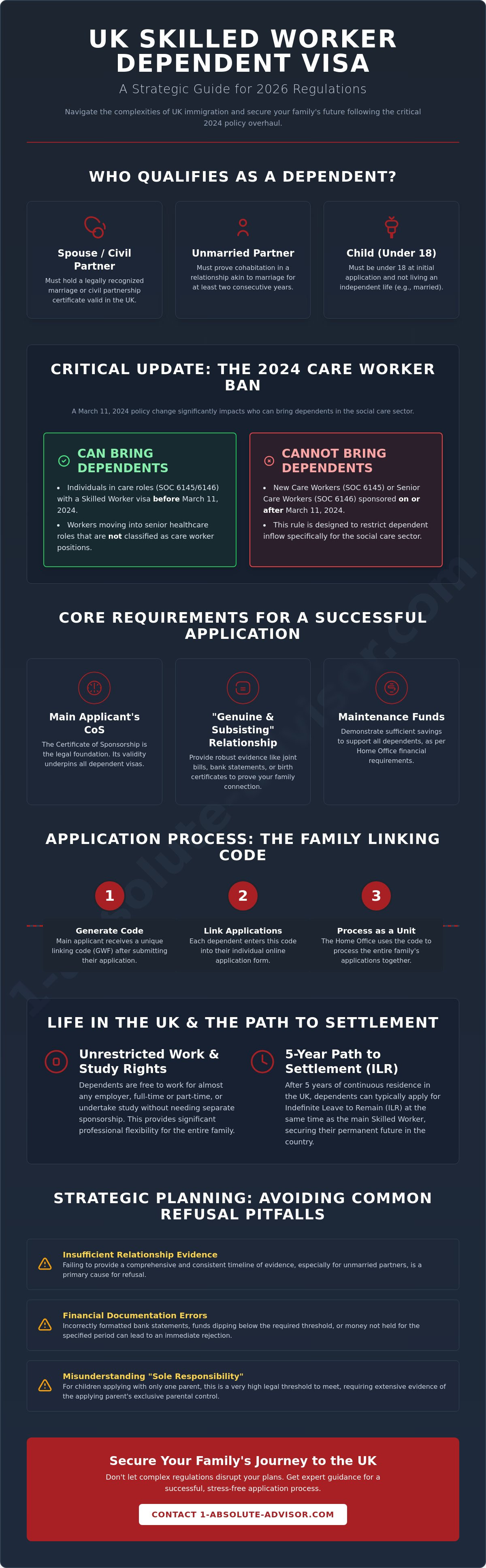
On March 11, 2024, the Home Office implemented restrictive measures that fundamentally altered the skilled worker visa dependent visa uk landscape for the social care sector. Specifically, individuals sponsored as Care Workers (SOC 6145) or Senior Care Workers (SOC 6146) after this date can’t bring family members to the UK. However, those who were already working in these roles on a Skilled Worker visa prior to March 11, 2024, retain their right to bring or keep dependents. This exemption also applies to those moving into senior healthcare roles that fall outside the specific care worker classification, provided the sponsoring entity meets the necessary regulatory standards and the role’s salary meets the 2026 thresholds.
Defining Eligible Partners and Children
For spouses and civil partners, the relationship must be legally recognized in the UK or the country where the ceremony took place. Unmarried partners face a more rigorous evidence threshold; they must prove they’ve lived together in a relationship akin to marriage for at least two years. The 2026 rules also specify that children must be under 18 at the time of the initial application. If a child is between 16 and 18, the Home Office requires proof they aren’t leading an independent life, which means they shouldn’t be married, in a civil partnership, or living away from the parental home for reasons other than full-time education. Verification of these details often involves:
- Joint bank statements or utility bills for unmarried partners.
- Birth or adoption certificates for children.
- Proof of ongoing financial support for children aged 16 to 18.
- Marriage certificates that comply with local legal standards.
Mandatory Requirements: Relationship Evidence and Maintenance
Securing a skilled worker visa dependent visa uk depends on meeting two rigorous standards: relationship validity and financial self-sufficiency. The Home Office doesn’t just look for a legal contract; they require proof that your connection is genuine and subsisting. This means the relationship must be active, ongoing, and intended to continue in the UK. Failure to provide a cohesive narrative through documentation is one of the most common reasons for delays or refusals in the relocation process.
Proving Your Relationship: Beyond the Marriage Certificate
For spouses and civil partners, a valid certificate is the baseline requirement. However, caseworkers often look for evidence of joint living to confirm the relationship isn’t one of convenience. You’ll need to provide documents like joint bank statements, utility bills, or tenancy agreements spanning the last few years. Unmarried partners face a higher evidentiary bar. You must demonstrate you’ve been in a relationship similar to marriage for at least two years. This is typically proven through official correspondence, such as council tax bills or medical letters, addressed to both partners at the same residence.
When children are involved, birth certificates are mandatory. If only one parent is relocating to the UK, the “sole responsibility” rule applies. This is a complex legal area where you must prove the UK-based parent has been the primary decision-maker for the child’s welfare, education, and health. Detailed UK government’s official guidance exists to help define these boundaries, but evidence like school reports or court orders is usually necessary to satisfy the Home Office.
The Financial Maintenance Requirement for 2026
Financial stability is a prerequisite for any skilled worker visa dependent visa uk application. In 2026, the Home Office mandates specific savings thresholds to ensure families can support themselves without relying on public funds. You must show £285 for your partner, £315 for the first child, and £200 for every subsequent child. These figures are cumulative. For example, a family of four requires £800 in accessible savings held in a regulated financial institution. Every pound must be accounted for to avoid a rejection.
The 28-day rule is the most frequent point of failure for applicants. Your bank balance can’t dip below the required threshold for even a single day during the 28-day period ending no more than 31 days before your application date. If your balance hits £799 when you need £800, the application will likely be rejected. You can bypass these personal savings requirements if your employer is an A-rated sponsor. By “certifying maintenance” on your Certificate of Sponsorship, the employer guarantees to cover your family’s costs during their first month in Britain. For those managing complex relocations, securing strategic advisory support can help verify that your financial evidence is bulletproof before submission.
The Application Process: Steps to a Successful Family Move
Relocating a family to the United Kingdom requires a high level of administrative precision. Every family member, including infants, must submit an individual online application. These separate entries are unified through a Family Linking Code, which the lead applicant generates during their own process. This code is the primary mechanism that ensures the Home Office reviews the family as a single unit rather than as isolated cases. Without this link, processing times can become desynchronized, leading to staggered arrival dates that disrupt relocation plans. You can find the specific technical requirements for these submissions in the UK Government Skilled Worker Dependent Visa Rules.
After submitting the digital forms, each applicant must attend a biometric appointment at a Visa Application Centre (VAC). During this session, officials record digital fingerprints and a photograph. It’s a mandatory step for securing the Biometric Residence Permit (BRP) or the digital equivalent. For 2026, the Home Office maintains a tiered processing structure. Standard applications submitted from outside the UK generally reach a decision within 15 working days. If you’re on a tight schedule, the Priority service offers a decision within 5 working days for an additional £500 fee. In many regions, Super Priority service is also available, providing a 24-hour turnaround for approximately £1,000 per person.
Outside vs. Inside the UK: Switching and Extending
The rules for a skilled worker visa dependent visa uk vary significantly based on the applicant’s current location. Family members already in the UK on Student or Graduate visas can often switch to a dependent route without leaving the country. However, the “Visitor Rule” remains a strict barrier. You can’t switch from a Standard Visitor visa to a dependent status while inside the UK. In such cases, the family member must return to their home country to apply. It’s also vital to remember that leaving the Common Travel Area while an “in-country” application is pending will result in the Home Office treating the application as withdrawn under Paragraph 34K of the Immigration Rules.
The Immigration Health Surcharge (IHS) and Fees
Strategic financial planning is essential for family relocation. For 2026, the Immigration Health Surcharge (IHS) remains a primary cost driver. For adults, the fee is £1,035 per year, while for children under 18, it’s £776 per year. A partner applying for a three-year visa must pay £3,105 upfront. Dependents of Health and Care Workers are currently exempt from this surcharge, which offers a massive financial advantage for medical professionals. If an application is refused, the Home Office typically refunds the IHS payment automatically within 6 weeks, though the initial application fee is retained by the department.
Conditions of Stay: Work, Study, and the Path to ILR
The flexibility of the skilled worker visa dependent visa uk is one of its most significant advantages for families planning a long-term future in Britain. Unlike the main sponsor, who’s restricted to a specific role with a licensed employer, dependents have almost total autonomy over their professional lives. This allows for a more robust family financial strategy, as the partner can pivot between industries or start a business as market conditions change. This adaptability is central to maintaining stability during the relocation process.
Work and Study Rights for Dependents
Dependents can engage in almost any type of employment, including full-time roles, part-time work, or self-employment. They don’t need a separate sponsorship license to change jobs or move between employers. There are only two specific professional boundaries to observe. Dependents cannot work as a professional sportsperson, including as a sports coach, and they’re barred from working as a doctor or dentist in training. Beyond these exclusions, the labor market is open. For children, the UK education system offers full access to state-funded primary and secondary schools. While university attendance is permitted, families should plan for international tuition rates until the student qualifies for settled status or meets specific home fee residency requirements.
Calculating the 5-Year Qualifying Period for ILR
Achieving Indefinite Leave to Remain (ILR) requires a strategic approach to residency. The standard route to settlement takes five years of continuous residence. A common misconception is that time spent on a Student visa counts toward this five-year skilled worker visa dependent visa uk settlement clock; it doesn’t. Only time spent on qualifying work-related visas or as a dependent on such visas contributes to this specific five-year path. If a family member previously held a Student visa, that time only assists if they’re pursuing the 10-year Long Residence route instead.
Maintaining continuous residence is the most critical compliance factor. Dependents must not spend more than 180 days outside the UK in any rolling 12-month period. Since the Home Office updated its guidance in April 2024, the calculation of these 180 days has become more rigorous. Every day spent outside the country, including travel days, must be tracked. If a partner exceeds this limit, their settlement clock resets to zero, potentially delaying the family’s permanent residency by years. Proactive planning of international travel is essential to ensure all family members remain on track for ILR simultaneously. To ensure your family meets every compliance milestone, you can consult our specialist advisors for a comprehensive residency review.
Strategic Planning: Avoiding Common Dependent Visa Refusals
Securing a skilled worker visa dependent visa uk requires more than just filling out forms. It demands a level of forensic detail that most applicants underestimate. Home Office data indicates that a significant percentage of family visa refusals stem from avoidable administrative errors rather than a lack of eligibility. These mistakes don’t just cause stress; they lead to lost application fees and months of unnecessary family separation.
The “sole responsibility” requirement for single parents remains one of the most challenging hurdles. The Home Office sets an incredibly high bar for this category. You must prove you’ve had total, exclusive control over the child’s upbringing, often requiring school records, medical documents, and legal affidavits spanning several years. Without a professional document audit, these applications face an uphill battle. Adopting an “Absolute” approach to your planning ensures that every piece of evidence is scrutinized before the Home Office ever sees it.
Common Pitfalls in Maintenance and Evidence
Financial requirements are a frequent point of failure. The “28-day rule” is absolute. If your bank statement is even one day outside the required window, or if the balance dipped below the threshold for a single afternoon, the application will be refused. We see many families fail because they didn’t realize their statements must be dated within 31 days of the online submission.
- Translation Errors: All non-English documents, from marriage certificates to birth records, must be handled by a certified translator. Self-translated documents are rejected immediately.
- CoS Inconsistencies: The dependent’s application must align perfectly with the main applicant’s Certificate of Sponsorship (CoS). Any discrepancy in job titles, salary levels, or start dates can trigger a red flag.
- Dated Evidence: Using utility bills or bank statements that are too old is a common mistake. Evidence must be recent to prove the relationship is subsisting.
How 1 Absolute Advisor Secures Your Family’s Future
We believe immigration is a strategic investment, not just a paperwork exercise. Our fixed-fee approach provides your family with budget certainty while we manage the complexities of your relocation. We don’t just check boxes. We draft expert legal cover letters that explain unique family circumstances, such as gaps in cohabitation or complex custody arrangements, in a language the Home Office understands.
Our team provides comprehensive advice on navigating UK immigration to ensure your family is positioned for long-term residency and eventual Indefinite Leave to Remain (ILR). We act as your strategic partner, anticipating risks before they become refusals. This proactive methodology is why our clients move forward with confidence.
Ensure your family’s application is handled with absolute precision. Book a consultation today.
Strategize Your Family Relocation for 2026
Navigating the skilled worker visa dependent visa uk landscape requires a meticulous approach to meeting Home Office criteria. Success depends on presenting robust relationship evidence and documenting the required maintenance funds, which currently stand at £285 for a partner and £315 for the first child. These benchmarks ensure your family’s stability from the moment you arrive. Relocating is more than a paperwork exercise; it’s the foundational step toward achieving Indefinite Leave to Remain after five years of residency.
By addressing potential refusal triggers early, you protect your long-term residency goals and avoid costly delays. Our OISC-registered advisors provide the strategic clarity needed for complex family cases through a transparent fixed-fee model. We maintain a high success rate by treating every application with the professional integrity your move deserves. Secure your family’s UK visa with our expert application management. Your journey toward a new life in Britain is well within reach with the right preparation.
Frequently Asked Questions
Can I bring my parents to the UK on a Skilled Worker Dependent visa?
You cannot bring your parents to the UK under this specific visa category. The Skilled Worker route only permits partners and dependent children to join the main visa holder. If you wish for your parents to relocate, they’d need to qualify under the Adult Dependent Relative route, which requires proving they need long-term care that’s only available or affordable in the UK.
What happens to my family’s visa if I lose my job or change employers?
Your family’s legal status is tied to your own, meaning their visas remain valid only as long as yours does. If your employment ends and your visa is curtailed, your dependents usually have 60 days to leave the country or find another way to stay. If you’re simply switching sponsors, your family doesn’t need to apply for a new skilled worker visa dependent visa uk immediately, provided their current permits haven’t expired.
Does my partner need to meet the English language requirement for a dependent visa?
Partners don’t need to meet an English language requirement when applying as a dependent on a Skilled Worker visa. This differs from the standard Family Visa route where language proficiency is mandatory. Your spouse can live and work in the UK without passing a Secure English Language Test, though they’ll still need to meet other eligibility criteria like the relationship and financial requirements.
Can my child stay in the UK as a dependent if they turn 18 after the visa is granted?
Children can stay in the UK as dependents after they turn 18 if they’re already here on a valid dependent visa. They must continue to live with you, remain unmarried, and not lead an independent life. When you apply for settlement or a visa extension, they’ll still be eligible to apply as your dependent as long as their initial leave was granted before they turned 18.
How much money do I need to show for a family of four in 2026?
A family of four must show a total of £2,070 in cash savings to meet the Home Office maintenance requirement. This figure includes £1,270 for the main applicant, £285 for a partner, £315 for the first child, and £200 for the second child. You must prove these funds have been in your bank account for at least 28 consecutive days ending no more than 31 days before the application date.
Can I apply for my family’s visa at the same time as my own Skilled Worker visa?
You can submit your family’s applications at the same time you apply for your own visa. This simultaneous approach is often more efficient for logistical planning and ensures the Home Office processes the family unit together. If you prefer, your family can also apply later as “joining dependents” once you’ve already established yourself and secured housing in the UK.
What is the “sole responsibility” rule for dependent children?
The sole responsibility rule applies when only one parent is moving to the UK with a child. You must provide clear evidence that you’ve had total and exclusive control over the child’s upbringing and major life decisions. The Home Office scrutinises these cases closely, so you’ll need to present school reports, medical records, or court orders to prove the other parent isn’t involved in the child’s life.
How long does it take to get a decision on a UK dependent visa application?
Standard processing for a skilled worker visa dependent visa uk typically takes three weeks if you’re applying from outside the UK. For those applying from within the country to switch or extend their stay, the standard decision time is eight weeks. You can often pay an extra £500 for the priority service to get a decision within five working days if you’re in a hurry.