

In 2026, securing Indefinite Leave to Remain is no longer a simple matter of checking boxes; it has evolved into a rigorous residency audit that demands proactive evidence management. You’ve likely felt the weight of shifting regulations, from the increased £41,700 salary threshold to the anxiety surrounding the government’s consultation on extending qualifying periods. The complexity of “rolling” 180-day absence calculations and the difficulty of obtaining precise employer support letters can make applying for ilr on skilled worker visa feel like a high-stakes obstacle course where any minor oversight carries significant risk.
We understand that your future stability in the UK depends on navigating these hurdles with absolute precision. This guide provides the strategic clarity you need to master the 5-year settlement route and secure your permanent residency with confidence. We’ll examine the latest “earned settlement” framework, clarify the January 2026 B2 English language requirements, and provide a methodical roadmap to ensure your application meets the Home Office’s strictest scrutiny, finally clearing your path toward British citizenship.
Key Takeaways
- Understand the 2026 “earned settlement” framework and how current consultations might impact the standard 5-year route to residency.
- Navigate the updated £41,700 salary threshold and the complex “rolling” 180-day absence rule when applying for ilr on skilled worker visa to ensure full compliance.
- Learn why the employer sponsor letter is the most scrutinized piece of evidence and how to meet the B2 English language requirements for new applicants.
- Identify your earliest possible submission window using the 28-day rule and evaluate whether priority processing services are right for your timeline.
- Discover how a strategic document review identifies hidden risks in your residence history before they lead to a Home Office refusal.
The 5-Year Route to ILR: Navigating the 2026 Regulatory Landscape
For most international professionals, the transition from a temporary visa to Indefinite Leave to Remain (ILR) represents the definitive milestone in their UK journey. ILR is a permanent right to reside in the country without time limits, effectively removing the constraints of immigration control. Once granted, you’re free to work for any employer, engage in business, or pursue education without sponsorship. Crucially, it provides access to public funds and serves as the essential prerequisite for British citizenship. While other paths exist, the Skilled Worker route remains the most robust and predictable method for high-skilled talent to secure their future in the UK.
The current landscape is defined by a rigorous 5-year qualifying period. However, 2026 has brought specific challenges that require careful navigation. You’ve likely heard discussions regarding the government’s recent consultation on extending this period. While rumors of a 10-year requirement have caused widespread anxiety, the 5-year route remains the active standard for those applying for ilr on skilled worker visa status as of May 2026. Maintaining a clear understanding of these shifting policies is vital, as the Home Office increasingly views settlement as a privilege earned through sustained economic contribution and compliance.
The “Earned Settlement” Concept in 2026
The 2025 Immigration White Paper introduced a shift toward “earned settlement,” a framework that prioritizes applicants who demonstrate deep integration and consistent professional growth. Under this model, your employment continuity isn’t just a checkbox; it’s proof of your ongoing value to the UK economy. The Home Office now places greater emphasis on your ability to meet the updated £41,700 salary threshold throughout your residency. This holistic approach means your application is treated as a comprehensive audit of your five years in the UK, rather than a simple administrative filing.
Combining Different Visa Categories
A frequent point of confusion involves “stacking” time spent on different visas to reach the five-year mark. If you switched from a Tier 2 (General) visa to a Skilled Worker visa, that time counts toward your qualifying period. You can also combine time from other specific routes, such as the Global Talent or Innovator Founder categories. However, time spent on a Student visa or a Graduate visa generally doesn’t count toward the 5-year Skilled Worker settlement path. One common pitfall occurs when switching employers; even a short gap between certificates of sponsorship can reset your residency clock if not managed with professional precision. For those in the culinary sector, you can visit Operational Chef Consultant to find permanent roles that offer the sponsorship stability needed for settlement. We ensure your transition dates align perfectly with Home Office requirements to protect your continuous residence status.
Eligibility Criteria: Salary Thresholds and Continuous Residence
Eligibility for Indefinite Leave to Remain is predicated on two primary pillars: financial contribution and physical presence. When applying for ilr on skilled worker visa, you must demonstrate that your residency has been both continuous and lawful. This means avoiding any gaps in your leave and adhering strictly to the absence limits. Even minor administrative oversights, such as a late visa renewal or a misunderstanding of “lawful presence,” can jeopardize your status and potentially reset your qualifying period. Beyond simple presence, you must also prove that your employment continues to meet the government’s elevated economic requirements.
Calculating the 180-Day Absence Limit
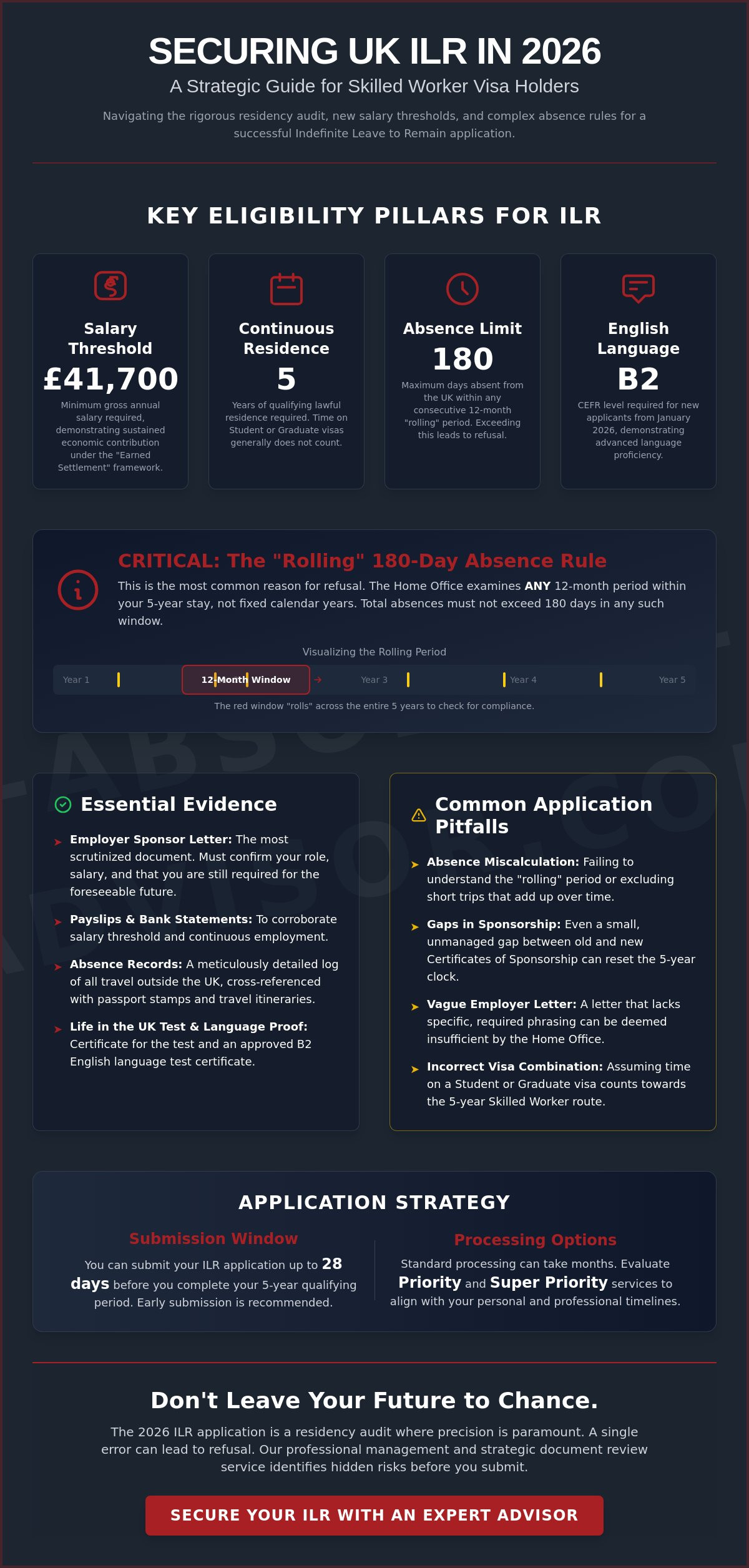
The most common cause for application failure is a misunderstanding of the “rolling” 12-month rule. Unlike older regulations that looked at fixed calendar years, the current system evaluates any consecutive 12-month period during your five-year stay. If your total absences exceed 180 days in any of these windows, the Home Office will likely issue a mandatory refusal. It’s vital to remember that only full 24-hour periods spent outside the UK count toward this limit; days of departure and arrival are generally excluded. For those with complex travel histories, utilizing a professional document checking service provides a precise audit of your absence records to ensure you remain within these strict limits.
Certain exemptions do exist for those whose work requires international travel. Research activities, natural disasters, or unavoidable travel disruptions like those seen in recent years may be discounted if supported by robust evidence. However, even a single day exceeding the 180-day threshold without a valid, evidenced exemption can lead to an automatic rejection of your settlement claim.
Salary Thresholds and SOC Code Variations
As of 2026, the financial requirements for settlement have become significantly more stringent. The general minimum salary threshold for Skilled Worker ILR applicants is now £41,700 per year. However, this is only the baseline. You must also meet the “going rate” for your specific Standard Occupational Classification (SOC) code if that rate is higher than the general threshold. This ensures that sponsored workers aren’t undercutting the local labor market.
- Standard Applicants: Must earn at least £41,700 or the SOC going rate, whichever is higher.
- Health and Care Workers: Often subject to different salary scales based on national pay structures.
- Immigration Salary List: Roles previously on the Shortage Occupation List may have transitional arrangements, though these are increasingly rare in 2026.
Your employer must confirm in writing that you’re still required for your role and that your salary meets these updated levels. If your pay has fluctuated or if you’ve changed SOC codes during your five years, your documentation must clearly explain these transitions to satisfy the caseworker’s audit.
The Evidentiary Burden: Essential Documentation for Success
The Home Office doesn’t just evaluate your eligibility; they audit your evidence. While the salary thresholds and absence records discussed previously establish your legal standing, the physical documentation you submit serves as the final arbiter of your success. When applying for ilr on skilled worker visa, your file must be beyond reproach. Caseworkers look for consistency across five years of financial data, employer declarations, and personal conduct records. Any discrepancy between your reported income and your P60s, or a gap in your bank statements, can trigger an immediate request for further information or a denial based on a failure to meet the evidentiary burden.
A comprehensive approach involves more than just gathering papers; it requires a strategic “Document Audit” to ensure every piece of evidence reinforces your narrative of compliance. This includes providing your most recent payslip and a corresponding bank statement, both dated within 31 days of your application. You’ll also need to account for your “Good Character.” This requirement extends beyond criminal convictions to include tax irregularities, litigation, or previous immigration breaches. Ensuring your record is clean and accurately disclosed is a fundamental step in securing your permanent tenure in the UK.
The Perfect Employer Support Letter
The sponsor letter is arguably the most scrutinized document in your submission. It isn’t enough for your employer to confirm you work there; the Home Office requires specific legal phrasing to satisfy the “genuine vacancy” and “ongoing need” criteria. The letter must explicitly state that you are “still required for the employment in question for the foreseeable future.” It must also confirm your SOC code and verify that your salary meets the updated £41,700 threshold or the relevant going rate. Common errors, such as using an outdated company letterhead or failing to mention the specific gross annual salary, often lead to avoidable inquiries that stall the process.
Knowledge of Language and Life (KoLL)
To integrate fully into British society, you must satisfy the Knowledge of Language and Life requirements. This involves passing the Life in the UK test, which remains valid indefinitely once completed. Regarding language proficiency, the 2026 standards are precise. As of January 8, 2026, new applicants must meet the B2 level of the Common European Framework of Reference (CEFR). However, if you already held your Skilled Worker visa before this date and met the previous B1 level, you generally don’t need to take a new test. Exemptions apply to those under 18, over 65, or those with long-term physical or mental conditions that make passing the tests impossible. Our Document Checking Service helps verify these exemptions and test certificates early in the process to prevent last-minute complications.
The Application Strategy: Timing and Fast-Track Options
Timing isn’t merely a logistical detail; it’s a legal requirement that determines the validity of your entire submission. When applying for ilr on skilled worker visa status, you must identify a specific window that satisfies the Home Office’s residency requirements without falling foul of early-submission rules. The standard “28-day rule” allows you to submit your application up to 28 days before you reach the five-year anniversary of your initial entry into the UK or the date your first visa was granted. Submitting even 24 hours before this window opens leads to a mandatory refusal, as you won’t have met the statutory qualifying period at the time of application.
Beyond the submission date, you must account for the processing period and its impact on your daily life. While your application is pending, your legal status is governed by Section 3C of the Immigration Act 1971. This crucial provision ensures your current rights, including the right to work for your sponsor and access the NHS, remain intact even if your original visa expires while you wait for a decision. However, this protection is fragile. Leaving the Common Travel Area while your application is under consideration results in the automatic withdrawal of your request, potentially leaving you without a valid visa to return to the UK. If you require professional certainty before hitting the submit button, our Indefinite Leave to Remain (ILR) Application Service provides a comprehensive review of your timeline to prevent these catastrophic errors.
Strategic Timing and Section 3C Leave
Section 3C leave provides a vital safety net for professionals whose visas expire during the administrative process. It’s a seamless extension that prevents you from becoming an overstayer, provided your application was submitted “in-time.” You don’t need to take additional action to trigger this; it happens automatically by operation of law. You must, however, remain in the UK. Any travel outside the UK, Ireland, the Isle of Man, or the Channel Islands while the Home Office is processing your file will void your application immediately. This rule is often overlooked by those with urgent business travel needs, making the choice of processing speed a strategic necessity rather than a luxury.
Fast-Tracking Your Settlement
In 2026, standard ILR applications can take up to six months to reach a conclusion. For many skilled workers, this half-year period of travel restrictions is professionally untenable. To mitigate this, the Home Office offers two expedited paths. The Priority service aims for a decision within five working days for an additional fee of approximately £500. For those requiring the fastest possible resolution, the Super Priority service aims for a decision by the end of the next working day for a cost of roughly £1,000. These fast-track options don’t change the eligibility criteria, but they do provide the immediate security of tenure required for international career commitments.
- Standard Service: Up to 6 months for a decision.
- Priority Service: Decision typically within 5 working days.
- Super Priority Service: Decision usually by the end of the next working day.
Choosing the right service level depends on your upcoming travel schedule and the complexity of your residence history. If your absence records are near the 180-day limit, utilizing a fast-track service combined with expert representation ensures that any queries are addressed while your evidence is fresh and your status is protected.
Professional Management: Why Expert Guidance Is Essential
Successfully applying for ilr on skilled worker visa status in 2026 requires more than just meeting the basic criteria; it demands a strategic approach to legal representation. The Home Office’s shift toward an “earned settlement” model means that every aspect of your five-year history is subject to intense scrutiny. Moving beyond the mere administrative task of filling out forms, our methodology focuses on identifying and mitigating risks before they reach a caseworker’s desk. Whether you’ve faced salary fluctuations due to unpaid leave or have a complex history of employer changes, professional management ensures your narrative remains consistent with the current Immigration Rules.
Our document check service is specifically designed to identify hidden vulnerabilities in your residence records. For instance, many applicants struggle with the rolling 180-day absence calculation, often failing to account for travel days correctly. We perform a granular audit of your passport stamps and travel logs to ensure your continuous residence is mathematically sound. Additionally, we provide guidance for those who have faced previous refusals or administrative challenges, ensuring that past issues are addressed transparently and legally to prevent them from compromising your settlement goals.
Our Fixed-Fee Application Management
We believe in transparent pricing and comprehensive support throughout the settlement process. Our Secure your UK residency with our expert ILR application service includes the preparation of a detailed legal cover letter. This document is vital for explaining complex residency gaps or variations in SOC code salary thresholds that might otherwise trigger a request for further evidence. By presenting a well-structured, evidence-backed argument from the outset, we reduce the likelihood of delays and provide the Home Office with the clarity needed for a prompt decision.
Beyond ILR: The Path to Naturalisation
Securing Indefinite Leave to Remain is a significant achievement, but for many, it’s the mandatory bridge to a UK passport. Once you’ve held ILR for at least 12 months, you may become eligible to apply for naturalisation as a British citizen. This final step requires further evidence of good character and continued residence, but it removes all future immigration restrictions entirely. Planning for this transition early ensures that your settlement application is handled with your long-term citizenship goals in mind. For a deeper understanding of the final stage of your journey, consult our resource on British Citizenship: The Complete Guide to Naturalisation in 2026. Our team remains your strategic partner from your initial Skilled Worker entry through to your final naturalisation ceremony.
Securing Your Permanent Future in the UK
The transition from a temporary visa to permanent residency is a defining moment for any international professional. As we’ve explored, the 2026 landscape demands absolute precision, particularly regarding the £41,700 salary threshold and the complex 180-day rolling absence calculations. Successfully applying for ilr on skilled worker visa status is no longer just about meeting time requirements; it’s about presenting a bulletproof residency audit that satisfies the Home Office’s “earned settlement” criteria.
Our OISC-registered consultants specialize in managing complex Skilled Worker settlement cases, providing the strategic oversight needed to identify risks before they lead to a refusal. We offer fixed-fee transparency and meticulous document checking to ensure your application is beyond reproach. If you’re ready to move beyond the uncertainty of temporary leave and secure your permanent tenure, book a consultation for your Skilled Worker ILR application today. Your path to British citizenship begins with a flawlessly executed settlement strategy. We’re here to ensure your five years of hard work and contribution result in the security you deserve.
Frequently Asked Questions
How early can I apply for ILR on a Skilled Worker visa?
You can submit your application up to 28 days before you reach the five-year anniversary of your qualifying period. Applying earlier than this specific window results in an automatic refusal because you haven’t yet met the statutory residency requirement. It’s vital to calculate this date from the day you first entered the UK on your visa or the date the initial leave was granted; whichever occurred first.
Can I combine time spent on a Student visa with a Skilled Worker visa for ILR?
No, time spent on a Student visa or Graduate visa doesn’t count toward the five-year settlement path. These categories are not qualifying routes for ILR under the Skilled Worker rules. If you switched from a Student visa to a Skilled Worker visa, your five-year qualifying period only began on the date your Skilled Worker leave was officially granted by the Home Office.
What happens to my ILR application if I lose my job?
Your application will likely be refused if you lose your job while the decision is pending. A central requirement for applying for ilr on skilled worker visa is a formal declaration from your sponsor confirming you’re still needed for the foreseeable future. If your employment ends, the sponsor is legally obligated to notify the Home Office, which invalidates the “ongoing need” criteria for settlement.
Do my dependents get ILR at the same time as me?
Dependants can apply for settlement at the same time as the main applicant, provided they’ve also completed five years of continuous residence in the UK. Each family member must satisfy their own eligibility criteria, including the Knowledge of Language and Life requirements. If a dependant hasn’t yet reached the five-year mark, they must apply for a further extension rather than Indefinite Leave to Remain.
What is the minimum salary for ILR on a Skilled Worker visa in 2026?
The general minimum salary threshold for settlement is £41,700 per annum as of May 2026. You must also meet the specific “going rate” for your job’s SOC code if that figure is higher than the general threshold. Your employer must provide written confirmation that your salary meets these updated levels and will be maintained for the foreseeable future to satisfy the Home Office audit.
How do I calculate the 180-day absence limit for settlement?
You must calculate absences on a rolling 12-month basis rather than a calendar year. This means you cannot have spent more than 180 days outside the UK in any consecutive 12-month window during your five-year qualifying period. Only full 24-hour periods spent abroad are counted toward this limit; the days you depart from and return to the UK are generally excluded from the total.
Is the Life in the UK test mandatory for all ILR applicants?
Yes, passing the Life in the UK test is a mandatory requirement for most applicants aged 18 to 64. The test certificate remains valid indefinitely once you’ve successfully completed it. Exemptions are only available for those under 18, over 65, or those with a documented long-term physical or mental condition that makes taking the test impossible, supported by specific medical evidence.
What is the cost of an ILR application in 2026?
The Home Office charges a standard application fee of £3,226 per person for settlement. This is a mandatory government cost and doesn’t include legal representation fees or optional priority service charges. If you require a faster decision, you may pay an additional £500 for the 5-day priority service or approximately £1,000 for the next-day super priority service.