

The UK’s long residence settlement is currently undergoing its most significant shift in a generation, and waiting even a few months to apply could be the difference between securing your future or facing a much harder “Earned Settlement” model. After a decade of building a life in Britain, the prospect of a £3,226 application fee and the fear of a technical refusal can feel overwhelming. It’s natural to feel anxious about the 10 year route to ilr uk, especially with the Home Office’s strict new absence rules and the complexities of transitional periods for travel that started before April 2024.
You’ve worked hard to reach this milestone, and you deserve a settlement process that reflects your commitment to the country. This guide will strip away the confusion, providing you with a clear, strategic roadmap to navigate these 2026 requirements and secure your Indefinite Leave to Remain with absolute confidence. We’ll break down the 180 day absence limits, explain how to calculate your qualifying period, and show you how to protect your application from common pitfalls that lead to costly rejections.
Key Takeaways
- Identify the specific visa categories that can be combined to meet your long residence requirements and establish a valid qualifying period.
- Navigate the complex 2025/2026 absence regulations for the 10 year route to ilr uk, including the 180-day limit and transitional rules for travel before April 2024.
- Determine your earliest possible application date to secure your status before proposed “Earned Settlement” policy changes are implemented.
- Protect your £3,226 investment by mastering the technical document requirements that prevent non-refundable refusals and application delays.
What is the 10-Year Route to ILR in the UK?
The 10-year route, officially known as Long Residence, represents a unique path to permanent settlement for individuals who’ve maintained legal status in the UK through various immigration categories. Unlike specific employment-based or family-based routes that often require you to stay on a single visa type for five years, this path recognizes the reality of a modern career and life. The 10 year route to ilr uk allows you to accumulate time across a diverse range of visa histories, rewarding the longevity of your stay rather than the specific category of your current leave. Long Residence serves as the ultimate safety net for individuals who’ve built their lives in Britain over a decade but may not qualify under more restrictive five-year settlement categories.
One of the most significant advantages of this route is the freedom it provides from a single sponsor or employer. While a Skilled Worker visa ties your status to a specific job, the Long Residence path focuses on your total time spent as a lawful resident. This means you can switch industries, move from being a student to a professional, or change from a dependent to a lead applicant without resetting your settlement clock. It provides a level of professional and personal autonomy that other routes simply cannot match.
Indefinite Leave to Remain (ILR) vs. Leave to Remain
Understanding the distinction between these two statuses is vital for your long-term planning. Leave to Remain is a temporary grant of stay that usually comes with an expiry date and specific conditions, such as no access to public funds or a requirement to work for a specific employer. In contrast, obtaining ILR provides you with permanent residency. To understand the legal foundations, it’s helpful to review What is Indefinite Leave to Remain and how it functions as a permanent status. Once you hold ILR, you’re no longer subject to immigration time limits, and it serves as the mandatory stepping stone for those pursuing British Citizenship.
The ‘Any Combination’ Visa Rule
The flexibility of the 10 year route to ilr uk stems from the ability to combine almost any legal visa types to reach the 10-year threshold. For example, many applicants begin this journey by securing admission to UK universities through services like Ideal Study Abroad, eventually transitioning from a Student visa to a Graduate visa and finally to a Skilled Worker visa. This cumulative approach ensures that your early years of education and initial career steps are not wasted. However, certain categories are strictly excluded from this calculation. Time spent on a Standard Visitor visa or as a short-term seasonal worker doesn’t count toward the 10-year total. Additionally, current guidance specifies that time spent in the UK under the various Ukraine schemes generally does not contribute to the Long Residence qualifying period.
Eligibility Criteria: How to Calculate Your 10-Year Qualifying Period
Precision is the foundation of a successful settlement application. Calculating the 10 year route to ilr uk begins from the exact date you first arrived in the country on a valid visa. It’s not simply about physical presence. You must have held continuous, lawful status for the entire decade without any unauthorized gaps. This process requires a meticulous audit of your past Biometric Residence Permits (BRPs) and passport entry stamps to construct a definitive timeline. Any discrepancy in these dates can lead to an immediate refusal. It’s essential to cross-reference your personal records with the Official government guidance on the 10-year route to ensure every month of your stay is accounted for.
A technicality that often catches applicants off guard is the ’12-month rule.’ Under current regulations, you must have held your current category of permission for at least one full year before you become eligible to apply for settlement under the long residence route. This rule prevents individuals from switching into a visa category at the last minute just to claim ILR. If you’re concerned about how your visa history aligns with these strict requirements, utilizing a professional document checking service can provide the clarity and peace of mind you need before committing to the high application fees.
What Breaks Continuous Residence?
Maintaining the 10-year clock requires absolute compliance with immigration laws. Overstaying your visa is the primary cause for breaking continuous residence; even a short lapse can reset your counter to zero. Similarly, if a visa extension is refused and you aren’t granted an administrative review or a new visa, your qualifying period is interrupted. Beyond administrative gaps, the Home Office evaluates ‘bad character’ issues. Criminal convictions or a history of deception in previous applications can lead to a refusal, regardless of how many years you’ve lived in the UK.
Understanding Section 3C Leave
Section 3C leave serves as a legal ‘bridge’ that protects your status while you wait for a decision on a pending application. If you’ve submitted a valid extension application before your current visa expires, Section 3C leave keeps your existing rights and conditions active. Importantly, this period counts toward your 10-year total. You should always keep records of your application submission dates and payment receipts. These documents are vital proof of your 3C status and ensure that processing delays by the Home Office aren’t unfairly counted as gaps in your lawful residence.
Absence Rules and the 2025/2026 Regulatory Updates
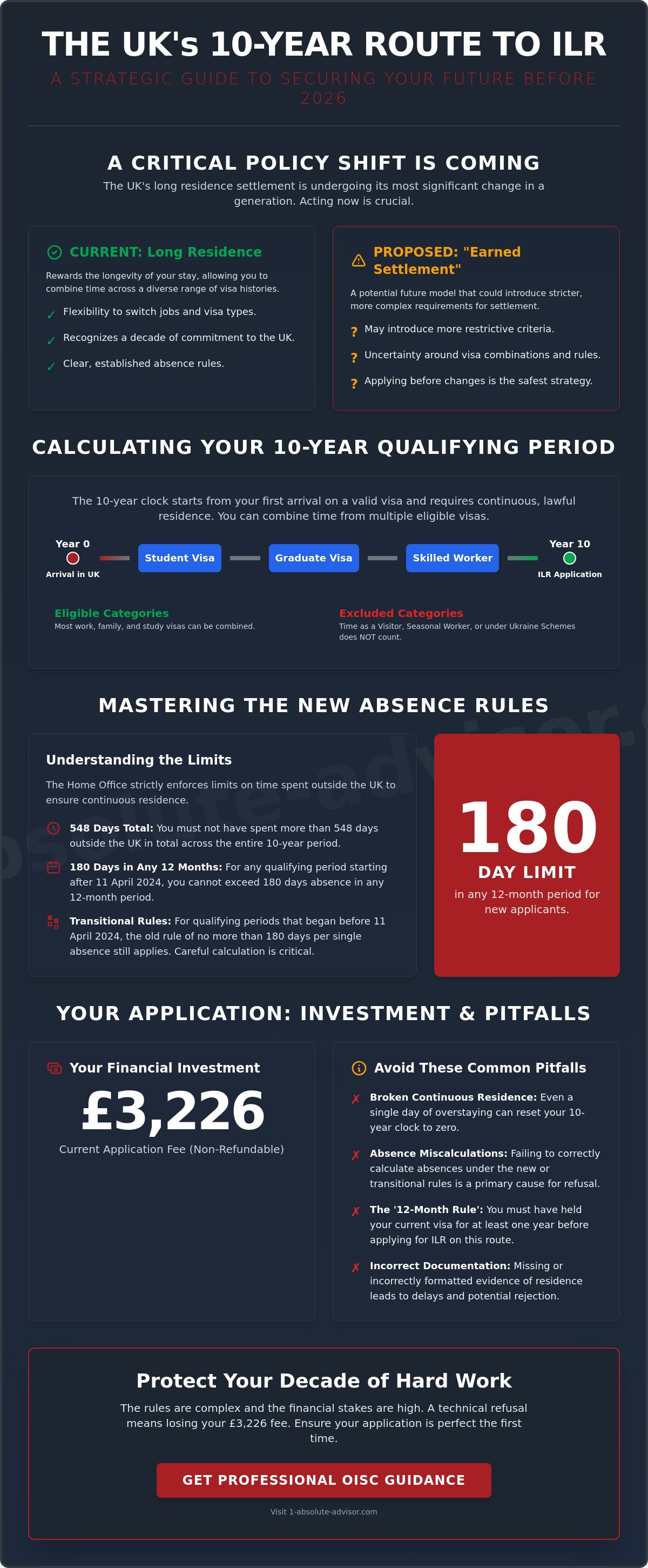
The Home Office’s approach to absences has become significantly more technical following the 11 April 2024 rule change. For any period of residence occurring after this date, the standard limit is now 180 days of absence within any rolling 12-month period. This is a departure from the older, fixed-period calculations. If your 10 year route to ilr uk includes travel that took place before April 2024, you’re subject to transitional protections. These older rules mandate that you must not have been absent for more than 184 days in a single instance and your total absences across the first 10 years must not exceed 548 days. Calculating these overlapping requirements requires a high degree of precision to protect your £3,226 application investment.
A vital but often overlooked update arrived in July 2025 regarding time spent in Crown Dependencies. If you’ve lived in Jersey, Guernsey, or the Isle of Man, this time can now be integrated into your 10-year timeline under specific conditions. This regulatory shift recognizes the mobility of professionals within the British Isles. However, the Home Office remains strict about how this time is credited. Your most recent grant of leave must have been issued within the UK, and the visa routes used in the dependencies must be equivalent to recognized UK settlement paths. This ensures that your cumulative residence is treated as a single, continuous journey toward permanent status.
The 180-Day Rule Explained
Calculating absences on a rolling basis means that you can’t simply look at calendar years. Instead, you must ensure that at any point in time, the preceding 12 months do not contain more than 180 days abroad. If you’ve exceeded these limits due to extraordinary circumstances, you may qualify for a “compassionate grounds” exception. The Home Office doesn’t grant these lightly. You’ll need to provide exhaustive evidence, such as hospital records for medical emergencies or official documentation regarding global travel disruptions. It’s not enough to have a compelling story; you must have a documented paper trail that proves the travel was truly unavoidable.
Crown Dependencies and the 2025 Shift
The July 2025 update is a significant win for applicants who’ve spent years in the Channel Islands or the Isle of Man. To include this time in your 10 year route to ilr uk, you must prove that your stay in these territories was lawful and consistent with UK immigration principles. The most critical requirement is the “last grant” rule: your current permission to stay must have been granted by the UK authorities, not the dependency’s government. This ensures that the final stage of your settlement journey is anchored in the UK’s own immigration system. If you meet these criteria, your years in the dependencies provide a valid foundation for your settlement application.
The ILR Application Process: Fees, Documents, and Timing
Timing is everything. The Home Office allows you to submit your application up to 28 days before you actually complete your 10-year qualifying period. This window requires precise calculation; applying even one day too early will result in an automatic refusal and the loss of your application fee. As of April 2026, the standard fee for a SET(LR) application is £3,226 per person. Once you’ve submitted the online form and paid this fee, you’ll need to attend a biometrics appointment to provide your fingerprints and a digital photograph. When you approach the final stages of the 10 year route to ilr uk, your focus must shift from simple residence to rigorous administrative preparation.
The biometrics appointment is more than a formality. It’s the point where your digital identity is linked to your application. You must bring your original passport and the appointment confirmation. Any delay in booking this appointment can extend the already lengthy six-month processing time. Regarding travel logs, don’t rely on memory. Cross-reference your email flight confirmations with your passport stamps to ensure every single exit and entry date is accurate to the day. This level of detail is what separates a successful application from one that triggers a request for further evidence.
Mandatory Prerequisites: Life in the UK and English Language
Before you even open the application form, you must meet two critical statutory requirements. You’ll need to prove your English language proficiency at CEFR Level B1 or higher through a Secure English Language Test (SELT). You’re exempt from this if you hold a degree taught in English from a UK university or if you’re a national of a majority English-speaking country. Additionally, you must pass the Life in the UK test. If you’re feeling unprepared, you can consult our detailed guide on how to pass the Life in the UK test to ensure you’re ready for this mandatory step.
Evidence Checklist for Long Residence
Navigating the 10 year route to ilr uk requires more than just time; it demands a flawlessly compiled dossier of your decade in Britain. You must collate every passport you’ve held during this period, along with your BRPs and a comprehensive travel log. If there are years where your history is complex, secondary evidence like P60s, bank statements, or utility bills becomes essential. A professional cover letter is often the deciding factor in a successful outcome. It allows you to explain any minor gaps or complex visa transitions clearly to the caseworker. To ensure your documentation meets these exacting standards, our Indefinite Leave to Remain (ILR) Application Service provides the expert oversight needed to protect your settlement future.
Professional Guidance: Why an OISC Advisor is Essential for the 10-Year Route
The 10 year route to ilr uk is arguably the most technically demanding pathway in the British immigration system. While other routes focus on a single visa type, Long Residence requires a flawless audit of ten years of varied permissions, travel dates, and personal history. A single miscalculation in your rolling 180-day absence limit or a misunderstood gap in lawful residence can lead to an immediate refusal. Because Home Office fees are non-refundable, a rejection means losing your £3,226 investment plus any priority service charges. Engaging an OISC-registered advisor ensures that your entire decade of history is scrutinized for hidden risks before the government ever sees your application.
Professional representation provides more than just a document check. It offers a strategic shield. For applicants with urgent travel needs or those who simply want peace of mind, we can facilitate Super Priority services to secure a decision within 24 hours. This level of speed is only valuable if the underlying application is robust. Our advisors act as your strategic partners, identifying potential issues with Section 3C leave or historic visa transitions that a standard applicant might overlook. We ensure your submission is not just a collection of forms, but a professionally presented case that meets the high evidentiary standards of 2026.
Managing Complex Visa Histories
Many applicants face “gaps” between visas caused by administrative delays or late submissions. These periods don’t always result in a refusal if handled with expert legal arguments. We specialize in drafting comprehensive cover letters for discretionary cases, explaining complex transitions to Home Office caseworkers with precision. To protect your future, you can utilize our document checking service to ensure every BRP and passport stamp in your 10-year history is compliant with current regulations.
Next Steps: From ILR to British Citizenship
Securing Indefinite Leave to Remain is the final prerequisite before you can apply for naturalisation. For most residents, there’s a mandatory 12-month waiting period after receiving ILR before you’re eligible for citizenship. However, if you’re married to a British citizen, you may be able to apply for naturalisation immediately upon receiving your settlement grant. This transition represents the end of your immigration journey and the beginning of full legal belonging in the UK. If you’re ready to secure your permanent future, we invite you to consult with an expert for a full eligibility assessment and a tailored roadmap to citizenship.
Securing Your Future in the United Kingdom
Completing a decade of life in Britain is a remarkable milestone, yet the final step toward permanent residency requires absolute technical precision. Success on the 10 year route to ilr uk currently depends on your ability to navigate the 2024 absence rule changes and the strict 28-day application window. With the government’s “Earned Settlement” proposals creating future uncertainty, securing your status under the current operational framework is a vital strategic move for any long-term resident.
The complexities of rolling 12-month absence audits and transitional travel rules leave no room for administrative error. Our OISC Registered Immigration Consultants specialize in managing complex Long Residence cases, providing the expert oversight necessary to protect your £3,226 investment. We prioritize fixed-fee transparency, ensuring you receive elite legal guidance with no hidden costs. Don’t let a minor technical oversight jeopardize your decade of hard work and commitment to your life in the UK.
Secure your UK settlement with expert ILR application management today. Your permanent future is within reach, and we’re here to ensure you cross the finish line with total confidence and peace of mind.
Frequently Asked Questions
Can I apply for ILR after 10 years if I was a student for part of that time?
Yes, time spent as a student counts toward your total residence. This flexibility is what makes the 10 year route to ilr uk so valuable for long-term residents. You can combine years spent on Student, Graduate, and Skilled Worker visas to reach the decade threshold. For students already in the country seeking flexible undergraduate or master’s options to support their educational goals, ukhomestudents.com provides tailored programmes. It’s essential that your status remained lawful throughout these transitions without any unauthorized breaks in your leave to remain.
What happens if I have a gap of a few days between my visas?
A gap of a few days can be problematic but isn’t always fatal to your application. The Home Office may disregard a period of overstaying if it’s 14 days or less and there’s a good reason for the delay. However, these gaps are scrutinized heavily by caseworkers. We suggest a full audit of your history to ensure any overlap doesn’t reset your ten-year counter to zero.
How much does the 10-year ILR application cost in 2026?
The standard fee for an ILR application is £3,226 per person as of April 2026. This cost applies to both main applicants and any dependants applying separately. If you require a faster decision, you’ll need to pay an additional £500 for Priority service or £1,000 for Super Priority service. These fees are non-refundable even if your application is refused for technical reasons.
Does the 10-year route count time spent on a visitor visa?
Time spent on a Standard Visitor visa is strictly excluded from the 10-year calculation. The Home Office only recognizes time spent under a valid grant of leave that allows for long-term residence. If you entered the UK as a tourist before switching to a resident visa, your ten-year clock only starts from the date your first resident visa was granted or your first entry on that visa.
Can I include my dependants in my 10-year long residence application?
No, dependants cannot be included on the main applicant’s SET(LR) form. Each family member must submit a separate application and pay the individual £3,226 fee. This requirement often makes the 10 year route to ilr uk a significant financial commitment for families. Each person must also independently meet the residence and absence requirements to be successful in their own right.
What is the 180-day absence rule for the 10-year route?
The 180-day rule mandates that you don’t spend more than 180 days abroad in any rolling 12-month period. This applies to all absences starting after April 11, 2024. If your travel occurred before this date, you’re protected by transitional rules that allow for a total of 548 days away over the entire ten-year period. Accuracy in these calculations is vital for an approval.
Do I need to pass the Life in the UK test for the 10-year route?
Yes, you must pass the Life in the UK test before submitting your settlement application. This is a mandatory requirement for most applicants between the ages of 18 and 64. You’ll also need to prove your English language proficiency at Level B1. Exemptions only apply if you’re from a majority English-speaking country or hold a degree taught in English from a recognized UK university.
How long does the Home Office take to decide on a 10-year ILR application?
The Home Office currently takes up to 6 months to process standard ILR applications. This timeline begins once you’ve attended your biometrics appointment and provided your fingerprints. High application volumes in early 2026 have led to many cases taking the full duration of this window. If you need a decision sooner, the Super Priority service can provide an outcome by the next working day.