

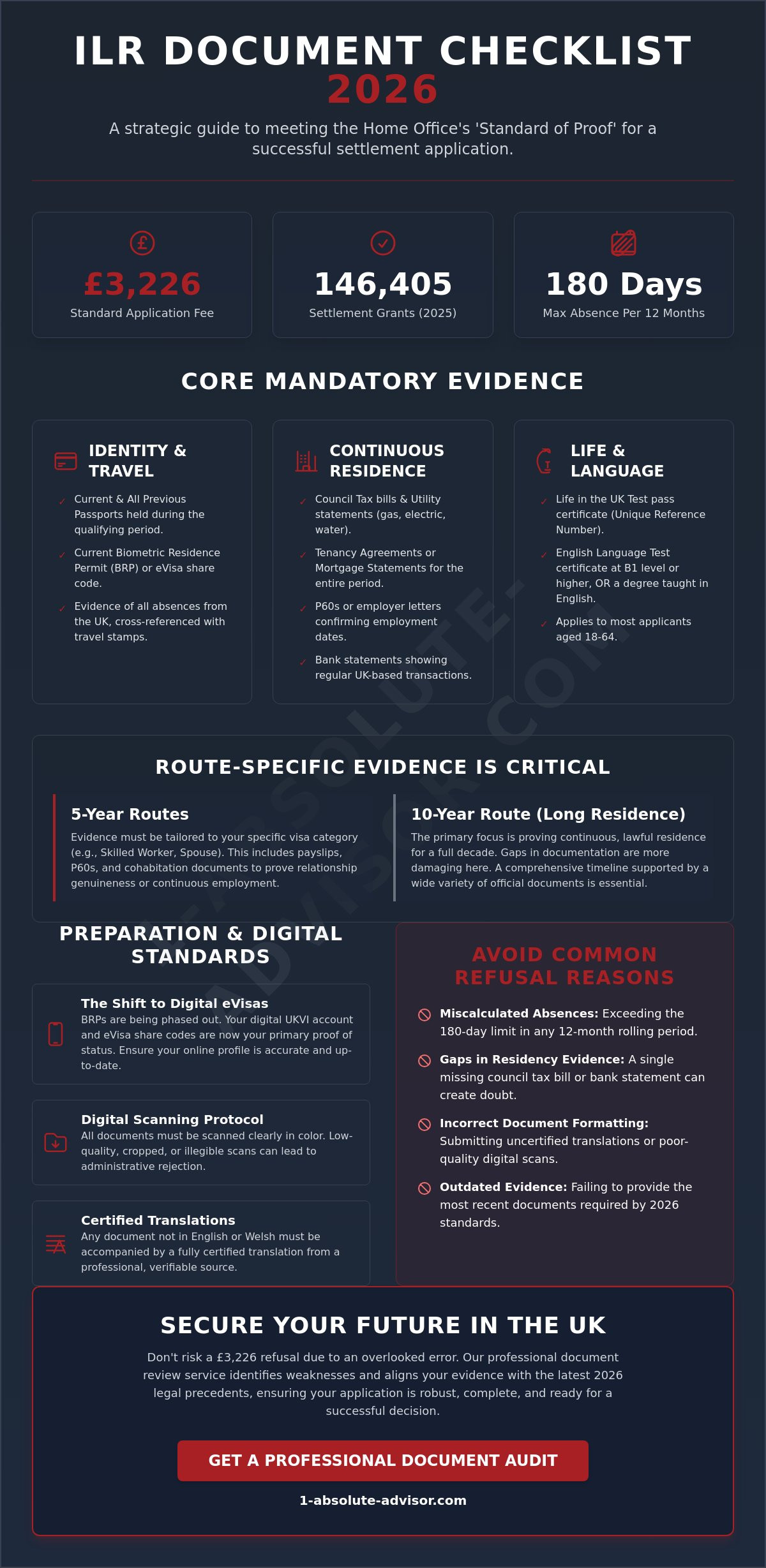
Is a single missing bank statement or a miscalculated absence worth risking a £3,226 application fee? With 146,405 settlement grants issued in 2025, the path to permanent residency is well-trodden, yet the Home Office’s “Standard of Proof” remains a significant hurdle. You likely feel the pressure of proving years of continuous residence while managing the shift to a digital-only eVisa system. Securing your future requires a precise ilr document checklist that goes beyond mere presence and focuses on the quality and formatting of your evidence.
We understand that the complexity of settlement can be daunting when your stability in the UK is on the line. This guide promises to help you master these complexities with a comprehensive, route-specific ILR document checklist for 2026. We will examine the exact evidence needed for your specific path, from financial records to residency proofs, ensuring your application reflects the professional integrity and strategic preparation required for a successful decision.
Key Takeaways
- Learn how to construct a strategic ilr document checklist that moves beyond basic compliance to meet the Home Office’s 2026 evidentiary standards.
- Identify the essential identity and residency records required to validate your continuous stay and confirm your Knowledge of Life in the UK.
- Differentiate between the evidentiary requirements for 5-year and 10-year routes to ensure your submission is perfectly tailored to your specific immigration path.
- Master the technical standards for document preparation, including strict certified translation rules and digital scanning protocols that prevent administrative rejection.
- Recognize how a professional document audit identifies overlooked errors and aligns your evidence with the latest 2026 legal precedents for a secure application.
The Critical Role of the ILR Document Checklist in 2026
An application for Indefinite Leave to Remain is more than an administrative formality; it’s a legal petition to the Crown. In 2026, your ilr document checklist acts as the blueprint for this petition. It’s a strategic assembly of evidence designed to prove your eligibility under strict UK Immigration Rules. With the standard application fee currently set at £3,226 per person, the financial and emotional stakes leave no room for oversight. Home Office refusal trends show that even minor discrepancies in residency evidence or outdated document formats can lead to immediate rejection. A well-structured checklist serves as the foundation for your legal cover letter, allowing you to present a cohesive narrative that anticipates a caseworker’s potential questions.
Understanding the ‘Standard of Proof’
Caseworkers don’t just look for the presence of documents; they evaluate their credibility and relevance. This is the “Standard of Proof.” Submitting a massive volume of papers can actually obscure your strongest evidence. You must distinguish between mandatory documents, such as your current passport, and discretionary evidence that supports your specific circumstances. Mandatory items are non-negotiable, while supporting documents provide the context necessary to bridge gaps in your residency history. A professional ilr document checklist ensures that every file serves a purpose, aligning with the requirements of your visa route while meeting the rigorous audit standards of the Home Office.
The Shift to Digital: eVisas and Share Codes
2026 marks a definitive shift in how the UK manages immigration status. The total phase-out of physical Biometric Residence Permits (BRPs) means your digital profile is now your primary legal identity. You must be proficient in generating and validating eVisa share codes to prove your status to caseworkers and employers alike. This transition requires a proactive approach to record-keeping. You’ll need to ensure your UKVI account is fully updated and that all previous immigration milestones are accurately reflected in the digital system. Maintaining a meticulous digital trail of your immigration history is no longer optional. It’s a core requirement for demonstrating your continuous residence throughout the qualifying period.
Core Mandatory Evidence: Identity, Residency, and Knowledge of Life
Establishing your identity is the foundational step of any settlement application. While many applicants assume a current passport is sufficient, the Home Office requires a comprehensive history of your movements. You must provide every travel document held during your qualifying period, including expired passports. These documents serve as primary evidence for your residency history, allowing caseworkers to cross-reference entry and exit stamps against your declared absences. As we move into 2026, the transition to a digital-first system means your physical Biometric Residence Permit (BRP) is being replaced by digital identity verification. You’ll likely need to provide your UKVI account details alongside your physical passport to ensure your ilr document checklist is complete and verifiable.
Proving Continuous Residence
The “180-day rule” is a strict threshold that requires meticulous documentation. You cannot spend more than 180 days outside the UK in any 12-month period during your qualifying years. To prove you’ve maintained a home here, you should gather a variety of independent evidence. Strong applications typically include:
- Annual Council Tax bills and utility statements (gas, electricity, or water).
- Signed tenancy agreements or mortgage statements.
- P60s and formal letters from employers confirming your start and end dates.
- Bank statements showing active daily spending within the UK.
If you find gaps in your documentation, perhaps due to a move or a digital banking shift, you must address these proactively. Providing a “Document Checking Service” or a professional audit can help identify these weaknesses before they lead to a refusal. If you’re concerned about missing records, our document checking service can provide the necessary oversight to ensure your evidence meets the required standard.
Knowledge of Language and Life Requirements
Most applicants aged 18 to 64 must demonstrate their integration into British society. This involves passing the Life in the UK test, which currently costs £50 per attempt. You’ll need to provide the unique reference number from your pass certificate in your application. For those following the ILR documents for 10-year route, ensuring this test is completed well in advance is vital to avoid processing delays.
English language proficiency is equally critical. You must prove you can speak and understand English to at least CEFR Level B1. This can be achieved through a Secure English Language Test (SELT) from an approved provider, such as Trinity College London or IELTS SELT Consortium. Alternatively, if you hold a degree taught in English from a UK university, your original degree certificate can serve as sufficient proof. Always check the expiry date of your SELT certificate; while they’re generally valid for two years, they can sometimes be reused for settlement if they were accepted for a previous successful visa application.
Route-Specific Requirements: Tailoring Your Evidence for ILR Success
While core identity documents are universal, the success of your settlement hinges on how well you tailor your ilr document checklist to your specific visa history. The Home Office evaluates applications against route-specific legal tests that vary significantly between categories. For instance, the 5-year route usually requires proof of ongoing employment or family ties, while the 10-year Long Residence route focuses on a decade of continuous, lawful stay regardless of the visa category. If you’ve switched categories, such as moving from a Student visa to a Skilled Worker route, you must ensure your timeline is unbroken and that your current evidence aligns with the most recent financial thresholds and residency rules.
Evidence for Skilled Worker Route Applicants
For those on the Skilled Worker route, the employer letter is the most scrutinized document in your submission. It isn’t enough for your employer to confirm your start date. The letter must explicitly state your job title, your SOC code, and your current gross annual salary, which must meet the relevant threshold for your occupation as of 2026. Crucially, the Home Office requires the letter to confirm that you are “still required for the foreseeable future” in your specific role. Without this specific phrasing and a clear link to your original Certificate of Sponsorship, your application faces a high risk of refusal. You should also provide your six most recent payslips and corresponding bank statements to verify this income matches your employer’s claims.
Evidence for Family and Spouse Route Applicants
Family-based applications focus on the “subsisting” nature of your relationship. A marriage certificate proves a legal union, but it doesn’t prove a shared life in 2026. Your ilr document checklist should include joint financial commitments like mortgage statements, joint bank accounts, or utility bills spread across the last two years. These should ideally come from at least three different official sources to show a consistent pattern of cohabitation.
The financial requirement is another common point of failure for families. You must prove your household meets the minimum income threshold through employment, self-employment, or cash savings. Finally, you must provide evidence that your home meets UK safety and overcrowding standards. This often requires a property inspection report or a formal letter from your landlord detailing the number of rooms and occupants. Ensuring these documents are present and correctly formatted is the only way to secure a positive outcome for your family’s future in the UK.
Preparation Standards: Ensuring Your Documents Meet Home Office Audits
Presentation is as vital as the evidence itself when submitting your final bundle. A “Decision-Ready” application significantly reduces the cognitive load on the caseworker, which often facilitates a smoother approval process. Your ilr document checklist must account for the technical rigour required by Home Office auditors in 2026. This preparation involves more than just gathering papers; it requires a systematic verification of every third-party document. You should confirm the authenticity of employer letters and bank statements before they reach the upload portal to ensure they meet current regulatory standards.
Certified Translation Requirements
Any document not written in English or Welsh must adhere to the strict “Certified Translation” standard. The Home Office won’t accept informal translations provided by friends, family, or non-professional services. Each translation must explicitly include four mandatory elements: a formal confirmation from the translator that it’s an accurate translation of the original, the date of the translation, the translator’s full name and signature, and their professional credentials or contact details. If your home country uses different dating conventions, such as the MM/DD/YYYY format, ensure the translator clarifies these to prevent any misinterpretation of your residency timeline.
Scanning and Uploading Best Practices
The UKVCAS upload portal is the primary gateway for your digital submission. Managing file size limits while maintaining legibility is a common technical challenge. You should aim for a scanning resolution of 300 dpi; this provides the necessary clarity for stamps and signatures without creating excessively large files. It’s essential that every edge of a document is visible in the scan. Blurry or cropped images of identity documents are a frequent catalyst for “Requests for Further Information,” which can push your processing time beyond the standard six-month window.
Organization within the portal is equally important. Adopt a logical naming convention for your files to demonstrate professional oversight. Instead of generic titles like “Doc1.pdf,” use descriptive names such as “Financial_Payslip_January_2026.pdf.” This methodical approach allows the caseworker to navigate your evidence with ease. While the system is now digital-first, you must retain all original hard copies. The Home Office maintains the right to request physical versions for verification at any point during the audit process. If you’re concerned about the technical quality of your evidence, our document checking service provides a professional final audit to ensure your submission is flawless.
Final Submission: How Professional Document Review Prevents Refusals
Even the most diligent applicants often develop a blind spot for their own errors after months of preparation. Reviewing your ilr document checklist one final time is essential, but it cannot replace the “fresh eyes” of a legal professional. A specialist audit ensures your evidence doesn’t just exist but actively aligns with 2026 case law and Home Office internal guidance. This final stage is where you transform a collection of files into a persuasive legal argument. A well-crafted legal cover letter is the key to this transformation. It “connects the dots” for the caseworker, explaining how each piece of evidence satisfies the specific requirements of the UK Immigration Rules and addressing any potential complexities in your residency or financial history.
In the 24 hours before you hit “submit,” verify that every scan is legible and that your eVisa share code is active. You should ensure your ilr document checklist is fully ticked off and that your cover letter matches the digital files you’ve uploaded. This methodical approach allows you to approach the submission button with the megnyugtató magabiztosság (reassuring confidence) that your application is of the highest professional standard.
The Value of a Standalone Document Checking Service
If you’ve already prepared your application, our Document Checking Service provides a final, expert audit of your bundle. We identify “red flag” documents, such as incorrectly formatted employer letters or bank statements that don’t clearly show the salary deposit, that could trigger a secondary inspection or a refusal. This service isn’t just about technical compliance; it’s about the psychological benefit of knowing your submission is robust. Having a strategic partner validate your evidence before you commit to the non-refundable £3,226 fee provides the certainty required in high-stakes immigration matters.
Next Steps: Beyond the ILR Approval
Receiving your settlement is a landmark achievement, but it’s also the beginning of a new legal status. Once you understand the rights and responsibilities associated with ILR UK, you can begin planning for the final step in your journey. Many settlement holders choose to transition to British Citizenship after twelve months of holding ILR. This progression requires its own set of evidentiary standards and character requirements, which we can help you prepare for well in advance. If you’re ready to secure your future in the UK with absolute confidence, contact 1 Absolute Advisor for a comprehensive ILR assessment today.
Securing Your Permanent Future in the United Kingdom
Achieving settlement is a transformative milestone that requires more than just a collection of papers. Your ilr document checklist must be a strategic asset that addresses the 2026 digital transition and specific evidentiary thresholds for your visa route. Precision in your residency proof and financial documentation is the only way to safeguard your £3,226 application fee and ensure a positive outcome. As the Home Office moves toward a digital-first system, maintaining a flawless evidentiary trail is no longer optional; it’s a requirement for your long-term security.
Our OISC-registered advisors specialize in managing the complexities of both 5 and 10-year routes with a focus on professional integrity and predictable results. We provide fixed-fee application management and a comprehensive document audit to identify potential risks before they reach a caseworker. You don’t have to manage this high-stakes process alone. Secure your UK future with a professional ILR document audit and take the final step toward permanent residency with absolute confidence. Your journey toward British citizenship starts with a successful settlement today.
Frequently Asked Questions
What are the mandatory documents for an ILR application in 2026?
Mandatory evidence includes your current passport, all previous travel documents held during your qualifying period, and your Life in the UK test reference number. You must also provide a Secure English Language Test (SELT) certificate at CEFR Level B1 or a UK degree certificate. These core items form the basis of every ilr document checklist regardless of your specific visa route.
Can I use an expired passport to prove my continuous residence for ILR?
Yes, expired passports are essential for demonstrating your travel history and continuous residence. Caseworkers examine the entry and exit stamps in these documents to calculate your total absences from the UK. If you’ve lost an old passport, you may need to provide a Subject Access Request from the Home Office to fill the gaps in your residency record.
How do I provide proof of my immigration status if I have an eVisa?
You must generate a digital share code through your UKVI account to prove your current status. The Home Office uses this code to access your digital immigration record directly. Since physical Biometric Residence Permits are being phased out, ensuring your UKVI account is updated with your latest passport details is a critical step in the 2026 application process.
Do I need to submit original paper documents to the Home Office?
No, the submission process is now primarily digital via the UKVCAS upload portal. You must provide high-quality scans of your original documents, ensuring all stamps and edges are clearly visible. While you don’t mail the originals, you must keep them in your possession as the Home Office reserves the right to request physical verification during their audit.
What happens if I cannot provide one of the documents on the checklist?
You must provide a formal letter of explanation detailing why the document is unavailable and what alternative evidence you are submitting instead. Simply omitting a required item without explanation will likely result in a refusal. We recommend professional advice when substituting evidence to ensure the alternative meets the Home Office’s strict “Standard of Proof.”
Does the 180-day absence rule apply to all ILR routes?
The 180-day rule applies to the majority of settlement categories, including Skilled Worker and Long Residence routes. It requires that you haven’t spent more than 180 days outside the UK in any 12-month period. While some family-based routes have different requirements focusing on cohabitation, the 180-day threshold remains the standard for most applicants.
How recent must my bank statements and payslips be for the application?
Your financial documents must be dated within 28 days of the date you submit your online application. This is known as the “28-day rule” and it’s a frequent cause of application failure. If your bank statements or payslips are older than this when you hit submit, the Home Office will likely consider your financial evidence invalid.
Is a professional document checking service worth the cost for ILR?
A professional audit is a strategic investment that protects your £3,226 application fee from being lost due to preventable errors. An expert review of your ilr document checklist identifies technical discrepancies and evidentiary gaps that are often invisible to the applicant. This service provides the professional certainty required to ensure your application is “Decision-Ready” upon submission.