

What if a single birth certificate from the early 20th century could bypass the complexities of modern corporate sponsorship and grant you a five year right to live and work in London? For many, exploring their ancestry in the United Kingdom begins as a personal journey into the past, yet it often leads to professional frustration when faced with the rigid evidentiary requirements of the Home Office. You’ve likely felt the weight of this uncertainty, where the gap between family history and a legal right to residency seems bridged only by overwhelming paperwork and confusing eligibility rules.
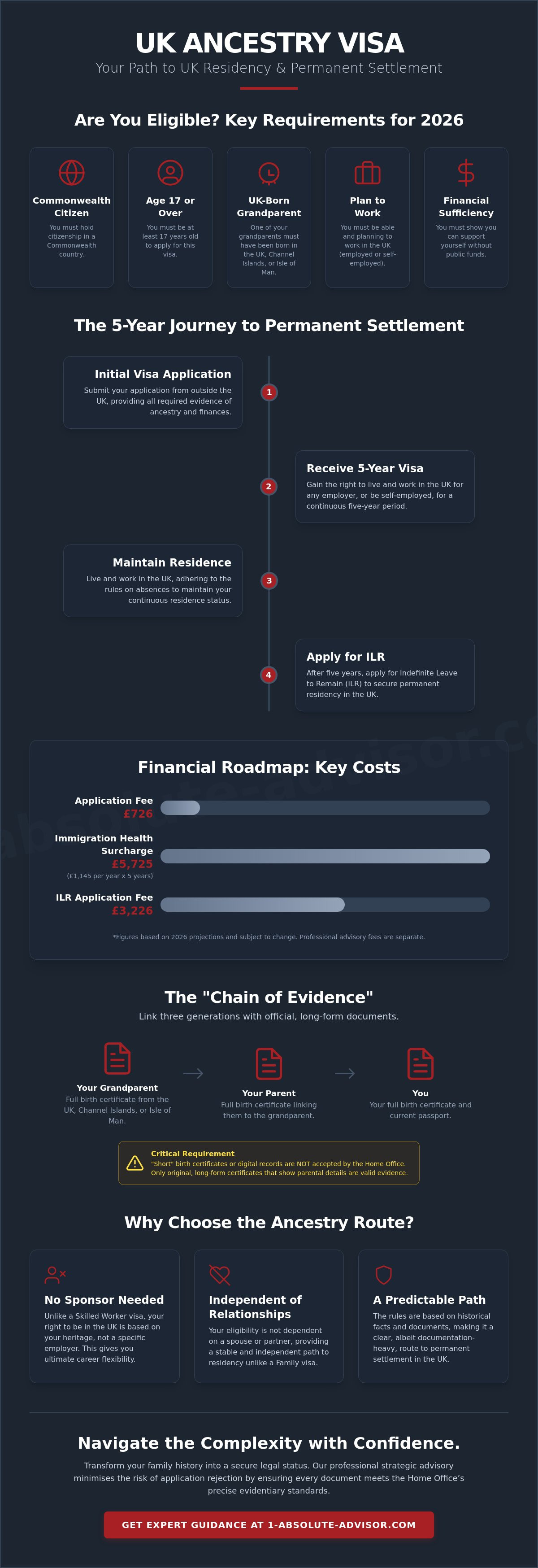
We provide the strategic clarity you need to transform your heritage into a secure legal status. This guide details how to navigate the £726 application fee and the Immigration Health Surcharge, which has risen to £1,145 per year as of April 2026. You’ll learn exactly which documents satisfy the Home Office and how to maintain the continuous residence required for your £3,226 Indefinite Leave to Remain application. We’ll outline the specific Commonwealth criteria and the financial self sufficiency standards that ensure your path to permanent residency remains stable and predictable.
Key Takeaways
- Distinguish between genealogical research and legal eligibility to determine if your ancestry in the United Kingdom grants you a formal right to residency.
- Verify your eligibility based on Commonwealth citizenship and the specific age and financial requirements established for the 2026 application cycle.
- Identify the mandatory “Chain of Evidence” documents, including the specific versions of birth certificates required to link your lineage across three generations.
- Understand the five-year residency requirements and absence limits that bridge the gap between your initial visa and permanent settlement in the UK.
- Learn how professional strategic advisory minimizes the risk of application rejection by ensuring every document meets the Home Office’s precise evidentiary standards.
Understanding Ancestry in the United Kingdom: From Roots to Residency
For many, researching their ancestry united kingdom is a weekend hobby involving digital archives and DNA kits. However, for citizens of the Commonwealth, these historical records represent much more than a nostalgic look at the past. They serve as the primary legal evidence required to secure a unique immigration status that bypasses the need for corporate sponsorship or high-net-worth investment. Unlike a standard Skilled Worker visa, which depends on a specific job offer, or a Family visa, which relies on a current relationship, the ancestry route is a recognition of historical ties and birthright. It’s a strategic pathway that transforms a family tree into a valid legal document.
The UK Ancestry Visa is unique because it doesn’t require a sponsor. While other routes demand proof of a specific salary or a marriage license, this category relies on the stability of historical records that have existed for decades. This creates a predictable, albeit documentation-heavy, path for those who qualify. You aren’t applying based on what you can do for a specific employer, but rather on who you are and where you come from. This distinction makes it one of the most flexible and sought-after routes for eligible individuals seeking a permanent future in Britain.
The Commonwealth Connection
This specific immigration path is reserved exclusively for individuals who hold a qualifying form of British nationality or citizenship in a Commonwealth country. Your current passport is just as critical as your grandparent’s birth certificate. This policy remains a cornerstone of the UK’s commitment to its former territories, offering a streamlined entry for those who can prove their lineage. You can find a comprehensive UK Ancestry visa overview that details the historical evolution of these rights from the 1971 Immigration Act to the present day. Eligibility extends to citizens of countries like Australia, Canada, New Zealand, and South Africa, provided they can demonstrate the required ancestral link to the UK, the Channel Islands, or the Isle of Man.
Genealogy vs. Legal Evidence
There’s a significant gap between genealogical interest and the strict evidentiary standards of the Home Office. A digital family tree on a subscription website might help you identify a relative, but it holds zero weight in a legal application. The Home Office demands a “Chain of Evidence” consisting of original, long-form birth certificates that explicitly link each generation. Digital transcriptions or “short” birth certificates that omit parental details aren’t accepted. Transitioning from a hobbyist researcher to a visa applicant requires a shift toward professional document procurement. Every date, location, and name must be verified through official government registers to ensure your ancestry united kingdom claim stands up to the scrutiny of an immigration officer.
The UK Ancestry Visa: Eligibility and Requirements for 2026
The UK Ancestry Visa is a powerful legal instrument for Commonwealth citizens who can prove they have a grandparent born in the UK, the Channel Islands, or the Isle of Man. To qualify, you must be at least 17 years old and demonstrate that you’re able and planning to work in the country. This “intent to work” is a critical pillar of the application. Unlike other routes, you don’t need a formal job offer before you arrive. However, you must show you’re actively seeking employment or planning to start a business once you land. This flexibility is what makes ancestry united kingdom claims so attractive for professionals seeking a new start without the constraints of corporate sponsorship.
The ancestral link must be clearly established through a direct line. You can claim through a biological grandparent or through a grandparent who legally adopted you or your parent. The Home Office also recognizes claims through illegitimate births, meaning your parents didn’t need to be married at the time of birth for the link to be valid. You’ll find the full breakdown of these nuances in the Official UK Ancestry Visa requirements. If you’re unsure if your specific family history meets these criteria, consulting with 1 Absolute Advisor can provide the professional certainty required for a successful submission.
The 2026 Financial Maintenance Thresholds
Maintenance is about proving self-sufficiency without relying on the British state. While the Home Office doesn’t set a rigid minimum figure in the rules, immigration experts recommend having between £5,000 and £7,000 in accessible savings for a single applicant. This demonstrates you can support yourself and any dependents until you secure employment. You must also account for the significant upfront costs, including the £726 application fee and the Immigration Health Surcharge (IHS). As of April 2026, the IHS has risen to £1,145 per year, totaling £5,725 for the five year duration of the visa. These funds must be held in your account for at least 28 days before you apply.
Work Rights and Restrictions
Freedom of movement within the labor market is the hallmark of this visa. You can be an employee, a director of your own company, or engage in voluntary work. When you compare this to the rigid structure of a Skilled Worker Visa, the benefits are clear. There’s no need for an employer to hold a sponsorship license or pay the Immigration Skills Charge. This makes you a more attractive candidate to UK employers, as you don’t require the administrative burden or costs associated with traditional work permits. You’re effectively a local candidate from day one, with the right to change jobs or start a business at your own discretion.
Proving Your Lineage: Essential Documentation for a Successful Claim
Establishing your ancestry united kingdom claim requires more than a simple family tree; it demands an unbroken chain of official documentation. The Home Office operates on a strict evidentiary basis, meaning every link from you to your grandparent must be verified through primary sources. This “Chain of Evidence” is the most common point of failure for self-managed applications. You must prove your birth, your parent’s birth, and finally your grandparent’s birth in the UK. If any link in this chain is missing or uses the wrong type of certificate, the application will likely face a summary refusal.
The Home Office mandates the submission of full, long-form birth certificates for every person in the lineage. Short-form certificates, which often omit parental details, are insufficient because they don’t prove the biological or legal link to the previous generation. Marriage or civil partnership certificates play a vital role in this process as well. They track name changes and establish the legal framework of the family unit, though they aren’t strictly required to prove lineage in cases of illegitimate births. If records were destroyed or are missing in your home country, you must provide a formal letter from the relevant registry office confirming the record’s absence, supplemented by secondary evidence such as baptismal records or school registers.
For couples currently establishing their own family history through a ceremony in the Republic of Ireland, working with a legal wedding solemniser Ireland ensures that your marriage is legally recognized and properly documented for future generations.
The Grandparental Birth Requirement
Geographical precision is mandatory when identifying your grandparent’s birthplace. The grandparent must have been born in England, Scotland, Wales, Northern Ireland, the Channel Islands, or the Isle of Man. Births that occurred on British-registered ships or aircraft are also eligible. A specific historical nuance applies to the Republic of Ireland; births occurring there before March 31, 1922, are considered valid for a UK Ancestry claim. You can verify these specific territorial rules within the UK Ancestry visa official guidelines to ensure your ancestor’s birthplace meets the 2026 criteria.
Evidence Checklist for 2026
Your document package must be comprehensive and current. Alongside the vital records of your ancestry united kingdom, you’ll need a valid passport with at least one blank page and tuberculosis (TB) test results if you’re applying from a country where this is required. To satisfy the “intent to work” rule, include a professional CV and evidence of job searches or inquiries made to UK employers. This demonstrates a proactive approach to your relocation. All documents not in English or Welsh must be accompanied by a certified translation that includes the translator’s credentials and the date of the translation.
The Path to Permanency: From Ancestry Visa to ILR
Securing an initial visa is only the first phase of a long-term strategic move. The ancestry route is widely regarded as one of the most stable paths to settlement because your right to remain is independent of a specific employer or salary threshold. Once you’ve completed five years of continuous residence in the country, you become eligible to apply for ILR UK. This status, also known as Indefinite Leave to Remain, removes all time restrictions on your stay and eliminates the need for further visa renewals or health surcharge payments. It is the definitive bridge between being a temporary resident and a permanent member of British society.
Maintaining eligibility for settlement requires strict adherence to residency rules during your five-year qualifying period. You must not have spent more than 180 days outside the United Kingdom in any rolling 12-month period. Every departure and arrival is scrutinized by the Home Office. Accurate record-keeping is essential, as you’ll need to list these absences in your final application. For those managing complex international careers or family commitments across the Commonwealth, verifying these dates against your ancestry united kingdom records is a critical step. If you’re concerned about how your travel history might impact your future, contact our strategic consultants for a comprehensive residency audit.
Extending Your Ancestry Visa
There are instances where an applicant reaches the five-year mark but does not yet meet the criteria for settlement. This often happens if you’ve exceeded the 180-day absence limit or if you cannot yet prove you’re still “able and intending to work.” In these cases, you can apply for a five-year extension. While this requires paying the application fees and the Immigration Health Surcharge again, it provides a vital safety net. It allows you to reset your residency clock or resolve documentation gaps without losing your legal status in the country.
Achieving British Citizenship
The final stage of the journey is naturalisation. You can typically apply for British Citizenship after holding ILR for at least 12 months. This process involves a naturalisation fee of £1,709 and requires passing the “Life in the UK” test, which costs £50. Most Commonwealth citizens find this transition smooth, as the UK generally allows dual citizenship, though you should always verify the regulations of your home country. By the time you reach this milestone, your initial ancestry united kingdom claim has evolved from a historical curiosity into a full legal right to a British passport.
Navigating the Ancestry Route with 1 Absolute Advisor
While a genealogist helps you discover who your ancestors were, our role is to define what those ancestors mean for your legal status today. The process of proving ancestry united kingdom for immigration purposes is significantly more rigorous than building a family tree for personal interest. 1 Absolute Advisor acts as a strategic partner, transforming your collected family records into a robust legal application that meets the exacting standards of the Home Office. We specialize in identifying the “Chain of Evidence” gaps that often lead to self-applied refusals, providing a level of professional certainty that hobbyist research can’t offer. Our document checking service is designed to scrutinize every date and registry seal, ensuring your claim is airtight before it reaches an entry clearance officer.
A professional advisor does more than just fill out forms; we manage the complexities of a bureaucratic system that’s increasingly digital and data-driven. By 2026, the Home Office has moved almost entirely toward digital UKVI accounts, making the management of your biometric data and status more technical than ever. We act as your mentor through this transition, ensuring that your evidence of intent to work and financial self-sufficiency is presented with the clarity required for a swift approval. This proactive approach minimizes the risk of delays, allowing you to plan your relocation to Britain with a predictable timeline and absolute confidence in the outcome.
Why Legal Expertise Matters
The financial and personal risks of a visa refusal are substantial. Beyond the loss of the £726 application fee and the logistical headache of reclaiming the Immigration Health Surcharge, a refusal creates a permanent record that can complicate future travel or visa applications globally. Our OISC-registered consultants are trained to handle complex family histories, including cases involving legal adoptions, name discrepancies across generations, or missing records from former Commonwealth territories. We ensure every aspect of your submission aligns with the latest 2026 standards for UK Immigration, protecting your investment and your future residency rights. This expertise is particularly vital when navigating the “intent to work” requirement, where we help you document your professional background to satisfy Home Office scrutiny.
Get Started on Your UK Journey
Your path to residency begins with a comprehensive assessment of your Commonwealth eligibility and the validity of your ancestral links. We don’t just check boxes; we provide a tailored roadmap for gathering evidence from across the globe, ensuring that every certified copy and translation is exactly what the government expects. By entrusting us with your application, you reduce the stress of direct Home Office correspondence and move toward your new life in Britain with a clear, professional strategy. We’ll guide you through the initial ancestry united kingdom claim all the way to your eventual settlement. When you’re ready to secure your future, Book a consultation for your Ancestry Visa application to begin your professional assessment.
Your Strategic Path to British Residency
Your family history is a powerful legal gateway that transcends simple genealogical interest. By establishing a clear chain of official records, you can transform your ancestry united kingdom into a secure, five-year right to live and work in Britain. This route remains one of the most reliable paths to permanent settlement, provided you maintain strict compliance with residency and financial requirements during your stay. It’s a journey that turns historical ties into a modern professional future.
The complexities of Home Office documentation shouldn’t stand in the way of your relocation goals. Our OISC-registered immigration experts provide the professional authority needed to navigate complex Commonwealth claims, ensuring every detail of your application meets current 2026 standards. We offer fixed-fee application management to provide you with absolute financial certainty throughout the process. Our team acts as your strategic partner, managing the technicalities so you can focus on your move.
Secure your UK Ancestry Visa with 1 Absolute Advisor and take the first step toward your future in Britain. We’re here to ensure your heritage becomes your most valuable legal asset, guiding you toward a successful and stable life in the United Kingdom.
Frequently Asked Questions
Can I apply for a UK Ancestry Visa if I am not a Commonwealth citizen?
No, you cannot apply for this visa unless you’re a Commonwealth citizen, a British overseas territories citizen, a British overseas citizen, a British national (overseas), or a citizen of Zimbabwe. This requirement is a strict eligibility pillar that cannot be bypassed. If you hold citizenship from a non-Commonwealth country, such as the United States or an EU member state, you must explore alternative routes like the Skilled Worker or Family visa categories.
Does a great-grandparent being born in the UK count for an ancestry claim?
A great-grandparent’s birth doesn’t qualify you for this specific visa. The rules explicitly state that you must have at least one grandparent born in the UK, the Channel Islands, or the Isle of Man. There are no exceptions for earlier generations. Your ancestry united kingdom claim must be based on a direct link to a grandparent, established through full, long-form birth certificates for three generations.
Can I bring my partner and children with me on an Ancestry Visa?
Yes, you can bring your partner and children under the age of 18 with you as dependents. They’ll have the right to live, work, and study in the UK for the same duration as your visa. Each dependent must pay their own £726 application fee and the required Immigration Health Surcharge. This makes the route an excellent choice for families seeking a stable path to Indefinite Leave to Remain.
What happens if my grandparent was born in the Republic of Ireland?
You can only use a grandparent born in the Republic of Ireland if they were born before 31 March 1922. After this date, the territory ceased to be part of the UK for ancestry purposes. If your grandparent was born after this cutoff, you won’t meet the birth requirement. You’ll need to provide an official birth certificate from the relevant Irish registry to verify the exact date of birth and location.
Do I need a job offer before I apply for the Ancestry Visa?
No, you don’t need a job offer to apply for the Ancestry Visa. This is one of the primary advantages over the Skilled Worker route. You must, however, demonstrate that you’re able to work and intend to seek employment or start a business once you arrive. The Home Office expects to see that you’re an active participant in the UK labor market throughout your five year stay in the country.
How much does the UK Ancestry Visa cost in 2026?
The application fee for the main applicant is £726 in 2026. Additionally, you must pay the Immigration Health Surcharge, which is £1,145 per person, per year as of April 2026. For a five year visa, the total IHS cost is £5,725. You should also budget for the £19.20 biometric enrollment fee and ensure you have at least £5,000 in personal savings to satisfy the recommended maintenance requirements.
Can I switch to an Ancestry Visa from within the UK on a different visa?
No, you cannot switch to an Ancestry Visa from another visa category while you’re already in the UK. You must submit your initial application from a country where you have a legal right to reside outside of the United Kingdom. If you’re currently in Britain on a Graduate or Student visa, you’ll need to return to your home country to begin your ancestry united kingdom application process officially.
What is the “intent to work” requirement and how do I prove it?
The “intent to work” requirement means you must prove you’re genuinely planning to be economically active in the UK. You can satisfy this by providing a professional CV, evidence of job applications, or correspondence with UK recruitment agencies. If you’re self-employed, a detailed business plan and proof of market research are required. The Home Office uses this evidence to ensure you won’t become a burden on public funds during your residency.