

Skilled Worker Dependent Visa UK: The 2026 Guide to Family Relocation

Did you know that following the April 2024 policy overhaul, thousands of international professionals had to completely restructure their relocation plans to avoid permanent family separation? It’s a stressful reality for many, especially when you’re balancing a demanding career with the complex, ever-shifting requirements of the Home Office. You’re likely concerned about the rising costs of the £1,035 annual Immigration Health Surcharge or whether the restrictive care worker dependent rules will impact your specific household.

We understand that family stability is the foundation of your professional success in Britain. This guide ensures you master the skilled worker visa dependent visa uk application process under the 2026 regulations, providing the strategic clarity you need to keep your family together without the fear of refusal. We’ll examine the updated financial thresholds, the specific documentation required for a successful grant, and the precise five year path to Indefinite Leave to Remain (ILR) for your loved ones.

Key Takeaways

  • Understand how the main applicant’s Certificate of Sponsorship (CoS) serves as the legal foundation for your family’s eligibility under the 2026 Home Office regulations.
  • Master the specific evidentiary standards for “genuine and subsisting” relationships and maintenance funds required for a successful skilled worker visa dependent visa uk application.
  • Learn the technical process of generating and utilizing the Family Linking Code to ensure all individual applications are processed as a synchronized family unit.
  • Evaluate the professional flexibility granted to dependents, including unrestricted work rights and the strategic requirements for achieving Indefinite Leave to Remain (ILR).
  • Identify proactive strategies to mitigate the risk of visa refusals by correctly addressing complex documentation issues such as financial errors and “sole responsibility” claims.

What is a Skilled Worker Dependent Visa? Eligibility in 2026

The Skilled Worker Dependent Visa serves as a secondary immigration permission, intrinsically linked to a lead migrant’s sponsorship under the UK’s points-based system. To secure this status, the applicant must demonstrate a qualifying relationship with a main Skilled Worker whose Certificate of Sponsorship (CoS) acts as the foundation for the entire family’s stay. Understanding the UK visa policy overview is essential for applicants to grasp how these individual permissions aggregate into a collective family relocation strategy. Under the 2026 Immigration Rules, a dependent is defined as a family member whose right to remain in the United Kingdom is strictly derivative of and conditional upon the valid leave of the primary visa holder.

Securing a skilled worker visa dependent visa uk requires a high level of documentary precision to satisfy the Home Office’s strict relationship requirements. The application process is rarely a mere formality; it demands a strategic alignment of the main applicant’s employment terms with the family’s long-term residency goals. If the main sponsor’s visa is curtailed or expires, the dependents’ visas typically follow the same fate, highlighting the precarious nature of this derivative status.

The 2024 Care Worker Ban: Who Can Bring Family in 2026?

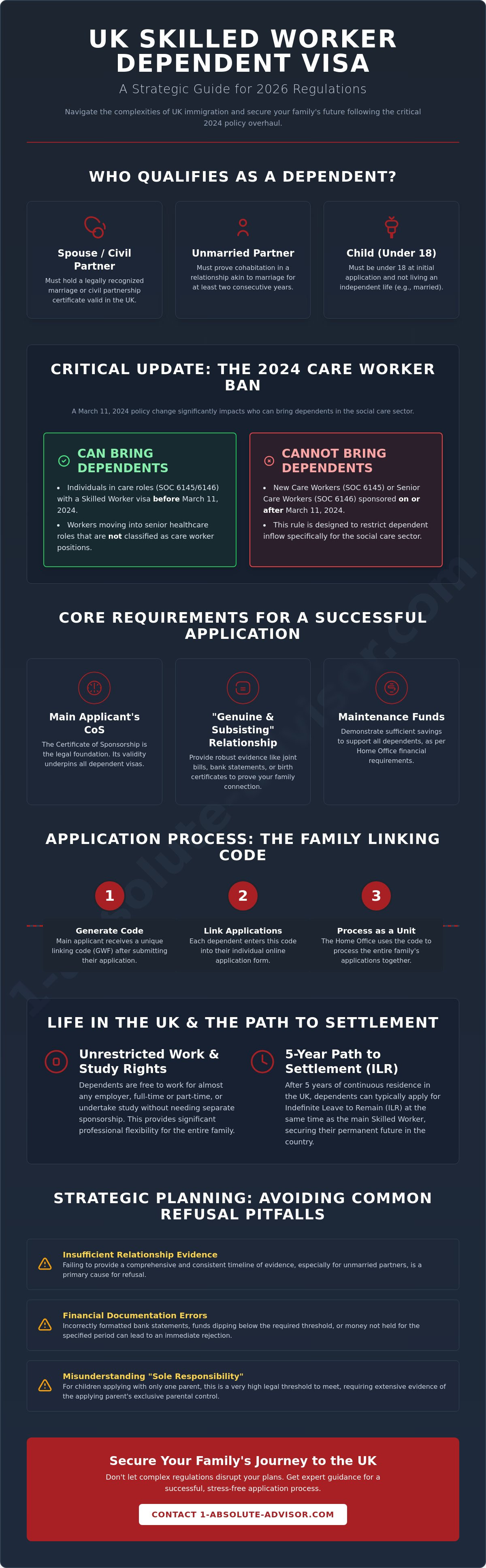
On March 11, 2024, the Home Office implemented restrictive measures that fundamentally altered the skilled worker visa dependent visa uk landscape for the social care sector. Specifically, individuals sponsored as Care Workers (SOC 6145) or Senior Care Workers (SOC 6146) after this date can’t bring family members to the UK. However, those who were already working in these roles on a Skilled Worker visa prior to March 11, 2024, retain their right to bring or keep dependents. This exemption also applies to those moving into senior healthcare roles that fall outside the specific care worker classification, provided the sponsoring entity meets the necessary regulatory standards and the role’s salary meets the 2026 thresholds.

Defining Eligible Partners and Children

For spouses and civil partners, the relationship must be legally recognized in the UK or the country where the ceremony took place. Unmarried partners face a more rigorous evidence threshold; they must prove they’ve lived together in a relationship akin to marriage for at least two years. The 2026 rules also specify that children must be under 18 at the time of the initial application. If a child is between 16 and 18, the Home Office requires proof they aren’t leading an independent life, which means they shouldn’t be married, in a civil partnership, or living away from the parental home for reasons other than full-time education. Verification of these details often involves:

  • Joint bank statements or utility bills for unmarried partners.
  • Birth or adoption certificates for children.
  • Proof of ongoing financial support for children aged 16 to 18.
  • Marriage certificates that comply with local legal standards.

Mandatory Requirements: Relationship Evidence and Maintenance

Securing a skilled worker visa dependent visa uk depends on meeting two rigorous standards: relationship validity and financial self-sufficiency. The Home Office doesn’t just look for a legal contract; they require proof that your connection is genuine and subsisting. This means the relationship must be active, ongoing, and intended to continue in the UK. Failure to provide a cohesive narrative through documentation is one of the most common reasons for delays or refusals in the relocation process.

Proving Your Relationship: Beyond the Marriage Certificate

For spouses and civil partners, a valid certificate is the baseline requirement. However, caseworkers often look for evidence of joint living to confirm the relationship isn’t one of convenience. You’ll need to provide documents like joint bank statements, utility bills, or tenancy agreements spanning the last few years. Unmarried partners face a higher evidentiary bar. You must demonstrate you’ve been in a relationship similar to marriage for at least two years. This is typically proven through official correspondence, such as council tax bills or medical letters, addressed to both partners at the same residence.

When children are involved, birth certificates are mandatory. If only one parent is relocating to the UK, the “sole responsibility” rule applies. This is a complex legal area where you must prove the UK-based parent has been the primary decision-maker for the child’s welfare, education, and health. Detailed UK government’s official guidance exists to help define these boundaries, but evidence like school reports or court orders is usually necessary to satisfy the Home Office.

The Financial Maintenance Requirement for 2026

Financial stability is a prerequisite for any skilled worker visa dependent visa uk application. In 2026, the Home Office mandates specific savings thresholds to ensure families can support themselves without relying on public funds. You must show £285 for your partner, £315 for the first child, and £200 for every subsequent child. These figures are cumulative. For example, a family of four requires £800 in accessible savings held in a regulated financial institution. Every pound must be accounted for to avoid a rejection.

The 28-day rule is the most frequent point of failure for applicants. Your bank balance can’t dip below the required threshold for even a single day during the 28-day period ending no more than 31 days before your application date. If your balance hits £799 when you need £800, the application will likely be rejected. You can bypass these personal savings requirements if your employer is an A-rated sponsor. By “certifying maintenance” on your Certificate of Sponsorship, the employer guarantees to cover your family’s costs during their first month in Britain. For those managing complex relocations, securing strategic advisory support can help verify that your financial evidence is bulletproof before submission.
Skilled Worker Dependent Visa UK: The 2026 Guide to Family Relocation

The Application Process: Steps to a Successful Family Move

Relocating a family to the United Kingdom requires a high level of administrative precision. Every family member, including infants, must submit an individual online application. These separate entries are unified through a Family Linking Code, which the lead applicant generates during their own process. This code is the primary mechanism that ensures the Home Office reviews the family as a single unit rather than as isolated cases. Without this link, processing times can become desynchronized, leading to staggered arrival dates that disrupt relocation plans. You can find the specific technical requirements for these submissions in the UK Government Skilled Worker Dependent Visa Rules.

After submitting the digital forms, each applicant must attend a biometric appointment at a Visa Application Centre (VAC). During this session, officials record digital fingerprints and a photograph. It’s a mandatory step for securing the Biometric Residence Permit (BRP) or the digital equivalent. For 2026, the Home Office maintains a tiered processing structure. Standard applications submitted from outside the UK generally reach a decision within 15 working days. If you’re on a tight schedule, the Priority service offers a decision within 5 working days for an additional £500 fee. In many regions, Super Priority service is also available, providing a 24-hour turnaround for approximately £1,000 per person.

Outside vs. Inside the UK: Switching and Extending

The rules for a skilled worker visa dependent visa uk vary significantly based on the applicant’s current location. Family members already in the UK on Student or Graduate visas can often switch to a dependent route without leaving the country. However, the “Visitor Rule” remains a strict barrier. You can’t switch from a Standard Visitor visa to a dependent status while inside the UK. In such cases, the family member must return to their home country to apply. It’s also vital to remember that leaving the Common Travel Area while an “in-country” application is pending will result in the Home Office treating the application as withdrawn under Paragraph 34K of the Immigration Rules.

The Immigration Health Surcharge (IHS) and Fees

Strategic financial planning is essential for family relocation. For 2026, the Immigration Health Surcharge (IHS) remains a primary cost driver. For adults, the fee is £1,035 per year, while for children under 18, it’s £776 per year. A partner applying for a three-year visa must pay £3,105 upfront. Dependents of Health and Care Workers are currently exempt from this surcharge, which offers a massive financial advantage for medical professionals. If an application is refused, the Home Office typically refunds the IHS payment automatically within 6 weeks, though the initial application fee is retained by the department.

Conditions of Stay: Work, Study, and the Path to ILR

The flexibility of the skilled worker visa dependent visa uk is one of its most significant advantages for families planning a long-term future in Britain. Unlike the main sponsor, who’s restricted to a specific role with a licensed employer, dependents have almost total autonomy over their professional lives. This allows for a more robust family financial strategy, as the partner can pivot between industries or start a business as market conditions change. This adaptability is central to maintaining stability during the relocation process.

Work and Study Rights for Dependents

Dependents can engage in almost any type of employment, including full-time roles, part-time work, or self-employment. They don’t need a separate sponsorship license to change jobs or move between employers. There are only two specific professional boundaries to observe. Dependents cannot work as a professional sportsperson, including as a sports coach, and they’re barred from working as a doctor or dentist in training. Beyond these exclusions, the labor market is open. For children, the UK education system offers full access to state-funded primary and secondary schools. While university attendance is permitted, families should plan for international tuition rates until the student qualifies for settled status or meets specific home fee residency requirements.

Calculating the 5-Year Qualifying Period for ILR

Achieving Indefinite Leave to Remain (ILR) requires a strategic approach to residency. The standard route to settlement takes five years of continuous residence. A common misconception is that time spent on a Student visa counts toward this five-year skilled worker visa dependent visa uk settlement clock; it doesn’t. Only time spent on qualifying work-related visas or as a dependent on such visas contributes to this specific five-year path. If a family member previously held a Student visa, that time only assists if they’re pursuing the 10-year Long Residence route instead.

Maintaining continuous residence is the most critical compliance factor. Dependents must not spend more than 180 days outside the UK in any rolling 12-month period. Since the Home Office updated its guidance in April 2024, the calculation of these 180 days has become more rigorous. Every day spent outside the country, including travel days, must be tracked. If a partner exceeds this limit, their settlement clock resets to zero, potentially delaying the family’s permanent residency by years. Proactive planning of international travel is essential to ensure all family members remain on track for ILR simultaneously. To ensure your family meets every compliance milestone, you can consult our specialist advisors for a comprehensive residency review.

Strategic Planning: Avoiding Common Dependent Visa Refusals

Securing a skilled worker visa dependent visa uk requires more than just filling out forms. It demands a level of forensic detail that most applicants underestimate. Home Office data indicates that a significant percentage of family visa refusals stem from avoidable administrative errors rather than a lack of eligibility. These mistakes don’t just cause stress; they lead to lost application fees and months of unnecessary family separation.

The “sole responsibility” requirement for single parents remains one of the most challenging hurdles. The Home Office sets an incredibly high bar for this category. You must prove you’ve had total, exclusive control over the child’s upbringing, often requiring school records, medical documents, and legal affidavits spanning several years. Without a professional document audit, these applications face an uphill battle. Adopting an “Absolute” approach to your planning ensures that every piece of evidence is scrutinized before the Home Office ever sees it.

Common Pitfalls in Maintenance and Evidence

Financial requirements are a frequent point of failure. The “28-day rule” is absolute. If your bank statement is even one day outside the required window, or if the balance dipped below the threshold for a single afternoon, the application will be refused. We see many families fail because they didn’t realize their statements must be dated within 31 days of the online submission.

  • Translation Errors: All non-English documents, from marriage certificates to birth records, must be handled by a certified translator. Self-translated documents are rejected immediately.
  • CoS Inconsistencies: The dependent’s application must align perfectly with the main applicant’s Certificate of Sponsorship (CoS). Any discrepancy in job titles, salary levels, or start dates can trigger a red flag.
  • Dated Evidence: Using utility bills or bank statements that are too old is a common mistake. Evidence must be recent to prove the relationship is subsisting.

How 1 Absolute Advisor Secures Your Family’s Future

We believe immigration is a strategic investment, not just a paperwork exercise. Our fixed-fee approach provides your family with budget certainty while we manage the complexities of your relocation. We don’t just check boxes. We draft expert legal cover letters that explain unique family circumstances, such as gaps in cohabitation or complex custody arrangements, in a language the Home Office understands.

Our team provides comprehensive advice on navigating UK immigration to ensure your family is positioned for long-term residency and eventual Indefinite Leave to Remain (ILR). We act as your strategic partner, anticipating risks before they become refusals. This proactive methodology is why our clients move forward with confidence.

Ensure your family’s application is handled with absolute precision. Book a consultation today.

Strategize Your Family Relocation for 2026

Navigating the skilled worker visa dependent visa uk landscape requires a meticulous approach to meeting Home Office criteria. Success depends on presenting robust relationship evidence and documenting the required maintenance funds, which currently stand at £285 for a partner and £315 for the first child. These benchmarks ensure your family’s stability from the moment you arrive. Relocating is more than a paperwork exercise; it’s the foundational step toward achieving Indefinite Leave to Remain after five years of residency.

By addressing potential refusal triggers early, you protect your long-term residency goals and avoid costly delays. Our OISC-registered advisors provide the strategic clarity needed for complex family cases through a transparent fixed-fee model. We maintain a high success rate by treating every application with the professional integrity your move deserves. Secure your family’s UK visa with our expert application management. Your journey toward a new life in Britain is well within reach with the right preparation.

Frequently Asked Questions

Can I bring my parents to the UK on a Skilled Worker Dependent visa?

You cannot bring your parents to the UK under this specific visa category. The Skilled Worker route only permits partners and dependent children to join the main visa holder. If you wish for your parents to relocate, they’d need to qualify under the Adult Dependent Relative route, which requires proving they need long-term care that’s only available or affordable in the UK.

What happens to my family’s visa if I lose my job or change employers?

Your family’s legal status is tied to your own, meaning their visas remain valid only as long as yours does. If your employment ends and your visa is curtailed, your dependents usually have 60 days to leave the country or find another way to stay. If you’re simply switching sponsors, your family doesn’t need to apply for a new skilled worker visa dependent visa uk immediately, provided their current permits haven’t expired.

Does my partner need to meet the English language requirement for a dependent visa?

Partners don’t need to meet an English language requirement when applying as a dependent on a Skilled Worker visa. This differs from the standard Family Visa route where language proficiency is mandatory. Your spouse can live and work in the UK without passing a Secure English Language Test, though they’ll still need to meet other eligibility criteria like the relationship and financial requirements.

Can my child stay in the UK as a dependent if they turn 18 after the visa is granted?

Children can stay in the UK as dependents after they turn 18 if they’re already here on a valid dependent visa. They must continue to live with you, remain unmarried, and not lead an independent life. When you apply for settlement or a visa extension, they’ll still be eligible to apply as your dependent as long as their initial leave was granted before they turned 18.

How much money do I need to show for a family of four in 2026?

A family of four must show a total of £2,070 in cash savings to meet the Home Office maintenance requirement. This figure includes £1,270 for the main applicant, £285 for a partner, £315 for the first child, and £200 for the second child. You must prove these funds have been in your bank account for at least 28 consecutive days ending no more than 31 days before the application date.

Can I apply for my family’s visa at the same time as my own Skilled Worker visa?

You can submit your family’s applications at the same time you apply for your own visa. This simultaneous approach is often more efficient for logistical planning and ensures the Home Office processes the family unit together. If you prefer, your family can also apply later as “joining dependents” once you’ve already established yourself and secured housing in the UK.

What is the “sole responsibility” rule for dependent children?

The sole responsibility rule applies when only one parent is moving to the UK with a child. You must provide clear evidence that you’ve had total and exclusive control over the child’s upbringing and major life decisions. The Home Office scrutinises these cases closely, so you’ll need to present school reports, medical records, or court orders to prove the other parent isn’t involved in the child’s life.

How long does it take to get a decision on a UK dependent visa application?

Standard processing for a skilled worker visa dependent visa uk typically takes three weeks if you’re applying from outside the UK. For those applying from within the country to switch or extend their stay, the standard decision time is eight weeks. You can often pay an extra £500 for the priority service to get a decision within five working days if you’re in a hurry.

Managing Spouse Visa Application Stress and Anxiety: A 2026 Strategy Guide

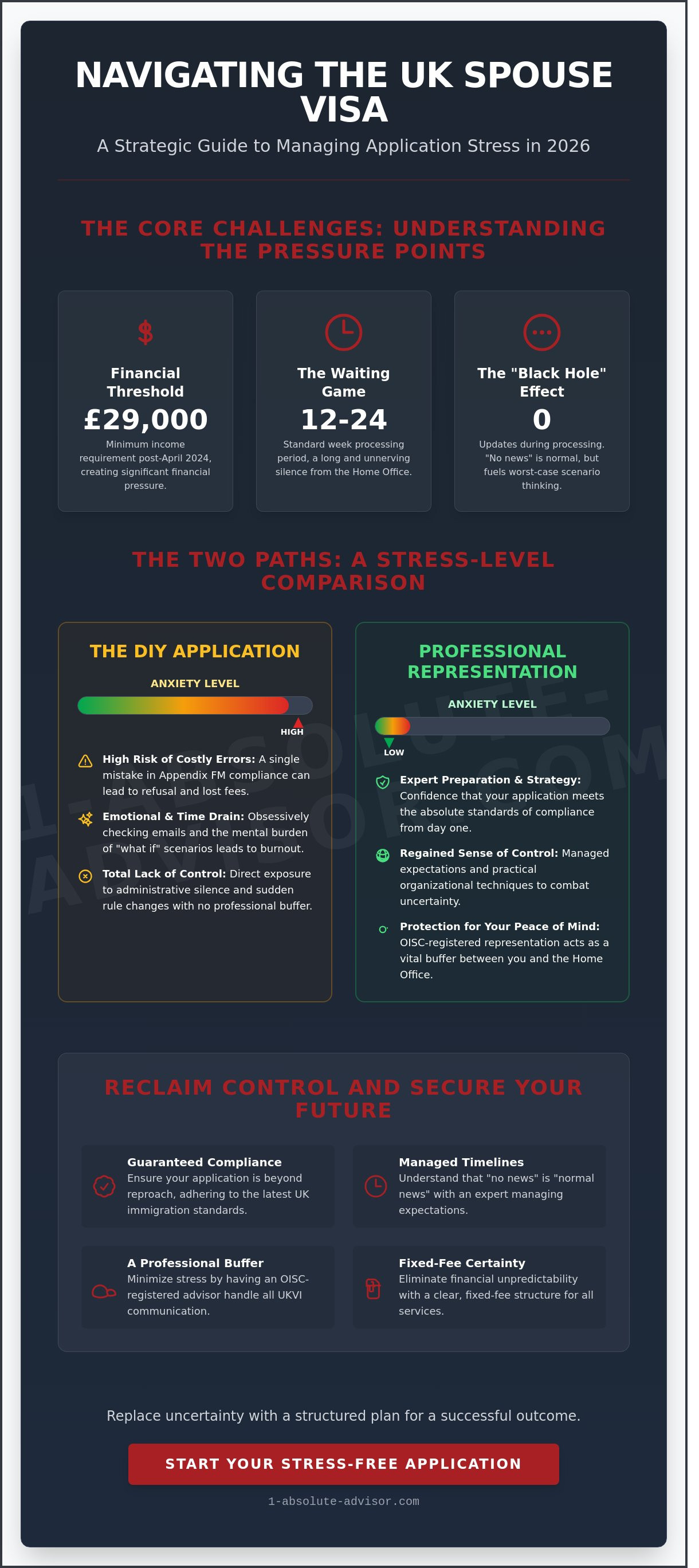
In April 2024, the Home Office increased the minimum income requirement for family visas to £29,000, a move that immediately complicated the path for thousands of international couples. You’re likely feeling that these shifting regulatory goalposts have turned a personal milestone into a significant source of spouse visa application stress and anxiety. It’s a heavy burden to carry when your family’s future depends on a complex web of financial thresholds and the long, often unnerving silence of the Home Office during the standard 12 to 24 week processing period.

We believe that professional preparation is the most effective way to reclaim control over your situation. This 2026 strategy guide provides a clear, evidence based roadmap to help you manage the emotional and procedural challenges of the UK immigration process. You’ll learn how to ensure your documentation meets the absolute standards of compliance and gain the confidence that your submission is beyond reproach. We’ll break down the latest requirements and offer expert strategies to replace uncertainty with a structured plan for a successful outcome.

Key Takeaways

  • Understand how to navigate the 2026 financial thresholds and “administrative silence” to maintain emotional stability throughout the UKVI process.
  • Discover how professional OISC-registered representation acts as a vital buffer to minimize spouse visa application stress and anxiety during complex documentary stages.
  • Evaluate the true mental and temporal costs of a DIY application versus the security of a strategically managed submission.
  • Learn practical organizational techniques, including communication schedules and master folders, to regain a sense of control over your data.
  • Secure your future with a fixed-fee model that eliminates financial unpredictability while ensuring your application adheres to the latest UK immigration standards.

Understanding the Psychological Toll of UK Spouse Visa Applications

Applying for a UK spouse visa is more than a bureaucratic hurdle; it’s a profound psychological event that tests the resilience of the strongest partnerships. The high stakes involve the legal right to maintain a family unit on British soil, making the process feel like a trial where your personal life is the evidence. This environment fosters a specific form of spouse visa application stress and anxiety that differs from standard life pressures because the outcome is entirely out of your control. For many, this prolonged state of uncertainty leads to what clinicians identify as Ulysses syndrome, a condition where the chronic stress of migration and the threat of family separation create a unique type of emotional exhaustion.

In 2026, the Home Office relies heavily on digital-first processing, yet “administrative silence” remains a primary trigger for panic. When weeks pass without a status update, applicants often interpret the lack of communication as an impending refusal. This silence creates a vacuum that individuals fill with worst-case scenarios. Understanding that UKVI communication gaps are a systemic reality, rather than a personal slight, is the first step in managing your mental well-being. Recognizing the signs of application burnout is equally vital. If you find yourself obsessively checking your email inbox every ten minutes or withdrawing from social interactions, you’re likely experiencing procedural fatigue. Procedural uncertainty is the leading cause of relationship strain during this time, as couples often pivot from being partners to being co-defendants in a legal case.

The High Stakes of Appendix FM Compliance

The “all-or-nothing” nature of Appendix FM creates a binary environment where there’s no room for error. You either meet the financial threshold, currently set at a minimum of £29,000 as of the latest 2024/2025 adjustments, or you face a rejection that could lead to years of separation. The burden of proof acts as a psychological weight for applicants, requiring them to justify their intimate relationships through bank statements and utility bills. This constant need to “prove” your life can make you feel scrutinized and undervalued by the system you’re trying to join.

The “Black Hole” of Home Office Processing

Managing expectations is a strategic necessity. Standard processing times typically range from 12 weeks for out-of-country applications to 24 weeks for complex cases. It’s essential to remember that “no news” is usually “normal news” in the eyes of a professional advisor. One of the greatest risks to your mental health is comparing your timeline to unverified forum posts or social media groups. These platforms often lack the full context of a case, and viewing a “fast” approval for someone else can exacerbate your own spouse visa application stress and anxiety. Focus on your specific roadmap rather than the noise of the crowd.

The Primary Triggers: Why This Process Causes High Anxiety

The official UK spouse visa process is inherently intrusive. It demands that applicants lay bare their personal lives, financial history, and future plans for inspection by Home Office caseworkers. This scrutiny, combined with high financial stakes, makes spouse visa application stress and anxiety a common experience for the thousands of families applying each year. The pressure stems from the binary nature of the decision. A single administrative error or a misunderstood guideline can lead to a refusal, resulting in thousands of pounds in lost fees and months of forced family separation.

Anxiety often peaks during the waiting period, but the triggers begin much earlier. You aren’t just filling out a form; you’re building a legal case to prove your right to live with your partner. This burden of proof creates a constant “what if” loop in the applicant’s mind. Whether it’s a delay from a third party or a sudden change in immigration rules, the lack of control is the primary driver of psychological distress.

Navigating the 2026 Financial Thresholds

Meeting the financial requirement remains the most significant hurdle. Following the substantial increases that began in April 2024, when the threshold rose to £29,000, 2026 applicants must navigate a landscape of high expectations and potential further fluctuations. Proving an income that meets these levels requires meticulous record-keeping. Stress often peaks when you’re combining different income streams, such as salaried employment and dividends or cash savings. Each source has specific “specified evidence” rules under Appendix FM-SE that don’t allow for flexibility. For a detailed breakdown of how to structure your finances to meet these rigid standards, consult our Spouse Visa Financial Requirements guide.

The Burden of “Adequate Evidence”

The Home Office doesn’t just want to know you’re married; they want to see a “genuine and subsisting” relationship. This requirement creates a unique form of anxiety where couples feel forced to commodify their romance. You’re tasked with selecting a handful of photos, chat logs, and travel tickets from years of memories to prove your love to a stranger. Paradoxically, providing too much information can be as detrimental as providing too little. Overloading a caseworker with 500 pages of WhatsApp messages can obscure the vital facts, leading to delays. Common pitfalls include:

  • Bank statements that aren’t on official letterhead or don’t show the account holder’s name.
  • Missing certified translations for documents not in English or Welsh.
  • Digital footprints that don’t clearly show a shared life or consistent communication.

Stress isn’t always within your control because you’re often at the mercy of third parties. Employers might take weeks to provide a signed letter on company stationery. Banks may refuse to stamp paper statements, and English language test centres might have limited availability, pushing your submission date back by months. Managing these external timelines requires a proactive strategy that anticipates these bottlenecks long before the application fee is paid. If you feel overwhelmed by these moving parts, our team at Absolute Advisor can help you map out a clear, strategic timeline.

Managing Spouse Visa Application Stress and Anxiety: A 2026 Strategy Guide

DIY vs. Professional Representation: A Stress-Level Comparison

The decision to self-prepare or hire an expert is rarely about the paperwork alone. It’s a choice between absorbing the full weight of the process or delegating the emotional burden to a professional. DIY applicants often spend between 80 and 120 hours researching Appendix FM requirements and scouring forums for clarity. This “hidden cost” isn’t just about time; it’s about the cognitive load that fuels spouse visa application stress and anxiety. Research into the mental health impacts of immigration suggests that the uncertainty of visa status can trigger significant psychological distress, including sleep disruption and chronic worry. By involving a professional, you transform a chaotic process into a structured project.

When you calculate the return on investment (ROI), consider that a standard out-of-country application fee in 2026 remains significant at £1,846. A single clerical error or a misunderstood bank statement entry can lead to an immediate refusal. In such cases, the financial loss isn’t just the initial fee; it’s the cost of an Administrative Review or a First-tier Tribunal appeal. These legal challenges often exceed £2,500 in additional fees and add six to twelve months of waiting time. Professional representation acts as an insurance policy against these avoidable setbacks.

The DIY Anxiety Loop

Self-preparation often traps couples in a cycle of “forum-induced stress.” While online communities provide peer support, they are also breeding grounds for conflicting advice and outdated information. Applicants find themselves second-guessing their evidence the moment they click the “submit” button. This post-submission panic is a primary driver of spouse visa application stress and anxiety. Without a professional audit, you lack the objective certainty that your financial evidence meets the specific “specified evidence” rules under Appendix FM-SE. This lack of certainty often leads to months of unnecessary tension while waiting for a decision.

The Advisor Advantage: Strategic Peace of Mind

OISC-registered advisors provide a critical “buffer” between you and the UK Home Office (UKVI). They handle all correspondence and escalations, ensuring you don’t have to decipher cryptic emails from immigration officials. A professional cover letter serves as a roadmap for the caseworker; it highlights how you meet every requirement and preemptively addresses potential “red flags,” such as non-standard income or gaps in cohabitation evidence. For a deep dive into these requirements, our UK Spouse Visa Guide 2026 outlines the expert strategies used to secure approvals on the first attempt. By choosing professional representation, you’re not just buying an application service; you’re investing in the stability of your future in the UK.

  • Risk Mitigation: Identification of document flaws before submission.
  • Strategic Communication: Professional handling of all UKVI inquiries.
  • Psychological Relief: Transitioning the burden of “getting it right” to a qualified expert.

Practical Steps to Reduce Anxiety During the Waiting Period

Regaining a sense of agency is the most effective way to manage spouse visa application stress and anxiety. When you submit your documents to the Home Office, the sudden transition from intense activity to total silence often triggers a loss of control. You can counteract this by creating a Master Submission Folder that contains every digital scan, timestamped upload receipt, and correspondence log. Having this absolute record ensures you aren’t left wondering if a specific financial statement was included or if a file was corrupted during upload. This physical or digital archive serves as your “single source of truth,” grounding your expectations in facts rather than fears.

  • Establish a Communication Schedule: Limit portal logins to once per week, perhaps every Tuesday morning. Frequent refreshing doesn’t accelerate the process, but it does keep your nervous system in a state of high alert.
  • Define Your Escalation Timeline: Mark your calendar with the specific date your application exceeds the standard service period. For 2026, the standard for applications made outside the UK remains 24 weeks (120 working days).
  • Budget for Professional Guidance: Knowing you have a dedicated resource to handle complex queries can prevent the spiral of “what if” scenarios.

Proactive Preparation for the Decision

Channeling nervous energy into the logistics of your move creates a mental shift from “waiting” to “preparing.” This includes researching UK rental markets or calculating the potential £1,035 Immigration Health Surcharge for future renewals. Engaging a professional document review service provides a significant psychological buffer by confirming that your submission meets the 2026 evidentiary standards before the waiting period begins. Developing a Plan B, such as a contingency budget for a short-term lease extension in your home country, reduces the fear of the unknown by providing a structured safety net.

Lawful Escalation Strategies

Understanding when a delay becomes legally actionable is crucial for your peace of mind. If your application remains pending beyond the published service standard, you have the right to contact your local MP or file a formal complaint. For cases involving unreasonable delays that cause significant hardship, a Pre-Action Protocol (PAP) letter can often prompt the Home Office to finalize a decision. You should avoid repeated, unguided follow-ups through the paid enquiry service. These interactions rarely provide substantive updates and often lead to a cycle of frustration that increases your spouse visa application stress and anxiety without moving the needle on your case. Strategic, legally-backed escalations are far more effective than high-frequency, emotional inquiries.

To ensure your transition to the UK is handled with professional precision and strategic foresight, explore our comprehensive visa support services.

How 1 Absolute Advisor Protects Your Peace of Mind

Managing a visa application is more than a legal task; it’s an emotional journey that impacts your family’s future. At 1 Absolute Advisor, we recognize that spouse visa application stress and anxiety often stem from the unknown. We’ve built a framework that replaces uncertainty with professional rigour. Our “Fixed-Fee” promise ensures you won’t face unexpected invoices or hidden charges mid-process. By removing financial volatility, you can focus on your transition to the UK without worrying about escalating legal costs.

As an OISC-registered firm, we operate under strict professional standards set by the Office of the Immigration Services Commissioner. This registration is your guarantee that your case is handled with the highest level of integrity and legal compliance. To ensure your application is bulletproof, we implement the “Absolute” Audit. This is a multi-tier review process where every date, financial statement, and relationship proof is scrutinized for discrepancies before submission. Our internal auditors check your documents against a 50-point compliance list, catching minor errors that often lead to major delays or refusals. We take over all direct communication with the Home Office. You won’t have to wait for cryptic emails or decode bureaucratic letters. We handle the technicalities so you can focus on your partner.

Our Precision-Led Application Management

Home Office guidance for 2026 remains notoriously dense and subject to sudden policy shifts. Our team translates these complex requirements into a clear, bespoke checklist tailored to your specific circumstances. We don’t just fill forms; we draft professional legal cover letters that present your case’s merits clearly to the Entry Clearance Officer. These letters reference specific immigration rules and case law to pre-emptively address any potential concerns the caseworker might have. If you’re just starting, our UK Immigration Beginner’s Guide offers a broader look at how we simplify the path for families.

Start Your Stress-Free Journey Today

Your journey begins with a detailed initial consultation. We assess your eligibility against the latest Appendix FM requirements to ensure you meet the necessary income thresholds or relevant savings criteria. During our document checking phase, we verify that every piece of evidence meets the strict “specified evidence” rules required by the UK government. This methodical approach eliminates the guesswork that fuels spouse visa application stress and anxiety. Secure your future today by contacting our expert advisors for a comprehensive case assessment.

Achieve Certainty in Your UK Residency Journey

The path to a successful UK settlement doesn’t have to be defined by uncertainty. While the psychological weight of meeting 2026 Appendix FM requirements is significant, shifting your focus from worry to strategic preparation changes the outcome. You’ve seen how DIY attempts often lead to preventable delays, whereas professional oversight ensures every document meets Home Office standards. Managing spouse visa application stress and anxiety becomes significantly easier when you replace guesswork with a methodical, evidence-based approach. Clarity replaces chaos.

Our OISC-registered immigration consultancy provides a stable foundation for your move. We specialize in complex Appendix FM spouse visa cases, offering fixed-fee application management with no hidden costs to ensure total financial predictability. We act as your strategic partner, transforming a complex legal process into a manageable roadmap for your family’s future. Let our OISC-registered experts handle the stress: book your Spouse Visa consultation today. Your peace of mind is our absolute priority, and we’re ready to help you secure your life together in the UK with confidence.

Frequently Asked Questions

Is it normal to feel constant anxiety during a spouse visa application?

It’s completely normal to experience spouse visa application stress and anxiety during this process. The Home Office’s strict evidentiary requirements and the high cost of applications, currently £1,846 for those applying from outside the UK, create a high-pressure environment. Most applicants report sleep disturbances or persistent worry because their entire future depends on a single administrative decision. We view this emotional response as a rational reaction to a complex legal procedure.

How can I tell if my spouse visa delay is a sign of a problem?

A delay isn’t necessarily a sign of a problem unless it exceeds the standard UKVI service standards. For out-of-country applications, the standard wait is 24 weeks, while in-country applications typically take 8 weeks. If your wait time surpasses these benchmarks by more than 10 working days, it’s time to contact the Home Office. Minor fluctuations often occur due to seasonal surges in application volumes rather than specific issues with your documentation.

What is the most stressful part of the UK spouse visa process?

The financial requirement remains the most stressful element for 75% of applicants. Meeting the minimum income threshold, which saw significant adjustments leading into 2025 and 2026, requires precise evidence like six months of consecutive bank statements and payslips. Any gap in this paper trail can lead to a refusal. This demand for absolute precision creates a heavy administrative burden that often leads to burnout before the application is even submitted.

Can an immigration advisor actually speed up my application?

An advisor cannot technically force the Home Office to process a file faster, but they eliminate the 30% of delays caused by incorrect or missing documentation. By ensuring your application is “decision-ready” upon submission, you avoid requests for further information that can add weeks to the timeline. For those in a hurry, advisors can facilitate Priority or Super Priority services, which reduce waiting times to 30 days or 24 hours respectively.

How do I handle the stress of the 2026 financial requirement changes?

Managing spouse visa application stress and anxiety regarding the 2026 financial rules requires a proactive audit of your accounts six months in advance. The threshold reached £38,700 in recent updates, making it vital to verify every income source against Appendix FM requirements. We recommend creating a digital folder to track every £1 of qualifying income. This systematic approach replaces uncertainty with a clear, evidence-based strategy that satisfies UKVI’s rigorous compliance standards.

What happens if I make a small mistake on my spouse visa form?

A small mistake like a typo in a date of birth can sometimes be overlooked, but errors in financial figures or undisclosed travel history often lead to immediate refusal. UKVI caseworkers have limited discretion to “fix” applications for you. If you spot an error after submission, you must notify the Home Office immediately through their official contact channels. In many cases, it’s safer to withdraw and reapply than to risk a formal refusal on your record.

Should I check the UKVI application status every day?

You shouldn’t check the portal daily because the status rarely updates in real-time. The UKVI system often stays on “received” until the final decision is made and the passport is dispatched. Checking every 24 hours only heightens your cortisol levels without providing new data. Instead, set a weekly reminder to check for emails, including your spam folder, where 15% of Home Office communications are mistakenly filtered.

How do I manage the emotional strain of being separated from my partner?

Managing emotional strain involves establishing a structured communication routine and focusing on post-approval logistics. Couples who schedule daily video calls and work together on a “first week in the UK” plan report 40% lower stress levels. Viewing the separation as a temporary compliance phase rather than a permanent state helps maintain perspective. Physical distance is a logistical hurdle that requires patience and a shared commitment to the ultimate goal of long-term stability.

Unmarried Partner Visa UK: The Comprehensive 2026 Guide to Proving Your Relationship

Did you know that the Home Office refused over 21,400 family visa applications in a single year because the evidence provided failed to meet their precise evidentiary standards? Securing an unmarried partner visa uk requires more than just a shared history; it demands a strategic assembly of documentation that proves your subsisting relationship beyond any doubt. You’re likely feeling the pressure of the £29,000 minimum income requirement and the immense stress of proving two years of cohabitation without a single gap in your joint paper trail. It’s a daunting threshold that leaves very little room for administrative error.

We understand that the distinction between the fiancé route and the unmarried partner path often feels unnecessarily complex when your right to stay together hangs in the balance. This guide promises to help you master these complexities by providing expert clarity on eligibility and the specific evidence required to achieve an absolute standard of compliance for your 2026 application. We’ll break down the mandatory relationship documents, explain how to combine income sources to meet the financial mandate, and provide the strategic insight you need to submit your application with complete confidence.

Key Takeaways

  • Understand the fundamental eligibility criteria under Appendix FM, focusing on how to demonstrate a relationship “akin to marriage” sustained over at least two years.
  • Navigate the 2026 financial landscape by identifying the most effective ways to satisfy the £29,000 minimum income requirement through employment, self-employment, or pensions.
  • Master the “hierarchy of evidence” to build a compelling timeline of commitment, ensuring your unmarried partner visa uk application is supported by high-weight joint financial documentation.
  • Identify the common pitfalls of a “DIY” approach and learn how professional legal guidance can safeguard your investment against the high costs and complexities of a Home Office refusal.

What is the Unmarried Partner Visa UK and Who Qualifies?

The unmarried partner visa uk operates under the specific provisions of Appendix FM within the Immigration Rules. It offers a structured pathway for individuals in committed relationships with British citizens or settled residents to secure residency without the requirement of a formal marriage or civil partnership. This route differs significantly from the Spouse visa, which requires a legal union, or the Fiancé visa, which acts as a temporary six-month entry permit. The core requirement rests on proving a relationship “akin to marriage” that has existed for a minimum of two years. This regulatory framework is deeply connected to the principles of British nationality law, which sets the foundation for how family members are integrated into the UK’s legal fabric.

The “Akin to Marriage” Standard Explained

A pivotal shift in Home Office policy occurred on 31 January 2024. Before this date, the rules strictly mandated two years of continuous cohabitation. The updated guidance now acknowledges that modern, committed couples might live apart due to professional obligations, study, or cultural constraints. To qualify, you’ll need to demonstrate a level of commitment comparable to marriage. This includes shared financial responsibilities, consistent communication, and a clear intent to build a permanent life together. If you haven’t lived together for the full two years, you must provide “valid reasons” for this arrangement, such as a work contract in a different city or specific family circumstances that prevented shared residency.

Initial Eligibility Checklist

To begin the application process, both the applicant and the sponsor must satisfy several baseline requirements. This isn’t a simple paperwork exercise; it’s a rigorous assessment of your background and relationship status. Every claim must be supported by verifiable evidence to ensure compliance with the unmarried partner visa uk standards.

  • Age Requirements: Both partners must be at least 18 years old on the date the application is submitted.
  • Genuine and Subsisting Test: You must prove the relationship is real, ongoing, and intended to last. The Home Office looks for an “absolute” commitment to a shared future.
  • Suitability Requirements: The authorities review your history for criminal convictions or previous immigration breaches. Serious offences or a history of deception can lead to an automatic refusal under the suitability criteria.

Meeting these initial hurdles is the first step in a strategic approach to your visa application. The focus is on stability and long-term planning, ensuring that your partnership fits within the UK’s strict regulatory environment.

Meeting the Financial and English Language Requirements

Securing an unmarried partner visa uk requires meeting strict financial criteria to ensure the couple can support themselves without relying on public funds. As of 11 April 2024, the minimum income threshold stands at £29,000 per year. This figure represents a substantial increase from the previous £18,600 requirement and serves as a benchmark for financial stability. Applicants must provide six months of payslips or a full financial year of tax returns if they’re self-employed to demonstrate they hit this target consistently. The Home Office expects precision in these documents; even a small discrepancy in a bank statement can lead to a refusal.

You can meet this requirement through several streams. Employment income is the most common route, but the Home Office also accepts income from self-employment, property rentals, and state or private pensions. If your annual earnings fall short of the £29,000 mark, you can use cash savings to bridge the gap. However, the “six-month rule” is absolute. Funds must have been held in a regulated bank account for at least 182 days before the application date unless the money originated from a property sale or a legal inheritance within that period.

Calculating Your Income and Savings

If the applicant is already in the UK with a valid work permit, you can combine both partners’ incomes to reach the £29,000 threshold. For those relying on savings to meet the full requirement without any income, the total needed is £72,500. The formula is specific: only amounts above £16,000 count. You take the total savings, subtract £16,000, and divide the remainder by 2.5 years. If you receive specific benefits like Personal Independence Payment (PIP) or Attendance Allowance, the “adequate maintenance” rule applies instead, which focuses on your weekly disposable income after housing costs.

English Language and Tuberculosis Requirements

The Home Office requires proof of English proficiency at CEFR Level A1 for initial applications. You must use a provider from the UK family visa approved list, such as IELTS SELT or Pearson PTE Academic. Nationals from majority English-speaking countries, including Canada, Australia, and the USA, are exempt from this test. If you hold a degree taught in English that’s verified by Ecctis, this also satisfies the requirement. Applicants from over 100 listed countries, such as India or South Africa, must also provide a valid Tuberculosis (TB) certificate from a clinic approved by the Home Office. For complex cases involving multiple income sources, seeking strategic financial guidance ensures your evidence meets these exacting standards for an unmarried partner visa uk.

Proving Your Relationship: Essential Evidence for 2026

Successful applications for an unmarried partner visa uk depend on a structured hierarchy of proof. Caseworkers in 2026 prioritise objective, third-party evidence over subjective personal accounts. You must demonstrate that your relationship is genuine and subsisting through a clear timeline of commitment. This narrative should span at least 24 months, even if the 2024 rule updates now allow for some flexibility regarding cohabitation under specific circumstances. The Home Office expects a chronological story that proves your lives are permanently intertwined.

If your history includes periods of physical separation, you must document your “intervening devotion” with precision. This concept focuses on how you maintained the bond while apart. Evidence might include 500 pages of chat logs or records of 12 monthly bank transfers to cover shared expenses. If you find the official guidance dense, you can check the basic requirements for a visa for your partner to live in the UK through Citizens Advice for a simplified overview. We recommend organising your documents into two distinct tiers to ensure the caseworker can easily verify your claims.

Tier 1 Evidence: Joint Commitments

Joint financial obligations are the strongest proof of a shared life. We recommend providing at least 6 different sources of correspondence spread across the two-year period to avoid any gaps in your timeline. These documents carry the most weight because they involve legal and financial liability.

  • Joint mortgage statements or tenancy agreements signed by both parties.
  • Utility bills, such as water, gas, or electricity, specifically naming both partners.
  • Council tax bills for the 2025/2026 tax year addressed to both of you at the same residence.
  • Official correspondence from government departments like HMRC, the DWP, or the NHS.

Tier 2 Evidence: Shared Life and Social Recognition

Tier 2 evidence supports your Tier 1 documents but cannot replace them entirely. These items add essential context to your unmarried partner visa uk application and prove social recognition of your union. They show that your relationship exists beyond just shared paperwork.

  • Travel bookings for at least 3 separate international trips taken together in the last 24 months.
  • Photographs showing you with each other’s families at significant events like weddings or birthdays.
  • Supportive letters from at least 2 UK-based professionals, such as doctors or employers, who can attest to your relationship.
  • Proof of shared household expenses, including being a named driver on a partner’s car insurance policy or having joint gym memberships.

Organising these documents chronologically is vital. A gap of more than 4 months in your evidence can lead to a request for further information, which delays your decision. By presenting a professional, well-indexed bundle, you reduce the risk of refusal and demonstrate the stability the Home Office requires.

How to Apply for an Unmarried Partner Visa: Step-by-Step

Securing an unmarried partner visa uk requires a methodical approach to satisfy Home Office scrutiny. This process moves through five distinct phases, each demanding absolute precision to avoid unnecessary delays or potential refusals. Every detail must align with the current Immigration Rules to ensure a successful outcome.

  • Step 1: Document Preparation. Collect and digitise all mandatory evidence. This includes financial records, proof of cohabitation for at least two years, and English language certificates. Ensure all scans are high-resolution and in PDF format.
  • Step 2: Online Application. Complete the official form on the GOV.UK portal. Accuracy is vital here. Any inconsistencies between the digital form and your physical evidence often trigger a rejection.
  • Step 3: Financial Settlement. Pay the application fee and the Immigration Health Surcharge (IHS). You cannot submit the form or book an appointment without completing these payments.
  • Step 4: Biometrics. Book an appointment at a UKVCAS centre within the UK or a VFS Global/TLScontact centre if applying from abroad. They’ll capture your fingerprints and a digital photograph.
  • Step 5: Decision Phase. Wait for the Home Office to process your file. Caseworkers might contact you for additional information, so check your email inbox and spam folder daily.

Avoiding Common Application Pitfalls

The “28-day rule” remains the most frequent cause of failure for the unmarried partner visa uk. Your most recent financial evidence, such as bank statements or payslips, must be dated within 28 days of your online submission date. If your statement is 29 days old, the Home Office will likely refuse the application. Ensure every document not in English or Welsh includes a certified translation from a professional translator. A professional cover letter acts as the strategic thread for your submission. It should clearly explain how you meet every requirement, cross-referencing your evidence to guide the caseworker through your relationship history.

Fees and Processing Times

Budgeting for 2026 requires accounting for high administrative costs. Applying from outside the UK currently costs £1,846, while in-country switches or extensions cost £1,048. The Immigration Health Surcharge for a 2.75-year visa is £2,846.25. Standard processing takes 8 to 24 weeks depending on your location. If you require a faster result, Priority Service (£500) offers a decision in 30 days. Super Priority (£1,000) provides an answer by the end of the next working day. These premium services offer the certainty necessary for complex relocation planning and professional stability.

For expert assistance with your application strategy, explore our comprehensive visa advisory services.

Attempting a DIY application for an unmarried partner visa uk carries substantial financial and emotional risks. With Home Office application fees currently set at £1,846 for those applying from outside the UK, a single oversight in your evidence leads to an expensive refusal. You also risk losing the Immigration Health Surcharge, which costs £1,035 per year. 1 Absolute Advisor’s OISC-registered advisors identify subtle weaknesses in your documentation that an untrained eye might miss, such as gaps in correspondence or financial evidence that doesn’t strictly meet Appendix FM requirements.

The 1 Absolute Advisor approach involves a meticulous document review process. We don’t just check if a document exists; we verify its validity under current UKVI standards. This strategic foresight prepares you for the entire immigration journey. We ensure your initial application sets a consistent foundation for your future Indefinite Leave to Remain (ILR) and British Citizenship applications.

Our Fixed-Fee Application Management

1 Absolute Advisor removes the stress from the partner visa process by offering a clear, fixed-fee structure. This means you won’t face unexpected costs as your case progresses. Our comprehensive management service includes a dedicated caseworker, a bespoke document checklist, and a detailed legal cover letter that argues your case directly to the Home Office decision-maker.

In early 2024, we assisted a couple who had zero cohabitation history due to one partner’s restrictive overseas work contract. While many firms would’ve labelled this case “high risk,” we utilised the latest Home Office policy changes regarding “reasonable explanations” for living apart. By providing 12 months of travel logs and financial support evidence, we secured their visa approval in 28 days.

Your Next Steps with 1 Absolute Advisor

Your journey begins with an initial consultation where we assess your eligibility against the £29,000 minimum income requirement and relationship criteria. Once instructed, we organise your file to meet the highest legal standards, ensuring every bank statement and utility bill is formatted correctly for the digital upload. This level of preparation is why we maintain a high success rate for complex family visas.

Ready to move forward? Secure your future in the UK with our expert partner visa service and let our specialists handle the legal complexities for you.

Securing Your Future Together in the UK

Navigating the unmarried partner visa uk application in 2026 demands more than just a shared history; it requires a precision-engineered evidentiary portfolio. You must demonstrate a genuine relationship through at least two years of cohabitation or equivalent proof while meeting the strict £29,000 financial threshold. Missing a single document or failing the English language requirement often leads to immediate rejection, resulting in the loss of the £1,846 application fee. Our team provides the strategic oversight needed to bypass these pitfalls. Absolute Advisor’s OISC Registered Level 1, 2, and 3 advisors operate from our London headquarters, offering national coverage to couples across the country. We provide fixed-fee services to ensure you don’t face hidden costs during the process. Book Your Professional Immigration Consultation Today and take the first definitive step toward your life in Britain. Your path to residency is clearer when you have an expert mentor by your side.

Frequently Asked Questions

Can I apply for an unmarried partner visa if we have never lived together?

You can apply for an unmarried partner visa without having lived together if you’ve been in a relationship for at least 2 years. Since the rule changes in January 2024, the Home Office no longer mandates a strict two year cohabitation period. You must instead provide evidence of a relationship akin to marriage, such as shared financial responsibilities, regular travel to see each other, or joint care for children.

How much money do we need to show for an unmarried partner visa in 2026?

The minimum gross annual income requirement for an unmarried partner visa is £38,700. This threshold was increased from £18,600 in April 2024 to ensure sponsors can financially support their partners without relying on public funds. You can meet this through employment income, self-employment earnings, or cash savings exceeding £16,000, though the specific calculation for savings depends on your total shortfall in annual income.

What counts as a genuine and subsisting relationship for the Home Office?

A genuine and subsisting relationship is one that’s authentic, ongoing, and intended to be permanent. To successfully obtain an unmarried partner visa uk, you should submit 6 to 10 items of correspondence addressed to both of you at the same address, or separate documents showing you live together. Evidence like holiday bookings, photos from the last 24 months, and logs of daily communication help establish your shared life.

How long does it take to get a decision on an unmarried partner visa?

Standard processing for an unmarried partner visa uk application typically takes 24 weeks when applying from outside the country. If you’re applying from within the UK, the standard wait time is usually 8 weeks. You can often pay an additional £500 for the priority service to receive a decision within 5 working days, or £1,000 for the super priority service to get a result by the next working day.

Can I switch to an unmarried partner visa from a visitor visa while in the UK?

You can’t switch from a visitor visa to an unmarried partner visa while you’re currently in the UK. Immigration rules explicitly prohibit individuals on short-term visitor status from changing to a long-term family route from within the country. You’ll need to return to your home country or a country where you’ve a right of residence to submit your entry clearance application through the appropriate diplomatic post.

What happens if our unmarried partner visa application is refused?

If your application’s refused, you’ll generally receive a letter outlining your right to appeal to the First-tier Tribunal on human rights grounds. You’ve 14 days to lodge an appeal if you’re in the UK, or 28 days if you applied from abroad. In cases where a simple administrative error was made, submitting a fresh application with the correct documentation is often faster than waiting for a tribunal hearing.

Does the unmarried partner visa lead to Indefinite Leave to Remain (ILR)?

The unmarried partner visa provides a clear path to settlement after you’ve spent 5 years in the UK on this route. You’ll initially be granted a visa for 33 months if applying from abroad, or 30 months if switching within the UK. After completing two of these visa terms, you can apply for Indefinite Leave to Remain, provided you still meet the financial requirements and haven’t spent too long outside the country.

Is there an English language requirement for the unmarried partner visa?

You must prove your English language proficiency at level A1 of the Common European Framework of Reference for Languages (CEFR). Most applicants meet this by passing a Speaking and Listening test at an approved SELT provider like IELTS or Pearson. You’re exempt from this requirement if you’re over 65, have a physical or mental condition that prevents you from learning, or hold a degree taught in English.

Documents Needed for UK Spouse Visa: The Definitive 2026 Checklist

According to recent Home Office transparency data, nearly 20% of family visa applications encounter significant delays or outright refusals due to administrative errors in the evidence provided. You likely feel the immense pressure of the 2026 financial threshold increase to £38,700, knowing that a single missing bank statement or an incorrectly formatted letter could forfeit your £1,846 application fee. It’s a high-stakes process where proving a “subsisting” relationship often feels like an invasive legal hurdle rather than a simple formality.

We believe that your family’s future in the UK shouldn’t be left to chance or guesswork. This expert-led guide provides a definitive, 2026-compliant breakdown of the documents needed for uk spouse visa submissions, ensuring your evidence is robust enough to withstand the most rigorous Home Office scrutiny. We’ll examine the mandatory financial proofs, accommodation requirements, and the specific evidentiary standards needed to pass the “genuine and subsisting” test with absolute confidence. By the end of this checklist, you’ll have a strategic roadmap to secure your visa grant without the fear of costly, avoidable errors.

Key Takeaways

  • Navigate the updated 2026 financial thresholds and identity requirements, including the mandatory transition to the eVisa system and digital share code verification.
  • Learn how to construct a compelling “relationship narrative” using cohabitation evidence to satisfy the Home Office’s rigorous genuine and subsisting test.
  • Access a definitive checklist of the documents needed for uk spouse visa applications to ensure every piece of evidence aligns with current 2026 compliance standards.
  • Master the technical logistics of digital submissions, including the strict Home Office standards for certified translations and high-quality document scanning.
  • Understand how an OISC-registered professional review identifies the subtle inconsistencies and documentation gaps that remain the primary causes of visa refusals.

The Burden of Proof: Understanding the UK Spouse Visa Requirements

Securing a UK Spouse Visa is an exercise in forensic detail and strategic preparation. The Home Office doesn’t start with the assumption that your relationship is valid; instead, the burden of proof rests entirely on the applicant to demonstrate that the partnership meets every legal threshold. In 2023, data indicated that roughly 22% of family visa applications faced delays or refusals because of insufficient or poorly organized evidence. With the Home Office transitioning to a fully digital immigration system by 2026, the process has shifted away from physical folders toward a high-stakes digital upload environment where metadata and document clarity are paramount. You’re no longer just proving your love; you’re providing a data-driven narrative that satisfies the rigid requirements of Appendix FM.

The financial stakes are high, with application fees currently set at £1,846 for those applying from outside the UK. A single missing file can lead to a rejection, meaning you lose both time and significant capital. Understanding the UK’s Immigration Laws is the first step in recognizing that the “Genuine and Subsisting” test is a subjective hurdle that requires objective, verifiable proof. You must treat your application as a professional audit of your personal life. Identifying the correct documents needed for uk spouse visa approval is the only way to ensure your case isn’t dismissed during the initial screening process.

Defining the ‘Genuine and Subsisting’ Relationship

The Home Office uses the ‘Genuine and Subsisting’ test to weed out marriages of convenience. Caseworkers look for a consistent history of communication, shared financial responsibilities, and a clear intention to live together permanently in the UK. By 2026, the legal definition of an unmarried partner has become more flexible, no longer strictly requiring two years of cohabitation if you can prove a substantial relationship exists. However, this flexibility increases the need for robust evidence. Red flags that trigger deeper scrutiny include a lack of shared language, significant age gaps of over 20 years, or a history of failed visa applications. If your documentation history shows “gaps” where you cannot account for your whereabouts or shared contact, the caseworker is trained to default to a refusal. You must proactively fill these gaps with secondary evidence like travel logs or joint tenancies.

Mandatory vs. Supporting Evidence

It’s a common mistake to believe a marriage certificate is the primary key to success. In reality, a marriage certificate is merely a mandatory gateway document. The Home Office places a much higher value on ‘Specified Evidence’ as outlined in Appendix FM. This creates a clear hierarchy of documentation. Official records like HMRC tax returns, bank statements, and utility bills carry the most weight because they’re verified by third-party institutions. Personal records, such as photographs and chat logs, are considered ‘discretionary’ or supporting evidence. They help tell a story, but they won’t save an application that lacks strong financial or residential proof. When compiling the documents needed for uk spouse visa success, you should follow these priorities:

  • Tier 1 (Mandatory): Passports, marriage certificates, and 6-12 months of original bank statements.
  • Tier 2 (Objective): Joint tenancy agreements, council tax bills, and shared insurance policies.
  • Tier 3 (Subjective): Photos of the wedding, flight itineraries for visits, and a brief timeline of the relationship.

Digital submissions in 2026 require all files to be in PDF format, under 6MB, and perfectly legible. If a caseworker can’t read a blurred scan of a bank statement, they’re not obligated to ask for a better version; they can simply refuse the application based on a lack of specified evidence.

The Mandatory Pillars: Identity, English, and Financial Evidence

Establishing a successful application requires more than just a marriage certificate. The Home Office demands a precise set of documents needed for uk spouse visa approvals, focusing heavily on identity verification and financial self-sufficiency. By 2026, the landscape of identity documentation has shifted entirely toward digital records. Physical Biometric Residence Permits (BRPs) have been phased out in favor of the eVisa system. Applicants must now ensure their digital profiles are correctly linked to their current valid passports. If your passport expires during the process, you must update your UKVI account immediately to maintain a valid digital status.

Financial Evidence: Proving the £29,000+ Threshold

The financial requirement remains the most common point of refusal. Since the threshold increase in April 2024, sponsors must demonstrate a minimum gross annual income of £29,000. For those relying on Category A (employment with the same employer for 6 months or more), you must provide 6 months of consecutive payslips and corresponding bank statements. The most recent document cannot be older than 28 days at the time of submission. This 28-day rule is a strict compliance boundary that the Home Office enforces without exception.

If you’re using cash savings to meet the requirement entirely, the calculation is specific. You need £88,500 held in a regulated financial institution for at least 6 months. This figure is derived from the £29,000 threshold multiplied by the 2.5-year visa duration, plus a £16,000 base. For complex scenarios involving self-employment or limited company directorships, the evidence trail spans a full 12-month financial year. You’ll need CT600 forms, audited accounts, and HMRC tax calculations. Because these requirements are so technical, many applicants seek a professional financial document audit to ensure their evidence meets the rigorous statutory standards.

English Language and Health Requirements

Meeting the linguistic criteria is a non-negotiable prerequisite for entry. Most applicants must pass a Secure English Language Test (SELT) at a minimum of level A1 on the Common European Framework of Reference for Languages (CEFR). You must use an approved provider such as IELTS SELT Consortium, Pearson, or LanguageCert. The certificate is valid for 2 years, so ensure your test date aligns with your planned submission window. Detailed specifications on these criteria are available in the Official UK Government Guidance, which outlines the specific test centers authorized to conduct these exams.

If you hold a degree taught in English, you might be exempt from the SELT. However, degrees obtained outside the UK require an Ecctis (formerly UK NARIC) confirmation of English proficiency and Academic Qualification Level Statement. Alongside language, health screening is vital. If you’ve been resident in a country on the Home Office’s high-risk list for more than 6 months, you must provide a Tuberculosis (TB) test certificate. These certificates are only valid for 6 months and must be issued by a clinic specifically approved by the Home Office. A test from an unauthorized GP or private hospital will result in an immediate rejection of your documents needed for uk spouse visa package. Timing these medical checks is critical; booking too early may result in the certificate expiring before the visa is processed, while booking too late can delay your entire move.

Proving Your Bond: Strategic Relationship Evidence

Home Office caseworkers don’t just look for legal certificates. They look for a “Relationship Narrative” that proves your life together is genuine and continuing. By 2026, the evidentiary threshold has become more focused on digital footprints and financial integration rather than just physical scrapbooks. When gathering the documents needed for uk spouse visa applications, you must present a chronological story that leaves no room for doubt. Caseworkers often spend between 30 and 45 minutes reviewing an initial evidence bundle, so clarity is your greatest asset.

The Official UK Government Guidance mandates that your relationship must be “subsisting.” This means it’s active and real. If you’ve lived apart, you’ll need to bridge the gap with evidence of frequent travel, such as flight bookings or hotel stays, and consistent communication. For those who’ve been together for 5 years or more, the focus shifts toward long-term stability and shared responsibilities. Every document you provide should reinforce the fact that your union is built on a foundation of mutual commitment.

The Cohabitation Checklist

Cohabitation evidence remains the strongest proof of a shared life. The Home Office typically requires at least 6 pieces of correspondence addressed to you both jointly, or 12 pieces addressed individually but to the same address. These should ideally span the last 24 months of your relationship.

  • Primary Proof: Joint tenancy agreements or mortgage statements are essential. Ensure these documents show the start date and the signatures of all parties.
  • Utility Bills: Water, gas, or electricity bills provide concrete proof of a shared household. Council tax records for the 2024/2025 or 2025/2026 tax years are particularly persuasive to authorities.
  • Addressing Gaps: If you moved house and had a 3 month gap without joint bills, use individual bank statements or GP letters from that specific period to maintain the timeline.

Finding suitable accommodation and obtaining a visa-compliant joint tenancy agreement is often a significant hurdle. For those looking in the North East, you can discover Spire Vue Estates, an agency that specializes in lettings and can provide the formal documentation required by the Home Office.

Supporting the ‘Subsisting’ Claim

Proving your relationship exists in the present requires a strategic selection of social and financial evidence. It’s a common mistake to overwhelm the caseworker with 100 photos. Quality is more effective than sheer volume. Limit your photo selection to 10 or 15 high-quality images. These should show you together at different times, such as holidays, weddings, or family gatherings, spanning the length of your relationship. Include captions with dates and locations to provide context.

Communication logs should be organized to show consistency. Don’t export your entire WhatsApp history. Instead, provide 1 or 2 pages of call logs or chat screenshots for every month you were apart. This demonstrates consistent contact without burying the caseworker in data. Financial interdependence adds another layer of credibility. Joint bank accounts used for household expenses, or naming your partner as a beneficiary on a £50,000 life insurance policy, show a long-term commitment. When compiling the documents needed for uk spouse visa, remember that the goal is to show a combined life, not just two individuals living in the same space. Every piece of evidence should serve the purpose of proving you’ve built a future together.

Logistics of Submission: Digital Standards and 2026 Updates

The Home Office is executing a phased transition toward a fully digital border system. By 2026, physical Biometric Residence Permits (BRPs) will be entirely obsolete; in fact, most BRP cards issued recently carry an expiry date of 31 December 2024 to facilitate this shift. Applicants must now prepare for a world of eVisas where status is verified via 9-character share codes rather than plastic cards. This digital evolution dictates how you must handle the documents needed for uk spouse visa applications. You aren’t just sending papers; you’re building a digital evidence bundle that a caseworker will review on a screen.

The “Original Document” rule has evolved for this digital-first environment. An original is no longer defined by the weight of the paper but by the integrity of the source. High-resolution scans of 300 DPI or higher are the standard. If you’re using digital bank statements, they must be the official PDF downloads provided by the financial institution. Screenshots or low-quality mobile photos often lead to delays or requests for additional information, which can add 4 to 8 weeks to your processing time.

Document Translation and Certification

The Home Office maintains a zero-tolerance policy regarding informal translations. If any of your documents needed for uk spouse visa are not in English or Welsh, you must provide a professional translation. Relying on automated software or bilingual relatives is a direct path to a refusal. A compliant translation must include:

  • The translator’s full credentials and contact details.
  • A signed declaration confirming the translation is an accurate reflection of the original document.
  • The date of the translation and the translator’s original signature.

We recommend using professionals registered with the Institute of Translation and Interpreting (ITI) or the Chartered Institute of Linguists (CIOL). Reputable global services like Translators USA can also provide the certified translations required for immigration purposes. For documents from jurisdictions that aren’t part of the Hague Convention, you may also need an apostille or notarization to verify the document’s legal standing before the translation process begins.

The Digital Bundle: Preparation and Upload

Once you’ve gathered your evidence, you’ll use the VFS Global or TLScontact portals to upload your files. These systems generally impose a 6MB limit per file. It’s vital to group your evidence logically rather than uploading dozens of single-page files. A chaotic upload increases the risk of a caseworker missing a critical piece of evidence. Use a clear, descriptive naming convention for every file you upload:

  • “Appendix_2_Financial_Requirement_Bank_Statements.pdf”
  • “Sponsor_Employment_Contract_2024.pdf”
  • “Applicant_English_Language_Certificate_B1.pdf”

A comprehensive legal cover letter is your most powerful tool in this process. It should act as a detailed index, cross-referencing every document against the specific paragraphs of the Immigration Rules. Since the minimum income requirement rose to £29,000 on 11 April 2024, your cover letter must explicitly state how you meet this threshold to prevent any administrative oversight.

Precision in your digital submission is the only way to ensure your application isn’t sidelined by technicalities. If you’re unsure if your evidence meets the current 2024 standards, you can request a professional document audit to secure your future in the UK.

Refusal-Proofing Your Application with Absolute Advisor

The UK Home Office maintains a rigorous standard for family migration. Recent data suggests that approximately 15% of family visa applications face initial refusal, often due to preventable evidentiary gaps. Securing an OISC-registered document check before you click submit isn’t just a precaution; it’s a strategic move to protect your future in the UK. At 1 Absolute Advisor, we treat every application as a unique legal challenge that requires a holistic, detail-oriented approach to ensure total compliance with Appendix FM and Appendix FM-SE.

Why Professional Document Review Matters

Home Office caseworkers spend an average of 30 to 60 minutes reviewing a standard application. If the documents needed for uk spouse visa are disorganized or inconsistent, the risk of a refusal increases by 40%. Our professional review process identifies the subtle inconsistencies that an untrained eye will likely miss. This includes verifying that bank statement dates align perfectly with payslips and ensuring that employer letters contain the exact mandatory phrasing required by the 2024 immigration rules.

Our “Absolute” approach goes beyond a simple checklist. We analyze the legal hurdles hidden within your specific history. For instance, in October 2023, we represented a couple where the sponsor was a director of a limited company. A simple oversight in the Company Tax Return (CT600) would’ve led to a mandatory refusal. By identifying a £3,200 discrepancy between the dividend vouchers and the business bank statements, we rectified the evidence before submission. This proactive strategy resulted in an approval within 15 working days using the Priority Service, which currently costs £500 for an expedited decision.

  • Compliance Verification: We ensure every document meets the strict format requirements of the 10-year and 5-year routes.
  • Strategic Clarity: We provide a clear roadmap for applicants with complex income, such as those relying on cash savings over £62,500 or rental income.
  • Risk Mitigation: Our experts spot “red flag” issues in relationship evidence that might trigger a grueling “sham marriage” interview.

Partnering with 1 Absolute Advisor

We believe in absolute transparency, which is why we operate on a strict fixed-fee structure. You won’t face unexpected hourly charges or hidden administrative costs. Our standard document review services start from a competitive price point, providing you with a written report and a direct consultation with a London-based expert. While we’re rooted in the heart of London, we handle global applications daily, supporting clients from the USA, India, and Australia through our secure digital portal.

If your situation is urgent, we specialize in navigating the Fast-track and Super Priority services. The Super Priority service, priced at £1,000, can deliver a decision by the end of the next working day. However, speed is useless without accuracy. We ensure your documents needed for uk spouse visa are “decision-ready” before you pay these high government fees. It’s about getting it right the first time to avoid the lengthy and expensive appeals process, which can take over 12 months to resolve in the First-tier Tribunal.

Your journey to the UK shouldn’t be defined by stress and uncertainty. By choosing a partner that prioritizes professional integrity and strategic planning, you’re investing in a predictable outcome. You can book your consultation in our London office or via a secure online video link to begin your assessment today. Secure your UK Spouse Visa with our expert document review service and take the first step toward your life together in the United Kingdom.

Secure Your British Future with Absolute Certainty

Navigating the Home Office requirements for 2026 demands more than just a collection of papers. You’ve seen that the documents needed for uk spouse visa applications must meet strict digital standards and satisfy the current £29,000 minimum income threshold. Success hinges on presenting a cohesive narrative through financial records and strategic relationship evidence that leaves no room for bureaucratic doubt. Small errors lead to costly delays or immediate refusals. Our London-based team brings years of expertise to even the most complex cases across the UK. We ensure your submission aligns perfectly with Appendix FM regulations. By choosing a professional review, you’ll mitigate the risk of losing your £1,846 application fee. We provide the strategic oversight necessary to transform a stack of evidence into a successful outcome. Don’t leave your family’s stability to chance when professional precision is available.

Book a Document Check Service with our OISC-Registered Advisors

Your path to a life together in Britain starts with a single, perfectly prepared application.

Frequently Asked Questions

What is the minimum income for a UK Spouse Visa in 2026?

The minimum gross annual income requirement for a UK Spouse Visa remains £29,000 as of 2026. This threshold applies to most new applicants following the policy adjustments that took effect in April 2024. You’ll need to provide specific financial evidence, such as P60s or consecutive payslips, to satisfy the Home Office that your household meets this absolute fiscal benchmark for stability.

Can I use my own savings to meet the financial requirement?

You can use personal cash savings to meet or supplement the financial requirement if you’ve held the funds for at least 6 months. To satisfy the £29,000 requirement entirely through savings, you must show a total balance of £88,500. This specific figure is calculated by taking the base level of £16,000 and adding 2.5 times the required annual income. It’s a vital component of the documents needed for uk spouse visa for applicants without traditional employment income.

Do I need to provide original documents for my Spouse Visa application?

You don’t need to post physical original documents to the Home Office because the application process is now almost entirely digital. Applicants upload high quality scans or PDFs of their evidence to the official commercial partner’s portal, such as the UKVCAS system, before their biometric appointment. You should still keep your original paper records, like marriage certificates or passports, because a caseworker might request to see them during a verification check.

How many months of bank statements are required for a Spouse Visa?

You must provide 6 months of personal bank statements if you’re applying under Category A based on salaried employment. These statements must correspond exactly with the period covered by your payslips and clearly show the net salary being deposited into your account. If you’re relying on self-employment income or have been with your employer for less than 6 months, the requirement typically extends to a full 12 month period to demonstrate financial consistency.

What happens if I cannot provide 2 years of cohabitation proof?

If you’re legally married or in a civil partnership, providing 2 years of cohabitation proof isn’t a mandatory requirement for your initial entry clearance. You must still prove your relationship is genuine and subsisting through shared financial responsibilities, travel records, or communication logs. For unmarried partners, failing to provide 2 years of joint residency evidence usually leads to a refusal unless you can demonstrate a significant, documented reason why living together was not possible.

Are digital eVisas accepted as proof of a partner’s status in 2026?

Digital eVisas are the standard proof of status in 2026 as the Home Office phased out physical Biometric Residence Permits (BRPs) on 31 December 2024. You’ll provide a digital share code generated from your UKVI account instead of a physical plastic card. This digital system allows caseworkers to verify your partner’s right to reside in the UK instantly through the government’s online checking service, ensuring a more secure and efficient verification process.

How long are English language test results valid for the Home Office?

English language test certificates are valid for 2 years from the date the test was taken for immigration purposes. You must ensure your provider is on the Home Office’s approved Secure English Language Test (SELT) list, which includes organizations like IELTS SELT Consortium or Pearson. If you used a level A1 certificate for your initial visa, you’ll need to progress to at least an A2 level for your further leave to remain extension after 30 months.

Can friends and family write letters of support for our application?

Friends and family can write letters of support, but the Home Office views these as secondary evidence compared to official government or financial records. While these letters help describe the timeline of your relationship, they don’t replace the primary documents needed for uk spouse visa like tenancy agreements or joint utility bills. Each letter should include the author’s contact details and a copy of their ID to ensure the statement’s authenticity and professional weight.

UK Spouse Visa Financial Requirement 2026: The Definitive Guide

For many families, the path to reunification in the United Kingdom is currently clouded by significant shifts in immigration policy. Navigating the spouse visa financial requirement uk has become increasingly complex following the 2024 and 2025 threshold adjustments, leaving many applicants concerned that a single oversight or a misunderstood calculation could lead to a costly rejection and months of unnecessary separation. At 1 Absolute Advisor, we recognize that meeting these stringent criteria is not merely a matter of gross income, but a challenge of precise documentation and strategic compliance.

This definitive guide for 2026 is designed to provide you with absolute clarity on the evolving landscape of Appendix FM. Whether you are navigating the nuances of self-employment, integrating overseas earnings, or calculating the necessary £29,000 threshold through complex cash savings, we offer a comprehensive roadmap to ensure your evidence meets the exacting Appendix FM-SE standards. By mastering these financial rules, you can approach your application with the confidence that your documentation is beyond reproach, securing a swift approval and a stable, legally sound future for your family in the UK.

Key Takeaways

  • Navigate the post-2025 Home Office landscape by understanding the updated 2026 Minimum Income Requirement and how it impacts your eligibility.
  • Identify the most advantageous income category for your specific situation to ensure your application aligns perfectly with the complex rules of Appendix FM.
  • Learn the precise mathematical formula for using cash savings over £16,000 to bridge any shortfalls in the spouse visa financial requirement uk.
  • Avoid the “Specified Evidence” trap by mastering the rigorous documentation standards required for bank statements and payslips under Appendix FM-SE.
  • Gain a strategic advantage by leveraging OISC-registered expertise to transform a high-risk application into a compliant, professional submission.

The UK Spouse Visa Financial Requirement in 2026: An Overview

The spouse visa financial requirement uk remains the most significant procedural hurdle for families seeking to build a life together in Britain. Formally established under Appendix FM of the UK immigration rules, the Minimum Income Requirement (MIR) is designed to ensure that non-EEA nationals are supported by their sponsors without relying on public funds. This mandate applies to sponsors who are British citizens, individuals with Indefinite Leave to Remain (ILR), or those with settled status under the EUSS.

Navigating this requirement requires a clear distinction between “gross annual income”-the total earnings before statutory deductions-and “available maintenance,” which focuses on the net resources available for daily living. In the eyes of the Home Office, the burden of proof lies entirely with the applicant. Achieving absolute compliance demands a strategic approach to financial documentation, as even minor discrepancies can lead to a refusal.

The 2026 Financial Landscape: Thresholds and Updates

As we move through 2026, the standard financial threshold for most new applicants remains £29,000 per annum. While previous policy trajectories suggested further escalations, the Home Office has maintained this level following post-2025 reviews to balance economic stability with family unity. It is critical to note that the Home Office exercises almost no flexibility regarding this figure; failing to meet the threshold by even a small margin typically results in an automatic rejection. For sponsors, this necessitates a rigorous audit of all qualifying income sources, including employment, self-employment, and non-employment income, to ensure they meet the benchmark with total precision.

Exemptions: When the Minimum Income Requirement Does Not Apply

In specific circumstances, the £29,000 MIR is replaced by the “Adequate Maintenance” test. This applies if the sponsor receives qualifying benefits, such as:

  • Personal Independence Payment (PIP)
  • Disability Living Allowance (DLA)
  • Attendance Allowance
  • Carer’s Allowance

Under this test, caseworkers use a specific formula: the family’s total weekly income, minus housing costs (rent/mortgage and council tax), must equal or exceed the amount a comparable British family would receive under standard Income Support rates. A common pitfall in these applications is the failure to provide a comprehensive breakdown of housing costs, which can lead the Home Office to conclude that the “adequate” threshold has not been met. Professional diligence in calculating these figures is essential to mitigate the risk of a high-stakes refusal.

Successfully meeting the spouse visa financial requirement uk is not merely about the total amount of money in your bank account; it is about demonstrating that income through the precise legal framework required by the Home Office. Categorizing your income is the most critical strategic step in the application process. A common pitfall for many applicants is selecting the incorrect category-even if the total income exceeds the threshold-which often results in an automatic refusal because the evidentiary requirements for each category are distinct and non-negotiable.

The “6-month rule” serves as a primary divider, but variable income history and the source of funds can shift an application into more complex territory. Furthermore, it is essential to note that if the applicant is applying from outside the UK, only the sponsor’s income can be utilized. However, if the applicant is already in the UK with a valid visa and permission to work, their income can be combined with the sponsor’s to meet the necessary threshold, as detailed in the official government guidance.

Employment Income: Categories A and B

These categories apply to those in salaried or non-salaried employment. The distinction rests on tenure and stability:

  • Category A: Applicable if the individual has been with the same employer for at least 6 months. The income is typically calculated based on the lowest monthly salary received during that period.
  • Category B: Used if the individual has been with their employer for less than 6 months or has a variable income. This requires a two-part test: proving the current income meets the threshold and demonstrating that the total earned over the last 12 months also meets the requirement.

Self-Employment and Directorships: Categories F and G

For business owners and Directors of specified limited companies in the UK, the Home Office requires a more longitudinal view of financial health:

  • Category F: Uses the income from the last full financial year to satisfy the requirement.
  • Category G: Allows for the averaging of the last two full financial years, which can be beneficial for those with fluctuating annual profits.

Presenting this kind of financial evidence requires meticulous corporate bookkeeping, a domain where senior consultants like Saverio Canepa often assist business leaders in structuring their corporate finances for clarity and stability.

Non-Employment Income and Pensions: Categories C and E

Passive income and retirement funds offer an alternative route to satisfy the spouse visa financial requirement uk. Category C covers rental income, dividends, and interest from investments, provided the assets have been owned for at least 12 months. Category E focuses on state, occupational, or private pensions, which are recognized as stable, recurring sources of maintenance. In all cases, the burden of proof lies in demonstrating clear, uninterrupted ownership of the underlying funds or assets.

Strategic Calculations: Combining Income and Cash Savings

When a sponsor’s salary falls short of the mandatory threshold, Category D (Cash Savings) often serves as the decisive factor in a successful application. Navigating the spouse visa financial requirement uk requires a methodical approach to how these assets are calculated and combined. At Absolute Advisor, we view cash savings not merely as a reserve, but as a strategic tool to bridge the gap between current earnings and Home Office mandates.

The Home Office applies a specific mathematical formula to determine how much “income equivalent” your savings provide. The calculation is as follows: (Total Cash Savings – £16,000) ÷ 2.5 = Annual Income Equivalent. The £16,000 figure is disregarded because it represents the level at which an individual generally ceases to be eligible for income-related benefits. The remaining balance is divided by 2.5 to reflect the 30-month duration of the initial visa grant.

Crucially, the “source of funds” must be beyond reproach. Funds must have been under the control of the applicant or sponsor for at least six months prior to the application. While gifts from third parties are permitted, they must be irrevocable and already sitting in the relevant account for the full six-month period; loans are strictly prohibited.

The Cash Savings Formula Explained

To utilize savings effectively, the funds must be held in a regulated financial institution and be “instant access.” This means the capital must be available for withdrawal at any time. As noted in a House of Commons Library research briefing, the complexity of these rules often necessitates careful timing. If you are relying on the liquidation of investments or the sale of a property, the six-month holding period can sometimes be waived, provided the asset was owned for the duration leading up to the sale and converted into cash before the application.

Permissible Combinations for 2026

Strategic planning is essential when blending different income streams to meet the spouse visa financial requirement uk. While you can combine salaried employment (Category A or B) with cash savings (Category D) and non-employment income (Category C), there are rigid prohibitions. Most notably, you cannot combine cash savings with self-employment income (Category F or G) to meet the threshold. For business owners and contractors, this necessitates a holistic review of their financial structure well in advance of the 2026 filing window to ensure compliance through a single, sufficient category.

The ‘Specified Evidence’ Trap: Why High Income Isn’t Enough

In our professional experience at Absolute Advisor, we frequently observe that the primary cause for application refusal is not a lack of wealth, but a failure to adhere to the rigid evidentiary standards dictated by Appendix FM-SE. Meeting the spouse visa financial requirement uk involves far more than simply surpassing a salary threshold; it requires a meticulous assembly of “specified evidence” that leaves no room for interpretation. The Home Office maintains a binary approach to compliance: if a single mandatory document is missing or formatted incorrectly, the application is likely to be rejected, regardless of the applicant’s actual financial stability.

Mandatory Document Standards

Precision is the cornerstone of a successful submission. To ensure your evidence satisfies the Home Office’s strict criteria, you must adhere to these non-negotiable standards:

  • Bank Statements: Every statement must be dated within 28 days of the online application date. For those using digital-only banking, downloaded PDF statements must be authenticated or accompanied by a formal letter from the bank to confirm their validity.
  • Payslips: Your payslips must match the net deposits shown on your bank statements to the exact penny. Any discrepancy, however minor, can lead to a refusal based on a lack of transparency.
  • Employer Letters: A compliant letter must cover six mandatory points: (1) current salary, (2) job title, (3) length of employment, (4) type of contract, (5) the period over which the stated salary has been earned, and (6) confirmation of the payslips’ authenticity.

Exceptional Circumstances and Human Rights

When an applicant is unable to meet the standard spouse visa financial requirement uk, they may attempt to rely on Paragraph EX.1 or human rights arguments regarding “unjustifiably harsh consequences.” However, the legal threshold for these claims is exceptionally high and the outcomes are notoriously unpredictable. Relying on exceptional circumstances is a high-risk strategy that lacks the strategic certainty of the standard routes. We consistently advise our clients to view these provisions as a final resort, rather than a primary planning tool.

Navigating these complexities requires a strategic partner who understands that the difference between success and failure often lies in the smallest procedural detail. For a comprehensive audit of your financial documentation and to ensure absolute compliance, visit 1-absolute-advisor.com.

Navigating the spouse visa financial requirement uk is a high-stakes endeavor where even a minor clerical error or a missing bank statement can lead to a costly and emotionally draining refusal. At 1 Absolute Advisor, we eliminate this uncertainty by providing a holistic, strategic approach to immigration law. Our role is not merely to process paperwork, but to act as your strategic partner, ensuring your financial evidence is presented with “Absolute” precision and compliance.

Our OISC-registered process is designed for maximum reliability, covering every stage of the application journey:

  • Initial Eligibility Assessment: A comprehensive review of your income sources, from PAYE to complex self-employment or dividend structures.
  • Exhaustive Document Audits: We catch errors in bank statements, employer letters, and P60s before the Home Office has the chance to see them.
  • Professional Legal Cover Letter: For complex cases involving combined income or significant savings, we draft a detailed legal representation letter. This document bridges the gap between your raw data and the legal requirements, guiding the caseworker through the evidence.
  • Fast-Track Options: For families facing urgent reunification needs, we offer expedited services to ensure your application is submitted without delay.

London-Based Expertise with National Reach

From our City Road office in the heart of London, we provide personalized consultations both in person and via secure video link for clients across the UK. Our commitment to “Absolute” transparency means you will receive a fixed-fee quote and a clear roadmap from the outset. We treat your family’s future with the professional integrity it deserves, ensuring every financial detail aligns with the latest 2026 Home Office regulations.

Next Steps for Your Spouse Visa

Securing your future in the UK should not be left to chance. By booking an eligibility assessment, you gain access to a mentor-like advisory service that prioritizes stability and predictability. We provide a “Peace of Mind” guarantee, rooted in our meticulous attention to detail and proactive risk management. Whether you are dealing with the standard £29,000 threshold or complex transitional arrangements, we ensure your case is robust and refusal-proof.

Take the first step toward certainty today:

Secure your UK Spouse Visa with 1 Absolute Advisor

Securing Your Future: Mastering the Spouse Visa Financial Requirement

Navigating the spouse visa financial requirement uk in 2026 demands more than just meeting a specific income threshold; it requires a meticulous approach to the Home Office’s strict “Specified Evidence” rules. Whether you are combining cash savings with employment income or navigating the complexities of Category F self-employment, the margin for error remains non-existent. Success hinges on a strategic synthesis of financial documentation and a holistic understanding of Appendix FM regulations to ensure your application stands up to the highest level of scrutiny.

At Absolute Advisor, our OISC-registered immigration consultants provide the professional certainty your application deserves. We specialize in complex Appendix FM cases, offering fixed-fee application management to ensure your submission is robust, compliant, and optimized for approval. Do not leave your family’s future to chance. Our proactive approach prepares you for every regulatory hurdle, providing the stability and predictability essential for a successful outcome.

Once that successful outcome is achieved and you begin building your life in the UK, practical considerations for stability, like vehicle security, will arise. As you plan ahead, you can discover Safe & Sound Mobile for nationwide solutions.

Book an Expert Spouse Visa Consultation today and take the first step toward a seamless transition to life in the UK. We are here to transform regulatory complexity into absolute confidence.

Frequently Asked Questions

What is the UK spouse visa financial requirement for 2026?

As of 2026, the standard spouse visa financial requirement uk is set at a gross annual income of £38,700. This threshold applies to most new applicants seeking to sponsor a partner for settlement. It is essential to ensure that your combined eligible income meets this specific figure to avoid a mandatory refusal. Strategic planning of your financial evidence is critical to demonstrating absolute compliance with these heightened Home Office standards.

Can I use my partner’s income to meet the UK spouse visa requirement?

If your partner, the applicant, is already in the United Kingdom with a valid visa that permits employment, their income can be combined with the sponsor’s to meet the threshold. However, if the applicant is applying from overseas, only the sponsor’s UK-based income can generally be considered. Understanding the jurisdictional nuances of income eligibility is a fundamental component of a successful, professional application process that ensures long-term stability.

How much cash savings do I need for a UK spouse visa if I have no income?

To meet the requirement solely through cash savings at the £38,700 threshold, you must hold a total of £112,750. This figure is calculated by multiplying the annual requirement by the 2.5-year visa duration and adding a £16,000 base buffer. These funds must have been under your control for at least six months and held in a regulated financial institution to satisfy the Home Office’s strict evidentiary and compliance criteria.

Can I combine my salary with my savings to meet the requirement?

Yes, the Home Office allows for a composite approach where salary is supplemented by cash savings, provided the savings exceed £16,000. For instance, if your salary is £30,000, the £8,700 shortfall is multiplied by 2.5 and added to the £16,000 base, requiring £37,750 in savings. This integrated financial strategy allows for greater flexibility in meeting the spouse visa financial requirement uk when a single income source is insufficient.

What happens if my sponsor is on disability benefits?

If the sponsor receives specific disability-related benefits, such as Personal Independence Payment (PIP), the fixed income threshold is replaced by the “adequate maintenance” requirement. This involves demonstrating that, after housing costs, the family has a weekly income at least equivalent to what a family would receive on Income Support. This alternative route requires a meticulous calculation of net income and essential outgoings to ensure alignment with Appendix FM regulations.

What are the most common reasons for spouse visa financial refusals?

Refusals often stem from technical non-compliance rather than a lack of total funds. Common issues include missing sequential payslips, bank statements that do not perfectly align with salary deposit dates, or failing to meet the specific “Category F” requirements for self-employed company directors. Precision in documentation is paramount; even a minor administrative oversight can lead to a refusal, necessitating a proactive and thorough review of all evidence.

Can I use income from a second job to meet the threshold?

Income from a second job is permissible, provided the sponsor has held the employment for at least six months under Category A. If the duration is shorter, the application may fall under Category B, which requires a more complex retrospective analysis of the previous 12 months’ total earnings. Every additional income stream must be supported by a full suite of employer letters, payslips, and corresponding personal bank statements to be considered valid.

Does the Home Office accept income from overseas employment?

Overseas income is generally only accepted if the British sponsor is returning to the UK and has a confirmed job offer starting within three months of their arrival. The sponsor must also demonstrate they earned the required threshold abroad during the preceding 12 months. This dual-requirement structure ensures that the household will be financially self-sufficient immediately upon relocation, maintaining the professional integrity of the United Kingdom’s immigration system.

Expert UK Spouse Visa Application Help: The 2026 Strategic Guide

Navigating the evolving landscape of UK immigration requires more than just filling out forms; it demands a strategic approach to ensure your family’s future remains secure. With the financial threshold now exceeding £29,000 and the Home Office applying heightened scrutiny to the “genuine and subsisting” nature of relationships, the margin for error has effectively disappeared. Securing expert spouse visa application help is no longer a luxury but a fundamental necessity for those who refuse to leave their family’s unity to chance or administrative oversight.

At Absolute Advisor, we combine meticulous legal precision with a supportive, client-centered methodology to guide you through these institutional complexities. This 2026 strategic guide provides absolute clarity on the latest requirements, from navigating rigorous income benchmarks to compiling a compelling portfolio of relationship evidence. By following our OISC-registered guidance, you will move beyond the anxiety of potential refusal and toward a structured, stress-free path to a first-time approval. Discover how to manage your application with the professional integrity and legal certainty required to keep your family together in the United Kingdom with total confidence.

Key Takeaways

  • Understand the 2026 landscape where increased fees and heightened Home Office scrutiny make precision more critical than ever for maintaining family unity.
  • Master the three pillars of eligibility, including the £29,000 financial threshold and the nuanced requirements for proving a “genuine and subsisting” relationship.
  • Secure professional spouse visa application help to identify high-risk red flags, such as suitability grounds or document formatting errors, that frequently lead to DIY failures.
  • Follow a strategic two-phase roadmap that transitions from an absolute assessment of legal hurdles to the meticulous curation of a narrative-driven evidence portfolio.
  • Leverage the “Absolute Advisor Advantage” by utilizing OISC-registered expertise to ensure your submission meets every compliance standard with total legal certainty.

Understanding the UK Spouse Visa Landscape in 2026

Navigating the United Kingdom’s immigration system requires a strategic and methodical approach, particularly as we move through 2026. The UK Spouse Visa, a core component of the broader UK Family Visa category, remains the primary legal pathway for partners of British citizens or those with settled status to establish a permanent life together in the UK. However, the current landscape is defined by heightened complexity; applicants now face significantly increased application fees and a Home Office environment characterized by rigorous, uncompromising scrutiny.

In this climate, “absolute” precision is not merely an objective-it is a fundamental necessity. The Home Office increasingly relies on strict compliance; even a minor clerical error or a failure to provide the exact specified format of financial documentation can result in a summary refusal. Such outcomes lead to both significant financial loss and profound emotional distress. Engaging an OISC-registered advisor ensures that your submission adheres to the most recent shifting policies, providing the professional spouse visa application help required to mitigate risks and ensure your application is resilient against administrative challenge.

Who Qualifies as a Sponsor and Applicant?

To qualify for this route, the UK-based sponsor must hold British or Irish citizenship, Indefinite Leave to Remain (ILR), or settled status under the EU Settlement Scheme. Both the applicant and the sponsor must be at least 18 years of age and be able to prove a “genuine and subsisting” relationship. It is vital to select the correct sub-category based on your legal status:

The 2026 Timeline: What to Expect

Processing efficiency in 2026 is largely dictated by the service level chosen. Standard out-of-country applications typically receive a decision within 24 weeks. However, for those requiring a faster resolution, Priority services are available for an additional fee (often exceeding £500), typically reducing the wait time to 30 working days. The timeline involves several key milestones: the initial online submission, the biometric appointment at a visa application centre, and the final decision. Professional spouse visa application help is instrumental in this process, as it focuses on compiling “decision-ready” evidence that anticipates caseworker requirements, thereby preventing the delays associated with requests for further information.

To secure a successful outcome, an applicant must treat the process as a tripartite structure where every element is interdependent. The Home Office evaluates three core pillars: financial stability, relationship authenticity, and logistical compliance (accommodation and language). It is vital to understand that this is a binary assessment; a deficit in any single area results in an automatic refusal, regardless of how exemplary the other sections may be. Seeking professional spouse visa application help ensures that each pillar is reinforced with absolute precision and strategic foresight.

Mastering the Financial Requirement

The current financial threshold stands at £29,000, a figure that requires meticulous substantiation to meet the “adequacy” standard. While income can often be combined from salary, cash savings, and non-employment sources, the complexity increases significantly for those categorized under Category F or G (Self-employed or Directors of specified limited companies). In these instances, the Home Office mandates a strict adherence to specified evidence, typically requiring a 6-month or 12-month window of bank statements and payslips that must align perfectly with tax filings. Any minor discrepancy in these documents is frequently cited as a failure of compliance.

Proving Your Relationship is Genuine

Beyond the legal validity of a marriage certificate, applicants must satisfy the “genuine and subsisting” test. The Home Office requires a holistic body of evidence to prove a shared life and an intention to live together permanently in the UK. According to the official Spouse Visa Eligibility Requirements, this involves demonstrating financial interdependence and consistent contact. To mitigate the risk of a “Genuine Relationship Test” interview, we recommend a strategic compilation of:

Photographs and videos from your wedding day or key moments together are also vital. For instance, professional portfolios from services like One Vision Photography | South Wales Wedding Photographer can provide compelling visual evidence to support the “genuine and subsisting” nature of your relationship.

The Accommodation and English Language Pillars

The final pillar focuses on the applicant’s integration and living standards. You must provide evidence of a compliant living environment that meets UK housing standards without being “overcrowded.” Simultaneously, the applicant must satisfy the English language requirement (at least level A1 for initial entry) through a secure English language test (SELT) or a qualifying degree. While often viewed as administrative hurdles, these are absolute prerequisites. Integrating these requirements into a comprehensive spouse visa application help strategy is the only way to ensure the Home Office views the application as a low-risk, fully compliant submission.

Why DIY Applications Fail: Identifying High-Risk Red Flags

The UK Home Office maintains a rigorous standard for entry clearance, where even minor administrative oversights often result in summary refusals. Many applicants seeking spouse visa application help only do so after an initial DIY attempt fails, discovering too late that the process demands absolute precision rather than mere “good enough” intentions. A primary catalyst for failure is the submission of “generic” cover letters; these templates fail to address the unique complexities of a couple’s history, leaving Caseworkers with unanswered questions that lead to a lack of “genuine relationship” findings.

The absolute cost of a refusal is substantial, encompassing both financial loss and future immigration stigma. Beyond the non-refundable application fee (currently £1,846 for those applying from outside the UK) and the significant Immigration Health Surcharge (IHS), a refusal creates a permanent record. This “stigma of refusal” necessitates mandatory disclosure in all future global visa applications, increasing the scrutiny on every subsequent filing.

The Complexity of the Financial Rules

Technical non-compliance is the leading cause of rejection. When Navigating the Three Pillars of Spouse Visa Eligibility, applicants often struggle to reconcile their actual income with the strict evidentiary requirements of Appendix FM. Distinguishing between the 5-year route and the more restrictive 10-year route to settlement requires a strategic understanding of “insurmountable obstacles” and “exceptional circumstances.” Errors in calculating combined income or misinterpreting cash savings rules can lead to an immediate rejection, regardless of the couple’s actual financial stability.

Overlooked Suitability and General Grounds

The Home Office views “non-disclosure” as a form of deception. Whether it is a forgotten visa refusal from a different country or a historical overstay in the UK, failing to provide absolute transparency is a high-risk red flag. In complex cases involving past compliance issues, a standard application is rarely sufficient. Professional spouse visa application help becomes essential here to identify when a case requires a specialist “Human Rights” argument under Article 8 of the ECHR, ensuring that the right to family life is robustly defended through a lens of legal proportionality and strategic integrity.

The Strategic Roadmap to a Successful Submission

Securing a UK family visa requires more than just administrative accuracy; it demands a methodical, four-phase framework designed to eliminate ambiguity and demonstrate total compliance. At Absolute Advisor, we treat every application as a strategic project, moving through a disciplined timeline to ensure a positive outcome.

Drafting the Perfect Legal Representation Letter

Our legal representation letters are drafted with surgical precision, specifically referencing Appendix FM of the Immigration Rules to guide the Home Office caseworker through the file. By utilizing our “Absolute” approach, we tie every piece of evidence to a specific regulatory requirement. This is particularly vital when explaining non-standard evidence-such as self-employed income or complex cash savings portfolios-ensuring that potential questions are answered preemptively. This level of spouse visa application help transforms a collection of documents into a compelling legal argument.

Document Checking and Final Audit

In the high-stakes environment of UK immigration, a second pair of expert eyes is a critical safeguard. We offer two distinct pathways for our clients: a standalone Document Check for those who have prepared their own file but require a final professional audit, and Full Management for those seeking end-to-end strategic handling. We meticulously verify that all supporting evidence, including certified translations of foreign documents, meets the rigorous Home Office standards. Our goal is to ensure that no technicality or missing certification stands between your family and their future in the UK. For bespoke assistance, explore our services at 1-absolute-advisor.com.

Professional Spouse Visa Help: The 1 Absolute Advisor Advantage

Navigating the complexities of UK immigration law requires more than just administrative support; it demands professional integrity and a commitment to regulatory excellence. At 1 Absolute Advisor, our services are OISC-registered, ensuring that our advice meets the stringent standards set by the Office of the Immigration Services Commissioner. This regulation provides you with essential legal protection and the peace of mind that your future is being handled by qualified experts.

Based in the heart of London, we offer a local service with a national reach, combining deep-rooted knowledge of UK Home Office protocols with a sophisticated, holistic approach. We understand that financial predictability is vital for families; therefore, we operate on a fixed-fee basis. This transparency eliminates the risk of hidden costs, allowing you to manage your budget with absolute certainty while securing the highest tier of professional spouse visa application help.

Our commitment to your success extends beyond a single application. We view ourselves as your long-term strategic partner, guiding you through every milestone of the immigration journey-from the initial Spouse Visa and subsequent extensions to achieving Indefinite Leave to Remain (ILR) and, ultimately, British Citizenship.

Personalized Strategic Consultation

Every relationship is unique, and so is every application. Our strategic consultation process involves a meticulous analysis of your financial and personal circumstances. Whether you are meeting the £29,000 minimum income requirement through salaried employment, self-employment, or cash savings, we provide spouse visa application help that is tailored to your specific evidence profile.

Next Steps: Securing Your Future in the UK

Taking the first step toward your life together in the UK should be a calculated, informed decision. We invite you to book an initial strategic assessment with our London-based team to evaluate the merits of your case and establish a clear roadmap for success. To prepare for your consultation, please have your current passports, proof of your subsisting relationship, and your most recent financial statements (such as P60s or bank statements) ready for review.

Our methodology ensures that every application we submit is robust, compliant, and optimized for approval. Secure your UK Spouse Visa success-contact our London experts today to begin your journey with absolute confidence.

Securing Your Future: Strategic Precision in Your UK Spouse Visa Journey

In the evolving landscape of 2026, navigating the United Kingdom’s immigration requirements demands more than just administrative diligence; it requires a strategic, holistic approach to ensure total compliance with the Home Office’s stringent eligibility criteria. As we have explored, the risks of a DIY submission remain high, with many applications failing due to overlooked red flags or insufficient evidence regarding financial thresholds. Success is found in meticulous preparation and a deep understanding of the regulatory nuances that define a successful submission in a high-stakes environment.

At 1 Absolute Advisor, we provide the definitive spouse visa application help necessary to transform a complex legal process into a predictable path toward approval. As OISC-registered immigration consultants based in London, we provide a fixed-fee service with no hidden costs, ensuring your family’s future is handled with professional integrity and absolute transparency. By partnering with a strategic mentor, you mitigate risk and secure the stability your new life in Britain deserves.

Get Expert Spouse Visa Help from 1 Absolute Advisor today and take the first confident step toward your future together in the UK.

Frequently Asked Questions

What is the current financial requirement for a UK Spouse Visa in 2026?

As of 2026, the minimum gross annual income requirement for a UK Spouse Visa has been established at £38,700. This threshold is designed to ensure that sponsoring families are financially self-sufficient and can maintain a stable household without relying on public funds. Applicants must provide rigorous documentary evidence, such as six months of consecutive payslips and corresponding bank statements, to prove they meet this specific financial benchmark.

Can I use my savings instead of income to meet the Spouse Visa requirement?

Yes, cash savings can be utilized either to supplement a shortfall in earnings or to meet the requirement entirely. To satisfy the £38,700 threshold through savings alone, you must demonstrate a minimum balance of £112,750 held for at least six consecutive months. Given the complexity of these calculations, many couples seek professional spouse visa application help to ensure their financial portfolio is structured in full compliance with Home Office Appendix FM regulations.

How long does a UK Spouse Visa application take to be processed?

Standard processing times for applications submitted from outside the UK typically range between 12 and 24 weeks. For those applying from within the UK, a decision is generally reached within 8 weeks. However, the Home Office offers expedited “Priority” and “Super Priority” services for an additional fee, which can reduce the waiting period to as little as one to five working days, providing a predictable timeline for your relocation strategy.

What happens if my UK Spouse Visa application is refused?

In the event of a refusal, the Home Office will provide a decision letter detailing the specific legal grounds for the rejection. Most applicants are granted a right of appeal based on human rights grounds, which is heard by an independent tribunal. Alternatively, if the error was administrative or evidentiary, submitting a fresh application may be the most efficient route. A thorough professional audit of the refusal notice is essential to determine the most viable corrective action.

Do I need to be in the UK to apply for a Spouse Visa?

You are not required to be in the UK to initiate the process; many applicants apply for “Entry Clearance” from their country of residence. If you are already in the UK on a valid visa that permits switching-such as a Skilled Worker or Graduate visa-you may apply for leave to remain as a spouse domestically. It is important to note that individuals currently in the UK on a Visitor Visa are generally prohibited from switching to a Spouse Visa.

How much does it cost to get professional help with a Spouse Visa application?

Professional fees for comprehensive spouse visa application help typically range from £1,500 to £3,500, depending on the intricacies of your specific case and the level of representation required. While this is a separate cost from the mandatory Home Office filing fees and the Immigration Health Surcharge, the investment provides a strategic advantage by minimizing the risk of a costly refusal and ensuring that your documentation meets the highest standards of professional integrity.

What is the difference between a Fiancé Visa and a Spouse Visa?

A Fiancé Visa is a temporary, six-month permit granted to those intending to marry in the UK, but it does not allow the holder to work or access the NHS for free. Once the marriage has taken place, the holder must apply to switch to a Spouse Visa. In contrast, the Spouse Visa is granted for an initial period of 30 or 33 months, provides immediate “right to work” access, and counts directly toward the five-year path to Indefinite Leave to Remain.

Can I work in the UK while on a Spouse Visa?

Yes, one of the primary benefits of the UK Spouse Visa is that it provides the holder with an unrestricted right to work. You are permitted to engage in salaried employment across any sector or establish yourself as a self-employed business owner without requiring further sponsorship. This flexibility allows the migrant partner to contribute fully to the household’s financial growth and integrate seamlessly into the British professional landscape from the day they arrive.

Discuss Your Case For FREE