
Reasons for Citizenship Application Refusal: Navigating UK Naturalisation Hurdles

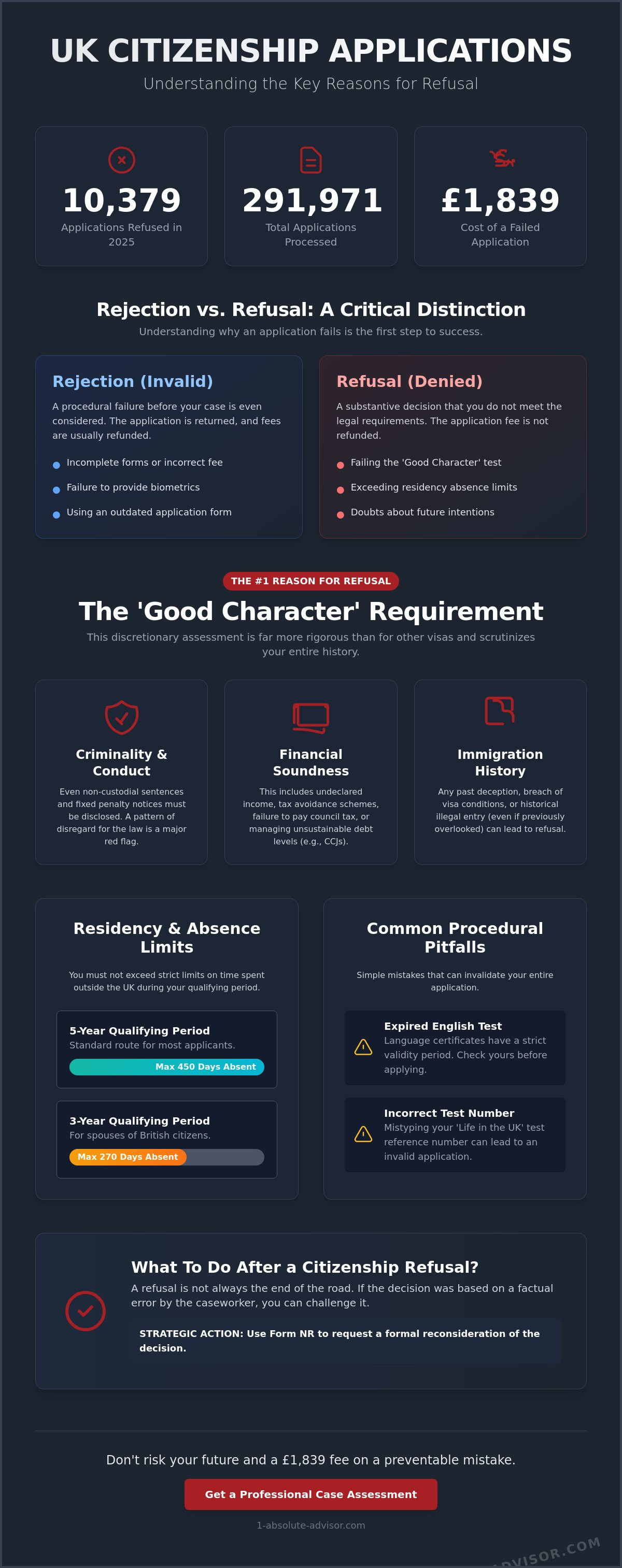
In 2025 alone, the Home Office refused 10,379 British citizenship applications, a stark reminder that naturalisation is a discretionary privilege rather than an automatic entitlement. Many applicants are surprised to find that holding Indefinite Leave to Remain does not guarantee a successful outcome, as the specific reasons for citizenship application refusal often involve “Good Character” assessments that are far more rigorous than those for permanent residency. With the adult application fee now standing at £1,839, the financial and emotional stakes of a rejection are higher than ever before.

It’s natural to feel concerned about how minor past oversights, such as tax errors or the stricter February 2025 policy on historical illegal entry, might impact your future in the UK. This article provides a professional analysis of current Home Office refusal criteria and explains how to proactively address potential risks in your profile. You’ll gain a clear understanding of how to protect your investment and the specific processes available, such as a formal reconsideration request, should you need to challenge a negative decision.

Key Takeaways

  • Distinguish between administrative rejections for invalidity and substantive reasons for citizenship application refusal under the Home Office’s discretionary powers.
  • Identify how the “Good Character” requirement extends beyond criminal records to include financial conduct and historical immigration compliance.
  • Master the precise calculation of absence limits to ensure you don’t exceed the strict 450-day or 270-day thresholds for residency.
  • Avoid common procedural errors related to expired English language certificates and incorrect Life in the UK test reference numbers.
  • Learn the strategic process for using the NR Form to request a formal reconsideration if your application is denied due to a factual error.

The Landscape of British Citizenship Refusals in 2026

Obtaining British citizenship represents the final step in a long and often arduous journey, yet the path is increasingly fraught with complexity. In the year ending December 2025, the Home Office processed 291,971 applications, of which 10,379 resulted in a refusal. These figures highlight a critical reality: naturalisation isn’t a mere administrative formality. It’s a discretionary process governed by British nationality law, specifically the British Nationality Act 1981, which grants the Home Secretary broad powers to decide who is fit to join the national community.

The financial stakes are high. With the adult naturalisation fee now at £1,839, a failed attempt carries a heavy economic burden. Understanding the common reasons for citizenship application refusal is the first step toward mitigating these risks and ensuring your investment isn’t lost to a preventable error. Approaching this process requires the same level of strategic planning as a high-stakes business decision.

Rejection vs. Refusal: Understanding the Distinction

Applicants often use these terms interchangeably, but they carry vastly different legal consequences. A rejection occurs when an application is deemed “invalid” before a caseworker even considers its merits. This typically happens due to procedural errors:

  • Failing to provide mandatory biometric data within the specified timeframe.
  • Using an outdated version of the application form.
  • Submitting the application without the correct fee payment.

A refusal, conversely, is a substantive denial. The caseworker has reviewed your history and concluded that you don’t meet the legal criteria. This is where professional scrutiny is most intense. Caseworkers exercise significant discretion, particularly when evaluating “Good Character” or residency patterns. Unlike a rejection, a refusal means the Home Office has actively decided you’re ineligible at this time, and you won’t receive a refund for the processing fee.

Why Naturalisation is Different from Other Visa Routes

Many assume that because they’ve successfully secured Indefinite Leave to Remain (ILR), citizenship is a guaranteed next step. This is a dangerous misconception. Visa routes are generally based on meeting rigid, statutory criteria. Naturalisation is different; it’s the grant of a privilege. The burden of proof rests entirely on you to demonstrate that you meet every facet of the requirements.

This shift in perspective is vital for navigating UK immigration in 2026. While ILR focuses on your right to stay, naturalisation focuses on your conduct and your future intentions. A single oversight in your past, even one that didn’t affect your ILR status, can become one of the primary reasons for citizenship application refusal. Approaching the process with a mentor-led mindset ensures these hidden hurdles are identified before they become permanent setbacks.

The ‘Good Character’ Requirement: The Most Common Refusal Reason

The “Good Character” requirement is perhaps the most misunderstood element of the naturalisation process. Unlike the residency criteria, which are largely based on quantifiable data, this assessment is inherently discretionary. The Home Office evaluates the conduct of every applicant over the age of 10 to determine if they are fit to be granted the privilege of citizenship. It’s not enough to simply lack a criminal record. One of the most frequent reasons for citizenship application refusal is a failure to demonstrate that you are a law-abiding and responsible member of society across all aspects of your life.

Caseworkers look for patterns of behaviour rather than isolated incidents. While a single minor mistake might not lead to an immediate denial, a history of non-compliance suggests a disregard for UK law. This assessment is far more rigorous than the checks performed for Indefinite Leave to Remain. If you’re concerned about how your history might be interpreted, our British Citizenship: The Complete Guide to Naturalisation in 2026 provides a deeper look into the standards expected by the Home Office.

Criminality and Conduct Beyond the Courtroom

Criminality is a primary focus, but the definition is broad. While custodial sentences often lead to mandatory refusal periods, non-custodial sentences and cautions are also significant. Even fixed penalty notices, such as those for driving offences or environmental littering, must be disclosed. A high volume of these “minor” infractions can indicate a lack of good character. As of February 10, 2025, the Home Office has also adopted a much stricter stance on historical illegal entry. Previously, a 10-year period of compliance might have mitigated an illegal entry; now, such an event can lead to a refusal regardless of how long ago it occurred.

The assessment also extends to your associations and public conduct. Involvement with extremist groups or having a reputation that brings your character into disrepute can trigger a refusal. Transparency is your best defence. Attempting to hide a past caution is often viewed as “deception,” which is itself a ground for a permanent bar on citizenship. You should consult Citizens Advice guidance for a baseline understanding of what constitutes a criminal record in a naturalisation context.

Financial Soundness and Debt Obligations

Your financial history is a direct reflection of your character in the eyes of the Home Office. Bankruptcy or being the director of a liquidated company doesn’t cause an automatic refusal, but the circumstances matter. If the bankruptcy was due to recklessness or a deliberate attempt to avoid creditors, it’s a major risk factor. Similarly, compliance with HMRC is non-negotiable. Unpaid taxes, late filings, or issues with self-assessment are common reasons for citizenship application refusal because they suggest a failure to contribute to the state as required.

Debt to the public purse is also scrutinised. Unpaid NHS debts of £500 or more are high-risk factors that often lead to denials. Before submitting your documents, it’s wise to ensure all council tax, taxes, and public debts are settled or managed through an agreed payment plan. If you’re unsure if your financial history meets the threshold, our British Citizenship Application Service can help you conduct a thorough pre-application audit to identify and mitigate these risks.
Reasons for Citizenship Application Refusal: Navigating UK Naturalisation Hurdles

Residence Requirements and Excessive Absences

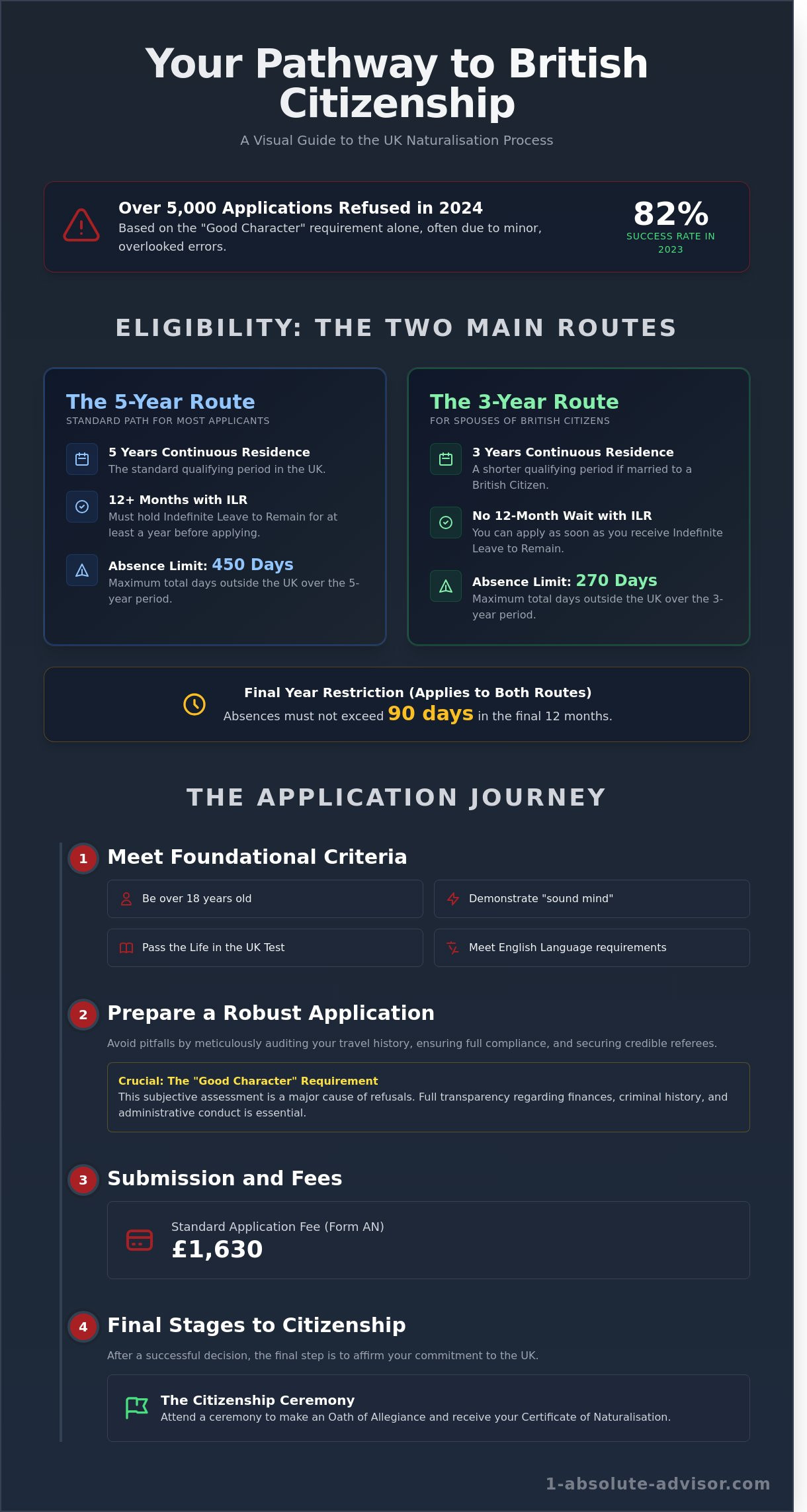
While “Good Character” assessments involve subjective judgement, residence requirements are strictly numerical. Yet, mathematical errors and poor record-keeping remain leading reasons for citizenship application refusal. The Home Office applies a binary logic to physical presence: you either stayed within the prescribed limits or you didn’t. For standard naturalisation, you shouldn’t have been absent for more than 450 days over the five-year qualifying period. If you’re applying as the spouse of a British citizen, this limit is significantly tighter, restricted to 270 days over a three-year period.

The final year of your residency is particularly sensitive. Regardless of your total five-year count, you must not have spent more than 90 days outside the UK in the 12 months immediately preceding your application. A common pitfall involves “partial days” of travel. The Home Office only counts full days of absence; the day you leave the UK and the day you return don’t count as absences. Miscalculating these even by 24 hours can trigger an automatic refusal of a £1,839 application.

The 5-Year and 3-Year Qualifying Periods

Precision is paramount when calculating your 5-year qualifying period for ILR and subsequent citizenship. You must have been physically present in the UK on the exact date five years (or three years for spouses) before the Home Office receives your application. If you were on a business trip or a weekend break on that specific calendar day years ago, your application will likely fail on a technicality.

Beyond physical presence, you must satisfy the “Future Intentions” requirement. This means proving the UK will be your principal home. If your records show frequent, long-term absences immediately after receiving Indefinite Leave to Remain, a caseworker might conclude you’re seeking a “passport of convenience.” This perceived lack of commitment is one of the more nuanced reasons for citizenship application refusal that catch high-travel professionals off guard.

Discretion for Excessive Absences

The Home Office has the power to exercise discretion if you’ve exceeded the limits, but it’s never guaranteed. You must provide compelling evidence for why your absences were unavoidable. Caseworkers generally only consider discretion for specific circumstances:

  • Unforeseen global travel restrictions or mandatory quarantine.
  • Serious, documented illness of the applicant or a close family member.
  • Unavoidable business travel that is essential to a UK-based role.

The evidentiary burden is high. You can’t simply state there was a family crisis; you must provide medical records, employer letters, or official certificates. “I didn’t know the rules” is never an acceptable justification. If your absences are borderline, our Document Checking Service can help ensure your evidence is robust enough to trigger caseworker discretion rather than a flat refusal.

Procedural Pitfalls: English Language and Life in the UK

Procedural compliance is the mechanical foundation of any naturalisation case. While previous sections of this guide focused on conduct and residency, these administrative hurdles are equally decisive. Many applicants find that technical oversights, such as using an unrecognised test provider or failing to provide a valid reference number, become the primary reasons for citizenship application refusal. These errors are particularly frustrating because they are entirely preventable through meticulous preparation and document auditing.

The Home Office relies on automated systems to verify your credentials. If the data you provide doesn’t perfectly align with their internal databases, your application may be stalled or denied. Beyond the tests themselves, failing to respond to a Home Office Request for Further Information (RFI) within the standard 10-working-day window is a common cause of failure. Caseworkers won’t chase you indefinitely; a lack of response is usually interpreted as an inability to meet the requirements.

The English Language Requirement in 2026

To qualify for naturalisation, you must demonstrate a B1 level of English in speaking and listening. This must be achieved through a Secure English Language Test (SELT) from an approved provider, such as IELTS SELT Consortium, Pearson, or LanguageCert. It’s a common mistake to rely on a certificate from a provider that has lost its Home Office accreditation. Even if the test was valid for your ILR application years ago, you must ensure it remains on the current approved list for citizenship.

If you’re using a degree taught in English from a non-UK university, you cannot simply submit the diploma. You must obtain a formal statement of comparability from Ecctis to prove the degree meets the required standard. Only those over the age of 65 or those with documented, long-term physical or mental conditions are exempt from this requirement. Without the correct Ecctis verification or a valid SELT, the Home Office will likely refuse the application on the basis that the language criteria haven’t been met.

The “Life in the UK” Test Nuances

The “Life in the UK” test is a mandatory hurdle for most applicants. However, simply passing the exam isn’t enough; the administrative details must be flawless. A frequent reason for a mismatch in the Home Office portal is using a different form of identification at the test centre than the one used for the citizenship application. If the passport numbers don’t align, the system may fail to verify your result.

You must ensure the reference number provided in your application is the correct, current version from your pass notification. For a detailed breakdown of how to prepare for this assessment and avoid technical errors, see our guide on how to pass the Life in the UK test. If you’re concerned that your documents or test results might lead to a refusal, our British Citizenship Application Service provides a comprehensive review to ensure every procedural detail is compliant before you commit to the £1,839 fee.

What to Do After a Citizenship Refusal: Strategic Recovery

Receiving a refusal letter is a significant setback, but it shouldn’t be viewed as the definitive end of your British citizenship journey. The first priority is to conduct a dispassionate, forensic analysis of the Home Office’s reasoning. You must determine if the decision was based on a factual error, such as a caseworker miscalculating your absences, or a discretionary judgement regarding your “Good Character.” Because there is no statutory right of appeal for naturalisation decisions, your strategy must be precise and based on the specific reasons for citizenship application refusal outlined in your letter.

In many cases, a refusal is the result of a caseworker overlooking evidence that was already provided or misapplying the Home Office’s own internal guidance. If the error is procedural or factual, a formal request for reconsideration is often the most appropriate path. However, if the refusal stems from a substantive failure to meet the requirements, such as a recent criminal caution or excessive absences without compelling evidence, a fresh application at a later date may be more effective. Balancing the £1,839 cost of a new application against the likelihood of a successful challenge requires careful professional consideration.

The Reconsideration Process (Form NR)

The Form NR process is the primary mechanism for challenging a negative decision. This isn’t a full appeal; it’s a request for a senior caseworker to review the original decision to see if it was legally or procedurally sound. You must submit this request within the strict timelines mentioned in your refusal notice. Success in this area often depends on a robust legal cover letter that cites specific paragraphs of the British Nationality Act 1981 or the Home Office’s “Nationality Policy Guidance.” If your application was denied because a document was missing or the caseworker ignored a specific explanation, the NR process provides a vital opportunity to rectify the record without paying the full application fee again.

Planning a Successful Reapplication

If a reconsideration is unlikely to succeed, you must plan your reapplication with a focus on transparency. If the reasons for citizenship application refusal involved “Good Character” issues, you may need to wait for a specific period to pass. For example, some offences carry a 10-year bar on successful naturalisation. It’s critical that any new application acknowledges the previous refusal. Failing to disclose a prior denial is often interpreted as an attempt at deception, which can lead to a permanent bar on your future in the UK.

Before resubmitting, a professional document audit is essential to ensure that every historical error has been addressed. If you’ve faced a refusal and need to determine the most viable path forward, our Administrative Review Service or a targeted Document Checking Service can provide the strategic oversight needed to secure your future. In rare cases where a decision is demonstrably “unreasonable” or “unlawful” and all other avenues have failed, Judicial Review remains the final legal resort to challenge the Home Secretary’s discretion.

Protecting Your Investment in British Citizenship

The path to naturalisation is no longer a simple administrative box-ticking exercise. It requires a holistic review of your residency, financial conduct, and personal history to satisfy the Home Office’s high standards. Most reasons for citizenship application refusal stem from preventable oversights in absence calculations or a failure to address the rigorous “Good Character” requirements that go beyond standard visa checks. Approaching your application with professional precision is the only way to safeguard your £1,839 fee and your long-term security.

To navigate these complexities with confidence, it’s essential to have a strategic partner by your side. Our OISC-registered immigration consultants provide a comprehensive British Citizenship Application Service, featuring fixed-fee management and an expert document checking service to mitigate risks before submission. Secure your British Citizenship with our expert application management and ensure your journey is handled with professional integrity. Your future in the UK is a significant milestone; let’s ensure it’s built on a foundation of absolute compliance and peace of mind.

Frequently Asked Questions

Can I appeal a British citizenship refusal?

No, there’s no statutory right of appeal against the refusal of a British citizenship application. Because naturalisation is a discretionary grant rather than a legal entitlement, you can’t challenge the decision in an immigration tribunal. Your available options are to request a formal reconsideration via Form NR if you believe a factual or procedural error occurred, or to submit a fresh application once you’ve addressed the underlying issues.

How long do I have to wait to reapply for citizenship after a refusal?

The waiting period depends on the specific reasons for citizenship application refusal identified in your letter. If the denial was based on a “Good Character” issue, such as a criminal record, you may be barred for up to 10 years. However, if the refusal was due to a procedural oversight, such as a missing document or a minor residency gap, you can often reapply as soon as you meet the eligibility criteria and have the necessary evidence ready.

Will a citizenship refusal affect my current Indefinite Leave to Remain (ILR)?

Generally, a refusal doesn’t impact your Indefinite Leave to Remain status. Your right to reside and work in the UK remains intact as long as you continue to meet the requirements of your residency. The only exception is if the Home Office discovers that you used deception or fraud to obtain your ILR during their citizenship investigation, which could lead to the revocation of your settlement status.

What is the “Good Character” requirement for UK citizenship?

The “Good Character” requirement is an assessment of your conduct across your entire time in the UK, including criminality, financial soundness, and immigration compliance. Under the stricter policy effective from February 10, 2025, any history of illegal entry is now a primary ground for refusal. It also encompasses non-custodial sentences, unpaid NHS debts over £500, and any record of tax non-compliance with HMRC.

Can I get a refund for my citizenship application fee if it is refused?

No, the Home Office doesn’t refund the £1,839 adult naturalisation fee if your application is refused. This fee covers the administrative cost of processing and investigating your eligibility. You’ll only receive a refund for the £130 citizenship ceremony fee, as that part of the process will not be completed. This high financial risk is why many applicants choose a professional document checking service before submission.

What happens if I spent more than 450 days outside the UK?

Exceeding the 450-day absence limit in the five-year qualifying period usually results in a refusal. While caseworkers have limited discretion to overlook absences for compelling reasons like serious illness or essential business travel, they require exhaustive evidence to do so. If you cannot prove that your absences were unavoidable, you’ll likely need to wait until your rolling five-year total falls back within the permitted thresholds.

How much does it cost to request a reconsideration (Form NR)?

Requesting a reconsideration involves a specific administrative fee paid to the Home Office, which is significantly lower than the initial application cost. This process is intended for cases where you can demonstrate that the caseworker made a clear error or missed evidence that was already provided. It’s a vital tool for correcting factual mistakes without undergoing the full reapplication process and paying the standard fee again.

Do I need a lawyer for a British citizenship reapplication?

You aren’t legally required to use a representative, but professional assistance is highly recommended when dealing with complex reasons for citizenship application refusal. An OISC-registered consultant can help you interpret the refusal letter and build a stronger evidence base for your next attempt. Given the £1,839 cost of each application, ensuring your second submission is flawless is a prudent financial and strategic decision.

British Citizenship Ceremony Process: The Final Step to Becoming a UK Citizen in 2026

A single administrative oversight following your naturalisation can result in a £1,000 fine, potentially turning a hard-earned celebration into a costly legal headache. You’ve navigated years of rigorous requirements, and mastering the british citizenship ceremony process is the final safeguard for your new status. It’s natural to feel a sense of urgency or even slight apprehension regarding the strict timelines and formal protocols required by the Home Office in 2026. You’ve worked hard to reach this milestone, and ensuring a compliant transition is the only way to protect your long-term security.

This article provides the professional clarity you need to transition from a resident to a citizen with absolute confidence. You’ll gain a comprehensive roadmap covering everything from the three month booking deadline to the specific differences between the Oath and the Affirmation. We’ll also detail the mandatory steps for returning your Biometric Residence Permit within five working days and explain exactly how to manage your travel rights while you wait for your first British passport application to be processed.

Key Takeaways

  • Understand the critical 90 day window to book your ceremony once the Home Office invitation arrives to avoid jeopardising your application status.
  • Navigate the choices between standard group and private ceremonies, ensuring you have the correct documentation ready for your local council appointment.
  • Prepare for the legal core of the british citizenship ceremony process by selecting the pledge version, either the Oath or Affirmation, that best reflects your personal values.
  • Learn the mandatory administrative steps required immediately after the ceremony, including the strict five day deadline for returning your Biometric Residence Permit to avoid significant fines.
  • Discover the essential role of your Certificate of British Citizenship in securing your first UK passport and establishing your permanent travel rights.

The Citizenship Ceremony Invitation: Your 90-Day Countdown

The british citizenship ceremony process serves as the definitive legal conclusion to your naturalisation journey. While many applicants view the approval email as the finish line, your legal status doesn’t actually change until you’ve stood before a registrar and made your formal pledge. Under the established framework of British nationality law, the ceremony is the mechanism that transforms a resident into a subject with full civic rights and responsibilities. Most adult applicants must participate in this tradition, though certain exceptions exist for those becoming British Overseas Territories citizens or those with specific physical or mental health exemptions.

Your invitation letter is essentially a “golden ticket” for the final stage of your application. It’s a mandatory document that you must present to the local authority on the day of your event. Without this specific correspondence, the registrar cannot legally administer the oath or issue your certificate. Treat this document with the same care you’d give a passport; it’s the only proof that your local council has the authority to grant your citizenship.

Receiving Your Home Office Notification

It’s vital to distinguish between the initial “successful application” notification and the formal ceremony invitation. You’ll often receive an email confirming your approval first, but this doesn’t always contain the booking instructions. The actual invitation follows shortly after, providing the specific details for your designated local council. If you haven’t received this second piece of correspondence within 12 weeks of your approval notice, you should proactively contact the Home Office Nationality Enquiries team. When it does arrive, verify every detail immediately. Ensure your name and date of birth match your identity documents exactly, as even a minor clerical error can cause significant friction during the british citizenship ceremony process.

The Consequences of Missing the Deadline

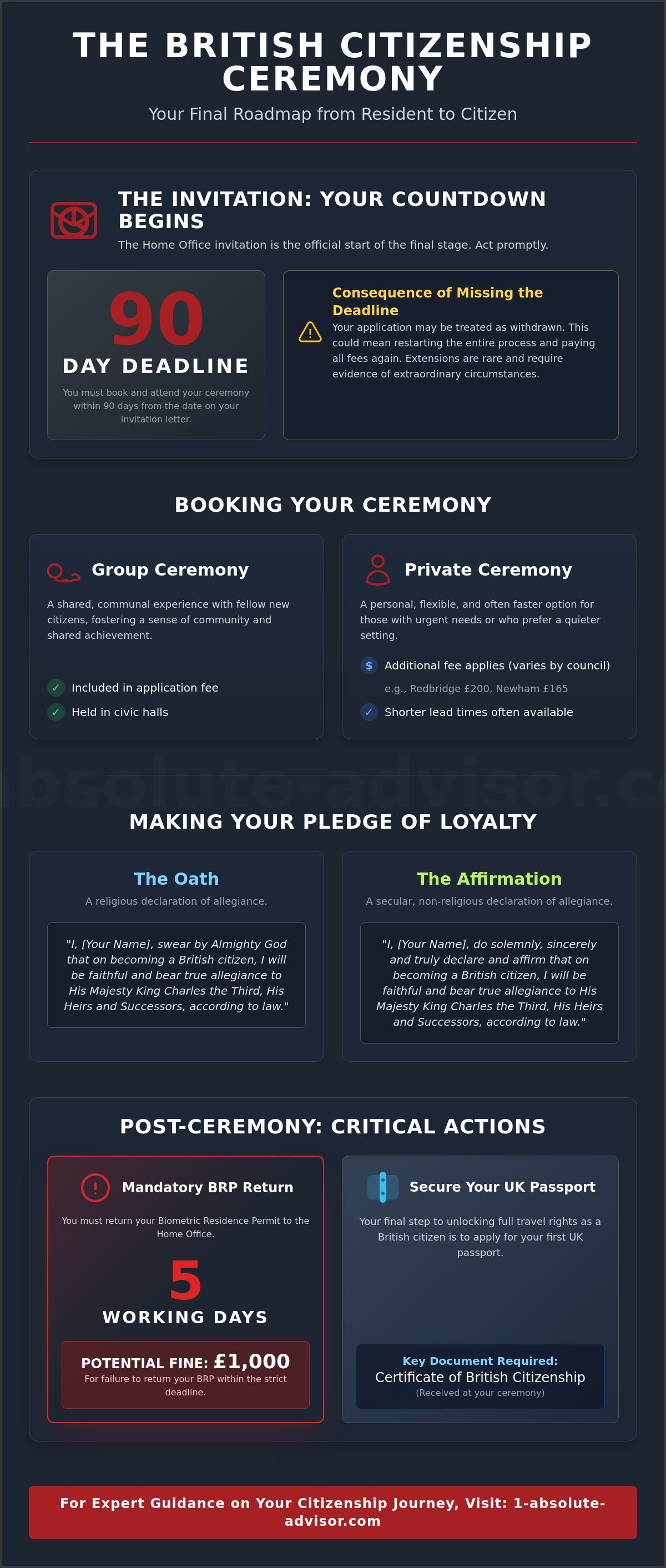
The Home Office imposes a strict 90 day window for you to book and attend your ceremony. This three month countdown begins from the date printed on your invitation letter, not the date you receive it. If you fail to schedule your appointment within this timeframe, your application may be treated as withdrawn. In such cases, you’d likely have to restart the entire British Citizenship Application Service process, including paying the application fees again.

If you’re facing extraordinary circumstances, such as a medical emergency or a family bereavement, you don’t have to face the risk of expiration alone. You can contact the Home Office to request an extension, provided you can supply documentary evidence of your situation. However, these extensions aren’t guaranteed. It’s always safer to book the earliest available slot to ensure you remain compliant with the 2026 regulations.

Booking and Preparing for Your British Citizenship Ceremony

Once you’ve received your invitation, the next phase of the british citizenship ceremony process involves coordinating with your local registrar’s office. This isn’t merely an administrative formality; it’s a choice between two distinct experiences. Most councils offer standard group ceremonies, which are included in the initial application fee, or private ceremonies for those seeking a more personal or expedited event. When booking your citizenship ceremony, you’ll need to confirm which format suits your schedule and personal preferences.

Group vs. Private Ceremonies

Group ceremonies foster a sense of shared achievement, often held in civic halls with multiple new citizens. They provide a community atmosphere that many find rewarding. However, if you require a more flexible schedule or a quieter environment, a private ceremony might be preferable. While the standard £130 fee covers group events, private options incur additional costs that vary by local authority. For example, Redbridge Council currently charges £200 for a private session, while Newham Council charges £165. These private appointments often provide shorter lead times, which can be critical if you need to secure your citizenship certificate quickly for urgent travel needs.

Administrative Checklist for the Day

Preparation is the key to a stress-free experience. You must bring your original Home Office invitation letter and a valid form of photographic identification. Acceptable ID includes your current passport, your Biometric Residence Permit (BRP), or a UK driving licence. Upon arrival, expect a check-in process where the registrar verifies your identity and confirms whether you’ve chosen the religious Oath or the secular Affirmation. This is also when you’ll finalise any guest arrangements. Most group ceremonies allow two guests per applicant, but space is often limited. Confirming guest numbers during the booking stage is essential to avoid disappointment on the day.

The ceremony is a formal legal occasion attended by local dignitaries, such as the Lord Lieutenant or the Mayor. While there’s no mandatory uniform, most applicants choose smart-casual attire or traditional national dress to reflect the dignity of the event. Aim to arrive 15 to 30 minutes before the scheduled start time. Registrars work to tight schedules. Late arrivals may be refused entry, which would require a complete rebooking of the appointment. Punctuality is vital throughout the british citizenship ceremony process to ensure your transition to citizenship remains on track. If you’re still in the earlier stages of your journey, using a professional British Citizenship Application Service can ensure your paperwork is flawless long before you reach the booking stage.

British Citizenship Ceremony Process: The Final Step to Becoming a UK Citizen in 2026

Oath vs. Affirmation: Making Your Pledge of Loyalty

Standing to recite your pledge is the precise legal point where your status changes from a resident to a citizen. While your application has been approved, the Official guidance on British citizenship ceremonies clarifies that this public declaration is the only venue where the transition becomes final. You aren’t just reciting a script. You’re entering a formal, lifelong agreement with the United Kingdom. The Superintendent Registrar or a presiding official will lead the group, ensuring the british citizenship ceremony process maintains the solemnity required for such a significant milestone.

The Oath of Allegiance

The Oath of Allegiance is tailored for applicants who wish to frame their commitment within a religious context. By swearing “by Almighty God,” you’re making a spiritual and legal promise of loyalty. The specific wording requires you to be faithful and bear true allegiance to His Majesty King Charles III, his heirs, and successors according to law. The Oath is a binding legal contract with the Crown. It signifies your acceptance of the UK’s democratic values and your willingness to uphold its laws.

The Affirmation of Allegiance

The Affirmation of Allegiance serves as a secular alternative for those who prefer a non-religious promise. It’s essential to understand that the Affirmation carries the exact same legal weight as the Oath. Choosing this version doesn’t change your status or your rights as a citizen. If your ceremony takes place in Wales, you can choose to make your pledge in either English or Welsh. This flexibility ensures that the british citizenship ceremony process remains inclusive and respectful of individual beliefs and cultural heritage.

After the pledges and the national anthem, the presiding official will present you with your Certificate of British Citizenship. This document is the definitive proof of your status. It’s far more vital than a birth certificate for a new citizen, as you’ll need it for every official interaction from this point forward. Most registrars suggest you verify the spelling of your name and your date of birth before leaving the hall. A small error caught now saves weeks of administrative delays during your first passport application. Your journey through the British Citizenship Application Service has led to this moment; treat this certificate as the foundation of your new life in the UK.

Post-Ceremony Obligations: BRP Return and Passport Applications

Completion of the british citizenship ceremony process marks a profound legal shift in your standing within the United Kingdom. You’re no longer a resident subject to immigration control; you’ve become a British citizen with all associated rights and duties. However, this new status brings immediate administrative obligations that carry heavy penalties if ignored. You must now manage the transition from your previous residency documents to your new identity as a citizen with precision and care.

The 5-Day BRP Return Rule

Your Biometric Residence Permit (BRP) becomes legally void the moment your ceremony concludes. Under 2026 Home Office regulations, you must return this permit within five working days of your ceremony. Failure to comply with this deadline can result in a fine of up to £1,000. To fulfil this requirement, you should cut the card into small pieces, ensuring you cut through the chip and the magnetic strip. Place these pieces in a plain, windowless envelope and post them to the address specified in your approval notification. This step is a critical final component of the british citizenship ceremony process and ensures your record remains compliant.

Applying for Your First British Passport

Your Certificate of British Citizenship is now your most vital legal document. It’s the primary evidence of your status, even more significant than a birth certificate for a naturalised citizen. You’ll need this original document to apply for your first UK passport. Before you begin the application, ensure you’ve reviewed the comprehensive requirements for British Citizenship to ensure all previous milestones were correctly recorded. Most applicants choose the online application route for efficiency, though paper forms remain available at designated Post Offices. Your certificate will be mailed back to you separately once your passport is issued.

Travel Restrictions During Transition

Many new citizens face a “travel gap” immediately following their ceremony. It’s unwise to book international travel until your British passport is physically in your possession. Since your BRP must be destroyed and your previous non-British passport no longer grants you entry as a UK resident, you risk being denied re-entry at the border. Current processing times for a first British passport typically range from 4 to 10 weeks. You should plan your international commitments strategically during this window to avoid being stranded abroad without a valid travel document that the UK border authorities will recognise.

If you’re concerned about the timing of your transition or need help managing your final documents, our British Citizenship Application Service provides the professional oversight needed to ensure your journey concludes without administrative errors.

Expert Guidance for Your British Citizenship Journey

Completing the british citizenship ceremony process is a monumental achievement, but the path to that final pledge is often paved with complex administrative hurdles. While the ceremony itself is a celebration, the legal work required to secure your invitation must be beyond reproach. A “first-time right” application isn’t just about filling out forms; it’s about presenting a comprehensive legal argument that satisfies every Home Office requirement. Engaging OISC-registered advisors ensures that your submission is reviewed with the same level of scrutiny it will face from immigration officials, effectively preventing the delays or refusals that can stall your progress for months.

Professional Oversight of Your Application

Our team focuses on the strategic elements of your case, particularly the “Good Character” requirements which are frequently the source of unexpected refusals. We examine your history with precision to ensure that when you submit your British Citizenship Application Service request, there are no hidden risks that could jeopardise your invitation. For those who are still building their residency foundation, we provide seamless support by managing ILR UK applications, ensuring that every stage of your journey is handled with professional integrity. Our fixed-fee approach to nationality services provides you with financial predictability, allowing you to focus on your future as a citizen without worrying about escalating legal costs.

Next Steps with 1 Absolute Advisor

Your relationship with the UK doesn’t end when the national anthem stops playing. Many new citizens face ongoing questions regarding complex nationality claims, particularly if they have ancestors with ties to former British territories. We also provide expert guidance on dual citizenship issues, helping you understand how your new British status interacts with the laws of your country of origin. Ensuring the security of your entire family is often the next priority. We specialise in supporting families through the registration of children as British citizens, ensuring that your loved ones share in the same permanent security you’ve worked so hard to achieve.

The british citizenship ceremony process is the gateway to a new life of opportunity and civic participation. By choosing a strategic immigration partner, you’re not just hiring a service; you’re securing a mentor who understands the nuances of the law and the importance of your success. If you’re ready to take the final step toward your UK passport with absolute confidence, book a consultation for your British Citizenship application today. We’ll ensure your transition is smooth, compliant, and professionally managed from start to finish.

Securing Your Future as a British Citizen

Navigating the british citizenship ceremony process is the final administrative hurdle before you can fully embrace the rights and responsibilities of UK nationality. By understanding the strict 90 day booking window and the mandatory five day deadline for returning your Biometric Residence Permit, you protect your status from unnecessary legal risks. This transition represents more than just a change in paperwork; it’s the culmination of years of dedication and adherence to the UK’s residency requirements. You’ve reached the threshold of a new life, and ensuring these final steps are compliant is vital for your long-term security.

If you’re beginning your application or facing a complex nationality claim, professional oversight is the most reliable way to ensure a successful outcome. Our OISC-registered immigration experts provide fixed-fee legal services tailored to your specific circumstances, ensuring your case is handled with the precision it deserves. Start your British Citizenship application with 1 Absolute Advisor to secure your future with confidence. Your journey to becoming a British citizen is a significant milestone, and we’re here to ensure every step is handled with the highest level of professional integrity and care.

Frequently Asked Questions

Do I need to attend a citizenship ceremony if I am under 18?

Attendance is not mandatory for applicants under the age of 18. Minors become British citizens the moment the Home Office approves their registration application. However, children who are turning 18 during the application process or those who wish to celebrate with their parents are welcome to attend. If a minor chooses to attend, they aren’t legally required to take the oath or affirmation, though they may participate in the celebratory aspects of the event.

Can I travel abroad after my citizenship ceremony but before I get my passport?

Traveling abroad during this window is highly discouraged due to significant re-entry risks. Once you complete the british citizenship ceremony process, your Biometric Residence Permit (BRP) is legally void and must be returned to the Home Office. You cannot use a void BRP or your citizenship certificate to pass through UK border control. You’ll generally need to wait for your first British passport to be issued, which currently takes between 4 and 10 weeks, to ensure a lawful return to the country.

What happens if I lose my British Citizenship Certificate?

If you lose your original certificate, you must apply to the Home Office for a formal replacement. This is a time consuming and costly process, as the certificate is the only legal proof of your naturalisation. Because you need this document for your first passport application and many other legal functions, it’s vital to store it in a secure location. If the certificate is lost or stolen, you should report it to the police and the Home Office Nationality Group immediately to begin the recovery process.

Can I have a private citizenship ceremony instead of a group one?

You can request a private ceremony through your local authority if you prefer a more personal setting or require a specific date. These appointments offer greater flexibility but require an additional fee beyond the standard application cost. For example, Redbridge Council currently charges £200 for a private session, while other regions like Leicestershire charge around £85. You should contact your designated council’s registrar as soon as you receive your invitation to discuss their specific availability and local pricing.

What is the difference between an Oath and an Affirmation?

The primary difference lies in the religious nature of the declaration. The Oath of Allegiance is a religious pledge where you swear by “Almighty God” to be faithful to the Crown. The Affirmation of Allegiance is a secular alternative that carries the exact same legal weight but involves a non-religious “solemn and sincere” promise. Both versions require you to pledge loyalty to His Majesty King Charles III and uphold the democratic values of the United Kingdom.

How much does the British citizenship ceremony cost in 2026?

The standard fee for a group citizenship ceremony is £130, which is included in the total naturalisation application cost of £1,839 as of the April 8, 2026 fee increase. This fee covers the administrative costs of the registrar and the production of your certificate. If you opt for a private ceremony, you’ll need to pay a separate surcharge directly to your local council. These private fees are not regulated nationally and vary significantly depending on your chosen location and the day of the week.

What documents must I bring to my citizenship ceremony?

You must present your original Home Office invitation letter and a valid form of photographic identification to the registrar. Acceptable ID includes your current passport, your UK driving licence, or your Biometric Residence Permit. This documentation is essential for the registrar to verify your identity before you participate in the british citizenship ceremony process. If you fail to bring these items, the official cannot legally allow you to take the pledge or issue your citizenship certificate on that day.

How long does the citizenship ceremony usually last?

A standard group ceremony typically lasts between 30 and 60 minutes. This timeframe includes the welcoming speeches from local dignitaries, the formal recitation of the pledges, and the presentation of the certificates. Private ceremonies are often shorter, usually concluding within 15 to 20 minutes, as they focus solely on the individual applicant. Regardless of the format, you should plan to arrive at least 15 minutes early to complete the mandatory identity checks and administrative registration before the event begins.

How to Apply for British Citizenship in 2026: A Strategic Guide to Naturalisation

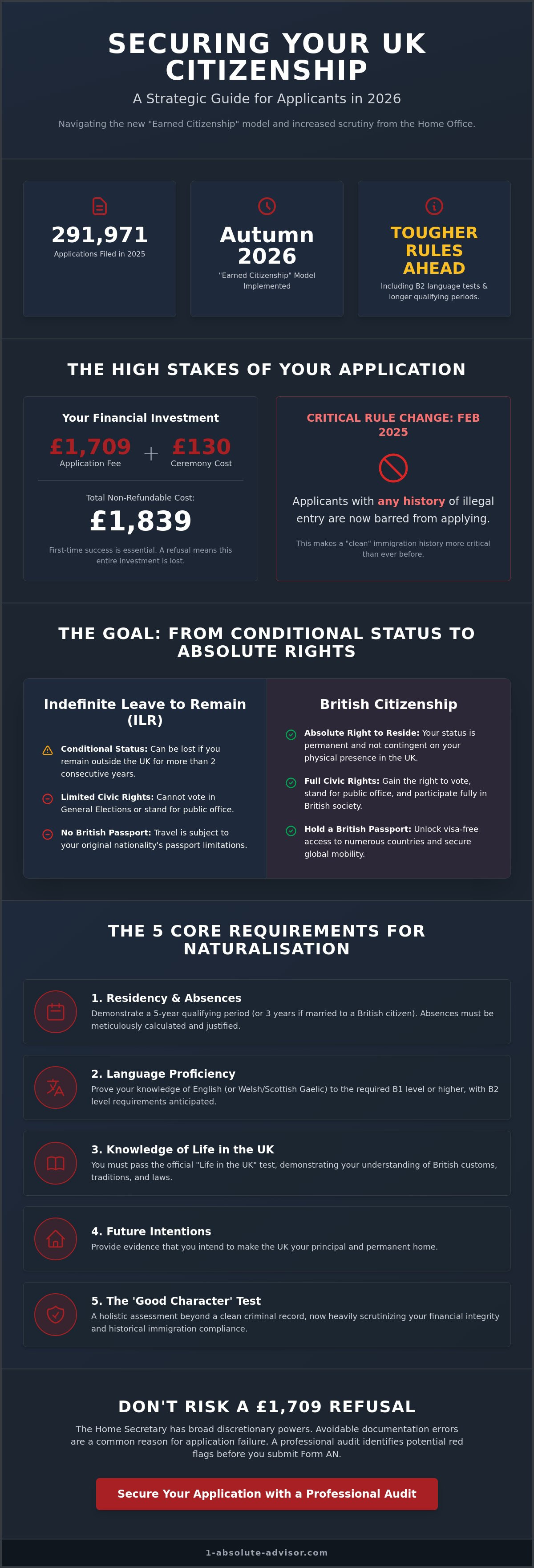
With 291,971 applications filed in 2025, the drive to secure a UK passport has reached an all-time high as the Home Office prepares to implement the “earned citizenship” model in Autumn 2026. When you decide to apply for british citizenship, you’re not just completing a form; you’re presenting a formal legal argument for your permanent place in British society. The financial commitment is significant, with the standard fee now at £1,709 plus a £130 ceremony cost, making a first-time success essential for your family’s stability.

We recognize that the shifting regulatory landscape, including the February 2025 ruling that bars those with any history of illegal entry, creates a sense of uncertainty. This guide provides a professional breakdown of the residency rules and evidence requirements you must navigate to ensure your application stands up to Home Office scrutiny. We’ll explore the updated good character test and the specific documentation needed to protect your investment. By following this strategic path, you’ll be prepared to secure your status before the government introduces tougher B2 language requirements and longer qualifying periods later this year.

Key Takeaways

  • Differentiate between Indefinite Leave to Remain and naturalisation to understand the strategic benefits of full British status for your family’s future.
  • Master the residency calculations and evidence requirements necessary to meet the qualifying periods without risking a high-cost refusal.
  • Navigate the expanded “Good Character” assessment by addressing financial integrity and historical immigration compliance as part of your holistic application.
  • Learn the precise steps to apply for british citizenship, including how to select appropriate referees and submit Form AN effectively before rules change.
  • Identify how professional audits can mitigate the risk of losing the £1,709 application fee by identifying avoidable documentation errors early.

Understanding British Citizenship: The Final Step in Your UK Immigration Journey

Naturalisation represents the formal legal mechanism through which a non-British adult acquires the same status as those born in the United Kingdom. It’s the definitive conclusion of an immigration journey that often spans many years. While Indefinite Leave to Remain (ILR) grants you the right to live and work without time limits, it remains a conditional status. If you stay outside the UK for more than two consecutive years, you risk losing your ILR status entirely. In contrast, once you successfully apply for british citizenship, your right to reside here becomes absolute; it’s no longer contingent upon your physical presence or periodic Home Office reviews.

The legal framework governing these transitions is rooted in British nationality law, which establishes the criteria for integration and allegiance. Beyond the security of tenure, citizenship unlocks fundamental civic rights. You gain the ability to vote in General Elections, stand for public office, and hold a British passport. This document is one of the most powerful travel assets globally, facilitating visa-free access to numerous jurisdictions. However, we must emphasize that naturalisation is legally classified as a privilege, not an automatic right. The Home Secretary maintains broad discretionary powers to refuse any applicant who fails to meet the stringent statutory requirements, particularly those concerning the good character test.

Naturalisation vs. Registration: Which Route Applies to You?

It’s vital to distinguish between the two primary paths to citizenship. Naturalisation is the standard route for most adult migrants who have lived in the UK for the required qualifying period. It requires the submission of Form AN. Registration, conversely, is typically reserved for children under 18 or individuals who already hold a form of British nationality but aren’t yet citizens. Because the majority of our clients are established professionals and business leaders, this guide focuses exclusively on the naturalisation process for residents looking to apply for british citizenship.

The Strategic Importance of British Citizenship in 2026

In 2026, the decision to secure citizenship has moved from a lifestyle choice to a strategic necessity. With the government’s “earned citizenship” model scheduled for implementation in Autumn 2026, the window for applying under the current framework is narrowing. Securing your status now provides a buffer against future policy shifts that may include tougher B2 language requirements and revised residency tests. A “clean” immigration history, free from breaches or deception, serves as the essential foundation for this transition. By acting now, you ensure your family’s future remains insulated from the complexities of evolving border controls.

The 5 Core Requirements for a Successful Naturalisation Application

To successfully apply for british citizenship, you must satisfy five distinct statutory criteria. These aren’t flexible suggestions; they’re rigid benchmarks that require documented proof. The Home Office evaluates each submission against residency, language proficiency, knowledge of life in the UK, future intentions, and the good character test. Because the application fee stands at £1,709 as of April 8, 2026, understanding the nuances of these citizenship application requirements is vital to protecting your financial and legal interests.

Most applicants must demonstrate a five-year qualifying period of residency. If you’re married to or in a civil partnership with a British citizen, this period is reduced to three years. Beyond time served, you must prove your intention to make the UK your principal home. This means your life, family, and primary economic interests should be centered here. While the requirements appear straightforward, the Home Office maintains a high threshold for evidence. If your background includes complex financial structures or international business interests, a professional audit of your profile can identify potential red flags before you submit your Form AN.

Calculating Your Residency and Absences

The residency requirement is often where applicants stumble. For a five-year application, you cannot have spent more than 450 days outside the UK in total. Crucially, you must not have exceeded 90 days of absence in the final 12 months before applying. There’s also the “physical presence” rule. You must have been physically present in the UK exactly five years (or three years for spouses) before the date the Home Office receives your application. If you were on holiday or a business trip on that specific calendar day five years ago, your application will likely be refused. While the Home Office can exercise discretion for excess absences, this is typically reserved for exceptional circumstances like medical emergencies or unavoidable work postings.

Meeting the Language and Life in the UK Standards

You must prove your integration through two specific tests. First, you need an English language qualification at B1 CEFR level or higher, unless you’re from a majority English-speaking country or over age 65. Second, you must pass the Life in the UK test. This 45-minute exam covers British history, law, and customs. The pass certificate doesn’t expire, so many people complete this during their settlement phase. If you’re still working toward your permanent residency, our ILR UK: The Complete Guide provides the necessary roadmap for that prerequisite stage. Ensuring these certificates are valid and correctly linked to your UAN is a fundamental step in the process.

How to Apply for British Citizenship in 2026: A Strategic Guide to Naturalisation

The ‘Good Character’ Requirement: Beyond Just a Clean Record

The good character requirement is the most qualitative and subjective element of the naturalisation process. Unlike residency days, which are mathematically verifiable, “character” involves a holistic assessment of your conduct, integrity, and compliance with UK society’s norms. When you apply for british citizenship, the Home Office doesn’t just look for the absence of a criminal record. They evaluate whether you’re a person of integrity who respects the laws and obligations of the United Kingdom. Because the application fee is £1,709 as of April 8, 2026, a refusal based on character is an expensive and professionally damaging setback.

Full disclosure is the absolute foundation of a successful submission. Many applicants mistakenly believe that “spent” convictions under the Rehabilitation of Offenders Act 1974 don’t need to be mentioned. This is a critical error. In nationality law, the concept of a spent conviction doesn’t apply in the same way it does for employment. You must disclose every caution, conviction, and civil penalty, regardless of how much time has passed. Dishonesty or “non-disclosure” is often viewed more severely than the original offence itself; the Home Office frequently refuses applications on the grounds of deception rather than the underlying incident.

Criminality and Minor Offences

The 2026 assessment framework places significant weight on even minor infractions. Fixed Penalty Notices (FPNs), such as speeding tickets or parking fines, won’t usually lead to a refusal if they’re disclosed and paid. However, a pattern of multiple FPNs can indicate a disregard for the law. Cautions and more serious convictions are subject to specific “rehabilitation periods” where an application will normally be refused if the conviction occurred within a certain timeframe. For any past mistake, we recommend a proactive strategy: include a detailed cover letter that acknowledges the incident, demonstrates remorse, and highlights your subsequent years of exemplary conduct.

Financial Integrity and Immigration Breaches

Financial soundness is a core pillar of the character test. The Home Office examines your history with HMRC, Council Tax, and even private debts. If you have active County Court Judgments (CCJs), are currently in an undischarged bankruptcy, or owe more than £500 to the NHS, your application faces a high risk of refusal. You must prove you’ve made arrangements to settle these debts. Furthermore, your immigration history is under intense scrutiny. Following the February 10, 2025 update, any history of illegal entry or significant periods of overstaying will normally result in a refusal. Integrity isn’t just about current compliance; it’s about your entire history since arriving in the UK. Ensuring your tax affairs are fully optimized and compliant is a prerequisite before you apply for british citizenship.

Step-by-Step: Navigating the Application Process and Timeline

The administrative journey toward naturalisation is a multi-stage process that requires meticulous attention to detail. Once you’ve confirmed you meet the statutory requirements, the first phase involves assembling your digital evidence portfolio. To apply for british citizenship, you must submit Form AN through the online portal and pay the mandatory fee of £1,709. This payment includes the cost of processing but excludes the £130 citizenship ceremony fee, which is typically settled at the point of approval. Precision during this stage is paramount; any discrepancy between your application and your supporting documents can trigger a request for further information, extending the timeline significantly.

After submission, you’ll book an appointment with UK Visas and Citizenship Application Services (UKVCAS). At this meeting, staff will capture your biometrics, including your fingerprints and a digital photograph. While your original documents are scanned and returned to you, the Home Office begins its internal review. The standard processing time is approximately six months. During this period, caseworkers may conduct enquiries with other government departments, such as HMRC or the Department for Work and Pensions, to verify your residency and financial integrity. If your case involves complex residency gaps, our expert consultants can conduct a pre-submission audit to ensure your timeline is beyond reproach.

Choosing Your Referees Correctly

Every application requires two referees who have known you personally for at least three years. The criteria are strict: one must be a person of any nationality who has a professional standing, such as an accountant, a teacher, or an OISC-registered advisor. The second referee must be a British citizen and either a professional person or over the age of 25. Neither can be related to you or to each other, and they cannot be your solicitor or an employee of the Home Office. Finding individuals who meet these specific parameters while also being willing to provide their passport details can be a logistical challenge for some, so identify these partners early in your preparation.

What to Expect at the Citizenship Ceremony

The final step in your journey is the citizenship ceremony. Once your application is approved, you’ll receive an invitation to book a ceremony with your local council. This must take place within 90 days of the approval date. During the event, you’ll take an oath or affirmation of allegiance to the Monarch and a pledge of loyalty to the United Kingdom. This is the precise legal moment you become a British citizen. You’ll receive your naturalisation certificate immediately after the pledge, which you’ll then use to apply for your first British passport. It’s a formal and celebratory conclusion to what is often a decade-long immigration path.

Ensuring Absolute Compliance: How Professional Advice Mitigates Risk

The decision to apply for british citizenship represents a significant financial and emotional investment. With the standard application fee set at £1,709 as of April 8, 2026, the cost of an administrative error is substantial. Most refusals aren’t the result of fundamental ineligibility but rather of avoidable evidentiary gaps or technical misunderstandings of the Home Office guidance. Professional oversight acts as a critical insurance policy, protecting your investment by ensuring every claim in your Form AN is supported by high-quality, verifiable documentation that meets the current 2026 standards.

OISC-registered consultants provide a level of scrutiny that goes beyond simple form-filling. We conduct a comprehensive audit of your residency history, cross-referencing travel records with HMRC data to ensure your 450-day absence limit is calculated with absolute accuracy. If your history includes complex elements, such as a period of self-employment with fluctuating tax records or a previous minor immigration breach, a professional cover letter becomes essential. This document allows us to present a legal argument for the Home Secretary to exercise discretion in your favor, effectively mitigating risks that might otherwise lead to a summary refusal based on the good character test.

The Value of a Professional Document Check

A professional document check is particularly valuable if you’ve lost previous passports or lack clear travel records from the start of your five-year qualifying period. We can help you reconstruct your residency narrative using secondary evidence like P60s, bank statements, or utility bills that meet the rigorous Home Office evidentiary standards. For a deeper analysis of the policy shifts driving these requirements and how they might affect your specific case, our British Citizenship: The Complete Guide to Naturalisation offers extensive insights into the current legal landscape.

Next Steps: From Citizenship to Your First British Passport

Once you receive your naturalisation certificate at the ceremony, your Biometric Residence Permit (BRP) becomes void. You must return it to the Home Office within five working days of the ceremony to remain compliant with immigration law. This certificate is the primary evidence you’ll need to obtain your first British passport, a process that typically takes an additional three to five weeks. Transitioning to citizenship is a complex, life-changing event that requires a proactive and precise approach. To ensure your application is handled with the professional integrity it deserves, book a consultation with 1 Absolute Advisor today and secure your family’s future in the United Kingdom.

Secure Your Permanent Status in the United Kingdom

The transition from permanent residency to full citizenship is the most significant legal milestone in your UK journey. By mastering residency calculations and ensuring total transparency within the good character assessment, you mitigate the risk of a high-cost refusal. As the Home Office prepares to implement more stringent “earned citizenship” criteria in Autumn 2026, the current window provides a strategic opportunity to solidify your family’s security and obtain your British passport.

Precision is not just a preference; it’s a requirement for success. Our OISC-Registered Immigration Consultants specialize in auditing residency histories and managing complex naturalisation cases to ensure every application is beyond reproach. We provide fixed-fee application management that transforms a daunting administrative burden into a structured, predictable process. When you’re ready to apply for british citizenship, don’t leave your family’s future to chance. Partner with a strategic mentor who understands the nuances of nationality law and the importance of absolute compliance.

Secure Your British Future with Expert Citizenship Advice

Frequently Asked Questions

How much does it cost to apply for British citizenship in 2026?

The total mandatory cost for most adults is £1,839. This figure consists of the £1,709 Home Office application fee, which was updated on April 8, 2026, and a £130 fee for the citizenship ceremony. Additional costs typically include £50 for the Life in the UK test and approximately £150 for an approved English language exam if you don’t already hold a qualifying degree.

Can I apply for British citizenship if I have a criminal record?

You can apply, but the Home Office will evaluate your record against the “Good Character” requirement. While minor infractions like a single speeding fine won’t usually result in a refusal, serious convictions or those falling within specific rehabilitation periods will. It’s vital to note that since the February 10, 2025 guidance update, any history of illegal entry into the UK will normally lead to a refusal regardless of how much time has passed.

What happens if my British citizenship application is refused?

If your application is refused, the Home Office will send a letter detailing the specific legal grounds for the decision. You won’t receive a refund of the £1,709 application fee. If you believe the caseworker made a factual or legal error, you can apply for a reconsideration using Form NR, which currently costs £450. Because of these high stakes, many individuals choose to have their evidence audited by a professional before they apply for british citizenship.

Do I need to live in the UK for 5 years before I can apply?

The standard residency requirement is five years, but this is reduced to three years if you’re married to or in a civil partnership with a British citizen. Standard applicants must also have held Indefinite Leave to Remain (ILR) for at least 12 months before submitting their application. Spouses of British citizens are exempt from this additional 12-month waiting period and can apply as soon as they receive their settlement status.

How many days can I be out of the UK before applying for citizenship?

For a standard five-year application, you must not have spent more than 450 days outside the UK in total. Additionally, you’re limited to 90 days of absence in the final 12 months before your application date. If you’re applying via the three-year route as a spouse, the total limit is 270 days. Exceeding these limits requires a detailed explanation in your cover letter to request Home Office discretion.

Can I travel while my British citizenship application is being processed?

You’re free to travel internationally while your application is pending because you retain your passport and Biometric Residence Permit (BRP) after your biometrics appointment. However, you must maintain your intention to make the UK your principal home. If you spend significant time abroad during the six-month processing window, the Home Office might question whether you meet the “future intentions” requirement of the naturalisation process.

Who can be a referee for my British citizenship application?

You must provide two referees who have known you for at least three years. The first must be a person of any nationality who has “professional standing,” such as an accountant, solicitor, or civil servant. The second must be a British citizen who is either a professional or over the age of 25. Referees cannot be related to you, related to each other, or be employees of the Home Office.

Is the Life in the UK test mandatory for everyone?

The Life in the UK test is a mandatory requirement for all applicants aged 18 to 64. You’re only exempt if you’re 65 or older or have a long-term physical or mental condition, supported by a specific medical waiver form from a doctor. When you apply for british citizenship, you must include the unique reference number from your pass certificate, which remains valid indefinitely once you’ve passed the exam.

British Citizenship for European Nationals: The 2026 Guide to Naturalisation

What if your £1,630 investment in a British future was rejected because of a single weekend trip you forgot to log three years ago? For many EU residents, the path to british citizenship for european nationals feels less like a logical progression and more like a high-stakes gamble with their life savings. You’ve worked hard to secure your Settled Status, yet the transition to naturalisation introduces a maze of physical presence rules and complex dual nationality laws that can feel overwhelming. It’s perfectly natural to worry about the financial risk and the potential for a refusal letter that impacts your long-term security.

We understand that you’re looking for more than just a checklist; you’re seeking the absolute certainty that your application is flawless. This guide offers a comprehensive roadmap to help you manage the 2026 requirements with professional precision. We’ll break down the specific residency calculations, address concerns regarding your home country’s stance on dual citizenship, and outline the exact process to ensure you finally hold a British passport and the permanent peace of mind you deserve.

Key Takeaways

  • Understand the mandatory 12-month waiting period following Settled Status and how to correctly calculate your continuous residence to meet Home Office requirements.
  • Master the essential eligibility criteria, including English language proficiencies and the “Day One” physical presence rule, to secure british citizenship for european nationals.
  • Learn to navigate the subjective “Good Character” requirement and the potential traps that often lead to application refusals for EU citizens.
  • Gain a step-by-step overview of the online Form AN and the specific criteria for selecting qualified referees to validate your application.
  • Discover the strategic value of professional OISC-registered audits in identifying errors before submission, protecting your investment and future in the UK.

The Transition from Settled Status to British Citizenship

Moving from the EU Settlement Scheme (EUSS) to naturalisation represents a definitive legal shift. While Settled Status provides a permanent right to reside under the Withdrawal Agreement, it remains an immigration status subject to Home Office oversight. Obtaining british citizenship for european nationals involves a formal application under the British Nationality Act 1981. This process transforms a resident into a citizen with full constitutional rights, moving beyond the limitations of treaty-based residency.

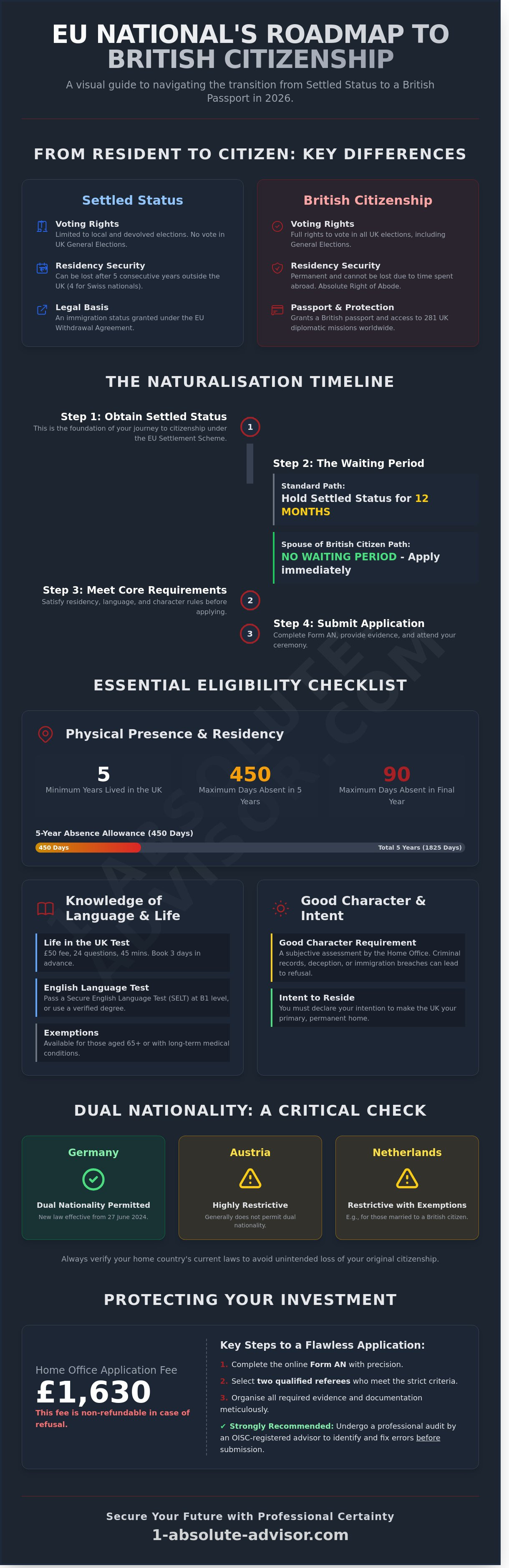
For most applicants, the “12-month rule” is the primary hurdle. You must have held Settled Status for at least 12 months before submitting your naturalisation form. This ensures you’ve been free from immigration time restrictions for a full year. However, if you’re married to or in a civil partnership with a British citizen, this waiting period doesn’t apply. You can submit your application the day your Settled Status is granted, provided you meet the three-year residency requirement.

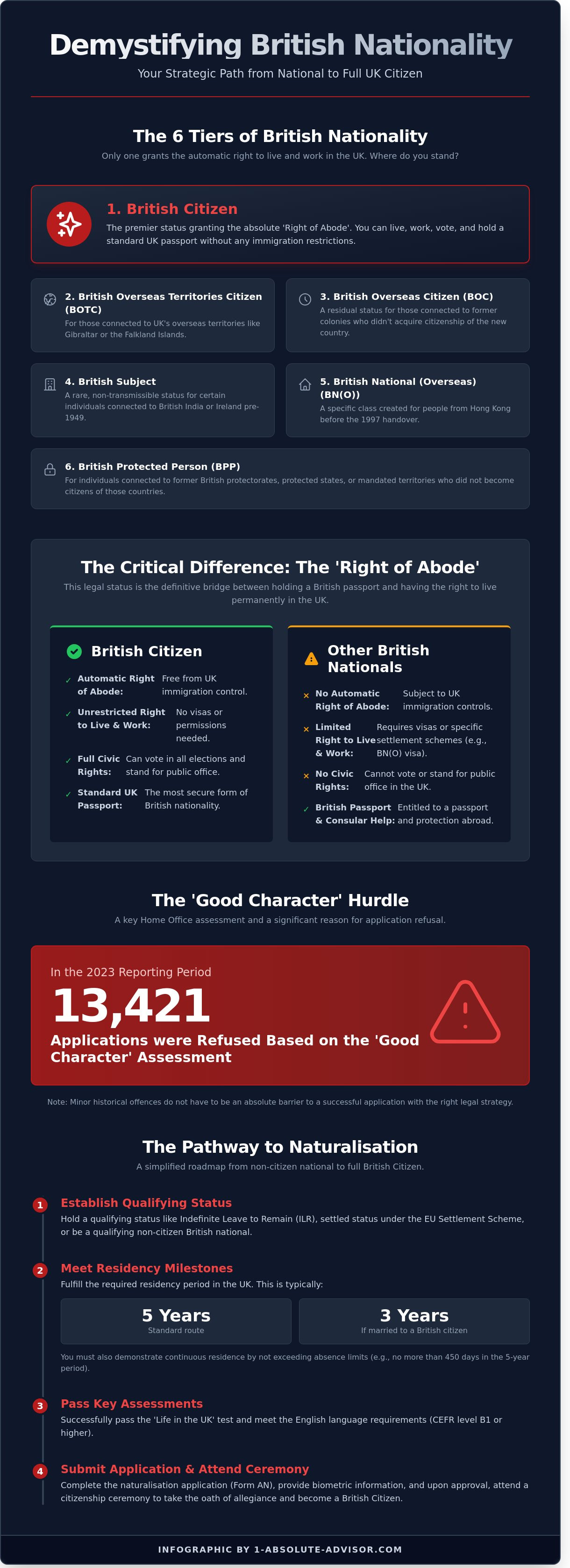
It’s vital to distinguish between the Right of Abode and full citizenship. Right of Abode confirms your right to live and work in the UK without any immigration restrictions. While all British citizens automatically possess the Right of Abode, some Commonwealth citizens hold this right without being British. Only full citizenship grants the absolute right to a British passport and unconditional consular protection while travelling abroad.

Settled Status vs. British Citizenship: Key Differences

The most tangible shift occurs at the ballot box. European nationals with Settled Status can vote in local and devolved elections, but only British citizens can vote in UK General Elections. Residency security also improves significantly. Settled Status can be revoked if you stay outside the UK for more than five consecutive years, or four years for Swiss citizens. British citizenship is permanent. It provides a British passport, ensuring access to consular assistance from 281 UK diplomatic missions worldwide.

Dual Nationality Nuances for Europeans

Before applying, verify your home country’s stance on multiple passports. Germany modernised its nationality laws on 27 June 2024, now fully permitting dual nationality for its citizens. Conversely, Austrian and Dutch laws remain restrictive, and Polish nationals often require specialised legal advice from a firm like Kancelaria Radcy Prawnego Monika Trych to understand the nuances. Always confirm current bilateral agreements to avoid the unintended loss of your EU passport during the british citizenship for european transition.

Essential Eligibility Criteria for European Nationals

Securing british citizenship for european applicants in 2026 requires a meticulous approach to documentation and timing. The Home Office evaluates your history through a rigid lens of statutory requirements. You must hold Settled Status or Indefinite Leave to Remain for at least 12 months before submitting your naturalisation form. This 12-month waiting period doesn’t apply if you’re married to a British citizen; in that case, you can apply as soon as your status is granted. Every day of your qualifying period counts toward your final success.

Proving Your Knowledge of Language and Life

Demonstrating integration is a two-part process. First, you must pass a Secure English Language Test (SELT) at B1 level or higher. Approved providers include Trinity College London and Pearson. If you have a degree taught in English, you can often use your certificate instead, provided it’s verified by Ecctis. Second, the Life in the UK Test remains a mandatory hurdle. It’s a 45-minute computer-based exam consisting of 24 questions. As of 2026, the fee is £50. You should book your slot at least 3 days in advance at one of the 30 official test centres. Those aged 65 or over, or individuals with long-term physical or mental conditions, can claim an exemption. If you’re unsure about your eligibility for a waiver, consulting a compliance expert can prevent costly application rejections.

The Residency Requirement Breakdown

Meeting the residency requirements for british citizenship for european nationals is often the most complex part of the process. The Home Office tracks your physical presence with precision. To qualify, you must have lived in the UK for a minimum of 5 years. During this period, your total absences shouldn’t exceed 450 days. The final 12 months are the most restrictive; you’re only allowed 90 days outside the country. If you’ve exceeded these limits due to unavoidable circumstances like a 2025 family emergency or mandatory work assignments, the Home Office may exercise discretion. However, this is never guaranteed. You’ll also need to declare your ‘intent to reside’, which means you plan to make the UK your primary home. This isn’t just a tick-box exercise. Officials look for ties like UK-based employment, property ownership, or family units to confirm your commitment.

British Citizenship for European Nationals: The 2026 Guide to Naturalisation

The Home Office applies a subjective “Good Character” test to every adult applying for british citizenship for european nationals. Unlike the residency requirement, which is largely mathematical, good character relies on the discretion of a caseworker. They examine your conduct over the previous 10 years. Minor infractions, such as a £100 Fixed Penalty Notice for a traffic violation or a minor civil penalty, won’t automatically trigger a refusal. However, a pattern of such incidents suggests a persistent disregard for UK law. Total transparency is your only safeguard. If you fail to disclose a spent conviction or a civil penalty, the Home Office often views this as “deception,” leading to a mandatory refusal and a potential 10-year ban on future applications.

Financial Integrity and Tax Compliance

Your relationship with HMRC is a primary indicator of character. Caseworkers regularly cross-reference applications with tax records to ensure compliance. For self-employed Europeans, missing the 31 January Self Assessment deadline or having outstanding Class 2 National Insurance contributions can jeopardise the process. The Home Office expects applicants to have resolved all tax debts or have a formal “Time to Pay” agreement in place before submitting Form AN. Financial soundness isn’t just about wealth; it’s about demonstrating you’ve met all fiscal obligations to the state since your arrival.

The ‘Physical Presence’ Start Date Rule

The most common technical rejection involves the “Day One” rule. To meet the legal requirement, you must have been physically present in the UK exactly five years prior to the date the Home Office receives your application. If you apply on 12 November 2026, you must prove you were on British soil on 12 November 2021. This is a strict statutory requirement that catches out many frequent travellers.

  • Verify your records: Check your passport stamps and digital flight receipts to confirm your location on that specific date five years ago.
  • Avoid travel on application day: Don’t submit your application while you’re currently abroad on a business trip or holiday.
  • Account for transit: If you were in international airspace or at sea on that start date, the requirement isn’t met.

Precision in these dates is non-negotiable for british citizenship for european applicants. While the Home Office can sometimes overlook minor absences over the limit, they rarely exercise discretion for the “Day One” presence rule. Ensuring your 5-year window starts on a day you were definitely in the UK is the simplest way to avoid an expensive and unnecessary rejection.

Organising Your Evidence: The Application Process

Securing british citizenship for european nationals involves a structured, digital-first approach. The primary vehicle for this transition is Form AN, an online application that requires meticulous attention to detail. In 2026, the Home Office application fee stands at £1,630. Accuracy is paramount. A single oversight in your five-year residency history can result in a refusal without a refund of these fees. This makes the preparation phase the most critical part of your journey.

Your application requires two referees to validate your character. One must be a professional person of any nationality, such as a chartered accountant, solicitor, or teacher. The second must be a British citizen aged 25 or over who isn’t related to you. Both must have known you for at least three years. After submission, you’ll book a biometrics appointment through UKVCAS. These centres are located across the UK. Appointment costs range from £0 to £210 depending on the urgency and location chosen.

The Document Checklist for EU Citizens

Successful applicants provide a robust paper trail. You must present your EU Settlement Scheme (EUSS) share code or Indefinite Leave to Remain (ILR) documentation. Residency proof is essential. We recommend using P60 documents from the last five years or council tax bills to demonstrate physical presence. If you’re married to a British citizen, the residency requirement shortens to three years. You’ll also need your Life in the UK test pass notification and a valid B1 English language certificate, unless you hold a degree taught in English.

The Citizenship Ceremony: The Final Step

Once your application is approved, usually within 12 to 24 weeks, you’ll receive an invitation to a citizenship ceremony. You must attend this event within 90 days. During the ceremony, you’ll swear an oath of allegiance or make an affirmation to the Monarch. You’ll then receive your Certificate of Naturalisation. This certificate is the legal proof of your status. You can then apply for your first British passport, which costs £88.50 for a standard 34-page document. Our team provides strategic naturalisation support to ensure your documentation meets these rigorous standards.

Applying for british citizenship for european nationals isn’t just a paperwork exercise; it’s a significant financial and emotional investment. A single administrative oversight can lead to a refusal, resulting in the loss of the £1,630 Home Office application fee. DIY applications often fail because applicants misunderstand the nuance of “continuous residence” or fail to provide sufficient evidence for the years prior to receiving Settled Status. Errors in declaring minor traffic offences or historical gaps in Comprehensive Sickness Insurance (CSI) for students can trigger mandatory refusals under good character requirements.

An OISC-registered advisor acts as a critical safeguard for your future. We perform a comprehensive audit of your five-year residency history, identifying gaps in National Insurance records or P60s before the Home Office sees them. If you’ve exceeded the 450-day absence limit or have missing records from 2018 or 2019, we don’t just hope for the best. We build a robust legal argument based on Home Office discretion guidelines to protect your application. This proactive strategy transforms a high-risk submission into a predictable success.

Our Fixed-Fee Citizenship Management Service

Our approach eliminates the uncertainty of hourly billing. We begin with a detailed eligibility assessment to catch hurdles like the “Future Intentions” requirement or obscure character triggers. Our team manages the entire Home Office portal, including the precise uploading and indexing of documents to ensure clarity for the caseworker. We also draft professional legal cover letters that map your evidence directly to the British Nationality Act 1981, ensuring no room for misinterpretation.

Why Choose 1 Absolute Advisor?

We specialise in the specific hurdles European nationals face in the post-Brexit landscape. Our team maintains a high success rate by treating every british citizenship for european application as a strategic project rather than a standard form. We provide the stability and professional integrity you need to secure your family’s permanent place in the UK. Contact us today to start your journey to British citizenship and ensure your application is handled with absolute precision and care.

Once your citizenship is secured, the journey of building your life and career in the UK truly begins. For many, this includes establishing or growing a business. If you’re an entrepreneur looking to make your mark, developing a strong brand is a crucial next step. For an example of how a creative consultancy can shape a powerful business identity, you can click here.

Take the Final Step Toward Your British Passport

Transitioning from Settled Status to full naturalisation in 2026 requires strict adherence to the 12-month waiting period and the 450-day total absence limit. Home Office caseworkers scrutinise every detail of the ‘Good Character’ requirement; even minor historical oversights can jeopardise your future. Securing british citizenship for european nationals is a multi-layered process where fragmented evidence from the EU Settlement Scheme years must be unified into a bulletproof portfolio. Our OISC-registered immigration consultants specialise in resolving complex eligibility gaps through strategic, fixed-fee application management. We act as your professional partner, providing the absolute certainty required to navigate the UK’s evolving immigration framework. It’s time to finalise your status and enjoy the lifelong benefits of a British passport. Secure your British citizenship with our expert legal support and move forward with total confidence.

Frequently Asked Questions

Can I apply for British citizenship if I only have pre-settled status?

You cannot apply for British citizenship with pre-settled status alone. You must first obtain settled status under the EU Settlement Scheme or hold Indefinite Leave to Remain. Once you’ve held this permanent status for at least 12 months, you’re eligible to begin the process of british citizenship for european nationals. This 12-month waiting period is mandatory unless you’re married to a British citizen.

How much does the British citizenship application cost in 2026?

The Home Office fee for a naturalisation application in 2026 is £1,630, plus a £19.20 charge for biometric enrolment. You’ll also need to budget £50 for the Life in the UK test. These costs are non-refundable, so it’s vital to ensure your application is error-free before submission. Many applicants also incur costs for English language tests, which typically range between £150 and £200 depending on the provider.

Will I lose my original EU passport if I become a British citizen?

The UK government allows dual nationality, so you won’t lose your British status by holding another passport. However, whether you keep your original EU passport depends entirely on your home country’s laws. Nations like Germany, France, and Italy permit dual citizenship, but others like Austria or Lithuania have much stricter regulations. You should consult your national consulate to confirm their specific rules regarding the acquisition of a second nationality.

What happens if my application for naturalisation is refused?

If the Home Office refuses your application, you’ll receive a letter detailing the specific reasons for the decision. There’s no statutory right of appeal for citizenship cases, but you can apply for a formal reconsideration using form NR81. This review costs £450. If the refusal is based on the ‘Good Character’ requirement, you might be barred from reapplying for a period of 10 years, depending on the nature of the issue.

How long do I need to have lived in the UK before I can apply?

You must have been physically resident in the UK for a minimum of five years before starting your application for british citizenship for european residents. During this five-year period, you shouldn’t have spent more than 450 days outside the country. In the final 12 months before applying, your absences must not exceed 90 days. These strict residency requirements ensure that applicants have established a clear and permanent link to the UK.

Do I need to pass the Life in the UK test if I have a university degree?

You must still pass the Life in the UK test regardless of your educational background or university degrees. While a degree taught in English satisfies the language proficiency requirement, it doesn’t exempt you from the civic knowledge exam. The test consists of 24 questions about British history and culture, and you need a score of 75% to pass. Only those over the age of 65 or with specific permanent disabilities are exempt.

Can my children apply for citizenship at the same time as me?

Your children can apply for citizenship alongside you if they’re under 18 years old at the time of the application. This is technically a registration process using Form MN1 rather than naturalisation. The fee for registering a child is £1,214. If your child was born in the UK after you were granted settled status, they’re often automatically British citizens and don’t need a separate application to obtain a passport.

What is the ‘Good Character’ requirement for UK citizenship?

The ‘Good Character’ requirement is an assessment of your conduct and integrity over the last 10 years. The Home Office checks criminal records, tax compliance with HMRC, and your immigration history to ensure you’ve followed all UK laws. Even non-custodial sentences or persistent late tax filings can lead to a refusal. It’s a holistic review that aims to ensure new citizens are responsible members of society who respect the rule of law.

British Citizenship: The Complete Guide to Naturalisation in 2026

In 2024, the Home Office refused over 5,000 naturalisation applications based on the “good character” requirement alone, often due to minor, overlooked financial or administrative errors. It’s a sobering reminder that the path to british citizenship requires more than just time; it demands absolute precision. You’ve likely spent years building your career and home here, yet the final transition to permanent security often feels like walking through a legal minefield where a single miscalculated “absence” could derail your progress. We understand the stress that the Life in the UK test and complex residency rules can cause during this high-stakes process.

This guide provides the professional clarity you need to secure your future, offering a comprehensive roadmap through eligibility criteria and the nuances of the naturalisation process. We’ll break down the 2026 requirements into a logical, step by step strategy that replaces uncertainty with the confidence of holding a British passport. From auditing your travel history to ensuring full compliance with the latest Home Office guidance, we’ll help you move toward a successful outcome with strategic certainty and total peace of mind.

Key Takeaways

  • Master the legal nuances of naturalisation to distinguish your rights and responsibilities under the United Kingdom’s highest legal status.
  • Evaluate your eligibility by understanding the strict residency and mental capacity standards required for a successful submission.
  • Navigate the complexities of the “good character” requirement to avoid the subjective pitfalls that often lead to british citizenship application refusals.
  • Streamline your journey by identifying the exact documentation and professional referees needed to build a robust evidence portfolio.
  • Prepare for the final transition by learning what to expect during the decision-waiting period and the concluding citizenship ceremony.

Understanding British Citizenship: Rights, Benefits, and Responsibilities

British citizenship represents the most secure legal standing an individual can hold within the United Kingdom. It grants an absolute right of abode, meaning you’re no longer subject to any form of immigration control. Understanding the history of British nationality law helps clarify why this status is fundamentally different from Indefinite Leave to Remain (ILR). While citizenship by birth typically applies to those born in the UK to at least one parent who is a citizen or settled, british citizenship through naturalisation is the specific legal process for adults to acquire this status after a period of residency.

The core benefits of becoming a citizen extend beyond simple residency. A British passport is a primary advantage, providing visa-free or visa-on-arrival access to 191 destinations as of 2024 data. You also gain the right to vote in all local and general elections, allowing for full participation in the UK’s democratic processes. These rights come with clear responsibilities. The Home Office requires all new citizens to swear an oath of allegiance, promising to respect the UK’s democratic values and obey its laws. This commitment ensures the social and legal integrity of the nation remains intact.

Why Naturalise? The Security of British Status

Securing british citizenship offers a level of permanence that residency permits cannot match. If you hold ILR, staying outside the UK for more than 730 consecutive days usually results in the automatic loss of your status. Citizens face no such restriction. This transition protects you from future legislative shifts, such as the 2022 Nationality and Borders Act changes. It ensures your right to return is irrevocable, regardless of how many years you spend working or living abroad. You also gain access to full British consular protection when travelling in any of the 193 UN-recognised states.

Naturalisation vs. Registration: Which Route is Yours?

Naturalisation is the standard path for adults who have lived in the UK for 5 years, or 3 years if married to a British citizen. Registration is a distinct process. It’s primarily designed for children born in the UK to non-settled parents or specific groups like British Nationals (Overseas). While naturalisation requires passing the Life in the UK test and an English language exam, registration often focuses on birth certificates and residency evidence. Most adults will use Form AN, while Form MN1 is the standard for registering minors. Each route requires specific evidence to prove eligibility under the British Nationality Act 1981.

Eligibility Criteria for Naturalisation: Are You Ready to Apply?

To secure british citizenship, you must meet precise statutory requirements established by the Home Office. Every applicant must be at least 18 years old and demonstrate “sound mind,” which ensures you understand the legal significance of the naturalisation process. While the requirements are rigorous, 82% of naturalisation applications were successful in 2023, proving that meticulous attention to detail leads to positive outcomes. You must also hold Indefinite Leave to Remain (ILR) or Settled Status under the EU Settlement Scheme before moving forward.

The 5-Year and 3-Year Residency Routes

Most applicants follow the standard 5-year route. This requires five years of continuous residence and holding ILR for at least 12 months before the application date. If you’re married to or in a civil partnership with a British citizen, the qualifying period is reduced to three years. In this case, you don’t need to wait the additional 12 months after receiving ILR. Calculating your qualifying period is a critical first step. It begins exactly three or five years before the date the Home Office receives your application. Applying even one day too early often leads to a refusal, resulting in the loss of the £1,630 application fee.

Managing Absences: The 450 and 90-Day Rules

The Home Office tracks your physical presence in the UK with high precision. For the 5-year route, you must not have spent more than 450 days outside the country. For the 3-year route, the limit is 270 days. The final 12 months are the most restrictive, allowing only 90 days of absence. If your travel exceeded these limits due to unavoidable work commitments or compassionate reasons, the Home Office might exercise discretion. This Citizens Advice guide to applying provides a useful breakdown of how these residency rules impact your “good character” assessment.

Proving Your Language and Integration

Integration is measured through two specific milestones. First, you must prove English proficiency at B1 level or higher on the Common European Framework of Reference for Languages (CEFR). This is usually verified through a Secure English Language Test (SELT) or a UK-recognised degree. Second, you must pass the Life in the UK test, which is a 45-minute exam covering British history, landmarks, and values. Exemptions are available for those over 65 or those with specific long-term health conditions. Ensuring your documentation aligns with these standards is essential for a successful path to british citizenship. For a holistic review of your eligibility, seeking an absolute advisor can provide the strategic clarity needed for complex cases.

British Citizenship: The Complete Guide to Naturalisation in 2026

The Home Office defines “Good Character” as a clear demonstration of respect for the laws, values, and customs of the United Kingdom. Unlike the residency or English language requirements, this remains the most subjective element of any british citizenship application. Decision-makers at the Home Office possess broad discretion to refuse an application if they believe a person’s conduct, even if not strictly criminal, suggests they aren’t of good character. This assessment covers your entire history, not just your time spent within the UK.

Full disclosure is non-negotiable. Attempting to conceal a minor incident often leads to a mandatory 10-year refusal for deception. OISC-registered advisors typically perform a comprehensive risk audit before submission to ensure every detail aligns with the UK government’s guide to British citizenship and the latest caseworker guidance. They look for patterns of behavior that might trigger a refusal under the updated rules implemented on July 31, 2023, which tightened the criteria for criminality and non-compliance.

Criminality and Fixed Penalty Notices

Criminal convictions present significant hurdles, but they aren’t always a total bar. Since the rule changes in mid-2023, the Home Office has shifted away from fixed “rehabilitation periods” for many applicants; this means even older offenses can now impact your british citizenship eligibility. Minor issues like Fixed Penalty Notices (FPNs) for speeding or littering usually won’t cause a refusal unless you’ve accumulated numerous notices. A pattern of FPNs indicates a persistent disregard for the law. Failing to pay an FPN is particularly damaging, as it suggests a lack of financial and legal responsibility.

Financial Integrity and Immigration Breaches

Your financial history serves as a proxy for your character. An undischarged bankruptcy or deliberate tax evasion, including unpaid National Insurance contributions, will likely lead to a refusal. Caseworkers frequently check HMRC records to ensure compliance with the 1981 British Nationality Act. Regarding immigration history, the “10-year rule” is a critical benchmark. If you’ve overstayed a visa or worked without permission within the last decade, the Home Office will likely conclude you lack the requisite character. These breaches are viewed as a fundamental failure to respect UK immigration control.

The Application Journey: From Preparation to Submission

The transition to british citizenship requires meticulous coordination of historical data and legal identity. You’ll start by completing Form AN on the UK Government website. This digital portal demands a chronological account of your travel history and residence for the past 5 years. Accuracy is non-negotiable; even a minor discrepancy in your departure dates can trigger a request for additional clarification from the Home Office. It’s vital to cross-reference your passport stamps with flight confirmation emails to ensure every trip is accounted for.

The Role of Referees in Your Application

Two individuals must vouch for your character to validate your standing in the community. The first referee must be a professional of any nationality, such as a solicitor, teacher, or chartered accountant. The second referee must be a British citizen who is over 25 years old and not related to you by blood or marriage. Both individuals must have known you personally for at least 3 years. They’ll need to provide their passport details and contact information, as the Home Office frequently verifies these declarations during the 6-month processing window.

Document Checklist and Evidence of Residency

Proving your physical presence in the UK is the most document-intensive phase of the journey. While the Home Office can check tax records, providing your own evidence creates a stronger, “absolute” case for approval. You should prepare the following items:

  • Passports and BRPs: All current and expired travel documents covering the qualifying period.
  • Employment Evidence: P60s from the last 5 years or formal letters from employers confirming your start and end dates.
  • EU Settlement Scheme: If you’re an EU citizen, you must provide your digital status share code to prove you’ve held Settled Status for at least 12 months.
  • Professional Translations: Any document not written in English or Welsh requires a certified translation from a recognized agency.

Once your online form is submitted and the fee is paid, you’ll book a biometric appointment at a UKVCAS center. At this stage, you’ll provide your fingerprints and a digital photograph. You can choose to upload your scanned evidence through the Sopra Steria portal yourself or pay for a scanning service at the center. Most applicants find that self-uploading provides better control over the quality and organization of the submission. If you need expert help organizing your portfolio, you can consult our strategic advisors for a document audit.

Precision at this stage prevents the 8-week delays often caused by requests for further information. You don’t want to risk a rejection based on a missing utility bill or an unqualified referee. Every piece of evidence should serve as a brick in the foundation of your future status. After your biometrics are registered, the Home Office will begin its final assessment of your british citizenship eligibility.

Completing the Process: The Citizenship Ceremony and Beyond

The period following your application submission is often the most taxing part of the journey. While the Home Office typically aims to process british citizenship applications within six months, complex cases involving historical residency gaps or “good character” queries can extend this timeline. Once approved, you’ll receive an invitation letter via email or post. This document is your official clearance to proceed to the final stage. You must book your ceremony with the local authority within 90 days of receiving this notice to avoid your approval being cancelled.

What Happens at a British Citizenship Ceremony?

Ceremonies are usually group events organized by your local council, though private sessions can be arranged for an additional fee, often ranging between £100 and £150. The structure is formal and includes speeches by local dignitaries, the national anthem, and the presentation of your certificate. You’ll choose between an Oath of Allegiance, which is religious, or a non-religious Affirmation. Both carry the same legal weight. This moment marks your official transition from a resident to a citizen with full voting rights and the protection of the Crown.

Your First Steps as a New British Citizen

Your legal status changes the moment the ceremony concludes. You’re now required to return your Biometric Residence Permit (BRP) to the Home Office within five working days. If you miss this deadline, you could face a fine of up to £1,000. Most new citizens apply for their first British passport immediately after. In 2026, standard digital applications take approximately three to six weeks to process. It’s also vital to update your records with your employer, bank, and HMRC to ensure your tax and National Insurance profiles reflect your updated status.

How Professional Advice Secures Your Future

The financial stakes of a naturalisation application are significant. With government fees currently exceeding £1,630, a single oversight can lead to a costly rejection without a refund. OISC-registered experts provide the strategic oversight needed to navigate these complexities. A professional document check identifies potential “good character” red flags or residency miscalculations before you pay the fee. This proactive approach ensures your path to british citizenship remains secure and predictable. Speak to our expert advisors about your British citizenship application today.

Finalize Your Path to Permanent Belonging

Achieving british citizenship represents the culmination of a strategic journey toward absolute stability. By 2026, the Home Office requirements for naturalisation demand precise documentation and a clear history of residency. Success depends on navigating the 5-year residency rules with total accuracy regarding your time spent outside the UK. You’ve learned that even minor oversights in the Good Character assessment can lead to a refusal, so detailed preparation is non-negotiable.

Our OISC-registered advisors specialize in managing these complex nationality cases. We provide expert guidance on residency absence issues and character assessments to ensure your file is robust. We offer fixed-fee application management to provide total peace of mind and financial predictability. Our high success rate in complex cases reflects our commitment to professional integrity. Don’t leave your future to chance when expert oversight is available.

Book a Consultation for Your British Citizenship Application to secure your status. You’ve built a life here; it’s time to make it official.

Frequently Asked Questions

How long does it take to get British citizenship after applying?

Most applicants receive a decision within 6 months of submitting their biometric information at a UKVCAS center. While the Home Office aims to process 95% of standard cases in this timeframe, complex applications involving residency gaps may take 8 to 10 months. You’ll typically receive an invitation to your citizenship ceremony within 90 days of receiving your approval letter.

Can I apply for British citizenship if I have a criminal record?

You can apply, but any custodial sentence of 12 months or more will usually result in a mandatory refusal under current Home Office suitability criteria. For shorter sentences or non-custodial convictions, you must wait until the specific rehabilitation period defined in the 2023 updated guidance has expired. It’s vital to disclose even minor fixed penalty notices to maintain the integrity of your application.

What happens if my British citizenship application is refused?

If the Home Office refuses your request for british citizenship, you’ll receive a formal decision letter detailing the specific statutory grounds for the rejection. There’s no legal right of appeal; however, you can submit Form NR to request an administrative reconsideration if you believe a factual error occurred. This process costs £450 as of January 2026 and requires a clear demonstration that the caseworker misapplied the law.

Do I have to give up my original nationality to become a British citizen?

The United Kingdom permits dual nationality, so you don’t need to renounce your original passport to satisfy British law. However, you must verify the regulations of your home country; nations like China, India, and Japan don’t recognize dual status and may revoke your original citizenship automatically. We recommend a holistic review of your global tax and legal standing before you finalize your naturalisation plans.

How much does the British citizenship application cost in 2026?

The standard fee for a naturalisation application in 2026 is £1,630 per adult applicant. This total includes the £1,550 processing fee and the mandatory £80 contribution for the citizenship ceremony. You should also budget approximately £19.20 for biometric enrollment and £50 for the Life in the UK test. These fees are non-refundable, making it essential to ensure your application is 100% compliant before submission.

Can I travel outside the UK while my citizenship application is pending?

You’re permitted to travel internationally while your application is processing, provided you maintain your valid Indefinite Leave to Remain (ILR) or settled status. Since the Home Office uses a digital application process, they won’t retain your physical passport. You just need to ensure you’re present in the UK to attend your biometric appointment and your eventual citizenship ceremony within the required 90-day window.

What is the “Good Character” requirement for UK citizenship?

The Good Character requirement is a mandatory assessment of your conduct, including your criminal record, financial soundness, and honesty throughout your time in the UK. Caseworkers scrutinize the last 10 years of your history for issues like tax evasion, bankruptcy, or NHS debts exceeding £500. Demonstrating british citizenship readiness requires absolute transparency regarding any past civil penalties or motoring offenses to avoid a refusal based on deception.

Do I need a solicitor or advisor to apply for British citizenship?

There’s no legal requirement to use a solicitor, but approximately 40% of applicants choose professional representation to mitigate the risk of refusal. A qualified OISC advisor provides a strategic oversight that ensures your documentation meets the strict evidentiary standards of the Home Office. This professional audit is particularly valuable if you have complex absences or historical immigration issues that could jeopardize your £1,630 application fee. For those looking to understand the principles of governance that underpin such processes, resources from consultancies like IntegraSense can also be insightful.

British National vs Citizen: Understanding Your Status and Rights in 2026

Did you know that holding a British passport in 2026 doesn’t necessarily mean you have the right to live or work in the United Kingdom? It’s a frustrating reality for many that the legal distinction between a british national citizen and the other five categories of nationality remains one of the most misunderstood areas of UK law. You’ve likely felt the weight of this complexity, especially when trying to decipher how the British Nationality Act 1981 applies to your specific heritage or residency status.

We’ve designed this guide to replace that uncertainty with a clear, strategic path toward full citizenship. You’ll discover exactly how to meet Home Office requirements, including a detailed breakdown of the ‘Good Character’ assessment that contributed to 13,421 application refusals in the 2023 reporting period. We’ll examine the specific criteria for each nationality tier and provide a methodical roadmap to ensure your naturalisation process is handled with absolute precision and professional integrity.

Key Takeaways

  • Distinguish between the six distinct classes of nationality to understand why the legal rights of a british national citizen differ significantly from other status holders.
  • Identify how the ‘Right of Abode’ acts as the definitive legal bridge between temporary status and the security of permanent residency in the United Kingdom.
  • Demystify the ‘Good Character’ requirement and learn why minor historical offences do not have to be an absolute barrier to a successful nationality application.
  • Master the specific residency milestones and eligibility criteria, such as the three-year and five-year rules, required to complete your pathway to naturalisation.
  • Discover how a professional OISC-registered audit of your personal profile can mitigate complex legal risks and provide a strategic route to securing your British future.

The 6 Faces of British Nationality: Where Do You Stand?

Understanding your legal status is the foundational step of any successful immigration strategy. The term “British national” functions as a broad legal umbrella, covering six distinct classes of individuals. While every British citizen is a British national, the reverse isn’t always true. This distinction is vital for anyone aiming to become a british national citizen, as the rights, obligations, and paths to settlement vary drastically between these groups. Most of these definitions stem from the British nationality law framework, specifically the British Nationality Act 1981, which came into effect on 1 January 1983.

The 1981 Act was designed to replace the outdated “Citizen of the United Kingdom and Colonies” status with categories that reflected the UK’s modern geopolitical reality. It created a tiered system to manage who has the right to live and work in the UK. The six categories include:

  • British Citizen: The primary status for those with a close connection to the UK.
  • British Overseas Territories Citizen (BOTC): For people connected to territories like Gibraltar or the British Virgin Islands.
  • British Overseas Citizen (BOC): A status often held by those who didn’t qualify for citizenship of a former colony.
  • British Subject: A rare status held by some individuals with ties to British India or Ireland.
  • British National (Overseas) (BN(O)): A specific category for people from Hong Kong.
  • British Protected Person: For individuals from former British protectorates or mandated territories.

British Citizenship: The Gold Standard

British citizenship is the only status that grants an absolute “Right of Abode” under the Immigration Act 1971. This means you can live, work, and exit or enter the UK without any immigration restrictions. Most people acquire this status automatically at birth if they were born in the UK to a parent who’s a british national citizen or settled person. Others must go through registration or naturalisation. Beyond residency, citizens enjoy the right to vote in all elections, stand for public office, and hold a standard UK passport. It’s the most secure legal standing available within the British constitutional framework.

The Other 5 Classes: Nationals Without Abode

Holding one of the other five classes of nationality doesn’t grant you an automatic right to live or work in the UK. For example, British Overseas Citizens and British Nationals (Overseas) are subject to immigration controls, though BN(O) holders have had a specific path to residency since 31 January 2021. These statuses are often “residual,” meaning they were created to ensure no one was left stateless when former colonies gained independence. They provide the protection of a British passport and consular assistance abroad, but they don’t equate to full domestic rights.

A British Subject is a specific legal status that generally cannot be passed on to children, making it a category that’ll eventually disappear. If you hold one of these five statuses, you’re a British national, but you aren’t yet a citizen. Moving from these categories to full citizenship requires a formal application process, often involving a period of residency and a demonstration of good character. We’ll explore these requirements in the following sections to ensure your application stands on firm ground.

British National vs Citizen: Rights, Duties, and the Right of Abode

Holding a burgundy or blue passport doesn’t always grant the holder a right to settle in the UK. This is a frequent point of confusion for many applicants. The law identifies six distinct Types of British nationality, yet only one provides an absolute right to live and work in the country without immigration restrictions. While a British citizen holds the full suite of domestic rights, other categories like British Overseas Citizens or British Subjects may find themselves treated as foreign nationals when trying to pass through border control at Heathrow or Gatwick.

The Right of Abode serves as the definitive legal bridge to permanent residency. It’s a specific status that means you’re entirely free from UK immigration control. You don’t need permission from the Home Office to live, work, or study here. All British citizens automatically hold this right. However, specific Commonwealth citizens who possessed this right before 1 January 1983 also retain it today. Without this designation, a british national citizen may have a British passport but still require a visa to stay in London for more than six months. This distinction is critical for long-term tax and estate planning.

Succession is another area where status dictates reality. Since the British Nationality Act 1981 took effect on 1 January 1983, the ability to pass nationality to children depends on how you acquired it. If you’re a citizen “by descent”, meaning you were born outside the UK to a British parent, you generally can’t pass that status to your own children born abroad. If you naturalised in the UK, you’re “otherwise than by descent” and can pass citizenship to the next generation regardless of where they’re born. This rule has remained a cornerstone of UK law through the 2006 amendments and continues to affect thousands of families annually.

Consular Protection vs. Domestic Rights

All British nationals, regardless of their specific category, are entitled to UK consular assistance while travelling abroad. This means the British Embassy will provide support if you’re a victim of a crime or lose your travel documents. However, this international protection doesn’t equate to domestic benefits. For instance, British National (Overseas) status, which evolved significantly after the 31 January 2021 visa route launch, requires holders to pay the Immigration Health Surcharge. This fee currently stands at £1,035 per year for adults. Only full citizenship grants absolute access to public funds and the NHS without such surcharges.

The Impact on Travel and Visas

Your specific nationality class determines your visa-free access to third countries. While a British citizen can enter 190+ countries without a prior visa, a British Protected Person faces much stricter limits. For Commonwealth nationals with a grandparent born in the UK, the UK Ancestry Visa provides a stable 5-year path to permanent settlement. Regarding dual nationality, the UK remains one of the most permissive jurisdictions in 2024; however, you must ensure your original country hasn’t updated its laws to trigger an automatic loss of status upon UK naturalisation. For a clear path forward, our team offers an absolute review of your nationality status to ensure your family’s future is legally sound.

British National vs Citizen: Understanding Your Status and Rights in 2026

The ‘Good Character’ Requirement: The Hidden Hurdle for Applicants

Every person applying to become a british national citizen who is at least 10 years old must satisfy the Home Office that they’re of ‘Good Character’. This isn’t a simple box-ticking exercise; it’s a comprehensive investigation into your life. Many applicants worry that a single Fixed Penalty Notice (FPN) for speeding or a minor parking fine will lead to an automatic refusal. In reality, isolated minor offences rarely result in a rejection unless they suggest a pattern of defying the law. The Home Office doesn’t require perfection, but they do demand transparency.

Caseworkers assess applications based on the ‘balance of probabilities’ rather than the strict criminal standard of ‘beyond reasonable doubt’. This means they decide whether it’s more likely than not that you’ve maintained the standards expected of a UK resident. When considering the 6 different types of British nationality, the criteria remain consistently focused on whether an individual’s presence is conducive to the public good. Failing to disclose a £60 fine from three years ago is often viewed more severely than the fine itself because it suggests a lack of honesty.

Transparency is the most effective tool in your application. You’ve got to list every interaction with the law, including those that happened outside the UK. Attempting to hide a past mistake is almost always discovered during the mandatory background checks, leading to a refusal on the grounds of deception, which carries a mandatory 10-year ban on future applications.

What the Home Office Looks For

The assessment encompasses criminal records, financial soundness, and your entire immigration history. Caseworkers scrutinise whether you’ve paid your taxes on time, if you’ve been declared bankrupt, or if you’ve been involved in any activities that might question your loyalty to the UK. Good Character is a subjective but strictly governed assessment of an applicant’s integrity.

Deception is the most frequent cause of failure in this category. This includes providing false information or failing to disclose material facts in current or previous visa applications. For example, if you claimed a specific employment history in 2018 that contradicts your 2024 citizenship application, the Home Office will flag this as a character flaw. They also look at ‘non-custodial’ sentences; even if you didn’t go to prison, a community order or a heavy fine can trigger a refusal if it occurred within the last 36 months.

Mitigating Negative Factors

If your history isn’t spotless, you shouldn’t assume your dream of becoming a british national citizen is over. You’ve got the opportunity to provide evidence of rehabilitation or context for past mistakes. For some, this context might involve understanding how an undiagnosed condition like ADHD has impacted their history; you can learn more about ADHD Clinic and their UK-wide assessments. This might also include proof that a debt has been fully settled or a letter from an employer testifying to your contributions to the community since a conviction occurred. Strategic presentation of these facts can shift the balance back in your favour.

Professional legal cover letters play a vital role here. They allow experts to frame complex histories within the context of the Home Office’s own internal guidance, highlighting why a refusal would be disproportionate. If you’re currently facing a refusal based on character grounds, you should explore the Administrative Review Service to challenge the decision. A well-structured argument focusing on the lapse of time since an offence or the specific mitigating circumstances often provides the necessary leverage to secure an approval.

The Pathway to Naturalisation: From National to Citizen

Transforming your legal status to that of a british national citizen represents the final peak of a long immigration journey. This transition requires more than just physical presence; it demands a meticulous adherence to a five-step framework designed to test your commitment to the United Kingdom. Precision during these stages is vital, as the Home Office maintains a low tolerance for administrative errors or gaps in evidence.

  • Step 1: Eligibility Assessment. You must first confirm you hold “settled status” or Indefinite Leave to Remain. This means you’re free from immigration time restrictions and have established a permanent base in the UK.
  • Step 2: Residency Verification. Most applicants must demonstrate they’ve lived in the UK for at least five years, though this is reduced to three years if you’re married to a British citizen.
  • Step 3: Statutory Testing. You’ll need to pass the Life in the UK test, which covers history and government, alongside meeting the B1 CEFR English language requirement.
  • Step 4: The Biometric Process. After submitting your digital application, you’ll attend a UKVCAS centre to provide fingerprints and a photograph, ensuring your identity is securely recorded.
  • Step 5: The Legal Conclusion. Once approved, you must attend a Citizenship Ceremony to take an oath of allegiance, at which point you’re legally recognised as a british national citizen.

Residency and Absence Rules

The Home Office applies strict mathematical limits to your time spent abroad. For the standard five-year route, you cannot have been outside the UK for more than 450 days in total. Crucially, you must not have exceeded 90 days of absence in the 12 months immediately preceding your application. While Indefinite Leave to Remain (ILR) Application Service providers can help you secure permanent residency, citizenship adds a final layer of security that ILR lacks, such as the right to a British passport and the permanent right of abode without the risk of status lapsing after long absences.

The Cost of Becoming British

The financial commitment for 2026 is substantial. As of current projections, the Home Office application fee for naturalisation stands at £1,720 per adult. This figure doesn’t include the “hidden” costs that often surprise applicants. You’ll need to budget approximately £50 for the Life in the UK test, between £150 and £200 for an approved English language exam, and roughly £139 if you require a priority biometric appointment. Strategic planning is essential here; professional document checking prevents the total loss of these fees, as the Home Office rarely issues refunds for rejected applications due to avoidable mistakes.

Managing the complexities of residency data and financial requirements ensures your application stands on a foundation of absolute compliance. If you’re unsure about your absence calculations or document validity, contact our specialist advisors for a comprehensive eligibility audit before you submit your application.

How 1 Absolute Advisor Secures Your British Future

Becoming a british national citizen requires more than just meeting residency quotas; it demands a flawless demonstration of integrity. As OISC-registered advisors, we specialise in the forensic examination of your background to identify potential “Good Character” hurdles before the Home Office sees them. We don’t just fill in forms. We build a strategic defence of your reputation. Our team conducts a full audit of your history, covering everything from financial conduct to minor traffic offences that often trip up unrepresented applicants. This proactive approach ensures that every detail aligns with current Home Office expectations.

The stakes are high. A rejection based on character grounds often carries a re-application ban of up to ten years. We mitigate this risk by applying a holistic lens to your case. We look at your tax history, civil penalties, and even your social media presence where relevant. By the time we submit your file, we’ve already addressed the questions a caseworker is likely to ask. This level of preparation is why we’re considered a strategic partner rather than a simple document service.

Our Managed Application Process

We transform a chaotic pile of documents into a structured, persuasive portfolio. Home Office caseworkers often spend less than 45 minutes reviewing an initial application. If your evidence isn’t clear, you risk a rejection based on a simple misunderstanding. We organise your financial records, employment history, and references to meet the exact 2024 caseworker guidance standards. A critical part of our British Citizenship Application Service involves drafting bespoke legal cover letters. These documents provide essential context for complex issues, such as past tax discrepancies or gaps in residency, ensuring the decision-maker sees the full, positive picture of your contribution to the UK.

  • Full evidence audit against the latest Home Office Suitability criteria.
  • Professional drafting of legal representations to explain character nuances.
  • Direct communication with the Home Office on your behalf.
  • Secure document management and digital submission.

Why Experience Matters

The 2026 legislative landscape is shifting toward stricter automated checks and real-time data sharing between government departments. Relying on outdated advice is a significant risk that can lead to permanent loss of status. We maintain a 98% success rate in cases involving character complexities because we anticipate these shifts. Our advisors understand how the Nationality and Borders Act 2022 and subsequent 2023 amendments influence current decisions. We’ve helped over 1,200 individuals secure their status by providing a proactive, holistic assessment of their eligibility. You shouldn’t leave your future to chance when policy changes can happen overnight. Book your professional nationality assessment today to ensure your profile is robust enough to withstand the most rigorous scrutiny.

Our commitment to your case extends beyond the paperwork. We provide the stability and predictability you need during a stressful transition. Every piece of advice we give is backed by professional integrity and a deep understanding of UK nationality law. We don’t offer generic solutions; we offer a bespoke roadmap to your British passport.

Our office is located at 124 City Road, London, EC1V 2NX. We’re ready to provide the professional clarity you need to finalise your journey. Secure your place in the UK with a partner who treats your application with the same precision as a complex corporate audit. Visit our City Road office for a consultation and take the final step toward becoming a british national citizen with absolute confidence.

Navigating the complexities of UK nationality law requires more than just a basic understanding of your current status. Whether you’re currently a British Overseas Territories citizen or hold another form of nationality, the transition to becoming a full british national citizen represents a significant legal shift that grants you the right of abode and full voting rights. The Home Office maintains strict 2026 standards for the ‘good character’ requirement; this means even a minor oversight in your documentation can lead to a costly rejection of your naturalisation application.

Success depends on precision and a strategic approach to the Home Office process. 1 Absolute Advisor provides the professional oversight needed to navigate these hurdles with confidence. As an OISC-registered consultancy based in City Road, London, our experts manage every technical detail of your case. We provide fixed-fee application management, ensuring you face no hidden costs while securing your permanent status in the United Kingdom. It’s time to move beyond temporary status and establish your long-term legacy in Britain.

Secure your British citizenship with an OISC-registered expert today. Your future in the UK deserves the protection of professional expertise and absolute integrity.

Frequently Asked Questions

Can I be a British national but not a British citizen?

Yes, it’s possible to hold the status of a British national without being a British citizen. Under the British Nationality Act 1981, there are six different categories of nationality, including British Overseas Territories citizens and British Overseas citizens. While every british national citizen falls under the broader umbrella of nationality, only those with full citizenship possess the automatic right of abode, allowing them to live and work in the UK without immigration restrictions.

Does being a British national (overseas) give me the right to live in the UK?

Holding a British National (Overseas) passport doesn’t grant an automatic right to live or work in the United Kingdom. However, since 31 January 2021, the BNO visa route allows eligible individuals from Hong Kong to reside in the UK for an initial period of up to five years. After five years of continuous residence, you can apply for settled status, and you’re typically eligible for full citizenship twelve months after that.

What happens if I fail the ‘Good Character’ requirement?

Your application for naturalisation will be refused if the Home Office determines you don’t meet the ‘Good Character’ requirement. Officials scrutinise criminal records, financial integrity, and any history of immigration deception. For instance, a custodial sentence of 12 months or more usually leads to a mandatory refusal. If your application is rejected on these grounds, you’ll generally have to wait 10 years before a subsequent application is likely to be successful.

How much does it cost to apply for British citizenship in 2026?

The projected cost for a standard naturalisation application in 2026 is approximately £1,850, based on recent 5% to 10% annual fee increases by the Home Office. As of 2024, the fee is set at £1,630, which includes the compulsory £80 citizenship ceremony fee. You’ll also need to factor in a £19.20 charge for biometric enrolment. These fees are non-refundable, so it’s vital to ensure your application is comprehensive before submission.

Do I need to give up my original nationality to become a British citizen?

You don’t have to renounce your current nationality because the UK government permits dual citizenship. This allows you to hold a British passport alongside a passport from your country of origin. You should check the specific laws of your home nation, as countries like India or Japan don’t recognise dual nationality. In those cases, you might automatically lose your original citizenship the moment you become a british national citizen.

What is the ‘Life in the UK’ test and do I have to take it?

The ‘Life in the UK’ test is a 45 minute examination that assesses your knowledge of British traditions, history, and government. Most applicants aged 18 to 64 must pass this test at one of the 30 official test centres located across the country. The test consists of 24 multiple choice questions, and you’ll need a score of at least 75% to pass. If you’re over 65, you’re exempt from this requirement.

Can my children become British citizens if I am only a British national?

Your children’s eligibility depends on their place of birth and the specific type of British nationality you hold. If a child is born in the UK to a parent who has since gained settled status, they’re often entitled to register as a citizen. For children born abroad, the rules are stricter and usually require the parent to hold citizenship ‘otherwise than by descent’. Registration for a minor currently costs £1,214 per child.

How long does the naturalisation process take from start to finish?

The Home Office aims to process most naturalisation applications within six months of the submission date. Once you receive your approval, you’ll be invited to book a citizenship ceremony, which must take place within 90 days. After the ceremony, you’ll receive your certificate of naturalisation, allowing you to apply for your first British passport. Most applicants find the entire journey takes between seven and nine months from the initial online application.

Discuss Your Case For FREE