

Dealing with Anxiety About Visa Interviews: A Professional Guide to Calm and Confidence

What if the physical symptoms of your stress, such as a sudden stutter or a racing pulse, aren’t the red flags you fear they are? It’s entirely rational to feel a sense of trepidation when the Home Office is applying such rigorous scrutiny to the “Genuine Student Rule” and skilled worker routes. With student visa grant rates dipping to 85% in late 2025, you might worry that being nervous is a valid reason for refusal. You aren’t alone in fearing that a momentary lapse in memory could be misread as dishonesty by a caseworker.

This professional guide offers a strategic approach to dealing with anxiety about visa interview requirements, transforming your stress into a calm, methodical performance. We’ll provide you with a structured framework to guarantee factual accuracy and share specific techniques to remain composed during repetitive or hostile questioning. By the end of this article, you’ll have the tactical tools needed to approach your appointment with the confidence of a well-prepared professional.

Key Takeaways

  • Learn to distinguish between natural performance anxiety and visa insecurity, normalizing your body’s response to high-stakes legal environments.
  • Understand the “Genuine Intention” test to ensure your verbal testimony aligns seamlessly with the evidence provided in your application.
  • Discover why prioritizing key facts over scripted sentences is the most effective way to demonstrate authenticity to Home Office caseworkers.
  • Implement professional strategies for dealing with anxiety about visa interview day, such as the “Logistical Lock” and the “Pause and Process” technique.
  • Find out how OISC-registered expert oversight and pre-interview coaching can eliminate the uncertainty that fuels most applicant stress.

Understanding Visa Interview Anxiety: Why the Stakes Feel So High

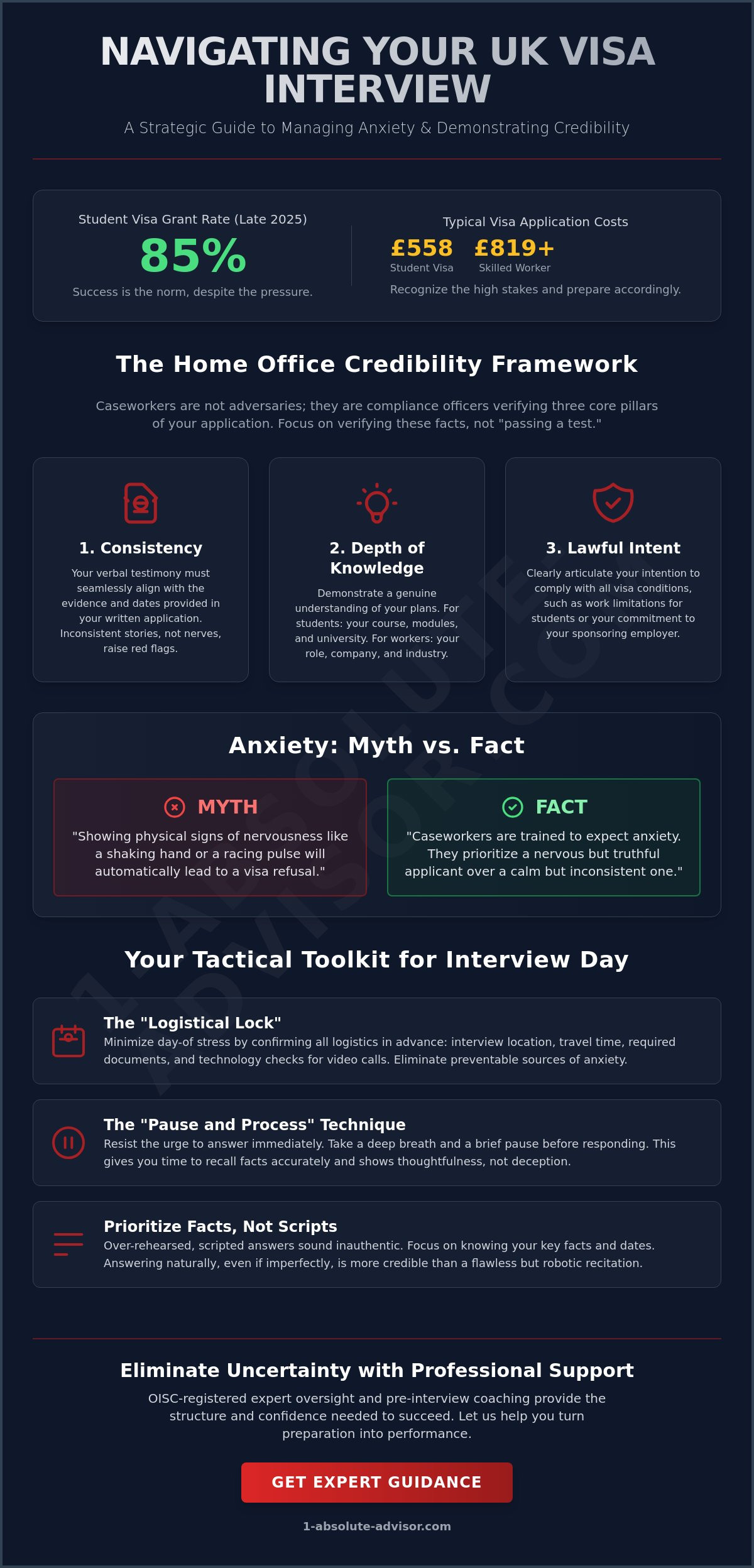
The interview room, whether it’s a physical office in London or a video call from overseas, represents the final hurdle in a long and expensive journey. When you’ve already committed £558 for a Student Visa or upwards of £819 for a Skilled Worker route, the pressure to perform is immense. This isn’t a casual conversation; it’s a formal legal inquiry where the Home Office places the burden of proof entirely on your shoulders. Dealing with anxiety about visa interview sessions starts with recognizing that your body’s “fight or flight” response is a natural reaction to this high-stakes environment.

Many applicants experience a specific form of performance anxiety that stems from the fear of being scrutinized under a microscope. This is distinct from general visa insecurity. While insecurity is a broad fear about your future in the UK, performance anxiety is the immediate dread of “failing” the interaction itself. In the current climate of May 2026, where “Credibility Interviews” are standard for many routes, the Home Office is actively looking for reasons to doubt your intentions. This creates a psychological environment where even the most honest applicant feels like a suspect.

The Science of Stress in a Legal Context

High-pressure questioning triggers a spike in cortisol, the body’s primary stress hormone. This chemical surge can temporarily impair the hippocampus, which is the region of the brain responsible for memory retrieval. This explains why you might “blank” on a specific date or the exact name of a business sponsor despite knowing them perfectly. It’s a biological glitch, not a sign of deception. Recognizing physical signs like a racing pulse or dry mouth as mere biology helps prevent them from escalating into a full panic response during the interview.

Myth-Busting: Does Being Nervous Cause a Visa Refusal?

One of the most persistent fears is that showing nerves will lead to an automatic refusal. This is simply not true. Home Office caseworkers are trained professionals who expect a degree of anxiety from every applicant. They’re taught to distinguish between “nervousness” and “inconsistency.” While a shaking hand is ignored, a story that changes under pressure is a red flag. Dealing with anxiety about visa interview protocols becomes much easier once you accept that a caseworker prefers a nervous, truthful applicant over a calm, scripted one. With student visa grant rates reaching 85% in late 2025, the data shows that the majority of applicants succeed despite their nerves, provided their “paper trail” and verbal testimony align.

The ‘Credibility Interview’ Framework: What the Home Office is Really Assessing

The Home Office doesn’t just want to see your passport. They want to see if your story holds up. In May 2026, the “Genuine Intention” test remains the primary tool used to identify inconsistencies. Dealing with anxiety about visa interview hurdles becomes manageable when you view the caseworker not as an adversary, but as a compliance officer verifying a checklist. They’re looking for three things: consistency with your documents, depth of knowledge about your UK plans, and a clear, lawful intent to follow visa conditions. By understanding this framework, you can shift your focus from “passing a test” to “verifying facts.”

Objectives change depending on your specific route. A Skilled Worker interview focuses on your professional qualifications and the legitimacy of your sponsoring employer. Conversely, a Spouse Visa interview investigates the “subsisting” nature of your relationship. Regardless of the route, the caseworker’s goal is to verify that the “paper trail” you’ve submitted matches the person sitting in front of them.

Consistency: The Core of Your Performance

Your verbal testimony must mirror the data in your application. If you’ve followed a UK Spouse Visa Guide 2026 to prepare your submission, your interview answers should reflect that same timeline. Don’t feel pressured to invent details. If you genuinely forget a specific date from years ago, “I don’t recall exactly” is a more credible answer than a guess that contradicts your written evidence. Caseworkers often ask the same question in three different ways to see if your story shifts. Stay steady. Consistency is the most effective tool for dealing with anxiety about visa interview questions, as it relies on your actual life rather than a fabricated narrative.

The ‘Genuine Intention’ Test Explained

You must prove that you aren’t just using the visa as a “stepping stone” for something else. For work routes, you’ll need to articulate how your role fits into the UK economy. Referencing the Skilled Worker Visa UK 2026 requirements helps you frame your professional goals within current regulations. In family cases, proving a “subsisting relationship” involves sharing personal anecdotes that feel authentic rather than rehearsed. Avoid sounding like you’ve memorized a script. The goal is to show that your life in the UK is a logical, lawful next step. If you find the complexity of these requirements overwhelming, navigating UK immigration is significantly simpler when you have a professional audit of your evidence before the interview day.
Dealing with Anxiety About Visa Interviews: A Professional Guide to Calm and Confidence

Strategic Preparation vs. Over-Rehearsal: Finding the Balance

A common pitfall for many applicants is the urge to memorize exact sentences. While this feels like a safety net, it often backfires in the high-pressure environment of a Home Office inquiry. Caseworkers are specifically trained to identify “over-rehearsed” testimony, which they may interpret as a lack of genuine intent or a sign of coaching. When you recite a script, you lose the natural cadence of human speech. If you forget one word, the entire structure of your answer can collapse, leading to the very “blanking” you’re trying to avoid. Dealing with anxiety about visa interview hurdles requires a shift from memorization to factual mastery.

Instead of scripts, focus on “anchor points.” These are the non-negotiable facts of your case: dates of entry, specific salary figures, or the name of your sponsoring officer. By mastering these data points, you allow yourself the freedom to answer naturally. This authenticity builds rapport and trust with the caseworker, which is far more valuable than a perfectly delivered but sterile response. You want to be perceived as a credible individual, not a rehearsed applicant.

The ‘Evidence-First’ Mental Map

Your preparation should begin and end with your document bundle. Every answer you give in the interview room must have a corresponding piece of evidence in your file. Visualizing this connection creates a mental map that is difficult to disrupt under pressure. For those who have spent years in the UK and are now referencing an ILR UK Guide to finalize their settlement, this consistency is vital. You isn’t just telling a story; you’re providing a verbal index to your written application. If the caseworker asks about your housing, you should mentally recall the utility bill or tenancy agreement you submitted. This link between memory and evidence is the ultimate shield against inconsistency.

Mock Interviews: The Right Way to Practice

Effective simulation is about environment, not just content. Practice with a professional or a neutral third party who doesn’t know your history. Their lack of prior knowledge forces you to explain your situation clearly and logically. Use a recording device to review your performance. Pay close attention to nervous tics or the excessive use of filler words like “um” or “basically.” While these are natural signs of stress, reducing them through targeted practice helps you project an image of calm authority. Research into legal testimony suggests that applicants who use factual “bullet points” rather than full-sentence scripts are 30% more likely to maintain composure during repetitive questioning. This strategic balance ensures you remain the expert on your own life.

A Tactical Plan for Managing Interview Day Nerves

Strategic preparation eliminates the variables that fuel performance dread. Dealing with anxiety about visa interview day requires more than just deep breaths; it demands a logistical lockdown 24 hours before your appointment. By removing the possibility of external chaos, you preserve your mental energy for the caseworker’s questions. This tactical approach ensures that when you enter the room, your focus is entirely on the “Genuine Intention” test rather than a misplaced document or a late train.

If you find yourself making a factual error during the conversation, don’t panic. Professionals correct themselves in real time. A simple, “I’d like to clarify my previous answer; I realized I gave the wrong start date for my employment,” demonstrates high integrity and attention to detail. Caseworkers value accuracy over a flawless, uncorrected performance. This level of composure proves that you’re an honest applicant who is simply navigating a high-pressure environment.

Logistical Preparation for Peace of Mind

Your “Logistical Lock” starts with a complete audit of your 2026 document requirements. Ensure you have both physical originals and high-resolution digital copies on a secure drive. A 45-minute arrival buffer is non-negotiable, especially when dealing with the unpredictability of Transport for London or regional rail networks. Arriving early allows your heart rate to settle before you’re called. Additionally, the psychological boost of professional dress shouldn’t be underestimated. Wearing business-standard attire isn’t just for the caseworker; it’s a signal to your own brain that you’re a capable professional entering a serious business meeting.

In-the-Moment Coping Strategies

When the questioning begins, use the “Pause and Process” technique. Take three seconds before responding to any query. This brief window allows you to filter out the initial stress response and access your “Evidence-First” mental map. If a question feels repetitive or hostile, reframe it as a verification opportunity. The caseworker is simply trying to help you confirm the facts already in your file. If you don’t understand a question, ask for it to be rephrased. Saying, “Could you please clarify what you mean by ‘subsisting’ in this context?” isn’t evasive; it’s a request for precision that ensures your answer is accurate.

To ensure your paperwork is as prepared as your mindset, consider our Document Checking Service to catch any discrepancies before the Home Office does. This final professional audit is often the difference between a stressed performance and a calm, successful one.

Professional Support: How Expert Oversight Eliminates Uncertainty

The root of most performance dread is the unknown. When you’re unsure if your evidence meets the Home Office’s stringent 2026 standards, every question feels like a potential trap. Dealing with anxiety about visa interview sessions is significantly easier when you know your application is legally sound. A professional audit doesn’t just check for missing signatures; it identifies the specific areas where a caseworker is likely to probe. By addressing these “red flags” in your initial submission through a robust legal cover letter, you often reduce the intensity of the interview itself. A well-prepared document bundle serves as your silent advocate, answering questions before they’re even asked.

Engaging an OISC-registered advisor provides a level of strategic coaching that self-preparation cannot replicate. These professionals understand the internal guidance caseworkers follow, allowing them to simulate the exact tone and pressure of a credibility inquiry. Navigating UK Immigration protocols requires more than just following a checklist; it requires a holistic understanding of how different visa routes intersect with current Home Office policy. This expert oversight transforms your preparation from a defensive scramble into a methodical, confident strategy.

The Value of a Standalone Document Review

A document review is your final line of defense against inconsistency. If your bank statements show irregular deposits or your employment history has gaps, these will be the focus of your interview. A professional review identifies these issues early, allowing you to prepare honest, evidence-backed explanations. This proactive approach builds the confidence that comes from 1 Absolute Advisor compliance. When you know your file is perfect, the interview becomes a simple formality of verifying facts you’ve already mastered. Dealing with anxiety about visa interview requirements is much simpler when you aren’t worried about hidden discrepancies in your paperwork.

Next Steps: Taking Control of Your Future

Moving from an anxious applicant to an approved resident is a process of incremental wins. Start by organizing your file and then seek a professional audit to eliminate any lingering doubts. As you prepare for your 2026 appointment, keep this final checklist in mind to ensure a stress-free experience:

  • The 48-Hour Audit: Verify that your physical document bundle perfectly matches your digital upload.
  • The Anchor Point Review: Re-confirm your key dates, salary figures, and sponsor details.
  • The Logistical Lock: Confirm your travel route and arrival buffer at least 24 hours in advance.
  • The Professional Mindset: Reframe the caseworker as a compliance partner rather than an interrogator.

The team at 1 Absolute Advisor is dedicated to ensuring your transition to the UK is handled with professional integrity and strategic precision. You’ve worked hard to reach this stage; don’t let nerves undermine your success. By combining tactical preparation with expert oversight, you can approach your visa interview with the calm authority of a well-prepared professional.

Securing Your UK Future with Composure and Clarity

Success in the interview room isn’t about being perfectly calm; it’s about being undeniably prepared. By shifting your focus from memorized scripts to factual anchor points, you align your verbal testimony with the high standards of the Home Office’s 2026 credibility tests. Implementing a logistical lockdown and mastering the “Pause and Process” technique ensures that biology doesn’t dictate the outcome of your application. Dealing with anxiety about visa interview requirements becomes a manageable task when you treat the session as a professional verification of your life and intentions.

The most effective way to eliminate uncertainty is to ensure your document bundle is beyond reproach before you ever sit down with a caseworker. Our OISC-registered specialists at 1 Absolute Advisor provide the technical oversight needed for complex spouse and worker visa routes, offering fixed-fee transparency so you can focus on your performance. Book a professional document review to ensure your interview goes smoothly and take the final step toward your life in the UK with absolute confidence. You’ve already navigated the hardest parts of the law; now it’s time to claim your result.

Frequently Asked Questions

Can I be refused a UK visa just because I was nervous during the interview?

No, nervousness is not a legal ground for refusal. Home Office caseworkers are trained to expect a degree of anxiety from applicants. They focus on factual consistency and the “Genuine Student” or “Genuine Intention” rules rather than your physical symptoms. While 85% of student applicants were successful in late 2025, those who failed typically did so because of contradictory information, not because they were shaking or stuttering.

What should I do if I forget a specific date or name during the questioning?

Honesty is the most professional response in this situation. If you genuinely cannot recall a detail, it’s better to state “I don’t remember exactly” than to provide a guess that contradicts your submitted evidence. Caseworkers look for a stable narrative that matches your paper trail. A single forgotten date is rarely an issue if the rest of your testimony is accurate and aligns with your application bundle.

How long does a typical UK visa credibility interview last in 2026?

Most credibility interviews in 2026 last between 30 and 60 minutes. The duration depends on the complexity of your route and the clarity of your initial submission. If your answers are concise and your evidence is well-organized, the session may conclude in as little as 20 minutes. Dealing with anxiety about visa interview length is easier when you realize that a shorter interview often indicates the caseworker is satisfied with your answers.

Is it okay to bring notes or a copy of my application into the interview?

You shouldn’t rely on notes or read from a script during your appointment. While you might have your application nearby for a video call, reading directly from a page is a red flag for caseworkers. They’re assessing your personal knowledge and authenticity. Strategic preparation involves mastering your “anchor points” so you can speak naturally about your plans without needing to look at a document for every answer.

What happens if I don’t understand the caseworker’s accent or the way they phrase a question?

You have every right to ask for clarification. If you don’t understand a question, simply say, “Could you please rephrase that?” or “I’m sorry, I didn’t catch that.” This isn’t seen as evasive; it’s considered a request for precision. It’s much better to clarify the intent of the question than to give an incorrect answer based on a misunderstanding of the caseworker’s phrasing or accent.

Can my spouse or partner join me in the interview to help keep me calm?

Most UK visa interviews are conducted with the applicant alone to ensure the testimony is independent. In spouse visa cases, the Home Office may choose to interview both partners separately to verify that the relationship is subsisting. Bringing a partner for moral support is generally not permitted during the actual questioning. Dealing with anxiety about visa interview isolation requires preparing to stand confidently on your own knowledge of your relationship.

What are the most common ‘trick’ questions in a UK spouse visa interview?

The Home Office doesn’t use “trick” questions; they use verification questions. Caseworkers may ask about daily routines, such as who does the cooking or what gifts you exchanged for your last birthday. These questions aim to prove that your relationship is genuine and shared. They’re checking for the small, natural details that exist in a real marriage but are often missing from a fabricated story or a “sham” arrangement.

How soon after the interview will I receive a decision on my visa?

Standard processing times for out-of-country applications are typically 3 weeks. If you’re applying from within the UK, the standard service standard is 8 weeks. For those who need a faster result, Priority Service offers a decision within 5 working days for an additional £500. Super Priority Service provides a decision by the end of the next working day for an additional fee of £1,000, though availability depends on your specific visa route.

Switching to a Skilled Worker Visa in the UK: A Complete 2026 Guide

What if the primary obstacle to your long-term career isn’t your professional merit, but a £38,700 salary threshold that shifted the entire immigration framework? It’s understandable to feel concerned as the Home Office implements some of the most significant changes to the UK’s points-based system since 4 April 2024. You’ve likely invested years into your British career, yet the fear of visa expiry remains a pressing reality for many professionals. Successfully switching to skilled worker visa in uk requires more than just a job offer; it demands a precise understanding of the 2026 eligibility criteria and the strict timelines that now govern student transitions.

Most individuals holding valid permission to stay in the UK can transition to this route. The most common applicants include those on Graduate visas, as this route provides a natural bridge from study to permanent career placement. Students who have completed their degrees or are within three months of completion are also eligible. For students still planning their academic path, Ideal Study Abroad offers expert admission assistance to help ensure your chosen program supports your long-term residency goals. Additionally, many individuals currently on Intra-company Transfer routes (now part of the Global Business Mobility category) choose this path because it offers a direct route to Indefinite Leave to Remain (ILR), which their original visas might not provide. It’s essential to verify your specific visa sub-category against the latest 2026 Appendix Skilled Worker rules to confirm your eligibility for an in-country move.

We’re here to provide the absolute clarity required to secure your professional future with confidence. This guide breaks down the complex financial requirements and the specific application strategies needed to avoid common pitfalls. You’ll gain a comprehensive overview of the mandatory documentation, updated salary benchmarks, and the essential steps to ensure your transition is both compliant and strategic.

Key Takeaways

  • Identify the updated 2026 eligibility criteria to confirm your transition can be completed entirely within the UK without the need for a costly or disruptive departure.
  • Navigate the complex 2026 financial landscape by mastering the new salary thresholds and the “going rate” specific to your role when switching to skilled worker visa in uk.
  • Learn the essential steps for securing a valid Certificate of Sponsorship (CoS) and gathering the mandatory evidence required to satisfy strict Home Office compliance standards.
  • Discover strategic timing for students and graduates to navigate the “visa brake” and optimize your transition for long-term Indefinite Leave to Remain (ILR) benefits.
  • Minimize the high risk of application refusal by identifying common errors and understanding how professional legal audits provide absolute certainty for your immigration status.

Switching to a Skilled Worker Visa: Eligibility and Restrictions in 2026

The process of switching to a skilled worker visa in the UK represents a strategic transition for professionals already residing in the country. It allows you to change your immigration status to a long-term employment category without the necessity of departing the UK to apply from abroad. This administrative shift is rooted in the evolving History of UK Work Permits, which has transitioned from a rigid permit system to the current flexible, points-based framework. Success depends on securing a formal job offer and a Certificate of Sponsorship (CoS) from an employer who holds a valid Home Office sponsor license.

In 2026, the landscape of UK immigration is defined by heightened compliance and the “visa brake” policy. This mechanism allows the government to adjust eligibility criteria or salary thresholds rapidly based on net migration figures. Applicants must navigate these shifts with precision. Maintaining valid leave throughout the transition is non-negotiable. If your current visa expires before you submit your application, you lose the legal right to switch in-country. This gap can lead to an overstaying mark on your record, which complicates any future residency or citizenship goals.

Who is Eligible to Switch Inside the UK?

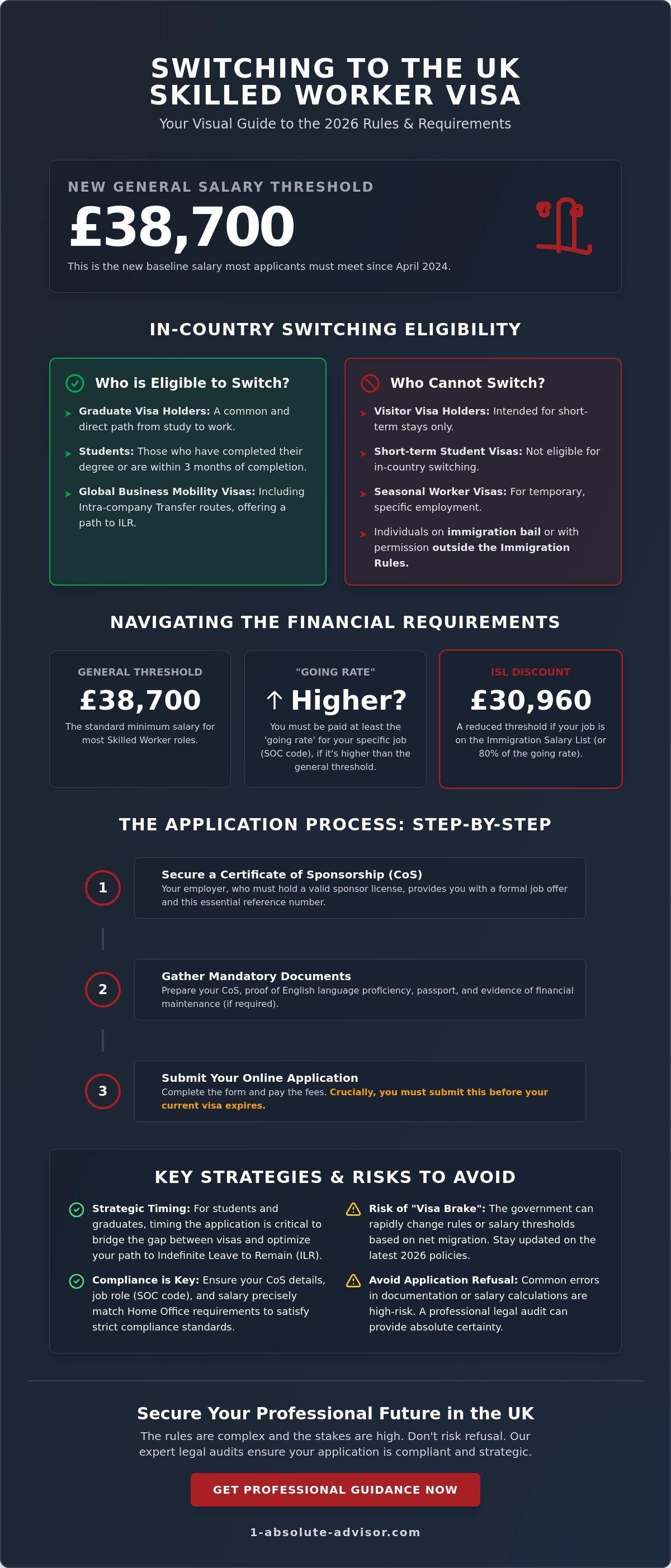
Most individuals holding valid permission to stay in the UK can transition to this route. The most common applicants include those on Graduate visas, as this route provides a natural bridge from study to permanent career placement. Students who have completed their degrees or are within three months of completion are also eligible. Additionally, many individuals currently on Intra-company Transfer routes (now part of the Global Business Mobility category) choose this path because it offers a direct route to Indefinite Leave to Remain (ILR), which their original visas might not provide. It’s essential to verify your specific visa sub-category against the latest 2026 Appendix Skilled Worker rules to confirm your eligibility for an in-country move.

Who Cannot Apply to Switch?

The Home Office maintains strict “no-switch” categories to prevent the circumvention of standard entry clearance procedures. You cannot perform the switching to skilled worker visa in uk if you’re currently on a Visitor visa, a Short-term Student visa, or a Seasonal Worker visa. These categories are designed for temporary stays and don’t permit internal status changes. Furthermore, individuals on immigration bail or those granted permission to stay outside the formal Immigration Rules are excluded from this process. If you fall into these groups, you must depart the UK and apply for entry clearance from your home country. This requirement ensures that the integrity of the border system remains intact while managing the volume of long-term residents effectively.

Meeting the 2026 Financial and Salary Requirements

Success when switching to a skilled worker visa in uk depends heavily on meeting the Home Office’s stringent financial criteria. By 2026, these regulations have become a cornerstone of the UK’s points-based system, requiring applicants to demonstrate both a high earning potential and personal financial stability. The baseline salary for most roles is now £38,700, though the specific requirement often depends on your individual circumstances and the nature of your profession.

Beyond the base threshold, you must account for the “going rate” of your specific job. The “going rate” is the minimum pay for a specific occupation. If the going rate for your role is higher than the general threshold, you’re required to earn that higher amount. This ensures that international workers aren’t used to undercut the local labor market. You can verify the most current rates and SOC codes through the Official UK Skilled Worker Visa Information to ensure your contract aligns with 2026 standards.

The General Salary Threshold vs. Occupation Codes

Every sponsored role is assigned a Standard Occupational Classification (SOC) code, which dictates the specific financial requirements you must meet. While the £38,700 figure is the standard, roles on the Immigration Salary List (ISL) allow for a reduction. If your job is on this list, you might qualify with a salary of £30,960 or 80% of the job’s going rate. It’s a strategic calculation that requires looking at your total compensation package, including basic pay but excluding most bonuses or regional allowances.

Applicants with a PhD relevant to their role can also benefit from “tradeable points.” A relevant PhD allows for a 10% reduction in the salary requirement, while a PhD in a Science, Technology, Engineering, or Mathematics (STEM) subject allows for a 20% reduction, provided the salary stays above £30,960. This holistic approach to eligibility rewards high-level expertise and fills critical gaps in the UK economy.

New Entrant Rates and Discounts

If you’re currently in the UK on a Student or Graduate visa, switching to skilled worker visa in uk is often more affordable through the “new entrant” category. This route is available to those under the age of 26 or those whose most recent visa was a Student visa. New entrants can be paid 70% of the standard going rate for their role, with a minimum floor of £30,960.

  • Four-Year Limit: You can only hold new entrant status for a maximum of four years. This includes any time you’ve already spent on a Graduate visa.
  • Long-term Planning: Once the four-year period ends, your employer must increase your salary to the full standard rate to renew your visa.
  • Financial Maintenance: You must show at least £1,270 in your bank account for 28 days straight to prove you can support yourself, unless your sponsor certifies they will cover this cost.

Precision in these calculations is vital because even a small deficit in your reported salary can lead to an immediate refusal. If you’re unsure how your specific benefits package fits into these 2026 rules, a professional financial assessment can help secure your transition. Most applicants find that documenting their financial history early prevents delays in the final application stage.

Switching to a Skilled Worker Visa in the UK: A Complete 2026 Guide

The Step-by-Step Process for Switching Your Visa

Transitioning to a new immigration status within the United Kingdom demands meticulous attention to detail. When you’re switching to skilled worker visa in uk, the sequence of your actions determines the success of your stay. You can’t simply start a new role; you must follow the Home Office’s structured digital pathway. According to the official guidance on How to Switch to a Skilled Worker Visa, you should apply at least three months before your new job’s intended start date to avoid administrative gaps.

The process begins with securing your Certificate of Sponsorship (CoS). This isn’t a physical paper document but a virtual reference number that links your application to your employer’s license. Once you have this, you’ll gather mandatory evidence. For most applicants, this includes proving your English language proficiency to at least level B1 on the CEFR scale. If you’re moving into sensitive sectors like healthcare or education, you’ll need a criminal record certificate from any country you’ve lived in for 12 months or more over the last 10 years. While TB tests are usually for those entering the UK, you might need to provide a recent certificate if you’ve traveled to high-risk areas during your current leave.

Completing the online application via the Home Office portal is the next stage. During this phase, you’ll prove your identity. Most applicants can use the “UK Immigration: ID Check” app on a smartphone to scan their BRP or passport chip. This digital route is faster and avoids the need for physical appointments. If the app can’t read your data, you’ll book an appointment at a UK Visa and Citizenship Application Services (UKVCAS) service point to provide biometrics in person.

The Certificate of Sponsorship (CoS) Explained

Your employer must assign an “Undefined” CoS for in-country switches. This differs from “Defined” certificates, which are reserved for those applying from overseas. Precision is vital. Your CoS details must match your passport exactly. Any discrepancy in your job description or salary, which must meet the 2026 threshold of £38,700 for most standard roles, can lead to a refusal. For a deeper look at sponsor requirements, consult our UK Work Visa Guide 2026.

Timelines and Priority Services

Standard processing for in-country switches takes approximately 8 weeks. If you need a faster decision, the Priority service costs an additional £500 for a 5-day turnaround. The Super Priority service provides a decision by the end of the next working day for £1,000. If your current visa expires while your application is pending, Section 3C of the Immigration Act 1971 protects your status. This legal provision allows you to continue living and working under your existing conditions until you receive a formal decision.

Strategic Considerations: Students, Graduates, and the Visa Brake

Success in 2026 requires more than just a job offer; it demands a calculated approach to timing and compliance. The UK government’s “Visa Brake” policy now acts as a dynamic regulator, allowing the Home Office to restrict application volumes or increase scrutiny for specific nationalities if net migration figures surpass established thresholds. This makes switching to skilled worker visa in uk a time-sensitive operation that requires constant monitoring of quarterly immigration statistics. If you’re applying during a period of high volume, expect heightened administrative hurdles.

Switching from a Student Visa: The “Course Completion” Rule

Current rules mandate that most international students must provide evidence of course completion before their new employment begins. You’re no longer permitted to switch mid-course to bypass academic obligations, a change designed to protect the integrity of the UK education system. PhD students represent the primary exception to this trend, as they may transition to a sponsored role after completing at least 24 months of their doctoral program. You cannot start work until the switch is approved, so it’s vital to align your job start date with your expected graduation and visa processing timelines.

Long-term Planning: From Skilled Worker to ILR

While the Graduate route offers short-term flexibility, it’s a temporary solution that doesn’t contribute toward your permanent residency requirements. Transitioning to a Skilled Worker visa is the most effective way to trigger your 5-year qualifying period for settlement. You must ensure your job code remains on the eligible list for the duration of your stay to maintain your path to residency. For a detailed breakdown of these requirements, consult our ILR UK Guide to secure your long-term future in the country.

Managing family unity is equally critical during this transition. In 2026, dependents must be handled with precision to avoid gaps in their lawful stay. If your dependents are already in the UK, they should apply simultaneously with you to ensure their leave aligns with your new status. This prevents administrative overlaps that could complicate future extension applications or lead to accidental overstaying. Following these steps ensures your family remains protected under the new, more restrictive framework.

Strategic planning is the foundation of a successful UK career. Contact Absolute Advisor to build your personalized visa transition roadmap today.

The process of switching to skilled worker visa in uk requires more than administrative accuracy; it demands a strategic understanding of Home Office scrutiny. Self-submission carries high risks. Common errors, such as selecting an incorrect SOC code or failing to meet the updated 2026 salary thresholds, lead to immediate refusals. Home Office data historically shows that administrative oversights account for a significant portion of rejected applications. A refusal doesn’t just lose you the application fee; it creates a record that complicates future UK immigration attempts and potentially jeopardizes your right to remain in the country.

Professional advisors provide an “absolute” audit of your evidence. This is vital when your switch involves complex variables like salary discounts for New Entrants or transitions from specialized visas. Our team ensures your Certificate of Sponsorship (CoS) aligns perfectly with your current professional status and long-term residency goals. We eliminate the guesswork by verifying that your sponsor’s license is active and your specific role meets the “genuine vacancy” test required for a successful transition.

Why OISC Registration Matters for Your Application

Professional immigration advice in the UK is strictly regulated. OISC registration ensures that your advisor operates under rigorous standards of competence and integrity. You shouldn’t trust your career to unregulated sources. 1 Absolute Advisor manages the end-to-end process, providing the stability needed during a life-changing transition. This holistic approach integrates legal compliance with your broader career strategy. You can learn more about our methodology for Navigating UK Immigration to understand the depth of our support.

Final 2026 Switching Checklist

Before hitting submit, verify these critical components to ensure your application is robust:

  • A valid Certificate of Sponsorship (CoS) specifically assigned for an in-country switch.
  • Documented proof of meeting the English language requirement at B1 level or higher.
  • Evidence of maintenance funds, typically £1,270 held for 28 days, unless your sponsor certifies maintenance.
  • Confirmation that your current visa allows for an in-country switch without a “cooling-off” period.
  • Verification that your salary meets the 2026 “going rate” for your specific occupation code.

Next Steps: Consultation and Document Review

Your journey begins with a detailed initial assessment. We review your specific circumstances to identify potential hurdles before they become problems. High-stakes switches, particularly those involving changes in occupation or employer, benefit from a professional document check. This step eliminates the uncertainty that often accompanies switching to skilled worker visa in uk. We act as your strategic partner, ensuring every document meets the Home Office’s exacting standards. Book a consultation for your Skilled Worker switch today to secure your professional future in the United Kingdom.

Securing Your Professional Future in the UK

Navigating the UK immigration landscape in 2026 requires a strategic approach to the Home Office’s strict salary thresholds and “visa brake” policies. Success depends on aligning your professional status with the general £38,700 salary requirement or the specific discounted rates available to new entrants. Precision in your documentation is vital because even minor errors lead to application rejections that disrupt your career trajectory. Switching to skilled worker visa in uk remains a viable path for those who prepare meticulously for the high compliance standards now in place. It’s about more than just a form; it’s about protecting your right to build a life here.

Our OISC-registered immigration consultants specialize in managing complex work visa transitions as your strategic partner. We offer fixed-fee management for total cost transparency, so you won’t face hidden charges during the process. Secure your UK future with our expert Skilled Worker visa switching service and take the next step in your professional journey with confidence. Your long-term stability in the British workforce is within reach when you have the right expertise by your side.

Frequently Asked Questions

Can I switch from a Student visa to a Skilled Worker visa before finishing my degree?

Yes, but specific restrictions apply to ensure academic progression. Under rules updated in 2023, you can only switch if your job start date is after your course completion date. PhD students must have completed at least 24 months of their programme. These regulations prevent students from abandoning their studies early to enter the full-time labour market before reaching their academic milestones.

How long does it take to switch to a Skilled Worker visa in the UK?

Standard processing typically takes 8 weeks once you’ve submitted your application from within the UK. If you require a faster decision, the Home Office provides priority service for £500, which yields a result in 5 working days. For urgent cases, the super priority service costs £1,000 and delivers a decision by the end of the next working day. These timelines depend on a valid Certificate of Sponsorship.

Can I start working for my new employer while my switching application is pending?

You can’t usually begin your new role until the Home Office officially approves your application. If you’re currently on a Student visa, you must continue to follow its specific work conditions, which generally limit employment to 20 hours per week during term time. Once your new visa is granted, you can transition into your full-time position under the Skilled Worker route requirements.

What is the minimum salary for switching to a Skilled Worker visa in 2026?

The standard salary threshold for most applicants in 2026 is £38,700 per year, or the specific going rate for the occupation code. Certain individuals, such as those under 26 or those switching from a Student visa, may qualify as “new entrants.” This status allows for a lower threshold of £30,960 or 70% of the job’s going rate for a maximum period of four years.

Do I need to leave the UK to apply for a Skilled Worker visa if I am already here?

You don’t need to leave the country if your current visa allows for an in-country change of status. Most applicants, including those on Graduate or Student visas, complete the process of switching to skilled worker visa in uk through a “leave to remain” application. It’s vital to submit this application before your current leave expires to ensure you maintain your legal right to stay in the UK.

Can my partner and children switch with me to the Skilled Worker route?

Yes, your eligible dependents can apply to switch their status at the same time as your main application. Each family member must pay the individual application fee and the Immigration Health Surcharge, which is £1,035 per year for adults in 2026. You’ll need to provide evidence of your relationship, such as marriage or birth certificates, and demonstrate that you have sufficient funds to support them.

What happens if my switching application is refused?

If the Home Office refuses your application, you’ll receive a formal letter outlining the specific reasons for the decision. You might have the right to an Administrative Review if you believe a factual error occurred during the assessment. If your previous visa is still valid, you can often submit a new application that corrects the original errors, such as providing a valid Certificate of Sponsorship or meeting financial requirements.

Is there an English language requirement when switching from a Graduate visa?

You don’t usually need to prove your English language ability again if you’ve already met this requirement in a successful previous application. Since Graduate visa holders have completed a degree taught in English at a UK university, they’ve already satisfied the B1 level requirement. This exemption simplifies the administrative burden when switching to skilled worker visa in uk for international graduates who have already integrated into the UK education system.

UK Dependent Visa Guide 2026: Bringing Your Family to the United Kingdom

A single missing bank statement or a misinterpretation of the March 11, 2024, policy shifts can turn a £5,000 investment into a heartbreaking refusal letter. It’s a harsh reality in an era where the Home Office scrutinizes relationship evidence with clinical precision. You’re likely feeling the pressure of the UK’s increasingly rigid immigration environment, where the £1,035 annual Immigration Health Surcharge is just the starting point of your financial commitment. It’s natural to worry that “insufficient evidence” might derail your plans, especially with the 2024 restrictions for care workers now fully embedded in the system.

This guide gives you the technical precision required to secure a dependent visa uk in 2026, ensuring your application is legally sound and strategically prepared from the outset. We’ll detail the exact financial thresholds, relationship proofing strategies, and the step-by-step process to bring your family to the United Kingdom with absolute confidence. By the end of this article, you’ll have a clear, actionable roadmap to overcome administrative hurdles and ensure a successful relocation for your loved ones.

Key Takeaways

  • Identify which primary immigration routes, including Skilled Worker and Student visas, allow your family members to qualify as dependants under the latest 2026 regulations.
  • Gain clarity on the specific evidentiary standards required to satisfy the two-year cohabitation rule and prove a subsisting relationship for spouses and partners.
  • Prepare for the mandatory financial maintenance thresholds, ensuring you hold the required funds-such as £285 for a partner-for the full 28-day qualifying period.
  • Streamline your dependent visa uk application by understanding the nuances of biometric appointments and the strategic differences between applying from inside or outside the country.
  • Recognize the strategic advantage of OISC-registered professional advice in navigating complex family cases and ensuring absolute compliance with UK Home Office requirements.

Understanding the UK Dependent Visa: Who Can Join You?

The UK immigration system underwent significant structural changes in 2024. These changes directly impact how you bring your family to Britain. A dependant is someone who relies on your financial support and residency status to live in the UK. Most commonly, this applies to those on the Skilled Worker or Health and Care Worker routes. Understanding the dependent visa uk requirements is the first step toward a successful relocation. The broader UK immigration policy dictates that while the government aims to reduce net migration, they maintain pathways for essential workers to remain with their immediate families under specific conditions.

Defining Eligible Family Members

Your spouse or civil partner must be at least 18 years old at the time of application. You’ll need to provide a valid marriage or civil partnership certificate that’s recognized under UK law. For unmarried partners, the Home Office requires proof of a durable relationship. Since January 31, 2024, the strict two-year cohabitation rule has been slightly relaxed to include those who haven’t lived together due to work or cultural reasons. However, you still need to demonstrate a relationship similar to marriage for at least 24 months through joint bank statements, tenancy agreements, or utility bills. It’s about proving a shared life, not just a shared address.

Children must be under 18 when they first apply. They can’t be leading an independent life, which means they shouldn’t be married or in a civil partnership. If only one parent is moving to the UK, you must prove “sole responsibility” for the child’s upbringing. This is a high evidentiary bar. You’ll need court orders, school records, or medical documentation showing you’re the only person making significant decisions for the child. If the other parent is alive and involved, the Home Office will likely refuse the application unless there are “serious and compelling” circumstances.

Restrictions for Care Workers and Students

The landscape for care workers shifted on March 11, 2024. From this date, new care workers (SOC 6145) and senior care workers (SOC 6146) can’t bring dependants to the UK. However, a “Grandfather Rule” protects those already in the system. If you held a care worker visa before March 11, 2024, and you’re extending your stay or changing employers within the same sector, you retain the right to have your family join you. This remains true for applications made in 2026, provided you haven’t broken your continuous leave.

Student visa holders face similar hurdles. Only those enrolled in postgraduate research programs, such as a PhD or a research-based Master’s, can sponsor family members. If you’re on a standard taught Master’s course, your family won’t be eligible for a dependent visa uk unless they were already present in the UK before January 1, 2024. You must also show you have enough money to support them. The current maintenance requirements are £285 for a partner, £315 for the first child, and £200 for each additional child, held for 28 consecutive days.

Children born in the UK during your stay occupy a unique legal space. Even if you’re on a restricted visa route that prevents bringing in new dependants from abroad, a child born on British soil can apply for permission to stay. This ensures the child has legal status to access the NHS and travel. You’ll need to provide a full UK birth certificate showing both parents’ names. It’s a vital safety net for families who find their visa rules changed mid-stay.

Eligibility Criteria and Proving Your Relationship

Securing a dependent visa uk requires more than just a valid marriage certificate or birth record. The Home Office applies rigorous scrutiny to ensure that every relationship is genuine, subsisting, and meets specific legal thresholds. Since the rule changes on January 31, 2024, the definition of a “durable relationship” has expanded, but the evidentiary burden remains high. You must demonstrate that your family unit is a functional reality rather than a legal convenience. This involves a strategic approach to documentation that leaves no room for ambiguity or doubt from entry clearance officers.

For spouses who’ve been living apart due to work or international commitments, the challenge is proving the relationship is “subsisting.” This requires a chronological trail of contact. If you’ve lived in separate countries for 12 months, you’ll need to show consistent financial transfers, regular travel logs, and digital communication records. The goal is to prove that despite the physical distance, the emotional and financial partnership remains intact. If you require a detailed assessment of your specific documentation, our strategic visa planning services provide the clarity needed for a successful submission.

The Document Strategy for Partners

The Home Office prefers “hard evidence” over personal testimonials. You should provide at least six pieces of joint correspondence, such as bank statements, tenancy agreements, or utility bills, spread evenly over the last 24 months. Soft evidence, including dated photographs and WhatsApp logs, should only supplement these official records to fill gaps in your history. A durable relationship is defined under the 2024 Appendix Relationship rules as a couple who’ve lived together in a relationship akin to marriage for at least two years or can provide a significant explanation why they haven’t while maintaining a subsisting bond. For the most accurate requirements, consult the official UK family visa guidance to ensure your evidence list is compliant.

Proving Dependency for Children

When bringing children, the “Both Parents” rule is the default standard; typically, both parents must be present in the UK or applying at the same time. If you’re a single parent, you must meet the “Sole Responsibility” threshold. This isn’t satisfied by a simple custody order. You must prove you’ve made every major decision regarding the child’s education, health, and daily welfare, often requiring letters from schools or doctors confirming you’re the sole point of contact.

  • Family Linking Code: Ensure the 16-digit Global Web Form (GWF) or Unique Application Number (UAN) of the lead applicant is clearly cited to link the dependent visa uk applications.
  • Over 18s: You must prove the child isn’t leading an “independent life,” which means they shouldn’t be married, have their own children, or be working full-time.
  • Financial Support: Provide bank statements showing 100% of the child’s living costs are covered by the parent, especially if the child is in full-time university education.

The complexity of these applications often stems from the 2024 requirement to prove that a child over 18 still resides in the family home. If the child is at university, you’ll need a letter from the registrar confirming their term-time address and a statement from you confirming they return to the family home during every holiday period. Precision in these details prevents the common 15% rejection rate associated with insufficient proof of dependency.

Financial Requirements and Maintenance Funds in 2026

Securing a dependent visa uk requires more than just proof of a relationship; it demands a clear demonstration of financial stability. The Home Office enforces strict maintenance requirements to ensure that families arriving in the United Kingdom don’t rely on public funds. For 2026, the specific amounts remain tiered based on the number of family members joining the lead applicant. You’ll need to show £285 for your partner, £315 for the first child, and £200 for each additional child. These figures are cumulative. If a spouse and two children are applying, the total maintenance fund required is £800. This capital must be held in a regulated financial institution for a consecutive 28-day period. The closing balance of this 28-day window cannot fall below the required threshold even for a single day, or the application will face an immediate refusal.

Timing your evidence is the most common pitfall for applicants. The bank statement used as evidence must be dated within 31 days of the online application submission. If your statement is 32 days old when you hit “submit,” the Home Office will disregard it. You should check the UK government family visa information to confirm if your specific bank is on the approved list, as certain institutions in countries like India, Pakistan, or Ghana are occasionally restricted due to verification concerns. Precision here isn’t just a suggestion; it’s a mandatory requirement for a successful outcome.

How to Meet the Maintenance Requirement

You can satisfy these requirements through personal savings or employer certification. If you’re using savings, the funds can be in the lead applicant’s name or the dependant’s name; joint accounts are also perfectly acceptable. Most applicants find that an “A-rated” sponsor provides the most streamlined path. If the lead applicant’s employer is A-rated, they can certify maintenance on the Certificate of Sponsorship (CoS). This “tick box” exercise on the CoS waives the need for bank statements entirely, as the employer guarantees they’ll provide at least £1,600 in support if needed during the first month. We’ve seen this reduce document heavy-lifting by 40% for our corporate clients.

Budgeting for the Immigration Health Surcharge (IHS)

The Immigration Health Surcharge remains the most substantial upfront cost for a dependent visa uk. In 2026, the adult rate is £1,035 per year of the visa’s duration, while the rate for children under 18 is £776 per year. For a three-year visa, a partner will pay £3,105 in IHS fees alone, excluding the standard visa processing fee of approximately £827 for those applying from outside the UK. It’s a significant financial commitment that must be paid in full at the time of application. However, there’s a vital exemption for those on the Health and Care Worker visa. Dependants of these professionals are exempt from the IHS, which saves a family of four over £10,000 across a three-year term. This exemption is a critical strategic consideration when choosing which visa route the lead applicant should pursue.

The Application Process and Common Pitfalls

The transition from understanding eligibility to submitting a formal application requires absolute precision. Applicants usually face two distinct pathways based on their current location. Those already residing in the UK on a qualifying visa, such as a Skilled Worker or Graduate visa, can often switch to a dependent visa uk through an in-country application. It’s a strategic choice that avoids the logistical burden of returning home. However, individuals on visitor visas are strictly prohibited from switching while inside the UK; they must depart and apply from their country of residence.

Your biometric appointment is the cornerstone of the identity verification process. You’ll visit a center managed by VFS Global or TLScontact to provide fingerprints and a digital photograph. In 2026, the Home Office has maintained a tiered pricing structure for processing speeds. A standard out-of-country application typically takes 15 to 20 working days, costing the base fee of £1,846 for a partner. Priority service, which aims for a decision within 5 working days, adds £500 to your costs. For many of our corporate clients, this extra expense is a sound investment to avoid the financial fallout of delayed school starts or missed housing contracts. Super Priority service, offering a 24-hour turnaround, is now available in 85% of global application centers for an additional £1,000.

Step-by-Step Application Timeline

The process begins with the online application form where you must generate a Family Linking Code. This unique identifier ensures your file stays attached to the lead applicant’s record, preventing administrative separation. Once the fee is paid, you’ll gain access to the document upload portal. In 2026, we’ve seen a 12% increase in digital processing speeds, yet manual errors in the upload stage remain the primary cause of delays. Follow this sequence for absolute clarity:

  • Complete the digital form and pay the Immigration Health Surcharge, currently £1,035 per year.
  • Generate and record the Family Linking Code to synchronize your application with your sponsor.
  • Upload all supporting evidence to the VFS Global or TLScontact portal at least 48 hours before your appointment.
  • Attend the biometric appointment and await the electronic notification of your decision.

Avoiding the “Insufficient Evidence” Refusal

Generic evidence is a high-risk strategy that often leads to disappointment. The Home Office frequently rejects applications that rely on “template” cover letters or bank statements that fail to clearly highlight the required maintenance funds. Case workers expect to see a clear narrative of your relationship and financial stability. If your documents aren’t in English, they must include a certified translation that lists the translator’s credentials and the date of translation. Minor oversights, like a missing signature on a tenancy agreement or a bank statement that is 32 days old instead of the required 28, lead to immediate refusals.

A refusal doesn’t just delay your plans; it creates a permanent record that must be declared in all future global travel. To mitigate this risk, Our Document Checking Service can identify these technical errors before submission, providing the professional oversight required for a successful relocation. We treat every dependent visa uk application as a strategic project, ensuring that every piece of evidence serves to strengthen your case rather than merely filling a checklist requirement.

Professional Assistance for Your Family’s UK Immigration

Securing a dependent visa uk involves more than filling out forms; it requires a strategic approach to UK immigration law. The Office of the Immigration Services Commissioner (OISC) sets the benchmark for this sector. Choosing an OISC-registered advisor ensures your case follows strict ethical guidelines and legal standards. This regulation protects you from the risks associated with unregulated consultants who often cause application rejections through simple clerical errors or a lack of current policy knowledge.

This principle of seeking specialized legal counsel holds true for all international legal matters, not just UK immigration. For example, when dealing with complex business or investment law between different jurisdictions like the US and Israel, professionals will visit Israel Cross Border Law Firm to navigate those specific regulations.

A London-based advisor provides a distinct advantage for complex family structures. We deal with the Home Office’s evolving digital systems daily. Our proximity to the UK’s legal and financial heart allows us to interpret policy shifts faster than regional firms. We don’t just process paperwork; we build a comprehensive legal framework for your family’s residency. This is vital when dealing with intricate financial requirements or non-standard family units where the burden of proof is higher.

Cost transparency remains a cornerstone of our professional integrity. Many firms use hourly billing; this often leads to unexpected costs during the standard 8-week to 12-week processing window. We utilize a fixed-fee model. This approach eliminates financial ambiguity and allows you to budget accurately for your family’s relocation. You’ll know exactly what the professional fees are upfront, without fearing hidden disbursements or “admin” surcharges that can inflate a bill by 20% or more.

The 1 Absolute Advisor Advantage

Our team drafts personalized legal cover letters that act as a strategic roadmap for Home Office caseworkers. These documents highlight how you meet every statutory requirement under the current Immigration Rules. We perform exhaustive document audits to ensure your evidence is 100% compliant with Appendix Skilled Worker or Appendix FM. Whether you’re a Skilled Worker holder or a British citizen sponsoring a spouse, our holistic review process catches inconsistencies before they become grounds for refusal.

Secure Your Family’s Future in the UK

Booking your initial consultation is the first step toward certainty. During this session, we’ll map out your timeline and identify if you qualify for “fast-track” Priority or Super Priority services. These services can reduce wait times from months to just 24 hours for an additional Home Office fee of £1,000. Don’t leave your family’s stability to chance. Book a consultation with an OISC-registered advisor today to begin your journey toward a secure life in the United Kingdom.

Secure Your Family’s Future in the United Kingdom

Navigating the 2026 immigration landscape requires more than just filling out forms; it demands a strategic approach to meet the £29,000 minimum income threshold and provide irrefutable evidence of your subsisting relationship. Whether you’re navigating the complexities of “Sole Responsibility” for a child or proving a long-term commitment for an “Unmarried Partner” application, the dependent visa uk process leaves no room for administrative errors. Success hinges on precise documentation and a clear understanding of Home Office scrutiny. Mistakes can lead to costly delays or immediate refusals that disrupt your family’s plans.

You don’t have to manage these high-stakes legal requirements alone. Our OISC-registered immigration consultants provide the professional oversight needed to ensure your application is audit-ready from day one. We offer fixed-fee application management with no hidden costs, giving you complete financial predictability throughout the process. Our team specializes in resolving complex cases that often prove challenging for standard applications, ensuring your family stays together without unnecessary stress. Secure your family’s UK visa with expert guidance from 1 Absolute Advisor and take the first definitive step toward your new life together in Britain. We’re ready to help you build your future here.

Once your visas are secured, the logistical challenge of the physical move comes next. For professional assistance with the entire relocation process, from packing to transport, many families turn to specialists like VP Smart Removals to ensure a smooth transition to their new home in the UK.

For professional families, arranging reliable childcare is often the next critical step after the move. Securing qualified support helps ensure a smooth transition into work and school routines. Agencies like Superstar Nannies specialize in placing elite, vetted childcare professionals and can be a valuable resource for those relocating internationally.

As you begin your new life in the UK, making your house a home is a wonderful part of the journey. For professional framing to display family photos or new art, many people turn to specialists like the First4Frames Gallery to help preserve their most cherished memories.

For those starting or expanding their family, the journey of pregnancy is another significant part of settling in. To capture some of these early, precious moments, you can visit Scan Baby Ltd for a range of private ultrasound services.

Exploring the UK’s rich history and iconic landmarks is a rewarding part of settling in. For families looking to celebrate their arrival or introduce loved ones to their new home, Timescape Tours provides private, driver-guided day trips from London.

Making your new house feel like a home is a key part of settling in. For made-to-measure window dressings that provide both privacy and style, you can check out Universal Blinds UK.

Frequently Asked Questions

Can I bring my parents to the UK on a dependent visa?

Bringing parents to the UK on a dependent visa is only possible under the Adult Dependent Relative (ADR) route, which requires proving they need long-term personal care for daily tasks. This isn’t a standard addition to a work visa. You must demonstrate that the required level of care is unavailable or unaffordable in their home country, a threshold the Home Office maintains with high rejection rates for non-essential cases.

How much does a UK dependent visa cost in 2026?

A standard dependent visa uk application for a Skilled Worker’s family member costs £827 for stays up to 3 years or £1,636 for longer periods. These 2026 figures exclude the Immigration Health Surcharge, which currently stands at £1,035 per year for adults. Total costs for a three-year stay typically exceed £3,932 per person when including all mandatory Home Office levies and biometric enrollment fees.

Can my partner work in the UK on a dependent visa?

Your partner can work in almost any role in the UK once their visa’s granted, including self-employment or professional consultancy. They aren’t restricted to specific shortage occupations or salary thresholds like the main applicant. The only major prohibitions involve working as a professional sportsperson or a doctor in training, ensuring full economic integration for your household and strategic financial stability.

For those looking to enter a new trade, intensive courses can be a fast track to a skilled career; you can check out YTA Training for examples of accredited construction programs.

What happens to dependants if the main applicant’s visa is cancelled?

If the main applicant’s visa is cancelled, the Home Office will typically curtail the dependants’ leave to remain to 60 days. This period allows families to either apply for a different visa category or arrange their departure from the UK. Failure to secure a new legal status within this window results in overstaying, which carries severe implications for future immigration compliance and international travel.

Is there an English language requirement for dependent visas?

Most applicants for a dependent visa uk linked to a work route don’t need to meet an English language requirement for their initial entry. This differs from the Family Visa route, where a CEFR level A1 is mandatory. However, all dependants must pass a B1 level test eventually if they intend to apply for Indefinite Leave to Remain after completing their five-year residency period in the UK.

Can a child over 18 apply as a dependant if they are still at university?

A child over 18 can’t usually apply as a new dependant, even if they’re full-time university students. They must have been granted leave as a dependant before turning 18 to qualify for an extension from within the UK. If they’re applying for the first time at age 19 or 20, they’ll likely need to secure their own independent Student or Graduate visa to remain compliant with current regulations.

How long does it take to get a decision on a dependent visa?

Standard processing times for applications made outside the UK are three weeks, while applications submitted within the country usually take eight weeks. You can expedite this by paying £500 for the Priority Service to get a decision in five working days. The Super Priority Service offers a next-day decision for a £1,000 fee, providing absolute certainty for families managing urgent relocation timelines.

What is the “Family Linking Code” and how do I use it?

The Family Linking Code is a unique reference number generated when the main applicant submits their application, ensuring all family members’ files are processed together. You’ll enter this code in the “Relationship” section of the dependant’s form to maintain administrative consistency. This mechanism prevents the Home Office from treating applications as separate cases, which significantly reduces the risk of conflicting decision dates or processing errors.

Discuss Your Case For FREE