

The UK’s immigration landscape underwent its most radical transformation in decades on April 8, 2026, effectively ending the era where settlement was a mere matter of time. For those preparing to apply for ilr, the implementation of the “Earned Settlement” model means your economic contribution and integration now carry as much weight as your years of residence. You likely feel the pressure of these heightened standards, especially with the standard application fee now set at £3,226 and the total abolition of the traditional 10 year long residence route. It’s understandable to fear that a technical error or a misunderstanding of the new four pillars could jeopardize your permanent future in the UK.
This guide provides the strategic clarity you need to navigate these complexities with absolute confidence. We’ll show you how to master the new requirements to ensure your application stands up to the Home Office’s rigorous scrutiny. We’ll explore the transition to eVisas, the specific fast-track pathways for high earners exceeding £50,270, and the precise documentation required to secure your freedom from immigration time limits once and for all.
Key Takeaways
- Understand how Indefinite Leave to Remain serves as the definitive bridge to British Citizenship while removing all future visa renewals and employment restrictions.
- Learn the precise mechanics of the 28-day rule to ensure that when you apply for ilr, your application is not disqualified for being submitted prematurely.
- Identify the critical financial and identity evidence required to meet the Home Office’s stringent compliance standards under the new 2026 “Earned Settlement” pillars.
- Master the selection process between SET(O), SET(M), and SET(LR) forms to eliminate procedural errors that frequently result in mandatory application refusals.
- Discover how a professional document audit can mitigate the inherent risks of a DIY submission and provide a secure path to permanent UK residency.
Understanding Your Path to Indefinite Leave to Remain (ILR)
Indefinite Leave to Remain represents the definitive milestone in a migrant’s journey, serving as the essential bridge between temporary residency and full British Citizenship. It’s not merely a visa extension; it’s a fundamental change in legal status that grants you the right to live, work, and study in the UK without any time restrictions. Understanding Indefinite Leave to Remain is critical because it removes the persistent pressure of visa expiry dates and the oversight of the Home Office. Once you secure this status, you gain access to public funds and the freedom to change employers or start a business without seeking further permission.
The year 2026 marks a historic shift in the settlement process. With the full implementation of the eVisa system, physical Biometric Residence Permits (BRPs) have been phased out in favor of a purely digital status. This modernization coincides with the “Earned Settlement” policy introduced on April 8, 2026, which prioritizes economic contribution and integration. It’s also vital to distinguish ILR from ‘Settled Status’ under the EU Settlement Scheme (EUSS). While both offer permanent residency, ILR is governed by the UK’s points-based system and requires a more rigorous demonstration of continuous residence and financial stability.
Common Qualifying Routes for Settlement
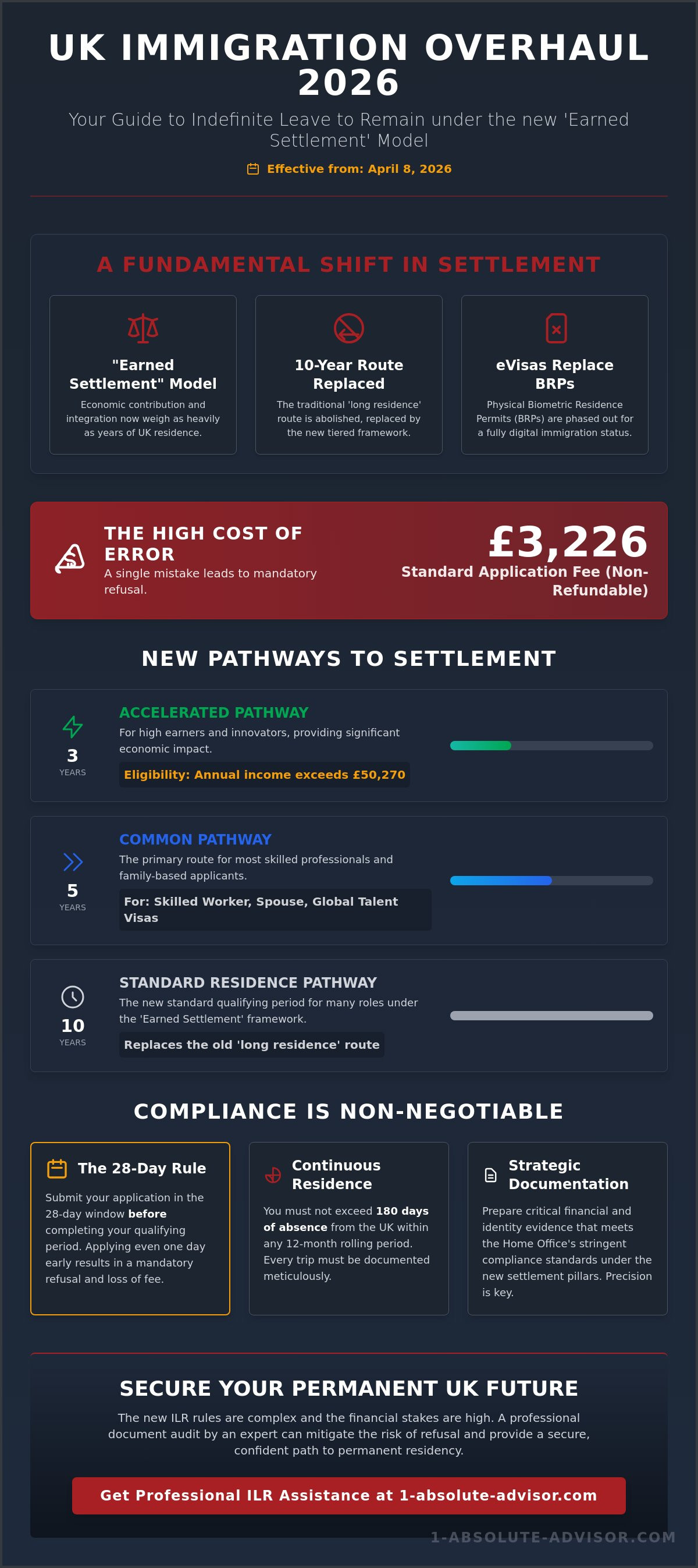
Most applicants utilize the 5-year route, which remains available for Skilled Workers, Spouses, and those on Global Talent visas. However, the 2026 reforms have significantly altered the landscape for others. The traditional 10-year long residence route has been replaced by the “Earned Settlement” framework, which now sets 10 years as the standard residency requirement for many lower-skilled roles. Conversely, accelerated pathways still exist for Innovator Founders and high earners. If your annual income exceeds £50,270, you may qualify for settlement in as little as 3 years, depending on your specific visa category and economic impact.
Why the ILR Application is Higher Stakes Than Previous Visas
When you prepare to apply for ilr in 2026, you’re facing a high-stakes financial and legal hurdle. The standard application fee rose to £3,226 per person on April 8, 2026. Because this fee is non-refundable in the event of a refusal, a single technical error can be financially devastating. Precision regarding the ‘Continuous Residence’ requirement is now more important than ever; the Home Office strictly monitors the 180-day absence limit within any 12-month period. Every day spent outside the UK must be documented and justified. For a deeper dive into these technicalities, consult our complete guide to ILR in 2026 to ensure your strategy is airtight.
Meeting the Eligibility Criteria: The 28-Day Rule and Qualifying Periods
The 28-day rule is a rigid boundary in UK immigration law that determines the earliest possible moment you can submit your request for settlement. If you choose to apply for ilr even a single day before this window opens, the Home Office will issue a mandatory refusal without refunding your £3,226 application fee. This window is calculated by counting back exactly 28 days from the date you complete your 5 or 10-year qualifying period. Precision here isn’t optional. While the official government guidance on ILR provides the general framework, the actual calculation requires a meticulous audit of every entry and exit stamp in your travel history.
Determining your qualifying period’s start date is the first strategic step in your timeline. For most 5-year routes, the period begins on the date your initial entry clearance or leave to remain was granted, rather than the day you physically arrived in the UK. However, if there was a delay of several weeks between the grant date and your arrival, those days count toward your 180-day absence limit for that first year. You must ensure you’ve held valid leave continuously throughout the entire period. Any gap in leave, unless covered by statutory 3C leave during a pending application, can reset your residency clock to zero.
Calculating Absences and the 180-Day Rule
Documenting your travel history requires a methodical approach, especially when consolidating records over a 5 or 10-year span. You must account for every departure and arrival date, including short business trips and weekend holidays. The Home Office allows certain exceptions for absences exceeding the limit, but these are strictly reserved for compelling and compassionate circumstances such as serious illness or natural disasters. Continuous residence is legally defined as maintaining a home in the UK and not spending more than 180 days outside the country in any rolling 12-month period.
English Language and Knowledge of Life Requirements
Passing the Life in the UK test early is a strategic necessity because the certificate doesn’t expire, unlike some English language qualifications. You must also demonstrate proficiency at CEFR Level B1 in speaking and listening through a Secure English Language Test (SELT) provider. While applicants over 65 or those with specific long-term physical or mental conditions are exempt, most professionals must secure these credentials months before their 28-day window opens. If you’re uncertain about how your specific travel history impacts your eligibility, a professional consultation can provide the certainty you need before committing to the application fees.
Compiling Your Evidence: A Strategic Document Checklist
Securing your permanent future in the UK requires more than just meeting residency dates; it demands a meticulous compilation of evidence that leaves no room for ambiguity. When you apply for ilr, the Home Office caseworker acts as an auditor of your life over the last five or ten years. Your identity documents, specifically all current and expired passports held during your qualifying period, form the foundation of this audit. While the transition to eVisas is fully active in 2026, you must still provide your current Biometric Residence Permit (BRP) to bridge the digital gap during the assessment. A detailed breakdown of ILR requirements highlights that financial evidence is often the most scrutinized element. For most routes, you’ll need six months of consecutive payslips and corresponding bank statements that precisely match your reported income. Caseworkers don’t hunt for missing information; they reject applications that fail to meet the absolute standard of proof.
For those on spouse or partner routes, the evidentiary burden includes proving two years of continuous cohabitation. This requires at least six pieces of correspondence from official sources, such as utility bills, council tax statements, or tenancy agreements, spread evenly across the 24 months preceding your application. Skilled workers face a different requirement: a formal letter from their sponsor. This document must confirm that you’re still required for your role for the foreseeable future and that your salary meets the specific threshold for your SOC code as of the 2026 regulations.
The Importance of Document Presentation
Digital submission is the standard, but the quality of your scans can dictate the speed of your decision. Every page of your passport, including blank ones, must be captured in high resolution. Organizing your evidence chronologically isn’t just a courtesy; it’s a strategic move to guide the caseworker through your narrative. A professionally drafted legal cover letter serves as the executive summary of your application. It allows you to proactively explain complex travel histories or fluctuations in your financial records before they become grounds for a request for further information.
Common Document Pitfalls to Avoid
The most frequent cause of refusal is the submission of outdated evidence. Bank statements must be dated within 28 days of the online application date to be considered valid. Similarly, ensuring your English language certificate is from a Home Office-approved provider and remains valid is non-negotiable. For those transitioning from employment-based routes, you must link your current status to your skilled worker visa UK history, providing a fresh letter from your sponsor confirming your ongoing need and salary. High-net-worth applicants should also prepare clear source of funds documentation to satisfy the 2026 Economic Contribution pillar. When you apply for ilr, these small details differentiate a successful settlement from a costly refusal.
The Online Application Process: Step-by-Step Execution
The digital transition of the Home Office reached its full implementation on April 8, 2026, creating a streamlined yet unforgiving online environment. When you prepare to apply for ilr, your journey begins with selecting the correct statutory form. SET(O) remains the primary route for Skilled Workers and Global Talent applicants, whereas SET(M) is dedicated to those on family and partner visas. Choosing the wrong form is a technical error that often leads to immediate rejection. After completing the detailed online questionnaire, you must pay the standard application fee of £3,226. This payment triggers the next phase of the process through the UKVCAS portal.
The second phase involves uploading the high-resolution evidence discussed in previous sections to the UKVCAS digital platform. Once your documents are submitted, you’ll book a biometric appointment at a designated center to provide your fingerprints and a digital photograph. In 2026, this step is purely for identity verification and background checks, as the final grant of settlement is no longer issued as a physical card. After your appointment, the Home Office will review your file and issue a decision via email, which will include instructions on how to activate your digital eVisa.
Standard vs. Super Priority Service
The choice between processing speeds is a strategic financial decision. Standard processing currently carries a six-month service standard, during which you cannot travel outside the Common Travel Area. If you leave the UK while your application is pending, the Home Office will treat it as withdrawn, and your fee will be forfeited. When you apply for ilr, evaluating the cost-benefit ratio of priority services is essential for maintaining your professional and personal commitments. The Super Priority Service, costing an additional £1,000, provides a decision by the end of the next working day, while the £500 Priority Service offers a five-working-day turnaround.
The Transition to eVisas in 2026
The most significant change for 2026 applicants is the total absence of physical documentation. Following a successful decision, you won’t receive a plastic BRP card. Your Indefinite Leave to Remain is now an eVisa, a digital record linked directly to your passport within your UKVI account. You must proactively update this account if you receive a new passport to ensure your digital status remains verifiable at border crossings. This digital-first approach requires you to share your status via “share codes” with employers or landlords to prove your right to work or rent. If the technical nature of these digital transitions seems daunting, our specialist ILR application service can manage the entire execution on your behalf.
Ensuring a Successful Outcome with Professional ILR Assistance
The complexity of the 2026 settlement framework makes the risks of a “DIY” approach significantly higher than in previous years. When you prepare to apply for ilr, you’re essentially presenting a multi-year audit of your life to a caseworker who must follow rigid, mandatory refusal criteria. A single oversight, such as a bank statement dated 29 days before submission or an employer letter lacking a specific SOC code reference, results in a refusal and the total loss of the £3,226 application fee. 1 Absolute Advisor provides a specialized Document Checking Service designed to eliminate these technical vulnerabilities. We perform a forensic audit of your evidence, ensuring every scan and date aligns with the current Home Office requirements before you hit submit.
OISC-registered representation offers a significant advantage in managing communications with the Home Office. Our advisors don’t just fill out forms; they draft comprehensive legal representations that highlight your compliance with the Residence, Contribution, and Integration pillars. This proactive strategy is particularly vital for those managing the UK work visa transition, where salary fluctuations or employer changes must be carefully contextualized. Successfully securing ILR isn’t just an end to visa renewals; it’s the final prerequisite for Applying for British Citizenship, a goal that requires a clean and successful settlement record.
Our Fixed-Fee ILR Application Management
Our end-to-end management service takes you from initial eligibility assessment to the final activation of your digital status. We handle the complexities of the UKVCAS portal and provide a clear, chronological structure for your evidence that assists caseworkers in reaching a positive decision. This comprehensive oversight gives you peace of mind, knowing that your permanent residency is being managed by strategic partners rather than mere document processors. We ensure that every aspect of your case, from biometric enrollment to the final decision, is handled with absolute precision.
Next Steps: Your Consultation with 1 Absolute Advisor
The most effective way to secure your future is to identify potential hurdles long before your 28-day window opens. During a consultation, we analyze your travel history for 180-day breaches and verify your income against the latest 2026 thresholds. We’ll help you set a precise timeline for your submission to ensure you don’t apply for ilr a day too early or too late. Book your ILR strategy session today to transform a complex legal process into a predictable path toward your permanent home in the UK.
Securing Your Permanent Future in the United Kingdom
The transition to the “Earned Settlement” framework has turned UK residency into a merit-based milestone rather than a simple countdown of years. For those ready to apply for ilr, the margin for error has narrowed significantly as the Home Office shifts its focus toward specific contribution and integration metrics. We’ve explored the critical nature of the 28-day rule, the necessity of high-resolution digital evidence, and the nuances of the new eVisa system. Success in this heightened regulatory environment requires a proactive compliance strategy that anticipates caseworker scrutiny before it occurs.
1 Absolute Advisor serves as your dedicated mentor through this intricate process. Our OISC-registered immigration consultants specialize in managing complex settlement cases, providing fixed-fee oversight that eliminates the financial anxiety of potential refusals. By partnering with a firm that deeply understands the 2026 legislative shifts, you ensure your transition to permanent residency is handled with the professionalism it deserves. Secure your UK settlement with expert ILR application support and begin your final chapter toward British Citizenship with absolute confidence. You’ve built your life here; it’s time to make it permanent.
Frequently Asked Questions
Can I apply for ILR more than 28 days before my 5-year anniversary?
No, you cannot submit your application earlier than 28 days before you complete your qualifying period. The Home Office applies this rule strictly; any application submitted even one day before this window opens will be refused automatically. Since the standard fee is £3,226 and is non-refundable, you must calculate your anniversary date with absolute precision before you apply for ilr.
What happens if my current UK visa expires while my ILR application is pending?
Your legal status and right to work are protected by Section 3C leave as long as you submitted your application before your current visa expired. This statutory protection ensures you don’t become an overstayer while waiting for a decision. You must remain in the UK during this time to keep this protection active and avoid the accidental withdrawal of your application.
How much does it cost to apply for ILR in 2026?
The standard application fee is £3,226 per person, a rate that became effective on April 8, 2026. You must also account for the £19.20 biometric enrollment fee and the £50 Life in the UK test. If your schedule requires a faster outcome, the Priority service costs an additional £500, while the Super Priority service for a next-day decision is £1,000.
Do I need to pass the Life in the UK test if I am over 65?
No, you are exempt from both the Life in the UK test and the English language requirement if you are 65 or older at the time of your application. You simply need to provide your passport or birth certificate to prove your age. For all other applicants, the test is a mandatory requirement that should be completed well before the 28-day application window opens.
Can I travel outside the UK while my Indefinite Leave to Remain application is being processed?
You must not travel outside the Common Travel Area, which includes the UK, Ireland, and the Crown Dependencies, while your application is pending. If you leave these territories before receiving a decision, the Home Office will treat your application as withdrawn. This results in the loss of your application fee and may leave you without a valid visa to re-enter the country.
What is the difference between ILR and British Citizenship?
ILR is a permanent residency status that removes immigration time limits but does not grant you a British passport or the right to vote in general elections. British Citizenship is the final step that provides full nationality and protection from deportation. Most residents must hold their settlement status for at least 12 months before they can transition to citizenship.
Will I get a physical Biometric Residence Permit (BRP) in 2026?
No, the UK has fully transitioned to a digital-only eVisa system as of 2026. You will no longer receive a plastic BRP card after your application is successful. Instead, your status is linked to your passport in your digital UKVI account. You can prove your right to work or rent by generating a secure share code through the official government portal.
What should I do if my ILR application is refused by the Home Office?
You must carefully review your refusal letter to see if you have been granted a right to an Administrative Review. Refusals in 2026 are often triggered by technical errors or a failure to meet the new “Earned Settlement” contribution pillars. It’s vital to seek professional legal advice immediately to determine whether to challenge the decision or submit a corrected application.