
What Happens to Your UK Visa if Your Sponsor Goes into Administration? (2026 Guide)

Imagine receiving an email on a Tuesday morning informing you that your employer has entered insolvency, and your first thought isn’t about your redundancy pay, but your legal right to remain in the country. It’s a moment of profound uncertainty that thousands of skilled workers face annually. You’re likely asking, “what happens to my visa if my sponsor goes into administration” and feeling the pressure of an invisible clock ticking. We understand that your career and residency are at stake, and the fear of immediate deportation can be overwhelming when you’ve built a life in the UK.

You aren’t alone in this concern, as many professionals wrongly assume their leave to remain expires the moment a company collapses. This guide provides the absolute clarity you need to manage this transition with confidence. We’ll explain the 60-day curtailment period, the specific steps to secure a new Certificate of Sponsorship, and how to assess alternative visa routes before your current status expires. By following this 2026 roadmap, you can transform a corporate crisis into a manageable professional transition while maintaining your legal standing and peace of mind.

Key Takeaways

  • Understand the critical 60-day curtailment period and why your timeline for action only begins once you receive an official notification letter from the Home Office.
  • Learn to distinguish between company administration and liquidation to determine the immediate risk level to your sponsorship and your future residency in the UK.
  • Discover exactly what happens to my visa if my sponsor goes into administration and how to navigate this transition while maintaining full legal compliance.
  • Identify the strategic steps for securing a new “Visa-Ready” employer and obtaining a fresh Certificate of Sponsorship (CoS) to protect your professional status.
  • Recognise why professional legal support is essential for managing Home Office communications and avoiding the procedural errors that often lead to visa refusals.

Understanding Sponsor Administration and Your Visa Status

When a UK company enters the legal process of administration, it means the business has become insolvent and is now placed under the control of a licensed insolvency practitioner. For a sponsored worker, this creates immediate professional and personal uncertainty. You’re likely asking: what happens to my visa if my sponsor goes into administration? While the situation is serious, it doesn’t mean your right to remain in the UK vanishes instantly. Administration is designed to rescue the company as a going concern or achieve a better result for creditors than liquidation, meaning there’s often a window where the business continues to operate.

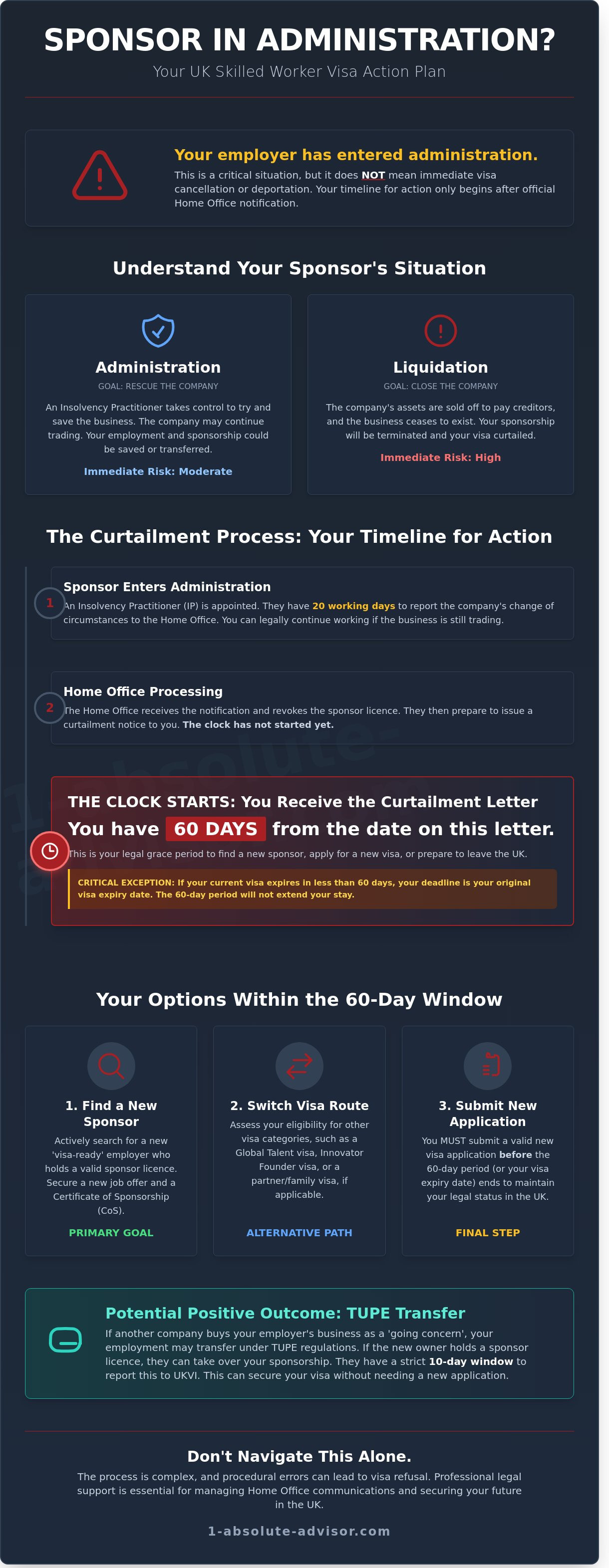
The Home Office requires all Skilled Worker sponsors to maintain specific financial and ethical standards. When a firm enters administration, its ability to honour its sponsorship duties is scrutinised. If the company eventually stops trading or loses its licence, your Certificate of Sponsorship (CoS) becomes invalid. However, you shouldn’t panic. The UKVI curtailment process isn’t instantaneous. You’ll typically receive a formal letter giving you 60 days to find a new sponsor or depart the UK, but this only happens after the Home Office is officially notified and processes the change. You won’t be deported the same day the administrators walk through the door.

The Role of the Insolvency Practitioner

Once appointed, the insolvency practitioner (IP) replaces the company’s directors in making all key decisions. They’re now responsible for your employment status and the company’s compliance duties. Under UKVI rules, the IP has a duty to report the change in the company’s circumstances to the Home Office within 20 working days. You should maintain regular contact with your HR department or the IP’s team during this transition. They’re legally bound to inform you if your role is being made redundant or if the sponsorship licence is being surrendered, which directly affects what happens to my visa if my sponsor goes into administration.

Your Right to Work During Early-Stage Administration

You can usually continue working while the company is “in the red,” provided the business is still trading and the administrators haven’t terminated your contract. If a new buyer acquires the company, your employment may transfer under the Transfer of Undertakings (Protection of Employment) Regulations, commonly known as TUPE. In these instances, the new owner has a strict 10-day window to report the business sale to UKVI. If they hold a valid sponsor licence, they can often take over your sponsorship, ensuring your visa remains secure without you needing to file a fresh application from outside the country.

The 60-Day Curtailment Rule: Your Timeline for Action

When a UK company enters insolvency or administration, its ability to sponsor migrant workers effectively ceases. According to the official Home Office guidance, the Home Office will usually revoke the sponsor licence once the organisation stops trading or undergoes a significant change in ownership that doesn’t involve a TUPE transfer. This triggers a process known as curtailment, which shortens your leave to remain. Understanding what happens to my visa if my sponsor goes into administration is vital for maintaining your lawful status.

The standard procedure provides you with a 60-day window to either find a new sponsor and submit a fresh visa application or leave the UK. It’s a common misconception that this countdown begins the moment the company enters administration. In reality, the 60-day period only starts from the date printed on the official curtailment notice sent to you by the Home Office. During this legal grace period, you’re permitted to remain in the country and search for new employment, though you cannot start working for a new employer until your new visa application is granted.

There’s a critical exception to the 60-day rule. If your current visa was already set to expire in less than 60 days, the Home Office won’t extend your stay. Your deadline remains your original visa expiry date. Acting quickly is essential, as the administrative process for issuing these notices can be unpredictable. If you’re concerned about your specific timeline, seeking professional immigration advice can help clarify your options before the notice arrives.

Receiving the Curtailment Letter

The Home Office typically sends curtailment notices via email or post. Delays are frequent; it can take several weeks or even months for the Home Office to process the sponsor’s insolvency report and issue your letter. You must ensure your contact details are up to date on the UKVI system. If you’ve moved house or changed your email address without notifying them, you might miss the notice, leading to an accidental overstay. If you know your employer has closed but haven’t received a letter, don’t assume your visa is safe. The 60-day limit is a hard deadline once issued, and “I didn’t receive the letter” is rarely accepted as a valid legal defence for overstaying.

Travel Restrictions During Curtailment

Leaving the UK during the curtailment period is exceptionally risky. While your visa remains technically valid for those 60 days, it’s “curtailed,” meaning it’s no longer backed by an active sponsor. If you exit the Common Travel Area, you’ll likely be refused re-entry at the border. Border Force officers can see the status of your sponsor licence in their system. If the licence is revoked, your right to enter the UK on that specific visa effectively ends the moment you clear passport control outbound. For urgent family matters abroad, you should consult a legal expert to explore if a Change of Conditions or a priority visa application is a safer route than attempting to travel on a compromised visa.

What Happens to Your UK Visa if Your Sponsor Goes into Administration? (2026 Guide)

How Different Types of Insolvency Affect Your Sponsorship

The legal framework governing insolvency determines the timeline and security of your visa status. While administration aims to rescue a business as a going concern, liquidation focuses on winding up operations and distributing assets to creditors. Understanding these distinctions is vital for assessing what happens to my visa if my sponsor goes into administration. Administration often provides a temporary breathing space where the company continues to trade, whereas liquidation is far more urgent and usually signals the immediate end of your sponsorship.

A Company Voluntary Arrangement (CVA) represents the most hopeful path for a sponsored worker. This is a formal agreement with creditors that allows a company to pay its debts over a fixed period. Because the business continues to exist as the same legal entity, the sponsor licence often remains intact. However, the Home Office must be notified of the CVA. They’ll assess if the company can still meet its sponsorship obligations. According to the official Home Office guidance on sponsor insolvency, a sponsor must report these changes within 20 working days via the Sponsor Management System (SMS).

In cases of compulsory or voluntary liquidation, the business ceases to trade, which makes licence revocation almost inevitable. If the Home Office chooses to suspend a licence instead of revoking it immediately, it’s usually to allow for an investigation. During a suspension, you can generally continue working, but the employer cannot issue any new Certificates of Sponsorship (CoS) or recruit new migrant workers.

When the Sponsor Licence is Revoked

Licence revocation brings an immediate halt to your legal right to work for that specific employer. This isn’t a gradual transition; your employment ends the moment the licence is removed from the Register of Licensed Sponsors. Even if the physical office remains open during a wind-down period, you can’t perform any duties. This event triggers the Home Office curtailment process, which typically reduces your remaining visa duration to 60 days. It’s your responsibility to monitor the Register of Licensed Sponsors to verify your employer’s status if communication from the company becomes unreliable.

TUPE Transfers and New Sponsors

If another company buys your employer out of administration, the Transfer of Undertakings (Protection of Employment) regulations, or TUPE, may protect your job. While your contract moves to the new owner, your visa sponsorship doesn’t transfer automatically. The new employer has a strict 28-day window to apply for a sponsor licence if they don’t already hold one. If the new owner refuses to take on your sponsorship or fails to meet the Home Office requirements, your role will no longer be visa-compliant. In this situation, you’ll need to secure a new sponsor or change your visa category to remain in the UK legally.

Understanding what happens to my visa if my sponsor goes into administration is the first step toward securing your future in the UK. Once the Home Office identifies that your employer is no longer trading, they’ll typically issue a curtailment letter. This notice usually shortens your remaining leave to 60 days. This window is your primary opportunity to either secure a new sponsor or transition to a different immigration category. You shouldn’t wait for the letter to arrive; proactivity is your most significant asset in this scenario.

The Search for a New Sponsor

Finding a “Visa-Ready” employer requires a targeted approach. You should immediately consult the Home Office Register of Licensed Sponsors, which currently lists over 100,000 organisations authorised to employ foreign workers. When you approach these companies, it’s vital to frame your situation transparently. Explain that your current sponsor has entered administration, a business event entirely outside your control. This positioning ensures you don’t appear as a “high-risk” candidate, but rather as a proven professional who’s available due to corporate restructuring.

The logistics of moving to a new employer involve obtaining a fresh Certificate of Sponsorship (CoS). Your new employer must assign this to you before you can submit a “Change of Employment” application. Speed is essential because you must complete this process before your 60-day curtailment period ends. The standard Home Office fee for a Skilled Worker visa (up to three years) is currently £827, and you’ll also need to account for the Immigration Health Surcharge, which stands at £1,035 per year.

Switching to Family or Residency Routes

If you’re hesitant to rely on another corporate sponsor, alternative routes might provide more stability. For those with a British or settled partner, switching to a UK Spouse Visa is often a logical move. This path grants you the right to work for any employer without needing individual sponsorship, effectively “future-proofing” your residency against corporate insolvency.

  • Indefinite Leave to Remain (ILR): If you’re nearing the five-year mark on your current route, you should verify your eligibility for Indefinite Leave to Remain (ILR). The Home Office generally doesn’t penalise applicants for brief gaps in employment caused by a sponsor’s administration, provided a new application is lodged promptly.
  • Global Talent Visa: This is an excellent option for leaders or potential leaders in fields like tech, science, or the arts, as it requires no specific employer sponsorship.
  • Graduate Visa: If you recently completed a degree in the UK, you might be eligible for a two-year unsponsored stay.

The Home Office views your status during the administration process through the lens of continuous lawful residence. As long as you submit a valid application for a new visa before your current leave expires, your right to remain in the UK is protected under Section 3C of the Immigration Act 1971. This legal safeguard ensures you aren’t considered an overstayer while your new application is being processed.

Consult with our absolute experts today to determine which visa route offers the most secure path for your specific professional circumstances.

When a company enters insolvency, the Home Office typically grants a 60-day grace period for visa holders to secure new employment or switch categories. Attempting a DIY visa switch during this high-pressure window often results in refusal. Errors in documentation or failing to account for the specific nuances of the sponsor’s insolvency can lead to a permanent mark on your record. 1 Absolute Advisor manages every aspect of communication with the Home Office to ensure your status remains protected while you focus on your next career move.

Understanding what happens to my visa if my sponsor goes into administration requires a strategic look at the 60-day deadline. We conduct a rigorous audit of your documents well before this limit expires. Our team identifies potential pitfalls in your application that could lead to administrative silence or immediate curtailment. We offer fast-track services for those who need to secure a new Certificate of Sponsorship (CoS) urgently, often within a matter of days.

Expert Guidance for Complex Transitions

Our consultants analyse your eligibility across multiple UK immigration routes to find the safest path forward. We don’t just fill out forms; we draft detailed legal cover letters that explain the technicalities of the sponsor’s administration to Home Office caseworkers. This level of detail is essential to maintain a clean immigration history. It ensures that your journey towards Indefinite Leave to Remain (ILR) or British citizenship isn’t derailed by circumstances outside your control.

Take Control of Your Immigration Status

Working with an OISC-registered consultant provides the professional integrity needed during a corporate crisis. Company collapses are chaotic, but your legal strategy shouldn’t be. We reduce the personal stress of redundancy by providing a clear, step-by-step roadmap for your transition. Our approach focuses on long-term stability and compliance rather than short-term fixes.

  • Immediate Eligibility Assessment: We review your qualifications for Skilled Worker, Global Talent, or High Potential Individual routes.
  • Direct Home Office Liaison: We act as your formal representative, handling all enquiries and notifications regarding your sponsor’s status.
  • Fast-Track Processing: For urgent cases, we prioritise your application to meet strict employment start dates.

Don’t leave your right to stay in the country to chance. Contact 1 Absolute Advisor for a priority consultation to discuss what happens to my visa if my sponsor goes into administration and secure your professional future in the UK.

Securing Your Right to Remain in the UK

Navigating the uncertainty of corporate insolvency requires immediate attention to Home Office timelines. The 60-day curtailment rule remains a rigid boundary for Skilled Worker visa holders, meaning you must secure a new sponsor or switch routes before this window closes. Understanding what happens to my visa if my sponsor goes into administration is the first step toward stability, but execution is what preserves your future. Whether your employer faces administration or full liquidation, the Home Office typically updates the register of licensed sponsors within days of the formal insolvency filing.

Success in these complex Skilled Worker transitions depends on precision and speed. At 1 Absolute Advisor, our OISC Registered Immigration Consultants provide fixed-fee visa management services to ensure your application meets every regulatory requirement without hidden costs. We act as your strategic partner, identifying alternative pathways and managing the transition to a new employer before your current leave expires. Don’t leave your status to chance when professional intervention can secure your position in the UK.

Book an Urgent Consultation to Protect Your UK Visa Status

You have options, and with the right legal framework, you can turn this professional challenge into a secure new beginning.

Frequently Asked Questions

How long can I stay in the UK if my sponsor goes into administration?

You’ll typically have 60 days to find a new sponsor or leave the UK once the Home Office issues a formal curtailment notice. This period starts from the date on the letter, not the date the company enters administration. If your current visa expires in less than 60 days, the original expiry date remains your final deadline. Understanding what happens to my visa if my sponsor goes into administration is vital for planning your next strategic move.

Can I start working for a new employer immediately if my current sponsor fails?

You can’t start working for a new employer until you’ve secured a new Certificate of Sponsorship and submitted a valid visa application. Under current Home Office regulations, you must wait for your new leave to remain to be granted or for specific “start work” conditions to be met. Moving to a new role without this formal approval constitutes illegal working, which jeopardises your future eligibility for Indefinite Leave to Remain.

Do I need to tell the Home Office if my company is in administration?

You aren’t personally required to notify the Home Office of the administration, as this responsibility lies with the court-appointed insolvency practitioner. They’re legally mandated to report the change in circumstances within 10 working days via the Sponsor Management System. However, you should proactively monitor your correspondence. Once the Home Office processes the report, they’ll send a formal notice detailing what happens to my visa if my sponsor goes into administration.

What happens to my dependents if my visa is curtailed?

Your dependents’ immigration status is directly linked to your own, so their leave will be curtailed in line with yours. If your visa is reduced to 60 days, your partner and children will receive similar notices and must act within the same timeframe. They’ll need to be included in any new application you make for a different visa route, such as a new Skilled Worker visa, to remain in the UK legally.

Can I switch to a Spouse Visa if my Skilled Worker sponsor goes bust?

You can switch to a Spouse Visa from within the UK if your partner is a British citizen or has settled status. You must meet the financial requirement, which rose to £29,000 on 11 April 2024, and provide evidence of a genuine relationship. This route offers more long-term security than the Skilled Worker path. It removes the dependency on a specific corporate sponsor for your residency rights and provides a stable foundation for your future.

Will I be banned from the UK if I stay past the 60-day curtailment period?

Overstaying your 60-day curtailment period by more than 30 days usually results in a mandatory re-entry ban of at least one year. Under the Immigration Act 1971, staying in the UK without valid leave is a criminal offence. Such a breach will also likely lead to the refusal of any future UK visa applications. The Home Office takes compliance with stay limits very seriously, so it’s essential to act before your leave expires.

Is it possible to extend the 60-day period if I haven’t found a job?

The Home Office rarely extends the 60-day curtailment period for individuals who haven’t found a new job. Extensions are only considered in exceptional cases, such as a documented medical emergency that prevents travel, supported by evidence from a consultant. Lack of employment opportunities isn’t considered a valid reason for an extension. You should focus on switching to an alternative visa category or securing a new sponsor before the 60 days conclude.

What if I am on maternity leave when my sponsor goes into administration?

You still face the standard 60-day curtailment rule even if you’re on maternity leave when the sponsor’s licence is revoked. While you might still be entitled to receive Statutory Maternity Pay from the government if the company can’t pay, your right to reside in the UK remains tied to your sponsorship. You’ll still face the 60-day limit to find a new sponsor or switch to a different visa category to maintain your legal status.

Justifying Visa Sponsorship Costs to Management: A Strategic Business Case Guide for 2026

What if the £5,335 total investment for a three-year Skilled Worker visa is actually the most efficient way to prevent a £40,000 revenue loss caused by a critical talent gap in 2026? Many HR leaders find that justifying visa sponsorship costs to management feels like an uphill battle against a finance department focused on immediate outgoings. It’s understandable to feel hesitant when the Immigration Skills Charge and legal fees appear as significant “sunk costs” on a balance sheet. You likely agree that the fear of a candidate departing shortly after the company pays these fees makes the investment feel even riskier.

This guide will show you how to reframe these expenses as high-yield strategic investments that your board will approve. We’ll provide a data-backed framework to demonstrate how securing global talent offsets the 15% increase in domestic recruitment costs reported in the 2024 REC industry analysis. You’ll also learn specific legal strategies, including structured clawback agreements, to protect your firm’s capital. By the end of this article, you’ll have a robust business case to turn a perceived “cost centre” into a long-term competitive advantage for your organisation.

Key Takeaways

  • Understand the 2026 UK economic landscape and how to reframe sponsorship fees as a high-yield investment rather than a mere administrative burden.
  • Quantify the true cost of vacant roles, comparing the £10,000-£15,000 sponsorship investment against the substantial revenue lost to project delays and team burnout.
  • Learn a structured approach for justifying visa sponsorship costs to management by integrating financial “clawback” clauses and clear ROI projections into your business case.
  • Evaluate the “Speed to Competence” metric to demonstrate how specialist international talent provides a faster path to profitability than searching for scarce local candidates.
  • Safeguard your organisation’s capital by identifying the compliance risks that lead to forfeited Home Office fees and failed applications.

The Economic Landscape of UK Visa Sponsorship in 2026

By 2026, the UK labour market has reached a critical inflection point where the domestic supply of specialised talent no longer meets the demands of high-growth sectors. In industries like aviation, where specialized training from providers like 2FLY Airborne is vital for developing a pipeline of commercial pilots, the traditional “local-first” recruitment model has become a bottleneck that restricts scalability. Shifting to a “talent-first” strategy is no longer a choice but a requirement for maintaining a competitive edge. When justifying visa sponsorship costs to management, it’s vital to present these expenses as a strategic capital investment rather than a mere administrative overhead. The Sponsorship Premium is the price of accessing the global top 5% of skilled professionals who possess the exact technical competencies your business requires to lead the market.

Breaking Down the Mandatory Fees

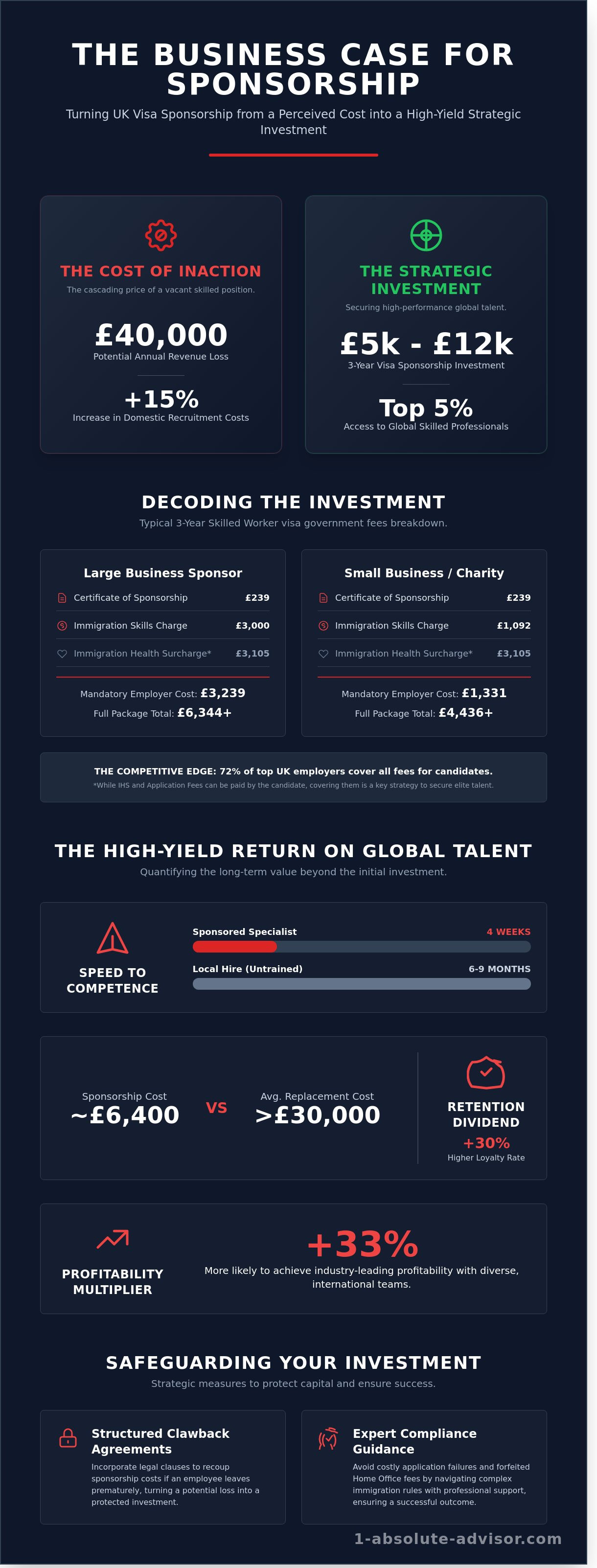
A transparent financial breakdown is the first step in justifying visa sponsorship costs to management. The total investment per head includes several non-negotiable components that must be budgeted with precision. The Certificate of Sponsorship (CoS) remains a modest one-off fee of £239, but the Immigration Skills Charge (ISC) represents a more significant recurring cost. For medium or large sponsors, this is £1,000 per year of the visa; smaller entities or charities benefit from a reduced rate of £364 per year.

The Immigration Health Surcharge (IHS), which stands at £1,035 per year as of the latest 2025/26 adjustments, often represents the largest upfront cost. It’s essential to distinguish between mandatory employer costs and optional employee costs. While the company must pay the CoS and ISC, the visa application fee and the IHS can technically be paid by the candidate. However, 72% of top-tier UK employers now choose to cover these costs as part of a competitive relocation package to secure the best international talent.

  • Certificate of Sponsorship: £239 (One-off fee).
  • Immigration Skills Charge: £1,000 per year (Large companies) or £364 per year (Small/Charitable).
  • Immigration Health Surcharge: £1,035 per year per individual.

The Retention Dividend

The financial argument for sponsorship is strengthened when you factor in the “Retention Dividend.” Data from 2024 and 2025 indicates that sponsored professionals show a 30% higher loyalty rate than local hires over a three-year period. This stability is a direct result of the mutual commitment inherent in the sponsorship process. In an era where the average cost of replacing a mid-level professional in the UK exceeds £30,000, reducing turnover is a primary driver of fiscal efficiency.

Sponsored employees often view their role through a long-term lens, providing the business with a stable foundation for complex, multi-year projects. This reliability creates a “favourite” employer status in the global market, allowing your firm to bypass the constant, expensive cycle of domestic headhunting. Investing in a global workforce ensures your organisation remains resilient against local economic shifts while building a diverse, high-performing team that is built to last.

Calculating the ROI of International Talent Acquisition

Management often views visa sponsorship as a line-item expense, focusing on the immediate £5,000 to £12,000 in upfront government fees and legal costs. This perspective is fundamentally flawed. To shift the narrative, you must quantify the value a specialist brings through a more sophisticated fiscal lens—a mindset applied to other strategic growth areas, from tech adoption to alternative investments explored by platforms like the Whisky Cask Club. A Skilled Worker Visa UK 2026 is an asset purchase, not a service fee. It represents the acquisition of high-performance human capital that is often unavailable within the domestic labour pool.

When justifying visa sponsorship costs to management, focus on “Speed to Competence.” A highly skilled international hire typically reaches 100% productivity within four weeks. In contrast, a less-qualified local hire may require six to nine months of intensive training before they contribute positively to the bottom line. This gap represents thousands of pounds in lost opportunity and diverted management time. Diversity of thought also plays a critical role; teams with international perspectives are 33% more likely to see industry-leading profitability, particularly when breaking into new global markets where cultural intelligence is a prerequisite for success.

The Productivity Multiplier

Estimating the revenue generated by a top-tier candidate over a 3-year or 5-year visa period reveals the true ROI. If a global expert generates £250,000 in annual value, the initial sponsorship cost becomes negligible, representing less than 2% of their total output. Compare this to a junior domestic alternative where training costs and lower initial output create a “productivity debt” that can take years to clear. Strategic benefits often include access to niche technical skills or established global networks that simply don’t exist in the UK’s current talent market. For businesses seeking a tailored financial breakdown of these costs, consulting a strategic advisor can clarify the fiscal impact.

Long-term Strategic Stability

Sponsorship isn’t just about filling a gap; it’s a retention strategy. Using the ILR UK path serves as a built-in 5-year retention roadmap. While domestic employees might change roles every 18 months, sponsored talent often demonstrates higher loyalty as they work towards permanent residency. This stability is vital for succession planning in senior leadership roles. A robust approach to justifying visa sponsorship costs to management involves highlighting how these hires enhance the company’s “Global Employer Brand,” making the organisation a magnet for the world’s top 1% of talent.

Justifying Visa Sponsorship Costs to Management: A Strategic Business Case Guide for 2026

Opportunity Cost: The Price of a Vacant Skilled Position

An empty desk represents a tangible leakage of capital that often goes unmeasured on a balance sheet. When justifying visa sponsorship costs to management, the conversation must shift from the upfront fee to the daily revenue loss. A vacant role in a high-growth sector doesn’t just sit at zero; it actively drains resources. If a senior consultant generates £1,000 in daily billable value, a six-month delay in recruitment results in a £120,000 deficit. Against this figure, a £10,000 to £15,000 investment in sponsorship is a pragmatic business decision rather than a luxury expense.

The financial impact extends beyond lost billable hours. Unfilled roles trigger a “Recruitment Loop” where companies spend upwards of £5,000 on repeated advertising cycles and agency fees. Settling for a second-choice local candidate who lacks the specific technical expertise often leads to project delays or, worse, contract penalties. These hidden costs quickly exceed the price of securing a world-class international hire who can deliver results from day one.

There is also a “Domino Effect” to consider. When a position remains vacant for months, the workload is redistributed among existing British staff. This leads to a measurable spike in burnout. Industry data from 2024 suggests that overworked teams see a 31% increase in error rates and a significantly higher risk of resignation. Losing a veteran staff member because the company refused to sponsor a new hire creates a secondary recruitment crisis that is far more expensive to solve.

Sponsorship vs. The “Wait and See” Strategy

Many CFOs opt for a “Wait and See” approach, hoping a domestic candidate will eventually appear. In the current UK labour market, this is often the most expensive strategy available. Data from 2024 indicates that the time-to-hire for specialist engineering and tech roles via domestic routes can exceed 24 weeks. Conversely, using the Skilled Worker route with priority processing can settle a candidate in 8 to 12 weeks. Choosing the international route isn’t just about talent; it’s about speed to market and ensuring project milestones aren’t missed due to a lack of capacity.

Internal Morale and Team Efficiency

A high-calibre international hire acts as a “Force Multiplier” for their UK colleagues. By bringing in niche skills that are currently scarce in the local market, the new hire enables the entire department to operate more effectively. This proactive approach to talent acquisition should be a pillar of your firm’s broader UK immigration strategy. Instead of seeing sponsorship as a hurdle, management should view it as a tool to protect the productivity and mental health of the existing workforce, ensuring the business remains competitive on a global scale.

Step-by-Step: Drafting a Persuasive Sponsorship Business Case

Presenting a business case for justifying visa sponsorship costs to management requires more than a spreadsheet of fees. It demands a narrative that aligns talent acquisition with long-term fiscal stability. You’ve got to structure your proposal in four distinct phases to ensure every executive concern is addressed before it becomes an objection.

  • Phase 1: The Executive Summary – Lead with the “Why Now.” Use data to show the specific talent gap. For instance, if the UK’s 2024 labour market statistics show a 30% shortage in your specific engineering niche, start there.
  • Phase 2: The Financial Breakdown – Present the total costs, such as the £1,035 annual Immigration Health Surcharge, alongside the safety net of a clawback agreement.
  • Phase 3: The Risk Mitigation Plan – Detail how you’ll handle Home Office compliance. Mentioning the oversight of professional advisors reduces the perceived “legal minefield” to a standard administrative process.
  • Phase 4: The Competitive Context – Highlight what rivals are doing. If 45% of your direct competitors already hold a sponsor licence, frame the cost as a necessary step to maintain market parity.

Structuring the Financial Justification

Management often views the Immigration Health Surcharge (IHS) and the Immigration Skills Charge as sunk costs. You should reframe these as “Front-loaded Retention Investments.” Since the Skills Charge for a large sponsor is £1,000 per year of sponsorship, it’s a predictable expense that secures a committed employee. To protect the firm’s capital, integrate clawback agreements into the offer letter. These legal frameworks ensure that if an employee leaves within a set period, the company recovers a portion of the non-statutory recruitment costs. It’s a strategy that effectively neutralises the “flight risk” argument during the process of justifying visa sponsorship costs to management. Always include professional fees in the initial recruitment budget to ensure total transparency from day one.

Addressing Compliance and Legal Anxiety

The fear of Home Office audits can stall a sponsorship application. You can alleviate this by explaining the role of an OISC-registered advisor. Their expertise ensures a 100% success rate by auditing your internal HR systems before the licence application even begins. Frame the UK work visa process as a manageable administrative hurdle rather than a high-stakes gamble. Providing a clear timeline is vital; management needs to know that a Certificate of Sponsorship (CoS) can be issued in as little as 24 hours with priority services, while entry clearance typically takes 3 weeks. This level of detail replaces anxiety with a predictable operational schedule.

Ready to secure the talent your business needs? Contact 1 Absolute Advisor today for a strategic consultation on building your sponsorship framework.

Mitigating Financial and Compliance Risks with Professional Guidance

When you’re justifying visa sponsorship costs to management, the conversation often focuses on the upfront price tag. However, the true financial risk lies in application failure. A DIY approach to visa applications is rarely a saving; it’s a gamble. If the Home Office refuses a Skilled Worker application because of a technical error, the business loses the Immigration Skills Charge and application fees. These non-refundable costs can exceed £3,000 per candidate depending on the sponsorship duration. Professional document checking acts as a vital insurance policy, ensuring these funds aren’t wasted on avoidable mistakes.

The risk doesn’t end with a single application. Your Sponsor Licence is a valuable corporate asset that requires constant protection. A single compliance breach can lead to a Home Office audit, licence suspension, or total revocation. The long-term value of professional guidance lies in maintaining “A-rated” status through regular mock audits. 1 Absolute Advisor provides the “Absolute” certainty required for high-stakes management approvals, transforming a complex legal hurdle into a predictable business process.

  • Expert oversight prevents the loss of non-refundable Home Office fees.
  • Compliance audits safeguard your ability to recruit internationally in the future.
  • Strategic positioning ensures your business meets the rigorous “genuineness” test.

Fixed-Fee Peace of Mind

Finance directors and stakeholders generally dislike open-ended invoices. They prefer fixed-fee legal support because it removes the volatility of hourly rates. This transparency allows you to present a “to the penny” budget for your recruitment drive. With the 2026 salary threshold rules introducing more complexity, specifically the £38,700 general threshold for many roles, having a dedicated advisor is essential. They don’t just fill in forms; they craft expert cover letters that sell the candidate’s eligibility. This proactive approach reduces the likelihood of “Requests for Further Information” from the Home Office, which often cause months of delay.

Your Next Steps to Talent Approval

Moving from the phase of justifying visa sponsorship costs to management to the actual recruitment of international talent requires a clear roadmap. You should request a formal “Sponsorship Assessment” to present to your Board. This document provides a holisitic view of the costs, timelines, and compliance requirements specific to your industry. It shifts the internal perception of sponsorship from an “expense” to a “strategic investment.” Once you’ve secured buy-in, you can transition smoothly into the execution phase.

Book a consultation to secure your Skilled Worker sponsorship strategy.

Securing Your Competitive Advantage in the 2026 Labour Market

The 2026 UK economic landscape demands a shift from viewing sponsorship as an expense to seeing it as a strategic investment. When justifying visa sponsorship costs to management, the focus must remain on the long-term ROI of securing top-tier global talent versus the significant financial drain of unfilled positions. Industry data suggests a vacant skilled role can cost a firm over £30,000 in lost productivity and recruitment fees. By quantifying this gap and aligning recruitment with strict Home Office compliance standards, your business case becomes a roadmap for growth rather than a simple budget request.

Navigating the complexities of the Skilled Worker route requires a partner who understands the nuances of the UK’s points-based system and the financial predictability needed for corporate planning. Absolute Advisor provides OISC-registered expert guidance to ensure every application meets rigorous regulatory hurdles. We operate with fixed-fee transparency to protect your management budgets and maintain a proven track record with complex Skilled Worker cases. It’s time to transform your recruitment strategy into a measurable business asset. Secure your international talent with expert UK visa management. Your 2026 growth depends on the experts you hire today.

Frequently Asked Questions

Is visa sponsorship worth the cost for a small business in 2026?

Visa sponsorship remains a strategic necessity for small businesses because the UK’s domestic skills gap in technical sectors is projected to persist through 2026. While the initial investment might range between £3,000 and £8,000, the cost of leaving a critical role vacant often exceeds £30,000 in lost productivity and recruitment fees. Accessing a global talent pool ensures your business maintains its competitive edge and operational continuity.

Can we legally recover visa costs from an employee if they leave early?

You can only recover specific costs like relocation expenses or legal fees, provided you’ve signed a formal clawback agreement before the process begins. It’s illegal to reclaim the Immigration Skills Charge or the Certificate of Sponsorship fee from the worker. The Home Office views these as statutory employer obligations, and attempting to recover them can lead to the revocation of your sponsor licence.

What is the most expensive part of the UK visa sponsorship process?

The Immigration Skills Charge is typically the largest financial component, costing £1,000 per year of sponsorship for large companies or £364 for small businesses. For a five-year visa, a large organisation faces an upfront cost of £5,000 for this charge alone. This specific fee is usually the most difficult element when justifying visa sponsorship costs to management during annual budget planning.

How long does it take to get management approval for sponsorship?

Internal approval usually takes two to four weeks if you present a comprehensive business case that includes a full breakdown of statutory fees. Delays often happen when stakeholders don’t understand the £1,035 annual Immigration Health Surcharge or the long-term ROI of the hire. Providing a clear financial roadmap that compares sponsorship against the cost of repeated local recruitment cycles accelerates the decision.

What happens if the Skilled Worker visa application is refused?

The Home Office automatically refunds the Immigration Health Surcharge, but your business will lose the application fee and the cost of the Certificate of Sponsorship. These lost fees can total over £1,200 depending on the length of the visa. Because of these non-refundable costs, we recommend a rigorous internal audit of all documentation before submission to mitigate financial risk.

Are there any exemptions to the Immigration Skills Charge for certain sectors?

Employers don’t pay the Immigration Skills Charge for workers in specific healthcare roles, researchers, or those switching from a Student visa to a Skilled Worker visa. There are also exemptions for certain PhD-level occupations and secondary school teachers. Identifying these exemptions can save your firm thousands of pounds and makes the financial argument for sponsorship much more compelling to the board.

How do we justify the high IHS (Immigration Health Surcharge) to the CFO?

You should present the £1,035 annual IHS as a fixed cost of acquisition for high-value talent that’s unavailable in the domestic market. When justifying visa sponsorship costs to management, contrast this fee with the high cost of project delays or the £25,000 average agency fee for executive searches. It’s a transparent, one-time payment that secures a dedicated specialist for several years.

What is the difference between a Certificate of Sponsorship and a work permit?

A Certificate of Sponsorship is a digital reference number issued through the Home Office’s online system, whereas a work permit was a physical document used in the old immigration regime. The certificate proves the role meets current requirements, such as the £38,700 general salary threshold. It’s the essential link between your company’s sponsor licence and the individual’s personal visa application.

Impact of Sponsor Company Acquisition on Skilled Worker Visas: 2026 Compliance Guide

A single administrative oversight during a corporate merger can trigger a Home Office audit within 28 days, potentially jeopardising every sponsored role in your business. You likely understand that corporate restructuring is a vital catalyst for growth, yet the technical burden of immigration compliance often feels like an after-thought during high-stakes negotiations. The impact of sponsor company acquisition on skilled worker visa status is a critical risk factor that requires precise, proactive management to prevent the automatic revocation of your key staff’s leave to remain.

We’ll show you how to protect your international workforce by aligning Transfer of Undertakings (Protection of Employment) regulations with strict Home Office reporting requirements. You’ll learn the exact steps to manage the 20-working-day reporting window and ensure a seamless sponsor licence transfer under your new corporate structure. This 2026 compliance guide provides a methodical roadmap to maintain continuous visa validity for all employees. By following this framework, you’ll avoid the £20,000 civil penalties per worker associated with compliance failures and secure an absolute level of stability for your strategic operations in the UK market.

Key Takeaways

  • Understand why UK sponsor licences are non-transferable and how a change in legal ownership necessitates a fresh application for the acquiring entity.
  • Learn how the distinction between a share sale and an asset sale dictates your reporting obligations and the overall impact of sponsor company acquisition on skilled worker visa compliance.
  • Identify the critical 28-day reporting window and the specific SMS actions required by both parties to maintain strict Home Office regulatory standing.
  • Clarify the specific conditions under which sponsored employees can remain in their roles without the immediate need to apply for a new visa during a corporate restructure.
  • Discover how pre-acquisition immigration due diligence can safeguard your business from penalties and ensure a seamless transition for your international workforce.

Understanding the Non-Transferable Nature of UK Sponsor Licences

A UK sponsor licence isn’t a tangible asset that a company can buy, sell, or trade during a corporate merger. It’s a specific regulatory permission granted to a unique legal entity based on the ownership structure presented at the time of the initial application. When a business changes hands, the Home Office views the new entity as a different legal person, even if the trading name remains identical. This distinction is vital because the Home Office doesn’t allow the transfer of a licence between different organisations under any circumstances.

Any significant change in controlling interest, such as a share sale exceeding 50% or a direct asset transfer, renders the existing licence potentially invalid. If the impact of sponsor company acquisition on skilled worker visa holders isn’t managed through the correct legal channels, the consequences are swift. A failure to notify the Home Office of these structural shifts is a fundamental breach of sponsor duties. In the eyes of the authorities, an unreported change in ownership suggests a loss of transparency. This usually results in the immediate revocation of the licence and the subsequent curtailment of all sponsored staff visas, leaving employees with just 60 days to find a new sponsor or leave the country.

Why the Home Office Tracks Ownership Changes

The entire UK sponsorship system is built on a foundation of trust between the government and the employer. The Home Office delegates the responsibility of border control to businesses, expecting them to act as gatekeepers. When ownership changes, the government must verify that the new directors and Authorising Officers are fit and proper to uphold these duties. This vetting prevents the emergence of a shell company trade, where sponsorship permissions are sold to the highest bidder without regard for immigration integrity. Ensuring that the new owners meet the same stringent standards as the original applicants is a non-negotiable requirement for maintaining national security.

The 20-Day Compliance Window

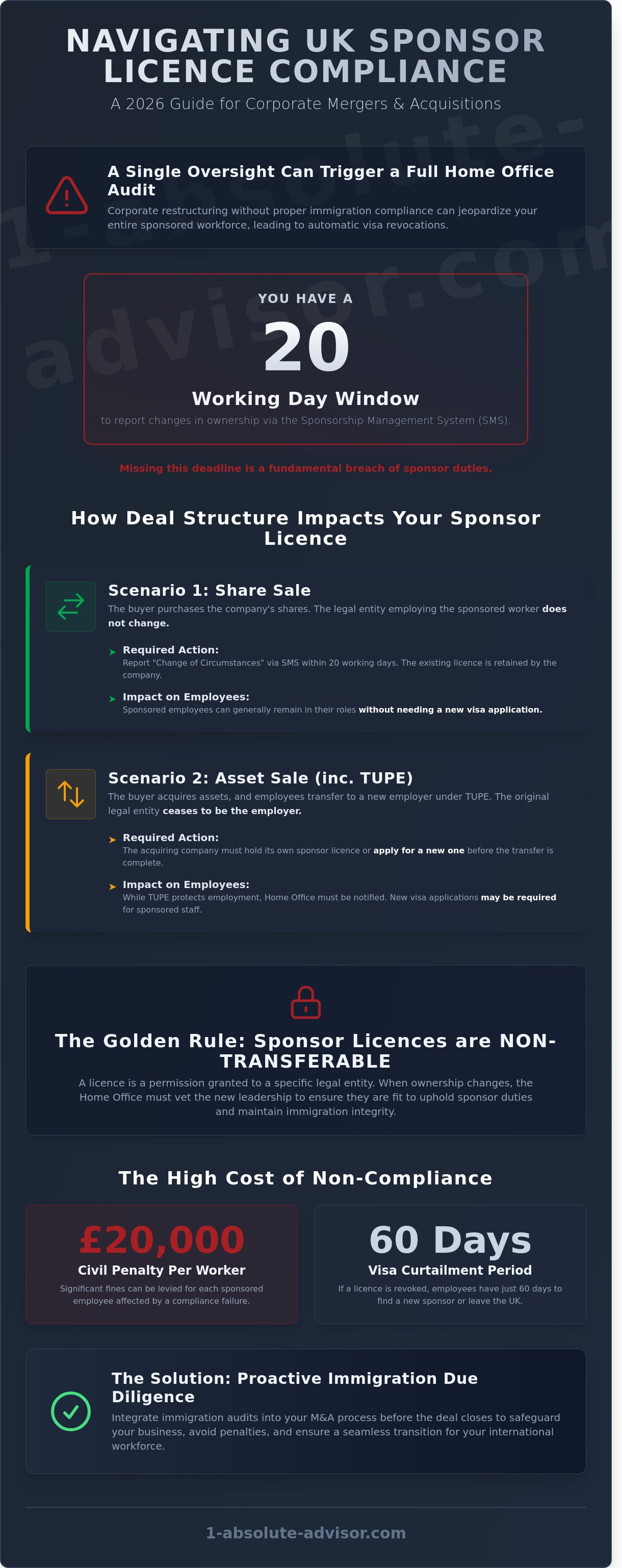
Speed is the most critical factor in maintaining compliance during a corporate transaction. The Home Office requires all sponsors to report changes in ownership or controlling interest via the Sponsorship Management System (SMS) within 20 working days. This isn’t a suggestion; it’s a hard deadline that leaves no room for administrative delay. The 20-day rule is the most critical timeline in UK business immigration. Missing this window can lead to severe operational risks, including:

  • Immediate suspension or revocation of the sponsor licence.
  • Civil penalties and fines for the business entity.
  • The cancellation of active Skilled Worker visas for your entire international workforce.
  • A cooling-off period before the company can apply for a new licence.

Strategic planning must account for the impact of sponsor company acquisition on skilled worker visa stability well before the deal closes. Proactive reporting ensures that the transition doesn’t disrupt your workforce or trigger unwanted Home Office scrutiny. Our experience shows that businesses that integrate immigration audits into their due diligence process avoid the most common pitfalls of post-acquisition compliance.

Share Sale vs. Asset Sale: How Deal Structure Affects Your Visa

The legal architecture of a corporate acquisition dictates the specific immigration workflow required to maintain compliance. While a deal might seem like a singular event to a boardroom, the Home Office views share sales and asset transfers through entirely different regulatory lenses. The impact of sponsor company acquisition on skilled worker visa holders depends on whether the legal entity employing them remains the same or changes entirely.

The Share Sale Scenario

In a share sale, the buyer purchases the shares of the target company. The legal entity employing the worker doesn’t change; the Company Registration Number and the existing employer-employee contracts remain intact. Only the “controlling interest” or the ultimate parent ownership shifts. This scenario generally involves fewer immediate hurdles for the visa holder, but it’s far from an administrative-free zone.

The sponsor must submit a “Change of Circumstances” report via the Sponsorship Management System (SMS) within 20 working days of the deal’s completion. Even though the licence remains valid, the Home Office requires full transparency regarding the new ownership structure. Existing Certificates of Sponsorship (CoS) stay in force, yet the new management must audit salary thresholds against 2026 standards. If the acquisition leads to a restructuring of pay scales, the organisation must ensure the worker still meets the minimum salary requirements for their specific SOC code. Failure to report these shifts accurately within the 20-day window can lead to a “B-rating” or total licence revocation.

The Asset Sale and TUPE Transfers

Asset sales are more complex because the employees move from Company A to Company B. This transition is typically governed by the Transfer of Undertakings (Protection of Employment) Regulations 2006, or TUPE. Under TUPE, the new employer inherits the rights, powers, duties, and liabilities of the previous employment contracts. From an immigration perspective, this constitutes a change of employer, which triggers a rigorous 20-day compliance countdown.

Company B must either already hold a valid sponsor licence or apply for one within 20 working days of the transfer. The new sponsor must explicitly report that they’re accepting “full responsibility” for the transferred staff. This process is strictly regulated by the UK Sponsor Duties and Compliance Guide, which outlines how the new owner assumes the legacy reporting history of the workers. If the new owner doesn’t secure a licence or fails to report the TUPE transfer correctly, the Home Office may curtail the workers’ visas to just 60 days, forcing them to find a new sponsor or leave the UK. Identifying these risks early in the due diligence phase is vital. If you’re managing a transition of this scale, seeking a strategic compliance audit can prevent costly disruptions to your workforce.

Impact of Sponsor Company Acquisition on Skilled Worker Visas: 2026 Compliance Guide

Navigating the SMS and Reporting Requirements Post-Acquisition

The Home Office mandates a strict 20-working-day window to report a corporate restructure. Missing this deadline can lead to the immediate downgrading or revocation of your sponsor licence. The impact of sponsor company acquisition on skilled worker visa holders is most acute during this administrative phase, as any lapse in reporting threatens the legality of their stay in the UK. Responsibility for reporting doesn’t fall on a single party; both the predecessor and the successor organisations must take action. The seller must report the cessation of trade or change in control, while the buyer must report the acquisition through their own Sponsorship Management System (SMS) portal.

The Home Office requires specific documentary evidence to validate the transition. You’ll need to upload the Sale and Purchase Agreement (SPA), relevant Companies House filings showing the new Persons of Significant Control (PSC), and a comprehensive list of all employees transferring under the Transfer of Undertakings (Protection of Employment) regulations, commonly known as TUPE. Managing the acquired company’s licence is equally critical. It typically becomes “dormant” for a period, allowing the new owner to move sponsored workers to their own licence before the old one is surrendered or expires.

Updating the SMS Profile

Distinguishing between a “Change of Ownership” and a “Merger” within the SMS is a common stumbling block. A merger usually involves two entities becoming a single new legal entity, while a change of ownership often involves the purchase of shares or assets. You must appoint a new Authorising Officer (AO) immediately if the previous one departs during the restructure. It’s also vital to add new Level 1 users from the acquiring company. This ensures that the system remains accessible and that the “dormant” licence doesn’t become an administrative dead end, preventing you from assigning new Certificates of Sponsorship (CoS) when needed.

Post-Acquisition Right to Work Audits

Acquiring a company doesn’t mean you inherit their statutory excuse against civil penalties. The new employer must re-verify the right to work for every transferred staff member to remain compliant with Home Office standards. Under TUPE, there’s a 60-day grace period from the date of transfer to complete these checks. Given that fines for illegal working rose significantly in 2024, reaching up to £60,000 per worker for repeat offenders, this audit is a non-negotiable priority. For a deeper understanding of standard compliance rules, refer to this guide on the Skilled Worker Visa UK 2026. The impact of sponsor company acquisition on skilled worker visa stability depends entirely on how meticulously these audits are performed within that initial two-month window.

The Impact on Sponsored Employees: Do You Need a New Visa?

The immediate reaction to a corporate takeover is often one of high anxiety. For workers on a Skilled Worker visa, the question “Will I be deported if my company is bought?” usually tops the list. You can rest assured that a change in ownership doesn’t trigger an automatic exit from the UK. Under the Transfer of Undertakings (Protection of Employment) Regulations 2006 (TUPE), your existing employment rights are protected. If the new entity takes over the sponsorship responsibility and your job role remains identical, you won’t need to apply for a new visa immediately. Your current leave remains valid until its original expiry date.

The impact of sponsor company acquisition on skilled worker visa holders depends heavily on the continuity of the role. You don’t need a new visa if your core duties, SOC code, and salary remain consistent with your original Certificate of Sponsorship (CoS). The Home Office views this as a seamless transfer of responsibility. While there’s no “cooling-off” period that requires you to stop working or leave the country, the new employer must report the change via the Sponsor Management System (SMS) within 28 days of the transfer. Failure to meet this administrative deadline is the employer’s risk, not yours, provided the job remains the same.

When a New Visa Application IS Required

There are specific triggers that mandate a fresh “Change of Employment” application. If the acquisition leads to a promotion or restructure that changes your core duties enough to move you into a different SOC code, you must apply for a new visa before starting that new role. Similarly, if your salary is adjusted downwards and falls below the 2026 thresholds, which currently sit at a baseline of £38,700 for most roles, your sponsorship might be at risk. Finally, if the acquiring company refuses to take over sponsorship or fails to obtain a license within the required 28-day window, your leave may be curtailed to 60 days.

Protecting the ILR Qualifying Period

Maintaining the “continuous residence” requirement is vital for those planning to stay in Britain long-term. Any “gap” in sponsorship during an acquisition can be catastrophic for your timeline. To avoid resetting the 5-year clock, ensure the new sponsor accepts full liability for your employment from day one of the transfer. This prevents a break in your lawful residence. You can learn more about how these periods are calculated in our ILR UK Guide, which explains the 5-year qualifying period in detail. Professional oversight ensures that the impact of sponsor company acquisition on skilled worker visa status doesn’t jeopardise your future settlement goals.

If you’re concerned about how a pending merger affects your residency status, contact our immigration compliance team for a strategic review of your sponsorship details.

Ensuring Compliance During Restructuring with Professional Support

Corporate restructures carry inherent risks that extend far beyond the balance sheet. At 1 Absolute Advisor, we bridge the gap between corporate law and immigration compliance, ensuring that the impact of sponsor company acquisition on skilled worker visa holders doesn’t lead to operational disruption. We manage the transition for both buyers and sellers by aligning HR systems with Home Office requirements before the deal concludes. This proactive stance prevents the automatic revocation of licences that often occurs when the strict 20-working-day reporting window is missed.

Our approach is rooted in risk mitigation. We act as a strategic partner, preparing the necessary evidence for TUPE transfers and ensuring that the new entity’s hierarchy is ready to take on sponsorship duties. By handling the administrative burden of the Sponsorship Management System (SMS), we allow leadership teams to focus on the commercial integration of the two businesses.

Immigration Due Diligence for Acquisitions

A successful acquisition requires a granular look at the target company’s immigration health. We identify hidden liabilities, such as historic reporting failures or incorrect salary rates, which could trigger a Home Office audit post-completion. Our expert review includes:

  • Licence Health Checks: Verifying if the target company has complied with Appendix Sponsor: Duties and Compliance to avoid inheriting “B-rated” or suspended licences.
  • CoS Verification: A rigorous audit of current Certificates of Sponsorship to ensure job descriptions and SOC codes align with 2024 and 2026 salary thresholds.
  • Right-to-Work Audits: Since civil penalties for illegal working increased to £60,000 per worker in February 2024, we verify the target’s historic compliance to protect the buyer from massive financial exposure.

Our Fixed-Fee Application Service

Managing the SMS during a merger is a technical burden that most internal HR teams aren’t equipped to handle alone. We provide fixed-fee management for the entire restructure process, offering a predictable cost structure that eliminates financial ambiguity. Our advisors provide dedicated support for Authorising Officers and Level 1 users, guiding them through the complexities of reporting “Changes of Circumstances” and new licence applications.

If a buyer isn’t already a sponsor, we facilitate fast-track licence applications to ensure they’re “sponsorship-ready” by the completion date. This ensures the impact of sponsor company acquisition on skilled worker visa status is managed with absolute precision, protecting your international talent from losing their right to remain in the UK.

Contact our OISC-registered advisors for a consultation to secure your workforce during your next corporate transition.

Securing Your Workforce During Corporate Transitions

Corporate restructures represent significant regulatory milestones rather than simple financial shifts. Whether your deal involves a share sale or an asset transfer, the impact of sponsor company acquisition on skilled worker visa holders requires immediate attention within the 20-working-day reporting window mandated by Home Office guidelines. Misidentifying a TUPE transfer or failing to update the Sponsorship Management System (SMS) can lead to the revocation of your licence and the curtailment of staff leave. It’s vital to remember that sponsor licences aren’t transferable; new entities often need to submit fresh applications within the 28-day grace period following a change of control.

Our team provides the absolute precision required to navigate these complex legal frameworks. As OISC-registered immigration consultants, we offer specialist expertise in corporate restructures and TUPE transfers to ensure your business remains compliant. We provide fixed-fee application management with no hidden costs, allowing you to plan your budget with total certainty. Secure your business and staff today with our professional Skilled Worker visa services. By addressing these compliance requirements proactively, you’ll protect your international talent and ensure your company’s long-term stability in the UK market.

These legal frameworks ensure businesses can operate smoothly, supporting the UK’s role as a global hub for both commerce and culture, including major sporting events. For international visitors, especially those planning complex trips from Europe, guides like fotballturer.no can offer a useful perspective on the logistics involved in traveling to the UK.

Frequently Asked Questions

Does a company acquisition automatically cancel my Skilled Worker visa?

No, an acquisition doesn’t automatically cancel your visa. Under the Transfer of Undertakings (Protection of Employment) Regulations 2006, your employment contract and sponsorship usually transfer to the new entity. You’ll remain legally employed as long as the acquiring company follows the mandatory Home Office reporting procedures within the 20-working-day deadline.

How long do we have to notify the Home Office after a business merger?

The acquiring company must report the merger through the Sponsor Management System within 20 working days of the transaction’s legal completion. This timeframe is non-negotiable. Failure to meet this deadline can lead to the Home Office reducing your visa duration to 60 days, effectively forcing you to leave the UK or find a new sponsor.

What happens if the acquiring company does not have a sponsor licence?

If the new owner doesn’t hold a valid licence, they must apply for one within 20 working days of the acquisition date. This is a critical factor when assessing the impact of sponsor company acquisition on skilled worker visa holders. If the application is rejected, the company can’t legally sponsor you, and your leave to remain will likely be curtailed.

Can a sponsored worker change roles during a company restructure?

You can’t move into a role with a different SOC code without submitting a fresh “change of employment” application to the Home Office. If the restructure only changes your job title but your core duties and SOC code remain identical, the sponsor simply needs to update the SMS. Significant changes to salary or location also require formal reporting to maintain compliance.

Do I need to pay the Immigration Skills Charge again after an acquisition?

You don’t usually need to pay the Immigration Skills Charge again if your employment transfers under TUPE rules. The Home Office treats the initial payment as valid for the remainder of your current visa period. However, if the acquisition forces you to apply for a new visa because your job role has changed, the employer must pay the £1,000 annual fee again.

What is the risk of a sponsor licence being revoked during a share sale?

The risk of revocation increases if the new management fails the Home Office “fit and proper” person test during the mandatory 20-day reporting window. If the Home Office uncovers previous compliance gaps or determines the new owners are unsuitable, they’ll revoke the licence. This results in all sponsored staff receiving a 60-day notice to find alternative employment.

How does TUPE affect my right to work in the UK?

TUPE protects your continuous service record, which is vital for your future settlement prospects. The new employer must carry out a fresh right-to-work check within 60 days of the transfer to comply with the Immigration, Asylum and Nationality Act 2006. As long as the transfer is documented correctly, your right to work remains continuous throughout the transition period.

Can I apply for Indefinite Leave to Remain if my employer was acquired?

Yes, you can apply for ILR once you complete the 5-year residency period. The impact of sponsor company acquisition on skilled worker visa status won’t reset your qualifying period if the transfer followed TUPE regulations. You’ll need to provide a sponsor letter from the new entity confirming your continued employment and that you’re still required for your specific role.

UK Spouse Visa Advisor London: Secure Your Future with Expert Legal Guidance

What if a single missing payslip or an incorrectly formatted employer letter is the only thing preventing your partner from joining you in the UK? You’ve likely already felt the pressure of the Home Office’s shifting goalposts, especially with the 2026 financial requirement thresholds scheduled to reach £38,700. It’s natural to feel overwhelmed by the prospect of gathering hundreds of pages of evidence while the fear of a forced separation hangs over your daily life. By working with a dedicated uk spouse visa advisor london, you can replace that uncertainty with a strategic roadmap to success. This guide explains how to master the complex 2026 evidentiary requirements and ensure your application is granted on the first attempt without unnecessary delays. We’ll examine the specific legal benchmarks you must hit, the exact way to document your relationship history, and the common pitfalls that lead to immediate visa refusals. Our goal is to provide you with the absolute certainty that your case is prepared to the highest professional standard.

Key Takeaways

  • Understand the complexities of the 2026 Home Office requirements to effectively mitigate the high risks associated with unrepresented visa applications.
  • Discover how an OISC-registered uk spouse visa advisor london provides the professional integrity and legal compliance necessary for a successful submission.
  • Compare the financial predictability of a fixed-fee service model against the traditional hourly rates of immigration solicitors to ensure total cost transparency.
  • Learn the strategic importance of a bespoke document mapping process that aligns your unique personal circumstances with strict UKVI criteria.
  • Explore a holistic roadmap to residency, moving from an initial eligibility assessment to a comprehensive final submission with absolute confidence.

The UK Spouse Visa remains the primary legal pathway for partners of British citizens or settled persons to build a life in the United Kingdom. In 2026, the landscape of British immigration is defined by rigorous compliance standards and a “digital-first” approach that leaves little room for clerical errors. For many couples, the stakes couldn’t be higher. A refusal doesn’t just mean a lost application fee; it often results in forced family separation and a complex appeals process that can last over 12 months. Home Office statistics consistently show that unrepresented applicants face higher rejection rates, often due to a failure to meet the specific evidential requirements of Appendix FM. Navigating the Complexities of the UK Spouse Visa requires a clinical understanding of the rules, where the burden of proof lies entirely on the applicant to demonstrate they meet the financial, relationship, and English language pillars.

Engaging a uk spouse visa advisor london provides the professional oversight necessary to bridge the gap between simple eligibility and total compliance. In a city that serves as the global hub for immigration law, an advisor doesn’t just fill out forms. They act as a strategic partner who audits your life through the lens of a Home Office caseworker, ensuring every bank statement and chat log serves as an indisputable piece of evidence.

The 2026 Financial Requirement: Why Strategy Matters

As of early 2026, the minimum income threshold for a Spouse Visa stands at £38,700 per annum, a figure that has stabilized after the phased increases of 2024. Meeting this requirement is rarely straightforward. While many rely on Category A salaried employment, others must navigate the complexities of Category F self-employment or Category D cash savings. If you’re using savings to meet the shortfall, the formula remains punishing: you need £16,000 plus 2.5 times the deficit of your annual income. For a couple with zero income, this necessitates a stagnant balance of over £112,000 held for at least six months. A professional audit is vital here because the Home Office rejects applications if a single payslip is missing or if a bank statement doesn’t show the net salary hitting the account on the exact date specified. We ensure your financial portfolio is airtight before submission.

Proving a Genuine and Subsisting Relationship

The Home Office looks far beyond a marriage certificate to determine if a union is “genuine and subsisting.” They seek “objective” proof of a shared life. For couples living together, this means providing at least six items of joint correspondence, or twelve individual items, from at least three different official sources like the NHS, HMRC, or utility providers. These documents must span the two years immediately preceding the application.

  • Joint Financial Commitments: Shared tenancy agreements, mortgages, or joint bank accounts showing active household spending.
  • Evidence of Contact: For those applying from overseas, a chronological log of travel tickets, photos together in different locations, and itemized call records.
  • Social Recognition: Letters of support from friends or family, though these are considered “weak” evidence compared to financial ties.

A common pitfall occurs when genuine couples rely on “subjective” evidence, such as hundreds of wedding photos, while neglecting the “objective” paper trail of cohabitation. Caseworkers often view an abundance of photos as a distraction from a lack of utility bills. A uk spouse visa advisor london identifies these evidentiary gaps early, allowing couples to rectify their documentation months before the actual filing date, ensuring the 2026 submission is beyond reproach.

Why Hire an OISC-Registered Spouse Visa Advisor in London?

Choosing a uk spouse visa advisor london involves more than just finding a consultant; it’s about ensuring your representative meets the legal standards set by the UK government. The Office of the Immigration Services Commissioner (OISC) acts as the statutory regulator for immigration advice in the UK to ensure consumer protection. Under the Immigration and Asylum Act 1999, providing immigration advice without being OISC-registered or otherwise exempt is a criminal offense. This regulatory framework guarantees that your advisor possesses the necessary professional indemnity insurance and follows a strict Code of Standards regarding ethics and financial transparency.

Registration isn’t a one-time achievement. Advisors undergo regular audits to prove their competence and must stay updated on the rapidly shifting landscape of UK immigration law. For example, the significant hike in the minimum income requirement to £29,000, which took effect on April 11, 2024, requires advisors to have a precise understanding of complex financial evidence. A qualified advisor ensures your application aligns perfectly with the latest UK Spouse Visa requirements, reducing the risk of a costly rejection or delay.

London-based advisors often handle a higher volume of “non-standard” cases compared to regional counterparts. Whether your situation involves self-employment income, previous visa refusals, or complex human rights arguments, an experienced consultant provides the strategic depth needed for success. If you’re unsure about the benefits of professional oversight, you can explore Why Use an OISC Registered Immigration Consultant in London? to understand the full scope of protection offered to applicants.

The Levels of OISC Advice: Choosing the Right Expertise

OISC regulation is divided into three distinct levels to match the complexity of different cases. Level 1 advisors handle straightforward applications within the Immigration Rules, making them suitable for standard spouse visa entries and extensions. Level 2 and Level 3 advisors are authorized to manage more intricate “non-standard” casework, including applications outside the rules or those involving discretionary leave. If your history includes a deportation order or a complex criminal record, a Level 3 specialist is essential for tribunal-level advocacy. Selecting the correct level ensures you don’t pay for unnecessary complexity while still receiving robust legal protection.

Local London Expertise with National Reach

The proximity of a uk spouse visa advisor london to the Home Office headquarters and major legal hubs like the Royal Courts of Justice provides a distinct advantage. London advisors are often the first to witness shifts in processing trends and Home Office “vibe” changes that might not be reflected in official guidance for months. This local insight allows for more proactive application strategies.

  • Strategic Location: Proximity to the Croydon Lunar House premium service centers can be beneficial for specific administrative hurdles.
  • Digital Accessibility: Modern London firms utilize secure digital portals, allowing them to serve clients in Manchester, Birmingham, or even overseas with the same precision as a face-to-face meeting.
  • Regional Trends: Advisors in the capital often have direct experience with a wider variety of Entry Clearance Officers across global visa processing hubs.

Experienced advisors don’t just fill out forms; they build a comprehensive evidence portfolio that pre-empts potential questions from caseworkers. This methodical approach is why many couples choose to consult with a specialist before submitting their documents. It’s about converting a stressful legal process into a manageable, predictable journey toward residency in the UK.

The primary hurdle for many families is the perceived cost of professional guidance. It’s common to view advisor fees as an additional burden on top of already high Home Office charges. However, the traditional legal model often relies on hourly rates that range from £250 to £450 per hour in Central London. This structure creates financial uncertainty; you can’t predict how many hours a solicitor will bill for “research” or “correspondence.” A specialized uk spouse visa advisor london like 1 Absolute Advisor operates differently by utilizing a fixed-fee model. This approach provides a clear, upfront cost that covers the entire journey from the initial consultation to the final decision.

Choosing a comprehensive management service means every detail is handled by a professional. This includes the meticulous collation of financial evidence, the drafting of detailed legal representations, and the final submission through the UKVCAS portal. For those who feel confident in their ability to gather documents but require a professional “safety net,” a Document Checking service serves as a vital alternative. This option typically costs significantly less than full management while still providing a rigorous audit of your evidence against current Appendix FM requirements.

The Hidden Costs of a DIY Visa Application

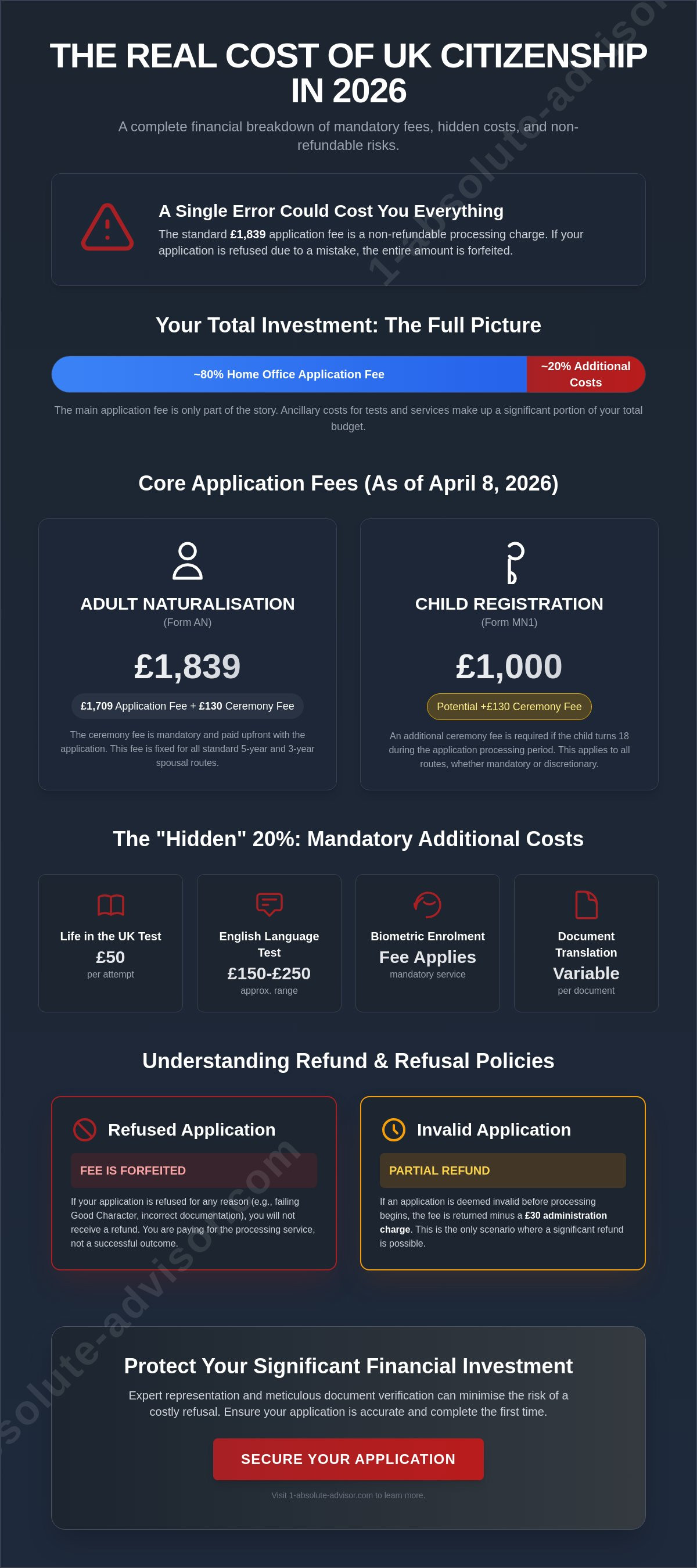
Opting for a DIY application often results in a false economy. As of 2024, the Home Office fee for a spouse visa applied for outside the UK is £1,846. When you add the Immigration Health Surcharge (IHS), which is currently £3,105 for a 33-month visa, your total government investment exceeds £4,900. If your application is refused due to a minor clerical error or a missing bank statement, the £1,846 application fee is lost forever. You don’t get a refund for mistakes. An appeal can take 6 to 12 months to process, keeping families apart and costing an additional £140 for a tribunal hearing plus thousands in extra legal fees. Professional fees are effectively an insurance policy that protects your £5,000 investment and your family’s future stability.

Transparency in Professional Fees

We believe that financial predictability is essential for a stress-free immigration process. 1 Absolute Advisor structures fees so there are no surprise costs at the end of your case. Every client receives a detailed client-care letter before any work begins. This document outlines the exact scope of our services and the total price you’ll pay. Value-based pricing is superior to time-based billing because it aligns our goals with yours; we focus on the quality and accuracy of the submission rather than the number of hours spent on the file. Working with OISC-registered advisors ensures that your case is handled by professionals who are legally required to maintain strict standards of competence and transparency.

A dedicated uk spouse visa advisor london provides more than just form-filling. We provide a strategic roadmap. Statistics show that roughly 15% of family visa applications are initially refused, often because the applicant failed to provide “specified evidence” in the exact format required by the Home Office. By choosing a professional service, you’re leveraging years of experience to avoid these common pitfalls. Whether you choose full representation or a final document check, the goal remains the same: a successful outcome on the first attempt, saving you from the emotional and financial drain of a refusal.

The Absolute Roadmap: From Initial Consultation to Visa Approval

Success in a UK family migration application isn’t a matter of luck; it’s the result of a rigorous, four-stage methodology. The journey starts with a forensic audit of your financial and personal circumstances to ensure absolute compliance with the current Immigration Rules. Since the Home Office increased the minimum income requirement to £29,000 on April 11, 2024, the margin for error has vanished. Retaining a uk spouse visa advisor london provides a structured pathway that mitigates the risk of a £1,846 application fee being wasted on a refusal.

  • Step 1: The Initial Assessment – We verify your eligibility against the financial, English language, and relationship requirements before any formal engagement. This prevents the 15% of applicants who fail due to basic eligibility oversights from proceeding prematurely.
  • Step 2: Strategic Document Mapping – We create a bespoke evidence matrix. Unlike generic online checklists, this plan accounts for your specific income source, whether it’s Category A salaried employment or complex Category F self-employment income.
  • Step 3: Legal Representation – Our team drafts a comprehensive legal summary. This document bridges the gap between your raw evidence and the specific paragraphs of Appendix FM.
  • Step 4: Submission and Beyond – We manage the digital upload to the Sopra Steria or VFS Global portals, ensuring every file meets the strict 6MB size limit and resolution standards required for clear viewing by entry clearance officers.

The Power of a Professional Legal Cover Letter

A professional cover letter acts as the executive summary of your entire life. It doesn’t just list documents; it argues why your case meets the law. By referencing specific Immigration Rules and relevant caselaw, such as Chikwamba principles for internal applications, we guide the officer to the only logical conclusion: an approval. This strategic clarity can reduce the time an officer spends on your file, often leading to faster decisions within the standard 24-week window or the 30-day priority service timeline.

Managing the Evidence: Quality Over Quantity

Home Office officers have approximately 30 to 60 minutes to review a standard application. Submitting 500 pages of unorganized WhatsApp screenshots or blurred photos is a recipe for delay. An expert uk spouse visa advisor london transforms a chaotic pile of documents into a curated, 20-page bundle of high-impact evidence. We ensure every foreign document is accompanied by a translation that meets the Home Office’s 2024 certification standards, including the translator’s credentials and a dated declaration of accuracy.

Don’t leave your family’s future to chance in an increasingly complex regulatory environment. Secure your path to the UK with a strategy built on precision and legal expertise.

Book your absolute eligibility assessment today

Once the submission is complete, our role shifts to proactive monitoring. We track the progress of your file through the Home Office back-end systems, providing you with updates as the “Application Received” status moves toward “Decided.” This end-to-end management provides the stability and predictability that is essential when your partner’s right to live in the UK is at stake. We don’t just submit forms; we manage the entire legal project from start to finish.

Start Your UK Journey with 1 Absolute Advisor

Professional integrity isn’t just a buzzword at 1 Absolute Advisor; it’s the foundation of every successful reunion we facilitate. The UK immigration system became significantly more complex in April 2024 following the increase in minimum income requirements to £29,000. Navigating these shifts requires a uk spouse visa advisor london who prioritizes precision over speed. Our fixed-fee model ensures that you face no hidden costs or unexpected invoices during what is already a financially demanding period. By providing a clear, upfront quote, we remove the fiscal ambiguity that often plagues legal services in the City.

Applying for a visa involves high stakes. A single missing bank statement or an incorrectly formatted employer letter can lead to a refusal, resulting in the loss of the £1,846 application fee. To mitigate this risk, we offer a specialized oversight that catches discrepancies before the Home Office sees them. You can learn more about this through Our Document Checking Service: Avoid Common Visa Errors, which has helped maintain our high success rate for complex family applications. Our goal is to provide absolute certainty in an uncertain regulatory environment.

A Personalized Approach to Immigration

We don’t view your application as a set of forms or a reference number in a database. Every couple has a unique history, and your evidence must reflect that reality while satisfying strict Home Office criteria. When you work with us, you’re assigned a dedicated advisor who remains your single point of contact for the entire duration of the process. This continuity is vital. Whether your case involves self-employment income, offshore savings, or previous immigration complications, your advisor understands the nuances of your specific file. You won’t have to repeat your story to different departments. We stand by you from the initial document gathering phase until the moment your BRP arrives. You don’t have to face the Home Office alone; we provide the strategic shield your family deserves.

Contact Your London Spouse Visa Expert Today

Taking the first step toward your new life in the UK is simple. We invite you to book a no-obligation initial assessment to discuss your eligibility and timeline. This session provides a clear roadmap, identifying potential hurdles before they become expensive mistakes. Our office is conveniently located on City Road, making it easy for London-based clients to attend in-person consultations. If you prefer a digital approach, we offer secure video meetings that fit into your professional schedule.

To begin, call our London office directly or fill out the inquiry form on our website. We respond to 95% of inquiries within four business hours because we know that time is your most precious commodity. Let us handle the bureaucratic burden while you focus on building your home. Choosing a uk spouse visa advisor london provides more than just administrative support; it secures your future in Britain. Secure your UK Spouse Visa with 1 Absolute Advisor and experience a service defined by professional excellence and absolute reliability.

Take the First Step Toward Your Life in the UK

Navigating the 2026 immigration landscape requires more than just filling out forms; it demands a strategic partnership. By choosing an OISC Level 1 registered professional, you ensure your application meets the stringent Home Office criteria from day one. Our team operates from the heart of London in the EC1V district, providing the stability and local expertise necessary to handle complex family migration cases. We’ve eliminated the uncertainty of traditional hourly billing by implementing a transparent fixed-fee guarantee, so you’ll know exactly what your investment is before we begin. Working with a dedicated uk spouse visa advisor london transforms a daunting legal process into a manageable, step-by-step roadmap toward your life together in Britain.

You don’t have to face the Home Office’s evolving requirements alone when professional integrity and expert support are within reach. It’s time to move past the stress of paperwork and focus on your shared future. Book Your Spouse Visa Consultation with a London Expert today and secure the professional guidance your family deserves. Your journey to a stable life in the UK starts with a single, well-informed decision.

Frequently Asked Questions

How much does a UK Spouse Visa advisor in London cost in 2026?

Professional fees for a uk spouse visa advisor london typically range from £1,500 to £3,500 for full application management in 2026. This investment covers your initial strategy consultation, document audit, and formal representation with the Home Office. You’ll also need to budget for the government application fee of £1,846 and the Immigration Health Surcharge, which currently stands at £1,035 per year of the visa duration.

What is the difference between an immigration solicitor and an OISC advisor?

The primary distinction lies in their regulatory bodies and the breadth of legal services they’re authorised to provide. Immigration solicitors are regulated by the Solicitors Regulation Authority (SRA) and can handle complex judicial reviews in the High Court. OISC advisors are regulated by the Office of the Immigration Services Commissioner and often specialise exclusively in visa applications. Both professionals provide expert guidance, but solicitors are often preferred for cases involving intricate legal litigation.

Can a London advisor help me if I am currently outside the UK?

You can certainly instruct a London-based expert while living abroad, as 90% of our international casework is now handled through secure digital portals and video consultations. This ensures your documentation meets strict UK standards before you attend your biometric appointment at a local visa application centre. Working with a uk spouse visa advisor london provides the advantage of local expertise and direct proximity to the Home Office decision-making framework while you’re still overseas.

What is the current processing time for a UK Spouse Visa with professional help?

Standard processing times for overseas applications currently average 24 weeks, while applications made within the UK typically take 8 weeks. If you require an expedited decision, the Priority Service can reduce this wait time to approximately 30 working days for an additional £500 fee. Professional oversight reduces the risk of delays, as 15% of self-submitted applications face requests for further information due to missing financial evidence.

What happens if my Spouse Visa application is refused?

If your application is refused, you’ll receive a formal decision letter detailing why you failed to meet the requirements of Appendix FM. You generally have 14 days to lodge an appeal if you applied within the UK, or 28 days for overseas refusals. We’ll analyse the caseworker’s logic to determine if a fresh application or an appeal to the First-tier Tribunal is the most efficient way to rectify the situation.

Is the financial requirement higher in 2026 than in previous years?

The minimum income requirement remains at £29,000 in 2026, following the significant increase implemented in April 2024. You must demonstrate this through six months of consecutive payslips or a full year of audited accounts if you’re self-employed. If your salary falls below this threshold, you can use cash savings above £16,000 to meet the requirement, provided those funds have been in your control for at least 180 days.

Can I switch from a Fiancé Visa to a Spouse Visa while in London?

You’re permitted to switch to a Spouse Visa from within the UK as soon as your marriage or civil partnership ceremony is complete. It’s vital to submit this application before your six-month Fiancé Visa expires to avoid overstaying your leave. This transition grants you a 30-month residency period and, unlike the initial fiancé entry, allows you to take up employment or self-employment immediately upon approval.

How many years of cohabitation do I need to prove for a Spouse Visa?

You must provide evidence of at least two years of cohabitation if you’re applying as an unmarried partner. For those who are already married or in a civil partnership, there isn’t a mandatory minimum cohabitation period, but you must prove your relationship is genuine. We typically recommend submitting six items of joint correspondence, such as council tax bills or bank statements, covering the 24 months preceding your application date.

Discuss Your Case For FREE