

Certificate of Sponsorship (CoS) UK Explained: A 2026 Expert Guide

Did you know that according to Home Office transparency data, thousands of Skilled Worker visa applications face delays or refusals each year simply because of minor clerical discrepancies on a digital record? Having the certificate of sponsorship uk explained in a clear, strategic context is no longer just a legal necessity; it’s a critical component of your organization’s growth and compliance framework. You likely feel that the distinction between Defined and Undefined certificates is unnecessarily opaque, and the fear of a 90 day expiry date passing by can create significant pressure on your HR team.

We’ve designed this 2026 expert guide to help you master these complexities, ensuring you can verify CoS accuracy with absolute confidence and avoid the pitfalls of Home Office rejection. We’ll provide a definitive breakdown of the current requirements, specific timelines for 2026, and a practical checklist to safeguard your recruitment process. By the end of this article, you’ll have a holistic understanding of how the CoS functions as the backbone of the UK immigration system, allowing you to proceed with your visa applications without the usual uncertainty.

Key Takeaways

  • Understand the role of the Certificate of Sponsorship as a mandatory electronic record that serves as the essential “golden ticket” for your UK work visa journey.
  • Learn to distinguish between Defined and Undefined certificates, a critical step in this certificate of sponsorship uk explained guide to ensure your employer follows the correct procedural route.
  • Master the technical requirements of a valid CoS, including the precise alignment of SOC codes and personal data to eliminate the risk of automatic visa refusal.
  • Navigate the essential 3-month validity timeline and assignment rules to manage your application process with absolute precision and cost-efficiency.
  • Discover how expert OISC-registered guidance acts as a strategic safeguard by auditing your CoS for clerical errors before your final submission to the Home Office.

Understanding the Certificate of Sponsorship (CoS) for UK Visas

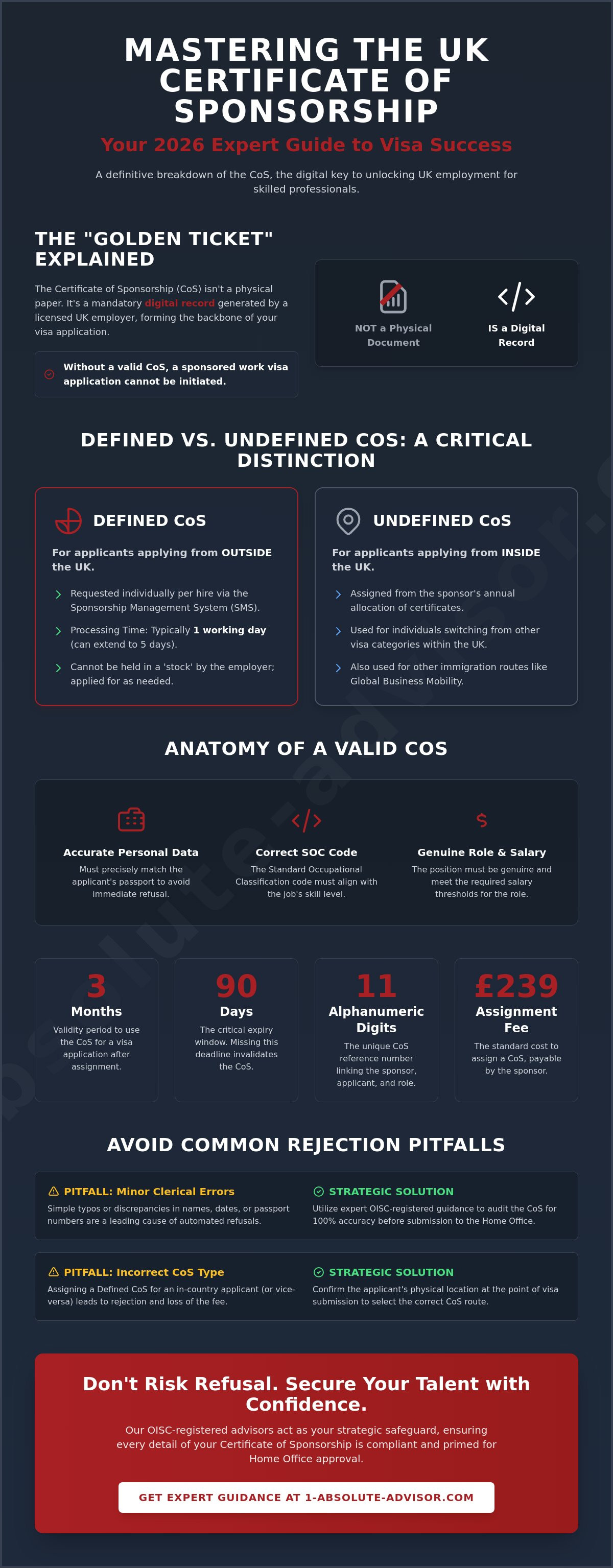
The Certificate of Sponsorship (CoS) represents the cornerstone of modern corporate immigration. Contrary to what the name might suggest, it isn’t a physical paper document or a printed certificate. It’s a digital record generated by a licensed employer and stored on the Home Office’s secure database. This electronic record is essential for any professional seeking to work in Britain under the UK points-based immigration system. Without a valid CoS, an individual cannot initiate a visa application for most sponsored work routes.

Securing a CoS is often described as the “golden ticket” for international talent. It’s a mandatory requirement for several key visa categories, most notably the Skilled Worker visa, the Health and Care Worker visa, and various Global Business Mobility routes. While the CoS is a fundamental prerequisite, it doesn’t guarantee a successful visa outcome. It serves as a verification that a legitimate UK business is willing to sponsor the applicant, but the Home Office will still independently assess the individual’s personal eligibility, including their English language proficiency and financial requirements. This certificate of sponsorship uk explained guide ensures you understand that the document is a bridge between the employer’s needs and the government’s compliance standards.

The Legal Relationship Between Sponsor and Migrant

Issuing a CoS creates a formal, legal pledge between the employer and the Home Office. By assigning this record, the sponsor confirms they’ve vetted the candidate and that the role is genuine. The employer carries the burden of proof to ensure the position meets specific skill levels and salary thresholds required by UK law. If the role is found to be a “sham” or doesn’t meet the SOC (Standard Occupational Classification) code requirements, the sponsor risks losing their license. The CoS reference number is the unique 11-digit alphanumeric key that allows UKVI officials to access the digital details of the sponsorship during the visa adjudication process.

The Sponsorship Management System (SMS)

The entire process takes place within the Sponsorship Management System (SMS), a dedicated online portal where licensed companies manage their sponsorship duties. Employers use this interface to request CoS allocations and assign them to specific individuals. Management of this portal falls under the responsibility of the Authorising Officer, a senior employee within the company who ensures all data entered is accurate and compliant with current regulations. Applicants never access the SMS directly; instead, they receive the reference number from their employer once the record is finalized. This separation of access ensures that the employer remains the primary point of accountability for the data provided to the government.

Defined vs. Undefined Certificates: Which One Do You Need?

Choosing the correct certificate is a critical compliance step for any UK sponsor. The distinction rests primarily on where the candidate is physically located when they submit their visa application. If an employer assigns the wrong type, the Home Office will likely reject the visa application. This mistake leads to the loss of the £239 (or £25) fee and causes significant delays in the recruitment timeline. Understanding how the certificate of sponsorship uk explained framework operates ensures your business remains compliant with the latest 2026 Home Office standards.

Defined CoS: For Out-of-Country Applicants

Employers must use a Defined CoS for Skilled Worker candidates applying from outside the UK. Unlike the pre-allocated pool for internal switches, you can’t hold a stock of these certificates. You’ve to request a specific Defined CoS for each individual hire through the Sponsorship Management System (SMS). According to the official guidance on sponsoring a Skilled Worker, these requests are typically processed within one working day. However, complex cases or high-volume periods in 2026 can extend this to five business days. You’ll need to provide specific job details, including the SOC code and salary, before the Home Office grants approval.

Undefined CoS: For In-Country Switches and Other Routes

Undefined certificates serve candidates already in the UK on a valid visa who wish to switch to the Skilled Worker route. This includes individuals moving from a Graduate visa or those extending their stay with their current employer. This annual cycle is a cornerstone of how the certificate of sponsorship uk explained framework functions for domestic recruitment. Businesses manage these through an annual allocation which runs from 6 April to 5 April each year.

If your allocation hits zero, you’ve to apply for an increase or a follow-on allocation. In 2026, the Home Office has streamlined the Priority Service for these requests. They often grant additional certificates within five working days for a £200 fee. Proactive management of your CoS pool prevents recruitment bottlenecks during peak hiring seasons.

Selecting the wrong category is a common administrative pitfall that triggers automatic refusals. An Undefined CoS assigned to an overseas candidate is invalid. This error forces the applicant to restart their 90-day window, often pushing start dates back by four to six weeks. For firms managing high-volume international recruitment, strategic sponsorship planning provides the necessary oversight to avoid these costly procedural resets. Ensuring your Level 1 user understands these distinctions is the best way to protect your sponsor licence rating.
Certificate of Sponsorship (CoS) UK Explained: A 2026 Expert Guide

Essential Requirements: What a Valid CoS Must Include

Precision is the foundation of a successful visa application. Even a minor discrepancy between your official documents and the digital record can trigger a rejection. When we look at how the certificate of sponsorship uk explained in a practical context, the most vital element is data alignment. The Home Office uses automated systems to cross-reference the CoS against your passport. If your middle name is missing or your date of birth has a transposed digit, the system flags a mismatch. You must ensure every character matches your travel document exactly. This isn’t just about identity; it’s about the legal integrity of the sponsorship.

The Standard Occupational Classification (SOC) code is another critical pillar. This four-digit code defines your job role, its required skill level, and the minimum salary your employer must pay. Choosing the wrong SOC code is a common pitfall that leads to immediate refusal because the Home Office views it as an attempt to bypass immigration rules. If the job duties described don’t align with the chosen SOC code, the caseworker will likely question the “genuineness” of the vacancy.

The Applicant’s Verification Checklist

Before your employer assigns the CoS, you should review a draft to catch errors. Use this checklist to maintain compliance:

  • Personal Details: Check that your name spelling, nationality, and passport number are identical to your current passport.
  • Job Alignment: Confirm that the job title and description meet the specific skilled worker visa uk criteria for skill level and complexity.
  • Maintenance Certification: Verify if your employer has “certified maintenance” on the CoS. If they tick “Yes,” you don’t need to show personal bank statements to prove you can support yourself.

Salary and Work Hours Compliance

The Home Office sets strict financial thresholds that are updated annually. For 2026, you must ensure the salary listed meets the latest uk work visa salary requirement. This involves checking both the general threshold and the “going rate” for your specific SOC code. The higher of the two always applies. Caseworkers calculate the going rate based on a 37.5-hour work week. If you work 40 or 48 hours, your salary must be pro-rated upwards to match the hourly equivalent of the going rate.

Employers often struggle with the financial administrative burden. Beyond the gross pay, they must account for the Immigration Skills Charge costs, which are mandatory for most Skilled Worker roles. If these fees aren’t paid correctly at the time the CoS is assigned, the certificate becomes invalid. If an error is discovered after assignment, the employer can’t edit the CoS directly. Instead, they must use the “Sponsor Notes” field to provide the correct information. This note becomes a permanent part of the digital record that the visa officer reviews during your application. It’s a vital tool for fixing salary typos or minor start-date changes without needing to pay for a new certificate.

Managing the Timeline: Validity, Assignment, and Costs

Successful sponsorship requires more than just finding the right talent; it demands a rigorous adherence to Home Office schedules. The certificate of sponsorship uk explained process highlights that timing is a critical risk factor for any UK business. A CoS remains valid for exactly three months from the date of assignment. If the candidate doesn’t submit their visa application within this window, the certificate expires, and the £239 assignment fee is forfeited. This expiration is absolute, meaning there’s no mechanism to “reactivate” a stale certificate.

Employers must also ensure the CoS isn’t assigned more than three months before the job’s intended start date. This creates a narrow window for administrative precision. If a CoS expires or is cancelled by the Home Office due to inaccuracies, the sponsor must issue a new one, incurring additional costs and potential delays in the recruitment cycle. Planning the assignment date is a strategic decision that should only happen once the candidate’s documentation is fully prepared for the visa submission.

Validity and Start Dates

The “Job Start Date” listed on the CoS acts as the anchor for the entire visa duration and the worker’s entry into the UK. While the Home Office allows some flexibility, the worker should generally begin their role within 28 days of the date listed on the CoS or the date the visa is granted, whichever is later. If delays occur beyond this 28-day threshold, sponsors must report the change via the Sponsorship Management System (SMS) or risk compliance action. It’s vital to remember that a CoS can only be used for one visa application; if the visa is refused, a new certificate is required for any subsequent attempt.

The Financial Burden of Sponsorship

Sponsoring an international worker involves two primary Home Office levies that businesses must account for in their 2026 budgets. First, the assignment fee for a Skilled Worker CoS is £239. Second, the Immigration Skills Charge (ISC) represents a larger investment that must be paid in full at the time of assignment. The rates for 2026 remain structured based on the size of the organisation:

  • Large Sponsors: £1,000 for every 12 months of the visa’s duration.
  • Small or Charitable Organisations: A reduced rate of £364 per year of sponsorship.

Strategic planning helps avoid unnecessary expenses. For example, certain roles, such as those in the Health and Care Visa category or individuals switching from a Student visa to a Skilled Worker visa, are exempt from the ISC. Applicants should clarify who is paying these fees before the CoS is issued, though the law mandates that the sponsor cannot pass the ISC or the CoS assignment fee onto the worker. Failing to pay the correct ISC amount will result in the CoS being marked as “invalid” until the balance is settled.

For a detailed breakdown of your specific sponsorship liabilities, contact our experts for an absolute compliance review.

Ensuring Compliance: How Professional OISC Guidance Prevents Visa Refusals

Precision is the bedrock of a successful Skilled Worker application. The Home Office operates on a policy of strict compliance, where even a minor clerical error on a CoS can trigger an automatic refusal. A misspelled name, an incorrect SOC code, or a slight mismatch in the reported salary versus the employment contract results in a wasted application fee and significant delays for your business operations. Caseworkers rarely offer the benefit of the doubt; they expect data to be perfect.

Professional OISC-registered advisors act as a critical firewall. They audit every data point on the CoS before the visa submission to ensure total alignment with the applicant’s supporting documents. This is particularly vital when dealing with complex cases involving salary trade-offs. For instance, following the April 2024 salary threshold increases to £38,700 for many routes, calculating whether an applicant qualifies as a “New Entrant” or meets the criteria for a specific occupation code requires surgical accuracy. Understanding the certificate of sponsorship uk explained through a lens of legal compliance ensures your uk immigration strategy remains robust and predictable.

Correcting Errors Post-Assignment

If you identify a mistake after a CoS has been assigned but before the visa application is submitted, you don’t always need to start over. The “Sponsor Note” function within the Sponsorship Management System (SMS) allows for minor corrections. This is useful for fixing a typo in a passport number or clarifying a job start date. However, this tool isn’t a universal fix. If the error involves the fundamental visa route or a significant salary discrepancy, the certificate must be cancelled. You’ll then need to assign a fresh CoS and pay the fee again, which is currently £239 for Skilled Workers. Our advisors interface directly with the Home Office to determine the safest course of action, preventing the risk of a refusal based on “invalidity.”

Why Absolute Advisor is Your Strategic Partner

We provide more than just administrative support; we offer a holistic approach to corporate mobility. Our team views the CoS as one piece of a broader business strategy, ensuring your sponsorship license remains in good standing while protecting your talent pipeline. We provide peace of mind through meticulous document checking and a deep understanding of the 2026 immigration landscape. We don’t just process papers; we prepare your business for future regulatory shifts and ensure every submission is audit-ready. Secure your UK work visa with expert CoS guidance from 1 Absolute Advisor.

Securing Your UK Business Growth Through Strategic Compliance

Navigating the Home Office sponsor management system requires more than just administrative effort; it demands a strategic understanding of current immigration law. As this certificate of sponsorship uk explained guide highlights, the distinction between Defined and Undefined certificates determines your entire recruitment timeline. Missing the three month assignment window or failing to pay the correct £239 fee can lead to immediate application rejections. We’ve seen how these small technicalities can derail significant corporate moves when not handled with precision.

Absolute Advisor provides the stability you need in a fluctuating regulatory environment. As an OISC-registered consultancy, we manage the entire lifecycle of your Skilled Worker cases with a focus on professional integrity. Our fixed-fee management ensures you don’t face unexpected costs while we handle the complexities of Home Office audits and compliance checks. We treat your visa strategy as a holistic part of your business’s long-term success, preparing you for future risks before they arise.

If you’re ready to move forward without the risk of administrative errors, book a consultation for your Skilled Worker Visa and CoS review today. We’ll help you build a secure foundation for your international talent.

Frequently Asked Questions

How long is a Certificate of Sponsorship valid for?

A Certificate of Sponsorship remains valid for exactly 3 months from the date your employer assigns it through the Sponsor Management System. You must submit your visa application within this 90 day window to prevent the reference number from expiring. If you miss this deadline, your sponsor must issue a new CoS and pay the associated government fees again. It’s also vital that the job start date listed on the CoS isn’t more than 3 months in the future at the time you apply.

Can I apply for a UK visa without a Certificate of Sponsorship?

You cannot apply for a Skilled Worker or Health and Care Worker visa without a valid Certificate of Sponsorship. The CoS serves as the foundational legal link between the applicant and the UK employer. It acts as a digital record that confirms the role meets Home Office salary and skill level requirements. While other routes like the Graduate visa don’t require sponsorship, the sponsored work categories depend entirely on this electronic document being issued by a licensed entity.

What is the difference between a Defined and Undefined CoS?

A Defined CoS is specifically for Skilled Worker visa applicants applying from outside the UK, requiring a separate application to the Home Office for each individual. Conversely, an Undefined CoS is used for those applying from within the UK or for other visa categories. Employers usually manage an annual allocation of Undefined certificates for internal hires or visa extensions. Understanding this distinction is a critical part of the certificate of sponsorship uk explained process to ensure compliance with Home Office recruitment timelines.

Does a CoS guarantee that my UK visa will be approved?

Receiving a CoS doesn’t guarantee visa approval. The Home Office evaluates your application against broader criteria, including English language proficiency, financial maintenance requirements, and your personal immigration history. Even with a valid certificate, caseworkers can refuse an application if they suspect the role isn’t genuine or if the applicant has previous immigration breaches. Data from the Home Office indicates that many refusals stem from errors in the visa application form itself, rather than the CoS data.

How much does a Certificate of Sponsorship cost in 2026?

The standard fee for a Skilled Worker CoS is £239 per applicant. Employers must also factor in the Immigration Skills Charge, which costs £1,000 per year of the visa for large sponsors or £364 for small businesses and charities. These figures represent the baseline costs set by the UK government for 2024 and 2025, which typically remain stable or increase slightly during annual reviews. Budgeting for these expenses is a core part of strategic workforce planning for any UK business looking to hire international talent.

What should I do if my employer makes a mistake on my CoS?

If your employer discovers a minor error after the CoS is assigned, they should add a Sponsor Note via the Sponsor Management System. This electronic update allows for corrections to salary details, job descriptions, or start dates without cancelling the certificate. However, significant errors in the applicant’s name or date of birth often require the employer to withdraw the original CoS and issue a new one. Precision during the initial data entry prevents these costly delays and ensures the visa application remains valid.

Can I have more than one Certificate of Sponsorship at the same time?

You can technically have multiple Certificates of Sponsorship assigned to you by different employers, but you can only use one for a single visa application. Once a CoS is used to successfully obtain a visa, any other active certificates assigned to your name automatically become invalid for that specific leave to remain. This ensures the Home Office maintains a clear link between a worker and their primary sponsoring entity. You don’t need to cancel other offers to start your visa process with your preferred employer.

Is the Certificate of Sponsorship a physical document I need to carry?

The Certificate of Sponsorship isn’t a physical paper document. It’s a unique digital reference number generated by the Home Office’s online system. Your employer will provide you with this 11 character alphanumeric code, which you then enter into your online visa application form. This digital approach streamlines the certificate of sponsorship uk explained journey, allowing caseworkers to access all necessary job and salary data instantly through the government’s centralized database. You won’t need to present a paper copy at the border.


UK Work Visa Guide 2026: Navigating Routes, Requirements, and Applications

Did you know that the Home Office’s recent policy shifts raised the minimum salary threshold for a Skilled Worker visa by 48 per cent, jumping from £26,200 to £38,700? This single adjustment redefined the landscape for thousands of professionals seeking a uk work visa and left many questioning if a British career remains financially viable in 2026. It’s understandable if you feel overwhelmed by these escalating costs and the increasingly stringent requirements for securing a licensed sponsor.

We recognise that the risk of a visa refusal isn’t just an administrative setback; it’s a significant financial blow involving thousands of pounds in non-refundable fees. You deserve a professional strategy that treats your relocation as a precise business operation rather than a gamble. This guide provides an absolute breakdown of the 2026 eligibility criteria to ensure you secure a successful grant on your first attempt. We’ll examine the total relocation costs, compare the most viable residency routes, and provide a clear roadmap to help you transition from applicant to UK resident with total confidence.

Key Takeaways

  • Navigate the 2026 points-based architecture and understand how increased salary thresholds and stricter compliance standards redefine eligibility for international professionals.
  • Identify the most appropriate uk work visa route for your career stage, from the sponsored Skilled Worker Visa to the prestigious Global Talent category.
  • Utilise our strategic decision-making framework to evaluate the advantages of various permits, including a comparative analysis of the Graduate and Skilled Worker routes.
  • Master the critical steps of the application journey, ensuring all evidence-from the Certificate of Sponsorship to English proficiency-meets rigorous Home Office requirements.
  • Learn how professional document audits and expert immigration advice can mitigate the risks of a complex, frequently changing regulatory landscape to ensure a successful outcome.

The Evolving Landscape of UK Work Visas in 2026

The UK’s immigration framework has transitioned into a rigorous, data-driven environment that prioritises specific economic needs. By 2026, the history of UK work permits has evolved into a points-based architecture that demands absolute compliance from both employers and employees. This structure isn’t just a hurdle; it’s a strategic tool designed to filter for high-value talent in a post-Brexit economy. Recent policy shifts have seen the general salary threshold rise to £38,700 for most routes, a move that ensures the uk work visa remains a pathway for those contributing significantly to the nation’s productivity.

Securing professional advice is a prerequisite for a successful application. The Office of the Immigration Services Commissioner (OISC) regulates advisers to ensure they maintain high standards of integrity and accuracy. This oversight is vital because the Home Office has increased its site audits for sponsoring businesses by 50% since early 2024. Beyond the immediate career growth, working in the UK offers a stable path to settlement. After five years of continuous residence, most workers become eligible for Indefinite Leave to Remain (ILR). This provides a permanent foundation for life in Britain, alongside access to the National Health Service via the Immigration Health Surcharge (IHS).

Understanding the Points-Based System

Applicants must accumulate 70 points to succeed. The first 50 points are non-negotiable. You’ll need a formal job offer from a licensed sponsor, a position at RQF Level 3 or higher, and proof of English language ability at B1 level or above. The final 20 points are flexible. You can secure these by meeting the specific salary requirement or through “tradable” attributes. For instance, a PhD in a STEM subject or a role on the Specialist Salary List can bridge a salary gap. The 2026 rules specifically incentivise roles in green technology and digital infrastructure, reflecting the UK’s commitment to a high-growth, sustainable economy.

Key Terminology for Applicants

Precision in terminology is essential for any uk work visa candidate. Understanding these definitions prevents costly administrative errors:

  • Sponsorship: This represents a binding legal obligation. The employer acts as a quasi-regulator for the Home Office, responsible for reporting any changes in your employment status.
  • Certificate of Sponsorship (CoS): This is a virtual document with a unique reference number. You’ll receive a “Defined CoS” if you’re applying from outside the UK. An “Undefined CoS” is reserved for those switching visa categories from within the country.
  • Entry Clearance vs. Leave to Remain: These terms define your application’s origin. Entry Clearance is your initial permission to enter from abroad. Leave to Remain refers to permission granted while you’re already on British soil.

The system is designed to be predictable for those who meet the criteria. It rewards clarity and preparation. Applicants who align their skills with the UK’s 2026 economic priorities find a welcoming environment for professional advancement. Successful integration requires a holistic view of these regulations, treating the visa process as a strategic business move rather than a mere box-ticking exercise.

Primary Routes: Skilled Worker, Global Talent, and Health & Care Visas

The UK’s immigration framework underwent significant structural changes following the April 2024 policy updates. For professionals seeking a uk work visa, three primary pathways now define the landscape. The Skilled Worker route remains the central pillar for general employment; meanwhile, the Health and Care Worker visa provides a streamlined path for medical staff. For those at the pinnacle of their respective fields, the Global Talent visa offers unparalleled professional freedom. Navigating these options requires a firm grasp of the Official UK work visa routes to ensure your application aligns with the latest Home Office compliance standards.

The Skilled Worker Route in Detail

The Skilled Worker visa is the most frequent choice for international recruits. It requires a formal job offer from an employer holding a valid Type 2 sponsor licence. By 2026, the standard salary threshold is expected to remain pegged to the median earnings for eligible occupations, which currently sits at £38,700 for most roles. New entrants, specifically those under the age of 26 or individuals switching from a Student visa, may qualify for a lower threshold of approximately £30,960. This 20% to 30% reduction serves as a strategic entry point for junior talent.

Practical requirements for this route include:

  • English Language Proficiency: You must prove your command of English at B1 level on the CEFR scale. This is typically achieved through a Secure English Language Test (SELT) from providers like IELTS SELT Consortia or Pearson.
  • Dependant Rights: This route allows you to bring a partner and children under 18. You’ll need to demonstrate financial maintenance, usually £1,270 for the main applicant and additional set amounts for each family member, held for a 28-day period.
  • Sponsorship: Your employer must issue a Certificate of Sponsorship (CoS) that details your role, salary, and the specific SOC code assigned to the position.

Global Talent: The ‘No Sponsor’ Alternative

The Global Talent route is designed for individuals who are recognized leaders or potential leaders in science, engineering, humanities, medicine, digital technology, or the arts. Unlike the Skilled Worker route, this uk work visa doesn’t require a specific job offer or a sponsor. Instead, you must be endorsed by a relevant body such as Tech Nation, the Royal Society, or the British Academy. This endorsement confirms your standing in the global market.

The flexibility of this visa is its greatest asset. There’s no minimum salary requirement and no cap on the number of people who can apply under the “Exceptional Talent” or “Exceptional Promise” criteria. Most importantly, it offers an accelerated 3-year path to Indefinite Leave to Remain (ILR) for leaders, compared to the standard 5-year wait. It’s the ideal choice for entrepreneurs and high-level researchers who value career mobility and want to avoid being tied to a single employer’s sponsorship.

The Health and Care Worker visa remains a vital sub-category. It offers a fast-track application process and a total exemption from the £1,035 annual Immigration Health Surcharge. This exemption represents a saving of over £5,000 for a five-year visa, making it the most cost-effective route for eligible medical professionals. Securing an absolute assessment of your eligibility ensures you don’t commit resources to a route that doesn’t serve your long-term residency goals.

Comparing Your Options: Which Work Permit Suits Your Career Path?

Selecting the correct uk work visa requires a cold analysis of your current professional standing and long-term residency goals. Your primary decision-making filter is the presence of a formal job offer from a Home Office licensed sponsor. If you possess a qualifying offer, the Skilled Worker visa requirements will likely dictate your application journey. If you don’t yet have a sponsor, you must look toward merit-based or entrepreneurial routes that allow for self-sponsored entry.

The High Potential Individual (HPI) visa is a prime example of a non-sponsored route. It’s available exclusively to graduates from the top 50 global universities outside the UK, as ranked by the Home Office. This permit grants a two-year stay (three years for PhD holders) to seek work or engage in self-employment. It’s a high-value entry point for elite talent, though it doesn’t lead directly to settlement. You’ll eventually need to switch into a sponsored category to remain permanently.

For those aiming to build their own enterprise, the Innovator Founder route is the strategic choice. Following the policy shift in April 2023, the Home Office removed the £50,000 minimum investment requirement. The focus has moved toward the scalability and originality of the business idea. You’ll need an endorsement from an approved body, but the route offers a fast track to settlement in just three years if specific growth milestones are met. It’s a demanding path that prioritises business viability over simple employment.

Graduate vs. Skilled Worker: The Transition Strategy

The Graduate visa is often a “breathing space” rather than a final destination. While it offers two years of unrestricted work, this time doesn’t count toward the five-year residency requirement for Indefinite Leave to Remain (ILR). Strategic professionals should aim to switch to a Skilled Worker visa as early as possible. Under rules effective through 2026, students must carefully time their transition to ensure they meet salary thresholds that may rise. If you’re nearing the end of your degree, follow this checklist:

  • Verify your employer’s sponsor licence status at least six months before graduation.
  • Confirm your role meets the specific SOC code and salary requirements for “New Entrants”.
  • Apply for your uk work visa switch before your current leave expires to maintain continuous residency.

Temporary Work Visas: Seasonal and Creative Routes

Temporary routes like the Creative Worker or Seasonal Worker visas serve specific, short-term industry needs. The Creative Worker visa is designed for those in the arts or film industry with contracts up to 12 months. The Seasonal Worker route focuses on horticulture and poultry for up to six months. These are tactical residency routes; they don’t allow for settlement and switching to permanent categories from within the UK is generally prohibited. We view these as short-term income opportunities rather than foundations for a life in Britain. They lack the long-term security provided by the Skilled Worker or Innovator Founder categories, making them unsuitable for those seeking a permanent move.

The Application Journey: From CoS to Biometrics

Securing a uk work visa requires a methodical approach that mirrors the precision of a high-level corporate audit. It isn’t merely a matter of submitting paperwork; it’s a strategic process that begins long before you reach the airport. The journey starts with a confirmed job offer from a business holding a valid A-rated sponsor licence. Your employer will issue a Certificate of Sponsorship (CoS), which is a unique digital reference number that links your identity to the specific role. Without this digital anchor, your application cannot proceed.

Once you have your CoS, you’ll need to compile your evidence with absolute accuracy. You must prove your English language proficiency to at least level B1 on the CEFR scale, typically through a Home Office-approved Secure English Language Test (SELT). You’ll also need bank statements showing you’ve held at least £1,270 for 28 consecutive days to prove you can support yourself. If you’re applying from a country where TB screening is mandatory, a clear test result from an approved clinic is essential to avoid immediate rejection.

The third step involves completing the online application and paying the necessary Home Office fees. Following this, you’ll book a biometrics appointment at a VFS Global or TLScontact centre. At this stage, you’ll provide your fingerprints and a digital photograph. After the Home Office processes your data, you’ll receive a decision. Successful applicants get a Biometric Residence Permit (BRP) or digital status, allowing them to begin their professional tenure in the UK.

Common Refusal Pitfalls to Avoid

The most frequent reason for refusal is an incorrectly assigned CoS or mismatched SOC codes. If the job description doesn’t align perfectly with the Standard Occupational Classification code chosen by the employer, the Home Office will reject the uk work visa application. They also apply a ‘Genuine Vacancy’ test to ensure the role actually exists and isn’t created solely to facilitate entry. Maintenance errors are another trap; if your sponsor doesn’t certify maintenance, failing to show the exact personal savings required leads to automatic rejection.

Calculating the Total Cost of Relocation

Budgeting for a UK move requires financial foresight. For 2026, the standard application fee for a Skilled Worker visa for up to three years is £827. The Immigration Health Surcharge is a mandatory tax for NHS access. This fee currently stands at £1,035 per year for most adults. If you require a faster decision, priority service costs an additional £500, while super-priority service for a 24-hour turnaround is £1,000.

Don’t overlook the hidden expenses that accumulate during the process. English language exams typically cost around £150 to £200, while TB tests range from £70 to £150 depending on your location. If your documents aren’t in English or Welsh, professional translation services will add another £60 to £100 per page. These costs are non-refundable, so ensuring your first submission is flawless is a matter of financial prudence.

Ensuring your application meets every regulatory requirement is the only way to protect your professional investment. To secure your future in the UK, consult with our absolute compliance experts for a detailed review of your sponsorship documents.

Ensuring Success: Why Professional Immigration Advice is Essential

UK immigration legislation is notoriously fluid. The Home Office typically publishes major Statement of Changes twice a year, but smaller policy tweaks happen almost monthly. On 4 April 2024, the minimum salary for a standard uk work visa rose by 48 per cent for many sectors, catching thousands of applicants and businesses off guard. These rapid shifts create a high-stakes environment where a single oversight leads to a costly rejection. Relying on outdated blog posts or forum advice is a significant risk that most professionals cannot afford to take.

Professional document audits serve as a pre-emptive strike against administrative errors. Caseworkers follow strict, often rigid, internal guidance. If a bank statement lacks a specific date or an employer’s Certificate of Sponsorship contains a minor clerical typo, the application will likely fail. Considering that Home Office application fees and the Immigration Health Surcharge can easily total £4,000 per person, the financial risk of a DIY approach is substantial. A professional review ensures every piece of evidence aligns perfectly with the current 2024 caseworking instructions.

The 1 Absolute Advisor Advantage

Our team holds full OISC registration, ensuring all advice meets the highest regulatory standards in the United Kingdom. We specialise in complex cases for the Skilled Worker and Global Talent routes, providing a London-based hub of expertise for both individuals and sponsoring companies. We operate on a transparent fixed-fee model. You’ll know the exact cost of your Skilled Worker Visa Application Service from the outset. We don’t believe in hourly billing or hidden administrative surcharges; we believe in absolute clarity and professional integrity.

For those who prefer to handle their own paperwork but require a final safety net, our Document Checking Service provides essential peace of mind. We meticulously scrutinise your prepared file to identify potential grounds for refusal. This service has saved 95 per cent of our clients from making avoidable errors that would have resulted in a lost application fee. We act as your strategic partner, ensuring your uk work visa submission is robust and compliant with the latest Home Office mandates.

Next Steps: Your Consultation

Every successful relocation or hiring process begins with a detailed initial assessment. We don’t just check boxes; we determine your specific eligibility based on the most recent immigration rules. If your application has inherent weaknesses, such as a non-standard salary structure or a previous visa refusal, we draft comprehensive legal cover letters. These documents cite specific immigration rules and case law to address potential concerns before a caseworker can flag them. This proactive approach is what distinguishes a successful application from a rejected one.

Don’t leave your professional future to chance in an ever-changing regulatory environment. Our experts provide the stability and precision needed to secure your status in Britain. Contact our London immigration experts today for a successful UK work visa application and ensure your transition is handled with absolute professional care.

Strategic Steps Toward Your 2026 British Career

Securing a uk work visa in 2026 demands more than just professional talent; it requires absolute compliance with the Home Office’s updated salary thresholds and sponsorship protocols. The transition from receiving a Certificate of Sponsorship (CoS) to completing biometrics is a complex journey where even minor errors result in costly delays. Aligning your career goals with the right immigration route is a strategic necessity that shouldn’t be left to chance.

At 1 Absolute Advisor, our OISC-registered consultants bring the professional authority needed to navigate these hurdles with precision. Operating from our London headquarters with nationwide coverage, we provide fixed-fee transparency to ensure your migration costs remain predictable and manageable. We’re specialists in complex Skilled Worker cases and provide the stability you need during this life-changing transition. Our holistic approach ensures your application isn’t just a document, but a solid foundation for your future in Britain.

Secure your UK career with expert visa guidance from 1 Absolute Advisor

We’re here to ensure your professional ambitions aren’t limited by administrative complexity.

Frequently Asked Questions

Can I apply for a UK work visa without a job offer?

You generally can’t apply for a standard uk work visa like the Skilled Worker route without a formal job offer and a Certificate of Sponsorship. However, specific pathways like the High Potential Individual visa or the Global Talent visa allow individuals to enter without a pre-existing contract. These routes focus on academic prestige or exceptional talent in fields like science, engineering, or medicine.

How much is the minimum salary for a Skilled Worker visa in 2026?

The general salary threshold for a Skilled Worker visa is currently £38,700 per year as established by the Home Office in April 2024. This figure represented a 48% increase from the previous £26,200 requirement. Applicants must earn either this base amount or the specific “going rate” for their occupation code; the Home Office uses the higher of these two values to determine eligibility.

How long does it take to get a decision on a UK work visa?

Standard processing times for applications made outside the UK typically take 3 weeks once you’ve attended your appointment at a visa application centre. If you’re applying from within the UK to switch or extend your status, the decision usually arrives within 8 weeks. Priority services can reduce these wait times to 5 working days for an additional fee of £500, providing a faster route for urgent business needs.

Can I bring my family to the UK on a work visa?

You can bring your partner and dependent children under the age of 18 to the UK as part of your application. Each family member must submit a separate application and pay the relevant healthcare surcharge, which is currently £1,035 per year for adults. Since April 2024, care workers and senior care workers on the Health and Care Worker visa are no longer permitted to bring dependants.

What happens if my UK work visa application is refused?

If your application is refused, the Home Office will provide a decision letter outlining the specific reasons for the rejection. You may have the right to request an Administrative Review if you believe a clerical error occurred during the assessment. Alternatively, you can submit a fresh uk work visa application, though you’ll need to pay all associated fees again and address the previous grounds for refusal to ensure success.

How many years do I need to work in the UK to get permanent residency (ILR)?

Most individuals on a Skilled Worker visa become eligible for Indefinite Leave to Remain after completing 5 years of continuous residence. You must demonstrate that you still meet the salary requirements and pass the Life in the UK Test. Some routes, like the Global Talent visa, offer an accelerated path to permanent residency in just 3 years for qualifying applicants who meet specific criteria.

Is the Health and Care Worker visa cheaper than the Skilled Worker visa?

The Health and Care Worker visa is significantly more cost-effective because applicants are exempt from paying the Immigration Health Surcharge. This exemption saves a single applicant £3,105 over a three-year period. Application fees are also lower, ranging from £284 to £551 depending on the duration of the stay, compared to standard fees which can exceed £1,500 for other routes.

Do I need to prove my English language skills for every work visa?

Most work routes require proof of English language proficiency at level B1 on the Common European Framework of Reference for Languages scale. You can satisfy this by being a national of a majority English-speaking country or holding a degree taught in English. Certain short-term routes like the Creative Worker visa don’t require formal language testing, provided the work period is less than 12 months.

Navigating UK Immigration in 2026: A Comprehensive Beginner’s Guide

The landscape of uk immigration is undergoing a significant transformation as we approach 2026. For many aspiring residents, the mandatory shift from physical Biometric Residence Permits to a fully digital eVisa system, coupled with escalating salary thresholds for work visas and the nuanced requirements for the 10-year settlement route, creates a challenging environment fraught with uncertainty. The risk of a misstep has never been higher, and strategic clarity has never been more critical for a successful outcome.

A fundamental pillar of any ILR application is the “Continuous Residence” requirement. This mandates that you must not have spent excessive time outside the country. Successfully managing your absences is as critical as meeting the financial and employment criteria of your visa category. The final stage, Naturalisation, transitions you from a permanent resident to a full British Citizen, completing your integration into the UK and opening up long-term financial planning like homeownership. For those exploring property finance options, you can discover more about Remortgaging to understand potential pathways.

This comprehensive guide is engineered to replace that uncertainty with professional confidence. We will provide a methodical breakdown of the 2026 system, offering a clear roadmap from initial application to successful settlement. You will gain a precise understanding of which visa pathways offer the most direct route to residency, how to build an application that pre-empts refusal, and master the new digital framework. Consider this your definitive resource for navigating the complexities ahead and securing your future in the United Kingdom.

Key Takeaways

  • Understand the critical transition from physical BRP cards to the new eVisa system and how to manage your digital immigration status from 2026.
  • Strategically assess whether a sponsored or unsponsored talent route aligns best with your long-term settlement goals in the United Kingdom.
  • Implement a two-phase preparation strategy to build an unassailable evidence portfolio for your uk immigration application, starting with a crucial eligibility audit.
  • Clarify the evolving requirements for Indefinite Leave to Remain (ILR) and how proposed changes could impact your qualifying period for settlement.

The 2026 UK Immigration Landscape: Digital Borders and New Realities

The landscape of uk immigration is undergoing its most significant transformation in a generation. Driven by the Home Office’s “digital by default” strategy, the system is set to be fully digitised by 2026, marking a definitive end to physical documents like Biometric Residence Permits (BRPs). This transition to a secure, online eVisa system is compounded by the stringent standards introduced following the 2025 “Restoring Control” White Paper, making the UK border more selective than at any point in the last decade. The principles guiding this evolution are part of a long-term strategic adjustment to the overarching UK immigration policy, prioritising security and data integrity. For applicants, navigating this new reality requires absolute precision and a clear understanding of the digital framework.

Understanding eVisas and the ETA Scheme

An eVisa is your digital record of immigration status, linked directly to your passport. To prove your right to work or rent, you no longer present a card but instead generate a secure ‘share code’ from your online UK Visas and Immigration (UKVI) account for employers or landlords to verify. Separately, the Electronic Travel Authorisation (ETA) scheme requires many non-visa nationals to obtain pre-authorisation for short visits. A common pitfall is failing to update your UKVI account with new passport details, which can temporarily prevent you from proving your status.

The Shift in Home Office Enforcement

The Home Office now leverages AI and automated checks to an unprecedented degree, cross-referencing data to flag inconsistencies within applications. In this high-scrutiny environment, the “Good Character” requirement is applied more rigorously than ever, meaning even minor discrepancies can have severe consequences. As a result, the Administrative Review process is becoming a critical tool for applicants. It provides a formal mechanism to challenge potential case-working errors that may arise from these complex automated systems, ensuring a vital layer of human oversight is maintained in the decision-making process.

Choosing Your Route: Strategic Visa Categories for 2026

Successfully navigating the UK immigration system in 2026 demands more than just meeting basic criteria; it requires a strategic alignment of your long-term personal and professional goals with the correct visa category. The UK government’s policy direction increasingly favours employer-sponsored routes, making a comprehensive understanding of the available pathways essential. Before delving into complex strategies, the foundational step is to use the official government portal to Check if you need a UK visa, which provides a baseline for your specific circumstances.

The landscape has shifted significantly. While “unsponsored” routes for exceptional talent exist, the primary pathways for long-term settlement are now dominated by sponsored employment and family ties, each with increasingly stringent requirements. A misstep at this early stage can lead to significant delays and costs, underscoring the importance of informed, forward-thinking planning.

The Skilled Worker and Health & Care Routes

The Skilled Worker visa remains the cornerstone of economic migration, but the 2025 salary threshold increases have reshaped its accessibility. Applicants in 2026 must generally meet a minimum salary of £38,700 or the “going rate” for their specific occupation, whichever is higher. A crucial prerequisite is securing a job offer and a Certificate of Sponsorship (CoS) from a Home Office-licensed employer. For recent graduates, a strategic transition from a Graduate visa to a Skilled Worker visa before its expiry is a critical career planning step, allowing them to gain UK work experience while seeking a sponsoring employer.

Family and Spouse Visas: Proving the “Genuine” Connection

For those joining a partner, the financial requirements have become a primary hurdle. As of 2026, the sponsoring partner must typically demonstrate a minimum annual income of £29,000. Beyond finances, proving a “genuine and subsisting relationship” is paramount. This requires substantial evidence, which in the digital age includes not just joint financial records but also communication logs, photographs, and travel histories. For unmarried partners, the route demands meticulous proof of at least two years of cohabitation, akin to a marriage or civil partnership.

The Path to Settlement: ILR and Citizenship in 2026

For many individuals navigating the complexities of UK immigration, the ultimate objective is achieving Indefinite Leave to Remain (ILR), which grants the right to live and work in the UK without time restrictions. The most common route to ILR is the 5-year qualifying period, though a 10-year “long residence” route also exists for those with a more varied immigration history. As we look towards 2026, it is crucial to anticipate how potential policy shifts, such as those that might be outlined in a future Government White Paper, could affect applicants already on their settlement journey. Proactive planning is essential to ensure compliance with a regulatory landscape that is in constant flux.

A fundamental pillar of any ILR application is the “Continuous Residence” requirement. This mandates that you must not have spent excessive time outside the country. Successfully managing your absences is as critical as meeting the financial and employment criteria of your visa category. The final stage, Naturalisation, transitions you from a permanent resident to a full British Citizen, completing your integration into the UK.

Calculating Your Qualifying Period

The 5-year settlement clock typically starts when you are first granted a visa on a qualifying route. Visas that commonly count towards this period include the Skilled Worker, Spouse, Global Talent, and Innovator Founder routes. However, it is imperative to verify that your specific visa category is eligible for settlement. Proposed policy changes, such as the hypothetical “Restoring Control” policy, could introduce stricter settlement eligibility criteria, particularly for dependants, reinforcing the need for continuous monitoring of Home Office rules. The 180-day rule dictates that you must not have been absent from the UK for more than 180 days in any rolling 12-month period during your qualifying years.

Meeting the Knowledge of Life and Language Standards

To qualify for ILR, applicants must demonstrate sufficient knowledge of British life and the English language. This is assessed through two mandatory components. First, the Life in the UK Test evaluates your understanding of British traditions and customs; applicants aiming for 2026 should stay informed of potential curriculum updates. Second, you must prove your English language proficiency to at least a B1 level on the Common European Framework of Reference for Languages (CEFR). It is essential that any language tests are taken with a provider officially approved by the Home Office. A full list of these centres and detailed requirements are maintained by UK Visas and Immigration (UKVI). Certain exemptions from these tests apply, most commonly for individuals aged 65 or over or those with a long-term physical or mental condition that prevents them from meeting the requirement.

Step-by-Step: How to Prepare a Successful UK Visa Application

A successful visa application is not a matter of chance; it is the result of a methodical, four-phase process. Approaching your submission with strategic precision minimises the risk of refusal and provides a clear pathway through the complexities of the uk immigration system. This structured approach ensures every requirement is met with absolute clarity.

  • Phase 1: Eligibility Audit. Before any fees are paid, a rigorous self-audit against the latest 2026 Immigration Rules is critical. Verify you meet the specific salary thresholds, maintenance fund requirements, and English language criteria for your chosen visa route. This foundational step prevents costly errors.
  • Phase 2: Document Architecture. Your objective is to build an unassailable evidence portfolio. This involves collating, checking, and organising every required document-from your passport and Certificate of Sponsorship (CoS) to educational certificates and financial statements-into a logical and compliant package that leaves no room for ambiguity.
  • Phase 3: The Online Submission. The application is completed via the official GOV.UK portal, where accuracy is paramount. Following submission and payment, you will be directed to book an appointment with a commercial partner (e.g., VFS Global or TLScontact) to provide your biometric information.
  • Phase 4: Post-Submission. Once your biometrics are enrolled, the waiting period begins. With the UK’s shift to digital status, decisions are now communicated via email as an eVisa notification. Diligently monitor your inbox, including spam folders, for this crucial update.

Avoiding Common Refusal Triggers

Many applications fail due to avoidable errors. The most common pitfalls include:

  • The “Innocent Mistake” Trap: Failing to disclose all previous travel history or a past visa refusal, no matter how minor, can be interpreted by the Home Office as deception. Absolute transparency is non-negotiable.
  • Financial Evidence: The “28-day rule” is strictly enforced. Required funds must be held in your bank account for a consecutive 28-day period. A balance that dips below the required amount, even for a single day, will invalidate the evidence.
  • Translation Requirements for 2026: Any supporting document not in English or Welsh must be submitted with a fully certified translation. The translation must confirm the translator’s credentials and affirm it is an accurate translation of the original document.

Managing Processing Times and Fast-Track Options

UK Visas and Immigration (UKVI) offers optional paid services to expedite decisions. Standard processing can take several weeks, while Priority (costing approximately £500) aims for a 5-working-day turnaround, and Super Priority (around £1,000) targets the next working day. The value of these services depends on your urgency.

While the move to eVisas has streamlined how decisions are delivered, it does not alter the core “decision waiting time.” If your application is delayed beyond the published service standard, you can contact UKVI for an update, but be prepared for a structured, formal response. For applications with complex timelines or business needs, navigating the uk immigration process with expert support can provide crucial peace of mind. For a strategic review of your case, our advisors can ensure your application is built for success.

Expert Advocacy: Why Professional Representation is Essential in 2026

As the landscape of uk immigration law evolves, particularly with policy shifts anticipated post-2025, the margin for error in visa applications has become vanishingly small. Navigating this system alone is a significant risk. Professional representation is no longer a luxury but a strategic necessity. It is crucial to distinguish between a regulated advisor, such as an OISC-registered professional, and an unregulated individual offering advice. OISC (Office of the Immigration Services Commissioner) accreditation ensures your advisor meets rigorous standards of knowledge and ethics, providing a layer of protection that is simply absent otherwise.

For cases with non-standard elements-such as self-employed income, complex travel histories, or previous refusals-a standard form-filling exercise is insufficient. At 1 Absolute Advisor, we manage what we term the “Holistic Application.” This involves weaving every piece of evidence into a coherent and compelling narrative. A key instrument in this process is the legal cover letter, a detailed submission that pre-empts caseworker queries, explains the context behind non-standard documents, and legally substantiates your eligibility. This proactive approach transforms your application from a collection of papers into a persuasive legal case.

The stakes are incredibly high, and the pressure can be immense—not unlike the sudden panic of a household emergency. Whether you need to explore Emergency Leak Repair or navigate complex legal statutes, the core principle is identical: timely, expert intervention is crucial to prevent a minor issue from escalating into a major disaster.

The alternative is to face the “Refusal Risk.” A failed application carries a severe financial and emotional toll. Beyond the non-refundable Home Office fees, which can exceed £2,000, there is the cost of appeals and the profound stress of uncertainty. Professional guidance is an investment in mitigating this risk, ensuring your case is presented with the rigour and precision the Home Office demands.

Our Fixed-Fee Management Service

Our comprehensive service provides absolute clarity from start to finish. We manage every aspect of your application, ensuring strategic alignment with current and emerging immigration rules. Our team is proactively preparing for the implementation of the 2025 White Paper policies to safeguard our clients’ futures.

  • Initial Assessment: A thorough evaluation of your eligibility and strategic case planning.
  • Document Collation: A bespoke checklist and meticulous review of all evidence.
  • Application Submission: Precision form-filling and submission via the correct official channels.
  • Liaison and Follow-up: Acting as your representative in all Home Office correspondence until a decision is made.

For family-based routes, explore Our Spouse Visa Application Service for tailored support.

Document Checking: A Professional Audit

If you have prepared your application but require an expert final review, our Document Checking Service is the ideal solution. We conduct a professional audit of your case file to identify “hidden” errors-subtle inconsistencies or omissions that automated Home Office checks and human caseworkers are trained to flag. This final verification provides critical peace of mind before you submit. To secure your position, Book a Consultation with our London Experts today.

Your Next Chapter in the UK: Navigating 2026 with Confidence

As we’ve explored, the landscape of uk immigration in 2026 is defined by digital transformation and increasingly stringent requirements. Successfully securing your future here hinges on a strategic approach: choosing the right visa pathway from the outset and preparing a flawless application that anticipates the complexities of the system. The path from initial application to settlement is intricate, and in this high-stakes environment, the margin for error is virtually non-existent.

Navigating this journey alone can be a formidable challenge. At 1 Absolute Advisor, our London-based experts have a national success record, offering specialist guidance in complex Spouse and Skilled Worker visa cases. As an OISC-registered firm, we provide the accredited, professional advocacy essential for your peace of mind. Let our expertise be your advantage. Secure your UK future with expert OISC-registered advice today.

Your ambition to live and work in the UK is achievable, and with the right strategic partner, you can embark on this next chapter with certainty and purpose.

Frequently Asked Questions About UK Immigration

What are the main changes to UK immigration after the 2025 White Paper?

The 2025 White Paper introduced a more dynamic, skills-led immigration system. Key changes include a revised Shortage Occupation List, now termed the “Critical Skills List,” with biannual reviews to reflect economic needs. Furthermore, the salary threshold for the Skilled Worker visa has been indexed to national median earnings, ensuring it remains competitive. The government also streamlined the application process through a fully integrated digital platform, aiming to reduce processing times for straightforward applications and enhance system security.

Do I still need a physical BRP card to enter the UK in 2026?

No, physical Biometric Residence Permit (BRP) cards are no longer the primary evidence of immigration status for most visa holders. Since the end of 2024, the UK has transitioned to a fully digital system. Your immigration status is now linked electronically to your passport through an eVisa. You must use the “View and Prove” online service to share your status with employers, landlords, or for re-entry into the UK, ensuring a more secure and efficient process. For reliable transport from London airports upon arrival, many newcomers pre-book with services like speedycars247.co.uk to ensure a smooth start to their journey.

How much money do I need in my bank account for a UK Spouse Visa?

To meet the financial requirement for a Spouse Visa, the sponsoring partner must typically demonstrate a minimum annual income of at least £29,000. If relying solely on cash savings, you must show evidence of holding £88,500. This amount must have been in your control for at least six months prior to the application date. The specific requirements can be complex, and it is crucial to provide correctly formatted financial evidence to avoid refusal on these grounds.

Can I switch from a Graduate Visa to a Skilled Worker Visa within the UK?

Yes, switching from a Graduate Visa to a Skilled Worker Visa is a permitted and common immigration route. You can apply from within the UK before your Graduate Visa expires. The core requirements are securing a job offer from a Home Office-licensed sponsor and being assigned a valid Certificate of Sponsorship (CoS). The role must meet the minimum skill level and the relevant salary threshold, allowing for a seamless transition into long-term skilled employment in the UK.

What is the “Good Character” requirement for British Citizenship?

The “Good Character” requirement is a comprehensive assessment of your personal history and conduct. The Home Office evaluates factors such as criminality (including convictions and cautions), financial integrity (e.g., unpaid taxes or bankruptcy), and any deception used in previous dealings with UK authorities. It also considers breaches of immigration law. Essentially, you must demonstrate that you have respected the UK’s laws and are a person of sound standing, which is a fundamental prerequisite for naturalisation.

How long does it take to get a decision on a UK visa in 2026?

Standard processing times for most visa applications submitted from outside the UK are typically between 3 to 8 weeks. For applications made from within the UK, decisions usually take around 8 weeks. However, these timelines can be influenced by the complexity of the case and application volumes. Priority and Super Priority services are often available for an additional fee, which can reduce the decision time to five working days or 24 hours, respectively, for eligible applicants.

Is the 10-year wait for Indefinite Leave to Remain (ILR) now law?

The 10-year route to Indefinite Leave to Remain (ILR), often called “long residence,” is not a new law but a long-established provision within the UK’s Immigration Rules. It allows individuals who have accumulated 10 years of continuous lawful residence in the UK to apply for settlement. This pathway is a critical option for those who may not qualify for ILR through other routes, such as work or family visas, but have built a significant and lawful life in the country.

What happens if my UK visa application is refused?

If your visa application is refused, you will receive a formal refusal letter detailing the reasons. Your immediate options depend on the type of application and your circumstances. You may be able to request an Administrative Review if you believe a caseworking error occurred. In some cases, you may have the right to an appeal. Alternatively, you can submit a new, stronger application that directly addresses the specific grounds for the initial refusal, ensuring all criteria are now met.

Discuss Your Case For FREE