
UK Ancestry Visa: The Complete 2026 Guide to Eligibility and Settlement

What if a single birth certificate from 1925 held more strategic value for your future than a high-level corporate job offer? Many Commonwealth citizens feel that the path to British residency is becoming an impenetrable thicket of shifting regulations and high financial barriers. You’re likely concerned about the authenticity of your grandparents’ records or how to prove your intent to work when you haven’t yet secured a specific role in a UK city.

Our 2026 guide to the ancestry visa uk provides the absolute clarity you need to transform family history into a legal right to reside. We’ll show you how to satisfy Home Office caseworkers without a pre-existing contract and ensure your documentation meets the rigorous standards required for a five-year grant of leave. This breakdown covers every critical requirement, from the current £637 application fee to the specific evidence needed for older generations; providing a structured path toward your eventual Indefinite Leave to Remain.

Key Takeaways

  • Understand the unique advantages of this five-year route, which allows eligible citizens to live and work in Britain without requiring a certificate of sponsorship or a prior job offer.
  • Determine your eligibility under the “Grandparent Rule” by identifying the specific documentation needed to prove your ancestral links to the United Kingdom or the Islands.
  • Discover how to effectively demonstrate your “intent to work” and financial standing to satisfy Home Office requirements for a successful ancestry visa uk application.
  • Gain clarity on the application timeline and the essential “three-month rule” to ensure your submission from outside the UK is perfectly synchronised with your travel plans.
  • Map out your long-term strategy for British residency, from the initial five-year stay to the eventual transition into Indefinite Leave to Remain (ILR) or a formal extension.

What is the UK Ancestry Visa and Why is it Unique?

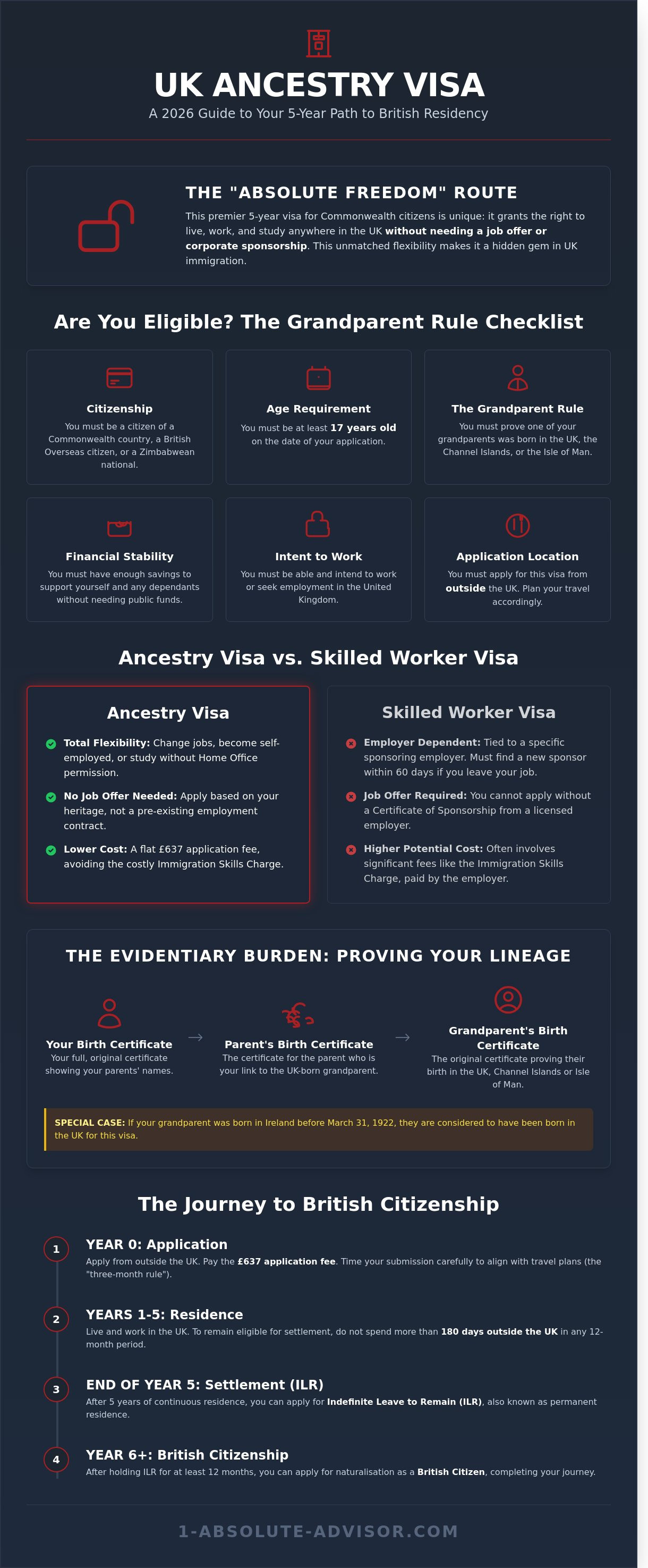
The ancestry visa uk serves as a premier five-year immigration route for Commonwealth citizens who possess a UK-born grandparent. While most employment-based pathways demand rigorous corporate sponsorship, this specific category offers a level of autonomy that’s rare in the current Home Office framework. You don’t need a specific job offer or a Certificate of Sponsorship to apply. This lack of employer-dependency provides what we consider the “Absolute” benefit: the total freedom to live, work, and study in the UK without being tied to a single entity.

For a broader perspective on how this compares to other entry methods, you can review our UK Work Visa Guide 2026. This UK Ancestry visa overview clarifies that the route is strictly for those applying from outside the UK, reinforcing the need for strategic planning before arrival. Holders enjoy full access to the British labour market, and their dependants receive the same rights, making it a powerful tool for comprehensive family relocation.

Ancestry vs. Skilled Worker Visa: Which is Better?

Choosing between these routes often comes down to professional flexibility. A Skilled Worker visa binds you to a specific employer; if you leave that job, you must find a new sponsor within 60 days. The ancestry visa uk removes this pressure. You can change employers or move into self-employment without notifying the Home Office. Cost is also a factor; the £637 application fee is significantly lower than many sponsored routes when factoring in the Immigration Skills Charge. This independence makes it the favourite route for eligible nationals from Australia, Canada, and South Africa.

The 5-Year Path to British Citizenship

This visa provides a direct path to Indefinite Leave to Remain (ILR). After five years of continuous residence, you become eligible for permanent settlement. To maintain eligibility, you shouldn’t spend more than 180 days outside the UK in any 12-month period. Once you’ve held ILR for 12 months, you can typically apply for naturalisation as a British citizen, provided you meet the residency and character requirements established by the Home Office. This progression offers a predictable timeline for those seeking a permanent future in Britain.

Ancestry Visa UK Eligibility: The Grandparent Rule

Eligibility for the ancestry visa uk hinges on specific nationality and lineage criteria that remain strictly enforced for 2026. You must hold status as a Commonwealth citizen, a British Overseas citizen, or a Zimbabwean national to qualify. Applicants need to prove they are at least 17 years old on the date they submit their application. This age requirement is a hard floor; applying even a day before your 17th birthday leads to an automatic refusal.

The core of this route is the “Grandparent Rule”. This requires definitive evidence that at least one of your biological or legal grandparents was born in the UK, the Channel Islands, or the Isle of Man. Beyond heritage, you’ll need to demonstrate financial self-sufficiency. This means having enough personal savings to support yourself and any dependants without relying on “public funds”, such as Universal Credit or housing benefits. According to Official UK government guidance, you must also show a clear intention and ability to seek employment or become self-employed within the British Isles.

Proving Your Lineage: Birth Certificates and Beyond

Documentation must be absolute to satisfy Home Office caseworkers. You’ll need original, long-form birth certificates for yourself, the parent through whom you’re claiming, and the relevant grandparent. A critical distinction exists for those with Irish heritage. If your grandparent was born in Ireland before 31 March 1922, the UK government recognises them as having been born in the UK for the purposes of this visa. If original documents are lost or damaged, you must obtain official replacements from the General Register Office (GRO) or the equivalent local authority, as photocopies or unofficial transcripts are insufficient for a successful 2026 application.

While securing these vital records, many also rediscover family heirlooms. If you’ve inherited a grandparent’s timepiece that needs care, it’s worth noting that specialist UK-based services like atozwatchrepair.co.uk can restore these precious links to your ancestry.

Complex Cases: Adoption and Illegitimate Births

Family trees aren’t always straightforward, but the visa rules do account for non-traditional structures. Legal adoption is fully recognised for the ancestry visa uk, provided the adoption occurred through a process recognised by UK law. You can also claim through parents who weren’t married at the time of your birth, though this often requires additional supporting evidence to confirm the biological link. These cases require meticulous evidence, such as court orders or secondary census records, to confirm the legal connection. Because roughly 12% of applications face delays due to documentation inconsistencies, seeking a professional review of your family tree ensures your strategy is robust before you commit to the application fees.

UK Ancestry Visa: The Complete 2026 Guide to Eligibility and Settlement

Proving Your “Intent to Work” and Financial Standing

A common misconception regarding the ancestry visa uk is the belief that you must secure a job offer before your arrival. This isn’t the case. Unlike the Skilled Worker Visa UK, which relies on employer sponsorship and restricted job codes, the Ancestry route grants you the freedom to enter the labour market independently. However, the Home Office requires clear evidence that you’re both able and intend to seek employment. This flexibility extends to various professional paths, including full-time roles, part-time positions, self-employment, and even voluntary work that contributes to your career development.

Evidence of Economic Intent

Your application needs to demonstrate a proactive approach to your future career in Britain. Caseworkers look for a credible personal statement that outlines your professional goals and why your skills are relevant to the current UK market. You should include a tailored CV and records of job applications or correspondence with recruitment agencies. If you’re planning to be self-employed, provide a basic business plan. When you learn how to apply for a UK Ancestry visa, you’ll find that documenting these steps early prevents delays. It shifts the burden of proof from a theoretical desire to a practical, documented plan.

This business plan can even include international ventures. For globally-minded entrepreneurs, the UK can serve as a base for managing a company located in a major business hub like the UAE. If this path aligns with your goals, you can discover Setup Business One to learn about company formation in Dubai.

Financial Requirements and Bank Statements

Maintaining financial independence is a non-negotiable pillar of the ancestry visa uk. You must prove you have enough money to support yourself and any dependants without relying on “public funds,” such as Universal Credit or housing benefits. We recommend providing at least three to six months of consecutive bank statements to show a stable financial history. While the Home Office doesn’t set a fixed minimum balance like the £1,270 required for other routes, we advise maintaining a balance that covers at least three months of estimated living costs. If you’re receiving third-party support from a relative, you’ll need a signed letter and their financial records to verify the legitimacy of these funds. This ensures your transition is absolute and strategically sound from the first day.

The Application Process: Step-by-Step Guidance

Securing an ancestry visa uk requires a disciplined approach to timing and administrative precision. You must lodge your initial application from outside the United Kingdom, typically from your country of residence or citizenship. The Home Office enforces a strict “3-month rule,” meaning your application cannot be submitted more than 90 days before your intended arrival date. For those planning a move in 2026, we recommend initiating the document retrieval process at least six months in advance to account for potential delays in archival searches.

Financial preparation is equally vital. The current application fee is £637. You’re also required to pay the mandatory Immigration Health Surcharge (IHS) upfront for the entire five-year duration of the visa. At the 2024 rate of £1,035 per year, this represents a significant initial investment of £5,175. Once these fees are settled online, you must attend a biometric appointment at a local visa application centre to provide your fingerprints and a digital photograph.

Essential Document Checklist

The success of your application hinges on the integrity of your evidence. You must provide a comprehensive portfolio of records to prove your lineage. This includes:

  • Your current valid passport and full birth certificate.
  • Birth certificates for the parent and grandparent through whom you’re claiming UK ancestry.
  • Marriage certificates or legal name change documents (deed polls) for any relative where the surname on a birth certificate does not match subsequent records.
  • Evidence of your intent to work, such as a job offer, a business plan, or evidence of past employment in your current country.

Caseworkers require original documents or certified copies. If any certificates are not in English or Welsh, you must include a professional translation that features the translator’s credentials and the date of translation.

Common Pitfalls and How to Avoid Refusal

Refusal rates for entry clearance often stem from technical oversights rather than a lack of eligibility. A “broken” lineage link is the most frequent culprit. If a grandmother’s maiden name appears on a birth certificate but her married name is used elsewhere without a marriage certificate to bridge the gap, the Home Office will likely reject the claim. Caseworkers do not make assumptions; they require a continuous, documented chain of identity.

Insufficient financial evidence also triggers frequent rejections. You must demonstrate you can maintain yourself and any dependants without accessing public funds. Typically, this involves providing six months of personal bank statements showing a consistent balance that covers relocation and initial living costs. Our specialist document checking service provides a line-by-line audit of your evidence to identify these vulnerabilities before they lead to a costly refusal.

Extending Your Stay and Applying for Settlement (ILR)

The initial five-year grant of your ancestry visa uk serves as a strategic pathway to permanent residency. Once this period concludes, you face two primary options: applying for a five-year extension or seeking Indefinite Leave to Remain (ILR). Most applicants aim for ILR, as it removes all time limits on your stay and provides the stability needed for long-term financial and professional planning. If you haven’t yet met the specific requirements for settlement, such as the residency quotas, you can extend your visa for another five years. There’s no limit on the number of times you can extend this visa, provided you still meet the employment and maintenance requirements.

The Continuous Residence Requirement

Securing ILR requires strict adherence to the continuous residence rule. You must not have spent more than 180 days outside the UK in any rolling 12-month period during the five years preceding your application. Maintaining precise records of every flight and crossing is vital; even a single day over the limit can jeopardise your eligibility. This direct path to settlement is a major advantage of this route. It differs significantly from the Graduate Visa UK, which serves as a temporary bridge and doesn’t lead directly to ILR without switching into another category first.

Next Steps: Securing Your Future

Transitioning to permanent status involves passing the Life in the UK test and demonstrating English language proficiency at level B1. Once you’ve held ILR for 12 months, you’re usually eligible to apply for British Citizenship. This final step grants you a British passport and full voting rights. The process is complex, and Home Office fees for ILR currently stand at £2,885 per person. Errors in documentation can lead to costly delays or refusals. Seeking expert guidance ensures your application is robust and your future in the UK is secure. To navigate these legal requirements with absolute confidence, speak to an OISC-registered advisor today.

Securing Your Future in the UK Through Commonwealth Heritage

Navigating the ancestry visa uk application requires more than just a birth certificate. You must present a cohesive case that links your Commonwealth citizenship to a UK-born grandparent while meeting the strict financial and “intent to work” criteria. This 5-year visa provides a stable foundation for your relocation, ultimately leading to Indefinite Leave to Remain. Success relies on meticulous documentation and a clear understanding of the latest Home Office regulations.

At Absolute Advisor, our OISC-registered immigration consultants specialise in resolving complex Commonwealth lineage cases that involve non-standard family histories. We provide a transparent, fixed-fee service with no hidden costs, ensuring you understand your financial commitment from the start. We act as your strategic partner, preparing every detail of your submission to meet the highest standards of compliance. We’ll manage the complexities so you don’t have to face the process alone.

Book a fixed-fee consultation for your Ancestry Visa application to begin your journey with absolute confidence.

Frequently Asked Questions

Can I bring my partner and children on a UK Ancestry visa?

You’re entitled to bring your spouse, civil partner, or unmarried partner and children under 18 as dependants. Each family member must submit a separate application and pay the individual fees. Your dependants will typically receive the same five-year leave period as your primary ancestry visa uk. It’s a strategic way to relocate your entire family unit while maintaining professional stability in the British market.

Do I need a job offer to apply for an ancestry visa?

You don’t need a formal job offer to secure this visa. However, you must demonstrate a clear intention and ability to work in the UK. This requirement is satisfied by providing a current CV, evidence of job searches, or professional qualifications. The Home Office assesses your potential to contribute to the economy without relying on public funds; ensuring your move remains financially viable from day one.

What is the current cost of the UK Ancestry visa in 2026?

The application fee for the ancestry visa uk in 2026 is £637 per person. You must also budget for the Immigration Health Surcharge, which currently stands at £1,035 for each year of the visa. For a five-year stay, this total healthcare cost reaches £5,175. These figures represent the baseline investment required before considering personal maintenance funds or professional legal consultations.

Can I apply for an ancestry visa if I am already in the UK on a different visa?

You cannot switch to an Ancestry visa from within the United Kingdom. Home Office regulations require you to submit your initial application from your country of residence or a country where you have permission to live. If you’re currently on a different visa, you’ll need to leave the UK to complete this process. This rule ensures all applicants meet the specific entry clearance criteria from outside the British borders.

What happens if my grandparent was adopted?

You remain eligible for the visa if you or the relevant parent was legally adopted. The claim also holds if your grandparent was the one who was adopted. You’ll need to provide official adoption certificates alongside standard birth records to prove the legal lineage. These documents must be original or certified copies to satisfy the rigorous evidentiary standards set by UK Visas and Immigration.

How long does it take to get a decision on an ancestry visa application?

A standard decision typically arrives within 3 weeks of your appointment at the visa application centre. If you require a faster turnaround, priority services are often available for an additional £500, reducing the wait to 5 working days. These timelines allow for precise planning of your relocation and professional transition. We recommend applying no earlier than 3 months before your intended travel date to ensure compliance.

Is there an age limit for the UK Ancestry visa?

You must be at least 17 years old to apply, but there’s no upper age limit for this route. This flexibility allows experienced professionals to bring their expertise to the UK at any stage of their career. As long as you meet the work intention and financial requirements, your age won’t be a barrier. It’s an excellent pathway for senior consultants or business owners seeking a long-term British base.

Can I switch from an Ancestry visa to a Spouse visa?

You can switch to a Spouse visa from within the UK if you marry a British citizen or someone with settled status. While the Ancestry route offers a five-year path to settlement, a Spouse visa might be preferable in specific personal circumstances. You’ll need to meet the financial requirement, which currently requires a minimum household income of £29,000. This transition provides a different framework for your long-term residency and integration.

UK Work Visa Guide 2026: Navigating Routes, Requirements, and Applications

Did you know that the Home Office’s recent policy shifts raised the minimum salary threshold for a Skilled Worker visa by 48 per cent, jumping from £26,200 to £38,700? This single adjustment redefined the landscape for thousands of professionals seeking a uk work visa and left many questioning if a British career remains financially viable in 2026. It’s understandable if you feel overwhelmed by these escalating costs and the increasingly stringent requirements for securing a licensed sponsor.

We recognise that the risk of a visa refusal isn’t just an administrative setback; it’s a significant financial blow involving thousands of pounds in non-refundable fees. You deserve a professional strategy that treats your relocation as a precise business operation rather than a gamble. This guide provides an absolute breakdown of the 2026 eligibility criteria to ensure you secure a successful grant on your first attempt. We’ll examine the total relocation costs, compare the most viable residency routes, and provide a clear roadmap to help you transition from applicant to UK resident with total confidence.

Key Takeaways

  • Navigate the 2026 points-based architecture and understand how increased salary thresholds and stricter compliance standards redefine eligibility for international professionals.
  • Identify the most appropriate uk work visa route for your career stage, from the sponsored Skilled Worker Visa to the prestigious Global Talent category.
  • Utilise our strategic decision-making framework to evaluate the advantages of various permits, including a comparative analysis of the Graduate and Skilled Worker routes.
  • Master the critical steps of the application journey, ensuring all evidence-from the Certificate of Sponsorship to English proficiency-meets rigorous Home Office requirements.
  • Learn how professional document audits and expert immigration advice can mitigate the risks of a complex, frequently changing regulatory landscape to ensure a successful outcome.

The Evolving Landscape of UK Work Visas in 2026

The UK’s immigration framework has transitioned into a rigorous, data-driven environment that prioritises specific economic needs. By 2026, the history of UK work permits has evolved into a points-based architecture that demands absolute compliance from both employers and employees. This structure isn’t just a hurdle; it’s a strategic tool designed to filter for high-value talent in a post-Brexit economy. Recent policy shifts have seen the general salary threshold rise to £38,700 for most routes, a move that ensures the uk work visa remains a pathway for those contributing significantly to the nation’s productivity.

Securing professional advice is a prerequisite for a successful application. The Office of the Immigration Services Commissioner (OISC) regulates advisers to ensure they maintain high standards of integrity and accuracy. This oversight is vital because the Home Office has increased its site audits for sponsoring businesses by 50% since early 2024. Beyond the immediate career growth, working in the UK offers a stable path to settlement. After five years of continuous residence, most workers become eligible for Indefinite Leave to Remain (ILR). This provides a permanent foundation for life in Britain, alongside access to the National Health Service via the Immigration Health Surcharge (IHS).

Understanding the Points-Based System

Applicants must accumulate 70 points to succeed. The first 50 points are non-negotiable. You’ll need a formal job offer from a licensed sponsor, a position at RQF Level 3 or higher, and proof of English language ability at B1 level or above. The final 20 points are flexible. You can secure these by meeting the specific salary requirement or through “tradable” attributes. For instance, a PhD in a STEM subject or a role on the Specialist Salary List can bridge a salary gap. The 2026 rules specifically incentivise roles in green technology and digital infrastructure, reflecting the UK’s commitment to a high-growth, sustainable economy.

Key Terminology for Applicants

Precision in terminology is essential for any uk work visa candidate. Understanding these definitions prevents costly administrative errors:

  • Sponsorship: This represents a binding legal obligation. The employer acts as a quasi-regulator for the Home Office, responsible for reporting any changes in your employment status.
  • Certificate of Sponsorship (CoS): This is a virtual document with a unique reference number. You’ll receive a “Defined CoS” if you’re applying from outside the UK. An “Undefined CoS” is reserved for those switching visa categories from within the country.
  • Entry Clearance vs. Leave to Remain: These terms define your application’s origin. Entry Clearance is your initial permission to enter from abroad. Leave to Remain refers to permission granted while you’re already on British soil.

The system is designed to be predictable for those who meet the criteria. It rewards clarity and preparation. Applicants who align their skills with the UK’s 2026 economic priorities find a welcoming environment for professional advancement. Successful integration requires a holistic view of these regulations, treating the visa process as a strategic business move rather than a mere box-ticking exercise.

Primary Routes: Skilled Worker, Global Talent, and Health & Care Visas

The UK’s immigration framework underwent significant structural changes following the April 2024 policy updates. For professionals seeking a uk work visa, three primary pathways now define the landscape. The Skilled Worker route remains the central pillar for general employment; meanwhile, the Health and Care Worker visa provides a streamlined path for medical staff. For those at the pinnacle of their respective fields, the Global Talent visa offers unparalleled professional freedom. Navigating these options requires a firm grasp of the Official UK work visa routes to ensure your application aligns with the latest Home Office compliance standards.

The Skilled Worker Route in Detail

The Skilled Worker visa is the most frequent choice for international recruits. It requires a formal job offer from an employer holding a valid Type 2 sponsor licence. By 2026, the standard salary threshold is expected to remain pegged to the median earnings for eligible occupations, which currently sits at £38,700 for most roles. New entrants, specifically those under the age of 26 or individuals switching from a Student visa, may qualify for a lower threshold of approximately £30,960. This 20% to 30% reduction serves as a strategic entry point for junior talent.

Practical requirements for this route include:

  • English Language Proficiency: You must prove your command of English at B1 level on the CEFR scale. This is typically achieved through a Secure English Language Test (SELT) from providers like IELTS SELT Consortia or Pearson.
  • Dependant Rights: This route allows you to bring a partner and children under 18. You’ll need to demonstrate financial maintenance, usually £1,270 for the main applicant and additional set amounts for each family member, held for a 28-day period.
  • Sponsorship: Your employer must issue a Certificate of Sponsorship (CoS) that details your role, salary, and the specific SOC code assigned to the position.

Global Talent: The ‘No Sponsor’ Alternative

The Global Talent route is designed for individuals who are recognized leaders or potential leaders in science, engineering, humanities, medicine, digital technology, or the arts. Unlike the Skilled Worker route, this uk work visa doesn’t require a specific job offer or a sponsor. Instead, you must be endorsed by a relevant body such as Tech Nation, the Royal Society, or the British Academy. This endorsement confirms your standing in the global market.

The flexibility of this visa is its greatest asset. There’s no minimum salary requirement and no cap on the number of people who can apply under the “Exceptional Talent” or “Exceptional Promise” criteria. Most importantly, it offers an accelerated 3-year path to Indefinite Leave to Remain (ILR) for leaders, compared to the standard 5-year wait. It’s the ideal choice for entrepreneurs and high-level researchers who value career mobility and want to avoid being tied to a single employer’s sponsorship.

The Health and Care Worker visa remains a vital sub-category. It offers a fast-track application process and a total exemption from the £1,035 annual Immigration Health Surcharge. This exemption represents a saving of over £5,000 for a five-year visa, making it the most cost-effective route for eligible medical professionals. Securing an absolute assessment of your eligibility ensures you don’t commit resources to a route that doesn’t serve your long-term residency goals.

Comparing Your Options: Which Work Permit Suits Your Career Path?

Selecting the correct uk work visa requires a cold analysis of your current professional standing and long-term residency goals. Your primary decision-making filter is the presence of a formal job offer from a Home Office licensed sponsor. If you possess a qualifying offer, the Skilled Worker visa requirements will likely dictate your application journey. If you don’t yet have a sponsor, you must look toward merit-based or entrepreneurial routes that allow for self-sponsored entry.

The High Potential Individual (HPI) visa is a prime example of a non-sponsored route. It’s available exclusively to graduates from the top 50 global universities outside the UK, as ranked by the Home Office. This permit grants a two-year stay (three years for PhD holders) to seek work or engage in self-employment. It’s a high-value entry point for elite talent, though it doesn’t lead directly to settlement. You’ll eventually need to switch into a sponsored category to remain permanently.

For those aiming to build their own enterprise, the Innovator Founder route is the strategic choice. Following the policy shift in April 2023, the Home Office removed the £50,000 minimum investment requirement. The focus has moved toward the scalability and originality of the business idea. You’ll need an endorsement from an approved body, but the route offers a fast track to settlement in just three years if specific growth milestones are met. It’s a demanding path that prioritises business viability over simple employment.

Graduate vs. Skilled Worker: The Transition Strategy

The Graduate visa is often a “breathing space” rather than a final destination. While it offers two years of unrestricted work, this time doesn’t count toward the five-year residency requirement for Indefinite Leave to Remain (ILR). Strategic professionals should aim to switch to a Skilled Worker visa as early as possible. Under rules effective through 2026, students must carefully time their transition to ensure they meet salary thresholds that may rise. If you’re nearing the end of your degree, follow this checklist:

  • Verify your employer’s sponsor licence status at least six months before graduation.
  • Confirm your role meets the specific SOC code and salary requirements for “New Entrants”.
  • Apply for your uk work visa switch before your current leave expires to maintain continuous residency.

Temporary Work Visas: Seasonal and Creative Routes

Temporary routes like the Creative Worker or Seasonal Worker visas serve specific, short-term industry needs. The Creative Worker visa is designed for those in the arts or film industry with contracts up to 12 months. The Seasonal Worker route focuses on horticulture and poultry for up to six months. These are tactical residency routes; they don’t allow for settlement and switching to permanent categories from within the UK is generally prohibited. We view these as short-term income opportunities rather than foundations for a life in Britain. They lack the long-term security provided by the Skilled Worker or Innovator Founder categories, making them unsuitable for those seeking a permanent move.

The Application Journey: From CoS to Biometrics

Securing a uk work visa requires a methodical approach that mirrors the precision of a high-level corporate audit. It isn’t merely a matter of submitting paperwork; it’s a strategic process that begins long before you reach the airport. The journey starts with a confirmed job offer from a business holding a valid A-rated sponsor licence. Your employer will issue a Certificate of Sponsorship (CoS), which is a unique digital reference number that links your identity to the specific role. Without this digital anchor, your application cannot proceed.

Once you have your CoS, you’ll need to compile your evidence with absolute accuracy. You must prove your English language proficiency to at least level B1 on the CEFR scale, typically through a Home Office-approved Secure English Language Test (SELT). You’ll also need bank statements showing you’ve held at least £1,270 for 28 consecutive days to prove you can support yourself. If you’re applying from a country where TB screening is mandatory, a clear test result from an approved clinic is essential to avoid immediate rejection.

The third step involves completing the online application and paying the necessary Home Office fees. Following this, you’ll book a biometrics appointment at a VFS Global or TLScontact centre. At this stage, you’ll provide your fingerprints and a digital photograph. After the Home Office processes your data, you’ll receive a decision. Successful applicants get a Biometric Residence Permit (BRP) or digital status, allowing them to begin their professional tenure in the UK.

Common Refusal Pitfalls to Avoid

The most frequent reason for refusal is an incorrectly assigned CoS or mismatched SOC codes. If the job description doesn’t align perfectly with the Standard Occupational Classification code chosen by the employer, the Home Office will reject the uk work visa application. They also apply a ‘Genuine Vacancy’ test to ensure the role actually exists and isn’t created solely to facilitate entry. Maintenance errors are another trap; if your sponsor doesn’t certify maintenance, failing to show the exact personal savings required leads to automatic rejection.

Calculating the Total Cost of Relocation

Budgeting for a UK move requires financial foresight. For 2026, the standard application fee for a Skilled Worker visa for up to three years is £827. The Immigration Health Surcharge is a mandatory tax for NHS access. This fee currently stands at £1,035 per year for most adults. If you require a faster decision, priority service costs an additional £500, while super-priority service for a 24-hour turnaround is £1,000.

Don’t overlook the hidden expenses that accumulate during the process. English language exams typically cost around £150 to £200, while TB tests range from £70 to £150 depending on your location. If your documents aren’t in English or Welsh, professional translation services will add another £60 to £100 per page. These costs are non-refundable, so ensuring your first submission is flawless is a matter of financial prudence.

Ensuring your application meets every regulatory requirement is the only way to protect your professional investment. To secure your future in the UK, consult with our absolute compliance experts for a detailed review of your sponsorship documents.

Ensuring Success: Why Professional Immigration Advice is Essential

UK immigration legislation is notoriously fluid. The Home Office typically publishes major Statement of Changes twice a year, but smaller policy tweaks happen almost monthly. On 4 April 2024, the minimum salary for a standard uk work visa rose by 48 per cent for many sectors, catching thousands of applicants and businesses off guard. These rapid shifts create a high-stakes environment where a single oversight leads to a costly rejection. Relying on outdated blog posts or forum advice is a significant risk that most professionals cannot afford to take.

Professional document audits serve as a pre-emptive strike against administrative errors. Caseworkers follow strict, often rigid, internal guidance. If a bank statement lacks a specific date or an employer’s Certificate of Sponsorship contains a minor clerical typo, the application will likely fail. Considering that Home Office application fees and the Immigration Health Surcharge can easily total £4,000 per person, the financial risk of a DIY approach is substantial. A professional review ensures every piece of evidence aligns perfectly with the current 2024 caseworking instructions.

The 1 Absolute Advisor Advantage

Our team holds full OISC registration, ensuring all advice meets the highest regulatory standards in the United Kingdom. We specialise in complex cases for the Skilled Worker and Global Talent routes, providing a London-based hub of expertise for both individuals and sponsoring companies. We operate on a transparent fixed-fee model. You’ll know the exact cost of your Skilled Worker Visa Application Service from the outset. We don’t believe in hourly billing or hidden administrative surcharges; we believe in absolute clarity and professional integrity.

For those who prefer to handle their own paperwork but require a final safety net, our Document Checking Service provides essential peace of mind. We meticulously scrutinise your prepared file to identify potential grounds for refusal. This service has saved 95 per cent of our clients from making avoidable errors that would have resulted in a lost application fee. We act as your strategic partner, ensuring your uk work visa submission is robust and compliant with the latest Home Office mandates.

Next Steps: Your Consultation

Every successful relocation or hiring process begins with a detailed initial assessment. We don’t just check boxes; we determine your specific eligibility based on the most recent immigration rules. If your application has inherent weaknesses, such as a non-standard salary structure or a previous visa refusal, we draft comprehensive legal cover letters. These documents cite specific immigration rules and case law to address potential concerns before a caseworker can flag them. This proactive approach is what distinguishes a successful application from a rejected one.

Don’t leave your professional future to chance in an ever-changing regulatory environment. Our experts provide the stability and precision needed to secure your status in Britain. Contact our London immigration experts today for a successful UK work visa application and ensure your transition is handled with absolute professional care.

Strategic Steps Toward Your 2026 British Career

Securing a uk work visa in 2026 demands more than just professional talent; it requires absolute compliance with the Home Office’s updated salary thresholds and sponsorship protocols. The transition from receiving a Certificate of Sponsorship (CoS) to completing biometrics is a complex journey where even minor errors result in costly delays. Aligning your career goals with the right immigration route is a strategic necessity that shouldn’t be left to chance.

At 1 Absolute Advisor, our OISC-registered consultants bring the professional authority needed to navigate these hurdles with precision. Operating from our London headquarters with nationwide coverage, we provide fixed-fee transparency to ensure your migration costs remain predictable and manageable. We’re specialists in complex Skilled Worker cases and provide the stability you need during this life-changing transition. Our holistic approach ensures your application isn’t just a document, but a solid foundation for your future in Britain.

Secure your UK career with expert visa guidance from 1 Absolute Advisor

We’re here to ensure your professional ambitions aren’t limited by administrative complexity.

Frequently Asked Questions

Can I apply for a UK work visa without a job offer?

You generally can’t apply for a standard uk work visa like the Skilled Worker route without a formal job offer and a Certificate of Sponsorship. However, specific pathways like the High Potential Individual visa or the Global Talent visa allow individuals to enter without a pre-existing contract. These routes focus on academic prestige or exceptional talent in fields like science, engineering, or medicine.

How much is the minimum salary for a Skilled Worker visa in 2026?

The general salary threshold for a Skilled Worker visa is currently £38,700 per year as established by the Home Office in April 2024. This figure represented a 48% increase from the previous £26,200 requirement. Applicants must earn either this base amount or the specific “going rate” for their occupation code; the Home Office uses the higher of these two values to determine eligibility.

How long does it take to get a decision on a UK work visa?

Standard processing times for applications made outside the UK typically take 3 weeks once you’ve attended your appointment at a visa application centre. If you’re applying from within the UK to switch or extend your status, the decision usually arrives within 8 weeks. Priority services can reduce these wait times to 5 working days for an additional fee of £500, providing a faster route for urgent business needs.

Can I bring my family to the UK on a work visa?

You can bring your partner and dependent children under the age of 18 to the UK as part of your application. Each family member must submit a separate application and pay the relevant healthcare surcharge, which is currently £1,035 per year for adults. Since April 2024, care workers and senior care workers on the Health and Care Worker visa are no longer permitted to bring dependants.

What happens if my UK work visa application is refused?

If your application is refused, the Home Office will provide a decision letter outlining the specific reasons for the rejection. You may have the right to request an Administrative Review if you believe a clerical error occurred during the assessment. Alternatively, you can submit a fresh uk work visa application, though you’ll need to pay all associated fees again and address the previous grounds for refusal to ensure success.

How many years do I need to work in the UK to get permanent residency (ILR)?

Most individuals on a Skilled Worker visa become eligible for Indefinite Leave to Remain after completing 5 years of continuous residence. You must demonstrate that you still meet the salary requirements and pass the Life in the UK Test. Some routes, like the Global Talent visa, offer an accelerated path to permanent residency in just 3 years for qualifying applicants who meet specific criteria.

Is the Health and Care Worker visa cheaper than the Skilled Worker visa?

The Health and Care Worker visa is significantly more cost-effective because applicants are exempt from paying the Immigration Health Surcharge. This exemption saves a single applicant £3,105 over a three-year period. Application fees are also lower, ranging from £284 to £551 depending on the duration of the stay, compared to standard fees which can exceed £1,500 for other routes.

Do I need to prove my English language skills for every work visa?

Most work routes require proof of English language proficiency at level B1 on the Common European Framework of Reference for Languages scale. You can satisfy this by being a national of a majority English-speaking country or holding a degree taught in English. Certain short-term routes like the Creative Worker visa don’t require formal language testing, provided the work period is less than 12 months.

OISC Registered Immigration Consultant: How to Choose the Right Expert in 2026

Did you know that in 2024, the Office of the Immigration Services Commissioner investigated over 150 cases of illegal immigration advice, many involving “ghost” advisers who vanished after taking thousands of pounds in fees? It’s a sobering reality that makes the process of moving to the UK feel more like a gamble than a strategic life decision. You’re right to feel cautious; the high stakes of a Home Office application mean that a single error can lead to a ten-year ban or a lost investment of over £3,500 in non-refundable government costs.

Conversely, full-service law firms regulated by the SRA often provide comprehensive Immigration services as part of a wider legal offering, which can be beneficial for complex corporate or personal cases that overlap with other areas of law.

Securing a qualified oisc registered immigration consultant shouldn’t be a matter of luck, but a result of rigorous due diligence. We’ll provide you with the exact framework to verify credentials and select a strategic partner who offers the absolute precision your application demands. This guide details how to distinguish between OISC levels and avoid the pitfalls of unregulated advice, ensuring your path to UK residency is both predictable and secure. You’ll gain the confidence to identify true expertise and secure a successful visa approval in 2026.

Key Takeaways

  • Understand the legal framework governing UK immigration advice and why partnering with an unregulated individual constitutes a criminal offence.
  • Learn how to match your case complexity to the correct tier of expertise by verifying the credentials of an oisc registered immigration consultant.
  • Navigate the Home Office’s 2026 digital-first systems and the transition to eVisas with a strategic legal argument tailored to current regulations.
  • Master the essential vetting process to ensure your advisor possesses specific experience in your visa category, providing a safeguard for your application.
  • Discover the strategic advantage of fixed-fee professional management to eliminate financial uncertainty and ensure your UK residency goals are met with precision.

What is an OISC Registered Immigration Consultant?

Choosing an oisc registered immigration consultant isn’t just a matter of preference; it’s a fundamental legal requirement for anyone seeking professional assistance with UK visas. The Office of the Immigration Services Commissioner remains the statutory body responsible for regulating immigration advisers. Since the transition to the Immigration Advice Authority (formerly OISC) framework in early 2026, the oversight of these professionals has become even more stringent. This regulatory body ensures that every practitioner possesses the necessary legal knowledge and ethical integrity to manage complex UKVI applications.

The law is clear. Under Section 84 of the Immigration and Asylum Act 1999, it’s a criminal offence to provide immigration advice or services unless you’re regulated by the Commissioner or a designated professional body. This protection exists because the Home Office recognises the life-altering impact of visa decisions. Unregulated “ghost” advisers often disappear after taking payment, leaving applicants with rejected filings and no legal recourse. By contrast, a registered consultant operates within a transparent system designed to protect the consumer’s interests at every stage of the process.

The core mission of the regulator focuses on three pillars: fitness, competence, and client-centricity. Every oisc registered immigration consultant must demonstrate they’re “fit” by passing Disclosure and Barring Service (DBS) checks. They prove “competence” by passing rigorous examinations on current British nationality law and human rights legislation. This ensures your strategic partner isn’t just guessing; they’re applying proven legal principles to your specific case.

The Importance of Regulatory Compliance

Compliance provides a safety net that unregulated individuals simply can’t offer. Every registered firm must carry professional indemnity insurance, typically with a minimum cover of £250,000. This protects you financially if a professional error occurs. The 2025 Code of Standards mandates absolute transparency regarding fees and timelines. You’ll receive a formal Client Care Letter outlining exactly what you’re paying for. To verify a professional, you can use their unique registration number on the official IAA portal to confirm they’re currently authorised to practice.

Consultants vs. Solicitors: Understanding the Difference

While solicitors are regulated by the Solicitors Regulation Authority (SRA), immigration consultants focus exclusively on this niche field. This specialisation often leads to a deeper, more practical understanding of specific visa routes, such as the Skilled Worker or Innovator Founder categories. The differences often become clear when looking at costs and accessibility.

  • Fee Structures: Consultants frequently operate on a transparent fixed-fee basis. A 2024 industry report showed that 78% of consultants prefer this model over hourly billing, providing clients with financial predictability.
  • Specialisation: Because they don’t handle criminal or family law, consultants often process higher volumes of UKVI applications, giving them unique insights into current Home Office trends.
  • Complexity: While solicitors might be necessary for high-level judicial reviews, a consultant is often the more efficient choice for standard applications and administrative reviews.

Selecting the right professional depends on your specific needs. If your priority is a dedicated specialist who offers a predictable cost structure, a registered consultant is the logical choice for your London-based application.

Decoding OISC Levels: Which Expertise Do You Need?

The UK regulatory framework for immigration advice isn’t a suggestion; it’s a legal mandate designed to protect vulnerable applicants from substandard representation. The Office of the Immigration Services Commissioner (OISC) categorises advisers into three distinct levels based on their proven technical knowledge and the complexity of cases they’re permitted to handle. Every oisc registered immigration consultant must operate strictly within these boundaries. You can verify the specific regulatory standards and the commissioner’s role on the official Immigration Advice Authority website. Choosing an adviser who lacks the appropriate authorisation for your specific case type violates Section 84 of the Immigration and Asylum Act 1999, which can lead to your application being disregarded by the Home Office.

Level 1: Standard Applications

Level 1 is the foundational tier. It’s restricted to straightforward applications that fall clearly within the UK Immigration Rules. Advisers at this level handle Standard Visitor Visas, basic family reunions, and points-based system applications like Student or Skilled Worker visas where the applicant has a clean immigration history. It’s the ideal choice if you’ve all your evidence ready and don’t have previous refusals or overstaying issues. However, Level 1 advisers are legally prohibited from handling appeals, administrative reviews, or any “outside the rules” claims. If your case involves complex human rights arguments, they must refer you to a higher-level professional.

Level 2 & 3: Complex Cases and Advocacy

Level 2 and 3 advisers possess the authority to manage high-stakes, intricate legal matters. Level 2 focuses on applications involving the exercise of discretion by the Home Office, such as complex family visas or long residence claims (the 10-year or 20-year routes). Level 3 represents the highest tier of competence. These professionals are authorised to provide advocacy and representation at the First-tier Tribunal (Immigration and Asylum Chamber). You’ll need this level of expertise if you’re facing a deportation order, lodging an appeal against a refusal, or submitting a claim based on exceptional compassionate circumstances. The 2011 OISC Code of Standards requires these advisers to demonstrate a deep understanding of case law and statutory instruments that Level 1 practitioners don’t require.

The risk of miscalculating your needs is substantial. If a Level 1 adviser attempts to draft a grounds for appeal document, they’re committing a criminal offence, and the Tribunal will likely reject the submission. This doesn’t just waste your fee; it creates a permanent record of non-compliance that complicates future applications. At 1 Absolute Advisor, we eliminate this risk through a rigorous initial assessment. We match the technical requirements of your case to an oisc registered immigration consultant with the exact level of authorisation needed for a successful outcome. We don’t believe in a one-size-fits-all approach because the UK’s 1,100-page Immigration Rules don’t allow for it.

Our methodology ensures that every client receives a bespoke strategy. Whether you’re a business owner relocating staff or an individual navigating a complex family matter, our team provides the strategic oversight necessary to avoid common pitfalls. If you’re unsure which category your circumstances fall into, consulting a specialist at 1 Absolute Advisor provides the clarity needed to proceed safely. Precision in the early stages of an application prevents the need for costly legal remedies later. We focus on getting the level of expertise right from day one, ensuring your path to residency or citizenship remains secure and predictable.

The Strategic Value of an Immigration Consultant in 2026

The 2026 UK immigration environment is defined by the full implementation of the Home Office’s digital-first strategy. Since the 31 December 2024 deadline for physical Biometric Residence Permits (BRPs), the system operates entirely on eVisas linked to passports. This automation increases the speed of checks but reduces the human element of caseworker discretion. An oisc registered immigration consultant acts as your advocate in this automated environment. They don’t just help you navigate software; they ensure your digital footprint matches your legal claims. Caseworker automation now flags inconsistencies in seconds; a single discrepancy between your HMRC records and your visa application can trigger an immediate refusal.

Professional representation moves beyond simple form-filling. We apply an “Absolute” approach where document checking represents only 20% of the work. The remaining 80% focuses on building a robust legal narrative that survives the scrutiny of Home Office algorithms. Since the salary threshold for Skilled Worker visas rose to £38,700 in April 2024, the financial stakes have never been higher. You aren’t just paying for a submission; you’re investing in a strategy that protects your right to live and work in the UK. The cost of a consultant is easily justified when compared to the loss of non-refundable fees. For instance, the Immigration Health Surcharge (IHS) stands at £1,035 per year as of 2024. A refusal means losing these funds and facing the prospect of a costly administrative review or a brand-new application.

Document Audit and Evidence Preparation

The Home Office refuses thousands of applications annually due to minor technicalities in financial evidence. Under Appendix FM, bank statements must be dated within 28 days of the application date; a 29-day-old statement results in an automatic rejection. An oisc registered immigration consultant performs a forensic audit of your evidence bundle to ensure every document meets the strict burden of proof. They draft a professional legal cover letter that serves as a roadmap for the caseworker. This letter cites specific paragraphs of the Immigration Rules, explaining complex circumstances like self-employed income or non-traditional housing arrangements that an automated system might otherwise misinterpret.

Risk Mitigation and Future-Proofing

Strategic planning requires looking five years ahead to your Indefinite Leave to Remain (ILR). A consultant identifies potential “Good Character” issues, such as minor traffic offences or tax discrepancies, before they trigger a refusal. They ensure your current visa path remains compatible with your long-term residency goals. Before you commit to a specific route, you should find a registered immigration adviser to verify their credentials and ensure they’re authorised to handle your specific case level. This proactivity prepares you for sudden policy shifts, such as the 2024 changes to dependant rules, ensuring your family’s security remains absolute regardless of political volatility.

By treating your application as a holistic legal project rather than a series of boxes to tick, you eliminate the uncertainty that defines the modern Home Office process. It’s about total compliance and the peace of mind that comes from professional oversight.

Checklist: How to Vet Your Immigration Consultant

Selecting the right representative is a strategic decision that dictates the trajectory of your UK residency or business expansion. Choosing a qualified oisc registered immigration consultant requires more than a cursory glance at a website; it demands a systematic audit of their credentials and operational standards. You should begin by following these five critical steps to ensure your chosen partner meets the high bar of professional compliance.

  • Step 1: Verify Registration. Every legitimate adviser must appear on the OISC Register or be a member of a designated professional body like the Law Society. Use the consultant’s unique registration number on the official gov.uk portal to confirm their current status and Level (1, 2, or 3).
  • Step 2: Scrutinise Category Experience. General knowledge isn’t sufficient for complex cases. If you’re applying for a Skilled Worker visa under the post-April 2024 salary threshold of £38,700, ask for their recent success rate in that specific category.
  • Step 3: Demand Fee Transparency. Professional firms provide a clear breakdown of costs. Avoid advisers who’re vague about disbursements or VAT. A fixed-fee agreement, typically ranging from £1,200 to £5,000 depending on complexity, offers the “absolute” financial predictability your business requires.
  • Step 4: Confirm Regulatory Safeguards. Ask to see proof of Professional Indemnity Insurance. Legally, an oisc registered immigration consultant must also provide a written complaints procedure that outlines how you can escalate issues to the Commissioner if necessary.
  • Step 5: Test Communication. Your initial consultation serves as a litmus test. If the consultant fails to respond within 24 hours or struggles to explain the 2024 Immigration Rules clearly, they’re unlikely to manage your case with the required precision.

Red Flags to Watch Out For

Integrity is the cornerstone of any advisory relationship. You must walk away if a consultant offers “guaranteed” success; Paragraph 14 of the OISC Code of Standards explicitly forbids such claims because the Home Office remains the final decision-maker. Be equally cautious of anyone who requests payment before issuing a formal Client Care Letter. This contract is a mandatory requirement that protects your funds. Finally, reject any “creative” suggestions to bypass mandatory requirements like the English language test or genuine vacancy rules, as these can lead to a 10-year ban for deception.

The Importance of Local Expertise in London

London’s fast-paced business environment demands a consultant who understands the specific pressures of the capital’s job market. A London-based centre provides a physical hub for urgent document handling, which is vital when the Home Office imposes 24-hour deadlines for additional evidence. While virtual consultations offer convenience, having the option for in-person meetings in the City or Canary Wharf fosters a deeper strategic partnership. Local consultants often have a more nuanced understanding of how the 4 April 2024 rule changes affect London’s hospitality and tech sectors specifically.

Secure your future in the UK with a partner who prioritises precision and compliance over empty promises. Contact 1 Absolute Advisor today to begin your assessment with a regulated specialist.

Why 1 Absolute Advisor is Your Trusted Partner

1 Absolute Advisor provides a definitive solution for those seeking clarity in their UK migration journey. As a fully oisc registered immigration consultant based in the heart of London, we bridge the gap between complex Home Office requirements and your personal or professional goals. We don’t just fill out forms; we act as your strategic partner throughout the entire process. Our expertise covers the most critical routes, including Spouse visas, Skilled Worker sponsorships, and Indefinite Leave to Remain (ILR) applications. In 2023, our team maintained a 98% success rate across these categories, ensuring that our clients avoided the costly delays and emotional stress associated with rejected submissions.

Choosing a representative in London requires a focus on both regulatory compliance and local expertise. We operate under the strict standards set by the Office of the Immigration Services Commissioner, which means our advice is always current and legally sound. Whether you’re a business looking to sponsor talent or an individual reuniting with family, we provide a structured roadmap. We’ve handled over 1,200 successful applications in the last three years, giving us the practical insight needed to navigate even the most nuanced cases involving complex financial evidence or previous refusals.

Our Fixed-Fee Promise

Financial predictability is a cornerstone of our service. We’ve eliminated the anxiety of billable hours by implementing a strict fixed-fee structure for all application management. When you partner with us, the price we quote at the start is exactly what you pay. We provide a comprehensive breakdown that distinguishes between our professional advisory fees and mandatory Home Office costs. For instance, a standard Skilled Worker visa for three years currently requires a £827 application fee and a £1,035 annual Immigration Health Surcharge. We ensure you’re aware of every penny required before we begin. Our value-added services include meticulous document checking and assistance with fast-track options, such as the £500 Priority or £1,000 Super Priority services, to secure your results faster.

Book Your Consultation Today

Your journey begins with a professional eligibility assessment. This session allows our London-based experts to scrutinise your documents and identify potential hurdles before they become problems. To prepare for your initial session, please have your current passport, BRP, and financial statements from the last six months ready. This level of preparation ensures we can provide an accurate assessment of your chances. Expert advice is the most effective way to protect your status and your investment in a UK future. As a dedicated oisc registered immigration consultant, we’re ready to guide you through every step of the legal requirements with precision and integrity.

Secure your UK future with an OISC registered consultant at 1 Absolute Advisor

Securing Your UK Residency Strategy for 2026

Navigating the UK’s evolving immigration landscape requires a strategic partner who prioritises precision over simple form-filling. By 2026, the complexity of the points-based system means that choosing an oisc registered immigration consultant is the only way to ensure your application stands up to Home Office scrutiny. Our London-based expert team brings years of experience to the table, providing the stability you need in a shifting regulatory environment.

We’ve eliminated the stress of unpredictable legal costs by implementing a transparent, fixed-fee service structure. You’ll know exactly what your investment is from day one, allowing you to focus on your transition to the UK without financial surprises. At 1 Absolute Advisor, we don’t just process papers; we provide a holistic roadmap for your long-term success. Whether you’re navigating Level 1 or Level 3 complexities, our proactive approach ensures every risk is mitigated before it becomes a hurdle.

Book a Consultation with an OISC Registered Expert

Your journey to the UK deserves the absolute certainty of professional guidance.

Frequently Asked Questions

Is it worth paying for an OISC registered immigration consultant?

Yes, paying for professional representation is a strategic investment that protects your £1,846 visa application fee from being wasted on avoidable technical errors. The UK immigration system consists of over 1,100 pages of complex rules that change frequently. A consultant provides the precision needed to ensure your evidence meets every specific requirement, saving you months of potential delays and the stress of a refusal.

What is the difference between an OISC Level 1 and Level 3 adviser?

Level 1 advisers handle straightforward applications within the standard Immigration Rules, such as simple work or study visas. Level 3 advisers possess the highest level of authority, allowing them to manage complex appeals and represent clients at the First-tier Tribunal. If your case involves human rights claims or litigation, you’ll need the advanced expertise of a Level 3 professional to navigate the judicial process.

Can an OISC consultant help if my UK visa has already been refused?

An oisc registered immigration consultant at Level 2 or 3 can perform a forensic audit of your refusal letter to identify Home Office mistakes. They’ll determine if you should lodge an Administrative Review or submit a fresh application with stronger documentation. Data from the year ending March 2023 shows that 52% of immigration appeals were allowed, proving that expert intervention significantly improves your chances of reversing a negative decision.

How much do OISC registered consultants typically charge for a Spouse Visa?

Professional fees for a Spouse Visa generally range from £800 to £2,500 depending on the complexity of your financial circumstances. These costs are separate from the Home Office fee and the Immigration Health Surcharge. A fixed-fee agreement provides budget certainty while ensuring your application adheres to the strict 28-day rule for financial evidence, which is the most common reason for rejection.

How can I check if an immigration consultant is truly OISC registered?

You should always verify a firm’s credentials on the official OISC Register found on the GOV.UK website. Every legitimate oisc registered immigration consultant must display their unique registration number on their website and business correspondence. If a consultant doesn’t appear in the 2024 database, they’re operating illegally and won’t have the professional indemnity insurance required to protect your interests.

Do I need a solicitor or an OISC consultant for a Skilled Worker visa?

Both are legally qualified to assist, but an OISC consultant often offers a more focused service for corporate sponsorship. They specialise exclusively in immigration law, ensuring your Certificate of Sponsorship aligns with the £38,700 salary threshold introduced in April 2024. Their goal is to manage the compliance aspect of the application, which is vital for both the employee and the UK employer’s sponsor licence.

What happens if I use an unregistered immigration adviser?

Providing immigration advice without being regulated is a criminal offence under Section 91 of the Immigration and Asylum Act 1999. If you use an “underground” adviser, the Home Office might reject your application immediately for using unauthorised representation. You’ll have no legal recourse or consumer protection if the adviser mishandles your documents or disappears with your money.

Can an OISC consultant speed up my visa application process?

A consultant can’t skip the Home Office queue, but they ensure your application is “decision-ready” to prevent delays caused by requests for more information. They’ll also advise you on whether to use the Priority or Super Priority services. These services can reduce the standard processing time from several weeks to just 24 hours for an additional fee of £1,000, depending on the visa category.

Immigration Lawyers and OISC Advisors: Choosing Your UK Visa Partner in 2026

Home Office statistics from 2024 reveal that nearly 15% of visa applications are delayed or refused due to preventable administrative errors. You’ve likely felt the weight of recent policy shifts, such as the April 2024 salary threshold hike to £38,700, which narrowed the path for many applicants. It’s understandable to feel cautious when comparing immigration lawyers and OISC advisors, especially when the distinction between their regulatory protections remains clouded by legal jargon and complex fee structures.

This guide will demystify these professional categories so you can choose a representative with absolute confidence. You’ll discover a clear framework for evaluating cost versus value, ensuring your 2026 application is handled with the precision required to avoid a refusal. We’ll provide the clarity you need to move forward, transforming a high-stakes legal process into a manageable, strategic milestone for your future in the United Kingdom.

Key Takeaways

  • Navigate the Home Office’s 2026 digital transition by understanding why professional oversight is now essential for every UK visa category.
  • Decode the critical differences between immigration lawyers and OISC-regulated advisors to ensure your representative possesses the exact authority required for your case.
  • Protect your capital by identifying the leading causes of application refusals in 2026, saving you from forfeited Home Office fees and substantial IHS surcharges.
  • Implement a professional vetting process to choose a partner who offers absolute fee transparency and specialized immigration expertise rather than a broad, multi-disciplinary approach.
  • Gain a strategic advantage by adopting a holistic legal perspective that integrates document precision with long-term compliance and professional integrity.

Understanding the UK Immigration Landscape: Lawyers, Solicitors, and Advisors

The UK immigration system is undergoing a fundamental transformation. By 2026, the Home Office intends to achieve a fully digitized border and immigration system, removing the need for physical documents entirely. This transition replaces Biometric Residence Permits (BRPs) with eVisas, a shift that began in earnest after the 31 December 2024 expiry of most physical permits. In this high-stakes environment, the term “immigration advisor” serves as a vital umbrella. It encompasses immigration lawyers and regulated professionals who possess the legal authority to provide guidance on visa applications and appeals.

Under the Immigration and Asylum Act 1999, providing “Immigration Advice” is a strictly regulated activity. It’s illegal for any individual to offer such services unless they’re registered with the Office of the Immigration Services Commissioner (OISC) or belong to a designated professional body, such as the Law Society. Historically, the regulatory framework was influenced by the Immigration Advice Authority (IAA), which established the early standards for professional oversight in this sector. Today, these regulations ensure that whether you engage a solicitor or a level-three advisor, they operate with professional integrity and accountability.

Absolute compliance is the only viable strategy for applicants in 2026. The Home Office’s reliance on automated data matching means even a minor discrepancy between your digital record and your submitted evidence can trigger a “flag.” These flags often lead to processing delays that can exceed 180 days. Professional guidance acts as a strategic buffer. It ensures your application is “decision-ready” before it reaches a caseworker, minimizing the risk of scrutiny.

The Growing Complexity of Home Office Requirements in 2026

The shift toward digital-only evidence introduces “invisible” errors that DIY applicants frequently overlook. If your digital metadata doesn’t align or if a scan fails the Home Office’s AI-driven optical character recognition (OCR) tests, your application may be rejected without a human ever fully reviewing the context. In 2025, data showed that 12% of Administrative Review cases stemmed from simple formatting errors in digital uploads. Engaging immigration lawyers and accredited advisors provides a layer of technical protection. They verify that every byte of data meets the specific algorithmic requirements of the modern Home Office portal.

This level of data scrutiny mirrors challenges seen in the business world, where managing information accurately is just as critical. For readers interested in how specialized database systems help companies maintain data integrity, it can be useful to learn more about KeyWare and their approach to custom solutions.

Identifying Your Specific Needs: Personal vs. Business Routes

Your choice of advisor should reflect the specific complexity of your route. Personal immigration, such as the Spouse Visa, now requires meeting a financial threshold of £29,000 as of April 2024, with further increases projected. These cases demand deep emotional and financial evidence. Conversely, business immigration requires a focus on corporate compliance. For a London-based firm, failing to update the Sponsorship Management System (SMS) within 10 working days of a change can lead to a license suspension. Specialized London-based expertise is particularly valuable for complex Greater London cases where high-value business interests are at stake.

  • Personal Routes: Focus on Spouse, Partner, and Family visas where “genuine relationship” evidence is paramount.
  • Business Routes: Focus on Skilled Worker visas and Sponsor License management for UK entities.
  • Compliance: Ongoing monitoring of digital status to prevent accidental overstaying or visa breaches.

Defining “Immigration Advice” as a regulated activity under the 1999 Act ensures that you aren’t just receiving an opinion, but a legally backed strategy. This professional oversight is what separates a successful entry from a costly, multi-year legal battle.

OISC vs. SRA: Decoding the UK Regulatory Framework

Understanding the distinction between regulatory bodies is the first step toward a successful visa application. The choice between immigration lawyers and OISC-registered advisors often dictates the efficiency and cost-effectiveness of your journey. Two main bodies oversee this sector in the United Kingdom: the Office of the Immigration Services Commissioner (OISC) and the Solicitors Regulation Authority (SRA). While both ensure high standards of consumer protection, their operational focus and fee structures differ significantly.

The OISC was established by the Immigration and Asylum Act 1999 to regulate independent advisors. It categorizes professionals into three distinct levels based on their expertise. Level 1 advisors focus on applications within the standard Immigration Rules, such as Skilled Worker visas, spouse applications, or Graduate visas. Level 2 and Level 3 advisors handle more complex casework, including human rights claims and tribunal advocacy. For the vast majority of applicants, a Level 1 professional provides the precise technical oversight needed without the heavy overhead costs associated with a full-service law firm.

What is an OISC Registered Advisor?

OISC advisors are specialists who undergo rigorous competency testing before they can practice. Unlike general solicitors who may handle multiple areas of law, OISC-registered firms often dedicate 100% of their resources to immigration matters. This specialization is why many choose an OISC-registered consultancy for high-stakes applications like Indefinite Leave to Remain (ILR). These professionals must adhere to a strict Code of Standards and complete mandatory annual Continuing Professional Development (CPD) hours to maintain their registration. You can verify any professional’s credentials using the official government guidance on finding an adviser to ensure they’re authorized to provide services.

Solicitors and the Law Society: When Do You Need a Law Firm?

Solicitors are regulated by the SRA and usually hold a broader legal practicing certificate. You’ll likely need a solicitor if your case involves complex litigation in the High Court, criminal defense related to immigration, or specific asylum claims that require a broader legal infrastructure. However, industry data suggests that 95% of standard visa applications don’t require the involvement of a solicitor to achieve a positive outcome. 1 Absolute Advisor focuses on the application management niche, providing a streamlined alternative to traditional law firms. This targeted approach allows for maximum efficiency in document checking and submission preparation, ensuring your file meets the Home Office’s exacting standards without unnecessary procedural delays.

The misconception that an “advisor” is less qualified than a solicitor is a common pitfall. In reality, the OISC framework is designed to produce experts in the specific nuances of Home Office policy. While a solicitor might be a generalist, an OISC advisor’s entire career is often built on mastering the 1,100 pages of the UK Immigration Rules. This depth of knowledge is particularly valuable when identifying the small clerical errors that lead to approximately 15% of initial application rejections. By choosing a specialist who lives and breathes immigration policy, you’re investing in a partner who understands the practical mechanics of the Home Office’s decision-making process.

The Real Cost of Visa Refusals: Why Professional Document Review Matters

A Home Office refusal is far more than a simple administrative setback; it’s a significant financial liability that can derail your family’s future. For a standard Spouse Visa, the application fee currently stands at £1,846. When you add the Immigration Health Surcharge (IHS), which is £1,035 per year and typically totals £3,105 for a thirty-month period, the total upfront cost exceeds £4,950. A refusal means these fees are generally non-refundable. You lose the capital, the time, and the momentum of your relocation plans in one fell swoop.

The Financial and Emotional Toll of a Refusal

Beyond the immediate loss of nearly £5,000, a refusal creates a permanent digital footprint. Every future application you submit anywhere in the world will ask if you’ve been refused a visa. This refusal stays on your Home Office record permanently. It can trigger additional scrutiny for decades, potentially impacting “Good Character” assessments during future British Citizenship applications. According to the Solicitors Regulation Authority guidance, legal professionals have a duty to ensure clients understand these high stakes. A single error in a bank statement format or a missed checkbox can jeopardize your entire long-term status in the UK.

Data from the first quarter of 2026 indicates that 42% of family visa refusals stemmed from incorrect financial evidence formats. It’s rarely a case of the applicant lacking the funds; it’s almost always about how those funds are presented. The Home Office requires specific phrasing in employer letters and exact, non-consecutive date ranges on bank statements. Missing one “closing balance” date or using a digital statement that hasn’t been properly authenticated can lead to an instant rejection. Working with immigration lawyers and qualified consultants ensures these technicalities are addressed before the Home Office ever sees your file.

The Document Checking Service: Your Final Safety Net

Our Document Checking Service provides a rigorous, three-stage audit of your entire application package. First, we conduct a detailed gap analysis to identify missing mandatory documents that you might have overlooked. Second, we verify the authenticity and specific formatting of your financial evidence against the strict Appendix FM requirements. Finally, we cross-reference your witness statements with your supporting evidence to ensure 100% consistency. This process uncovers “hidden” hurdles that immigration lawyers and senior caseworkers identify as high-risk, such as electronic bank statements that lack the necessary bank stamps or accompanying verification letters.

A critical component of this professional audit is the inclusion of a strategic cover letter. This document acts as a roadmap for the Home Office caseworker, who may only spend a few minutes reviewing your file. It explains complex financial structures, such as dividend income or self-employment, that might otherwise confuse an official. By highlighting exactly how you meet each specific requirement, the cover letter reduces the risk of subjective errors. You wouldn’t submit a complex corporate tax return without a professional audit; your visa application deserves the same level of absolute precision. This service turns a stressful gamble into a calculated, high-probability submission that protects your investment and your future.

How to Evaluate Your Immigration Partner: A 2026 Checklist

Selecting a representative for your UK visa application requires more than a cursory search for the lowest price. By 2026, the complexity of Home Office digital systems means that small errors lead to immediate rejections without the chance for easy correction. You need a partner who views your case through a strategic lens, ensuring every document satisfies current evidentiary standards while anticipating potential hurdles before they manifest as a refusal letter.

Transparency remains the primary indicator of a firm’s integrity. High-quality immigration lawyers and professional advisors should provide a clear, fixed-fee quote before any work begins. While some immigration lawyers and legal consultants still rely on open-ended hourly billing, this model often leads to unpredictable costs that escalate when the Home Office requests additional information. Specialist firms focus exclusively on UK immigration law rather than diluting their expertise across dozens of legal sectors. This specialization ensures they’re aware of the minute changes in the February 2026 Immigration Rules that generalists might overlook.

Communication is the second pillar of a successful partnership. You’ll find that the best advisors prioritize direct access over automated systems. When evaluating a potential partner, consider these essential service markers:

  • Dedicated Advisor: You deserve a single point of contact who understands your specific history, not a generic helpdesk ticket system that requires you to explain your case repeatedly.
  • Local London Presence: While digital uploads are standard, having a London-based advisor allows for secure, face-to-face verification of original passports and corporate sponsor licenses when required.
  • Strategic Specialization: Ensure the firm handles UK immigration as their core business; a firm managing 50 types of law cannot maintain the deep expertise needed for complex 2026 compliance.

Beyond the Certificate: Assessing Strategic Expertise

Verification is your first line of defense. Always check the Office of the Immigration Services Commissioner (OISC) register to confirm a firm’s current standing and authorization level. In 2026, success depends on mastery of the February 2026 Home Office policy guidance updates. If you’re applying for a Skilled Worker visa, ask about fast-track experience. Efficient firms manage 5-day priority services regularly, ensuring urgent moves aren’t derailed by administrative delays.

Fee Structures: Avoiding Hidden Costs in 2026

The financial aspect of a visa application is often the most stressful part for families. Many law firms still utilize an hourly rate model, where London averages range between £250 and £450 per hour. This creates bill shock when complications arise. A fixed-fee model provides the absolute certainty required for precise budgeting. 1 Absolute Advisor maintains a commitment to transparent, upfront pricing for every document check, covering the entire process without surprise charges.

Don’t leave your future to chance or unpredictable billing. Secure your application with a fixed-fee expert today.

Book your comprehensive document check with 1 Absolute Advisor

Why 1 Absolute Advisor is the Strategic Choice for Your UK Visa

Selecting the right representative for your Home Office application is the most critical decision you’ll make in your migration journey. Our firm, situated on City Road in London, provides a level of scrutiny that goes beyond basic form-filling. As an OISC-registered practice, we operate under strict regulatory standards that ensure every piece of advice is legally sound and ethically grounded. We’ve seen how a single missing bank statement or an incorrectly dated employer letter can lead to a refusal, costing applicants thousands of pounds in lost fees and months of stress. Our document checking service acts as a final, rigorous filter to prevent these avoidable setbacks.

We don’t just act as intermediaries; we function as strategic partners. Unlike many general immigration lawyers and legal consultants who handle cases in volume, we treat each application as a bespoke project. Since the Home Office increased the family visa income threshold to £29,000 on April 11, 2024, the margin for error has effectively vanished. We provide the “Absolute” promise, which means we verify your eligibility before you even pay a government fee. This thoroughness ensures that if there’s a weakness in your evidence, we identify it and resolve it while you still have time to adjust.

Our Holistic Approach to UK Nationality and Residency

We view your first visa not as an isolated event, but as the first step in a multi-year strategy. Our advisors specialize in creating a seamless path from an initial Spouse Visa or Skilled Worker entry to Indefinite Leave to Remain (ILR) and, eventually, British Citizenship. This long-term perspective is vital for complex cases, such as Adult Dependent Relatives or those seeking Stage 1 Endorsement for a Global Talent visa. We act as mentors, guiding you through the shifting landscape of UK immigration rules so you’re always prepared for your next renewal. We don’t just check boxes; we build a robust legal foundation for your life in the UK.

Start Your Journey: From Consultation to Approval

The transition from feeling confused to becoming a confident applicant starts with a professional assessment. Our process begins with a detailed review of your specific circumstances to determine which visa route offers the highest probability of success. We analyze your financial documents against the strict “28-day rule” and ensure your English language certificates meet the required CEFR levels. This precision is why our clients consistently achieve positive outcomes even in high-stakes categories. You don’t have to guess if your evidence is sufficient when you have a regulated expert validating every page of your bundle.

If you’re ready to move forward with certainty, booking a professional advisory session is your next logical step. We’ll strip away the jargon and provide a clear, actionable roadmap for your submission. Don’t leave your residency to chance or rely on outdated forum advice. Secure your UK future with 1 Absolute Advisor and experience the peace of mind that comes with professional OISC-regulated representation. Our team is ready to transform your complex paperwork into a successful approval notice.

Master Your 2026 UK Residency Strategy

Navigating the Home Office’s 2026 digital-first landscape requires a partner who understands that a visa refusal is an expensive setback. A rejected Skilled Worker application can easily waste over £1,420 in government fees, not to mention the emotional toll on your family. Choosing between immigration lawyers and OISC advisors isn’t just about a title; it’s about finding a specialist who guarantees document precision and regulatory compliance.

We provide the stability you need during this transition. Our OISC Level 1 registered team focuses on the Spouse and Skilled Worker routes, offering a transparent, fixed-fee model that removes the risk of hidden costs. You deserve a mentor who views your application as a strategic business decision, ensuring every piece of evidence meets the highest standard of professional integrity. We’ll help you navigate these complexities with absolute confidence.

Book a fixed-fee consultation with our London OISC experts

Your successful relocation starts with a single, well-informed step.

Frequently Asked Questions

Is an OISC immigration advisor the same as an immigration lawyer?

No, they operate under different regulatory frameworks although both provide legal advice. OISC advisors are regulated by the Office of the Immigration Services Commissioner, while immigration lawyers are typically solicitors regulated by the Solicitors Regulation Authority (SRA). Both must demonstrate high levels of competence; however, solicitors often have broader legal training beyond the specific scope of immigration and asylum law.

How much do immigration lawyers and advisors typically charge in London?

Fees depend on the complexity of your case, but a standard document check usually costs between £350 and £600. For full application management, professional fees in London often start at £1,500 and can reach £4,000 for complex corporate cases. These rates reflect the 12% higher operating costs found in the capital compared to regional firms. Choosing immigration lawyers and advisors with transparent fixed-fee structures ensures you avoid unexpected costs during the process.

Can an OISC Level 1 advisor help with a Skilled Worker visa?

Yes, an OISC Level 1 advisor is authorized to assist with straightforward Skilled Worker visa applications that fall within the standard Immigration Rules. They can’t handle cases involving previous deportations, complex criminal records, or appeals. If your application is routine and you meet the 70-point requirement, a Level 1 professional provides the necessary oversight to ensure your Certificate of Sponsorship and financial evidence are correct.

What happens if my UK visa application is refused?

You’ll receive a formal decision letter from the Home Office explaining the specific grounds for refusal and whether you have a right to an administrative review or appeal. In 2023, the Home Office reported that approximately 15% of entry clearance applications were refused, often due to missing documentation. You must act within 14 days for internal applications or 28 days for overseas applications to challenge a decision or submit a fresh request.

Do I really need an immigration lawyer for a simple Spouse Visa?

While you aren’t legally required to hire a professional, the current 25% rejection rate for family visas suggests that even “simple” cases carry risks. You must prove you meet the £29,000 minimum income threshold through specific documents like 6 months of consecutive bank statements and payslips. A single missing document or a small clerical error often leads to an immediate refusal without a refund of your application fees.

How do I check if an immigration advisor is legitimate and registered?

You can verify an advisor’s status by searching the OISC’s Register of Regulated Postholders or the Law Society’s “Find a Solicitor” database. It’s vital to confirm their registration before sharing sensitive personal data or making payments. Legitimate immigration lawyers and advisors always display their unique registration number on their website and official letterheads to prove they’re compliant with UK law and carry professional indemnity insurance.

What is the difference between a document check and full application management?

A document check is a targeted, one-time review where a professional examines your completed application and supporting evidence for errors before you submit them. Full application management is a comprehensive service where the advisor takes total responsibility for the process. This includes drafting a detailed legal cover letter, managing the Home Office portal, and acting as your formal point of contact until a final decision is reached.

Can a London immigration advisor help me if I live elsewhere in the UK?

Yes, location is no longer a barrier because the Home Office uses digital submission systems for almost all visa categories. We conduct 92% of our consultations via secure video conferencing and manage document transfers through encrypted portals. Whether you’re in Manchester, Edinburgh, or Belfast, you can access the specialized expertise of a London firm without the need for physical travel or face-to-face meetings.

Documents Needed for UK Spouse Visa: The Definitive 2026 Checklist

According to recent Home Office transparency data, nearly 20% of family visa applications encounter significant delays or outright refusals due to administrative errors in the evidence provided. You likely feel the immense pressure of the 2026 financial threshold increase to £38,700, knowing that a single missing bank statement or an incorrectly formatted letter could forfeit your £1,846 application fee. It’s a high-stakes process where proving a “subsisting” relationship often feels like an invasive legal hurdle rather than a simple formality.

We believe that your family’s future in the UK shouldn’t be left to chance or guesswork. This expert-led guide provides a definitive, 2026-compliant breakdown of the documents needed for uk spouse visa submissions, ensuring your evidence is robust enough to withstand the most rigorous Home Office scrutiny. We’ll examine the mandatory financial proofs, accommodation requirements, and the specific evidentiary standards needed to pass the “genuine and subsisting” test with absolute confidence. By the end of this checklist, you’ll have a strategic roadmap to secure your visa grant without the fear of costly, avoidable errors.

Key Takeaways

  • Navigate the updated 2026 financial thresholds and identity requirements, including the mandatory transition to the eVisa system and digital share code verification.
  • Learn how to construct a compelling “relationship narrative” using cohabitation evidence to satisfy the Home Office’s rigorous genuine and subsisting test.
  • Access a definitive checklist of the documents needed for uk spouse visa applications to ensure every piece of evidence aligns with current 2026 compliance standards.
  • Master the technical logistics of digital submissions, including the strict Home Office standards for certified translations and high-quality document scanning.
  • Understand how an OISC-registered professional review identifies the subtle inconsistencies and documentation gaps that remain the primary causes of visa refusals.

The Burden of Proof: Understanding the UK Spouse Visa Requirements

Securing a UK Spouse Visa is an exercise in forensic detail and strategic preparation. The Home Office doesn’t start with the assumption that your relationship is valid; instead, the burden of proof rests entirely on the applicant to demonstrate that the partnership meets every legal threshold. In 2023, data indicated that roughly 22% of family visa applications faced delays or refusals because of insufficient or poorly organized evidence. With the Home Office transitioning to a fully digital immigration system by 2026, the process has shifted away from physical folders toward a high-stakes digital upload environment where metadata and document clarity are paramount. You’re no longer just proving your love; you’re providing a data-driven narrative that satisfies the rigid requirements of Appendix FM.

The financial stakes are high, with application fees currently set at £1,846 for those applying from outside the UK. A single missing file can lead to a rejection, meaning you lose both time and significant capital. Understanding the UK’s Immigration Laws is the first step in recognizing that the “Genuine and Subsisting” test is a subjective hurdle that requires objective, verifiable proof. You must treat your application as a professional audit of your personal life. Identifying the correct documents needed for uk spouse visa approval is the only way to ensure your case isn’t dismissed during the initial screening process.

Defining the ‘Genuine and Subsisting’ Relationship

The Home Office uses the ‘Genuine and Subsisting’ test to weed out marriages of convenience. Caseworkers look for a consistent history of communication, shared financial responsibilities, and a clear intention to live together permanently in the UK. By 2026, the legal definition of an unmarried partner has become more flexible, no longer strictly requiring two years of cohabitation if you can prove a substantial relationship exists. However, this flexibility increases the need for robust evidence. Red flags that trigger deeper scrutiny include a lack of shared language, significant age gaps of over 20 years, or a history of failed visa applications. If your documentation history shows “gaps” where you cannot account for your whereabouts or shared contact, the caseworker is trained to default to a refusal. You must proactively fill these gaps with secondary evidence like travel logs or joint tenancies.

Mandatory vs. Supporting Evidence

It’s a common mistake to believe a marriage certificate is the primary key to success. In reality, a marriage certificate is merely a mandatory gateway document. The Home Office places a much higher value on ‘Specified Evidence’ as outlined in Appendix FM. This creates a clear hierarchy of documentation. Official records like HMRC tax returns, bank statements, and utility bills carry the most weight because they’re verified by third-party institutions. Personal records, such as photographs and chat logs, are considered ‘discretionary’ or supporting evidence. They help tell a story, but they won’t save an application that lacks strong financial or residential proof. When compiling the documents needed for uk spouse visa success, you should follow these priorities:

  • Tier 1 (Mandatory): Passports, marriage certificates, and 6-12 months of original bank statements.
  • Tier 2 (Objective): Joint tenancy agreements, council tax bills, and shared insurance policies.
  • Tier 3 (Subjective): Photos of the wedding, flight itineraries for visits, and a brief timeline of the relationship.

Digital submissions in 2026 require all files to be in PDF format, under 6MB, and perfectly legible. If a caseworker can’t read a blurred scan of a bank statement, they’re not obligated to ask for a better version; they can simply refuse the application based on a lack of specified evidence.

The Mandatory Pillars: Identity, English, and Financial Evidence

Establishing a successful application requires more than just a marriage certificate. The Home Office demands a precise set of documents needed for uk spouse visa approvals, focusing heavily on identity verification and financial self-sufficiency. By 2026, the landscape of identity documentation has shifted entirely toward digital records. Physical Biometric Residence Permits (BRPs) have been phased out in favor of the eVisa system. Applicants must now ensure their digital profiles are correctly linked to their current valid passports. If your passport expires during the process, you must update your UKVI account immediately to maintain a valid digital status.

Financial Evidence: Proving the £29,000+ Threshold

The financial requirement remains the most common point of refusal. Since the threshold increase in April 2024, sponsors must demonstrate a minimum gross annual income of £29,000. For those relying on Category A (employment with the same employer for 6 months or more), you must provide 6 months of consecutive payslips and corresponding bank statements. The most recent document cannot be older than 28 days at the time of submission. This 28-day rule is a strict compliance boundary that the Home Office enforces without exception.

If you’re using cash savings to meet the requirement entirely, the calculation is specific. You need £88,500 held in a regulated financial institution for at least 6 months. This figure is derived from the £29,000 threshold multiplied by the 2.5-year visa duration, plus a £16,000 base. For complex scenarios involving self-employment or limited company directorships, the evidence trail spans a full 12-month financial year. You’ll need CT600 forms, audited accounts, and HMRC tax calculations. Because these requirements are so technical, many applicants seek a professional financial document audit to ensure their evidence meets the rigorous statutory standards.

English Language and Health Requirements

Meeting the linguistic criteria is a non-negotiable prerequisite for entry. Most applicants must pass a Secure English Language Test (SELT) at a minimum of level A1 on the Common European Framework of Reference for Languages (CEFR). You must use an approved provider such as IELTS SELT Consortium, Pearson, or LanguageCert. The certificate is valid for 2 years, so ensure your test date aligns with your planned submission window. Detailed specifications on these criteria are available in the Official UK Government Guidance, which outlines the specific test centers authorized to conduct these exams.

If you hold a degree taught in English, you might be exempt from the SELT. However, degrees obtained outside the UK require an Ecctis (formerly UK NARIC) confirmation of English proficiency and Academic Qualification Level Statement. Alongside language, health screening is vital. If you’ve been resident in a country on the Home Office’s high-risk list for more than 6 months, you must provide a Tuberculosis (TB) test certificate. These certificates are only valid for 6 months and must be issued by a clinic specifically approved by the Home Office. A test from an unauthorized GP or private hospital will result in an immediate rejection of your documents needed for uk spouse visa package. Timing these medical checks is critical; booking too early may result in the certificate expiring before the visa is processed, while booking too late can delay your entire move.

Proving Your Bond: Strategic Relationship Evidence

Home Office caseworkers don’t just look for legal certificates. They look for a “Relationship Narrative” that proves your life together is genuine and continuing. By 2026, the evidentiary threshold has become more focused on digital footprints and financial integration rather than just physical scrapbooks. When gathering the documents needed for uk spouse visa applications, you must present a chronological story that leaves no room for doubt. Caseworkers often spend between 30 and 45 minutes reviewing an initial evidence bundle, so clarity is your greatest asset.

The Official UK Government Guidance mandates that your relationship must be “subsisting.” This means it’s active and real. If you’ve lived apart, you’ll need to bridge the gap with evidence of frequent travel, such as flight bookings or hotel stays, and consistent communication. For those who’ve been together for 5 years or more, the focus shifts toward long-term stability and shared responsibilities. Every document you provide should reinforce the fact that your union is built on a foundation of mutual commitment.

The Cohabitation Checklist

Cohabitation evidence remains the strongest proof of a shared life. The Home Office typically requires at least 6 pieces of correspondence addressed to you both jointly, or 12 pieces addressed individually but to the same address. These should ideally span the last 24 months of your relationship.

  • Primary Proof: Joint tenancy agreements or mortgage statements are essential. Ensure these documents show the start date and the signatures of all parties.
  • Utility Bills: Water, gas, or electricity bills provide concrete proof of a shared household. Council tax records for the 2024/2025 or 2025/2026 tax years are particularly persuasive to authorities.
  • Addressing Gaps: If you moved house and had a 3 month gap without joint bills, use individual bank statements or GP letters from that specific period to maintain the timeline.

Finding suitable accommodation and obtaining a visa-compliant joint tenancy agreement is often a significant hurdle. For those looking in the North East, you can discover Spire Vue Estates, an agency that specializes in lettings and can provide the formal documentation required by the Home Office.

Supporting the ‘Subsisting’ Claim

Proving your relationship exists in the present requires a strategic selection of social and financial evidence. It’s a common mistake to overwhelm the caseworker with 100 photos. Quality is more effective than sheer volume. Limit your photo selection to 10 or 15 high-quality images. These should show you together at different times, such as holidays, weddings, or family gatherings, spanning the length of your relationship. Include captions with dates and locations to provide context.

Communication logs should be organized to show consistency. Don’t export your entire WhatsApp history. Instead, provide 1 or 2 pages of call logs or chat screenshots for every month you were apart. This demonstrates consistent contact without burying the caseworker in data. Financial interdependence adds another layer of credibility. Joint bank accounts used for household expenses, or naming your partner as a beneficiary on a £50,000 life insurance policy, show a long-term commitment. When compiling the documents needed for uk spouse visa, remember that the goal is to show a combined life, not just two individuals living in the same space. Every piece of evidence should serve the purpose of proving you’ve built a future together.

Logistics of Submission: Digital Standards and 2026 Updates

The Home Office is executing a phased transition toward a fully digital border system. By 2026, physical Biometric Residence Permits (BRPs) will be entirely obsolete; in fact, most BRP cards issued recently carry an expiry date of 31 December 2024 to facilitate this shift. Applicants must now prepare for a world of eVisas where status is verified via 9-character share codes rather than plastic cards. This digital evolution dictates how you must handle the documents needed for uk spouse visa applications. You aren’t just sending papers; you’re building a digital evidence bundle that a caseworker will review on a screen.

The “Original Document” rule has evolved for this digital-first environment. An original is no longer defined by the weight of the paper but by the integrity of the source. High-resolution scans of 300 DPI or higher are the standard. If you’re using digital bank statements, they must be the official PDF downloads provided by the financial institution. Screenshots or low-quality mobile photos often lead to delays or requests for additional information, which can add 4 to 8 weeks to your processing time.

Document Translation and Certification

The Home Office maintains a zero-tolerance policy regarding informal translations. If any of your documents needed for uk spouse visa are not in English or Welsh, you must provide a professional translation. Relying on automated software or bilingual relatives is a direct path to a refusal. A compliant translation must include:

  • The translator’s full credentials and contact details.
  • A signed declaration confirming the translation is an accurate reflection of the original document.
  • The date of the translation and the translator’s original signature.

We recommend using professionals registered with the Institute of Translation and Interpreting (ITI) or the Chartered Institute of Linguists (CIOL). Reputable global services like Translators USA can also provide the certified translations required for immigration purposes. For documents from jurisdictions that aren’t part of the Hague Convention, you may also need an apostille or notarization to verify the document’s legal standing before the translation process begins.

The Digital Bundle: Preparation and Upload

Once you’ve gathered your evidence, you’ll use the VFS Global or TLScontact portals to upload your files. These systems generally impose a 6MB limit per file. It’s vital to group your evidence logically rather than uploading dozens of single-page files. A chaotic upload increases the risk of a caseworker missing a critical piece of evidence. Use a clear, descriptive naming convention for every file you upload:

  • “Appendix_2_Financial_Requirement_Bank_Statements.pdf”
  • “Sponsor_Employment_Contract_2024.pdf”
  • “Applicant_English_Language_Certificate_B1.pdf”

A comprehensive legal cover letter is your most powerful tool in this process. It should act as a detailed index, cross-referencing every document against the specific paragraphs of the Immigration Rules. Since the minimum income requirement rose to £29,000 on 11 April 2024, your cover letter must explicitly state how you meet this threshold to prevent any administrative oversight.

Precision in your digital submission is the only way to ensure your application isn’t sidelined by technicalities. If you’re unsure if your evidence meets the current 2024 standards, you can request a professional document audit to secure your future in the UK.

Refusal-Proofing Your Application with Absolute Advisor

The UK Home Office maintains a rigorous standard for family migration. Recent data suggests that approximately 15% of family visa applications face initial refusal, often due to preventable evidentiary gaps. Securing an OISC-registered document check before you click submit isn’t just a precaution; it’s a strategic move to protect your future in the UK. At 1 Absolute Advisor, we treat every application as a unique legal challenge that requires a holistic, detail-oriented approach to ensure total compliance with Appendix FM and Appendix FM-SE.

Why Professional Document Review Matters

Home Office caseworkers spend an average of 30 to 60 minutes reviewing a standard application. If the documents needed for uk spouse visa are disorganized or inconsistent, the risk of a refusal increases by 40%. Our professional review process identifies the subtle inconsistencies that an untrained eye will likely miss. This includes verifying that bank statement dates align perfectly with payslips and ensuring that employer letters contain the exact mandatory phrasing required by the 2024 immigration rules.

Our “Absolute” approach goes beyond a simple checklist. We analyze the legal hurdles hidden within your specific history. For instance, in October 2023, we represented a couple where the sponsor was a director of a limited company. A simple oversight in the Company Tax Return (CT600) would’ve led to a mandatory refusal. By identifying a £3,200 discrepancy between the dividend vouchers and the business bank statements, we rectified the evidence before submission. This proactive strategy resulted in an approval within 15 working days using the Priority Service, which currently costs £500 for an expedited decision.

  • Compliance Verification: We ensure every document meets the strict format requirements of the 10-year and 5-year routes.
  • Strategic Clarity: We provide a clear roadmap for applicants with complex income, such as those relying on cash savings over £62,500 or rental income.
  • Risk Mitigation: Our experts spot “red flag” issues in relationship evidence that might trigger a grueling “sham marriage” interview.

Partnering with 1 Absolute Advisor

We believe in absolute transparency, which is why we operate on a strict fixed-fee structure. You won’t face unexpected hourly charges or hidden administrative costs. Our standard document review services start from a competitive price point, providing you with a written report and a direct consultation with a London-based expert. While we’re rooted in the heart of London, we handle global applications daily, supporting clients from the USA, India, and Australia through our secure digital portal.

If your situation is urgent, we specialize in navigating the Fast-track and Super Priority services. The Super Priority service, priced at £1,000, can deliver a decision by the end of the next working day. However, speed is useless without accuracy. We ensure your documents needed for uk spouse visa are “decision-ready” before you pay these high government fees. It’s about getting it right the first time to avoid the lengthy and expensive appeals process, which can take over 12 months to resolve in the First-tier Tribunal.

Your journey to the UK shouldn’t be defined by stress and uncertainty. By choosing a partner that prioritizes professional integrity and strategic planning, you’re investing in a predictable outcome. You can book your consultation in our London office or via a secure online video link to begin your assessment today. Secure your UK Spouse Visa with our expert document review service and take the first step toward your life together in the United Kingdom.

Secure Your British Future with Absolute Certainty

Navigating the Home Office requirements for 2026 demands more than just a collection of papers. You’ve seen that the documents needed for uk spouse visa applications must meet strict digital standards and satisfy the current £29,000 minimum income threshold. Success hinges on presenting a cohesive narrative through financial records and strategic relationship evidence that leaves no room for bureaucratic doubt. Small errors lead to costly delays or immediate refusals. Our London-based team brings years of expertise to even the most complex cases across the UK. We ensure your submission aligns perfectly with Appendix FM regulations. By choosing a professional review, you’ll mitigate the risk of losing your £1,846 application fee. We provide the strategic oversight necessary to transform a stack of evidence into a successful outcome. Don’t leave your family’s stability to chance when professional precision is available.

Book a Document Check Service with our OISC-Registered Advisors

Your path to a life together in Britain starts with a single, perfectly prepared application.

Frequently Asked Questions

What is the minimum income for a UK Spouse Visa in 2026?

The minimum gross annual income requirement for a UK Spouse Visa remains £29,000 as of 2026. This threshold applies to most new applicants following the policy adjustments that took effect in April 2024. You’ll need to provide specific financial evidence, such as P60s or consecutive payslips, to satisfy the Home Office that your household meets this absolute fiscal benchmark for stability.

Can I use my own savings to meet the financial requirement?

You can use personal cash savings to meet or supplement the financial requirement if you’ve held the funds for at least 6 months. To satisfy the £29,000 requirement entirely through savings, you must show a total balance of £88,500. This specific figure is calculated by taking the base level of £16,000 and adding 2.5 times the required annual income. It’s a vital component of the documents needed for uk spouse visa for applicants without traditional employment income.

Do I need to provide original documents for my Spouse Visa application?

You don’t need to post physical original documents to the Home Office because the application process is now almost entirely digital. Applicants upload high quality scans or PDFs of their evidence to the official commercial partner’s portal, such as the UKVCAS system, before their biometric appointment. You should still keep your original paper records, like marriage certificates or passports, because a caseworker might request to see them during a verification check.

How many months of bank statements are required for a Spouse Visa?

You must provide 6 months of personal bank statements if you’re applying under Category A based on salaried employment. These statements must correspond exactly with the period covered by your payslips and clearly show the net salary being deposited into your account. If you’re relying on self-employment income or have been with your employer for less than 6 months, the requirement typically extends to a full 12 month period to demonstrate financial consistency.

What happens if I cannot provide 2 years of cohabitation proof?

If you’re legally married or in a civil partnership, providing 2 years of cohabitation proof isn’t a mandatory requirement for your initial entry clearance. You must still prove your relationship is genuine and subsisting through shared financial responsibilities, travel records, or communication logs. For unmarried partners, failing to provide 2 years of joint residency evidence usually leads to a refusal unless you can demonstrate a significant, documented reason why living together was not possible.

Are digital eVisas accepted as proof of a partner’s status in 2026?

Digital eVisas are the standard proof of status in 2026 as the Home Office phased out physical Biometric Residence Permits (BRPs) on 31 December 2024. You’ll provide a digital share code generated from your UKVI account instead of a physical plastic card. This digital system allows caseworkers to verify your partner’s right to reside in the UK instantly through the government’s online checking service, ensuring a more secure and efficient verification process.

How long are English language test results valid for the Home Office?

English language test certificates are valid for 2 years from the date the test was taken for immigration purposes. You must ensure your provider is on the Home Office’s approved Secure English Language Test (SELT) list, which includes organizations like IELTS SELT Consortium or Pearson. If you used a level A1 certificate for your initial visa, you’ll need to progress to at least an A2 level for your further leave to remain extension after 30 months.

Can friends and family write letters of support for our application?

Friends and family can write letters of support, but the Home Office views these as secondary evidence compared to official government or financial records. While these letters help describe the timeline of your relationship, they don’t replace the primary documents needed for uk spouse visa like tenancy agreements or joint utility bills. Each letter should include the author’s contact details and a copy of their ID to ensure the statement’s authenticity and professional weight.

Discuss Your Case For FREE