

On August 14, 2025, a dedicated applicant received a refusal letter not because of their finances, but because their shared living space was three square meters short of a legal definition. It’s a common misconception that simply having a place to stay is sufficient for the Home Office. You likely feel that the accommodation requirements for uk spouse visa are a labyrinth of contradictory rules, particularly when you’re trying to figure out if a room in your parents’ house counts as “overcrowded” under the Housing Act 1985. We understand that this technical uncertainty creates unnecessary anxiety for families who just want to be together.
Our objective is to provide you with the absolute certainty required to handle these housing standards with professional precision. You’ll learn how to calculate room capacity like a Home Office caseworker and identify the exact documents your landlord must provide to prevent a summary refusal. This guide breaks down the complex 2026 statutory requirements into a clear, actionable strategy for your successful application. We’ll examine the specific evidence needed to prove your housing is both permanent and legally compliant, ensuring your path to residency is secure.
Key Takeaways
- Understand the legal foundation of “adequate accommodation” under Appendix FM to ensure your housing meets the Home Office’s standards for financial independence.
- Master the complex accommodation requirements for uk spouse visa by learning the precise definitions of exclusive occupation and the three pillars of adequacy.
- Learn how to apply the Housing Act 1985 standards to your home to prevent application refusal based on statutory overcrowding and room-sharing rules.
- Identify the mandatory evidence list, from Land Registry deeds to utility bills, and determine if your specific case requires a professional Property Inspection Report.
- Discover how professional document oversight can detect hidden housing risks and ensure your evidence aligns perfectly with 2026 immigration standards.
Understanding the UK Spouse Visa Accommodation Requirement in 2026
Securing a UK spouse visa involves more than proving a genuine relationship or meeting the current financial thresholds. Under Appendix FM of the Immigration Rules, every applicant must demonstrate they have access to adequate housing. This specific mandate ensures that couples entering the country don’t face destitution or rely on state-funded emergency housing. While many applicants fixate on the minimum income requirements, the accommodation requirements for uk spouse visa applications remain a frequent point of failure for those who underestimate the Home Office’s strict definitions of “adequate.”
The core objective here is social and economic stability. The UK government uses these rules to prevent overcrowding and maintain public health standards. Within the broader context of British nationality law, these regulations safeguard the UK’s infrastructure from undue pressure. If an application lacks a professional property inspection report or clear evidence of legal occupation, the Home Office often issues an immediate refusal. This happens even if the sponsor’s salary far exceeds the mandatory limits, as housing is treated as a standalone compliance pillar.
Who needs to meet this requirement?
Most individuals applying for entry clearance or leave to remain on the 5-year route to settlement must satisfy this rule. If you’re on the 10-year route due to exceptional circumstances, the rules are sometimes more flexible, yet the expectation for safe housing persists. When dependant children are included in a 2026 application, the space requirements change significantly. The Home Office calculates room capacity based on the ages and genders of all inhabitants. A one-bedroom flat that suffices for a couple won’t meet the accommodation requirements for uk spouse visa if a child over the age of 10 is also moving in, due to strict gender-separation rules for non-couples.
The “No Recourse to Public Funds” rule
A critical pillar of the UK immigration system is the “No Recourse to Public Funds” (NRPF) condition. This means the applicant cannot claim benefits like Housing Benefit or Council Tax Reduction to pay for their home. It’s a common misconception that the sponsor must stop their own existing claims. If the UK-based sponsor already receives certain benefits, they can usually continue to do so. The key is proving the home remains “adequate” without needing extra state support because of the partner’s arrival. We see many cases where a failure to distinguish between the sponsor’s rights and the applicant’s restrictions leads to avoidable legal complications. You must prove the home is available for your exclusive use or shared with family without violating the Housing Act 1985 overcrowding standards.
Defining Adequate Accommodation: Exclusive Occupation and Standards
Meeting the UK Immigration Rules for housing isn’t just about having a roof over your head. The Home Office evaluates adequacy through three specific pillars: legal ownership or occupation, the avoidance of additional public funds, and the prevention of overcrowding. You don’t need to own the property to succeed. You only need to show a clear, enforceable right to live there without relying on state-funded housing benefits. This standard ensures that the couple can live together in a stable environment without putting undue pressure on the UK’s social housing system.
The term “exclusive occupation” often confuses applicants. It doesn’t mean you need to own the front door or live alone. It means you and your partner must have at least one bedroom for your exclusive use. Shared kitchens, bathrooms, and living rooms are perfectly acceptable under the current accommodation requirements for uk spouse visa. A formal tenancy agreement or a letter from the landlord serves as the primary evidence of your right to reside in the property. Your evidence must prove that no other person, aside from your immediate family unit, shares that specific sleeping quarter.
Exclusive occupation in shared houses (HMOs)
Houses in Multiple Occupation (HMOs) are common in 2026 urban rental markets. If you’re renting a room in a shared house, the Home Office requires proof that your private bedroom is large enough for a couple. You’ll need to provide the tenancy agreement and often a letter from the landlord confirming they’ve granted permission for your spouse to move in. This prevents the property from exceeding its legal occupancy limit. Ensure the landlord’s HMO licence is valid, as the caseworker may check local council registers to verify the property’s status.
Living with family members
Many couples start their journey by living with parents. In this scenario, you must prove the family has the legal authority to host you. Even if the sponsor doesn’t own the home, you must include the Land Registry document to prove the parents’ ownership. The parents should provide a signed letter granting you a “licence to occupy” the premises. This document should specify the number of rooms in the house and confirm that your stay won’t lead to overcrowding. Clearly defining this licence ensures the caseworker understands you aren’t a guest, but a resident with permission.
Professional guidance ensures your evidence meets these strict definitions. If you’re unsure if your current living situation qualifies under the accommodation requirements for uk spouse visa, consulting an expert advisor can prevent a costly refusal. Every piece of documentation, from the Land Registry search to the sponsor’s letter, must align with the 1985 Housing Act standards to guarantee success.
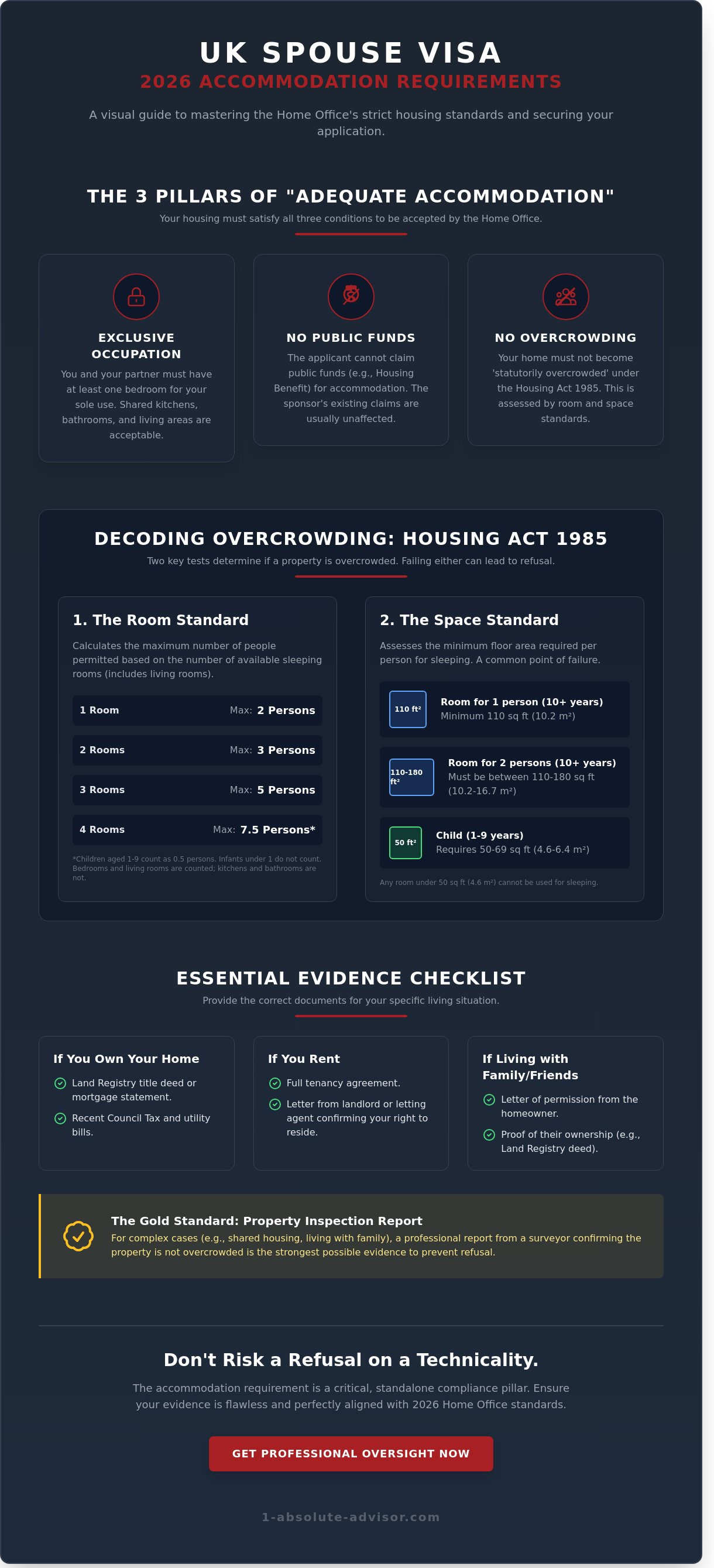
Navigating Overcrowding Standards and Space Requirements
The Home Office evaluates housing suitability through the lens of the Housing Act 1985. This legislation provides the primary framework for identifying statutory overcrowding, a critical factor in any Spouse Visa Accommodation Requirements assessment. Caseworkers apply two distinct tests: the Room Standard and the Space Standard. If a property fails either test, the application faces a high risk of refusal based on public health and safety concerns. It’s a binary assessment; the property is either legally overcrowded or it isn’t.
The Room Standard calculation
To pass this test, the property must provide enough separate sleeping areas so that two people of the opposite sex, who aren’t living together as a couple, don’t have to sleep in the same room. This rule applies to anyone aged 10 or older. When calculating capacity, “sleeping rooms” include bedrooms, living rooms, and even dining rooms. Kitchens and bathrooms are strictly excluded from these calculations. For instance, a typical one-bedroom flat with a separate lounge counts as two rooms. Under these guidelines, such a property could legally accommodate a couple and their three-year-old child without breaching the standard. The logic is that the lounge can serve as a sleeping space if necessary.
The Space Standard and floor area
The Space Standard focuses on the actual dimensions of each room to determine the maximum number of permitted occupants. Rooms under 50 square feet are disregarded entirely; they cannot be used for sleeping. A room measuring between 70 and 90 square feet is permitted for one person, while any room exceeding 110 square feet is rated for two persons. Precise measurements are vital for applicants living in compact urban apartments where every inch counts toward compliance. If a room is 108 square feet, it only counts for 1.5 persons, which could lead to a technical failure if the household size isn’t managed carefully.
The Home Office uses a weighted system for dependents when assessing the accommodation requirements for uk spouse visa. Infants under 12 months don’t count toward the total occupant number at all. Children between the ages of 1 and 10 count as 0.5 units. Once a child reaches their tenth birthday, they’re counted as a full adult unit. Ensuring your home meets these standards involves totaling these units against the property’s verified room count and floor area. Professional surveyors are often used in borderline cases to provide an official Property Inspection Report, which serves as definitive evidence that the dwelling won’t become overcrowded upon the applicant’s arrival.
Essential Evidence and the Role of Property Inspection Reports
While not every application requires a Property Inspection Report (PIR), it becomes a strategic necessity if you’re sharing a property with people who aren’t part of your immediate family. If you’re living in a House in Multiple Occupation (HMO) or a property where the total number of occupants might approach the legal limit, a PIR provides the objective proof an Entry Clearance Officer needs. You must ensure the report is fresh. In practice, this means the inspection should occur within the 6 months prior to your visa submission date to reflect current living conditions accurately.
The Property Inspection Report checklist
A qualified surveyor or Environmental Health Officer conducts the inspection based on the Housing Health and Safety Rating System (HHSRS). They specifically look for 29 potential hazards, categorised as Category 1 (serious) or Category 2 (less urgent). To satisfy the Home Office, the report must confirm the property is free from these risks, particularly damp, mould, or structural instability. The inspector will record precise room dimensions for all “habitable” rooms to calculate the maximum permitted number of residents. A compliant report concludes with a definitive statement that the applicant’s arrival won’t result in statutory overcrowding under Part X of the Housing Act 1985.
Alternative evidence for homeowners
Homeowners can often bypass the full formal report if the property’s size makes overcrowding a non-issue. You’ll need the “Official Copy” of the Land Registry entry, which currently costs £3 and provides definitive proof of ownership. Supplement this with a mortgage statement from the last 12 months and a council tax bill for the 2025/2026 period. These documents collectively prove the property is fit for human habitation and that you possess the legal right to occupy it. If you’ve recently purchased the home, a letter from your conveyancing solicitor confirming the completion of the sale is also acceptable evidence.
For tailored guidance on complex housing situations and document verification, consult our specialist advisors to ensure your evidence meets the current 2026 standards.
Securing Your Application with Professional Legal Oversight
Navigating the Home Office’s interpretation of “adequate” can be a minefield for the unprepared. Caseworkers frequently reject applications due to minor technicalities in tenancy agreements or missing property inspection reports. 1 Absolute Advisor acts as a strategic partner, conducting a rigorous pre-audit of your evidence to identify these risks before you submit. By analyzing your housing situation against the 1985 Housing Act standards, we ensure your accommodation requirements for uk spouse visa are met without ambiguity.
The complexity of Appendix FM means that raw documents are rarely enough. Our document review process verifies that every letter from a landlord or local authority contains the specific mandatory phrasing required for approval. For couples in non-standard living arrangements, such as multi-generational homes or properties with shared communal spaces, we draft a comprehensive legal cover letter. This document bridges the gap between your personal circumstances and Home Office policy, providing the caseworker with a clear, evidence-based reason to approve the application. Our OISC-registered status ensures you receive high-level expertise throughout your journey for a spouse visa uk.
Our bespoke application management
We provide personalized checklists that adapt to your specific housing situation, whether you own your home, rent, or live with family. Our advisors often communicate directly with landlords or chartered surveyors to ensure that property inspection reports are accurate and contain the necessary room measurements to disprove overcrowding. If you’re currently in short-term or temporary accommodation, we provide strategic advice on how to secure a “permanent” intent for the caseworker. This proactive approach eliminates the guesswork that often leads to costly delays or refusals.
Next steps for your spouse visa
The first step toward a successful application is a professional eligibility assessment. During your initial consultation, we’ll review your current housing documents and identify any gaps that could trigger a refusal. We also look toward the future. Maintaining consistent housing records is vital for your eventual transition to ilr uk, as the Home Office requires a clear trail of cohabitation over several years. Contact 1 Absolute Advisor today to secure your future in the UK with professional, absolute support.
Ensure Your 2026 Application Meets Absolute Standards
Meeting the 2026 standards for your family’s relocation involves more than just finding a house; it requires proving that your home meets the specific overcrowding formulas set out in the Housing Act 1985. You must demonstrate exclusive occupation and provide a professional Property Inspection Report to ensure your application isn’t rejected on technical grounds. Navigating the accommodation requirements for uk spouse visa involves calculating room sizes and floor areas with absolute precision. Our team acts as your strategic partner throughout this complex process. As OISC Registered Level 1 Immigration Consultants, we provide the professional integrity needed to handle complex family visa routes. We offer a fixed-fee service with no hidden costs, ensuring your financial planning remains stable and predictable. We focus on absolute compliance so you can focus on your new life. Don’t leave your family’s future to chance when professional oversight can provide the certainty you need.
Secure your UK Spouse Visa with our expert application management
Your journey toward a life together in the UK starts with a solid foundation and a compliant application.
Frequently Asked Questions
Can I use an Airbnb or hotel as accommodation for my UK spouse visa?
You generally can’t use an Airbnb or hotel as your primary residence because these lack the permanence required by the Home Office. The 2024 Appendix FM guidelines state that accommodation must be available for the exclusive use of the family and not temporary. While a short-term booking might bridge a gap of 2 or 3 days, it won’t satisfy the long-term stability criteria for a successful application.
Does my sponsor need to earn a certain amount to prove the accommodation is adequate?
Your sponsor’s income doesn’t directly dictate the adequacy of the housing, though they must meet the separate £29,000 minimum income requirement effective since April 4, 2024. The core rule is that the couple must be able to maintain the home without relying on public funds as defined in Part 6 of the Immigration Rules. You’ve got to demonstrate that after paying for housing and council tax, you’ve enough residual income equivalent to statutory Income Support levels.
What happens if the property becomes overcrowded after the visa is granted?
If a property becomes overcrowded after the visa’s issuance, it may jeopardize your Further Leave to Remain application in 30 months. The Home Office uses the Housing Act 1985 to define overcrowding based on the number of rooms and occupants. If a new child or additional tenant pushes the property over the legal limit, you’ll need to secure larger accommodation to meet the accommodation requirements for uk spouse visa during your next renewal.
Can I live in a house-share (HMO) with my spouse?
You can live in a House in Multiple Occupation provided you’ve at least one room for your exclusive use. The property must hold a valid HMO license if it houses 5 or more people from different households. You’ll need a specific letter from the landlord confirming they’ve given permission for the spouse to reside there and that the addition won’t breach the local council’s occupancy limits.
Do I need a property inspection report if I am renting a whole house to myself?
While not an absolute legal requirement for sole-occupancy rentals, obtaining a property inspection report from a qualified surveyor is a strategic safeguard. Home Office entry clearance officers often use their discretion to request proof that the home meets the 1985 Housing Act standards. Providing this document upfront reduces the risk of a refusal based on subjective assessments of the property’s size or physical condition.
Is a letter from my landlord enough to prove adequate accommodation?
A landlord’s letter is a vital component, but it’s insufficient on its own to satisfy the accommodation requirements for uk spouse visa. You must also provide the original tenancy agreement signed by all parties and proof of the landlord’s ownership, such as a Land Registry title deed. Including a recent utility bill from the last 3 months adds another layer of verification that the property is currently occupied and managed as claimed.
Can I count a living room as a bedroom for the space standard calculation?
You can count a living room as a bedroom under the Housing Act 1985 space standards, provided it’s a room where a person can sleep. However, any room smaller than 50 square feet is completely excluded from these calculations. For a room to count as a full space for an adult, it must typically exceed 110 square feet. Kitchens and bathrooms are never included in the room count for overcrowding assessments.
What if my name is not on the tenancy agreement yet?
It’s standard for the applicant’s name to be absent from the tenancy agreement during the initial application because you don’t yet have the right to rent in the UK. The Home Office focuses on the sponsor’s legal right to occupy the property and their ability to provide a home for you. You’ll simply need a written commitment from the landlord stating they’ll add your name to the lease once your 2.5 year visa is granted.